
Yes. NAJIT-credentialed Spanish, Mandarin, Russian, and Arabic federal-court interpreters are dispatched to the E. Barrett Prettyman U.S. Courthouse and the William B. Bryant Annex for criminal, civil, and grand-jury matters at the U.S. District Court for the District of Columbia. Send the docket, the courtroom, and the setting time — a DC-side project manager confirms an interpreter assignment within hours, including phone and VRI when sequestration or remote appearance is required.
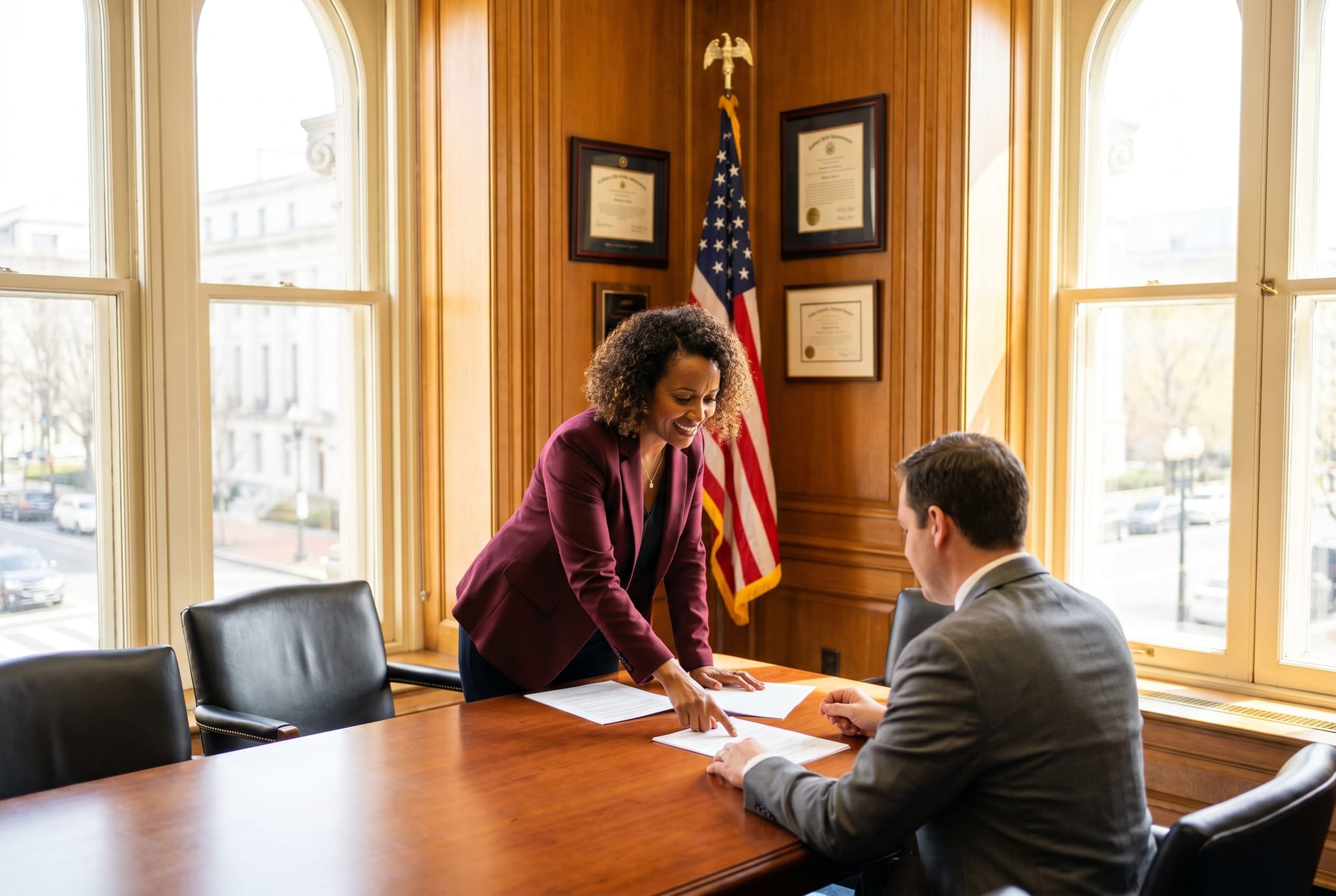
Washington, DC
Diplomatic, legal & government translation for the U.S. capital region.
From embassy filings on Massachusetts Avenue to federal-court interpretation in DC, Arlington, and Baltimore EOIR cases — certified translation, NAJIT-credentialed legal interpreting, and embassy-legalization workflows in 500+ languages, on ISO 17100 / 27001 workflows, with cleared linguists for sensitive federal work.
- ATA-certified · USCIS-accepted
- ISO 17100 / 27001 certified
- NAJIT-credentialed legal linguists
- Cleared linguists for federal work
Trusted across regulated industries
ISO 17100ISO 27001HIPAASOC-2 Type IIATA Member
Certifications and accreditations
Credentials
Verified · third-party audited
- ISO 17100Translation Quality
- ISO 27001Information Security
- HIPAAHealthcare Privacy
- SOC-2 Type IISecurity & Availability
- ATA MemberTranslators Association
Why Day Translations
Calibrated to the capital's federal and diplomatic working day.
Since 2007 we’ve been the linguistic operations layer for the U.S. District Court for the District of Columbia at the Prettyman and Dirksen courthouses, the USCIS Washington Field Office, the EOIR immigration courts in DC, Arlington, and Baltimore, the 180+ foreign embassies along Massachusetts Avenue and across Embassy Row, the World Bank and IMF on Pennsylvania Avenue, federal agencies including DOJ, State, and DHS, Georgetown, GW, and Howard university hospitals, and Children’s National. NAJIT-credentialed federal-court interpreters dispatched to Prettyman for criminal and civil hearings; Amharic-, Tigrinya-, and Oromo-certified linguists for the Silver Spring/DC Ethiopian community and EOIR Arlington asylum cases; cleared linguists with background checks for federal contractor and FOIA work; chain-of-authentication managers running embassy legalization through the State Department Office of Authentications.
That same DC layer runs on ISO 17100 quality and ISO 27001 security with HIPAA-aligned protocols and a SOC-2 Type II certification — calibrated to the city’s actual working day. A Prettyman federal sentencing hearing in the morning, a notes-verbales translation for an embassy on Massachusetts Avenue at noon, and a World Bank country-strategy paper delivered to the Pennsylvania Avenue offices that evening all route through the same audit-ready vendor without you switching providers between court, embassy, and IFI.
How we work
From file receipt to Prettyman- and embassy-ready filing.
- 01
Federal, embassy & EOIR intake
Files received over encrypted transfer; mapped against U.S. District Court for DC e-filing deadlines (Prettyman, Dirksen), USCIS Washington Field Office interview windows, EOIR Arlington and Baltimore master-calendar settings, embassy-legalization chain timing through the State Department Office of Authentications, federal-contract proposal cutoffs, and World Bank/IMF multilingual report cycles. Glossary aligned to Day's DC domain bank — federal-court legal terminology, diplomatic notes-verbales conventions, IFI economic-policy vocabulary, and Amharic/Arabic/Persian asylum-affidavit register.
- 02
NAJIT federal-court pairing
NAJIT-credentialed federal-court interpreters dispatched to Prettyman and Dirksen; cleared linguists (background-checked, NDA-bound) assigned to DOJ, State, and DHS work where confidentiality protocols require it; Amharic, Tigrinya, Oromo, Persian/Farsi, Russian, Arabic, and Mandarin specialists routed to EOIR Arlington and the Silver Spring/DC Ethiopian community; conference-grade simul teams for IMF Spring/Annual Meetings and World Bank delegations; embassy-registered translators for missions that require their own roster.
- 03
Apostille & embassy-ready chain
Signed Statement of Accuracy, bilingual PDFs formatted for U.S. District Court e-filing, USCIS Washington Field Office submission, or EOIR Arlington/Baltimore intake; FOIA-redacted bilingual deliverables for federal-agency disclosure work; full chain-of-authentication management for embassy legalization (notary → state Secretary of State → U.S. State Department Office of Authentications → destination embassy on Massachusetts Avenue or Embassy Row); apostille for Hague Convention countries handled in-house. ITAR-aware controls applied to defense and federal-contractor content.
Dedicated linguist pools
Brand-voice memory across years
Encrypted file transfer
Role-based access · signed NDAs
99.9% accuracy rate
Across 100,000+ clients served
Why Washington, DC
Built for DC's high-stakes diplomatic and federal workflows.
When a single mistranslated treaty term can spark an international incident, when an EOIR asylum decision rides on a witness statement, when an embassy-legalization chain stretches from notary to State Department to consulate — these are the operational realities the city demands, and what we set up our DC work around.
Live · 24/7 production500+ languages
- Cleared Linguists for Sensitive Work
Translators with security clearances and rigorous background checks for federal-government and diplomatic documents under strict confidentiality protocols.
- USCIS & Court-Filing Ready
Certified translations formatted for USCIS packets and U.S. District Court / D.C. Circuit submissions — with signed Statements of Accuracy and NAJIT-credentialed translators where preferred.
- EOIR Immigration-Court Interpreters
Court-certified interpreters for DC, Arlington, and Baltimore EOIR immigration courts — Spanish, Amharic, Arabic, French, Mandarin, and 100+ additional languages.
- Embassy Legalization & Apostille
End-to-end management of notary → Secretary of State → U.S. Department of State → foreign embassy authentication chains for documents bound for international use.
- Regulated Content Handling
Diplomatic, federal, and legal documents routed through secure, role-based workflows with signed NDAs, audit logs, and ITAR-aware controls where applicable.
- On-Site Across the DMV
On-site interpreters dispatched across the District, Northern Virginia, and the Baltimore metro for hearings, embassy meetings, and federal-agency engagements.
Services
What we deliver for Washington, DC organizations.
Cleared Linguists for Sensitive Work
Translators with security clearances for federal-government documents, diplomatic communications, and contractor work — under strict confidentiality protocols.
EOIR Immigration-Court Interpreters
Court-certified interpreters for the DC, Arlington, and Baltimore EOIR immigration courts — civil, criminal, and asylum matters in 500+ languages.
Embassy & Diplomatic Translation
Apostille, consular, and notarized translation for the District’s diplomatic community — full chain-of-authentication management to the destination embassy.
USCIS-Accepted Certified Translation
Foreign-language birth certificates, marriage licenses, police records, and asylum documentation translated to strict USCIS standards — signed Certificate of Accuracy included.
HIPAA-Aligned Medical Translation
Medical records and asylum-related medical documentation handled under HIPAA-aligned PHI workflows — with secure file transfer and signed NDAs.
On-Site & Remote Interpretation
Court, conference, embassy, and federal-agency interpreters available across the DMV in 500+ languages — on-site, video remote, and 24/7 phone interpreting.
Industries
Where we show up across Washington, DC.
The work we deliver across Washington, DC is shaped by the city’s biggest engines and the regulated, deadline-bound environments they operate in.
- Diplomatic
Embassies & Diplomatic Missions
Notes verbales, treaties, policy briefs, and apostille / consular legalization for the 177 foreign embassies and diplomatic missions concentrated in the District.
- Cleared Linguists
Federal Government & Contractors
Cleared linguists with security backgrounds for federal-agency translation, regulatory submissions, and contractor documentation under strict confidentiality protocols.
- World Bank · IMF
International Development
Multilingual reporting and policy translation for the World Bank, IMF, OAS, and the 6,000+ staff at international organizations headquartered in DC.
- NAJIT · EOIR
Federal Courts & EOIR
NAJIT-credentialed interpreters for the U.S. District Court, the D.C. Circuit, and the EOIR immigration courts in DC, Arlington, and Baltimore — civil, criminal, and asylum proceedings.
- Policy & Research
Think Tanks & Policy
Translation and editing of policy briefs, white papers, and conference materials for DC’s think tanks, advocacy groups, and international-relations programs.
- USCIS-Ready
Immigration Law & Asylum
USCIS-accepted certified translation of foreign-language birth certificates, marriage licenses, police records, and asylum-supporting documentation for DC’s immigration practitioners.
Featured Washington, DC Report
Diplomatic Translation in Washington, DC: A Primer
Washington, DC is home to 177 foreign embassies and over 6,000 international-organization staff. Within this intricate web of global relations, translation is not just a business necessity — it is a fundamental component of statecraft. We mapped the rigorous world of sworn translation, embassy legalization, and federal-court certification.
In the heart of the United States capital, language is more than a medium of communication; it is the bedrock of international diplomacy, federal law, and global policy. Washington, DC is home to 177 foreign embassies and over 6,000 international-organization staff members, creating an unparalleled ecosystem of cross-cultural exchange. The demand for precise, authoritative, and legally binding language services is immense.
Unlike standard commercial translation, diplomatic translation operates under the highest stakes imaginable. A single mistranslated term in a bilateral treaty, a federal court filing, or an immigration dossier can lead to international incidents, legal dismissals, or the denial of asylum. The professionals who navigate this landscape must possess not only exceptional linguistic fluency but also a profound understanding of international law, diplomatic protocol, and federal regulations.
177 foreign embassies, 6,000+ international-organization staff, and a 24% surge in diplomatic translation demand over the past decade.
The Anatomy of Diplomatic Translation in the Capital
The presence of 177 embassies, alongside institutions such as the World Bank, the International Monetary Fund (IMF), and the Organization of American States (OAS), necessitates a constant flow of multilingual documentation. From diplomatic notes (notes verbales) and treaties to policy briefs and press releases, the linguistic output of the capital is staggering. According to the U.S. Department of State’s Office of Language Services, demand for diplomatic translation and interpretation has surged 24% over the past decade.
Diplomatic translation requires a unique skill set. Translators must be adept at capturing the nuanced, often deliberately ambiguous language of diplomacy. They must understand the specific terminology used by different international bodies and the stylistic conventions expected in formal state communications. Confidentiality and security are paramount — translators working on sensitive government or diplomatic documents must often undergo rigorous background checks and adhere to strict security protocols to prevent unauthorized disclosure of classified information.
Federal Court Filings & NAJIT Certification
Beyond diplomacy, Washington, DC is the epicenter of the U.S. federal judicial system. The city hosts the Supreme Court, the U.S. Court of Appeals for the District of Columbia Circuit, and numerous federal district courts. In these high-stakes legal environments, the accuracy of translated documents is not a preference — it is a strict legal requirement. Foreign judgments, evidentiary exhibits, and witness testimonies must be translated into English before they can be admitted into the court record.
In many cases, federal courts prefer or require translations performed by professionals who hold certification from the National Association of Judiciary Interpreters and Translators (NAJIT). NAJIT certification is widely recognized as the gold standard for legal translation and interpretation in the United States. To obtain this credential, linguists must pass a rigorous examination testing their knowledge of legal terminology, court procedures, and ethical standards.
Federal Courts
Preparing a Document for Federal Court Filing
The process involves several meticulous steps. First, the source document must be carefully analyzed to identify ambiguities or culturally specific legal concepts that may not have a direct equivalent in U.S. law. The translator then renders the text into English, ensuring legal meaning and intent are preserved. Finally, the translation is thoroughly proofread and formatted to comply with the specific rules of the court in which it will be filed.
For law firms and federal agencies operating in DC, partnering with a language service provider that specializes in legal translation is essential. We offer access to NAJIT-credentialed linguists and the infrastructure to handle large volumes of documents securely and efficiently — whether dealing with a complex antitrust case involving multinational corporations or a sensitive national-security matter.
Most-Requested Languages at Federal Agencies in DC
Estimated annual volume of translation requests for top languages at DC federal agencies. Source: 2025 federal-agency reporting.
Thousands of requests / year
Embassy Legalization: The Path to International Validity
One of the most complex services required in Washington, DC is embassy legalization. When a U.S.-issued document — a birth certificate, corporate charter, or power of attorney — needs to be recognized as legally valid in a foreign country, it must undergo a rigorous authentication process. For countries that are not signatories to the Hague Apostille Convention, this process culminates in legalization by the destination country’s embassy or consulate in DC.
The chain is intricate: notarization by a local notary public, authentication by the Secretary of State of the issuing state, authentication by the U.S. Department of State’s Office of Authentications, and finally submission to the foreign embassy. Many embassies require the document be translated into their official language before legalization — often by a translator registered with the embassy or via a notarized certified translation.
Need help navigating embassy legalization?
Our DC team manages the full notary → State Department → embassy chain for you. Call us at 1-800-969-6853 or request a free quote online.
USCIS & Immigration: The Critical Role of Certified Translation
Washington, DC is also a major hub for immigration policy and administration. The headquarters of U.S. Citizenship and Immigration Services (USCIS) is located in the national capital region. USCIS has strict requirements: any document not in English — including birth certificates, marriage certificates, police records, and academic transcripts — must be accompanied by a full English translation, certified by the translator with a formal Certificate of Accuracy.
Asylum Claims: Where Translation Quality Is Critical
In the context of asylum claims, the quality of translation is particularly critical. Asylum seekers often rely on translated personal statements, medical records, and news articles to substantiate their claims of persecution. Translators must possess not only linguistic expertise but also a deep understanding of human-rights terminology and the specific legal standards applied in U.S. asylum law. Many of these documents contain highly sensitive personal information — medical histories, financial records — so robust data protection measures and HIPAA-aligned handling are critical.
Securing Your Diplomatic Communications
Whether you are a federal agency requiring NAJIT-credentialed translations for a court filing, a corporation navigating the intricacies of embassy legalization, or an individual submitting documents to USCIS, the quality of your translations directly impacts your success. Our team of expert linguists includes ATA-certified translators and professionals with extensive experience in diplomatic, legal, and governmental translation — under ISO 17100 quality and ISO 27001 information-security controls.
FAQ
Common questions, answered.
We run the full chain: notarization → the issuing state's Secretary of State → the U.S. Department of State Office of Authentications at 600 19th Street → the destination embassy or consulate on Embassy Row. For Hague Convention signatories we deliver an apostille; for non-signatories we hand-walk the document through the foreign embassy's legalization desk and translate into the official language by a translator the embassy will accept (some missions maintain their own approved roster, which we map at intake).
Yes. Amharic, Tigrinya, and Oromo are core DC pairs. We deliver USCIS-accepted certified Amharic translation of birth and marriage records, school records, country-conditions evidence, and personal statements for asylum filings at the USCIS Washington Field Office and EOIR Arlington Immigration Court — and dispatch court-certified Amharic interpreters to master-calendar and merits hearings for clients across Silver Spring, Adams Morgan, and U Street.
FOIA-redacted source documents are received under signed NDAs through encrypted transfer; cleared linguists work inside role-based environments with audit logs, and redactions are preserved (not reflowed) so the bilingual deliverable matches the agency's redaction set page-for-page. We can operate inside the agency's secure document-management system or VPN, and chain-of-custody is documented from intake through final delivery for DOJ, State, DHS, and contractor disclosure work.
Yes. The IMF/World Bank Spring and Annual Meetings, embassy receptions on Massachusetts Avenue, and federal-agency delegations are routine venues for our DC conference team. We supply ISO 4043 simul booths, conference-grade interpreters in Spanish, French, Arabic, Mandarin, Russian, and Portuguese (the IMF's working languages plus delegation pairs), and on-site coordinators for multi-language general sessions and breakouts at the IMF/HQ buildings, the Ronald Reagan Building, and DC convention venues.
Call (202) 787-3984 or our toll-free line 1-800-969-6853, email [email protected], or request a free quote online.
Get in touch
Contact our Washington, DC team.
Multiple ways to reach us. Choose what works best for you.
Washington, DC Office
Day Translations, Inc.
Serving Washington DC, Arlington & BaltimoreAvailable 24/7 across the DMVGet directions
Sending us your documents couldn’t be easier.
Website Form
Our online form is the easiest and fastest way to submit your documents.
Email
Email your scanned documents to [email protected]
Fax
Fax your documents to 1-800-856-2759
Get started
One document or a multi-year program — we’re ready.
Quote requests return quickly. Standard translation begins the same day. Rush windows confirmed by a project manager as soon as we have your requirements.