
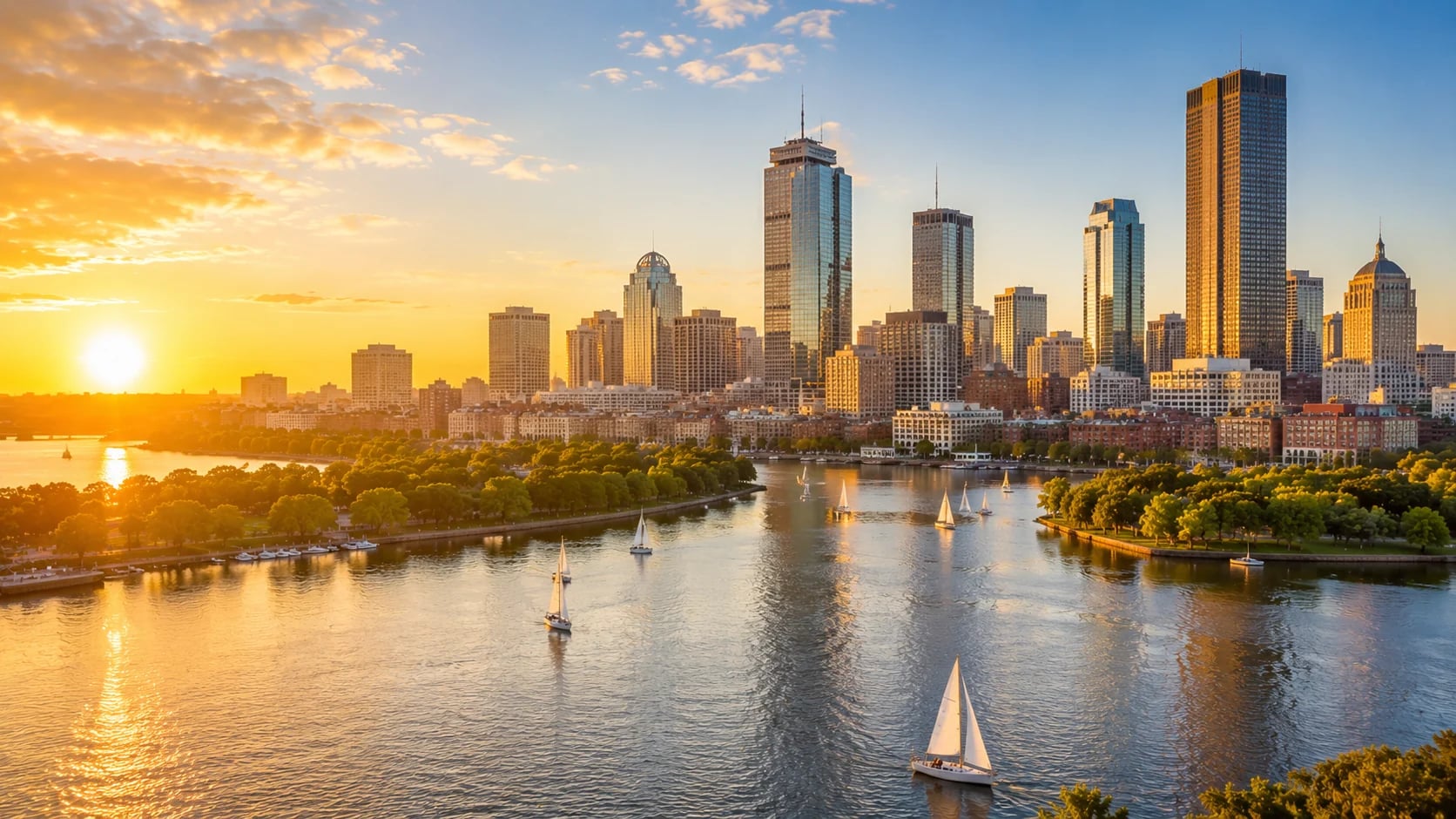
Boston, Massachusetts
Language services in Boston.
Day Translations is a global language services company providing translation, interpreting, and localization in Boston for businesses, research institutions, legal teams, healthcare providers, and individuals across 500+ languages. Our team supports local projects with secure workflows, professional linguists, and 24/7 global language support.
- USCIS & federal court ready
- HIPAA-aligned medical workflows
- ISO 17100 / 27001 certified
- Clinical-trial language support for regulated workflows
Trusted across regulated industries
ISO 17100ISO 27001HIPAASOC-2 Type IIATA Member
Services
Translation, interpreting & localization services in Boston.
From certified document translation to real-time interpreting and business localization, Day Translations helps Boston clients communicate clearly across languages. Whether you need a one-time document translation or ongoing language support for your organization, our team can help.
Translation Services in Boston
Document, business, legal, medical, technical, financial, marketing, and certified translation for individuals and organizations across Boston, Cambridge, and the greater metro area.
Interpreting Services in Boston
Phone, video, and on-site interpreting for medical, legal, conference, and business settings. Court-credentialed interpreters for Suffolk Superior Court and the U.S. District Court of Massachusetts, plus medically trained interpreters for the city's hospital networks.
Localization Services for Boston Businesses
Website, app, software, ecommerce, training, marketing, and multimedia localization for Cambridge tech firms and Greater Boston SaaS companies expanding into global markets.
Local language support
Local language support in Boston.
Boston runs on biotech, academia, and law — three sectors where a single mistranslated word can stop a clinical trial, derail an admission, or lose a case. Since 2007, Day Translations has supported the organizations that define the city: the Cambridge and Kendall Square biotech corridor, the Longwood Medical Area’s hospital and research networks, Harvard, MIT, and BU research teams, and the federal and state courts of Massachusetts.
Boston is also a city of immigrants. A meaningful share of residents speak a language other than English at home, with large Spanish, Portuguese, Haitian Creole, Chinese, and Vietnamese communities across East Boston, Somerville, Brockton, Chinatown, Mattapan, and Dorchester. From a graduate student translating a diploma, to a hospital serving a multilingual patient population, to a Phase III trial sponsor coordinating across 30 countries, our Boston team supports the full range of local language needs.
Industries
Industries we support across Boston.
Boston's industries operate under tight deadlines and strict regulatory scrutiny. Here's where our work shows up.
- Cambridge · Kendall Sq
Biotech & Life Sciences
The life-sciences corridor anchored by Moderna, Vertex, and Biogen runs on clinical-trial documentation, Informed Consent Forms, protocols, and Patient-Reported Outcomes that must meet FDA and EMA scrutiny. Our linguists bring life-sciences subject-matter expertise and ISO 17100 quality processes. See our Healthcare Translation Services.
- Longwood · HIPAA
Healthcare Providers
Mass General, Brigham and Women's, Boston Children's, Beth Israel Deaconess, and Dana-Farber rely on HIPAA-aligned translation of IRB consents and patient communications, plus on-site medical interpreters for the diverse communities they serve.
- Harvard · MIT · BU
Universities & Research
From a single grad student's diploma to multi-institution research programs, Boston's academic community depends on credential precision and research translation that holds up to scrutiny at Harvard, MIT, BU, and beyond.
- Court-Ready
Legal Teams & Courts
From individual immigration cases to BigLaw arbitration, Suffolk Superior Court and the U.S. District Court of Massachusetts rely on certified translations and court-credentialed interpreters delivered under tight deadlines. See our Legal Translation Services.
- Cambridge Tech
Technology & SaaS Teams
Cambridge tech firms and Greater Boston SaaS companies use our localization services for software, UX, and marketing content as they expand into international markets.
Certified Translation
Certified translation & document support in Boston.
Boston's certified translation demand looks different from most cities. Every fall, thousands of international students arrive at Harvard, MIT, BU, and the city's dozens of other institutions needing diplomas, transcripts, and credentials translated and certified for admissions and student-visa filings. Year-round, researchers and visiting scholars need credential and grant documentation translated for university HR and federal sponsors.
Boston's immigrant communities, from Brazilian Somerville to Haitian Mattapan, file USCIS petitions that require certified translations of birth certificates, marriage certificates, and civil records. And the city's law firms submit certified translations to Suffolk Superior Court and the U.S. District Court of Massachusetts on litigation deadlines.
Included with every certified order
Certificate of Translation Accuracy
Signed, on company letterhead, and prepared for submission.
- Accepted by USCIS for immigration filings
- Massachusetts state courts
- U.S. District Court of Massachusetts
- Apostille assistance for documents headed abroad
Most personal documents turn around within one to two business days.
How we work
How our Boston language service process works.
- 01
Submit your files or project details
Upload your documents through our secure portal — whether that's a clinical-trial protocol from a Kendall Square sponsor, an academic transcript for a Harvard application, or a court filing on a Suffolk County deadline. Request an interpreter for a specific date and time, or describe a localization project. Same-day quote responses for most standard requests.
- 02
Match with the right language specialist
We match your project to a professional linguist by language pair, subject matter, and service type: life-sciences linguists for ICFs and Patient-Reported Outcomes, academic-credential specialists for transcripts and diplomas, court-credentialed interpreters for depositions, and localization engineers for Cambridge software teams. For ongoing programs, you get a dedicated project manager and consistent linguist team.
- 03
Translation, interpreting or localization begins
Work proceeds under secure, role-based workflows. Clinical and legal translation projects follow an ISO 17100 dual-linguist process. Medical interpreters are dispatched to Boston's hospital networks on-site or connected by phone or secure video. Research and software localization projects include engineering setup and integration.
- 04
Quality review and secure delivery
Every deliverable is reviewed for accuracy, formatting, and compliance before delivery — whether the standard is an IRB's, a university registrar's, or a federal court's. Certified translations include a signed Statement of Accuracy. Files are delivered through encrypted channels with post-delivery support if needed.
Dedicated linguist pools
Brand-voice memory across years
Encrypted file transfer
Role-based access · signed NDAs
99.9% accuracy rate
Across 100,000+ clients served
Why Day Translations
Why Boston businesses & individuals choose Day Translations.
From a single certified document to a multi-year, multi-language clinical program, here's what Boston organizations and individuals count on us for.
Live · 24/7 production500+ languages
- 500+ Languages
500+ languages covered, including Boston's most-requested community and research languages.
- Life-Sciences Depth
Clinical-trial documentation, ICFs, and Patient-Reported Outcomes handled by life-sciences linguists.
- Academic Credentials
Transcript, diploma, and university-filing expertise for Harvard, MIT, BU, and beyond.
- Court-Credentialed
Interpreters for Suffolk Superior Court and the U.S. District Court of Massachusetts.
- 24/7 Support
Round-the-clock coverage for trial timelines, admissions deadlines, and court dates.
- Secure & Confidential
Secure, confidential workflows with role-based access and signed NDAs.
- ISO & HIPAA
ISO 17100 and ISO 27001 certified processes, with HIPAA-aligned handling.
- Local + Global
Local support with global reach from our Seaport District office.
Get in touch
Contact our Boston team.
Multiple ways to reach us. Choose what works best for you.
Sending us your documents couldn’t be easier.
Website Form
Our online form is the easiest and fastest way to submit your documents.
Email
Email your scanned documents to [email protected]
Fax
Fax your documents to 1-800-856-2759
Mail or Courier
Mail or courier to Day Translations, Inc., 1 Marina Park Drive #1410, Boston, MA 02210.
Languages
Languages commonly requested in Boston.
Boston's language demand reflects both its immigrant communities and its global research and business reach.
- SpanishEast Boston, Chelsea, and Lawrence Dominican community.
- PortugueseBrazilian and Cape Verdean communities in Somerville and Brockton.
- ChineseCantonese and Mandarin across Boston Chinatown.
- Haitian CreoleMattapan and Hyde Park clinical and court needs.
- ArabicResearch, academic, and community demand.
- VietnameseDorchester healthcare and small business.
Metro coverage
Nearby areas we serve.
Day Translations supports clients across the greater Boston metro area, including:
CambridgeBiotech corridor, Kendall Square, MIT and Harvard research.
SomervilleBrazilian and Portuguese community work.
BrooklineHealthcare and academic clients.
QuincyChinese and Vietnamese community demand.
NewtonCorporate and education clients.
WorcesterHealthcare and university work.
ProvidenceCross-border New England research and legal exchange.
DirectoryBrowse all our locationsFAQ
FAQs about language services in Boston.
Yes. Day Translations supports Boston and Cambridge clients with translation, interpreting, and localization across 500+ languages, from our Seaport District office, with on-site coverage across the metro area and remote support worldwide.
Yes. Every certified translation we deliver in Boston comes with a signed Certificate of Translation Accuracy that meets USCIS, Massachusetts state court, and U.S. District Court of Massachusetts requirements. Most personal documents turn around within one to two business days.
Yes. We provide certified academic transcript translations for Harvard, MIT, BU, and Greater Boston students applying domestically and abroad. For immigration-related filings, we also provide USCIS-ready certified translations with a signed Certificate of Translation Accuracy.
Yes. We provide phone, video, and on-site interpreters across Boston for medical appointments at the city's hospital networks, legal depositions, and court hearings — including court-credentialed interpreters for Suffolk Superior Court and the U.S. District Court of Massachusetts.
Yes. For ongoing programs, multi-language clinical trials, or large document portfolios, our team will scope, quote, and assign a dedicated project manager and consistent linguist team. Standard quotes return same-day.
We support 500+ language pairs. The most commonly requested in Boston are Spanish, Portuguese, Chinese, Haitian Creole, Arabic, and Vietnamese, though we regularly handle dozens more across the city's communities and research institutions.
Featured Boston Report
A closer look at one of the most demanding categories we handle for Boston clients.
Bridging the Language Gap in Boston's Biotech Clinical Trials
In the world's leading life-sciences hub, Boston and Cambridge biotech firms are pioneering tomorrow's therapies. Bringing them to global markets demands more than scientific breakthroughs. It demands impeccable, regulatory-compliant clinical-trial translation.
Boston is not merely a city; it is an ecosystem of medical innovation. The concentration of academic institutions, research hospitals, and biotechnology startups creates an unparalleled environment for scientific discovery. According to MassBio, the Massachusetts biopharma industry is a global leader, with the Boston-Cambridge area serving as its epicenter. The journey from a Kendall Square laboratory bench to a patient’s bedside in Tokyo, Berlin, or São Paulo, however, runs through dense regulatory and linguistic terrain.
When a Boston biotech initiates a Phase III trial, it rarely confines recruitment to the United States. To hit statistical significance and enrollment timelines, trials must run multinationally — generating an enormous volume of regulated documentation. From the Clinical Trial Protocol to the Investigator's Brochure, Informed Consent Forms, and Patient-Reported Outcomes, every document must be meticulously translated. A single ambiguity in an ICF can trigger regulatory rejection, delayed timelines, and millions in lost revenue.
It is not unusual for a single global oncology or rare-disease trial originating in Boston to require translation into 25 to 32 languages — and every one of them must withstand FDA, EMA, and IRB scrutiny.
Navigating FDA and EMA Language Requirements
Both the FDA and the European Medicines Agency have explicit language requirements for clinical-trial documentation. The FDA clinical-trial guidance mandates that information provided to participants — particularly the Informed Consent Form — be in a language the subject understands; if a non-English speaker is enrolled, a certified ICF translation is required, and the translator’s qualifications and process must be documented.
Similarly, the EMA's Clinical Trials Regulation requires that documentation submitted via the Clinical Trials Information System be in the official language(s) of each Member State where the trial runs. The EMA places particular emphasis on the readability of patient-facing materials and the lay summaries of trial results, which must be translated into the local languages of all participants.
Linguistic Validation
Patient-Reported Outcomes and Cognitive Debriefing
Linguistic validation is a core step in the translation of Patient-Reported Outcomes (PROs). It involves forward translation, back translation, and cognitive debriefing with native speakers in the target demographic — to confirm that the translated instrument measures the same clinical concepts as the original English version and preserves the scientific integrity of trial data.
Boston biotech firms aiming for dual FDA/EMA approval can’t treat translation as a downstream task. The most successful sponsors integrate language-service providers from protocol drafting onward, building standardized glossaries with their subject-matter experts so terminology stays consistent across every country, every submission, and every amendment.
Clinical-Trial Translation Demand by Therapeutic Area
Average number of languages required per global trial originating in Boston, by therapeutic area — illustrating why rare-disease and oncology programs concentrate the highest linguistic demand in the city.
Average languages per trial
The Longwood Medical Area: A Hub of Multilingual Research
Where Kendall Square anchors biotech corporate activity, the Longwood Medical Area is the beating heart of clinical research. Home to Harvard Medical School, Beth Israel Deaconess Medical Center, Brigham and Women’s Hospital, and (nearby) Massachusetts General Hospital, it is where theoretical science meets patient care. According to Harvard Catalyst, Boston investigators lead thousands of active clinical trials at any given time.
Longwood Medical Area
Local Recruitment Across a Multilingual City
Greater Boston is a city of immigrants, and a meaningful share of the population speaks a language other than English at home. To support equitable access to cutting-edge therapies, LMA researchers must provide trial information in Spanish, Portuguese, Haitian Creole, and Mandarin Chinese, among others.
Beyond local recruitment, LMA principal investigators frequently lead international multi-center trials. A PI at Dana-Farber may coordinate with sites in Paris, Tokyo, and Sydney — making rapid, accurate translation of protocol amendments, adverse-event reports, and updated consents essential for patient safety and global dataset integrity.

Need Expert Clinical-Trial Translation?
Ensure your global studies meet all FDA and EMA language requirements with our specialized life-sciences linguists. Call us at 1-800-969-6853 or request a free quote today.
Translating Complex Protocols: Oncology and Rare Diseases
Linguistic demand varies sharply by therapeutic area. In Boston, there is heavy concentration in oncology and rare diseases — fields with their own translation challenges. Oncology trials often involve novel mechanisms (CAR-T, bispecific antibodies) whose terminology may not yet have stable target-language equivalents; translators must work alongside subject-matter experts to build standardized glossaries and lock consistent terminology across every trial document.
Rare-disease trials, with inherently small patient populations, must cast a wide geographic net to find eligible participants — averaging the highest language counts in the city. They also frequently involve pediatric populations, requiring carefully adapted Assent Forms understandable to children at varying ages, balancing medical accuracy with age-appropriate language.
Regulatory Compliance and ISO 17100 Standards
For Boston biotech, partnering with a translation provider isn't a vendor relationship — it is part of regulatory strategy. Industry leaders insist on ISO 17100-certified providers because the standard mandates rigorous translator selection, project management, and an independent reviser step. Two qualified linguists, in sequence, on every document — that's what the standard requires.
In clinical trials, that quality discipline is non-negotiable. Whether the document is a Case Report Form, an Investigator's Brochure, or a regulatory submission, the translation must be flawless. Combined with HIPAA-aligned handling of PHI and proprietary research data, ISO 17100 is what turns translation from a service into the bridge that connects Boston innovation to global health.
Get started
Get started with Day Translations in Boston.
Whether it's a clinical-trial protocol on a regulatory deadline, a transcript for an admissions cutoff, or a certified document for a court date, our Boston team is ready. Get a free quote for translation, interpreting, or localization support, available 24/7.