One word cost a hospital 71 million dollars.
A young man arrived at a Florida emergency room unconscious. His family, speaking Spanish, used the word “intoxicado,” meaning poisoned by something he had eaten. A bilingual staff member heard “intoxicated,” and the care team treated him for a drug overdose. He was actually suffering from brain hemorrhage. By the time anyone caught the mistake, he was quadriplegic, and the settlement reached 71 million dollars. The whole outcome turned on a single mistranslated word.
Most language decisions do not end in a courtroom. But every enterprise operating across languages is placing bets like this one constantly, in contracts, product labels, patient instructions, marketing campaigns, and regulatory filings. The difference between a strong language partner and a cheap one is not a line item on an invoice. It is the difference between a launch that lands and a recall that does not, between a deal that closes and a clause that gets disputed for two years.
The trouble is that this decision rarely gets the scrutiny its stakes deserve. Under deadline pressure it tends to collapse into a three-quote comparison; everyone confirms they “do translation,” and the lowest bidder wins more or less by default. The cost of that shortcut surfaces later, in the work itself.
This guide is for the people who carry that risk: procurement leads, operations managers, and business owners who need a defensible way to select a language services company and the confidence to stand behind the choice in front of stakeholders. It is not a ranking of providers, because rankings answer the wrong question. It is a framework for deciding which partner fits your languages, your industry, your risk profile, and the way your organization actually buys. It also reflects what Day Translations has learned from nearly two decades of partnering with the enterprises, law firms, hospital systems, and government agencies.
The stakes are higher than the invoice suggests
Consider the scale of what you are buying. The global language services market reached roughly 72 billion dollars in 2025, according to Mordor Intelligence, and continues growing at a mid-single digit pace year over year. It is a mature, fast-consolidating sector, and the range in capability across providers is wide enough that the choice genuinely matters to the outcome.
Demand keeps climbing because language drives revenue, and its absence quietly erases it. CSA Research, in its widely cited “Can’t Read, Won’t Buy” study of 8,709 consumers across 29 countries, found that 76 percent of online shoppers prefer to buy products with information in their own language, and 40 percent will not buy from a website in another language at all. That second figure reframes localization as a market-access question rather than a content cost. Skip it, and up to 40 percent of the addressable market is gone before first contact.
The downside risk is just as concrete. When HSBC’s “Assume Nothing” campaign was mistranslated in several markets as “Do Nothing,” the bank reportedly spent around 10 million dollars rebranding to undo it. When infant formula maker Mead Johnson had preparation instructions go wrong, it recalled more than 4.6 million cans at a direct cost above 10 million dollars, alongside brand damage that outlasts the recall. This is what happens when a language services company is treated as a commodity rather than a safeguard.
So, the operative question is not who is the cheapest. It is who can be trusted with the parts of the business that break expensively when language fails.
Why “best company” lists do not help
Search this topic and the results fill up with listicles ranking providers one through ten. They look helpful. For an enterprise buyer they rarely are, because there is no universal best.
The needs of a hospital network, a fintech expanding into the EU, a manufacturer publishing technical manuals, and a law firm running cross-border litigation overlap very little. A provider organized around high-volume software localization is solving a different problem than one organized around certified court interpreting, which is different again from one organized around regulated life sciences documentation. The useful question is never which provider is best in the abstract. It is which one is genuinely built around the requirements you have: the languages, volumes, security obligations, and turnaround your work actually demands.
Fit is what matters, and fit is specific to you. The approach that holds up is to define what you need, turn it into weighted criteria, and score every candidate against the same standard. That produces a decision defensible in a procurement review, and it surfaces exactly the differences a rankings list is built to obscure. It is also the framework Day Translations is built to win on, because breadth of service, independent certifications, enterprise-grade security, and global scale are precisely the criteria that hold up under this kind of scrutiny.
Start from your requirements, not the vendor’s pitch
The evaluation only works when it starts with your requirements rather than the vendor’s positioning. Most enterprise buyers know this in principle. The gap tends to open under time pressure, when requirements stay implicit, which is precisely when a polished pitch starts to resemble a fit it is not. A written requirements set keeps the comparison anchored to your reality, and in Day Translations’ own intake the pattern is consistent: the buyers who arrive with this defined run faster, cleaner selections.
The questions worth settling with the teams who will actually use the service come down to a handful. Which language pairs are needed now, and which in eighteen months, including the rare ones where qualified linguists are scarce? What content is in scope: contracts, marketing, clinical documentation, software strings, all of it? Is the work a one-time project, a steady monthly flow, or unpredictable surges tied to launches and litigation? Is same-day turnaround a real requirement or a nice-to-have? Does the content fall under HIPAA, GDPR, financial regulation, or government security rules, given that this single answer eliminates much of the market? Does the provider need to integrate with a content management system, a code repository, or a support platform? And what is the real budget, with whom to sign off?
With those settled, the evaluation has a backbone, and everything below becomes a matter of measuring candidates against it.
The criteria that separate a partner from a liability
With requirements in hand, these are the categories where enterprise selections are won and lost. Each is worth scoring rather than ticking.
Whether one partner can actually cover the full scope
A typical engagement starts with one need, usually document translation, then expands into interpreters for a deposition, subtitles for training videos, and a fully localized website for a new market. Every additional vendor multiplies contracts, security reviews, invoices, and quality variables.
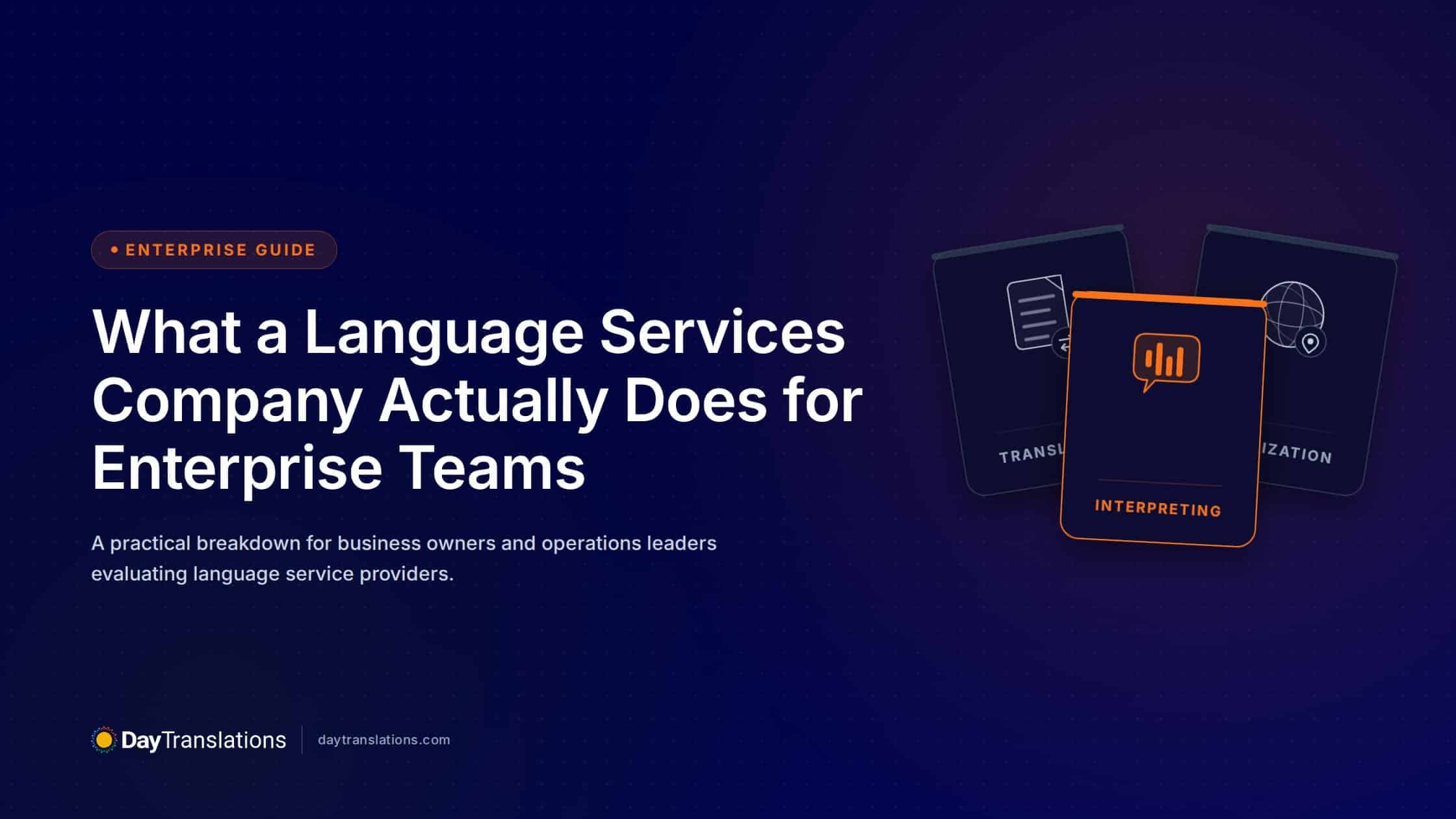
A provider with genuine depth across the board earns a premium on operational simplicity. The three pillars to look for are real strength in translation, spanning documents, legal and medical content, technical manuals, and brand-sensitive marketing; interpreting across phone, video remote, on-site, and conference settings, ideally around the clock; and localization, which goes beyond words to adapt software, apps, websites, and learning content to a specific market and culture.
Consider a company entering a new region. It needs its app and website localized, support docs translated, interpreters for partner meetings, and subtitled training for local staff. Split across four vendors, four contracts, four security reviews, and four glossaries that quietly drift apart until the brand says three different things in the same language. Day Translations delivers all of it under one roof, across more than 500 languages, which is part of why enterprises, law firms, hospital systems, and government agencies consolidate with a single partner.
Quality you can verify, not quality you are promised
Every provider says it delivers quality. The ones worth hiring can show their work.
The strongest proof is independent certification. ISO 17100 is the international standard built specifically for translation services, and it mandates a defined process: translation, revision by a second qualified linguist, and qualified project management. A provider certified to it has committed to a workflow an auditor has verified. Day Translations holds ISO 17100:2015 certification and is a member of the American Translators Association, the kind of credential that functions as table stakes for any serious enterprise vendor.
The questions that go past the certificate are revealing ones. Does every project get a second-linguist review, or only on request? How are linguists vetted and tested before they touch your content? How is terminology managed so the same technical term does not get rendered in three different ways across three projects? Quality assurance is a process, not a disposition, and the providers who answer specifics are the ones who actually have one. The providers who answer in adjectives are selling a feeling.
Genuine expertise in your industry
A gifted generalist is the wrong choice for a clinical study report or patent filing. In 2006 and 2007, a German hospital harmed dozens of knee replacement patients after implant instructions were mistranslated, turning “non-cemented” into “cemented.” Specialized content calls for linguists who understand the field, its terminology, and its regulatory weight, because the cost of error there is measured in liability rather than embarrassment.
What matters is whether the provider assigns linguists to the subject area and keeps genuine specialists in your sector. Day Translations runs dedicated practices across healthcare, life sciences, legal, finance, technology, government, and more, with the vetted talent pools and terminology resources those fields require. Examples from your industry, along with a straight answer on how a project like yours would be staffed, tend to separate real depth from improvisation.
Security, confidentiality, and compliance
For enterprise buyers this often carries the most weight, and it is the category generic guides treat most lightly. The moment content changes hands, the provider’s security posture becomes your exposure, and that content includes unreleased products, patient records, financial data, and litigation strategy.
This is a documentation question more than a trust exercise. ISO 27001 signals a formal, independently audited information security management system. SOC 2 readiness speaks to controls around security, availability, and confidentiality. HIPAA compliance is non-negotiable for protected health information, and GDPR compliance matters for anything touching the EU. Day Translations carries ISO 27001:2022 certification, HIPAA and GDPR compliance, SOC 2 readiness, and GSA approval as a government vendor, and it consolidates the proof in a public Trust Center so buyers can review certifications, policies, and statements in one place rather than chasing them down.
The practical layer matters as much as the certificates. Whether linguists are bound by confidentiality agreements, whether data is encrypted in transit and at rest, who can access files, and whether that access is logged. A provider that cannot answer these quickly is signaling how it handles your data.
Capacity that holds up when volume spikes
A vendor that handles a single contract beautifully may struggle under a launch that needs 200,000 words across thirty languages in three weeks. Enterprise demand is rarely flat. It spikes around launches, filings, acquisitions, and crises, and a partner has to absorb those spikes without quality sliding.
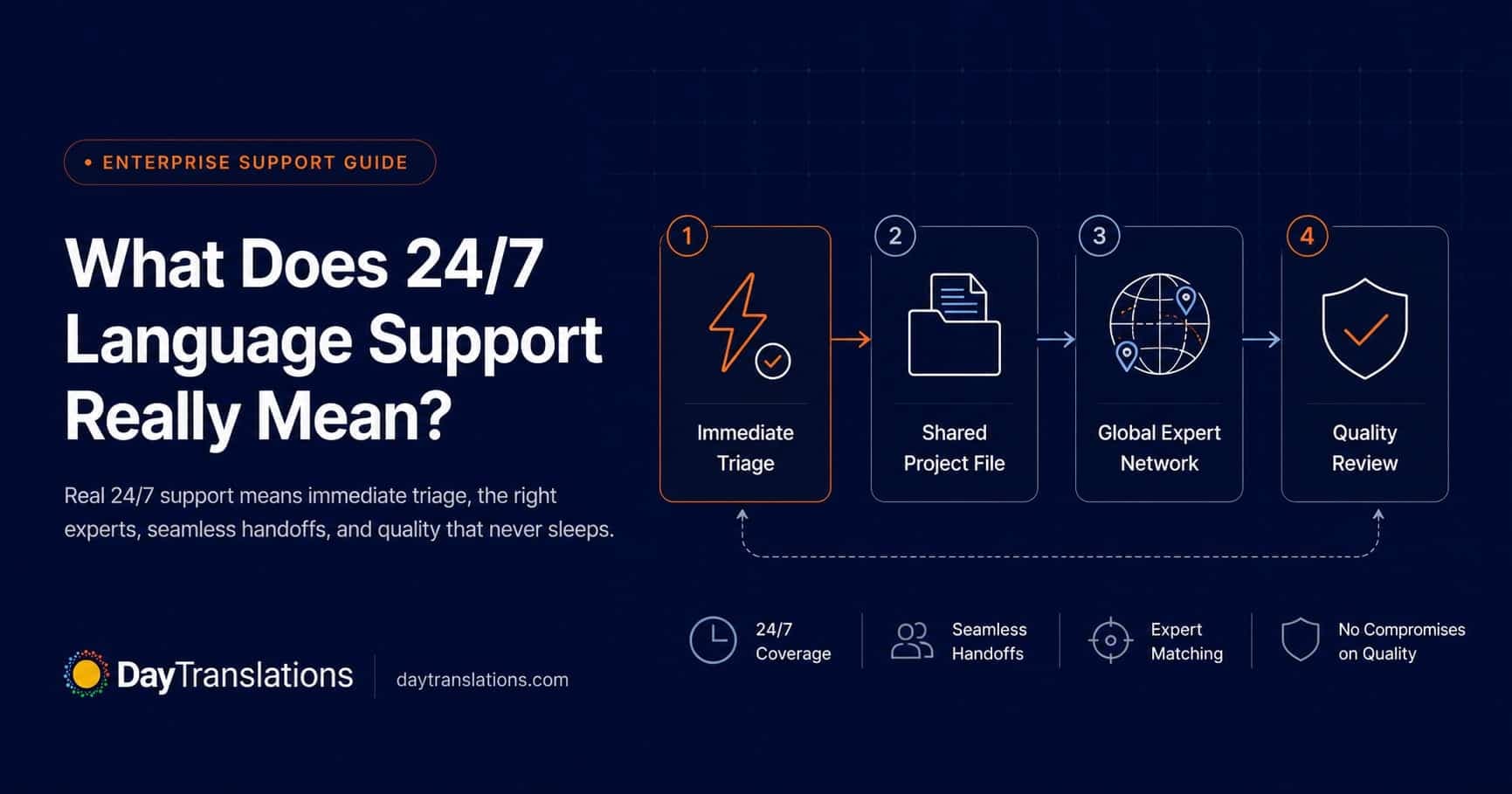
The relevant questions are about depth. How large is the linguist network, and how is it distributed across your languages? Can it scale fast while keeping every linguist vetted? What is the real turnaround for your volumes, as opposed to the best-case marketing number? Is 24/7 support genuine, or just business hours in one time zone? Day Translations operates a network of more than 10,000 linguists across the globe, the kind of depth that absorbs a sudden surge across dozens of languages without the timeline slipping or the quality bar dropping.
Technology and a measured approach to AI
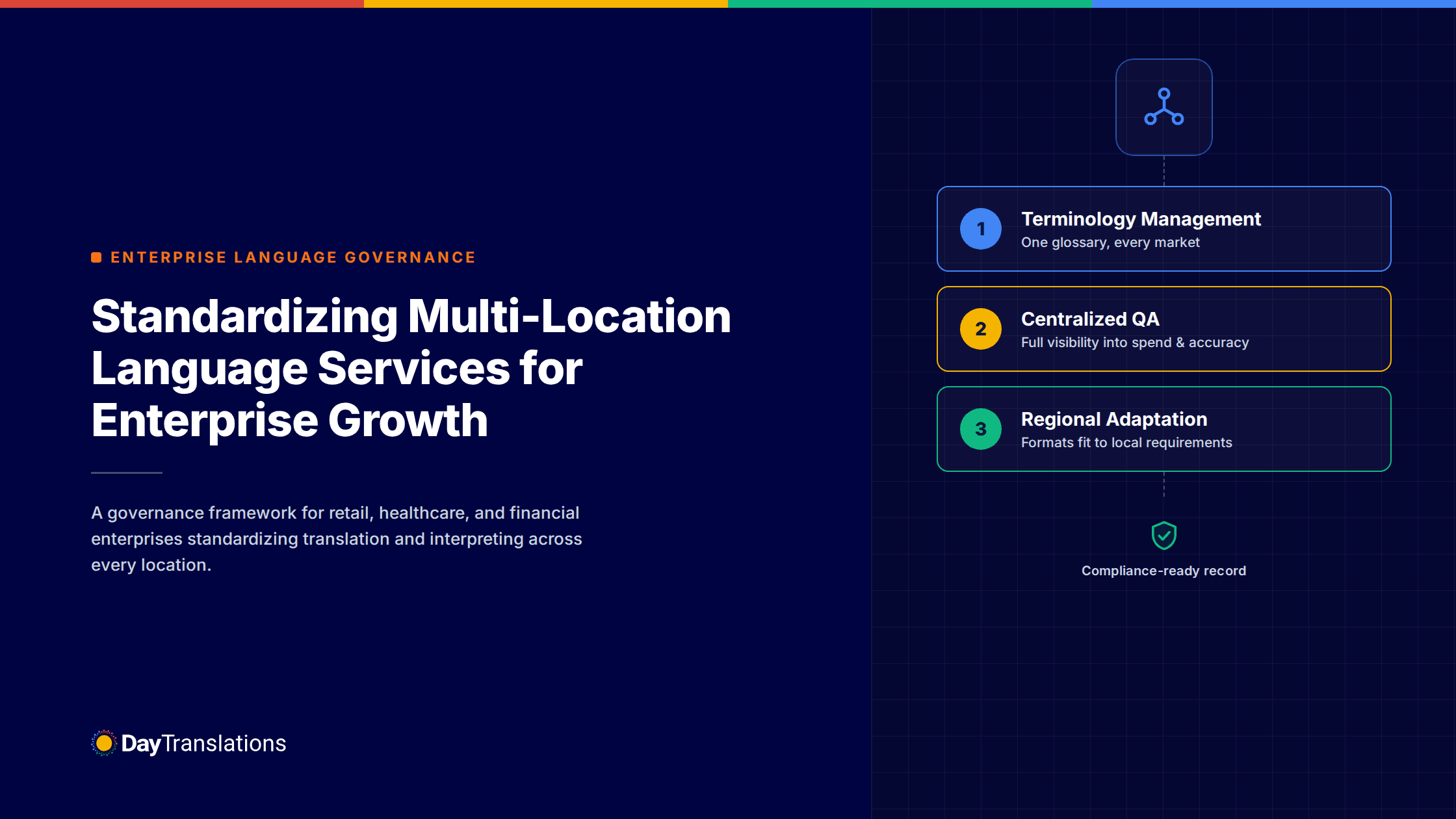
Language at scale cannot run on email attachments and copy-paste. Translation memory reuses previously approved content, so the same sentence is not paid twice. Terminology management keeps brand and technical language consistent across every linguist and project. Integration matters too: systems that connect through connectors or an API remove the manual handoffs that introduce delay and error at every step and do not scale.
The AI question is now unavoidable, and it is where the real distinctions show up. Machine translation genuinely delivers speed and cost advantages, and recent industry analysis suggests large language models can lift linguist productivity by up to 45 percent. Raw machine output, though, is a liability on anything sensitive or high stakes. The thing that makes AI safe on an enterprise scale is the method wrapped around it.
That method is human-in-the-loop, and it is how Day Translations runs its enterprise AI translation. Neural machine translation handles the first pass at speed and volume, then qualified human linguists’ step into the loop to post-edit, validate, and sign off on the output before any of it ships. For enterprise programs, that workflow pairs with custom engines fine-tuned on the client’s own terminology and with secure, confidential handling of the data throughout, so the AI accelerates the work without ever becoming the final authority on it. The machine carries the volume; the human guarantees the meaning. It is the difference between using AI to move faster and trusting AI to be right, and only one of those is acceptable when the cost of a wrong word can run into the millions.
Pricing and total cost of ownership
Price matters, but the lowest quote is frequently the most expensive option once everything is counted. The per-word rate is only the surface. How a provider prices, whether revisions and project management and rush work are included or billed later as surprises, and whether translation memory discounts apply so identical content is not retranslated at full freight, all sit underneath it.
The hidden costs of a weak partner belong in the comparison too: the hours staff burn fixing errors and chasing late deliveries, and the risk cost of a compliance failure or a brand misstep. A slightly higher rate from a provider with real quality controls, verified security, and reliable turnaround usually beats a cheap vendor that generates rework and exposure downstream. It is the total cost of ownership, not the headline rate, that belongs in the business case.
Track record and stability
This is not a transaction so much as a relationship that may run for years and carry business-critical, sensitive work, which makes the provider’s history relevant. How long has it operated, and through what kinds of clients and crises, says a great deal. Day Translations has been in business since 2007, more than nineteen years, serving over 100,000 clients worldwide, which means it has weathered the operational tests that quietly sink less mature vendors.
References in your own vertical are worth more than a logo wall, and the conversation is worth having before signing. How a provider behaves when something goes wrong, because something eventually will, is the truer measure of a partner than how it behaves when everything is smooth. Whether you get a dedicated account manager and named project managers, or get routed to whoever is free, determines whether knowledge about your content accumulates or resets with every job.
Running the selection process
Good criteria still need a process to run them through. The sequence below is the one that tends to produce a defensible decision and survive internal scrutiny.
A weighted scorecard does most of the work. The evaluation categories, each weighted for its real importance, with every candidate scored the same way. When security is the top concern, weighting it accordingly keeps the math honest about your priorities rather than your first impression.
A focused RFP to three to five providers, rather than a dozen, keeps responses comparable, particularly when everyone receives identical questions tied to your specific languages, volumes, security needs, and integrations rather than a generic capabilities deck.
The paid pilot is what separates a confident decision from a hopeful one. A real, representative sample, judged on quality, turnaround, communication, and how questions get handled under mild pressure, reveals in two weeks what a sales cycle can hide for two months.
References are best checked during the pilot rather than after. The SLA is best negotiated before signing, with turnaround commitments, quality standards, confidentiality terms, the point of contact, and the consequences of a missed deadline all pinned down. That document is where good intentions become enforceable obligations.
Onboarding is the step buyers most often overlook. A strong provider does not simply start taking orders. It learns your brand voice, builds a glossary of your terminology, captures style preferences per market, and sets up the integrations and translation memories that pay off over the life of the relationship. How a finalist handles onboarding, and how quickly it reaches full productivity, is a reliable signal of whether it is thinking in years or in job tickets.
Red flags worth taking seriously
A handful of warning signs reliably predict trouble, and any one of them deserves a hard second look. A price far below the rest of the field usually means corners are being cut on vetting, review, or security, because quality language work has real costs. Vague answers about quality assurance usually mean there is no real process behind them. Missing or evasive security documentation should be disqualifying for any sensitive content. A refusal to say which services are in-house versus subcontracted hides something about quality control. No named project manager signals a future as a ticket number. Pressure to sign quickly, reluctance to run a pilot, and unwillingness to provide references at all, point in the same direction. A capable partner welcomes scrutiny, because scrutiny is how it wins.
Making the decision
When the pilots are done and the scorecards are filled in, the choice is usually clearer and far more defensible than it was at the start. The provider that should win is the one scoring highest against the criteria that matter most to your organization, not the cheapest quote and not the slickest pitch. The reasoning is worth documenting, because the same logic that justifies the choice to stakeholders is what keeps the provider accountable later.
The enterprises that get this right share one habit. They treat language not as a commodity to buy at the lowest price, but as a function carrying real risk and real strategic value, and they choose accordingly. The right language services company covers the breadth you need, proves its quality and security rather than asserting them, scales when you spike, integrates with how you work, and stays steady across years instead of transactions.
Day Translations has supported global enterprises, law firms, hospital systems, and government agencies for more than nineteen years, across 500-plus languages and 10,000-plus linguists, with ISO 17100 and ISO 27001 certification, HIPAA and GDPR compliance, SOC 2 readiness, and 24/7 availability. For teams running a selection process and looking for a partner that can answer every question in this guide with evidence rather than adjectives, requesting a quote or speaking with a specialist is a straightforward way to put it to the test.