Managing operations across an expansive retail footprint, an international financial institution, or a network of healthcare clinics introduces immediate communication complexities. When regional branches handle their own messaging independently, the core corporate identity inevitably fractures. A decentralized approach creates regulatory compliance risks, dilutes customer experience, and introduces severe financial inefficiencies. Organizations eliminate these vulnerabilities by implementing a unified strategy for multi-location language services.
Centralizing your linguistic assets ensures that every regional office communicates with a single, clear voice. From patient intake documentation in an emergency room to point-of-sale displays in a global franchise, language access must scale predictably. Organizations require an established infrastructure to manage this complexity.
Optimize Your Global Communication Infrastructure Managing disconnected language vendors across multiple regions introduces operational friction and risks brand dilution. Day Translations provides the centralized enterprise language framework required to unify your global voice, accelerate turnaround times, and secure absolute compliance. Contact our corporate strategy team today to consolidate your translation and localization assets under a single operational standard.
The Quantifiable Risks of Fragmented Language Access
Leaving translation and interpretation to the discretion of individual branches forces regional managers to surrender control over accuracy and brand integrity. A local office manager might hire an unvetted local vendor, use public machine translation tools that expose proprietary data, or rely on bilingual staff to interpret complex technical or medical terms. This localized approach guarantees inconsistent terminology and unmonitored spending.
In highly regulated fields, the consequences of fragmented communication extend far beyond brand perception. Language barriers introduce immediate legal and physical liabilities in clinical environments. The 2025 Candello Benchmarking Report indicates that communication failures now factor into 40 percent of asserted medical professional liability cases.
When these breakdowns occur, they are overwhelmingly between the provider and the patient, representing 63 percent of communication-related cases. The financial consequences are measurable: closed cases involving communication failures resulted in average indemnity payments of $420,000 and average defense expenses of $79,000.
Beyond financial liability, the direct impact on patient care is significant. A 2024 review by the Pennsylvania Patient Safety Authority analyzed 336 specific safety events related to language barriers. The findings illustrate a clear operational gap:
- An interpretation challenge was identified in 82.4 percent of the reported events.
- In 57.9 percent of reports where a language barrier was associated with clinical process issues, the provider was unable to communicate the diagnosis, treatment, or care plan.
- The most frequently reported impact on the patient was missed or delayed care, occurring in 55.8 percent of these cases.
Relying on uncertified interpretation rather than professional medical interpreters exposes an organization to strict regulatory penalties and lowers the standard of care. Standardizing language access protocols across all corporate facilities mitigates this exact liability.
Consumer behavior data further highlights the financial returns realized by structuring and adapting regional content. In global commerce, language directly influences consumer trust and purchasing behavior. Recent data demonstrates that localized content is a fundamental requirement for market penetration, rather than a secondary feature.
A comprehensive CSA Research survey of 8,709 global consumers across 29 countries reinforces this standard:
- 40 percent of consumers state they will never buy from websites in other languages.
- 76 percent of online shoppers prefer to purchase products that offer information in their native language.
- 65 percent of respondents prefer content in their language, even if the translation is of poor quality.
A retail group entering a new geographic market must adapt its digital platforms, physical signage, and customer support channels to match local expectations. Leaving this adaptation to unguided local teams guarantees lost revenue.
Defining Multi-Location Language Services
Enterprise language support requires a clear division of operational tasks. Translation moves text from one language to another. Localization determines whether that text functions correctly once it arrives at its destination. Standardizing this process requires a centralized ecosystem that governs specific corporate functions.
Terminology Management
The enterprise establishes a single, definitive glossary containing brand vocabulary, technical specifications, and approved messaging. Every translator assigned to the corporate account references this identical database. This structure guarantees that a product specification sheet published in Tokyo maintains the exact tone, register, and terminology as a marketing campaign deployed in Frankfurt.
Centralized Quality Assurance
All content routes through a primary partner applying identical validation checks to every language pair. Corporate headquarters gains absolute visibility into localization spending, delivery velocity, and accuracy rates across all locations. This eliminates the opaque billing structures common when regional branches source local vendors independently.
Regional Adaptations
While the core corporate message remains strictly standardized, the delivery format adjusts to regional technical requirements. A button label designed in English frequently overflows its user interface container when translated into German, where text strings run roughly 15 percent longer on average. Similarly, a date written as 03/04 reads as March 4 in the United States but denotes April 3 across the majority of Europe. When scaling your digital presence, investing in dedicated localization services ensures your interface adapts structurally to regional demands before the assets reach the target consumer.
Implementing this centralized structure shifts language access from a recurring regional problem to an integrated, measurable corporate asset.
Deploying On-Demand Interpreting Services Across Physical Locations
A retail store or medical clinic in Miami operates within a different demographic reality than a counterpart located in Seattle. Data from the United States Census Bureau indicates that nearly 68 million individuals within the United States speak a language other than English at home. When a customer or patient walks through the doors of a physical facility, staff must communicate critical information accurately and immediately. Forcing front-line employees to handle language barriers using ad hoc translation software on personal mobile devices creates customer friction, slows operational throughput, and introduces immediate liability.
Enterprises resolve this operational vulnerability by integrating professional interpreting services directly into their daily branch workflows. Organizations deploy Over-the-Phone Interpreting (OPI) and Video Remote Interpreting (VRI) software endpoints across all physical properties. A triage nurse or bank teller can connect with a certified interpreter in under 30 seconds via a dedicated tablet or terminal. This explicit, verifiable access to trained linguists removes guesswork from the interaction, allowing front-line workers to focus entirely on their primary operational tasks.
The physical implementation requires minimal infrastructure investment. Secure, cloud-based interpreting platforms route incoming requests dynamically based on language, dialect, and required industry specialization. A financial advisor discussing commercial loan terms connects with an interpreter trained specifically in banking and regulatory terminology, while an emergency room physician accesses a linguist certified in medical protocols. This structural consistency ensures that every customer receives an identical standard of service, regardless of the specific facility they visit.
Consolidate Your Localized Touchpoints Under One Provider
Disconnected interpreting vendors and fragmented localization pipelines increase administrative costs and expose your brand to regulatory penalties. Day Translations delivers specialized, enterprise-grade interpreting services and localization services tailored to high-volume corporate operations. By integrating our certified linguist network directly into your branch workflows, we eliminate communication bottlenecks across all your global footprints. Speak with our language integration specialists to unify your multi-location communication strategy.
Establishing an Enterprise Localization Workflow
Decentralized translation models fail because they lack unified corporate memory. A corporate headquarters might send a technical operation manual to a vendor in Paris, while the regional office in France sends the corresponding marketing collateral to a local boutique agency. The resulting translations will inevitably conflict. The technical manual will utilize precise, formal terminology, while the marketing materials adopt a loose, colloquial register. This public inconsistency erodes brand trust and creates confusion for the end user.
A standardized multi-location language services strategy requires a central Translation Memory (TM). A Translation Memory is an enterprise database that stores previously translated segments of text, phrases, and sentences. When an organization updates a user manual, alters a service agreement, or introduces a new product line, the localization system automatically scans the file, identifies identical sentences, and populates the approved translations.
This mechanism alters the economics of language operations over time. The enterprise pays exclusively for new or modified text strings, accelerating deployment times from 10 to 14 business days down to less than 48 hours for standard operational updates. This workflow cuts localization expenditures and guarantees that technical terms remain identical across every piece of literature.
Industry Blueprints for Language Standardization
To deploy a multi-location language services framework successfully, corporate leaders must tailor the standardization model to their specific sector. Examining distinct use cases across franchises, healthcare networks, and retail groups demonstrates how centralized language management operates in practice.
The Franchise Framework: Preserving Brand Equity Across Geographies
Franchise systems rely entirely on operational predictability. A consumer enters a franchise location expecting a specific menu configuration, service standard, and brand identity. When expanding across linguistically diverse domestic or international markets, maintaining this predictability requires absolute corporate control over consumer-facing text.
Left to individual franchisees, brand messaging degrades. A regional owner might translate a corporate marketing slogan literally, producing an awkward phrase that misrepresents the brand or alienates local consumers. To prevent this, corporate headquarters establishes a mandatory enterprise language kit containing:
- Localized Style Guides: These documents define the brand persona, preferred tone, and forbidden words for each target market. For example, a brand that utilizes an energetic, casual register in English may require a formal, honorific grammatical structure in Japanese to preserve its premium market position.
- Centralized Marketing Repositories: All advertising layouts, email marketing templates, and digital assets reside in a secure, central corporate repository. When a regional franchisee requires a promotional banner, they select from pre-approved, pre-localized templates rather than generating creative assets independently.
- Dynamic Menu and Catalog Localization: For food and beverage or product franchises, descriptions must account for local compliance laws and local culinary terminology. An ingredient name that is standard in the United States might require a distinct chemical designation or specific allergen disclosure under European Union labeling regulations.
- Standardized Training Materials: Ensuring that employees across 40 countries follow identical safety, assembly, and service protocols requires training manuals translated into native languages. Centralizing this production guarantees that operational safety standards remain uniform worldwide.
The Healthcare Framework: Minimizing Liability and Ensuring Patient Safety
For healthcare groups, medical clinics, and hospital networks, standardizing multi-location language services is a strict regulatory mandate. In the United States, Section 1557 of the Affordable Care Act mandates that individuals with limited English proficiency receive meaningful, immediate access to healthcare programs and activities. Failure to provide qualified interpreters or certified translations constitutes a violation of federal civil rights law, exposing the institution to discrimination lawsuits and the loss of federal funding.
Healthcare systems ensure compliance by executing a centralized Language Access Plan (LAP) across all clinics and hospitals. This plan standardizes critical patient touchpoints:
- Informed Consent and Intake Documentation: Patient intake forms, medical history questionnaires, and informed consent documents must be available in the primary languages spoken within the facility’s geographic catchment area. Centralized translation guarantees that complex medical risks and legal rights are explained accurately, reducing the likelihood of malpractice claims stemming from communication failures.
- Discharge Instructions and Medication Guides: Misunderstanding post-operative care instructions or prescription dosages directly increases patient readmission rates. Standardizing these documents through a certified medical translation process eliminates regional variations in terminology and protects patient health.
- On-Demand Telehealth Interpreting: As healthcare groups expand their digital footprints, telehealth platforms must integrate live interpretation directly into the session. Centralizing this service ensures that any clinician, regardless of location, can bring a qualified medical interpreter into a virtual consultation within moments.
- Signage and Wayfinding Assets: Navigating a large medical campus causes anxiety for patients who do not speak the local language. Standardized, multilingual signage ensures clear direction from the parking garage to the correct clinical department, improving the overall patient experience.
The Retail Framework: Synchronizing Physical and Digital Storefronts
Large-scale retailers operate in an omni-channel environment where physical stores must align perfectly with e-commerce platforms. Managing a supply chain across multiple regions means product information must be updated simultaneously across print labels, mobile applications, and point-of-sale displays.
Standardization in retail relies on integrating language services with Product Information Management (PIM) systems. When a retail group introduces a new inventory item, the technical specifications, sizing data, and marketing descriptions enter the PIM software. A centralized translation workflow extracts this data, translates it into the required regional languages, and distributes it to the appropriate brick-and-mortar locations and regional websites.
This integration addresses critical operational details:
- Sizing and Measurement Conversion: A garment size or structural measurement must be accurately converted between metric and imperial systems based on regional expectations. Mistakes in these calculations cause elevated product return rates, which increases logistics costs.
- Local Currency and Pricing Display: Regional pricing involves more than currency conversion. It requires adapting numerical formats, tax inclusion displays, and regional currency symbols.
- Seasonal Campaign Alignment: Retailers run synchronized campaigns across global networks. A centralized language workflow ensures that promotional materials for a global winter campaign launch simultaneously in Paris, New York, and Seoul, with zero regional delays.
- Customer Loyalty Program Assets: Retaining customers requires localizing rewards for applications, terms and conditions, and promotional notifications. Ensuring these materials conform to regional consumer protection laws requires a centralized legal and linguistic review.
Technological Infrastructure and API Integrations
Scaling content distribution across dozens of international storefronts or regional clinical portals requires automated data handling. Relying on manual file extraction, email-based translation submissions, and manual copy-pasting introduces human error and delays product launches.
Advanced language standardization relies on an Application Programming Interface (API) to connect to an enterprise Content Management System (CMS) or PIM platform directly to the language service provider database. When a corporate content manager alters a corporate policy, updates a product description, or publishes a critical operational directive in the primary language, the API isolates the modified text strings automatically. The system packages the data, routes it securely to the translation team, and returns the verified, localized text to the corresponding regional nodes without requiring manual human file handling.
This structural configuration allows an enterprise to manage content modification across 20 to 50 distinct geographic regions with the exact same corporate head count required to manage a single market.
Measuring Performance: KPIs for Corporate Language Operations
Enterprises require objective, un-hyped metrics to evaluate the operational performance of their centralized language infrastructure. Shifting from a fragmented regional approach to a centralized structure must yield traceable improvements across four primary Key Performance Indicators (KPIs):
Translation Memory Leverage Rate
This metric measures the percentage of content words translated using pre-approved text segments stored within the central corporate database. A rising leverage rate directly reduces corporate localization expenditures and accelerates product delivery timelines. For recurring retail catalogs, corporate policy revisions, or standard software updates, enterprises target a translation memory leverage rate between 40 percent to 70 percent.
Linguistic Quality Assurance Scores
Linguistic accuracy is quantified using objective analytical frameworks, such as the Multidimensional Quality Metrics (MQM) standard. Independent, certified proofreaders review samples of localized text to detect specific error categories, including terminology deviations, mistranslations, and non-compliance with the corporate style guide. The corporate target is to maintain an MQM error score below 1 percent across all active language pairs.
Time-to-Publish Velocity
This KPI tracks the total number of business days or hours required to advance content from the primary creation stage to live deployment across all international and regional sub-domains. Connecting an enterprise CMS directly to a translation provider API typically reduces this operational timeline from 14 business days down to less than 48 hours for standard text volumes.
Regulatory Compliance and Audit Pass Rates
For healthcare systems and financial institutions, this metric tracks the occurrence of documentation errors or language access failures identified during internal or external regulatory audits. Standardizing language operations under a single certified partner provides a clear, documented audit trail for every translated file and live interpretation session, reducing compliance penalties to zero.
Managing Future Scale via Hybrid Workflows
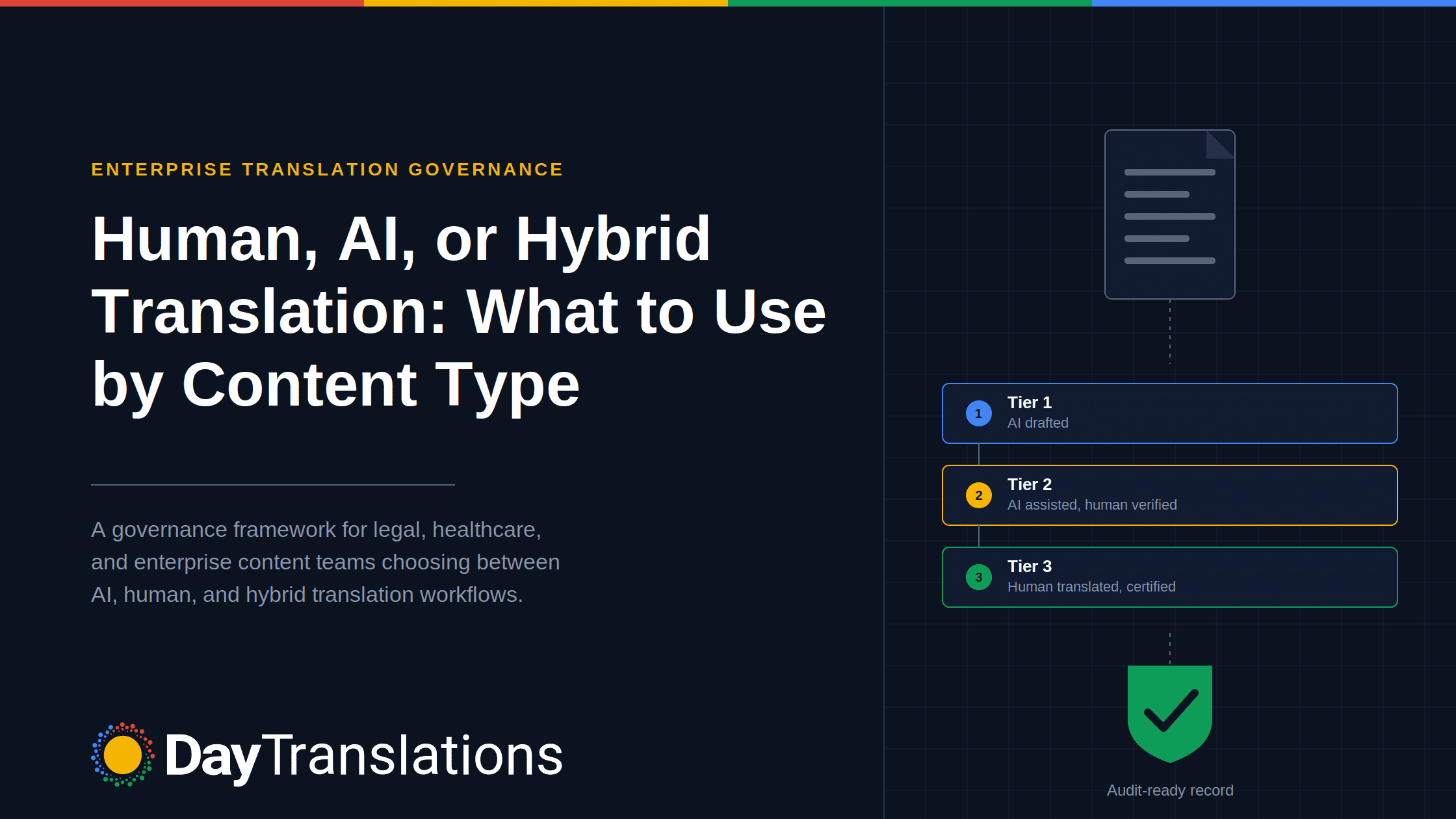
As organizations expand their digital footprints, the total volume of data requiring translation scales exponentially. Managing this massive volume under strict budgetary constraints requires a transition toward hybrid language workflows. These modern workflows combine secure machine intelligence with human-in-the-loop validation to balance processing speed, deployment cost, and absolute linguistic safety.
In a centralized enterprise model, corporate content is categorized systematically by its operational risk level. Low-risk, high-volume internal text, including automated supply chain alerts or internal inventory data, routes through secure, private machine translation engines. This content processes instantly, allowing international distribution centers to maintain complete alignment without manual operational delays.
Conversely, high-risk, customer-facing assets continue to require deep human expertise. A marketing campaign designed to deploy across 30 distinct national markets requires professional transcreation to ensure that brand imagery, cultural metaphors, and humor function correctly in the target market. A medical device instruction leaflet, financial disclosure form, or patient informed consent document requires a multi-step human translation, secondary editorial review, and strict proofreading process to guarantee zero margin for error. Centralizing governance allows enterprise procurement leaders to distribute financial resources intelligently based on these explicit risk parameters.
Frequently Asked Questions
How do centralized systems address regional dialects within the same language? A centralized language program utilizes localized terminology glossaries to manage dialect variations systematically. The central Translation Memory organizes linguistic data using specific geographic locale codes. This system ensures regional branches receive text tailored precisely to local demographics while utilizing the exact same corporate quality control infrastructure.
What is the baseline turnaround time for content updates routed via an automated API? Turnaround times correlate directly with the word count volume of the new content. For text updates under 2,000 words, automated routing via an API delivers completed, human-reviewed localized files within 24 to 48 hours. Extensive technical documentation or massive marketing overhauls exceeding 10,000 words follow a tiered delivery schedule, typically averaging 3,000 words per business day. The integration of Translation Memory assets constantly compresses these timelines by auto-populating pre-translated matches instantly.
How can a corporation verify the professional credentials of live interpreters deployed at physical facilities? Organizations manage compliance by requiring their language service partner to provide verifiable documentation of industry certifications. Within clinical healthcare environments, live interpreters must hold active credentials from the National Board of Certification for Medical Interpreters or the Certification Commission for Healthcare Interpreters. For financial or legal environments, linguists must hold recognized state court certifications or documented technical competencies in financial regulations. A centralized corporate language partner stores and displays these compliance records transparently within a single portal, simplifying corporate governance and third-party regulatory audits.
Does centralizing language services limit the autonomy of local franchise owners or regional managers? Centralization changes local autonomy by removing the administrative burden of vendor sourcing from regional managers. Local stakeholders retain the ability to flag terminology issues, submit local translation requests, and provide feedback through a central corporate ticketing dashboard. However, they are completely relieved of the responsibility to locate translators, negotiate independent contract rates, or verify linguistic accuracy. This structural shift allows regional branch leaders to focus their operational time entirely on local sales velocity, direct patient care, and facility performance.
Operational Implications for Enterprise Leadership
Transitioning to a unified multi-location language services framework is an operational decision that transforms language access from a fragmented, unmonitored branch expense into a highly optimized corporate asset. Centralizing your linguistic ecosystem eliminates vendor redundancies, secures total control over brand identity, and insulates the organization from severe compliance penalties and litigation.
For modern enterprises managing operations across linguistically diverse landscapes, communication consistency correlates directly with market share. Organizations that integrate their translation and interpretation workflows directly into their core corporate technology stacks achieve a definitive operational velocity. They enter new regions faster, manage distributed branches with lower administrative overhead, and build deep, localized trust with their consumers. Sourcing a dedicated language infrastructure is the definitive operational step toward building a scalable, resilient global operation.
Secure Your Global Footprint with Day Translations
Achieving operational consistency across a distributed multi-location enterprise requires a language partner built for high-volume corporate deployment. Day Translations delivers the specialized infrastructure, certified linguist networks, and API technology integrations required to centralize and scale your corporate communication. Whether you are expanding a retail franchise, deploying on-demand clinical interpreting, or localizing digital storefronts across global locations, we eliminate compliance risks and secure your brand identity. Contact our enterprise strategy division today to build a unified, cost-controlled language framework for your organization.