Ask five people what a language services company does and you will get five different answers. Some will say “they translate documents.” Others will say “interpreters, right?” A few will mention localization without being entirely sure how that’s different from translation. All five are partially right, and all five are underselling what a language services company actually does once you look at how it operates inside a real enterprise account.
If you are a business owner or operations leader trying to figure out what you’d actually be paying for, the vague answer isn’t good enough. Here is the direct one.
What Does a Language Services Company Do?
A language services company manages the process of adapting content, communication, and products for other languages and cultures. That covers translation, interpreting, and localization, plus the linguist sourcing, quality control, terminology management, technology, and compliance work that makes those services reliable at enterprise scale. Businesses hire one so multilingual communication becomes a managed, repeatable function instead of a scramble every time a document, meeting, or product needs to work in another language.
That’s the summary. The rest of this article is what sits underneath it, because that operational layer, not the one-line definition, is where the real value and the real cost live.
The Core Services: Translation, Interpreting, and Localization
Most explanations of language services stop at a list: translation, interpreting, localization, maybe transcription or subtitling tacked on at the end. That list isn’t wrong, but it tells you what the outputs are, not what the company is actually doing to produce them reliably, month after month, across a dozen languages and multiple departments.
Here’s the honest version of each core service, and where it fits.
Translation
Translation is the conversion of written content from one language into another while preserving meaning, tone, and intent. For an enterprise, this rarely means a single document. It means contracts that need legal precision, marketing copy that needs to sound native rather than converted, product documentation that has to stay technically accurate, and internal policies that need to read the same way in every regional office. A language services company treats these as different disciplines with different linguists, not one generic “translation” service applied uniformly.
Interpreting
Interpreting is the spoken equivalent, handled in real time. This is where a lot of business owners underestimate the complexity. Interpreting isn’t one service; it’s phone-based, video remote, in-person, and simultaneous conference interpreting, each suited to a different scenario, from a same-day customer support call to a multi-day arbitration hearing. An enterprise-grade provider staffs and schedules interpreters the way a workforce management system staffs shifts, except the “shift” might be a 10-second connection request at 2 a.m. from a hospital intake desk.
Localization
Localization goes beyond translating words. It adapts a product, website, app, or piece of content so it functions and feels native in a target market: currency formats, date conventions, imagery, legal disclaimers, UI text length (German text runs longer than English, and your buttons need to account for that), and cultural references that don’t survive a literal translation. Localization is why a software company can ship the same product into 20 markets without 20 separate engineering builds.
Additional and Supporting Services
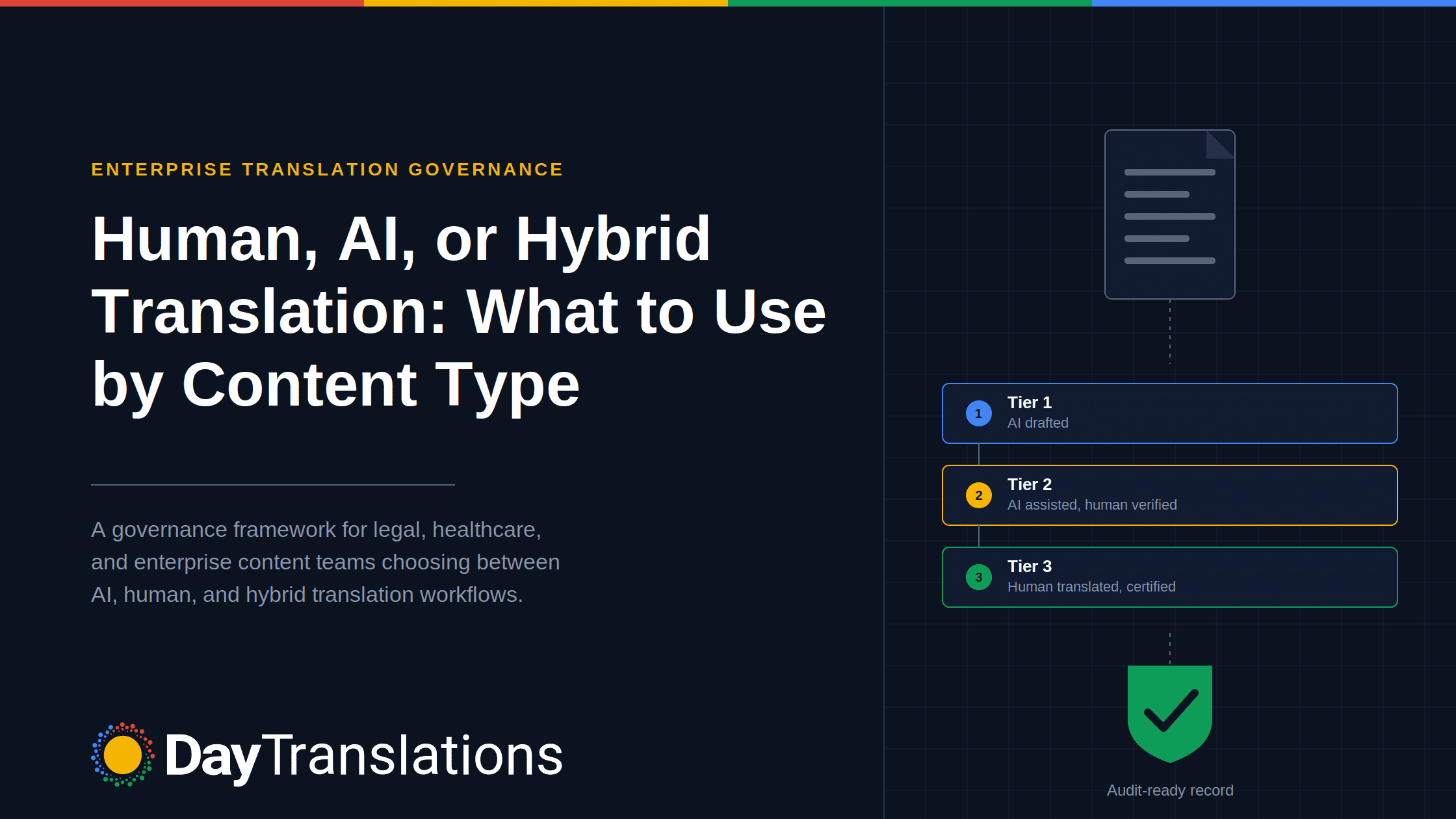
Most established providers also handle transcription, subtitling and dubbing, voiceover, and certified or notarized translation for legal and immigration use cases. Increasingly, they also run AI-assisted translation workflows, where machine translation handles first-pass volume and human linguists review, correct, and sign off before anything ships. None of these are separate businesses bolted on for cross-selling. They’re the same infrastructure (linguists, quality processes, project management) applied to different content types.
The Operational Workflow Behind an Enterprise Engagement
This is the part that rarely makes it into a glossary definition, and it’s the part that actually determines whether the work is any good.
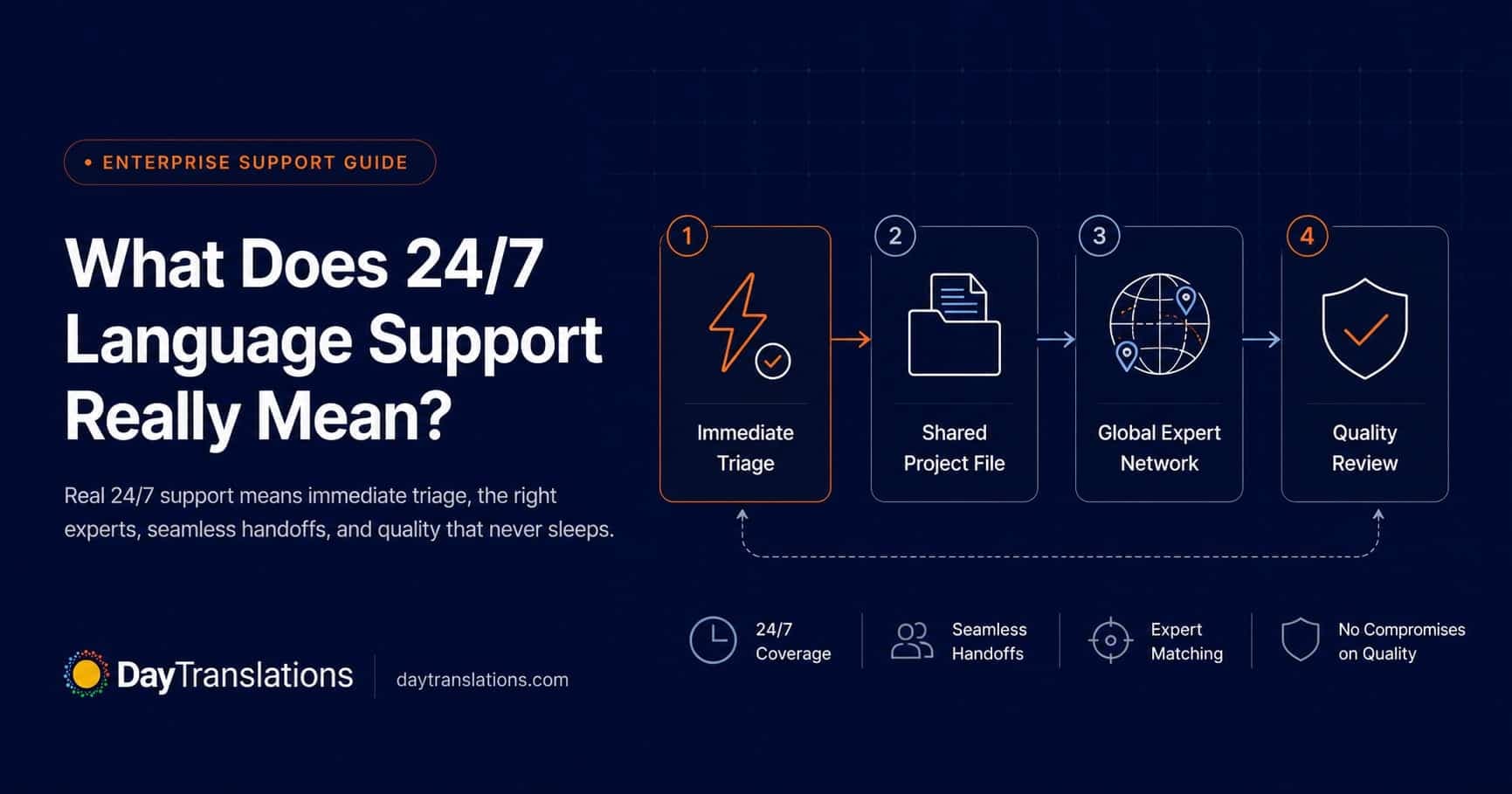
Intake and scoping. A request comes in: 40,000 words of technical documentation into six languages, due in three weeks. Before any translation happens, a project manager scopes the content, flags anything that needs subject-matter expertise (medical, legal, financial), and builds a schedule that accounts for translation, editing, and review, not just the first pass.
Linguist matching. Enterprise providers don’t assign “a French translator.” They assign a translator with relevant industry experience, native fluency in the target language, and, ideally, prior work on similar content. A pharmaceutical clinical trial document and a consumer app’s onboarding screens should never go to the same linguist, even if both happen to be French.
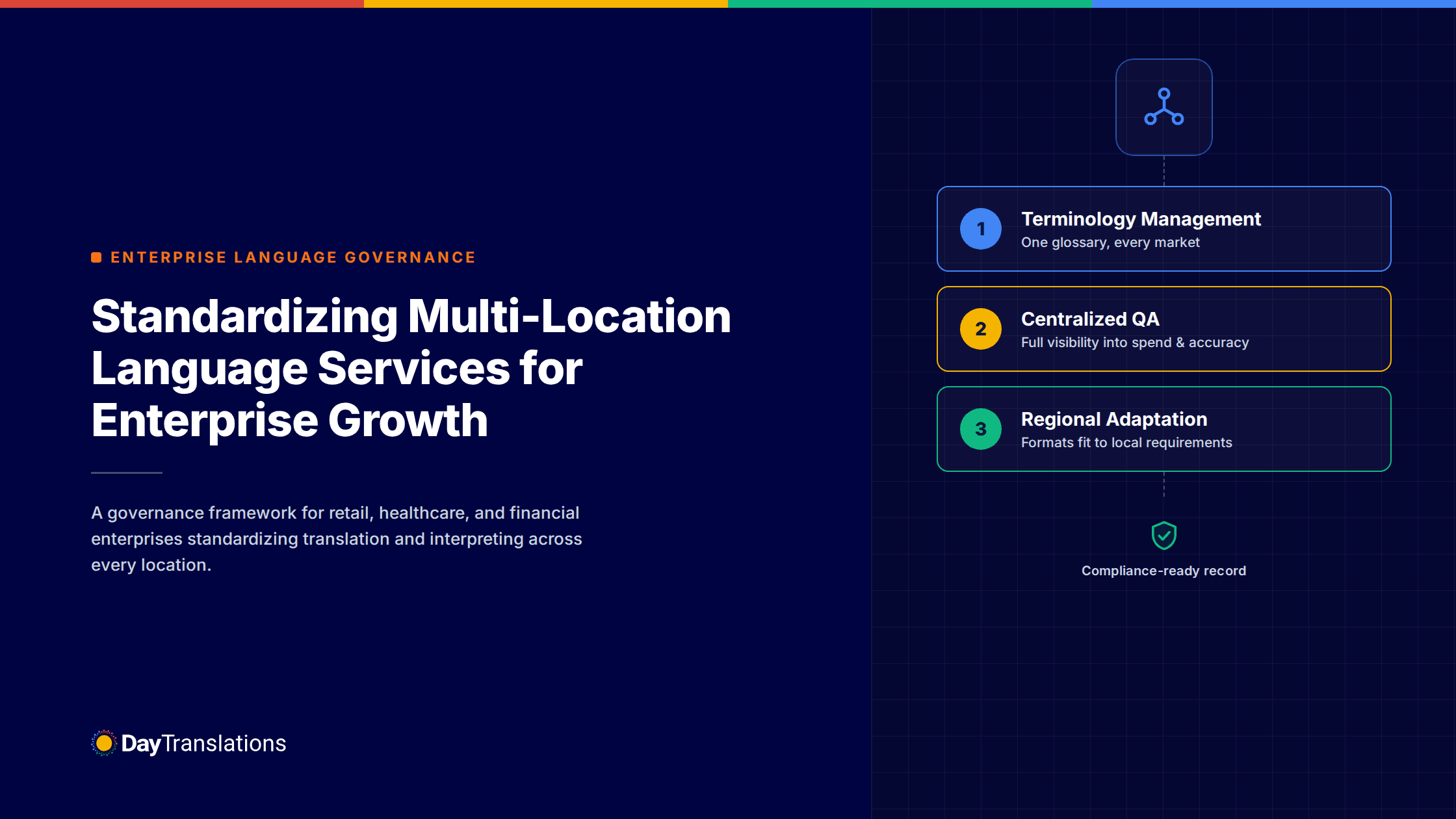
Translation memory and terminology management. This is the piece that separates a real operation from a freelancer with a laptop. Translation memory (TM) stores previously translated segments so identical or similar phrases aren’t retranslated from scratch every time, which cuts cost and turnaround on repeat content. A managed glossary ensures your product name, legal disclaimers, and brand terminology stay consistent whether the content came from marketing, legal, or product. Without this, it’s entirely possible for your German website and your German user manual to use two different words for the same feature.
Multi-stage quality review. Serious providers don’t ship a single linguist’s first draft. The standard model is translation, independent editing by a second linguist, and a final proofread or linguistic quality assurance (LQA) pass, often scored against a formal quality framework. Providers holding ISO 17100 certification, the standard specific to translation services, are required to follow this multi-step review structure, not just claim they do.
Project management as the actual product. For any account running more than one or two languages, the project manager is doing as much work as the linguists: coordinating timelines, resolving ambiguous source content, managing file formats and desktop publishing, and giving you one point of contact instead of a dozen individual vendor relationships to track yourself.
Technology and integration. Enterprise accounts increasingly connect directly into a translation management system (TMS) or API, so content flows from a CMS, product codebase, or support ticketing system straight into the translation pipeline without manual file handoffs. This matters more as content volume grows; nobody wants to manually email spreadsheets for a website with weekly updates.
Security and compliance. For regulated industries, this is not optional. Certifications like ISO 27001 (information security), SOC 2 readiness, HIPAA compliance for healthcare data, and GDPR alignment for EU data determine whether a provider can even be considered for legal, medical, financial, or government work. Day Translations holds ISO 17100 and ISO 27001 certification alongside SOC-2 readiness, HIPAA compliance, and GDPR alignment, which is the kind of documentation an enterprise buyer should expect any serious provider to produce without hesitation, not just claim in a sales call.
Why Enterprise Teams Outsource Language Services
None of the above is complicated to describe, but it’s genuinely difficult to build in-house at the quality and speed enterprises need. Here’s the actual business case operations leaders land on:
Speed and scale without headcount. Hiring, vetting, and managing linguists across a dozen languages internally is its own function, not a side task for a marketing coordinator. A language services company already has that bench built.
Consistency across departments and markets. Centralized terminology management prevents the scenario where legal, marketing, and support all describe the same product feature differently across five languages.
Risk reduction. In regulated industries, a mistranslated clause or an interpreting error isn’t a minor quality issue; it’s a compliance and liability problem. Providers built around ISO 17100, HIPAA, and GDPR compliance exist specifically to reduce that exposure.
Avoiding vendor sprawl. Managing eight freelancers for eight languages means eight relationships, eight invoices, and eight different quality bars to police. A single provider consolidates that into one contract and one accountable point of contact.
Cost efficiency over time. Translation memory, reusable glossaries, and established linguist relationships mean the fifth project in a language pair is cheaper and faster than the first. That compounding efficiency is difficult to replicate with ad hoc freelance hiring.
Language Services Company vs. Freelancer vs. In-House Team
| Freelance translator/interpreter | In-house team | Language services company | |
| Best for | One-off, low-volume, single-language jobs | High, sustained volume in one or two core languages | Multi-language, multi-format, ongoing needs |
| Quality control | Depends entirely on the individual | Consistent, but limited to your build-out | Structured multi-step review (translate, edit, proofread) |
| Scalability | Limited; you’re one person’s calendar | Limited by headcount and budget cycles | Built to flex up or down by language and volume |
| Compliance readiness | Rarely audited or certified | Possible, but you own the entire build | Often already ISO, SOC 2, HIPAA, GDPR aligned |
| Cost pattern | Lower per-project, less predictable at scale | High fixed cost (salaries, tools, management) | Variable cost, discounts compound with volume via TM |
None of these is universally “correct.” A single translated contract might genuinely be fine with a qualified freelancer. A company operating in 20 languages with legal, medical, and marketing content flowing constantly is a different problem, and it’s the one language services companies are actually built to solve.
Signs Your Organization Needs a Language Services Partner
A few patterns tend to show up right before a business decides to formalize this:
- Content needs to go into three or more languages on any kind of recurring basis
- Compliance requirements (healthcare, legal, financial, government) mean translation errors carry real liability
- Internal teams are managing translation as a side task on top of their actual jobs
- Terminology and brand voice are inconsistent across markets or departments
- Interpreting needs are unpredictable (support calls, legal proceedings, on-site visits) and can’t wait for someone to find and vet a freelancer each time
If two or more of these are true, the cost of not having a managed process is usually already higher than the cost of the service itself, it’s just showing up as rework, inconsistency, or risk rather than as a line item.
The Cost of Not Having a Managed Language Services Partner
That cost is worth breaking down, because it rarely arrives as a single number and that’s exactly why it gets underestimated. It shows up in several places at once, usually all quietly.
Internal time that never gets billed anywhere. Someone bilingual on the team becomes the unofficial translation department: reviewing marketing copy after hours, proofing a contract between meetings, jumping on a customer call in Spanish because nobody else can. Their actual job doesn’t pause to make room for it, so something else slips instead.
Rework. A product page or press release that goes out with a translation that’s grammatically fine but culturally off doesn’t sit there quietly. A regional office or customer flags it, it comes down, and it gets redone, usually on a worse timeline and at a worse rate than if it had been handled correctly the first time.
Deals that stall for reasons nobody names. A proposal, contract, or RFP response with inconsistent terminology or an obviously machine-translated section tells a prospect something about the vendor behind it: that it isn’t actually set up to operate in their market. That’s a quiet way to lose business you never find out you lost for that reason.
Compliance exposure. A mistranslated clause in a vendor agreement, an inaccurate consent form in a clinical trial, or an interpreting error in a deposition stops being a quality issue and becomes a liability. When these costs land, they tend to be an order of magnitude larger than a managed translation process would have cost to prevent them in the first place.
Slower market entry. Ad hoc translation, find a freelancer, wait, hope the quality holds, adds days or weeks to every localization cycle. For a company on a timeline to launch in a new market, that delay carries a real opportunity cost, even when nobody puts a specific figure on it.
None of these show up on an invoice the way a language services contract does. That’s exactly why they’re easy to underweight when comparing the cost of hiring a provider against the cost of continuing to handle it internally.
Criteria for Choosing a Language Services Provider
Once you’ve decided a managed provider makes sense, the evaluation questions matter more than the sales pitch:
Ask about their review process, not just their linguists. “Native speaker” is table stakes. What matters is whether every project goes through independent editing and a final quality pass, and whether that process is certified (ISO 17100) or just described.
Ask what happens to your terminology. A real glossary and translation memory setup should be part of onboarding, not an afterthought you have to request.
Ask about security posture directly. If you’re in healthcare, legal, or finance, get specifics on HIPAA, GDPR, and information security certifications like ISO 27001 or SOC 2 readiness before you send them a single file.
Ask how they handle scale changes. A provider that’s great at 10,000 words a month should be able to explain, concretely, what changes operationally at 100,000.
Ask who your actual point of contact is. The difference between a good and mediocre experience at enterprise scale usually comes down to whether you have one accountable project manager or a rotating cast of assigned staff.
Key Takeaways
A language services company does far more than convert words from one language to another. It runs a managed operation: vetted linguists matched to your industry, a multi-step quality process, centralized terminology and translation memory, project management that scales with your volume, and compliance infrastructure built for regulated industries. That’s what separates a real language services partner from a freelancer with a translation app.
Day Translations has built that infrastructure across translation, interpreting, and localization for enterprises, healthcare systems, law firms, and government agencies operating in 500+ languages. Contact us to explore what an enterprise-grade language services company looks like before you decide.