
Russia is located in northeastern Europe and northern Asia and shares boundaries with the Arctic Ocean on the North, northern Pacific Ocean on the West, China, Mongolia, Kazakhstan, the Caspian Sea, Azerbaijan, Georgia on the South, and the Black Sea, Ukraine, Belarus, Latvia, Estonia, Finland on the West.
:: Background of Russia ::
Founded in the 12th century, the Principality of Muscovy, was able to emerge from over 200 years of Mongol domination (13th-15th centuries) and to gradually conquer and absorb surrounding principalities. In the early 17th century, a new Romanov Dynasty continued this policy of expansion across Siberia to the Pacific. Under PETER I (ruled 1682-1725), hegemony was extended to the Baltic Sea and the country was renamed the Russian Empire. During the 19th century, more territorial acquisitions were made in Europe and Asia. Defeat in the Russo-Japanese War of 1904-05 contributed to the Revolution of 1905, which resulted in the formation of a parliament and other reforms. Repeated devastating defeats of the Russian army in World War I led to widespread rioting in the major cities of the Russian Empire and to the overthrow in 1917 of the imperial household.
The Communists under Vladimir LENIN seized power soon after and formed the USSR. The brutal rule of Iosif STALIN (1928-53) strengthened Communist rule and Russian dominance of the Soviet Union at a cost of tens of millions of lives. The Soviet economy and society stagnated in the following decades until General Secretary Mikhail GORBACHEV (1985-91) introduced glasnost (openness) and perestroika (restructuring) in an attempt to modernize Communism, but his initiatives inadvertently released forces that by December 1991 splintered the USSR into Russia and 14 other independent republics. Since then, Russia has struggled in its efforts to build a democratic political system and market economy to replace the social, political, and economic controls of the Communist period. In tandem with its prudent management of Russia’s windfall energy wealth, which has helped the country rebound from the economic collapse of the 1990s, the Kremlin in recent years has overseen a recentralization of power that has undermined democratic institutions. Russia has severely disabled the Chechen rebel movement, although violence still occurs throughout the North Caucasus.
In this Country Profile
:: Geography of Russia ::
Location: Northern Asia (the area west of the Urals is considered part of Europe), bordering the Arctic Ocean, between Europe and the North Pacific Ocean.
Geographic coordinates: 60 00 N, 100 00 E
Area:
total: 17,075,200 sq km
land: 16,995,800 sq km
water: 79,400 sq km
Area – comparative: approximately 1.8 times the size of the US
Land boundaries:
total: 20,241.5 km
border countries: Azerbaijan 284 km, Belarus 959 km, China (southeast) 3,605 km, China (south) 40 km, Estonia 290 km, Finland 1,313 km, Georgia 723 km, Kazakhstan 6,846 km, North Korea 17.5 km, Latvia 292 km, Lithuania (Kaliningrad Oblast) 227 km, Mongolia 3,441 km, Norway 196 km, Poland (Kaliningrad Oblast) 432 km, Ukraine 1,576 km.
Maritime claims:
territorial sea: 12 nm
contiguous zone: 24 nm
exclusive economic zone: 200 nm
continental shelf: 200-m depth or to the depth of exploitation
Climate:
territorial sea: 12 nm
contiguous zone: 24 nm
exclusive economic zone: 200 nm
continental shelf: 200-m depth or to the depth of exploitation
Terrain: broad plain with low hills west of Urals; vast coniferous forest and tundra in Siberia; uplands and mountains along southern border regions.
Elevation extremes:
lowest point: Caspian Sea -28 m
highest point: Gora El’brus 5,633 m
Natural resources: wide natural resource base including major deposits of oil, natural gas, coal, and many strategic minerals, timber. Note: formidable obstacles of climate, terrain, and distance hinder exploitation of natural resources.
Land use:
arable land: 7.17%
permanent crops: 0.11%
other: 92.72% (2005)
Natural hazards: development; volcanic activity in the Kuril Islands; volcanoes and earthquakes on the Kamchatka Peninsula; spring floods and summer/autumn forest fires throughout Siberia and parts of European Russia.
Environment – current issues: air pollution from heavy industry, emissions of coal-fired electric plants, and transportation in major cities; industrial, municipal, and agricultural pollution of inland waterways and seacoasts; deforestation; soil erosion; soil contamination from improper application of agricultural chemicals; scattered areas of sometimes intense radioactive contamination; groundwater contamination from toxic waste; urban solid waste management; abandoned stocks of obsolete pesticides.
Environment – international agreements: party to: Air Pollution, Air Pollution-Nitrogen Oxides, Air Pollution-Sulfur 85, Antarctic-Environmental Protocol, Antarctic-Marine Living Resources, Antarctic Seals, Antarctic Treaty, Biodiversity, Climate Change, Climate Change-Kyoto Protocol, Endangered Species, Environmental Modification, Hazardous Wastes, Law of the Sea, Marine Dumping, Ozone Layer Protection, Ship Pollution, Tropical Timber 83, Wetlands, Whaling. Signed, but not ratified: Air Pollution-Sulfur 94.
:: People of Russia ::
Population: 140,702,096 (July 2008 est.)
Age structure:
0-14 years: 14.6% (male 10,577,858/female 10,033,254)
15-64 years: 71.2% (male 48,187,807/female 52,045,102)
65 years and over: 14.1% (male 6,162,400/female 13,695,673) (2008 est.)
Median age:
total: 38.3 years
male: 35.1 years
female: 41.4 years (2008 est.)
Population growth rate: -0.474% (2008 est.)
Birth rate: 11.03 births/1,000 population (2008 est.)
Death rate: 16.06 deaths/1,000 population (2008 est.)
Net migration rate: 0.28 migrant(s)/1,000 population (2008 est.)
Sex ratio:
at birth: 1.06 male(s)/female
under 15 years: 1.05 male(s)/female
15-64 years: 0.93 male(s)/female
65 years and over: 0.45 male(s)/female
total population: 0.86 male(s)/female (2008 est.)
Infant mortality rate:
total: 10.81 deaths/1,000 live births
male: 12.34 deaths/1,000 live births
female: 9.18 deaths/1,000 live births (2008 est.)
Life expectancy at birth:
total population: 65.94 years
male: 59.19 years
female: 73.1 years (2008 est.)
Total fertility rate: 1.4 children born/woman (2008 est.)
HIV/AIDS – adult prévalence rate: 1.1% (2001 est.)
HIV/AIDS – people living with HIV/AIDS: 860,000 (2001 est.)
HIV/AIDS – deaths: 9,000 (2001 est.)
Nationality: noun: Russian(s) adjective: Russian
Ethnic groups: Russian 79.8%, Tatar 3.8%, Ukrainian 2%, Bashkir 1.2%, Chuvash 1.1%, other or unspecified 12.1% (2002 census)
Religions: Russian Orthodox 15-20%, Muslim 10-15%, other Christian 2% (2006 est.) Note: estimates are of practicing worshipers; Russia has large populations of non-practicing believers and non-believers, a legacy of over seven decades of Soviet rule.
Languages: Russian, many minority languages
Literacy:
definition: age 15 and over can read and write
total population: 99.4%
male: 99.7%
female: 99.2% (2002 census)
Geography of Russia: Important Geographical Information about Russia
In this Country Profile
Located in the northern and middle latitudes of the Northern Hemisphere, Russia spans almost half the globe from east to west and about 4,000 kilometers from north to south. Divided into eleven time zones, Russia is by far the world’s largest country. It occupies occupies a substantial part of Eastern Europe and Northern Asia. As the world’s largest country, Russian has a very diverse geography. Russia’s topography includes the world’s deepest lake and Europe’s highest mountain and longest river.
Russia is traditionally divided into five natural zones: the tundra zone; the forest zone; the steppe, or plains, zone; the arid zone; and the mountain zone. Most of Russia consists of two plains (the East European Plain and the West Siberian Plain), two lowlands (the North Siberian and the Kolyma, in far northeastern Siberia), two plateaus (the Central Siberian Plateau and the Lena Plateau to its east), and a series of mountainous areas. Ural mountains cover 2,500 miles of eastern Russia and are the most famous of the country’s mountain ranges because they form the natural boundary between Europe and Asia. The highest peak, Mount Narodnaya, is only 1,894 meters. The magnificent Caucasus Mountains rise to impressive heights, forming a boundary between Europe and Asia. Mount Elbrus is the highest point in Europe: 5,642 m.
Russia has more than 100,000 rivers. Volga is one of the most famous rivers in the world, and not only because it is Europe’s longest river, but also because of its major role in Russian history. The largest and most prominent of Russia’s bodies of fresh water is Lake Baikal, the world’s deepest (1700 m), most ancient (25 million years) lake which contains 20% of the world’s total unfrozen freshwater reserve. It is a powerful symbol of environmental purity for Russians.
Professional Translation Organizations & Associations in Russia
In this Country Profile
Below is a list of the major translation organizations and associations of Russia. Day Translations seeks to be involved with translation organizations to improve the knowledge and awareness of the importance of translation and interpretation in our constantly changing, global world.
:: List of Organizations ::
Moscow Linguistic University
Nizhny Novgorod Linguistic University. College of Translation & Interpreting
South Ural State University
St Petersburg State University, Translating and Interpreting
Union of Translators of Russia
Information about the Russian Flag: Colors and Meaning of the Flag of Russia
In this Country Profile
:: Meaning of the Russian Flag ::
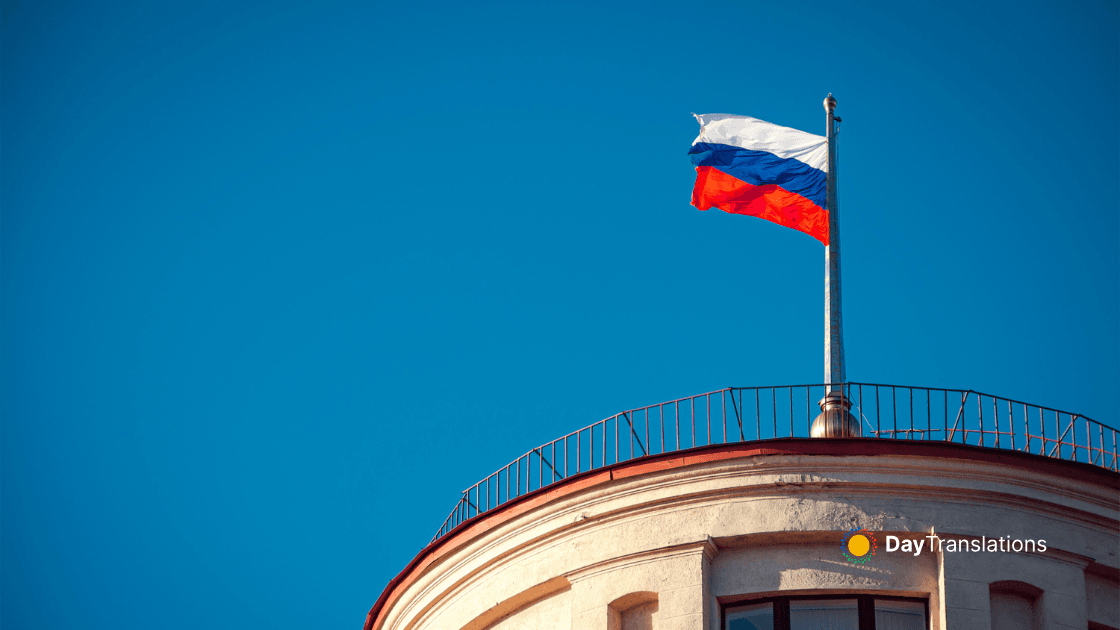
The flag of Russia (sometimes called the “Imperial flag”) is a tricolor flag consisting of three equal horizontal bands of white (on the top), blue and red (on the bottom). The flag ratio is described as 2:3 (length 1½ times the height ). The Russian flag was adopted on August 21, 1991.
he Russian flag consists of the Pan-Slavic colors of red, blue and white that appear in the flags of Slavic countries, like the Czech Republic, Slovakia, Slovenia, and Serbia. There are various theories regarding the meaning of the Russian flag, but there is no official meaning assigned to the colors in Russian laws.
One version states that the three colors are associated with the robes of the Virgin Mary, the holy Protectress of Russia. According to another theory, the three colors reflected the Russian social system under the monarchy: white symbolizes God, blue the Tsar and red the peasants. Another interpretation is that the colors come from the coat of arms of the Grand Duchy of Moscow, which depict Saint George wearing a white (silver) armor, riding a white horse, wearing a blue cape and holding a blue shield, on a red field.
:: Meaning of the Russian Coat of Arms ::
The arms: red shield, golden double-headed eagle with scepter, orb and three crowns. Silver horseman is in red escutcheon. The author of drawing is Evgeny Ukhnalyov from St.Petersburg. The scepter and crown represent the Tsars rule. The eagle with St. George slaying the dragon symbolizes the Russian military strength combined with Christianity. The symbol of the double eagle is called by most of the countries that use it “The Orao”. The Orao represents on the Russian Coat of Arms insight into this world and the NEXT, because, the eagle is looking both East – sunrise = life and West – sunset = Death. The vigiliantly Orao looks both ways representing protection of the State.
Extensive List of Languages of Russia: Spoken and Extinct Languages
In this Country Profile
:: Languages of Russia (Europe) ::
Also see Russia in Asia for a listing of languages in Asia. 143,782,338. Also includes Armenian (532,000), Assyrian Neo-Aramaic (10,000), Belarusan (1,206,000), Eastern Yiddish (701,000), Estonian (56,000), Greek (105,000), Latvian (29,000), Lithuanian (70,000), Northern Kurdish (30,000), Polish (94,000), Pontic, Romanian (178,000), Standard German (896,000). The number of languages listed for Russia (Europe) is 60. Of those, 59 are living languages and 1 is extinct.
:: List of Languages ::
Abaza [abq] 34,800 in Russia (1989 census). Population total all countries: 44,895. Karachay-Cherkess Republic. Also spoken in Germany, Turkey (Asia). Alternate names: Abazin, Abazintsy, Ashuwa. Dialects: Tapanta, Ashkaraua (Ashkar), Bezshagh. Some dialects are partially intelligible with Abkhaz. Classification: North Caucasian, West Caucasian, Abkhaz-Abazin
Adyghe [ady] 125,000 in Russia (1993 UBS). Population total all countries: 499,180. Adygea Republic. Maikop is the capital. Also spoken in Australia, Egypt, France, Germany, Iraq, Israel, Jordan, Macedonia, Netherlands, Syria, Turkey (Asia), USA. Alternate names: Circassian, Lower Circassian, Kiakh, Kjax, West Circassian, Adygei, Adygey. Dialects: Shapsug (Sapsug), Xakuchi, Bezhedukh (Bzedux, Bzhedug, Bezhehux-Temirgoi, Temirgoj, Chemgui), Abadzex (Abadekh, Abadzeg), Natuzaj (Natukhai). Closest to Kabardian. Classification: North Caucasian, West Caucasian, Circassian
Aghul [agx] 17,373 in Russia (1989 census). Population total all countries: 17,405. Ethnic population: 17,728 in Russia (1989 census). Southern Dagestan ASSR. Also spoken in Azerbaijan. Alternate names: Agul, Aghulshuy, Aguly. Dialects: Koshan, Keren, Gekxun, Agul. Classification: North Caucasian, East Caucasian, Lezgic, Nuclear Lezgic, East Lezgic
Akhvakh [akv] 3,500 (1990). Ethnic population: 3,500 (1990 A. E. Kibrik). Southern Dagestan ASSR. Alternate names: Axvax. Dialects: Kaxib, Northern Akhvakh, Southern Akhvakh (Tlyanub, Tsegob). ‘Dialects’ are diverse; speakers communicate in Avar. Classification: North Caucasian, East Caucasian, Avar-Andic, Andic
Andi [ani] 10,000 (1993 UBS). Ethnic population: 20,000 (1990 A. E. Kibrik). Southern Dagestan ASSR. Alternate names: Andii, Qwannab, Andiy. Dialects: Munin, Rikvani, Kvanxidatl, Gagatl, Zilo. Dialects appear to be quite divergent. Classification: North Caucasian, East Caucasian, Avar-Andic, Andic
Archi [aqc] 1,000 (2000). Ethnic population: 1,000 (1990 A. E. Kibrik). Southern Dagestan. Alternate names: Archin, Archintsy. Dialects: One of the most divergent of the Lezgian languages. Classification: North Caucasian, East Caucasian, Lezgic, Archi
Avar [ava] 556,000 in Russia (1989 census). Population total all countries: 600,959. Southern Dagestan ASSR and Terek and Sulak river areas. Also spoken in Azerbaijan, Kazakhstan, Turkey (Asia). Alternate names: Avaro, Dagestani. Dialects: Salatav, Kunzakh (Xunzax, Northern Avar), Keleb, Bacadin, Untib, Shulanin, Kaxib, Hid, Andalal-Gxdatl, Karax (Karakh), Batlux, Ancux (Antsukh), Zakataly (Char). Classification: North Caucasian, East Caucasian, Avar-Andic, Avar
Bagvalal [kva] 2,000 (1990). Ethnic population: 2,000 (1990 A. E. Kibrik). Southern Dagestan ASSR. Alternate names: Kvanadin, Kvanada, Bagwalal, Bagulal, Bagvalin, Barbalin. Dialects: Tlisi. Close to Tindin. Classification: North Caucasian, East Caucasian, Avar-Andic, Andic
Bashkir [bak] 1,800,000 in Russia (2001 Johnstone and Mandryk). Population total all countries: 1,871,383. Baskir ASSR, between the Volga River and Ural Mountains, and beyond the Urals. Ufa is the capital. Over 61% of the people live in cities. Also spoken in Kazakhstan, Kyrgyzstan, Tajikistan, Turkmenistan, Ukraine, Uzbekistan. Alternate names: Basquort, Bashkort. Dialects: Kuvakan (Mountain Bashkir), Yurmaty (Steppe Bashkir), Burzhan (Western Bashkir). Close to Tatar. Classification: Altaic, Turkic, Western, Uralian
Bezhta [kap] 3,000 (1993 UBS). Ethnic population: 4,000 (1990 Kibrik). Southern Dagestan ASSR. Alternate names: Bezhita, Bezheta, Bezhti, Bexita, Bechitin, Kapucha, Kupuca, Kapuchin. Dialects: Bezhta, Tlyadaly, Khocharkhotin. A separate language from Hunzib (B. Comrie 1989). Classification: North Caucasian, East Caucasian, Tsezic, East Tsezic
Botlikh [bph] 5,000 (1990). Ethnic population: 5,000 (1990 Kibrik). Southern Dagestan ASSR. Alternate names: Botlix. Dialects: Botlikh, Zibirkhalin. Close to Andi. Godoberi is a separate language (B. Comrie 1989). Classification: North Caucasian, East Caucasian, Avar-Andic, Andic
Chamalal [cji] 5,000 (1990). Ethnic population: 5,000 (1990 Kibrik). Southern Dagestan ASSR. Alternate names: Camalal, Chamalin. Dialects: Gadyri (Gachitl-Kvankhi), Gakvari (Agvali-Richaganik-Tsumada-Urukh), Gigatl. Dialects are quite distinct. Classification: North Caucasian, East Caucasian, Avar-Andic, Andic
Chechen [che] 944,600 in Russia (1989 census). Population total all countries: 955,600. Ethnic population: 956,879. Chechnya, north Caucasus. The capital is Syelzha Ghaala (Chechen name) or Grozny (Groznii; Russian name). 80% live in rural areas. Also spoken in Georgia, Germany, Jordan, Kazakhstan, Kyrgyzstan, Syria, Turkey (Asia), Uzbekistan. Alternate names: Nokhchiin, Nokchiin Muott, Galancho. Dialects: Ploskost, Itumkala (Shatoi), Melkhin, Kistin, Cheberloi, Akkin (Aux). Melkhi is the transitional dialect to Ingush. Chechen is at least partially intelligible with Ingush, more so with contact. Classification: North Caucasian, East Caucasian, Nakh, Chechen-Ingush
Chuvash [chv] 1,800,000 in Russia (2001 Johnstone and Mandryk). Population total all countries: 1,834,394. Chuvashia, east of Moscow, near the Volga River. Cheboksary is their capital. About half live in towns (1995). Also spoken in Estonia, Kazakhstan, Kyrgyzstan, Uzbekistan. Alternate names: Bulgar. Dialects: Anatri, Viryal. The only extant language in the Bolgar branch of Turkic. Classification: Altaic, Turkic, Bolgar
Dargwa [dar] 365,000 in the former USSR (1993 UBS). Population total all countries: 371,488. Southern Dagestan ASSR. Also spoken in Azerbaijan, Kazakhstan, Kyrgyzstan, Turkey (Asia), Turkmenistan, Ukraine, Uzbekistan. Alternate names: Dargin, Dargi, Dargintsy, Khiurkilinskii. Dialects: Cudaxar (Tsudakhar), Akusha (Urkarax, Urakha-Akhush, Akkhusha), Uraxa-Axusha, Kajtak (Xajdak, Kaitak, Kaytak), Kubachi (Kubachin, Kubachintsy, Ughbug), Dejbuk, Xarbuk, Muirin, Sirxin, Itsari, Chirag. Kaytag, Kubachin, Itsari, and Chirag may be separate languages from Dargwa. Classification: North Caucasian, East Caucasian, Dargi
Dido [ddo] 7,000 (1994 UBS). Ethnic population: 8,000 (1990 Kibrik). Southern Dagestan ASSR. Alternate names: Didoi, Tsez, Cez, Tsezy, Tsuntin. Dialects: Sagadin. Sagadin dialect is most distinct. Slight dialect differences from village to village. Classification: North Caucasian, East Caucasian, Tsezic, West Tsezic
Domari [rmt] Karachi dialect is in the Caucasus, Luli and Maznoug in Uzbekistan. Dialects: Karachi, Luli, Maznoug. Classification: Indo-European, Indo-Iranian, Indo-Aryan, Central zone, Dom
Erzya [myv] 440,000 in Russia. Population total all countries: 517,575. Mordovian Republic, northern and eastern. Also in the adjacent regions of Nizhni Novgorod, Ulyanovsk, Penza, Samara, Buguruslan, and the republics of Chuvassia, Tatarstan, and Bashkortostan. Also spoken in Azerbaijan, Kazakhstan, Kyrgyzstan, Turkmenistan, Ukraine, Uzbekistan. Alternate names: Mordvin-Erzya, Mordvin, Erzia. Dialects: Quite different from Moksha. Classification: Uralic, Mordvin
Finnish [fin] 17,050 in Russia (2000). Ethnic population: 77,000 in Russia (1979 census). St. Petersburg area, Ingria Region. Classification: Uralic, Finnic
Ghodoberi [gdo] 3,000 (1996). Ethnic population: 2,500 (1990 Kibrik). Southern Dagestan ASSR. Alternate names: Godoberi, Godoberin. Dialects: Close to Andi. A separate language from Botlikh (B. Comrie 1989). Classification: North Caucasian, East Caucasian, Avar-Andic, Andic
Hinukh [gin] 200 (1991 Kibrik). Ethnic population: 300 (1990 Kibrik). Southern Dagestan ASSR. Alternate names: Ginukh, Ginux, Ginukhtsy, Hinux. Dialects: Close to Tsez (Dido) but probably not inherently intelligible. Classification: North Caucasian, East Caucasian, Tsezic, West Tsezic
Hunzib [huz] 2,000 (1995 H. Ven den Berg). Ethnic population: 2,000. Southern Dagestan ASSR. Alternate names: Gunzib, Xunzal, Khunzaly, Khunzal, Enzeb. Dialects: A separate language from Bezhta (B. Comrie 1989). Classification: North Caucasian, East Caucasian, Tsezic, East Tsezic
Ingrian [izh] 302 (1989 census). Ethnic population: 820 (1989 census). Baltic area, Kingisepp and Lomonosov areas of St. Petersburg Oblast. Alternate names: Izhor. Dialects: Soykin, Khava, Lower Luzh, Oredezh (Upper Luzh). Close to Karelian but the government considers them separate languages. Classification: Uralic, Finnic
Ingush [inh] 230,315 in Russia (1989 census). Ethnic population: 237,438. Chechen Ingushetia, northern Caucasus, west of the Chechen. Vladikavkaz (Ordzhhonikidze) is the main city. Nazran in the lowlands is an important market town. 64.6% live in rural areas. Since 1992 up to 60,000 Ingush refugees are reported to be in Ingushetia. Also spoken in Uzbekistan. Alternate names: Ghalghay, Ingus. Dialects: Somewhat intelligible with Chechen, more so with contact. Classification: North Caucasian, East Caucasian, Nakh, Chechen-Ingush
Judeo-Tat [jdt] 7,000 in Russia (1989 census). Dagestan ASSR, Nalchik in Kabardino-Balkar ASSR, in villages and ancient cities of the Caucasus mountains (Derbent, Makhachkale, Nalchik, Majalis, Pyatigorsk). Until recently they were in Grozny in Checheno-Ingush. None in Iran. Alternate names: Judeo-Tatic, Hebrew Tat, Jewish Tat, Bik, Dzhuhuric, Juwri, Juhuri. Dialects: Derbend. Classification: Indo-European, Indo-Iranian, Iranian, Western, Southwestern, Tat
Kabardian [kbd] 443,000 in Russia. Population includes 46,000 Cherkes in Russia (1993 UBS), 97% speak it as first language. Population total all countries: 1,012,000. Kabardino-Balkaria and Karachai-Cherkessia. Naltshik is the capital. Also spoken in Saudi Arabia, Turkey (Asia), USA. Alternate names: Beslenei, Upper Circassian, East Circassian, Kabardino-Cherkes, Kabardo-Cherkes. Dialects: Greater Kabardian, Baksan, Lesser Kabardian, Malka, Mozdok, Kuban, Cherkes, Beslenei (Beslenej). Close to Adygey. Classification: North Caucasian, West Caucasian, Circassian
Kalmyk-Oirat [xal] 174,000 Kalmyk in Russia (1993 UBS). Population total all countries: 518,500. The Kalmyk are in Kalmykia, the steppes between the Don and Volga rivers, lower Volga Region, now the Astrakhan Province. The capital is Elista. The Dorbot and Torgut live between the Volga and the Don, west of the Caspian and north of the Caucasus, in the Republic of Kalmykia. Also spoken in China, Germany, Kyrgyzstan, Mongolia, Taiwan, USA. Alternate names: Kalmuk, Kalmuck, Kalmack, Qalmaq, Kalmytskii Jazyk, Khal:mag, Oirat, Volga Oirat, European Oirat, Western Mongolian. Dialects: Buzawa, Oirat, Torgut (Torguut, Torguud, Torghud, Torghoud), Dörböt (Dörböd, Derbet), Sart Qalmaq. Their language has diverged from other Mongolian languages and they are called ‘Kalmyk’ in Russia; ‘Oirat’ in China and Mongolia. In USA Kalmyk has not been heavily influenced by Russian as it has been in Russia. Different from other varieties in China called Oirat, which are sometimes called ‘Asiatic Oirat’. Classification: Altaic, Mongolian, Eastern, Oirat-Khalkha, Oirat-Kalmyk-Darkhat
Karachay-Balkar [krc] 236,000 in Russia (1993 UBS). Population includes 156,000 Karachay, 85,000 Balkar. Population total all countries: 241,038. Karachi-Cherkessia and Kabardino-Balkaria. Karachaevsk-Cherkessk is the capital. The Balkar are isolated. Also spoken in Armenia, Azerbaijan, Kazakhstan, Kyrgyzstan, USA, Uzbekistan. Alternate names: Karachay, Karachai, Karachayla, Karachaitsy, Karacaylar. Dialects: Balkar, Karachay. Classification: Altaic, Turkic, Western, Ponto-Caspian
Karata [kpt] 5,000 (1990). Ethnic population: 5,000 (1990 A. E. Kibrik). Southern Dagestan ASSR. Alternate names: Karatin, Kirdi, Karatai. Dialects: Tokita (Tokitin), Anchix. Karatin and Tokitin are quite different. Classification: North Caucasian, East Caucasian, Avar-Andic, Andic
Karelian [krl] 118,000 in Russia (1993 Johnstone). Population total all countries: 128,000. Ethnic population: 172,000 in Russia. Karelia, Tver (Kalinin), St. Petersburg, and Murmansk oblasts. Petrozavodsk is the capital. Also spoken in Finland. Alternate names: Karely, Karelian Proper, Sobstvenno-Karel’skij-Jazyk, Severno-Karel’skij, Karel’skiy Jazyk. Dialects: Northern Karelian, Southern Karelian, Novgorod, Tver (Kalinin). Ludic and Livvi are separate languages. Classification: Uralic, Finnic
Khvarshi [khv] 500 (1990). Ethnic population: 500 (1990 A. E. Kibrik). Southern Dagestan ASSR. Alternate names: Xvarshi, Khvarshin. Dialects: Xvarshi, Inxokvari. Dialects are quite distinct. Classification: North Caucasian, East Caucasian, Tsezic, West Tsezic
Komi-Permyak [koi] 116,000 (1979 census). Ethnic population: 151,000. Komi-Permyak National Okrug, west of the central Ural Mountains, south of Komi-Zyrian. Alternate names: Permyak, Komi-Permyat, Kama Permyak, Komi-Perm. Dialects: Zyudin, North Permyak (Kochin-Kam), South Permyak (Inyven). Possible difficulty in understanding among dialects. 80% cognate with Komi-Zyrian and Udmurt. Classification: Uralic, Permian, Komi
Komi-Zyrian [kpv] 262,200 (1993 UBS). Ethnic population: 345,000. Komi ASSR, 60′ N. Lat., nearly to the Arctic Ocean. South of Yurak, west of the Vogul (Mansi) peoples. Capital is Syktywkar. Alternate names: Komi. Dialects: Yazva. Lexical similarity 80% with Komi-Permyak and Udmurt. Classification: Uralic, Permian, Komi
Kumyk [kum] 282,000 in Russia (1993 UBS). Population total all countries: 282,554. Southern Dagestan ASSR, northern and eastern Caucasian plain. Also spoken in Kazakhstan, Turkey (Asia). Alternate names: Kumuk, Kumuklar, Kumyki. Dialects: Khasavyurt, Buinaksk, Khaikent. Dialects are apparently quite divergent. Classification: Altaic, Turkic, Western, Ponto-Caspian
Lak [lbe] 112,100 in Russia. Population total all countries: 119,512. Ethnic population: 118,000 in Russia. Southern Dagestan ASSR. Also spoken in Azerbaijan, Georgia, Kazakhstan, Kyrgyzstan, Tajikistan, Turkey (Asia), Turkmenistan, Ukraine, Uzbekistan. Alternate names: Laki, Kazikumukhtsy. Dialects: Kumux (Kumkh), Vicxin (Vitskhin), Vixlin (Vikhlin), Ashtikulin, Balxar-Calakan (Balkar-Tsalakan). Dialects are close. Classification: North Caucasian, East Caucasian, Lak
Lezgi [lez] 257,000 in Russia (1996). Population total all countries: 451,112. Southern Dagestan ASSR, the western Caspian Sea coast, central Caucasus. Also spoken in Azerbaijan, Georgia, Kazakhstan, Kyrgyzstan, Turkey (Asia), Turkmenistan, Ukraine, Uzbekistan. Alternate names: Lezgian, Lezghi, Lezgin, Kiurinsty. Dialects: Kiuri, Akhty, Kuba, Gjunej, Garkin, Anyx, Stal. Some dialects are reported to not be inherently intelligible with others. Kuba is considerably different from the standard dialect. Classification: North Caucasian, East Caucasian, Lezgic, Nuclear Lezgic, East Lezgic
Livvi [olo] 14,142 in Russia (2000 WCD). Population total all countries: 19,314. Ethnic population: 140,000. Karelian Republic. ‘Olonets’ is the Russian name of their capital, which they call ‘Anus’, or ‘Aunus’ in Finnish. Also spoken in Finland. Alternate names: Olonetsian, Olonets, Livvikovian, Livvikovskij Jazyk, Southern Karelian. Dialects: Close to Karelian and Finnish. Classification: Uralic, Finnic
Ludian [lud] 5,000 (2000 Salminen). Karelian ASSR. Alternate names: Lyudikovian, Lyudic, Ludic. Dialects: Ludian is transitional between Livvi and Veps. A separate language from Karelian (Juha Janhunen 1990). May be separate from Livvi. Classification: Uralic, Finnic
Mari, Eastern [mhr] 525,480 in Russia (1993 UBS). Population total all countries: 534,569. Ethnic population: 604,000. Mari ASSR, east of the Volga, Bashkir, Tatar, Udmurt ASSR, Perm, Sverov, Kirov Oblasts. Capital is Yoshkar-Ola, 500 km east of Moscow. Also spoken in Kazakhstan. Alternate names: Cheremis, Low Mari, Mari, Mari-Woods, Meadow Mari, Lugovo Mari. Dialects: Grassland Mari (Meadow Mari, Sernur-Morkin, Yoshkar-Olin, Volga). Classification: Uralic, Mari
Mari, Western [mrj] 66,000 (1993 UBS). Mari ASSR, south of the Volga, Gorno-Mariy, and some in Bashkortostan. Capital is Yoshkar-Ola. Alternate names: Cheremis, Gorno-Mariy, High Mari, Hill Mari, Mari-Hills. Dialects: Kozymodemyan, Yaran. Speakers have difficulty reading Eastern Mari because of lexical differences. There are also phonological and morphological differences. Classification: Uralic, Mari
Moksha [mdf] 296,904 (2000 WCD). Mordovia, southern. Saransk is the capital. Alternate names: Mordvin-Moksha, Mordov, Mordoff, Mokshan. Dialects: Considerable difference with Erzya. Classification: Uralic, Mordvin
Nogai [nog] 67,500 in Russia (1993 UBS). Population total all countries: 67,806. Ethnic population: 75,000. Northern Caucasus, Cherkes Ao. Also spoken in Kazakhstan, Uzbekistan. Alternate names: Nogay, Noghay, Noghai, Noghaylar, Nogaitsy, Nogalar. Dialects: White Nogai (Ak), Black Nogai (Kara), Central Nogai. Dialect differences are slight. Classification: Altaic, Turkic, Western, Aralo-Caspian
Romani, Vlax [rmy] 10,000 Kalderash in Russia, Ukraine, and Moldova. Russian SFSR, Odessa, Transcarpathia. Dialects: Central Vlax Romani, Kalderash. Classification: Indo-European, Indo-Iranian, Indo-Aryan, Central zone, Romani, Vlax
Russian [rus] 117,863,645 in Russia (2000 WCD). Population total all countries: 145,031,551. Also spoken in Armenia, Azerbaijan, Belarus, Bulgaria, Canada, China, Czech Republic, Estonia, Finland, Georgia, Germany, Greece, India, Israel, Kazakhstan, Kyrgyzstan, Latvia, Lithuania, Moldova, Mongolia, Norway, Poland, Romania, Slovakia, Tajikistan, Turkmenistan, Ukraine, Uruguay, USA, Uzbekistan. Alternate names: Russki. Dialects: North Russian, South Russian. Classification: Indo-European, Slavic, East
Russian Sign Language[rsl] Moscow, Armavir, Gorky, Kazan, Kirov, Kolomna, Kujbyshev, St. Petersburg, Novosibirsk, Rostov on Don, Sverdlovsk have schools for the deaf. Also used in Bulgaria. Dialects: Related to Austrian and French sign languages. Classification: Deaf sign language
Rutul [rut] 20,000 in Russia (1993 UBS). Population total all countries: 20,111. Ethnic population: 19,503 in Russia (1989 census). Southern Dagestan ASSR. Also spoken in Azerbaijan. Alternate names: Rutal, Rutuly, Rutultsy, Mykhanidy, Chal, Mukhad. Dialects: Shina, Borch, Ixreko-Muxrek. Dialects are not sharply defined. Classification: North Caucasian, East Caucasian, Lezgic, Nuclear Lezgic, West Lezgic
Saami, Akkala [sia] 8 (2000 T. Salminen). Ethnic population: 100 (1995 M. Krauss). Southwest Kola Peninsula. Alternate names: Ahkkil, Babinsk, Babino. Dialects: Closest to Skolt. Classification: Uralic, Sami, Eastern Nearly extinct.
Saami, Kildin [sjd] 800 (2000 T. Salminen). 1,900 Saami in Russia (1995 M. Krauss). Ethnic population: 1,000 (1995 M. Krauss). Alternate names: “Kildin Lappish”, “Lapp”, Saam, Saami. Classification: Uralic, Sami, Eastern
Saami, Skolt[sms] 20 to 30 in Russia. Ethnic population: 400 in Russia (1995 M. Krauss). Northern and western Kola Peninsula around Petsamo. Alternate names: “Skolt Lappish”, “Russian Lapp”, “Lapp”, Saam, Lopar, Kolta, Skolt. Dialects: Notozer, Yokan. Classification: Uralic, Sami, Eastern
Saami, Ter [sjt] 6 (1995 M. Krauss). Ethnic population: 400 population (2000 Salminen). Alternate names: “Ter Lappish”, “Lapp”, Saam. Classification: Uralic, Sami, Eastern Nearly extinct.
Serbian [srp] 5,000 in Russia (1959 census). Classification: Indo-European, Slavic, South, Western
Tabassaran [tab] 95,000 in Russia (1993 UBS). Population total all countries: 95,905. Ethnic population: 98,000 in Russia. Southern Dagestan ASSR. Also spoken in Azerbaijan, Kazakhstan, Turkmenistan, Uzbekistan. Alternate names: Tabasaran, Tabasarantsy, Ghumghum. Dialects: South Tabasaran, North Tabasaran (Khanag). Classification: North Caucasian, East Caucasian, Lezgic, Nuclear Lezgic, East Lezgic
Tat, Muslim [ttt] In Northern Caucasus (Dashestan) and a large community in Moscow. Alternate names: Mussulman Tati. Dialects: Northern Tats. Classification: Indo-European, Indo-Iranian, Iranian, Western, Southwestern, Tat
Tatar [tat] 464,669 in Russia (2000). Population total all countries: 1,610,032. Ethnic population: 6,645,588 in the former USSR (1989 census). Tatarstan, from Moscow to eastern Siberia. Capital is Kazan (Kasan), on the Volga River. Also spoken in Afghanistan, Azerbaijan, Belarus, China, Estonia, Finland, Georgia, Kazakhstan, Kyrgyzstan, Latvia, Lithuania, Moldova, Tajikistan, Turkey (Europe), Turkmenistan, Ukraine, USA, Uzbekistan. Alternate names: Tartar. Dialects: Middle Tatar (Kazan), Western Tatar (Misher), Eastern Tatar (Siberian Tatar). Eastern Tatar is divided into 3: Tobol-Irtysh, Baraba, and Tom. Tobol-Irtysh is divided into 5: Tyumen, Tobol, Zabolotny, Tevriz, and Tara (Tumasheva). Mixed dialects are: Astrakhan, Kasimov, Tepter, and Ural (Poppe). 43,000 Astrakhan have assimilated to the Middle dialect. Kasim (5,000) is between Middle and Western Tatar. Tepter (300,000) is reported to be between the Tatar and Bashkir languages. Uralic Tatar (110,000) is spoken by the Kerashen Tatar. Classification: Altaic, Turkic, Western, Uralian
Tindi [tin] 6,693 (2000 WCD). Southern Dagestan ASSR. Alternate names: Tindal, Tindin. Dialects: Bagvalal is closely related, but probably not inherently intelligible. Classification: North Caucasian, East Caucasian, Avar-Andic, Andic
Tsakhur [tkr] 7,000 in Russia. Southern Dagestan ASSR and Azerbaijan. Alternate names: Tsaxur, Caxur, Tsakhury. Dialects: Kirmico-Lek, Mikik, Misles. Classification: North Caucasian, East Caucasian, Lezgic, Nuclear Lezgic, West Lezgic
Udmurt [udm] 550,000 in Russia (1989 census). Population total all countries: 565,786. Ethnic population: 750,000 in the former USSR. Udmurtia, 1,000 km northeast of Moscow, bounded by the Kama and Cheptsa rivers, near the Ural Mountains Izhyevsk (Ischewsk) is the capital. Also spoken in Kazakhstan. Alternate names: Votiak, Votyak. Dialects: North Udmurt (Besermyan, Udmurt), South Udmurt (Southwestern Udmurt). Classification: Uralic, Permian
Veps [vep] 6,355 (1990 A. Kibrik). Ethnic population: 13,500. Among Russian speakers, on the boundary between St. Petersburg and Vologda oblasts and in Karelian Republic. Half reportedly went to Finland during World War II. Alternate names: Vepsian, “Chudy”, “Chuhari”, “Chukhari”. Dialects: Southern Veps, Central Veps, Prionezh (North Veps). Classification: Uralic, Finnic
Vod [vot] 25 (1979 Valt). Ethnic population: 200 (1990 A. E. Kibrik). Kingisepp area of St. Petersburg. Alternate names: Votian, Vote, Vodian, Votish, Votic. Dialects: East Vod, West Vod. Intelligible with Estonian of the northeast coast. Classification: Uralic, Finnic Nearly extinct.
:: Extinct Languages ::
Slavonic, Old Church [chu] Extinct. Classification: Indo-European, Slavic, South, Eastern.
:: Languages of Russia (Asia) ::
Includes Baltic Romani (20,000), Georgian (130,000), Kazakh (636,000), Korean, Lomavren, Mandarin Chinese, North Azerbaijani (336,000), Northern Uzbek (61,588), Osetin (400,000), Plautdietsch, Tajiki (38,000), Turkish, Turkmen, Udi (1,000), Ukrainian (4,363,000). The number of languages listed for Russia (Asia) is 45. Of those, 42 are living languages and 3 are extinct
:: Living Languages ::
Ainu [ain] South Sakhalin Island and southern Kuril Islands. Dialects: Sakhalin (Saghilin), Taraika, Hokkaido (Ezo, Yezo), Kuril (Shikotan). Classification: Language Isolate Nearly extinct.
Aleut [ale] 190 in Russia (2002 K. Matsumura). 5 on Bering Island Atkan (1995 M. Krauss). Ethnic population: 702 (1989 census). Nikolskoye settlement, Bering Island, Commander (Komandor) Islands. Alternate names: Unangany, Unangan, Unanghan. Dialects: Beringov (Bering, Atkan). Classification: Eskimo-Aleut, Aleut
Aleut, Mednyj [mud] 10 (1995 M. Krauss). Copper Island, Komandor Islands. Alternate names: Medny, Copper, Copper Island Aleut, Attuan, Copper Island Attuan, Creolized Attuan. Classification: Mixed Language, Russian-Aleut Nearly extinct.
Altai, Northern [atv] 29,098 (2000 WCD). Gorno-Altai Ao mountains, bordering on Mongolia and China. Alternate names: Teleut, Telengut, Telengit. Dialects: No comprehension of Southern Altai. Considered a separate language outside the region. Teleut may be a separate language. Classification: Altaic, Turkic, Northern
Altai, Southern [alt] 20,000 (1993 Janhunen). Ethnic population: 68,686. Gorno-Altai Ao mountains, bordering on Mongolia and China. Alternate names: Oirot, Oyrot, Altai. Dialects: Altai Proper (Altai-Kizhi, Altaj Kizi, Maina-Kizhi, Southern Altai), Talangit (Talangit-Tolos, Chuy). Northern Altai and Southern Altai are not inherently intelligible, although there is a dialect cluster between them. Classification: Altaic, Turkic, Northern
Alutor [alr] 100 to 200 (2000 A. E. Kibrik). Ethnic population: 2,000 (1997 M. Krauss). Koryak National District, northeast Kamchatka Peninsula, many in Vyvenka village, 2 families in Rekinniki, and individual families in Tilichiki and Tymlyt. Some speakers are separated at considerable distances and without regular contact. Alternate names: Alyutor, Aliutor, Olyutor. Dialects: Alutorskij (Alutor Proper), Karaginskij (Karaga), Palanskij (Palana). Considered a dialect of Koryak until recently. Classification: Chukotko-Kamchatkan, Northern, Koryak-Alyutor
Bohtan Neo-Aramaic [bhn] Classification: Afro-Asiatic, Semitic, Central, Aramaic, Eastern, Central, Northeastern
Buriat, Russia [bxr] 318,000 (1990 National Geographic). Ethnic population: 422,000. East of Lake Baikal, Siberia, bordering on Mongolia. Ulan Ude is the capital. Alternate names: Buryat, Buriat-Mongolian, Northern Mongolian. Dialects: Ekhirit, Unga, Ninzne-Udinsk, Barguzin, Tunka, Oka, Alar, Bohaan (Bokhan), Bulagat. The Buriat in newspapers is that of the area around Irkutsk, west of Lake Baikal. The Buriat east of the lake is less influenced by Russian and is more like that in Mongolia. The literary dialect differs considerably from those spoken in Mongolia and China, which are influenced by other languages. Khori is the main dialect in Russia. Speakers in Russia apparently understand each other well. Classification: Altaic, Mongolian, Eastern, Oirat-Khalkha, Khalkha-Buriat, Buriat
Chukot [ckt] 10,000 (1997 M. Krauss). Ethnic population: 15,000. Chukchi Peninsula, Chukot and Koryak National Okrug, northeastern Siberia. Alternate names: Chukcha, Chuchee, Chukchee, Luoravetlan, Chukchi. Dialects: Uellanskij, Pevekskij, Enmylinskij, Nunligranskij, Xatyrskij, Chaun, Enurmin, Yanrakinot. Classification: Chukotko-Kamchatkan, Northern, Chukot
Chulym [clw] 500 (1990). Ethnic population: 500 (1990 A. E. Kibrik). Basin of the Chulym River north of the Altay Mountains, a tributary of the Ob River. Alternate names: Chulym-Turkish, Chulim, Melets Tatar, Chulym Tatar. Dialects: Lower Chulym, Middle Chulym. Close to Shor; some consider them one language. The government considers them separate. Classification: Altaic, Turkic, Western, Uralian
Dolgan[dlg] 5,000 (1994 UBS). Ethnic population: 6,945 (1989 census). Yakut ASSR. Classification: Altaic, Turkic, Northern
Enets, Forest [enf] 40 (1995 M. Krauss). Ethnic population: 209 with Tundra Enets (1989 census). Taimyr National Okrug. Along the Yenisei River’s lower course, upstream from Dudinka. The Forest variety is in the Potapovo settlement of the Dudinka Region. Alternate names: Yenisei Samoyedic, Bay Enets, Pe-Bae. Dialects: Forest and Tundra Enets are barely intelligible to each other’s speakers. It is transitional between Yura and Nganasan. For a time it was officially considered part of Nenets. Classification: Uralic, Samoyed Nearly extinct.
Enets, Tundra[enh] 30 (1995 M. Krauss). Ethnic population: 209 together with Forest Enets (1990 census). Taimyr National Okrug. Along the Yenisei River’s lower course, upstream from Dudinka. ‘Tundra’ in the Vorontzovo settlement of the Ust-Yenisei Region. Alternate names: Yenisei Samoyedic, Madu, Somatu. Dialects: Tundra and Forest Enets barely intelligible to each other’s speakers. It is transitional between Yura and Nganasan. For a time it was officially considered part of Nenets. Classification: Uralic, Samoyed Nearly extinct.
Even [eve] 7,543 (1989 census). Ethnic population: 17,199 (1989 census). Yakutia and the Kamchatka Peninsula, widely scattered over the entire Okhotsk Arctic coast. Alternate names: Lamut, Ewen, Eben, Orich, Ilqan. Dialects: Arman, Indigirka, Kamchatka, Kolyma-Omolon, Okhotsk, Ola, Tompon, Upper Kolyma, Sakkyryr, Lamunkhin. Ola dialect is not accepted by speakers of other dialects. A dialect cluster. It was incorrectly reported to be a Yukaghir dialect. Classification: Altaic, Tungus, Northern, Even
Evenki [evn] 9,000 in Russia (1997 M. Krauss). Ethnic population: 30,000 in Russia (1997 M. Krauss). Evenki National Okrug, Sakhalin Island. Capital is Ture. Alternate names: Ewenki, Tungus, Chapogir, Avanki, Avankil, Solon, Khamnigan. Dialects: Manegir, Yerbogocen, Nakanna, Ilimpeya, Tutoncana, Podkamennaya Tunguska, Cemdalsk, Vanavara, Baykit, Poligus, Uchama, Cis-Baikalia, Sym, Tokmo-Upper Lena, Nepa, Lower Nepa Tungir, Kalar, Tokko, Aldan Timpton, Tommot, Jeltulak, Uchur, Ayan-Maya, Kur-Urmi, Tuguro-Chumikan, Sakhalin, Zeya-Bureya. Classification: Altaic, Tungus, Northern, Evenki
Gilyak [niv] 1,089 (1989 census). Population includes 100 Amur, 300 Sakhalin (1995 M. Krauss). Ethnic population: 4,673 (1989 census), including 2,000 Amur, 2,700 Sakhalin (1995 M. Krauss). Sakhalin Island, many in Nekrasovka and Nogliki villages, small numbers in Rybnoe, Moskalvo, Chir-Unvd, Viakhtu, and other villages, and along the Amur River in Aleevka village. Alternate names: Nivkh, Nivkhi. Dialects: Amur, East Sakhalin Gilyak, North Sakhalin Gilyak. The Amur and East Sakhalin dialects have difficult inherent intelligibility of each other. North Sakhalin is between them linguistically. Classification: Language Isolate
telmen [itl] 60 (2000). Ethnic population: 2,481 (1989 census). Southern Kamchatka Peninsula, Koryak Autonomous District, Tigil Region, primarily in Kovran and Upper Khairiuzovo villages, west coast of the Kamchatka River. Alternate names: Itelymem, Western Itelmen, Kamchadal, Kamchatka. Dialects: Sedanka, Kharyuz, Itelmen, Xajrjuzovskij, Napanskij, Sopocnovskij. Classification: Chukotko-Kamchatkan, Southern
Karagas [kim] 25 to 30 (2001). Ethnic population: 730 (1989 census). Siberia, Irkutsk Region. Alternate names: Tofa, Tofalar, Sayan Samoyed, Kamas, Karagass. Classification: Altaic, Turkic, Northern Nearly extinct.
Kerek[krk] 2 (1997 M. Krauss). There were 200 to 400 speakers in 1900. Ethnic population: 400. Cape Navarin, in Chukot villages. Dialects: Mainypilgino (Majna-Pil’ginskij), Khatyrka (Xatyrskij). Previously considered a dialect of Chukot. Classification: Chukotko-Kamchatkan, Northern, Koryak-Alyutor Nearly extinct.
Ket [ket] 550 to 990 (1995 M. Krauss). Ethnic population: 1,222 (2000). Upper Yenisei Valley, Krasnoyarski krai, Turukhansk, and Baikitsk regions, Sulomai, Bakhta, Verkhneimbatsk, Kellog, Kangatovo, Surgutikha, Vereshchagino, Baklanikha, Farkovo, Goroshikha, and Maiduka villages. East of the Khanti and Mansi, eastern Siberia. Alternate names: Yenisei Ostyak, Yenisey Ostiak, Imbatski-Ket. Classification: Yeniseian
Khakas [kjh] 64,800 in Russia (1993 UBS). Population total all countries: 64,810. Ethnic population: 80,000 in Russia. Khakassia, north of the Altai Mountains, and a few north of the Oblast. Ababan is the capital. Also spoken in China. Alternate names: Khakhas, Khakhass, Abakan Tatar, Yenisei Tatar. Dialects: Sagai (Sagaj), Beltir, Kacha (Kaca), Kyzyl, Shor, Kamassian. Classification: Altaic, Turkic, Northern
Khanty [kca] 12,000 (1994 Salminen, 1994 Janhunen). Ethnic population: 21,000. Khanty-Mansi National Okrug. Farther east than the Mansi, along the Ob River. Alternate names: Khanti, Hanty, Xanty, Ostyak. Dialects: Northern Khanti, Eastern Khanti, Southern Khanti, Vach (Vasyugan). Intelligibility is difficult between geographically distant dialects. Three dialect groups. Vach is an ‘archaic’ dialect. The dialect used in writing is rejected by many speakers. Classification: Uralic
Koryak [kpy] 3,500 (1997 M. Krauss). Ethnic population: 7,000. Koryak National Okrug, south of the Chukot; northern half of Kamchatka Peninsula and adjacent continent. Alternate names: Nymylan. Dialects: Cavcuvenskij (Chavchuven), Apokinskij (Apukin), Kamenskij (Kamen), Xatyrskij, Paren, Itkan, Palan, Gin. Chavchuven, Palan, and Kamen are apparently not inherently intelligible. Classification: Chukotko-Kamchatkan, Northern, Koryak-Alyutor
Mansi [mns] 3,184 (1990 census). Northern Mansi has 3,000 speakers out of 7,000, Eastern Mansi has 100 speakers out of 1,000 population. Ethnic population: 8,500 including Northern Mansi 7,000, Eastern Mansi 1,000 (1989 census). Western Siberia between Komi-Zyrian and west of the Urals, between Urals and Ob River. Alternate names: Vogul, Vogulich, Mansiy, Voguly. Dialects: Northern Vogul (Sos’va, Sosyvin, Upper Lozyvin), Southern Vogul (Tavdin), Western Vogul (Pelym, Vagily, Middle Lozyvin, Lower Lozyvin), Eastern Vogul (Kondin). Intelligibility between geographically distant dialects is difficult. May be 4 languages. Closest to Hungarian. Classification: Uralic
Mongolian, Halh [khk] 2,095 in Russia (2000 WCD). Buryat. Alternate names: Halh, Khalkha Mongolian, Mongol, Central Mongolian. Dialects: Khalkha (Halh), Dariganga, Urat, Ujumuchin. Classification: Altaic, Mongolian, Eastern, Oirat-Khalkha, Khalkha-Buriat, Mongolian Proper
Nanai [gld] 5,760 in Russia (1990 census). Population total all countries: 5,772. Ethnic population: 11,877 in Russia. In the extreme Soviet far east, confluence of the Amur and Ussuri rivers, scattered in Ussuri Valley and Sikhote-Alin, settled more densely in the Amur Valley below Khabarovsk. Also spoken in China. Alternate names: Nanaj, Gold, Goldi, Hezhen, Hezhe, Heche. Dialects: Sunggari, Torgon, Kuro-Urmi, Ussuri, Akani, Birar, Kila, Samagir. The dialects are quite distinct. Classification: Altaic, Tungus, Southern, Southeast, Nanaj
Negidal [neg] 100 to 170 (1995 M. Krauss). Ethnic population: 500 (1995 M. Krauss). Lower reaches of the Amur River, in two regions of the Khabarovsk Krai (Kamenka settlement and Im, and in the Paulina Osipenko Region). Alternate names: Negidaly, Neghidal. Dialects: Nizovsk, Verkhovsk. Classification: Altaic, Tungus, Northern, Negidal
Nenets [yrk] 26,730 (1989 census). Population includes 1,300 Forest Nenets, 25,000 Tundra Nenets. Ethnic population: 34,665 (1989 census) including 2,000 Forest Enets. Northwest Siberia, tundra area from the mouth of the northern Dvina River in northeastern Europe to the delta of the Yenisei in Asia, and a scattering on the Kola Peninsula; Nenets, Yamalo-Nenets, and Taimyr national okrugs. Alternate names: Nenec, Nentse, Nenetsy, Yurak, Yurak Samoyed. Dialects: Forest Yurak, Tundra Yurak. Classification: Uralic, Samoyed
Nganasan [nio] 500 (1995 M. Krauss). Ethnic population: 1,300. Taimyr National Okrug, Taimyr Peninsula, Siberia, Ust-Avam village in the Dudinka Region; Volochanka and Novaya villages in the Khatang Region. They are the northernmost people in Russia, near the Yakut, Dolgan, and Evenki peoples. Alternate names: Tavgi Samoyed. Dialects: Avam, Khatang. Classification: Uralic, Samoyed
Oroch [oac] 100 to 150 (1995 M. Krauss). Ethnic population: 900 (1990 census). Eastern Siberia in the Khabarovsk Krai along the rivers that empty into the Tatar Channel, on Amur River not far from the city of Komsomolsk-na-Amure. Many live in the Vanino Region in Datta and Uska-Orochskaya settlements. Some live among the Nanai. Alternate names: Orochi. Dialects: Kjakela (Kjakar, Kekar), Namunka, Orichen, Tez. Classification: Altaic, Tungus, Southern, Southeast, Udihe
Orok [oaa] 30 to 82 in Russia (1995 M. Krauss). Population total all countries: 33 to 85. Ethnic population: 250 to 300 (1995 M. Krauss). Sakhalin Island, Poronajsk District, Poronajsk town, Gastello and Vakhrushev settlements; Nogliki District, Val village, Nogliki settlement. Also spoken in Japan. Alternate names: Oroc, Ulta, Ujlta, Uilta. Dialects: Poronaisk (Southern Orok), Val-Nogliki (Nogliki-Val, Northern Orok). Significant differences between dialects. For a while Orok was officially considered part of Nanai. Classification: Altaic, Tungus, Southern, Southeast, Nanaj Nearly extinct.
Selkup [sel] 1,570 (1994 Salminen, 1994 Janhunen). Northern Sel’kup has 1,400 speakers out of 1,700, Central Sel’kup has 150 speakers out of 1,700, Southern Sel’kup has 20 speakers out of 200. Ethnic population: 3,600. Tom Oblast, Yamalo-Nenets Autonomous District, Krasnoyarski Krai and Tomskaya Oblast. The northern dialect is spoken in Krasnoselkup Region, Krasnoselkup, Sidorovsk, Tolka, Ratta, and Kikiyakki villages; part of the Purovsk Region, Tolka Purovskaya village; adjacent regions of the Krasnoyarski Krai; Kureika village, Kellog, and Turukhan River basin and Baikha. The southern dialect (Tym) is spoken in a range of villages in the northern part of the Tomskaya Oblast. Alternate names: Ostyak Samoyed. Dialects: Taz (Northern Sel’kup, Tazov-Baishyan), Tym (Central Selk’up, Kety), Narym (Central Sel’kup), Srednyaya Ob-Ket (Southern Sel’kup). A dialect continuum with difficult or impossible intelligibility between the extremes. Speakers in the south are separated from others. Classification: Uralic, Samoyed
Shor [cjs] 9,446 (1989 census). Ethnic population: 16,652 (1989 census). Altai Krai, Khakass Ao and Gorno-Altai Ao, on the River Tomy. Alternate names: Shortsy, Aba, Kondoma Tatar, Mras Tatar, Kuznets Tatar, Tom-Kuznets Tatar. Dialects: Mrassa (Mrasu), Kondoma. Some sources combine Shor and Chulym. Classification: Altaic, Turkic, Northern
Tuvin [tyv] 180,000 in Russia (2001). Population total all countries: 209,400. Tuvin Ao. Capital is Kyzl. Also spoken in China, Mongolia. Alternate names: Tuva, Tuvan, Tuvia, Tyva, Tofa, Tokha, Soyot, Soyon, Soyod, Tannu-Tuva, Tuba, Tuvinian, Uriankhai, Uriankhai-Monchak, Uryankhai, Diba, Kök Mungak. Dialects: Central Tuvin, Western Tuvin, Northeastern Tuvin (Todzhin), Southeastern Tuvin, Tuba-Kizhi. Sharp dialect differences. Classification: Altaic, Turkic, Northern
Udihe [ude] 100 (1991 Kibrik). Ethnic population: 1,600 (1991 Kibrik). Siberian far east; Khabarovsk Krai, Gvasiugi settlement, Lazo Region; Arsenievo settlement, Nanai Region; Primorski Krai, Krasny Yar settlement in the Pozharsk Region, Agzu settlement in the Terneisk Region. Alternate names: Udekhe, Udegeis, Udehe. Dialects: Khungari, Khor, Anjuski, Samargin, Bikin, Iman, Sikhota Alin. Dialect differences are not great. Classification: Altaic, Tungus, Southern, Southeast, Udihe Nearly extinct.
Ulch [ulc] 500 to 1,000 (1995 M. Krauss). Ethnic population: 3,200 (1990 census). Ulch Region of the Khabarovsk Krai along the Amur River and its tributaries, along the coast of the Tatar Channel. Bogorodskove is the capital. Also at Bulava, Dudi, Kalinovka, Mariinskoe, Nizhnaya Gavan, Savinskoe, Mongol, Solontsy, Kolchom, Sofiyskoe, Tur, and Ukhta. Alternate names: Ulchi, Ulcha, Ulych, Olch, Olcha, Olchis, Hoche, Hol-Chih. Classification: Altaic, Tungus, Southern, Southeast, Nanaj
Yakut[sah] 363,000 (1993 UBS). Ethnic population: 382,000. Yakutia, near the Arctic Ocean, nearly the entire length of the basin of the middle Lena River and the Aldan and Kolyma rivers; 2,000 miles long. Jakutsk (Yakutsk) is the capital. Alternate names: Sakha, Yakut-Sakha. Classification: Altaic, Turkic, Northern
Yugh [yuu] 2 or 3 (1991 G. K. Verner in Kibrik). Nonfluent speakers. Ethnic population: 10 to 15 (1991 G. K. Verner in Kibrik). Turukhan Region of the Krasnoyarsk Krai at the Vorogovo settlement. Previously they lived along the Yenisei River from Yeniseisk to the mouth of the Dupches. Alternate names: Yug. Classification: Yeniseian Nearly extinct.
Yukaghir, Northern [ykg] 30 to 150 (1995 M. Krauss, 1989 census). Ethnic population: 230 to 1,100 (1995 M. Krauss, 1989 census). Yakutia and the Kamchatka Peninsula. Alternate names: Yukagir, Jukagir, Odul, Tundra, Tundre, Northern Yukagir. Dialects: Distinct from Southern Yukaghir (Kolyma). It may be distantly related to Altaic or Uralic. Classification: Yukaghir Nearly extinct.
Yukaghir, Southern [yux] 10 to 50 (1995 M. Krauss, 1989 census). Ethnic population: 130 (1995 M. Krauss, 1989 census). Yakutia and the Kamchatka Peninsula. Alternate names: Yukagir, Jukagir, Odul, Kolyma, Kolym, Southern Yukagir. Dialects: Not inherently intelligible with Northern Yukaghir. Classification: Yukaghir Nearly extinct.
Yupik, Central Siberian [ess] 300 in Russia (1991 Kibrik). Ethnic population: 1,200 to 1,500 in Russia (1991 Kibrik). Chukchi National Okrug, coast of the Bering Sea, Wrangel Island. The Chaplino live in Providenie Region in Novo-Chaplino and Providenie villages. Alternate names: Yoit, Yuk, Yuit, Siberian Yupik, “Eskimo”, Bering Strait Yupik, Asiatic Yupik. Dialects: Aiwanat, Noohalit (Peekit), Wooteelit, Chaplino. Classification: Eskimo-Aleut, Eskimo, Yupik, Siberian
Yupik, Naukan [ynk] 75 (1990 L.D. Kaplan). Ethnic population: 350. Chukota Region, Laurence, Lorino, and Whalen villages, scattered. Formerly spoken in Naukan village and the region surrounding East Cape, Chukot Peninsula, but they have been relocated. Alternate names: Naukan, Naukanski. Dialects: 60% to 70% intelligibility of Chaplino. Classification: Eskimo-Aleut, Eskimo, Yupik, Siberian
:: Extinct Languages ::
Kamas [xas] Extinct. Sayan Mountains, Abalakovo village. Alternate names: Kamassian. Dialects: Kamassian, Koibal. Classification: Uralic, Samoyed
Mator [mtm] Extinct. Sayan Mountains Region. Dialects: Mator, Taigi, Karagas. Classification: Uralic, Samoyed
Yupik, Sirenik [ysr] Extinct. Chukot Peninsula, Sireniki village. Alternate names: Sirenik, Sirenikski, Old Sirenik, Vuteen. Classification: Eskimo-Aleut, Eskimo, Yupik, Siberian
:: Reference ::
Gordon, Raymond G., Jr. (ed.), 2005. Ethnologue: Languages of the World, Fifteenth edition. Dallas, Tex.: SIL International. Online version: http://www.ethnologue.com/
Famous Russian People: Russian Artists, Scientists, Leaders, Musicians, Politicians and Athletes
In this Country Profile
Russia guarantees to impress you with its enchanting and fascinating cities, splendid architecture, old buildings, rich history, snowy winters, beautiful landscapes filled with lyricism and wonderful harmony of coloring, light, but what would be great Russia without its great achievers, dynamic leaders, brilliant inventors and famous artists? They are simply remarkable individuals who have one thing in common: are not easy to stereotype.
The following people made their mark on both the local and international scenes. They are just some of many famous Russians who have lifted Russia’s name worldwide and made a difference in our world. Their purpose and stories inspired awe if not greatness.
:: List of Famous People from Russia ::
Peter the Great (Peter the I of Russia)
“I have conquered an empire but I have not been able to conquer myself.”
Peter the Great, an experienced army officer and navy admiral, a skilful shipbuilder and an amazingly energetic personality, ruled Russia and later the Russian Empire from 1682 until his death and is credited with dragging Russia out of the medieval times to such an extent that Russia was considered a leading eastern European state.
Peter the First carried out a policy of Westernization and expansion by centralizing the government, modernizing the army, creating a navy and increasing the subjugation and subjection of the peasants. Peter the Great transformed the Tsardom of Russia into the 3-billion acre Russian Empire, a major European power and is cited as one of the greatest rulers in the 17th century.
Mendeleev Dmitri
Dmitri Mendeleev, the brilliant Russian chemist, revolutionized our understanding of the properties of atoms and is known as the father of the periodic chart of elements, table that probably adorns every chemistry classroom in the world. His greatest achievement is the discovery of the Periodic Law and the development of the Periodic Table. By arranging all of the 63 elements then known by their atomic weights, Mendeleev managed to organize them into groups possessing similar properties.
Dostoevsky Fyodor
Dostoevsky, one of the founding fathers of existentialism and an outstanding Russian novelist, is considered to be among the most influential writers, whose novels like ‘Crime and Punishment’ (1866), ‘The Brothers Karamazov’ (1880) have profoundly influenced the literature of the 20th century. His ‘Notes from Underground’ (1864), “the best overture for existentialism ever written” have made him a precursor of existentialism.
Dostoevsky is one of the first writers to explore the ideas of human psychology. Sigmund Freud ranked ‘The Brothers Karamazov’ as one of the greatest artistic achievements of all time. His novels and the psychological penetration into the human soul anticipated many of the ideas of Nietzsche, Freud, and influenced writers as Thomas Mann and Albert Camus.
Fyodor Dostoevsky, this genius of psychological prose, will continue to be considered one of the preeminent novelists of Russia and of all time.
Tchaikovski Pyotr
“How can one express the indefinable sensations that one experiences while writing an instrumental composition that has no definite subject? It is a purely lyrical process. It is a musical confession of the soul, which unburdens itself through sounds just as a lyric poet expresses himself through poetry… As the poet Heine said, ‘Where words leave off, music begins.’ ”
Tchaikovsky is a towering figure in Russian music and one of the most popular composers in music history, a genius who simply made the most beautiful ballet music, a giant of the 19th century. He has undoubtedly made his mark as one of the greatest masters of the late Romantic era.
Tchaikovsky has left us a wealth of great music: from piano solo pieces and chamber works to concertos, symphonies, and operas. He is particularly remembered for: The Nutcracker Suite, Swan Lake, Romeo and Juliet, The Sleeping Beauty, also the 1812 Overture, Symphony #6 – the Pathetique, and the Piano Concerto in B.
Mikhail Gorbachev
Gorbachev, Soviet political leader, a skilled technocrat and reformer, was awarded with the Nobel Peace Prize in 1990. His series of summit talks improved substantially the relations with the U.S. and decreased East – West tensions. Gorbachev contributed to the end of the Cold War and ended the political supremacy of the Communist Party of the Soviet Union which led to the dissolution of the Soviet Union.
Gorbachev is considered by many to be one of the most innovative and revolutionary leaders of the second half of the twentieth century and is widely recognized as a strong influence of worldwide freedom.
Evgeni Plushenko
Plushenko is a very talented Russian figure skater, who was seven-time National Champion, five-time European Champion, three-time World Champion, 2006 Winter Olympics gold medalist and four-time Grand Prix Final gold medalist.
Evgeni Plushenko is showing the diversity and versatility of his skating as he sets new skating standards: he is one of the few male skaters to perform the Biellmann spin, he was the first skater in the world to perform a quadruple toe loop-triple toe loop-double loop jump (4-3-2) combination and his great achievements don’t stop here.
Plushenko is considered one of the best male figure skaters ever, the King on Ice due to his fascinating skating skills: incredible stroking, great power and speed, sharp and precise movements and outstanding carriage.
Rasputin Grigori
Rasputin, one of the most enigmatic men in modern history, was seen as a Russian mystic, visionary, healer, prophet, and, on the other side of the coin, as a debauched religious charlatan.
The only son of Nicholas II, Alexis, suffered from hemophilia. Rasputin managed to stop the bleeding and become from then on a member of the royal entourage. He gained a powerful hold over Czarina Alexandra Feodorovna and, through her, over the czar. It has been argued that Rasputin’s friendship with Russia’s last emperor and empress wrecked the Romanov dynasty’s prestige and contributed to the coming of the Russian Revolutions of 1917. Historians may find it to be true, but there is too much uncertainty.
Aleksandr Stepanovich Popov
Was a Russian physicist and electrical engineer, a pioneer in the invention of radio and its application. He first demonstrated the practical application of electromagnetic (radio) waves. Although he did not apply for a patent for his invention, Popov is credited with being the first to use an antenna in the transmission and reception of radio waves.
Sergey Mihailovich Brin
Sergey Brin is famous for revolutionizing the world of Internet search engines. He is a Russian born American entrepreneur who co-founded Google with Larry Page. The whole world knows about Google. He is the President of Technology at Google and takes an active role in shaping the company’s future. Brin is the fourth youngest billionaire in the world with a net worth estimated at $18.5 billion in 2007.
Isinbayeva Yelena
Isinbayeva is considered by many sport experts as the best female pole-vaulter in history. She is a two-time Olympic Gold Medalist (2004 and 2008), was elected Female Athlete of the Year by the IAAF twice (2004 and 2005), and Sportswoman of the Year by Laureus, moreover, on July 22, 2005 she became the first female pole vaulter to clear 5.00 metres.