
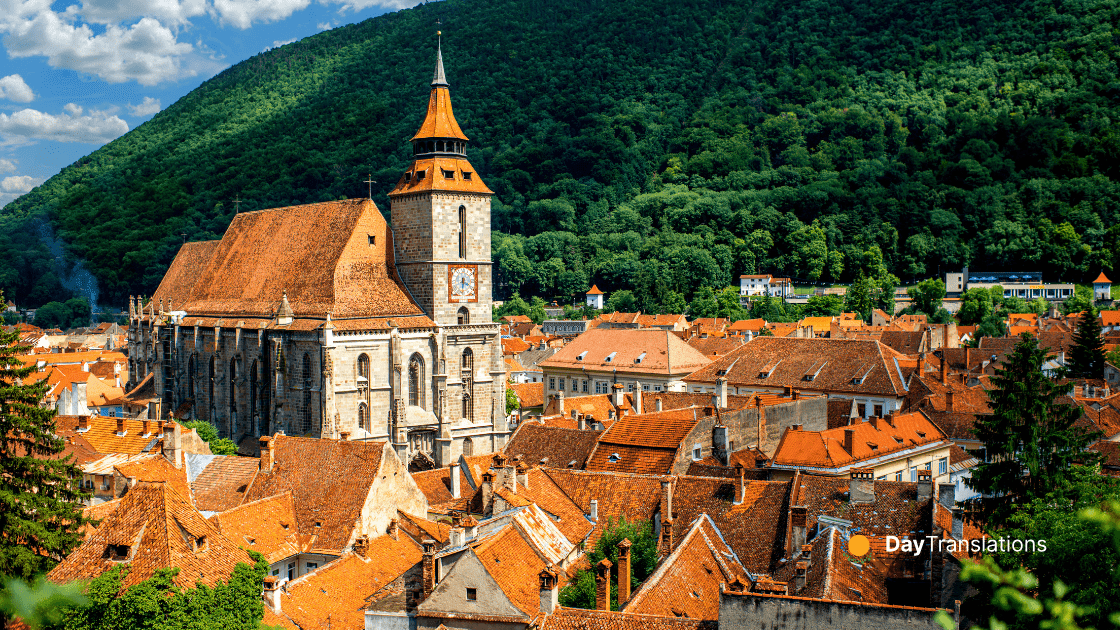
Located in South-Eastern Central Europe and with an area of 238,391 km², Romania is the largest country in Southeastern Europe. It borders Hungary to the northwest, Yugoslavia to the southwest, Bulgaria to the south, the Ukraine to the southeast and north, the Republic of Moldova to the east and the Black Sea (225 km of coastline).
Romania has an excellent geographical position, at the crossroads of some great trade routes that connect the Far East with the Western Europe. Romania can ensure through the Rhine-Main-Danube Canal important connections between North and South, allowing the access to over 200 million consumers in a 1000 km radius. Major companies from all over the world have been coming to invest in Romania in the last few years and among them also private investors.
:: Background of Romania ::
The principalities of Wallachia and Moldavia – for centuries under the suzerainty of the Turkish Ottoman Empire – secured their autonomy in 1856; they united in 1859 and a few years later adopted the new name of Romania. The country gained recognition of its independence in 1878. It joined the Allied Powers in World War I and acquired new territories – most notably Transylvania – following the conflict. In 1940, Romania allied with the Axis powers and participated in the 1941 German invasion of the USSR. Three years later, overrun by the Soviets, Romania signed an armistice. The post-war Soviet occupation led to the formation of a Communist “people’s republic” in 1947 and the abdication of the king. The decades-long rule of dictator Nicolae CEAUSESCU, who took power in 1965, and his Securitate police state became increasingly oppressive and draconian through the 1980s. CEAUSESCU was overthrown and executed in late 1989. Former Communists dominated the government until 1996 when they were swept from power. Romania joined NATO in 2004 and the EU in 2007.
In this Country Profile
:: Geography of Romania ::
Location: Southeastern Europe, bordering the Black Sea, between Bulgaria and Ukraine.
Geographic coordinates: 46 00 N, 25 00 E
Area:
total: 237,500 sq km
land: 230,340 sq km
water: 7,160 sq km
Area – comparative: slightly smaller than Oregon
Land boundaries:
total: 2,508 km
border countries: Bulgaria 608 km, Hungary 443 km, Moldova 450 km, Serbia 476 km, Ukraine (north) 362 km, Ukraine (east) 169 km.
Maritime claims:
territorial sea: 12 nm
contiguous zone: 24 nm
exclusive economic zone: 200 nm
continental shelf: 200-m depth or to the depth of exploitation.
Climate: temperate; cold, cloudy winters with frequent snow and fog; sunny summers with frequent showers and thunderstorms.
Terrain: central Transylvanian Basin is separated from the Plain of Moldavia on the east by the Carpathian Mountains and separated from the Walachian Plain on the south by the Transylvanian Alps.
Elevation extremes: lowest point: Black Sea 0 m; highest point: Moldoveanu 2,544 m.
Natural resources: petroleum (reserves declining), timber, natural gas, coal, iron ore, salt, arable land, hydropower.
Land use:
arable land: 39.49%
permanent crops: 1.92%
other: 58.59% (2005)
Natural hazards: earthquakes, most severe in south and southwest; geologic structure and climate promote landslides.
Environment – current issues: soil erosion and degradation; water pollution; air pollution in south from industrial effluents; contamination of Danube delta wetlands.
Environment – international agreements: party to: Air Pollution, Air Pollution-Persistent Organic Pollutants, Antarctic-Environmental Protocol, Antarctic Treaty, Biodiversity, Climate Change, Climate Change-Kyoto Protocol, Desertification, Endangered Species, Environmental Modification, Hazardous Wastes, Law of the Sea, Ozone Layer Protection, Ship Pollution, Wetlands. Signed, but not ratified: none of the selected agreements.
:: People of Romania ::
Population: 22,246,862 (July 2008 est.)
Age structure:
0-14 years: 15.6% (male 1,778,864/female 1,687,659)
15-64 years: 69.7% (male 7,718,125/female 7,791,102)
65 years and over: 14.7% (male 1,337,915/female 1,933,197) (2008 est.)
Median age:
total: 37.3 years
male: 35.9 years
female: 38.7 years (2008 est.)
Population growth rate: -0.136% (2008 est.)
Birth rate: 10.61 births/1,000 population (2008 est.)
Death rate: 11.84 deaths/1,000 population (2008 est.)
Net migration rate : -0.13 migrant(s)/1,000 population (2008 est.)
Sex ratio:
at birth: 1.06 male(s)/female
under 15 years: 1.05 male(s)/female
15-64 years: 0.99 male(s)/female
65 years and over: 0.69 male(s)/female
total population: 0.95 male(s)/female (2008 est.)
Infant mortality rate:
total: 23.73 deaths/1,000 live births
male: 26.81 deaths/1,000 live births
female: 20.46 deaths/1,000 live births (2008 est.)
Life expectancy at birth:
total population: 72.18 years
male: 68.69 years
female: 75.89 years (2008 est.)
Total fertility rate: 1.38 children born/woman (2008 est.)
HIV/AIDS – adult prévalence rate: less than 0.1% (2001 est.)
HIV/AIDS – people living with HIV/AIDS: 6,500 (2001 est.)
HIV/AIDS – deaths: 350 (2001 est.)
Nationality: noun: Romanian(s), adjective: Romanian.
Ethnic groups: Romanian 89.5%, Hungarian 6.6%, Roma 2.5%, Ukrainian 0.3%, German 0.3%, Russian 0.2%, Turkish 0.2%, other 0.4%
Religions: Eastern Orthodox (including all sub-denominations) 86.8%, Protestant (various denominations including Reformate and Pentecostal) 7.5%, Roman Catholic 4.7%, other (mostly Muslim) and unspecified 0.9%, none 0.1% (2002 census).
Languages: Romanian 91% (official), Hungarian 6.7%, Romany (Gypsy) 1.1%, other 1.2%
Literacy:
definition: age 15 and over can read and write.
total population: 97.3%
male: 98.4%
female: 96.3% (2002 census
Geography of Romania: Important Geographical Information about Romania
In this Country Profile
Situated in the northeastern side of the Balkan Peninsula, Romania is located halfway between the equator and the North Pole and equidistant from the westernmost point of Europe: the Atlantic Coast, and the most easterly: the Ural Mountains.
The backbone of Romania is formed by the Carpathian Mountains, which swing southeastward and then westward through the country. The spectacular alpine view, the diversity and configuration of the vegetation, the different types of relief particularities glacial, karstic, riverine, structural-lithological, the alternation of mountainous and depressions units, the gorges and fabulous valleys make the Romanian Carpathians a spectacular open-air museum. It remains one of the last undisturbed places in all Europe.
Romania’s Carpathians are differentiated into three ranges: the Eastern Carpathians, the Southern Carpathians or Transylvanian Alps, and the Western Carpathians. The offer spectacular views and hikes on a glacier carved landscape. The magnificent Southern Carpathians , rising in places the highest peak at 2,500 m (Moldoveanu Peak 2,544m and Negoiu 2,535 m), have more than 150 glacial lakes.
The Eastern Carpathians are covered with forests. 32% of Romania’s woodlands are there. The Western Carpathians are the lowest of the three ranges and are fragmented by many deep structural depressions.
The Danube travels 1,075 km (almost 40% of its entire length) through or along Romanian territory, running westward between the Transylvanian Alps and the Bihor Mountains. The most important rivers are: the Mures River, the Olt River, the Prut, the Siret River. Romania has approximately 2,300 lakes.
Professional Translation Organizations & Associations in Romania
In this Country Profile
Below is a list of the major translation organizations and associations of Romania.
:: List of Organizations ::
Asociatia Traducatorilor din Romania
Asociaþia Românã a Tinerilor Traducãtori
Association of Romanian Translation Companies
Babes-Bolyai University, Faculty of Letters, Foreign Applied Languages
Romanian Ministry of Culture – Central Commission for Granting Translator Certificates
Romanian Ministry of Justice
Spiru-Haret University, Department of Foreign Languages
Transylvania University Brasov, Foreign Applied Languages
Universitatea “Al. I. Cuza” – Iasi – Facultatea de Litere
Universitatea Lucian Blaga Sibiu – Limbi Moderne Aplicate
Universitatea Petre Andrei
University of Bucharest, Section of Translation, Interpretation and Terminology
University of Craiova
Information about the Romanian Flag: Colors and Meaning of the Flag of Romania
In this Country Profile
:: Meaning of the Romanian Flag ::
The Romanian Tricolor consists of three equal vertical bands of blue (hoist side), yellow and red. The current Romanian flag was adopted on December 27, 1989. The shape and flag ratio of the Romanian flag is described as 2:3 ( length 1½ times the height).
Michael the Brave reunited all 3 Romanian provinces: Wallachia, Transylvania and Moldavia in 1600. Therefore, there were united also the colors of the individual flags of the above mentioned provinces: red, yellow and blue. According to Ancient and Heraldic traditions much symbolism is associated with colors:
– Blue is the symbol of vigilance, truth, perseverance & justice
– Yellow stands for generosity
– Red represents strength, valor, the blood split in the Revolution for liberty.
:: Meaning of the Romanian Coat of Arms ::
The Romanian Coat of Arms was adopted on 10 September 1992 and it consists of the three colors: red, yellow, and blue, which represent the colors of the National Flag. As a central element it shows a golden eagle holding a cross in its beak. The eagle holds in its talons the insignia of sovereignty: a scepter and a saber. The four quarters represent the symbols of the historical Romanian provinces (Wallachia, Moldavia, Transylvania, Banat and Crisana) as well as two dolphins reminding of the country’s Black Sea
Extensive List of Languages of Romania: Spoken and Extinct Languages
In this Country Profile
:: List of Languages ::
Bulgarian [bul] 6,747 in Romania (2002 census). Romanian Banat. The Palityan dialect is also in Bulgaria and Hungary. Dialects: Palityan (Palitiani, Bogomil). Classification: Indo-European, Slavic, South, Eastern.
Crimean Turkish [crh] 21,482 in Romania (2002 census). Eastern Romania. Alternate names: Crimean Tatar. Dialects: Northern Crimean (Crimean Nogai, Steppe Crimean), Central Crimean, Southern Crimean. Classification: Altaic, Turkic, Southern.
Gagauz [gag] Alternate names: Gagauzi. Dialects: Bulgar Gagauz, Maritime Gagauz. Classification: Altaic, Turkic, Southern, Turkish.
German, Standard [deu] 45,129 in Romania (2002 census). Transylvania. Dialects: Transylvania. Classification: Indo-European, Germanic, West, High German, German, Middle German, East Middle German.
Greek [ell] 4,146 in Romania (2002 census). Classification: Indo-European, Greek, Attic.
Hungarian [hun] 1,447,544 in Romania (2002 census). Trans-Carpathian provinces. Alternate names: Magyar. Classification: Uralic, Finno-Ugric, Ugric, Hungarian.
Polish [pol] 2,755 in Romania (2002 census). Alternate names: Polski. Classification: Indo-European, Slavic, West, Lechitic.
Romani, Balkan [rmn] Black sea region. Dialects: Ursári (Usari). Classification: Indo-European, Indo-Iranian, Indo-Aryan, Central zone, Romani, Balkan.
Romani, Carpathian [rmc] One dialect is in Transylvania. Dialects: Galician, Transylvanian. Classification: Indo-European, Indo-Iranian, Indo-Aryan, Central zone, Romani, Northern.
Romani, Vlax [rmy] 241,617 in Romania (2002 census). 6,000,000 to 11,000,000 all Gypsies in the world (1987 Ian Hancock). Population total all countries: 1,497,846. Also spoken in Albania, Argentina, Bosnia and Herzegovina, Brazil, Bulgaria, Canada, Chile, Colombia, France, Germany, Greece, Hungary, Italy, Mexico, Moldova, Netherlands, Norway, Poland, Portugal, Russia (Europe), Slovakia, Spain, Sweden, Ukraine, United Kingdom, USA. Alternate names: Gypsy, Tsigene, Romanese, Vlax Romany, Danubian. Dialects: Sedentary Romania, Kalderash (Kelderashícko, Coppersmith), Ukraine-Moldavia, Eastern, Churari (Churarícko, Sievemakers), Lovari (Lovarícko), Machvano (Machvanmcko), North Albanian, South Albanian, Serbo-Bosnian, Zagundzi, Sedentary Bulgaria, Ghagar, Grekurja (Greco). Vlax developed from the Romani spoken when they were slaves in Romania for 500 years. There were migrations out of Romania from the mid-14th to mid-19th centuries. Those who left earlier have less Romanian influence in their dialects. Kalderash, Ursari, Churari are occupational ethnonyms; Machvano is a geographical one. Other names are Argintari ‘silversmith’ and Lingurari ‘spoonmakers’. Machvano and Serbian Kalderash have a south Slavic superstratum; Russian Kalderash is influenced by east Slavic, mainly Russian; Lovari is influenced by Hungarian; Grekurja is probably Turkish influenced and is distinct from the Greek Romani dialect of Balkan Romani. All 20 or more Vlax dialects are inherently intelligible; the differences are mainly lexical and sociolinguistic (I. Hancock). Classification: Indo-European, Indo-Iranian, Indo-Aryan, Central zone, Romani, Vlax.
Romanian [ron] 19,741,356 in Romania (2002 census). Population total all countries: 23,498,367. Moldavian is in Moldova to the northeast, and Muntenian in Muntenia, or Wallachia in the southeast, other dialects in the north and west, including much of Transylvania. Also spoken in Australia, Azerbaijan, Canada, Finland, Hungary, Israel, Kazakhstan, Kyrgyzstan, Moldova, Russia (Europe), Serbia and Montenegro, Tajikistan, Turkmenistan, Ukraine, USA, Uzbekistan. Alternate names: Rumanian, Moldavian, Daco-Rumanian. Dialects: Moldavian, Muntenian (Walachian), Transylvanian, Banat, Bayash. Little dialect variation. The Bayash are Gypsies who speak a dialect based on Banat, but influenced by Romani and Hungarian. Romanian has 77% lexical similarity with Italian, 75% with French, 74% with Sardinian, 73% with Catalan, 72% with Portuguese and Rheto-Romance, 71% with Spanish. Classification: Indo-European, Italic, Romance, Eastern.
Romanian Sign Language [rms] Classification: Deaf sign language.
Romanian, Macedo [rup] 28,000 in Romania (official). Southeastern Romania, especially Dobrudja (75%), but also in major cities such as Bucharest and Constanta, and other places. Alternate names: Aromanian. Classification: Indo-European, Italic, Romance, Eastern.
Serbian [srp] 27,001 in Romania (2002 census). Classification: Indo-European, Slavic, South, Western.
Turkish [tur] 28,714 in Romania (2002 census). Along the Danube in southeast Romania. Alternate names: Osmanli. Dialects: Danubian. Classification: Altaic, Turkic, Southern, Turkish.
:: Reference ::
Gordon, Raymond G., Jr. (ed.), 2005. Ethnologue: Languages of the World, Fifteenth edition. Dallas, Tex.: SIL International. Online version: http://www.ethnologue.com/
Famous Romanian People: Romanian Artists, Scientists, Leaders, Musicians, Politicians and Athletes
In this Country Profile
Daring dreamers are great achievers! This category of Romanian daring dreamers changed the past, shaped the modern world and build the future!
:: List of Famous People from Romania ::
Henri Coanda
Henri Coanda was a prominent Romanian inventor, aerodynamics pioneer, parent of the modern jet aircraft. He was the builder of the world’s first jet powered aircraft, the Coanda-1910. Another most known, studied, and applied discovery of Henri Coanda is the ‘Coanda Effect’. This effect has been utilized in many aeronautical inventions and is crucial to successful supersonic flight.
H. Coanda was honored in New York, 1958 as the inventor of the first jet aeroplane: one speaker lauded him as “the past, present and the future of aviation.” He received in 1965 at the International Automation Symposium the Harry Diamond Laboratories Award. Furthermore, Coanda was awarded also by UNESCO for his scientific research.
Maia Morgenstern
Is a a symbol of Romanian theater and film. She reached international stardom with the role of Mary, the mother of Jesus, in Mel Gibson’s The Passion of the Christ. She has been nationally known since her 1992 role as Nela in Balanta, a film known in the United States as The Oak, set during the waning days of Communist Romania.
Maia Morgenstern was honored in 2004 with the Best Film Actress Award for The Passion of the Christ at the Ethnic Multicultural Media Awards, UK and with the European Film Award in 1993 for the performance as Best Actress for Balanta (1992).
Constantin Brancusi
Constantin Brancusi was an internationally renowned Romanian sculptor, a central figure of the modern movement and a pioneer of abstraction. His sculptures blend simplicity and sophistication, are noted for its visual elegance and sensitive use of materials. Brancusi worked on several ambitious public sculpture projects, an unrealized temple in India for the Maharajah of Indore and the installation at Tirgu Jiu, Romania, of his Gate of the Kiss, Table of Silence and a 100-foot tall cast iron version of Endless Column. His works can be seen also at Guggenheim Museum. On his death Brancusi left the contents of his studio to the Museum of Art of the City of Paris. Some of his works worth more than 20 million Euros/work.
Nadia Comaneci
Nadia embodies the determination and fight-to-the-end spirit! She is a Romanian gymnast, the first gymnast to be awarded a perfect score of 10 in an Olympic gymnastic event. By the time the 1976 Olympics ended, Nadia had earned seven perfect tens, three gold medals, one bronze and one silver. She was inducted into the International Gymnastics Hall of Fame in 1996. Moreover, Nadia Comaneci was honored by ABC News and Ladies Home Journal as one of the 100 Most Important Women of the 20th Century.
Anca Parghel
One of Romania’s greatest voices, Anca Parghel Anca is a musical powerhouse who released so far 17 albums. She is a not only a stunning jazz vocalist but also a pianist, composer, arranger, band leader and a bel canto & vocal jazz professor. Anca Parghel taught at the Royal Conservatory in Bruxelles and participated in numerous international jazz festivals, sharing the stage with top musicians such as Jon Hendricks Band, Johnny Raducanu, Mircea Tiberian, Garbis Dedeian, Billy Hart, Archie Shepp, Larry Coryell, Jean-Louis Rassinfosse, Phillipp Catherine, Marc Levine, Claudio Roditi, Thomas Stanko, Ricardo Del Fra, Stephane Galland, or Klaus Ignatzek.
Gheorghe Zamfir
Gheorghe Zamfir is one of the famous artists throughout the world. He is an outstanding Romanian pan flute musician who has received throughout his 50-year-long career 120 golden and platinum disc awards and sold over 60 million albums . He is widely known as “Zamfir, Master of the Pan Flute”.
His music has also been heard on the soundtracks of many Hollywood movies. He was asked by Ennio Morricone to perform the pieces “Childhood Memories” and “Cockeye’s Song” for the soundtrack of Sergio Leone’s classic 1984 gangster film Once Upon A Time In America, his music is heard throughout the 1984 film The Karate Kid, and his song “The Lonely Shepherd”, penned by James Last and recorded with the James Last Orchestra, is featured in Quentin Tarantino’s film Kill Bill Vol. 1.
George Enescu
“… I used my skills to love music and try to create it. If the number of my works is relatively small, this is because I wanted to give, I say it without pride, the best of myself. I have published only what I thought that was almost finished.”
Enescu was a prominent Romanian composer, violinist, pianist, conductor and teacher, one of the greatest musicians of the 20th century, and one of the best performers of his time. He became best known in America as a conductor. He was considered as a successor to Toscanini in New York. Enescu reached fame in Europe as one of the greatest violinists of the century.
George Emil Palade
Palade was a highly regarded Romanian cell biologist. In 1974 George Palade received the Nobel Price for his magnificent work in medicine. Nobel Prize in Physiology or Medicine with Albert Claude and Christian de Duve, for discovering the vacuole.
Dr. Palade also received the U.S. National Medal of Science in Biological Sciences for “pioneering discoveries of a host of fundamental, highly organized structures in living cells…”
Michael Cretu
Michael Cretu (known also Curly M.C.) is the man behind the world famous Enigma project, project which is widely regarded as one of the most interesting music projects. His genius created a phenomenon that has sold millions of records worldwide. Cretu created a music which is famous for it’s unique, mysterious style and sound. Enigma is a gorgeous, almost hallucinatory, or better, the ultimate music experience!
Aurel Vlaicu
Was a Romanian aviation pioneer, engineer, inventor, airplane constructor and early pilot. He built his first airplane Vlaicu I., an airplane which was extremely well build, stabile and very maneuverable. He won several prizes in international contest abroad from that time like Rolland Garos. In 1911 Aurel Vlaicu built his second plane “Vlaicu II” and wins 2 memorable prizes at Aspern, Austria.
Vlad the Impaler, Count Dracula
Vlad III, was a Wallachian voivode, born in today’s Transylvania. Vlad the Impaler is known for the exceedingly cruel punishments he imposed during his reign. Vlad Dracula ruled with a cruel hand. Just about every crime was punishable by death. Furthermore, author Bram Stoker (1847-1912) based the title character of his 1897 novel Dracula on Vlad the Impaler and Vlad III influenced like this the vampire myth. Vlad the Impaler was not a “real” vampire, but he probably caused more rivers of blood than any other tyrant in the worldwide history. We must not forget, that Vlad III is also a symbol of fight for independence against ottomans. He tried also to reduce the economic role of the nobility and increase the rights of peasantry.
Mircea Eliade
The Romanian Mircea Eliade was a personality of international renown. He was a historian of religions, phenomenologist of religion, author of novels, novellas, short stories, noted journalist and essayist. Eliade was one of the most influential scholars of religion of the 20th century and one of the world’s foremost interpreters of religious symbolism and myth. He was for 30 years the director of the History of Religions department at the University of Chicago. His considerable influence is truly hard to quantify.
Among his works are: major scholarly works: Traité d’histoire des religions (1949; Patterns in Comparative Religion), which signalled his arrival as a major scholar of religion; Le Mythe de l’éternel retour (1949; The Myth of the Eternal Return, also translated as Cosmos and History), popular books, such as The Sacred and the Profane (1959) and many others. His most ambitious and challenging novel is Forêt interdite (1955; The Forbidden Forest), which he considered a literary masterpiece.