
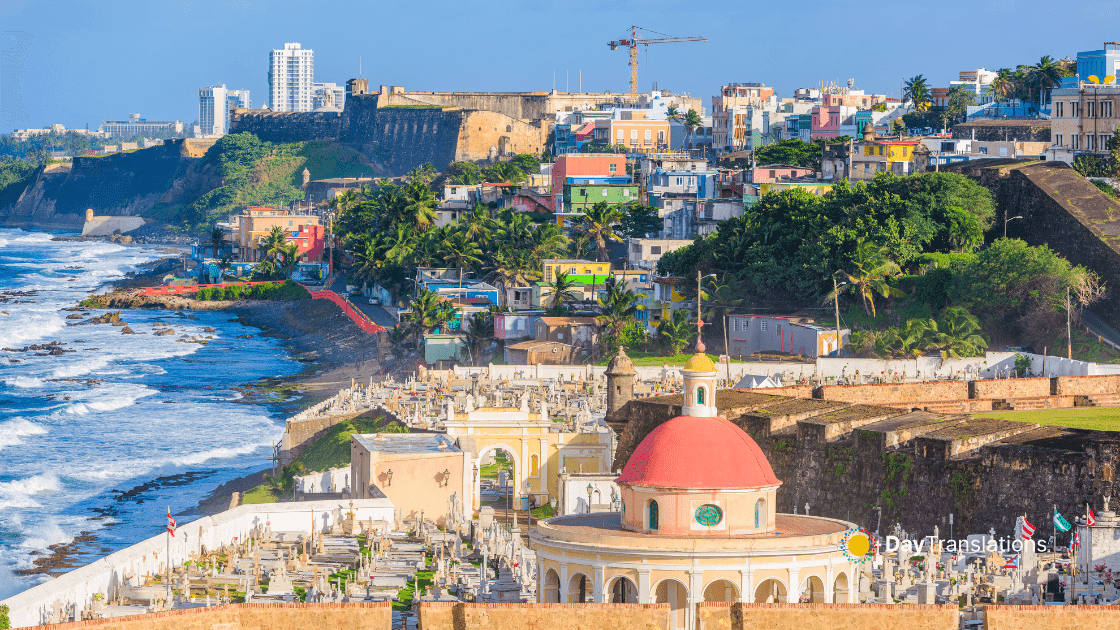
Puerto Rico is a self-governing unincorporated territory of the United States located in the northeastern Caribbean, east of the Dominican Republic and west of the Virgin Islands. The 3.950 million people that inhibit the island of Puerto Rico make it one of the most densely populated islands in the world.
The official languages are Spanish and English with Spanish being the primary language. It is also a crossroads of Hispanic and Anglo cultures.
Puerto Rico is a leader in the pharma and medical technology manufacturing sector. The economy of Puerto Rico is one of the most dynamic in the Caribbean region. Puerto Rico is still a viable investment destination for individual and corporate investors.
:: Background of Puerto Rico ::
Populated for centuries by aboriginal peoples, the island was claimed by the Spanish Crown in 1493 following COLUMBUS’ second voyage to the Americas. In 1898, after 400 years of colonial rule that saw the indigenous population nearly exterminated and African slave labor introduced, Puerto Rico was ceded to the US as a result of the Spanish-American War. Puerto Ricans were granted US citizenship in 1917. Popularly-elected governors have served since 1948. In 1952, a constitution was enacted providing for internal self government. In plebiscites held in 1967, 1993, and 1998, voters chose not to alter the existing political status.
In this Country Profile
:: Geography of Puerto Rico ::
Location: Caribbean, island between the Caribbean Sea and the North Atlantic Ocean, east of the Dominican Republic.
Geographic coordinates: 18 15 N, 66 30 W
Area:
total: 13,790 sq km
land: 8,870 sq km
water: 4,921 sq km
Area – comparative: slightly less than three times the size of Rhode Island
Land boundaries: 0 km
Coastline: 501 km
Maritime claims: territorial sea: 12 nm, exclusive economic zone: 200 nm
Climate: tropical marine, mild; little seasonal temperature variation
Terrain: mostly mountains with coastal plain belt in north; mountains precipitous to sea on west coast; sandy beaches along most coastal areas.
Elevation extremes: lowest point: Caribbean Sea 0 m, highest point: Cerro de Punta 1,339 m
Natural resources: some copper and nickel; potential for onshore and offshore oil
Land use:
arable land: 3.69%
permanent crops: 5.59%
other: 90.72% (2005)
Natural hazards: periodic droughts; hurricanes
Environment – current issues: erosion; occasional drought causing water shortages
:: People of Puerto Rico ::
Population: 3,958,128 (July 2008 est.)
Age structure:
0-14 years: 20.5% (male 415,141/female 396,782)
15-64 years: 66% (male 1,254,416/female 1,358,229)
65 years and over: 13.5% (male 229,727/female 303,833) (2008 est.)
Median age:
total: 35.6 years
male: 33.8 years
female: 37.3 years (2008 est.)
Population growth rate: 0.369% (2008 est.)
Birth rate: 12.61 births/1,000 population (2008 est.)
Death rate: 7.88 deaths/1,000 population (2008 est.)
Net migration rate: -1.03 migrant(s)/1,000 population (2008 est.)
Sex ratio:
at birth: 1.05 male(s)/female
under 15 years: 1.05 male(s)/female
15-64 years: 0.92 male(s)/female
65 years and over: 0.76 male(s)/female
total population: 0.92 male(s)/female (2008 est.)
Infant mortality rate:
total: 8.65 deaths/1,000 live births
male: 9.15 deaths/1,000 live births
female: 8.13 deaths/1,000 live births (2008 est.)
Life expectancy at birth:
total population: 78.58 years
male: 74.64 years
female: 82.73 years (2008 est.)
Total fertility rate: 1.76 children born/woman (2008 est.)
HIV/AIDS – adult prévalence rate: NA
HIV/AIDS – people living with HIV/AIDS: 7,397 (1997)
HIV/AIDS – deaths: NA
Nationality: noun: Puerto Rican(s) (US citizens) adjective: Puerto Rican
Ethnic groups: white (mostly Spanish origin) 80.5%, black 8%, Amerindian 0.4%, Asian 0.2%, mixed 4.2%, other 6.7% (2000 census)
Religions: Roman Catholic 85%, Protestant and other 15%
Languages: Spanish, English
Literacy:
definition: age 15 and over can read and write
total population: 94.1%
male: 93.9%
female: 94.4% (2002 est.)
Geography of Puerto Rico: Important Geographical Information about Puerto Rico
In this Country Profile
Puerto Rico, a territory of the United States, is the easternmost island of the Greater Antilles in the Caribbean Sea and its geography describes an archipelago located between the Caribbean Sea and the North Atlantic Ocean, east of the Dominican Republic and west of the Virgin Islands. The main island of Puerto Rico is the smallest and most eastern of the Greater Antilles. With an area of 3,515 square miles (9,104 km²), it is the third largest island in the United States and the 82nd largest island in the world. Two small islands, Culebra and Vieques lie off the east coast, and the tiny island of Mona to the west.
Puerto Rico is divided into three geographical areas:
Central Interior Mountain Ranges: This area covers most of the island of Puerto Rico. The mountainous core is formed by the Cordillera Central and the Sierra de Luquillo, continuations of the Cordillera Central on neighboring Hispaniola. This area includes the interior mountains, hills, mountain sides, and low areas within the mountains. These mountain ranges are La Cordillera Central, La Sierra de Cayey, La Sierra de Luquillo, and La Sierra Bermeja. The highest peak is the 4,398 feet Cerro La Punta.
Northern Karst: is a region of limestone hills shaped like haystacks. It covers an area in the north of the Island from the center to the western end. This area is a plateau with elevations from 100-700 ft. The northern part is made up of limestone hills while the interior is pocketed with hills, holes and caves. Many caves here have not been completely explored.
Coastal Plains: The largest cities on the island are located here, San Juan, Ponce and Mayaguez. Beaches and sand dunes are abundant on Puerto Rico’s 1,126 kilometers of coast. There are many small rivers the largest of which are Río de la Plata, Río Grande de Loíza, Rí Grande de Manatí, and Río Grande de Arecibo. Over 300 miles of coast rim the island shaded by coconut palms.
Information about the Puerto Rican Flag: Colors and Meaning of the Flag of Puerto Rico
In this Country Profile
:: Meaning of the Puerto Rican Flag ::
The flag of Puerto Rico consists of five equal horizontal bands of red (top and bottom) alternating with white; a blue isosceles triangle based on the hoist side bears a large, white, five-pointed star in the center. Puerto Rico’s official flag was adopted in 1952 (on the same day that Puerto Rico became a Commonwealth).
The Puerto Rican flag has a rich history. It was designed after the Cuban flag with the colors inverted as a sign of solidarity with Cuba. The red stripes symbolize the ‘blood’ that nourishes the government or that of brave warriors and the white stripes symbolize victory, liberty and independence. The blue triangle represents both the three sides of government and the blue waters of the ocean, while the white star symbolizes the island-country of Puerto Rico. (the sky and coastal waters of this beautiful Caribbean island).
“Many people see the red, white and blue of the Puerto Rican flag and simply assume that this is an offshoot of the American flag. Not true. The flag was created in 1895 by the Puerto Rican section of the Cuban Revolutionary Party in New York City. These Cubans and Puerto Ricans were, in fact, independentistas; that is, they wanted independence from Spain, and there was a revolution in Cuba at that very moment. Lola Rodríguez de Tío, a Puerto Rican independentista poet who also penned the words to La Borinqueña, the national anthem, in 1867, wrote that Cuba and Puerto Rico were “two wings of the same bird;” they received “flowers and bullets in the same heart.”
We know the rest of the story. Independence never came to Puerto Rico. The Spanish-American War came in 1898. The United States took the Philippines, Cuba and Puerto Rico as spoils of war. The Puerto Rican flag, since it represented the desire for independence, was outlawed for half a century.” Martin Espada.
:: Meaning of the Puerto Rican Coat of Arms ::
The coat of arms of Puerto Rico was first granted by the Spanish Crown in 1511, and is the oldest arms still used in the New World. The predominant color on the background is the green, it is known that this color was used at the beginnings of the Christian era in allusion to Saint John the Baptist, as a symbol of the grass or vegetation when he would preach in the deserted jungle of Judea. Within the background there is a white lamb on top of the Book of Revelations, holding the seven seals of The Apocalypse of Saint John the Apostle. The lamb symbolizes peace, purity, humble, integrity, and holds a white flag with a red cross. The flag means “truce”, or knowledge to stop fighting.The rim is covered by 16 symbols: 4 castles signifying the “Kingdom of Castilla”, 4 lions, representing the “Kingdom of Leon”, both, lions and castles, represents the unity of both kingdoms, 4 flags, and 4 crosses of Jerusalem are symbols of Saint John the Baptist.
The crown on top symbolizes the “Royalty” who authorized this shield. To the right, an “F” for Fernando, to the left, a “Y” for Ysabel, who were over the crown (King and Queen of the Spanish Empire) when Puerto Rico was discovered, evoke the great pioneering efforts. The quiver of arrows and yoke represent ideograms for the initials of the Catholic Kings, F and Y. The motto on the Coat of Arms is “JOANNES EST NOMEN EJUS”. It’s Latin. It means “John is his name” and is a quotation from the book of Luke in the Bible. Puerto Rico was originally called San Juan (Saint John), which today is the name of the capital city.
Extensive List of Languages of Puerto Rico: Spoken and Extinct Languages
In this Country Profile
:: List of Languages ::
English [eng] 82,000 in Puerto Rico (1995). Classification: Indo-European, Germanic, West, English
Puerto Rican Sign Language [psl] Ethnic population: 8,000 to 40,000 deaf persons (1986 Gallaudet Univ.). Alternate names: PRSL. Dialects: Related to American Sign Language. Classification: Deaf sign language
Spanish [spa] 3,437,120 in Puerto Rico (1996). Classification: Indo-European, Italic, Romance, Italo-Western, Western, Gallo-Iberian, Ibero-Romance, West Iberian, Castilian
:: Reference ::
Gordon, Raymond G., Jr. (ed.), 2005. Ethnologue: Languages of the World, Fifteenth edition. Dallas, Tex.: SIL International. Online version: http://www.ethnologue.com/
Famous Puerto Rican People: Puerto Rican Artists, Scientists, Leaders, Musicians, Politicians and Athletes
In this Country Profile
Some of these notable Puerto Ricans have dedicated their life to exploring the full breadth and depth of Puerto Rican music and contributed greatly to a worldwide phenomenon: SALSA, the most widely heard and influential form of music from „La Isla del Encanto”! Salsa has definitely made Puerto Rico famous in the world of international music. There are times when the meaning of words seem to fade away, they seem so poor, so entirely does our language fail to express the reality. Salsa is more than a music or a dance, it is the motion of intense rhythm, being in the beat and on top of things, it is the rhythm of the islands, Salsa is more than a trend, a form of entertainment it is an escape, a passion and a way to reconnect with long lost cultural roots, Salsa is LIFE!
Salsa is literally translated as “sauce” to denote music that spices and enlivens things. Hot and spicy, highly danceable, rhythmically sophisticated, and compelling, Salsa originally developed within the Puerto Rican community of New York. It draws heavily from the musical roots of the Cuban and the African-Caribbean experience.
According to Tijiana Ilich, between 1930 and 1960 there were musicians from Cuba, Puerto Rico, Mexico and South America coming to New York to perform. They brought their own native rhythms and musical forms with them, but as they listened to each other and played music together, the musical influences mixed, fused and evolved.This type of musical hybridization gave birth to the 1950s creation of the mambo from son, conjunto and jazz traditions. Continuing musical fusion went on to include what we know today as the cha cha cha, rhumba, conga and, in the 1960s, salsa.
Among the Salsa legends and pioneers are: Celia Cruz, Tito Puente, Willie Colon, Ruben Blades, El Gran Combo, Eddie Palmieri, Ray Baretto, Ismael Miranda, Pete El Conte Rodriguez, Gilberto Santa Rosa and many many others.
:: List of Famous People from Puerto Rico ::
Gilberto Santa Rosa – El Caballero de la Salsa
Gilberto Santa Rosa is known as “El Caballero de la Salsa” (the gentleman of salsa). He is a famous Puerto Rican singer of salsa, bolero, and bandleader. Gilberto Santa Rosa is considered one of the true “soneros” of his generation. In 1976 Santa Rosa made his recording debut as a backup singer with the Mario Ortiz Orchestra and soon after became the lead singer for La Grande Orchestra, followed by a stint with the Puerto Rican All-Stars in 1979. Gilberto Santa Rosa is one of the most successful vocalists in Puerto Rico. His albums have all achieved platinum status in Puerto Rico and Latin America. He is known for his exceptional interpretation of “salsa romantica” as well.
Rivera Zuleyka
Puerto Rico is famous not only for its music, but also for its natural beauties: Zuleyka is a Puerto Rican beauty queen who has held the titles Miss Puerto Rico Universe and Miss Universe 2006. Rivera was the fifth Puerto Rican to win the title, which makes the island, along with Venezuela(2008) the second most successful entity in the pageant (behind the United States).
Clemente Roberto Walker
Roberto Clemente was a professional baseball player and a Major League Baseball right fielder. Moreover, he was first Puerto Rican member of Baseball Hall of Fame. Clemente played eighteen seasons in Major League Baseball from 1955 to 1972, all with Pittsburgh. He was awarded the National League’s Most Valuable Player Award in 1966. He won twelve Gold Glove Awards and led the league in batting average four different seasons.
Jennifer Lopez
J. Lo. is an American Golden Globe-nominated actress, Grammy Award-nominated singer, record producer, dancer, fashion designer and television producer. According to Reuters, she is the richest person of Latin American descent in Hollywood according to Forbes, and the most influential Hispanic entertainer in the U.S. according to People en Español’s list of “100 Most Influential Hispanics”. Jennifer Lopez is one of the prominent Latin American performers in the world.
Tapia y Rivera, Alejandro
Tapia y Rivera is one of the most prolific authors of the nineteenth century, a Puerto Rican poet, dramaturg, essayist and writer. Tapia is considered to be the father of Puerto Rican literature and as the person who has contributed the most to the cultural advancement of Puerto Rico’s literature. Some of his outstanding works include: the novels Póstumo el transmigrado (1872), Póstumo el envirginado (1882), and Cofresí (1876); the plays Roberto D’Evreux (1856), Bernardo de Palissy, or El heroísmo del trabajo (1857), and La parte del león (1878); the poem La Sataniada (1874) and many others. In addition to his writing, Rivera was also a fervent abolitionist and a women’s rights advocate.
Oscar de la Renta
Even if Oscar de la Renta was born in the Dominican Republic, his father is of Puerto Rican origins. Oscar de la Renta is a leading fashion designer. His talent received continual international recognition. he received the CFDA Womenswear Designer of the Year Award in 2000 and in 2007 (tied with Proenza Schouler). In February 1990, he was honored with the CFDA Lifetime Achievement Award. From 1973 to 1976, and from 1986 to 1988, he served as President of the CFDA. He is also a two-time winner of the
American Fashion Critic’s Award.
“Oscar de la Renta is one of the most acclaimed, luxury fashion designer today who captures the ultimate in fashion for the modern woman. designer’s style and grace is truly represented in the distinctive, elegantdesign of the store and in his exquisite women’s ready-to-wear collection and accessories,” said Nancy A. Nasher.
Dávila Virgilio
Dávila is considered by many to be one of Puerto Rico’s greatest representatives of the modern literary era. He was a Puerto Rican poet, an educator, politician and businessman. Among his better known poems are: “Patria” (1903) “Viviendo y Amando” (1912) “Aromas del Terruño” (1916) “No des tu Tierra al Extaño”.
Dr. Beauchamp Pedro
The first Puerto Rican specialist certified by the American Reproductive Endocrinology and Infertility Board is Dr. Beauchamp Pedro. He performed the first in vitro fertilization (IVF) technique on the island in 1985. Dr. Beauchamp was responsible and is credited with delivering the first triplets born by in-vitro fertilization in the United States and the first in-vitro baby born in Argentina. His work is known as GIFT (in vitro fertilization and embryo transfer) and TET (Tubal Embryo Transfer).
Ricky Martin
Ricky Martin is a worldwide famous Puerto Rican pop singer. Ricky is one of the greatist preformers of our time, one of the world’s biggest entertainers, an extremly talented person. He won several Grammy Awards, Billboard Music Awards, MTV Awards and many others. The first and most prominent single was “Livin’ La Vida Loca,” which reached number one in many countries around the world, including the U.S., the U.K., Argentina, Australia, Brazil, France, Turkey, Greece, India, Israel, Italy, Japan, Guatemala, Mexico, Russia.
José Feliciano
José Feliciano, known to some as the “greatest living guitarist”, is a Puerto Rican singer and virtuoso guitarist, known for many international hits. When he was five years old he moved to New York and could play the concertina by six using records as his teacher. He started his musical life playing accordion until his grandfather gave him a guitar and has since won over 40 gold and platinum records, 6 out of 14 Grammy nominations, and prestigious awards all over the world. He is even a star on the Hollywood Walk of Fame. His most famous works are Light My Fire, Chico & the Man, Destiny, Ay cariño, Cuando el amor se acaba.
Ed Figueroa
is a former Major League Baseball player. Figueroa played in the majors from 1974-1981 for the California Angels, New York Yankees, Texas Rangers and Oakland Athletics. He was the first Puerto Rican to win 20 games in Major League. His best season came in 1978 with the Yankees as a starting pitcher, when he posted a won-loss record of 20-9 and helped the Yankees win the World Series.