
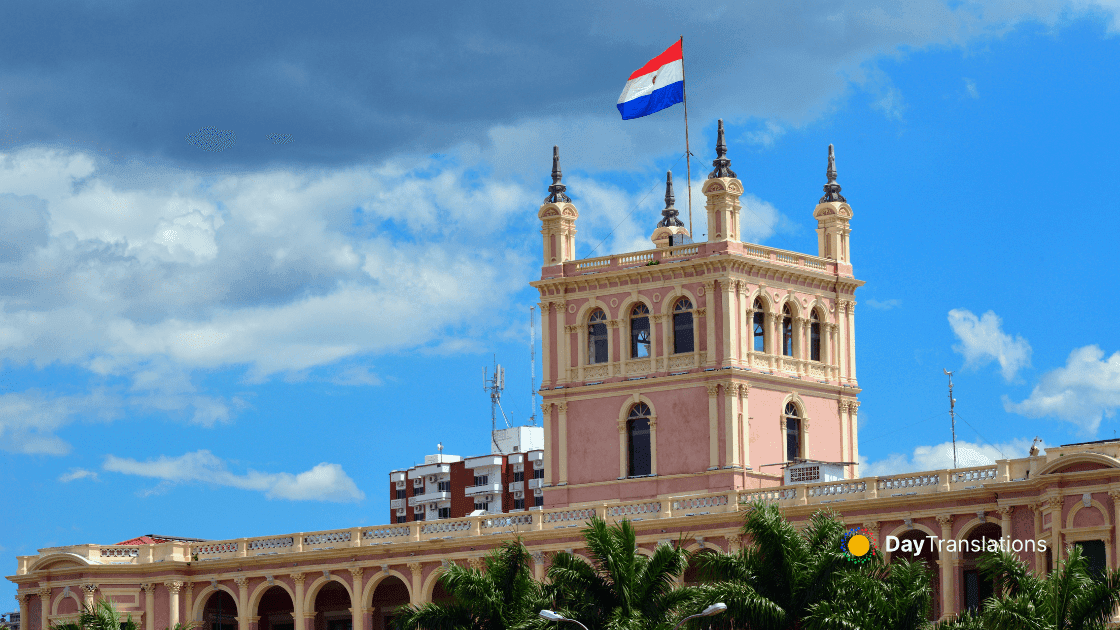
The Republic of Paraguay is a landlocked country located in South America. It is bordered by Argentina to the south and southwest, Brazil to the east and northeast, and Bolivia to the northwest. Paraguay lies on both banks of the Paraguay River, which runs through the center of the country from north to south.
Paraguay’s capital and largest city is Asunción. The official languages are Spanish and Guaraní, both being widely spoken in the country. Guarani have been living in Paraguay since prior to the arrival of Spaniards in the 16th century, when Paraguay became part of the Spanish colonial empire – Paraguay gained independence from Spain in 1811. Up to 95% of Paraguayans are mestizos, people of mixed Spanish and Native American descent. Many speak the language of the indigenous Guarani; the rest are bilingual or only speak Spanish.
With few mineral resources, Paraguay’s economy revolves around agriculture. The 1990s saw slow, steady growth, but by 2002 the economy was in serious trouble, partly because of a financial crisis in neighboring Argentina. Emergency loans – conditional on economic reforms – were negotiated with the IMF.
In this Country Profile
:: Background of Paraguay ::
Paraguay achieved its independence from Spain in 1811. In the disastrous War of the Triple Alliance (1865-70) – between Paraguay and Argentina, Brazil, and Uruguay – Paraguay lost two-thirds of all adult males and much of its territory. The country stagnated economically for the next half century. Following the Chaco War of 1932-35 with Bolivia, Paraguay gained a large part of the Chaco lowland region. The 35-year military dictatorship of Alfredo STROESSNER ended in 1989, and, despite a marked increase in political infighting in recent years, Paraguay has held relatively free and regular presidential elections since then.
:: Geography of Paraguay ::
Location: Central South America, northeast of Argentina
Geographic coordinates: 23 00 S, 58 00 W
Area:
total: 406,752 sq km
land: 397,302 sq km
water: 9,450 sq km
Area – comparative: slightly smaller than California
Land boundaries: 3,995 km
Coastline: 0 km (landlocked)
Maritime claims:
none (landlocked)
Climate: subtropical to temperate; substantial rainfall in the eastern portions, becoming semiarid in the far west
Terrain: grassy plains and wooded hills east of Rio Paraguay; Gran Chaco region west of Rio Paraguay mostly low, marshy plain near the river, and dry forest and thorny scrub elsewhere
Elevation extremes:
lowest point: junction of Rio Paraguay and Rio Parana 46 m
highest point: Cerro Pero 842 m
Natural resources: hydropower, timber, iron ore, manganese, limestone
Land use:
arable land: 7.47%
permanent crops: 0.24%
other: 92.29% (2005)
Irrigated land: 670 sq km (2003)
Total renewable water resources: 336 cu km (2000)
Freshwater withdrawal (domestic/industrial/agricultural):
total: 0.49 cu km/yr (20%/8%/71%)
per capita: 80 cu m/yr (2000)
Natural hazards: local flooding in southeast (early September to June); poorly drained plains may become boggy (early October to June)
Environment – current issues: deforestation; water pollution; inadequate means for waste disposal pose health risks for many urban residents; loss of wetlands
Environment – international agreements: party to: Biodiversity, Climate Change, Climate Change-Kyoto Protocol, Desertification,
Endangered Species, Hazardous Wastes, Law of the Sea, Ozone Layer Protection, Wetlands; signed, but not ratified: none of the selected agreements
Geography – note: landlocked; lies between Argentina, Bolivia, and Brazil; population concentrated in southern part of country
:: People of Paraguay ::
Population: 6,375,830 (July 2010 est.)
Age structure:
0-14 years: 36.7% (male 1,304,115/female 1,260,560)
15-64 years: 58.1% (male 2,043,509/female 2,023,317)
65 years and over: 5.2% (male 168,554/female 195,600) (2010 est.)
Median age:
total: 24.9 years
male: 24.7 years
female: 25.1 years (2010 est.)
Population growth rate: 1.31% (2010 est.)
Birth rate: 17.73 births/1,000 population (2010 est.)
Death rate: 4.55 deaths/1,000 population (July 2010 est.)
Net migration rate: -0.08 migrant(s)/1,000 population (2010 est.)
Urbanization:
urban population: 60% of total population (2008)
rate of urbanization: 2.8% annual rate of change (2005-10 est.)
Sex ratio:
at birth: 1.05 male(s)/female
under 15 years: 1.03 male(s)/female
15-64 years: 1.01 male(s)/female
65 years and over: 0.86 male(s)/female
total population: 1.01 male(s)/female (2010 est.)
Infant mortality rate:
total: 23.83 deaths/1,000 live births
male: 27.84 deaths/1,000 live births
female: 19.62 deaths/1,000 live births (2010 est.)
Life expectancy at birth:
total population: 75.99 years
male: 73.39 years
female: 78.71 years (2010 est.)
Total fertility rate: 2.16 children born/woman (2010 est.)
HIV/AIDS – adult prevalence rate: 0.6% (2007 est.)
HIV/AIDS – people living with HIV/AIDS: 21,000 (2007 est.)
HIV/AIDS – deaths: fewer than 1,000 (2007 est.)
Nationality: noun: Paraguayan(s) adjective: Paraguayan
Ethnic groups: mestizo (mixed Spanish and Amerindian) 95%, other 5%
Religions: Roman Catholic 89.6%, Protestant 6.2%, other Christian 1.1%, other or unspecified 1.9%, none 1.1% (2002 census)
Languages: Spanish (official), Guarani (official)
Literacy:
definition: age 15 and over can read and write
total population: 94%
male: 94.9%
female: 93% (2003 est.)
School life expectancy (primary to tertiary education):
total: 12 years
male: 12 years
female: 12 years (2007)
Education expenditures: 4% of GDP (2008)
Geography of Paraguay: Important Geographical Information about Paraguay
In this Country Profile
Paraguay is a landlocked country in South America, bordering Brazil, Argentina and Bolivia. The Paraguay River (Spanish: Río Paraguay) divides the country into strikingly different eastern and western regions. Both the Eastern region (officially called Eastern Paraguay, Paraguay Oriental, and known as the Paraneña region) and the Western region (officially Western Paraguay, Paraguay Occidental, and known as the Chaco) gently slope toward and are drained into the Paraguay River, which separates and unifies the two regions. With the Paraneña region reaching southward and the Chaco extending to the north, Paraguay straddles the Tropic of Capricorn and experiences both subtropical and tropical climates.
The Eastern region of Paraguay extends from the Río Paraguay eastward to the Río Paraná, which forms the border with Brazil and Argentina. The eastern hills and mountains, an extension of a plateau in southern Brazil, dominate the region, whose highest point is about 700 meters (2,297 ft) above sea level. The Eastern region also has spacious plains, broad valleys, and lowlands. About 80% of the region is below 300 meters (984 ft) in elevation; the lowest elevation, 55 meters (180 ft), is found in the extreme south at the confluence of the Río Paraguay and Río Paraná.
The Eastern region is drained primarily by rivers that flow westward to the Río Paraguay, although some rivers flow eastward to the Río Paraná. Low-lying meadows, subject to floods, separate the eastern mountains from the Río Paraguay.
The Eastern region as a whole naturally divides into five physiographic sub-regions: the Paraná Plateau, the Northern Upland, the Central Hill Belt, the Central Lowland, and the Ñeembucú Plain. In the east, the heavily wooded Paraná Plateau occupies one-third of the region and extends its full length from north to south and up to 145 kilometers (90 mi) westward from the Brazilian and Argentine borders. The Paraná Plateau’s western edge is defined by an escarpment that descends from an elevation of about 460 meters (1,509 ft) in the north to about 180 meters (591 ft) at the sub-region’s southern extremity. The plateau slopes moderately to east and south, its remarkably uniform surface interrupted only by the narrow valleys carved by the westward-flowing tributaries of the Río Paraná.
The Northern Upland, the Central Hill Belt, and the Central Lowland constitute the lower terrain lying between the escarpment and the Río Paraguay. The first of these eroded extensions stretching westward of the Paraná Plateau—the Northern Upland—occupies the portion northward from the Aquidabán River (Río Aquidabán) to the Apa River on the Brazilian border. For the most part it consists of a rolling plateau about 180 meters (591 ft) above sea level and 76 to 90 meters (249 to 295 ft) above the plain farther to the south. The Central Hill Belt encompasses the area in the vicinity of Asunción. Although nearly flat surfaces are not lacking in this sub-region, the rolling terrain is extremely uneven. Small, isolated peaks are numerous, and it is here that the only lakes of any size are found. Between these two upland sub-regions is the Central Lowland, an area of low elevation and relief, sloping gently upward from the Río Paraguay toward the Paraná Plateau. The valleys of the Central Lowland’s westward-flowing rivers are broad and shallow, and periodic flooding of their courses creates seasonal swamps. This sub-region’s most conspicuous features are its flat-topped hills, which project 6–9 meters (19.7–29.5 ft) from the grassy plain. Thickly forested, these hills cover areas ranging from a hectare to several square kilometers (acres to square miles). Apparently the weathered remnants of rock related to geological formations farther to the east, these hills are called “islas de monte” (mountain islands), and their margins are known as “costas” (coasts).
The remaining sub-region—the Ñeembucú Plain—is in the southwest corner of the Paraneña region. This alluvial flatland has a slight westerly-southwesterly slope obscured by gentle undulations. The Tebicuary River (Río Tebicuary)—a major tributary of the Río Paraguay — bisects the swampy lowland, which is broken in its central portion by rounded swells of land up to three meters in height. The main orographic features of the Paraneña region include the Cordillera de Amambay, the Cordillera de Mbaracayú, and the Cordillera de Caaguazú. The Cordillera de Amambay extends from the northeast corner of the region south and slightly east along the Brazilian border. The average height of the mountains is 400 meters (1,312 ft) above sea level, although the highest point reaches 700 meters (2,297 ft). The main chain is 200 kilometers (124 mi) long and has smaller branches that extend to the west and die out along the banks of the Río Paraguay in the Northern Upland.
The Cordillera de Amambay merges with the Cordillera de Mbaracayú, which reaches eastward 120 kilometers (75 mi) to the Río Paraná. The average height of this mountain chain is 200 meters (656 ft); the highest point of the chain, 500 meters (1,640 ft), is within Brazilian territory. The Río Paraná forms the Salto del Guairá waterfall where it cuts through the mountains of the Cordillera de Mbaracayú to enter Argentinian territory.The Cordillera de Caaguazú rises where the other two main mountain ranges meet and extends south, with an average height of 400 meters (1,312 ft). Its highest point is Cerro de San Joaquín, which reaches 500 meters (1,640 ft) above sea level. This chain is not a continuous massif but is interrupted by hills and undulations covered with forests and meadows. The Cordillera de Caaguazú reaches westward from the Paraná Plateau into the Central Hill Belt.
A lesser mountain chain, the Serranía de Mbaracayú, also rises at the point where the Cordillera de Amambay and Cordillera de Mbaracayú meet. The Serranía de Mbaracayú extends east and then south to parallel the Río Paraná; the mountain chain has an average height of 500 meters (1,640 ft).
Separated from the Eastern region by the Paraguay River, the Chaco region is a vast plain with elevations reaching no higher than 300 m (984 ft) and averaging 125 m (410 ft). Covering more than 60 percent of Paraguay’s total land area, the Chaco plain gently slopes eastward to the Río Paraguay. The Paraguayan Chaco is subdivided into two parts. The Alto Chaco (Upper Chaco), also called Chaco Seco (Dry Chaco) is the western three-quarters of the region, bordering on Bolivia, while the Bajo Chaco(Lower Chaco) or Chaco Húmedo (Humid Chaco) borders on the Paraguay River. The low hills in the northwestern part of the Alto Chaco are the highest parts in the Gran Chaco. One prominent wetland of the Bajo Chaco is the Estero Patiño, which at 1,500 km2 (579 sq mi) is the largest swamp in the country.
The Paraguay Chaco’s western two-thirds belong to the semi-arid tropics with annual precipitations between 550 and 1,000 mm (21.7 and 39.4 in), vegetation being dry low scrub in the west to higher growth xerophytic (semi-arid impenetrable thorn) forest towards the east. The eastern third belongs to the semi-humid tropics with rainfall between 1,000 and 1,300 mm (39.4 and 51.2 in), vegetation being taller, tropical semi-humid forest. A belt about 50 km (31 mi) in length along the Paraguay River again has a different evergreen vegetation of wetlands and palm tree forests (Bajo Chaco).Annual evaporation is around 1,500 mm (59.1 in). There is a very pronounced dry season May to October and a wet season November to April, when the vegetation turns green and abundant.
The soils of the Chaco are very deep sedimentary soils rich in nutrients, including luvisols, cambisols, and regosols, and are in general very fertile and apt for agriculture and pasture (always presumed that responsible and sustainable techniques are applied), more so then most of the world’s semi-arid tropics.[1] Limiting factors are a lack of ground freshwater in most of the Paraguay’s Chaco, except the north and the west. The lowlands facing the Paraguay River have insufficient drainage and seasonal flooding (which again increases soil fertility) as a constraint.
Paraguay experiences a subtropical climate in the Paraneña region and a tropical climate in the Chaco. The Paraneña region has a humid climate, with abundant precipitation throughout the year and only moderate seasonal changes in temperature. During the Southern Hemisphere’s summer, which corresponds to the northern winter, the dominant influence on the climate is the warm sirocco winds blowing out of the northeast. During the winter, the dominant wind is the cold pampero from the South Atlantic, which blows across Argentina and is deflected northeastward by the Andes in the southern part of that country. Because of the lack of topographic barriers within Paraguay, these opposite prevailing winds bring about abrupt and irregular changes in the usually moderate weather. Winds are generally brisk. Velocities of 160 kilometers per hour (99 mph) have been reported in southern locations, and the town of Encarnación was once leveled by a tornado.
The Paraneña region has only two distinct seasons: summer from October to March and winter from May to August. April and September are transitional months in which temperatures are below the midsummer averages and minimums may dip below freezing. Climatically, autumn and spring do not really exist. During the mild winters, July is the coldest month, with a mean temperature of about 18 °C (64.4 °F) in Asunción and 17 °C (62.6 °F) on the Paraná Plateau. There is no significant north-south variation. The number of days with temperatures falling below freezing ranges from as few as three to as many as sixteen yearly, and with even wider variations deep in the interior. Some winters are very mild, with winds blowing constantly from the north, and little frost. During a cold winter, however, tongues of Antarctic air bring subfreezing temperatures to all areas. No part of the Paraneña region is entirely free from the possibility of frost and consequent damage to crops, and snow flurries have been reported in various locations.
Moist tropical air keeps the weather warm in the Paraneña region from October through March. In Asunción the seasonal average is about 24 °C (75.2 °F), with January—the warmest month—averaging 29 °C (84.2 °F). Villarrica has a seasonal mean temperature of 21 °C (69.8 °F) and a January mean of 27 °C (80.6 °F). During the summer, daytime temperatures reaching 38 °C (100.4 °F) are fairly common. Frequent waves of cool air from the south, however, cause weather that alternates between clear, humid conditions and storms. Skies will be almost cloudless for a week to ten days as temperature and humidity rise continually. As the soggy heat nears intolerable limits, thunderstorms preceding a cold front will blow in from the south, and temperatures will drop as much as 15 °C (27.0 °F) in a few minutes.
Rainfall in the Paraneña region is fairly evenly distributed. Although local meteorological conditions play a contributing role, rain usually falls when tropical air masses are dominant. The least rain falls in August, when averages in various parts of the region range from 200 to 100 millimeters (7.9 to 3.9 in). The two periods of maximum precipitation are March through May and October to November.
For the region as a whole, the difference between the driest and the wettest months ranges from 100 to 180 millimeters (3.9 to 7.1 in). The annual average rainfall is 1,270 millimeters (50 in), although the average on the Paraná Plateau is 250 to 380 millimeters (9.8 to 15.0 in) greater. All sub-regions may experience considerable variations from year to year. Asunción has recorded as much as 208 millimeters (8.2 in) and as little as 560 millimeters (22 in) of annual rainfall; Puerto Bertoni on the Paraná Plateau has recorded as much as 3,300 millimeters (129.9 in) and as little as 790 millimeters (31.1 in).
In contrast to the Paraneña region, the Chaco has a tropical wet-and-dry climate bordering on semi-arid. The Chaco experiences seasons that alternately flood and parch the land, yet seasonal variations in temperature are modest. Chaco temperatures are usually high, the averages dropping only slightly in winter. Even at night the air is stifling despite the usually present breezes. Rainfall is light, varying from 500 to 1,000 millimeters (19.7 to 39.4 in) per year, except in the higher land to the northwest where it is somewhat greater. Rainfall is concentrated in the summer months, and extensive areas that are deserts in winter become summer swamps.
Professional Translation Organizations & Associations in Paraguay
In this Country Profile
Below is a list of the major translation organizations and associations of Paraguay.
:: List of Universities ::
Universidad Nacional de Asunción
Universidad Nacional de Caaguazú
Universidad Nacional de Canindeyú
Universidad Nacional de Concepción
Universidad Nacional del Este
Universidad Nacional de Itapúa
Universidad Nacional de Pilar
Universidad Nacional de Villarrica
Information about the Paraguayan Flag: Colors and Meaning of the Flag of Paraguay
In this Country Profile
The national flag of Paraguay contains three equal, horizontal bands of red (top), white, and blue with an emblem centered in the white band; unusual flag in that the emblem is different on each side; the obverse (hoist side at the left) bears the national coat of arms (a yellow five-pointed star within a green wreath capped by the words REPUBLICA DEL PARAGUAY, all within two circles); the reverse (hoist side at the right) bears a circular seal of the treasury (a yellow lion below a red Cap of Liberty and the words PAZ Y JUSTICIA (Peace and Justice).
Note: the three color bands resemble those on the flag of the Netherlands; one of only three national flags that differ on their obverse and reverse sides – the others are Moldova and Saudi Arabia.
Red symbolizes bravery and patriotism, white represents integrity and peace, and blue denotes liberty and generosity.
Extensive List of Languages of Paraguay: Spoken and Extinct Languages
In this Country Profile
:: List of Languages ::
Aché [guq] 1,360 (2007). Ethnic population: 1,500. Eastern departments of Alto Paraná and Caaguazú; Chopa Pou, Cerro Moroti, Puerto Barra, Koetuvy, Ypetimi and Arroyo bandera reservations.Alternate names: Axe, “Guaiaqui” , “Guayakí” , Guayaki-Ache, “Guoyagui”. Dialects: 6 dialects. Classification: Tupi, Tupi-Guarani, Subgroup I
Ayoreo [ayo] 2,300 in Paraguay (2007 Perik). Population total all countries: 3,070. Chaco, northern Alto Paraguay departments. Also in Bolivia. Alternate names: Ayoré, Moro, Morotoco, Pyeta Yovai. Dialects: Tsiracua. Classification: Zamucoan
Chamacoco [ceg] 1,800 (2007 Perik). Northeast Chaco, east Alto Paraguay Department, Puerto Bahia Negra, Puerto Diana, Puerto Esperanza, Dos Estrellas, Fuerte Olimpo, along Paraguay River. Possibly some in Brazil. Alternate names: Ishiro, Jeywo, Yshyro. Dialects: Chamacoco Bravo (Tomaraho), Ebitoso (Ishiro). Classification: Zamucoan
Chorote, Iyo’wujwa [crq] 530 in Paraguay (2007 Perik). 480 monolinguals. Boquerón District, Santa Rosa Town; Mcal, Estigarribia, Pedro P. Pena, Campo Loa, Platanilia, Yakaquash, Filadelfia, Neuland.Alternate names: I’no’, Inkijwas, Manjuy. Dialects: Manjui, Choroti. Classification: Mataco-Guaicuru, Mataco
Emok [emo] Extinct. East Chaco, near Asunción. Alternate names: Toba, Toba-Emok. Classification:Mascoian
German, Standard [deu] 166,000 in Paraguay. 19,000 L1 speakers of Plautdietsch. Classification: Indo-European, Germanic, West, High German, German, Middle German, East Middle German
Guana [gva] 280 (2007 Perik). Boquerón, Salado River, south of Chamacoco, north of Sanapaná, Loma Plata, Machete vayre, Castilla near Rio Mosquito, Rio Apa. Alternate names: Cashquiha, Kaskihá. Dialects: Layana (Niguecactemigi), Echoaldi (Echonoana, Chararana). Similar to Sanapaná [sap]. Classification: Mascoian
Guarani [grn] A macrolanguage. Population total all countries: 4,926,984.
Guaraní, Ava [nhd] 7,000 in Paraguay (1991). Population total all countries: 11,900. East Paraguay. Also in Argentina, Brazil. Alternate names: Apytare, Ava, Chiripá, Nhandeva, Ñandeva, Tsiripá, Txiripá. Dialects: Apapocuva. Similar to Paraguayan Guaraní [gug]. Classification: Tupi, Tupi-Guarani, Subgroup I
Guaraní, Eastern Bolivian [gui] 2,530 in Paraguay (2007 Perik). Chaco. Alternate names: “Chawuncu” , “Chiriguano” , Guarayo, Guasurango. Classification: Tupi, Tupi-Guarani, Subgroup I
Guaraní, Mbyá [gun] 16,400 in Paraguay (2007 Perik). Departamentos de Caaguazú, Guairá, Caazapá, San Pedro, Concepción, Canindeyú, Itapúa, and scattered. Alternate names: Mbua, Mbyá. Classification: Tupi, Tupi-Guarani, Subgroup I
Guaraní, Paraguayan [gug] 4,650,000 in Paraguay (1995). Population total all countries: 4,850,000. Also in Argentina.Alternate names: Avañe’e. Dialects: Jopará (Yopará). One Chiripá speaker [nhd] indicated it was bilingualism rather than linguistic closeness that made Paraguayan Guaraní intelligible to him. Jopará is the colloquial form mixed with Spanish loanwords, used by 90% of the population in Asunción area. Lexical similarity: 80% with Chiriguano [gui] and 75% lexical similarity with Mbyá [gun]. Classification: Tupi, Tupi-Guarani, Subgroup I
Lengua [leg] 15,000 (2007 Perik). Chaco, Presidente Hayes Department, Boquerón. Alternate names:Enxet. Dialects: Northern Lengua (Eenthlit, Vowak, Lengua Norte), Southern Lengua (Lengua Sur). Differences between the 2 dialects reportedly mainly phonological and orthographic. Southern Lengua seminomadic. Classification: Mascoian
Maka [mca] 1,500 (2000 A. Chemhey). Ethnic population: 1,500 (2000). Southwest, Presidente Hayes Department, Qemkuket; Main village north of Asunción in Mariano Roque Alonso; Par River; a changing number in a very small reserve in Ciudad del Este 4 blocks from the bridge to Brazil; Encarnación near the airfield. Alternate names: Enimaca, Enimaga, Maca, Macá, Mak’á, Maká. Classification: Mataco-Guaicuru, Mataco
Maskoy Pidgin [mhh] Puerto Victoria. Classification: Pidgin, Mascoian based
Nivaclé [cag] 13,700 in Paraguay (1991 SIL). Population total all countries: 13,900. Chaco, Departments of Presidente Hayes and Boquerón. Also in Argentina. Alternate names: Ashlushlay, Axluslay, “Chulupe” , “Chulupí” , “Chulupie” , “Churupí” , Nivaklé. Dialects: Forest Nivaclé, River Nivaclé. Mataguayo languages in Paraguay are less similar than Mascoi languages in Paraguay (Fasold 1984). Classification: Mataco-Guaicuru, Mataco
Ñandeva [tpj] 2,270 in Paraguay (2007 Perik), decreasing. 1,000 monolinguals. Population total all countries: 2,440. Chaco: Laguna Negra, Santa Elena, San Lazaro, Pykasu, Nyu Guasu, Coloni 5, Santa Teresita, Marite, Loma. Also in Argentina, Bolivia. Alternate names: Guasurango, Guasurangue, Nandeva, Ñanagua, Tapiete, Tirumbae, Yanaigua. Dialects: Linguistically between Eastern Bolivian Guarani [gui] and Paraguayan Guaraní [gug]. Classification: Tupi, Tupi-Guarani, Guarani I
Pai Tavytera [pta] 15,000 (2007 Perik), decreasing. East, Colonia Juan Carlos. Alternate names: Ava, Pai, Tavytera. Dialects: Lexical similarity: 70% with Kaiwá [kgk] of Brazil. Classification: Tupi, Tupi-Guarani, Guarani I
Plautdietsch [pdt] 38,000 in Paraguay. 19,000 who speak Plautdietsch and Standard German as L1. Chaco and east: Filadelfia, Menno Colony, Loma Plata, Neuland. Alternate names: Low German. Classification: Indo-European, Germanic, West, Low Saxon-Low Franconian, Low Saxon
Sanapaná [sap] 6,810 (2007 Perik). 785 Sanapana, 1,085 Angaite, and 9,350 Enlit. Ethnic population: 6,814. Chaco. Sanapana north of Angaite and Lengua; Boquerón, Presidente Hayes Department, Galbán River; many at Salazar Ranch, La Patria, and Esperanza. Angaite in southeast Chaco, Presidente Hayes Department, Boquerón, San Carlos. Alternate names:Lanapsua, Quiativis, Quilyacmoc, Saapa, Sanam. Dialects: Sanapana, Angaite (Angate), Enlit (Enlhet), Covavitis (Covahloc). Lexical similarity: 85% with Northern Lengua [leg]. Classification:Mascoian
Spanish [spa] 187,000 in Paraguay (2000 WCD). Mainly Asunción, urban areas. Classification: Indo-European, Italic, Romance, Italo-Western, Western, Gallo-Iberian, Ibero-Romance, West Iberian, Castilian
Toba Qom [tob] 1,510 in Paraguay (2007 Perik). Northwest of Asunción, Franciscan mission. Alternate names: Qom, Toba-Qom. Classification: Mataco-Guaicuru, Guaicuruan
Toba-Maskoy [tmf] 1,680 (2007 Perik). East Chaco, reserve of 30,000 hectares near Puerto Victoria and Puerto Guaraní. Alternate names: Cabanatit, Machicui, Quilyilhrayrom, Toba of Paraguay. Classification:Mascoian
:: Reference ::
Gordon, Raymond G., Jr. (ed.), 2005. Ethnologue: Languages of the World, Fifteenth edition. Dallas, Tex.: SIL International. Online version: http://www.ethnologue.com/
Famous Paraguayan People: Paraguayan Artists, Scientists, Leaders, Musicians, Politicians and Athletes
In this Country Profile
Paraguay is a melting pot of cultures and ethnicities with outstanding individuals who made a difference with their remarkable achievements.
:: List of Famous People from Paraguay ::
Pedro Juan Caballero
Pedro Juan Caballero became a leading figure of Paraguayan independence. He was born in Tobatí a town located in a region called Department Cordillera, Paraguay. Even though he was six years younger than Fulgencio Yegros and twenty years younger than José Gaspar Rodríguez de Francia he played a significant role in the Revolution of Independence that occurred in the early morning hours of May 15, 1811.He was involved in the conspiracy of 1820 and committed suicide in his cell on July 13, 1821. The Paraguayan city of Pedro Juan Caballero is named after him.
Fulgencio Yegros y Franco de Torres
Fulgencio Yegros was a Paraguayan soldier and first head of state of independent Paraguay. Yegros and Pedro Juan Caballero were the main military figures in the revolution in May 1811, which led to the independence of Paraguay. Following independence, Yegros and José Gaspar Rodríguez de Francia were chosen as Consuls of the Republic following the model of the French Revolution. He founded the first military academy in independent Paraguay.
José Gaspar Rodríguez de Francia y Velasco
Dr. José Gaspar Rodríguez de Francia was the first leader of Paraguay following its independence from Spain. He ran the country with no outside interference and little outside influence from 1814 to 1840. Francia imbued Paraguay with a tradition of autocratic rule that lasted, with only a few breaks, until 1989. Nonetheless, he is still considered a national hero.
Alfredo Stroessner Matiauda
Alfredo Stroessner was a Paraguayan military officer and dictator from 1954 to 1989. His lengthy rule was the 14th longest ever by state leaders other than monarchs, with only Fidel Castro having a longer tenure among 20th century Latin American leaders. Soon after taking office, Stroessner declared a state of siege and suspended constitutional freedoms. It was renewed every 90 days for the rest of his term, and was only lifted during elections. A devoted anti-Communist, he justified this action as a necessary tool to protect the country. Paraguayans remain divided on Stroessner and his controversial legacy. Many feel a strong distaste for him, perceiving him as a corrupt, authoritarian dictator. Those who defend his legacy cite the political stability and economic progress under his rule
Luis María Argaña
Luis María Argaña was a prominent politician in Paraguay and influential member of the Colorado Party until his assassination in 1999. He served in a number of important national positions during previous administrations before running an ultimately unsuccessful bid for president in the country’s 1998 election, losing in a bitterly contested primary election against General Lino Oviedo. Due to the General’s involvement in a failed coup attempt in 1996, Oviedo was imprisoned before the 1998 general election. Oviedo’s running mate, Raúl Cubas, became the de facto candidate for the Colorado Party, but lacked the widespread support that Oviedo commanded. Luis Argaña was selected as Cubas’ running mate, the pair subsequently being elected to office by a wide margin. One of Cubas’ first actions as president was to grant Oviedo a pardon from prison, defying the Supreme Court. Shortly thereafter, the legislative branch began an investigation that would ultimately lead to impeachment proceedings against President Cubas. With Cubas’ impeachement pending, Argaña was set to succeed him as president. However, assailants ambushed the vice president’s vehicle just outside of his Asunción home on the morning of March 23, 1999, peppering the SUV with multiple rounds of gunfire before escaping. President Cubas ordered a lockdown of the country’s borders. In the wake of the killing, the subsequent riots that took place in the capital area, and his impending impeachment, Cubas resigned the presidency on March 28, fleeing the country and seeking and ultimately being granted political asylum in neighboring Brazil.
Fernando Lugo
Fernando Lugo is the current President of Paraguay and the former Roman Catholic bishop of the Diocese of San Pedro. On April 20, 2008, Lugo won the election by a margin of 10 percentage points, although far short of a majority. The Colorado Party candidate, Blanca Ovelar, acknowledged that Lugo had an unassailable lead and conceded the race that same night at about 9 p.m. local time. Two hours later, former president Nicanor Duarte acknowledged that the Colorado Party had lost an election for the first time in 61 years. Lugo became Paraguay’s second leftist president (the first being Rafael Franco, who served from 1936 to 1937), and the first to be freely elected. Also, his swearing in marked the first time in Paraguay’s history (the country gained independence in 1811) that a ruling party peacefully surrendered power to an elected member from the opposition. Lugo was sworn in as President on August 15, 2008. He said that he would not accept the presidential salary because it “belongs to more humble people” and encouraged other politicians to refuse their salaries as well.
Hugo Rodríguez Alcalá
Hugo Rodríguez Alcalá was a Paraguayan writer, essayist, poet, narrator and literature critic. Together with the poets Elvio Romero, Josefina Plá, Hérib Campos Cervera, Oscar Ferreiro and Augusto Roa Bastos, he was a part of the brilliant, unique and poetic generation of the 1940s.
Famous People from Paraguay: Famous Paraguayan Footballers/Soccer Players
In this Country Profile
The following Paraguayan athletes dedicated themselves in promoting and inspiring people about football, one of the most well-loved sports in the world.
Arsenio Erico
Arsenio Erico is considered the best Paraguayan footballer of all time. During the early 1930s, Erico was part of the Paraguayan Red Cross football team that was on tour in Argentina in order to gather funds for the Chaco War. Because of his good performances during the friendly matches in the mentioned tour, Club Atlético Independiente of Argentina signed him. He made his debut for Independiente on May 5, 1934. Erico scored 293 goals in Argentine football during his career. Although Erico never played an official game for Paraguay, he did score 56 goals in 26 unofficial matches between 1933 and 1934. Arsenio Erico had a brief career as a football coach after retiring from professional football. He managed the club where he started his career as a footballer, Nacional and also had a brief stint in Club Sol de América where he led the team to a second place finish in the 1957 Paraguayan league.
José Luis Chilavert
Paraguayan football star José Luis Chilavert played as a goalkeeper. He was a three-time IFFHS World’s Best Goalkeeper award winner. Chilavert was also known for his skills as a free kick specialist, and often took penalties. He scored 62 goals in his professional career, many of them crucial, including eight in international matches. Four of his international goals were scored during Paraguay’s qualification for the 2002 FIFA World Cup. His pioneering of this expertise in his position made him the highest scoring professional goalkeeper ever, until surpassed by Brazilian keeper Rogerio Ceni.
Roque Santa Cruz
Roque Luis Santa Cruz Cantero is a Paraguayan footballer who plays for Premier League side Blackburn Rovers as a striker on loan from Manchester City and the Paraguay national football team. Santa Cruz made a name for himself at the 1999 FIFA World Youth Championship, where he scored three goals for a surprising Paraguay team. His performance there led to a call-up to the full Paraguay national team for the Copa América at the age of 17. Santa Cruz made his senior debut at age 17 for Paraguay at Copa América leading his national team in scoring with three goals. He also scored a total of seven goals in the 2002 and 2006 World Cup qualification rounds, and appeared in the 2002 FIFA World Cup, where he scored one goal while helping his team advance to the elimination rounds. Santa Cruz was in doubt for the 2006 World Cup as he was recovering from a serious knee injury. However, he recovered in time for the start of the tournament and played all three group stage matches for Paraguay. Santa Cruz was one of Paraguay’s top scorers (three goals) in the 2010 FIFA World Cup Qualifiers.