
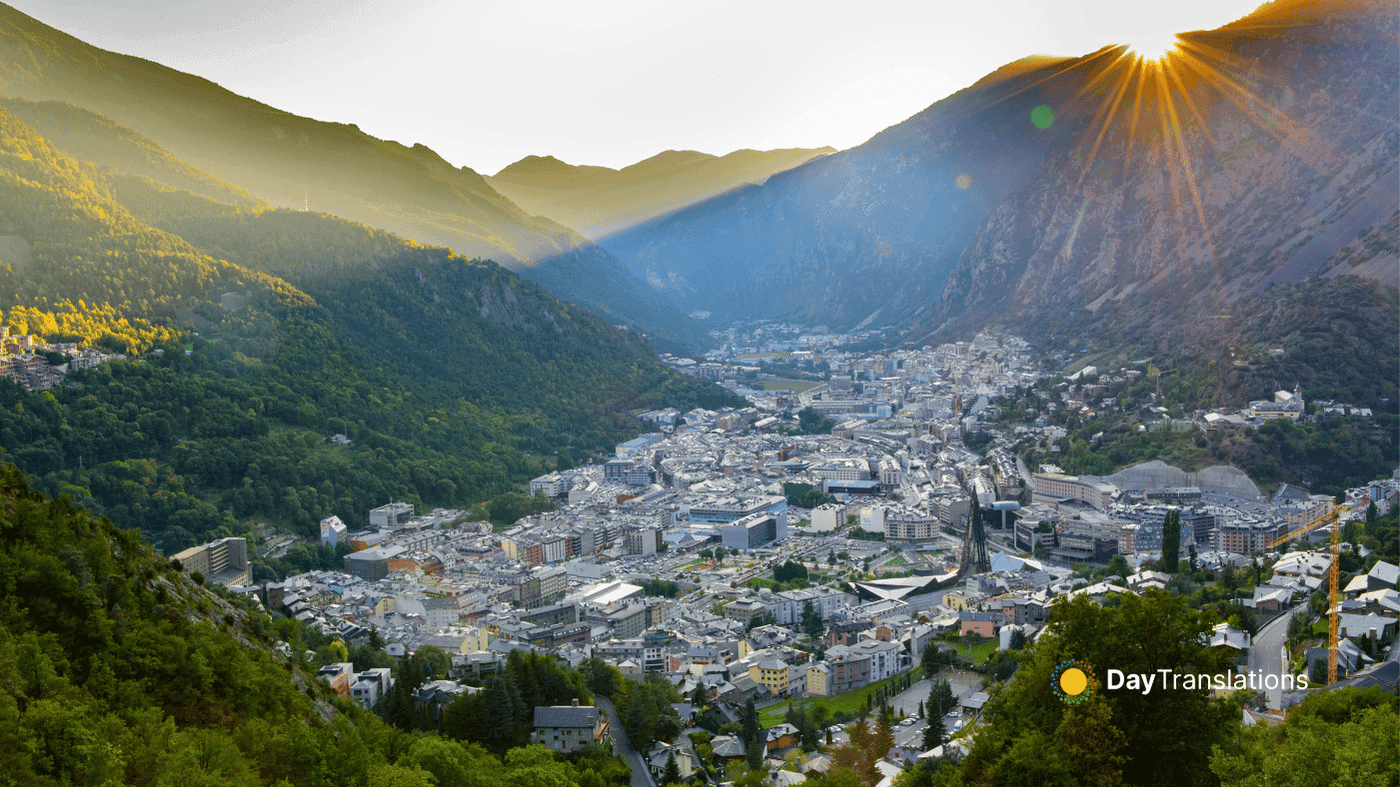
Perched in the heart of the Pyrenees range and bordering between France and Spain, Andorra is a small principality under the joint sovereignty of the leader – the king, later the President – of France and the Roman Catholic bishop of the diocese of La Seu d’Urgell in Catalonia, Spain, who are acknowledged as co-princes.
Andorra enjoys a prosperous economy thanks to the estimated 10 million tourists who visit the country every year and the increasing number of overseas investors who benefit from the lack of a direct taxation system in the country. Tourists visiting the Principality are mostly attracted by the excellent conditions for the practice of open-air sports activities, both in summer and winter, and the availability of duty-free goods. The country’s banking sector, which enjoys a partial tax haven status, also accounts for a substantial proportion of the economy. Financial institutions in Andorra are well known for their transparency and security aspects.
Since its sovereignty was established with the 1993 constitution, Andorra has become an active member of the international community, becoming a full member of many international organizations, such as the United Nations (UN), the United Nations Educational, Scientific and Cultural Organization (UNESCO), the International Telecommunications Union (ITU), and the Organization for Security and Cooperation in Europe (OSCE).
In this Country Profile
:: Background of Andorra ::
For 715 years, from 1278 to 1993, Andorrans lived under a unique co-principality, ruled by French and Spanish leaders (from 1607 onward, the French chief of state and the Spanish bishop of Seu d’Urgell). In 1993, this feudal system was modified with the titular heads of state retained, but the government transformed into a parliamentary democracy. For decades Andorra enjoyed its status as a small refuge of fiscal and banking freedom and benefitted from Spanish and French tourists attracted to the country’s duty-free shopping. The situation has changed in recent years as Andorra started to tax foreign investment and other sectors. Tourism accounts for over 80% of Andorra’s gross domestic product.
:: Geography of Andorra ::
Location: Southwestern Europe, between France and Spain
Geographic coordinates: 42 30 N, 1 30 E
Area:
total: 468 sq km
land: 468 sq km
water: 0 sq km
Area – comparative: 2.5 times the size of Washington, DC
Land boundaries: 120.3 km
Coastline: 0 km (landlocked)
Maritime claims: none (landlocked)
Climate: temperate; snowy, cold winters and warm, dry summers
Terrain: rugged mountains dissected by narrow valleys
Elevation extremes:
lowest point: Riu Runer 840 m
highest point: Pic de Coma Pedrosa 2,496 m
Natural resources: hydropower, mineral water, timber, oil, iron ore, lead
Land use:
arable land: 2.13%
permanent crops: 0%
other: 97.87% (2005)
Irrigated land: NA
Natural hazards: avalanches
Environment – current issues: deforestation; overgrazing of mountain meadows contributes to soil erosion; air pollution; wastewater treatment and solid waste disposal
Environment – international agreements: party to: Biodiversity, Desertification, Hazardous Wastes, Ozone Layer Protection; signed, but not ratified: none of the selected agreements
Geography – note: landlocked; straddles a number of important crossroads in the Pyrenees
:: People of Andorra ::
Population: 84,525 (July 2010 est.)
Age structure:
0-14 years: 15.5% (male 6,710/female 6,305)
15-64 years: 72.2% (male 31,604/female 28,925)
65 years and over: 12.3% (male 5,113/female 5,231) (2010 est.)
Median age:
total: 39.9 years
male: 40.2 years
female: 39.6 years (2010 est.)
Population growth rate: 0.382% (2010 est.)
Birth rate: 10.03 births/1,000 population (2010 est.)
Death rate: 6.21 deaths/1,000 population (July 2010 est.)
Net migration rate: 0 migrant(s)/1,000 population (2010 est.)
Urbanization:
urban population: 89% of total population (2008)
rate of urbanization: -0.2% annual rate of change (2005-10 est.)
Sex ratio:
at birth: 1.066 male(s)/female
under 15 years: 1.06 male(s)/female
15-64 years: 1.09 male(s)/female
65 years and over: 0.99 male(s)/female
total population: 1.07 male(s)/female (2010 est.)
Infant mortality rate:
total: 3.84 deaths/1,000 live births
male: 3.79 deaths/1,000 live births
female: 3.89 deaths/1,000 live births (2010 est.)
Life expectancy at birth:
total population: 82.36 years
male: 80.3 years
female: 84.55 years (2010 est.)
Total fertility rate: 1.34 children born/woman (2010 est.)
HIV/AIDS – adult prevalence rate: NA
HIV/AIDS – people living with HIV/AIDS: NA
HIV/AIDS – deaths: NA
Nationality: noun: Andorran(s) adjective: Andorran
Ethnic groups: Spanish 43%, Andorran 33%, Portuguese 11%, French 7%, other 6% (1998)
Religions: Roman Catholic (predominant)
Languages: Catalan (official), French, Castilian, Portuguese
Literacy:
definition: NA
total population: 100%
male: 100%
female: 100%
School life expectancy (primary to tertiary education):
total: 12 years
male: 11 years
female: 12 years (2008)
Education expenditures: 3.2% of GDP (2008)
Geography of Andorra: Important Geographical Information about Andorra
In this Country Profile
Even though it is not a large country, the Principality of Andorra is an important geographical crossroads within the Pyrenees mountain range, which is home to almost two hundred and seventy miles of spectacular rocks, rivers and scenery.
Andorra is a land of narrow valleys and mountain peaks that rise to heights of more than 2700 meters (approximately 8860 feet). The major stream is the Valira River, also known as La Valira, in Catalan, which flows through the Principality’s capital, Andorra la Vella, and leaves the country in the south near the road border crossing between Andorra and its southern neighbor of Spain. The land of Andorra is rich in iron and lead deposits and marble quarries; the mountains are covered by forests of pine and birch, whereas the low-lying areas have pastureland where sheep are grazed.
Andorra la Vella is the highest capital city in Europe, located at an elevation of 1023 meters or about 3356 feet. Even though the Principality has no railway system or airport, the country offers an excellent road network. Moreover, it is also worth mentioning that the Toulouse-Blagnac Airport in France is just a 3-hour drive away.
Information about the Andorran Flag: Colors and Meaning of the Flag of Andorra
In this Country Profile
:: Meaning of the Andorran Flag ::
The Andorran flag contains three vertical bands – blue, on the hoist side; yellow, in the middle; and a red band on the right side, with the national coat of arms centered in the yellow band. Although the three vertical bands may at first appear to be of equal width, the yellow band is slightly wider than the other two so that the ratio of band widths is 8:9:8. The Andorran flag resembles the flags of Chad and Romania, which do not have a national coat of arms in the center, and the flag of Moldova, which does bear a national emblem. However, unlike that of Andorra, the flags of Chad, Romania and Moldova have stripes of equal width.
The coat of arms of Andorra, which appears on the Andorran flag since 1969, features a quartered shield with the emblems of (starting in the upper left and proceeding clockwise): La Seu d’Urgell, Foix, Béarn, and Catalonia; the motto reads VIRTUS UNITA FORTIOR (United Virtue is Stronger).
The Andorran flag combines the blue and red French colors with the red and yellow of Spain, which relates to the fact that both France and Spain have historically protected the independence of the small principality.
Extensive List of Languages of Andorra: Spoken and Extinct Languages
In this Country Profile
Catalan-Valencian-Balear [cat] 31,000 in Andorra (1990). Alternate names: Bacavès, Català, Catalán. Classification: Indo-European, Italic, Romance, Italo-Western, Western, Gallo-Iberian, Ibero-Romance, East Iberian
French [fra] 2,400 in Andorra (1986). Classification: Indo-European, Italic, Romance, Italo-Western, Western, Gallo-Iberian, Gallo-Romance, Gallo-Rhaetian, Oïl, French
Spanish [spa] 24,600 in Andorra (1986). Alternate names: Castilian. Classification: Indo-European, Italic, Romance, Italo-Western, Western, Gallo-Iberian, Ibero-Romance, West Iberian, Castilian
:: Reference ::
Gordon, Raymond G., Jr. (ed.), 2005. Ethnologue: Languages of the World, Fifteenth edition. Dallas, Tex.: SIL International. Online version: http://www.ethnologue.com/
Famous Andorran People: Andorran Artists, Scientists, Leaders, Musicians, Politicians and Athletes
In this Country Profile
Given Andorra’s strategic location and political features, establishing very close links with its neighboring countries in southwestern Europe, the Pyrenean principality has traditionally attracted foreign visitors who eventually settle down and make of Andorra their new home. Apart from being the second home for outstanding individuals who became new Andorrans, the principality was also the place of birth of great people who made a difference with their remarkable achievements.
The following people made their mark on both the local and international scenes. They are just some of many famous Andorrans who have lifted Andorra’s name worldwide and made a difference in our world. Their purpose and stories inspired awe if not greatness.
:: List of Famous People from Andorra ::
Philippe Wolff
The prominent medievalist Philippe Wolff was born in Tolouse, but he lived in retirement in Andorra between 1984 and 2001, where he passed away at the age of 88. Philippe Wolff was a leading authority on economic and social history as well as the development of languages. He was a respected member of the French Academy of Inscriptions and Belles-Lettres, the Institute of Catalan Studies, the Royal Academy of Belles-Lettres of Barcelona, the Medieval Academy of America, and the Royal Historical Society of London.
Jacques Trémoulet
Jacques Trémoulet was a French radio and press tycoon who founded Radio Andorra, the first independent radio of the Principality, in 1939. Between 1940 and 1944, Radio Andorra was the only French-speaking private radio that was able to broadcast freely without any political control either from the Allies or Germany, thanks to the neutrality of Andorra during World War II. The other private radio stations owned by Trémoulet which were located in France were under control of the Vichy government regime. Radio Andorra remained independent till 1981, when its broadcasting license expired.
Hocine Haciane Constantin
Hocine Haciane is Andorra’s most famous swimmer. He was the flag bearer at the 2004 Olympic Games in Athens, Greece, and in Beijing in 2008. Hocine Haciane also won five medals during the 2009 Games of the Small States of Europe (GSSE) celebrated in Cyprus.
Cyril Despres
Three times winner of the Dakar Rally, Cyril Despres is an Andorran resident since 2000, when he moved to the Principality after the late rally racing veteran Henri Magne offered him a job and became his mentor.
Àlex Antor
The Andorran alpine skier Àlex Antor represented his country at the Winter Olympics in 2002 and 2006. Moreover, he was also chosen to be the flag bearer at the opening ceremony of the 2006 Winter Olympics in Torino. After his second Olympics, Àlex Antor left competition and started to work at the Ministry of Sports in Andorra.