
Located in the northern hemisphere, Turkey stretches across the Anatolian peninsula in western Asia and Thrace in the Balkan region of southeastern Europe. Land wise, Turkey is bordered by eight countries: Bulgaria to the northwest; Greece to the west; Georgia to the northeast; Armenia, Azerbaijan and Iran to the east; and Iraq and Syria to the southeast.
Turkey is positioned on an area where Europe meets Asia and is very close geographically to Africa. Turkey’s geographical location plays an important role in the geo-politics of Europe and Asia not just as a crucial land bridge between the two continents, but as an integral part of the prosperous Mediterranean economy, a center for trade.
:: Background of Turkey ::
Modern Turkey was founded in 1923 from the Anatolian remnants of the defeated Ottoman Empire by national hero Mustafa KEMAL, who was later honored with the title Ataturk or “Father of the Turks.” Under his authoritarian leadership, the country adopted wide-ranging social, legal, and political reforms. After a period of one-party rule, an experiment with multi-party politics led to the 1950 election victory of the opposition Democratic Party and the peaceful transfer of power. Since then, Turkish political parties have multiplied, but democracy has been fractured by periods of instability and intermittent military coups (1960, 1971, 1980), which in each case eventually resulted in a return of political power to civilians. In 1997, the military again helped engineer the ouster – popularly dubbed a “post-modern coup” – of the then Islamic-oriented government. Turkey intervened militarily on Cyprus in 1974 to prevent a Greek takeover of the island and has since acted as patron state to the “Turkish Republic of Northern Cyprus,” which only Turkey recognizes. A separatist insurgency begun in 1984 by the Kurdistan Workers’ Party (PKK) – now known as the People’s Congress of Kurdistan or Kongra-Gel (KGK) – has dominated the Turkish military’s attention and claimed more than 30,000 lives. After the capture of the group’s leader in 1999, the insurgents largely withdrew from Turkey mainly to northern Iraq. In 2004, KGK announced an end to its ceasefire and attacks attributed to the KGK increased. Turkey joined the UN in 1945 and in 1952 it became a member of NATO. In 1964, Turkey became an associate member of the European Community; over the past decade, it has undertaken many reforms to strengthen its democracy and economy enabling it to begin accession membership talks with the European Union.
In this Country Profile
:: Geography of Turkey ::
Location: Southeastern Europe and Southwestern Asia (that portion of Turkey west of the Bosporus is geographically part of Europe), bordering the Black Sea, between Bulgaria and Georgia, and bordering the Aegean Sea and the Mediterranean Sea, between Greece and Syria.
Geographic coordinates: 39 00 N, 35 00 E
Area:
total: 780,580 sq km
land: 770,760 sq km
water: 9,820 sq km
Area – comparative: slightly larger than Texas
Land boundaries:
total: 2,648 km
border countries: Armenia 268 km, Azerbaijan 9 km, Bulgaria 240 km, Georgia 252 km, Greece 206 km, Iran 499 km, Iraq 352 km, Syria 822 km
Maritime claims:
territorial sea: 6 nm in the Aegean Sea; 12 nm in Black Sea and in Mediterranean Sea
exclusive economic zone: in Black Sea only: to the maritime boundary agreed upon with the former USSR
Climate: temperate; hot, dry summers with mild, wet winters; harsher in interior
Terrain: high central plateau (Anatolia); narrow coastal plain; several mountain ranges
Elevation extremes:
lowest point: Mediterranean Sea 0 m
highest point: Mount Ararat 5,166 m
Natural resources: coal, iron ore, copper, chromium, antimony, mercury, gold, barite, borate, celestite (strontium), emery, feldspar, limestone, magnesite, marble, perlite, pumice, pyrites (sulfur), clay, arable land, hydropower
Land use:
arable land: 29.81%
permanent crops: 3.39%
other: 66.8% (2005)
Natural hazards: severe earthquakes, especially in northern Turkey, along an arc extending from the Sea of Marmara to Lake Van.
Environment – current issues: water pollution from dumping of chemicals and detergents; air pollution, particularly in urban areas; deforestation; concern for oil spills from increasing Bosporus ship traffic.
Environment – international agreements: party to: Air Pollution, Antarctic Treaty, Biodiversity, Climate Change, Desertification, Endangered Species, Hazardous Wastes, Ozone Layer Protection, Ship Pollution, Wetlands. Signed, but not ratified: Environmental Modification
:: People of Turkey ::
Population: 71,892,808 (July 2008 est.)
Age structure:
0-14 years: 24.4% (male 8,937,515/female 8,608,375)
15-64 years: 68.6% (male 25,030,793/female 24,253,312)
65 years and over: 7% (male 2,307,236/female 2,755,576) (2008 est.)
Median age:
total: 29 years
male: 28.8 years
female: 29.2 years (2008 est.)
Population growth rate: 1.013% (2008 est.)
Birth rate: 16.15 births/1,000 population (2008 est.)
Death rate: 6.02 deaths/1,000 population (2008 est.)
Net migration rate: 0 migrant(s)/1,000 population (2008 est.)
Sex ratio:
at birth: 1.05 male(s)/female
under 15 years: 1.04 male(s)/female
15-64 years: 1.03 male(s)/female
65 years and over: 0.84 male(s)/female
total population: 1.02 male(s)/female (2008 est.)
Infant mortality rate:
total: 36.98 deaths/1,000 live births
male: 40.44 deaths/1,000 live births
female: 33.34 deaths/1,000 live births (2008 est.)
Life expectancy at birth:
total population: 73.14 years
male: 70.67 years
female: 75.73 years (2008 est.)
Total fertility rate: 1.87 children born/woman (2008 est.)
HIV/AIDS – adult prévalence rate: less than 0.1%; note – no country specific models provided (2001 est.)
HIV/AIDS – people living with HIV/AIDS: NA
HIV/AIDS – deaths: NA
Nationality: noun: Turk(s) adjective: Turkish
Ethnic groups: Turkish 80%, Kurdish 20% (estimated)
Religions: Muslim 99.8% (mostly Sunni), other 0.2% (mostly Christians and Jews)
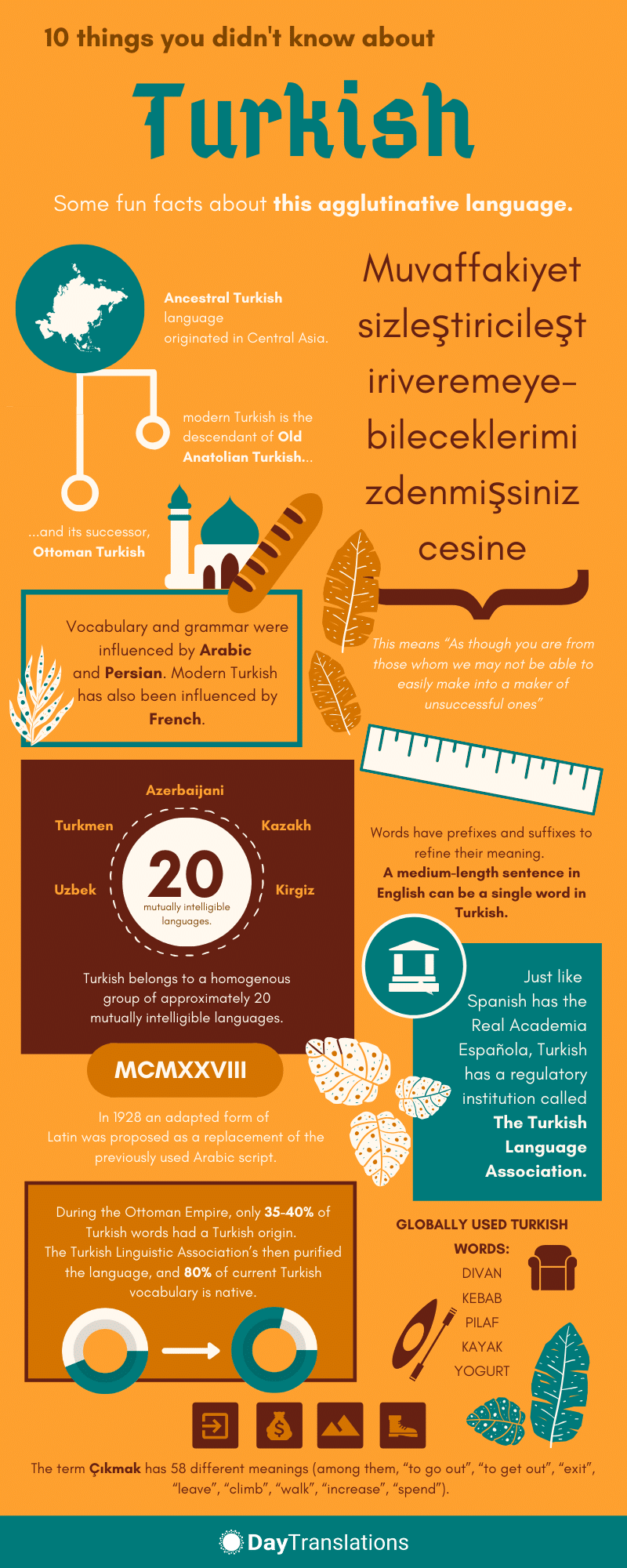
Languages: Turkish (official), Kurdish, Dimli (or Zaza), Azeri, Kabardian
note: there is also a substantial Gagauz population in the European part of Turkey
Literacy:
definition: age 15 and over can read and write
total population: 87.4%
male: 95.3%
female: 79.6% (2004 est.)
Geography of Turkey: Important Geographical Information about Turkey
In this Country Profile
One of the most interesting facts about Turkey is that the country lies on two separate continents: Europe and Asia. Turkey forms a natural bridge between the old continents of Asia, Africa and Europe. Its geography is very diverse and everything from snow topped mountains to sandy beaches can be found in Turkey. The highest peak of Turkey is the Mount Ararat in the east, on which Noah’s Ark is believed to be, and it is not far from the lake Van, the biggest lake of the country.
Geography of Eastern Turkey: Eastern Turkey is where the Pontus and Taurus Mountains converge. The climate in the east of Turkey is generally cooler than other parts of the country, because the geography is mainly mountainous. Many of the peaks are extinct volcanoes.
Geography of Black Sea Areas of Turkey: covers the area on the 1,700 km Black Sea coast which is a steep and rocky. The geography towards the Eastern part of Turkey consists of mountain ranges with elevations of 1,525 to 1,800 meters in the west and 3,000 to 4,000 meters in the east. They form an almost unbroken wall separating the coast from the interior.
Geography of Central Anatolia: is a vast plateau situated among the high mountain ranges. The land is mainly a rolling steppe with dry, hot summers and cold, damp winters. The capital city of Turkey is situated in central Anatolia. The geography of this part of Turkey is formed of high land plateaus although there are some mountain ranges and even volcanoes.
Geography of western Turkey: The Western part of Turkey is known as Marmara and contains Turkey’s largest city Istanbul, as well as a coastline on the Aegean Sea. The European side comprises of rolling plains and low hills, while the Asian side includes low hills and higher mountains.
Professional Translation Organizations & Associations in Turkey
In this Country Profile
Below is a list of the major translation organizations and associations of Turkey.
:: List of Organizations ::
Çeviri Dernegi
Bilkent University, Translation and Interpretation, Vocational Program in Translation
Birlesik Konferans Tercümanlari Dernegi
Bogazici University
Edebiyat ve Ilim Eserleri Sahipleri Meslek Birligi
Hacettepe University
Kitap Çevirmenleri Meslek Birligi
Okan University
Yildiz Teknik Üniversitesi-Fen-Edebiyat Fakültesi, Department of Translation and Interpretation
Information about the Turkish Flag: Colors and Meaning of the Flag of Turkey
In this Country Profile
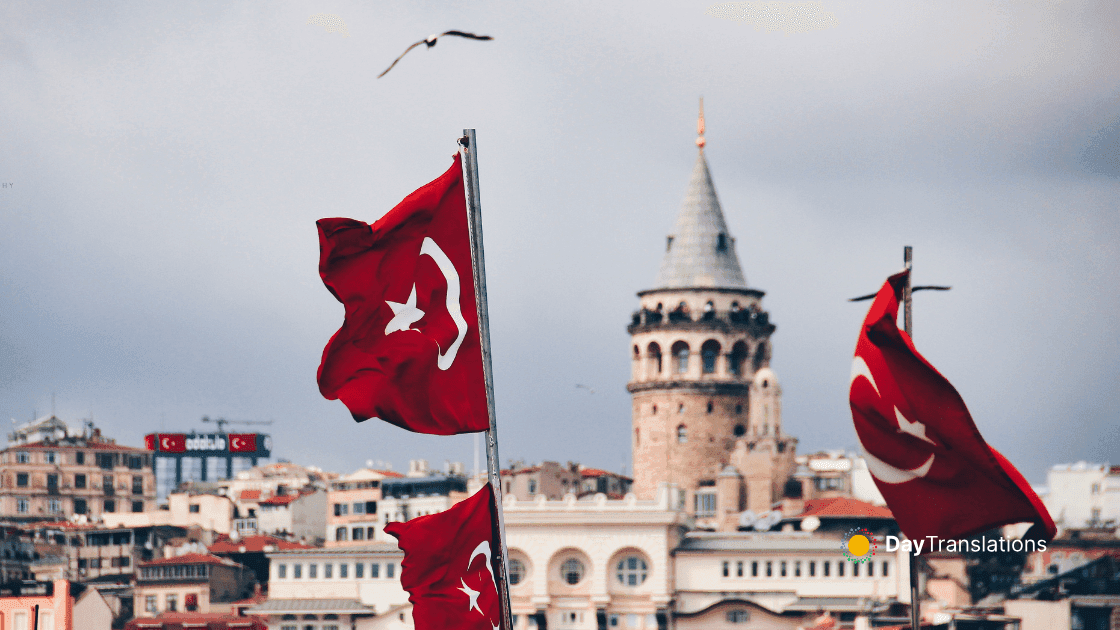
The flag of Turkey has an overall red background with a white crescent moon and a five-pointed star in its centre. The flag is called Ay Yildiz (literally, moon star) or Alsancak (red banner) in Turkish. The shape and flag ratio of the Turkish flag is described as 2:3 (length 1½ times the height).
The Turkish flag uses the same symbols of the late flag of the Ottoman Empire. The crescent and star are ancient symbols of Islam and are considered to be signs of good luck. The most accepted legend of the flag in Turkey is that in the year 1071, after the Battle of Manzikert and the defeat of the Byzantine army, the Seljuk Khan, Alp Arslan was roaming the battlefield where he saw the reflection of the crescent moon and the star on a pool of blood of Turkish warriors. After he saw this image, he decided that this would be the flag representing the Turks.
Extensive List of Languages of Turkey: Spoken and Extinct Languages
In this Country Profile
:: List of Languages ::
:: Turkey Asia: List of Languages ::
Also see Turkey in Europe for a listing of languages in Europe. Also includes Assyrian Neo-Aramaic, Avar, Chaldean Neo-Aramaic, Chechen (8,000), Dargwa, Lak (300), Lezgi (1,200), Mesopotamian Spoken Arabic (100,000), North Levantine Spoken Arabic (500,000), Northern Uzbek, Western Farsi (500,000). The number of languages listed for Turkey (Asia) is 24. Of those, 23 are living languages and 1 is extinct.
Abaza [abq] 10,000 in Turkey (1995). Alternate names: Abazin, Tapanta, Abazintsy, Ahuwa. Dialects: Tapanta, Ashkaraua (Ashkar), Bezshagh. Classification: North Caucasian, West Caucasian, Abkhaz-Abazin
Abkhaz [abk] 4,000 in Turkey (1980). Ethnic population: 39,000 in Turkey (2001 Johnstone and Mandryk). Coruh in northeast Turkey, and some in northwest. Mainly villages in Bolu and Sakarya provinces. Alternate names: Abxazo. Dialects: Bzyb, Abzhui, Samurzakan. Classification: North Caucasian, West Caucasian, Abkhaz-Abazin
Adyghe [ady] 277,900 in Turkey (2000). 6,409 monolinguals (1965 census). Ethnic population: 130,000 in Turkey (1965 census). Villages in Kayseri, Tokat, Karaman Maras, and many other provinces in central and western Anatolia. Alternate names: Adygey, Circassian, Cherkes. Classification: North Caucasian, West Caucasian, Circassian
Arabic, North Mesopotamian Spoken [ayp] 400,000 in Turkey (1992). Mardin and Siirt provinces. Alternate names: Syro-Mesopotamian Vernacular Arabic. Classification: Afro-Asiatic, Semitic, Central, South, Arabic
Azerbaijani, South [azb] 530,000 in Turkey. Kars Province. Alternate names: Azeri. Dialects: Kars. Classification: Altaic, Turkic, Southern, Azerbaijani
Crimean Turkish [crh] It is not known how many still speak it in Turkey, though there are definitely some Crimean Tatar villages, such as Karakuyu in Polatli District of Ankara Province. Alternate names: Crimean Tatar. Dialects: Northern Crimean (Crimean Nogai, Steppe Crimean), Central Crimean, Southern Crimean. Classification: Altaic, Turkic, Southern
Dimli [diq] 1,000,000 in Turkey (1999 WA). Between 1.5 and 2.5 million speakers (including all dialects) (1998 Paul). East central, mainly in Elazig, Bingol, and Diyarbakir provinces, upper courses of the Euphrates, Kizilirmaq, and Murat rivers. Also spoken in Germany. Alternate names: Dimili, Zazaki, Southern Zaza, Zaza. Dialects: Sivereki, Kori, Hazzu (Hazo), Motki (Moti), Dumbuli (Dumbeli). Several dialects. Related to Gurani group. Classification: Indo-European, Indo-Iranian, Iranian, Western, Northwestern, Zaza-Gorani
Georgian [kat] 40,000 in Turkey (1980). 4,042 monolinguals (1965 census). Ethnic population: 91,000. Villages in Artvin, Ordu, Sakarya, and other provinces of north and northwest Anatolia. Alternate names: Kartuli, Gruzin. Dialects: Imerxev. Classification: Kartvelian, Georgian
Hértevin [hrt] 1,000 (1999 H. Mutzafi). Originally Siirt Province. They have left their villages, most emigrating to the West, but some may still be in Turkey. Dialects: Hértevin Proper (Arton), Umraya, Jinet. Considerable differences from other Northeastern Aramaic varieties, and not intelligible with any or most of them. Classification: Afro-Asiatic, Semitic, Central, Aramaic, Eastern, Central, Northeastern
Kabardian [kbd] 550,000 in Turkey (2001 Johnstone and Mandryk). Most around Kayseri. 1,000 villages of Kabardian and Adyghe in Turkey. Classification: North Caucasian, West Caucasian, Circassian
Kazakh [kaz] 600 in Turkey (1982). Salihli town in Manisa Province, and an unknown number in Istanbul city; 308 in Kayseri Province; refugees from Afghanistan, now Turkish citizens. Alternate names: Kazakhi, Qazaqi, Kazax, Kosach, Kaisak. Classification: Altaic, Turkic, Western, Aralo-Caspian
Kirghiz [kir] 1,137 in Turkey (1982). Van and Kars provinces. Classification: Altaic, Turkic, Western, Aralo-Caspian
Kirmanjki [kiu] 140,000 in Turkey. Population includes 100,000 in 182 villages in Tunceli Province, 40,000 in 13 or more villages in Erzincan Province (1972). Tunceli Province, Tunceli Merkez, Hozat, Nazmiye, Pülümür, and Ovacik subprovinces; Erzincan Province, Erzincan and Cayirli subprovinces; 8 or more villages in Elazig Province, Elazig Merkez and Karakoqan subprovinces; 3 villages in Bingöl Province, Kigi and Karkiova subprovinces; 46 villages in Mush Province, Varto Subprovince; 15 or more villages in Sivas Province, Zara, Imranli, Kangal, and Divrigi subprovinces; 11 or more villages in Erzerum Province, Hinis and Tekman subprovinces; and in many major cities of Turkey. Also spoken in Austria, Denmark, France, Germany, Netherlands, Sweden, Switzerland, United Kingdom. Alternate names: Zaza, Northern Zaza, Zazaki, Alevica, Dimilki, Dersimki, So-Bê, Zonê Ma. Dialects: Tunceli, Varto. Closest to Dimli. Lexical similarity 70% with Dimli. Classification: Indo-European, Indo-Iranian, Iranian, Western, Northwestern, Zaza-Gorani
Kumyk [kum] A few villages. Alternate names: Kumuk, Kumuklar, Kumyki. Dialects: Khasav-Yurt, Buinak, Khaidak. Classification: Altaic, Turkic, Western, Ponto-Caspian
Kurdish, Northern [kmr] 3,950,000 in Turkey (1980). Population total all countries: 9,113,505. Ethnic population: 6,500,000 in Turkey (1993 Johnstone). The majority are in provinces of Hakkari, Siirt, Mardin, Agri, Diyarbakir, Bitlis, Bingol, Van, Adiyaman, and Mus. Also in Urfa, Kars, Tunceli, Malatya, Erzurum, Marash, Sivas, and other provinces. Communities in central Turkey (Cankiri, Cihanbeyli, near Konya). Many live in large cities in western Turkey (including Istanbul, Adana, Ankara, Izmir). Also spoken in Armenia, Australia, Austria, Azerbaijan, Bahrain, Belgium, Canada, Denmark, Finland, France, Georgia, Germany, Greece, Iran, Iraq, Italy, Jordan, Kazakhstan, Kuwait, Kyrgyzstan, Lebanon, Netherlands, Norway, Russia (Europe), Sweden, Switzerland, Syria, Turkmenistan, United Kingdom, USA. Alternate names: Kurmanji, Kurmancî, Kirmancî, Kermancî, Kurdi, Kurdî. Dialects: Boti (Botani), Marashi, Ashiti, Bayezidi, Hekari, Shemdinani. Differences in speaking among dialects, but all use the same written form. Classification: Indo-European, Indo-Iranian, Iranian, Western, Northwestern, Kurdish
Laz [lzz] 30,000 in Turkey (1980). Population total all countries: 33,000. Ethnic population: 92,000 in Turkey (1980). Rize in northeast, towns of Kemer, Atin, Artasen, Vitse, Arkab, Hopa, Sarp; and villages in Artvin, Sakarya, Kocaeli, and Bolu provinces. Also spoken in Belgium, France, Georgia, Germany, USA. Alternate names: Lazuri, Laze, Chan, Chanzan, Zan, Chanuri. Dialects: Officially considered to be a single language with Mingrelian, called ‘Zan’, although linguists recognize that they are not inherently intelligible with each other. Classification: Kartvelian, Zan
Osetin [oss] The Digor dialect is reported to be in Bitlis and another small town in the west. Iron dialect in cities or towns of Sarikamis and Erzerum. Also in Mugla, Kars, Antalya. May also be in Syria. Alternate names: Ossete. Dialects: Digor, Tagaur, Kurtat, Allagir, Tual, Iron. Classification: Indo-European, Indo-Iranian, Iranian, Eastern, Northeastern
Turkish [tur] 46,278,000 in Turkey (1987). Population total all countries: 50,625,794. Spoken throughout Turkey as first or second language. Also spoken in Australia, Austria, Azerbaijan, Belgium, Bosnia and Herzegovina, Bulgaria, Canada, Cyprus, Denmark, El Salvador, Finland, France, Georgia, Germany, Greece, Honduras, Iran, Iraq, Israel, Kazakhstan, Kyrgyzstan, Macedonia, Netherlands, Romania, Russia (Asia), Serbia and Montenegro, Sweden, Switzerland, Tajikistan, Ukraine, United Arab Emirates, United Kingdom, USA, Uzbekistan. Alternate names: Türkçe, Türkisch, Anatolian. Dialects: Danubian, Eskisehir, Razgrad, Dinler, Rumelian, Karamanli, Edirne, Gaziantep, Urfa. Danubian is western; other dialects are eastern. Classification: Altaic, Turkic, Southern, Turkish
Turkish Sign Language [tsm] Classification: Deaf sign language
Turkmen [tuk] 925 in Turkey (1982). Tokat Province. Alternate names: Trukhmen. Classification: Altaic, Turkic, Southern, Turkmenian
Turoyo [tru] 3,000 in Turkey (1994 Hezy Mutzafi). Population total all countries: 84,000. Ethnic population: 50,000 to 70,000 (1994). Southeastern Turkey, Mardin Province (originally). Also spoken in Argentina, Australia, Belgium, Brazil, Canada, Germany, Iraq, Lebanon, Netherlands, Sweden, Syria, USA. Alternate names: Suryoyo, Syryoyo, Turani, Süryani. Dialects: Midyat, Midin, Kfarze, `Iwardo, Anhil, Raite. Related to Northeastern Aramaic varieties. Turoyo subdialects exhibit a cleavage between Town Turoyo (Midyat Turoyo), Village Turoyo, and Mixed (Village-Town) Turoyo. The latter is spoken mainly by the younger generation outside Tur `Abdin, Turkey, the language’s original location, and is gaining ground throughout the Jacobite diaspora in other countries. Classification: Afro-Asiatic, Semitic, Central, Aramaic, Eastern, Central, Northwestern
Uyghur [uig] 500 in Turkey (1981). Kayseri city, and an unknown number in Istanbul. Possibly in Iran. Alternate names: Uighur, Uygur, Uigur. Classification: Altaic, Turkic, Eastern
Uzbek, Southern [uzs] 1,981 in Turkey (1982). Hatay, Gaziantep, and Urfa provinces. Also possibly in Germany. Classification: Altaic, Turkic, Eastern
:: Turkey Asia: Extinct Languages ::
Syriac [syc] Extinct. Turkey, Iraq, and Syria. Also spoken in Iraq. Alternate names: Classical Syriac, Ancient Syriac, Suryaya, Suryoyo, Lishana Atiga. Dialects: Western Syriac, Eastern Syriac. The Syrian churches: Eastern (Nestorian), Syrian Orthodox (Jacobite), Syrian Catholic (Melkite, Maronite) developed a vast literature based on the Edessa (currently Sanliurfa, southeastern Turkey) variety of the Syrian dialect. The Assyrian group (see Assyrian Neo-Aramaic in Iraq and elsewhere) separated denominationally from the Chaldean (see Chaldean Neo-Aramaic in Iraq) and Jacobite (see Turoyo in Turkey and Syria) in the Middle Ages. Neo-Eastern Aramaic languages spoken by Christians are often dubbed ‘Neo-Syriac’, although not directly descended from Syriac. Classification: Afro-Asiatic, Semitic, Central, Aramaic, Eastern.
:: Turkey Europe: Living Languages ::
Also see Turkey in Asia for a listing of languages in Asia. The number of languages listed for Turkey (Europe) is 12. Of those, 11 are living languages and 1 is extinct.
Albanian, Tosk [als] 15,000 in Turkey (1980). 1,075 monolinguals (1965 census). Ethnic population: 65,000 in Turkey. Scattered in western Turkey. Classification: Indo-European, Albanian, Tosk
Armenian [hye] 40,000 in Turkey (1980). 1,022 monolinguals (1965 census). Ethnic population: 70,000 in Turkey (1980). Many in Istanbul, and a few scattered across eastern Turkey. The Hemshin (Hamshen) are Armenian Muslims, living near the Laz. Alternate names: Haieren, Somkhuri, Ermenice, Armjanski. Dialects: Eastern Armenian. Classification: Indo-European, Armenian
Balkan Gagauz Turkish [bgx] 327,000 in Turkey (1993 Johnstone). Population includes 7,000 Surguch (1965) and 320,000 Yuruk. Population total all countries: 331,000. Yuruk dialect on the west coast in Macedonia. Also spoken in Greece, Macedonia. Alternate names: Balkan Turkic. Dialects: Gajol, Gerlovo Turks, Karamanli, Kyzylbash, Surguch, Tozluk Turks, Yuruk (Yoruk, Konyar). Classification: Altaic, Turkic, Southern, Turkish
Bulgarian [bul] 300,000 in Turkey (2001 Johnstone and Mandryk). Population includes refugees from Bulgaria. Scattered in Edirne and other western provinces. Alternate names: Pomak. Dialects: Pomak. Classification: Indo-European, Slavic, South, Eastern
Domari [rmt] 28,461 in Turkey (2000 WCD). Mainly in western Turkey, some in eastern Turkey. Alternate names: Middle Eastern Romani, Tsigene, Gypsy. Dialects: Karachi, Beludji, Marashi. Classification: Indo-European, Indo-Iranian, Indo-Aryan, Central zone, Dom
Greek [ell] 4,000 in Turkey (1993). Istanbul city. Classification: Indo-European, Greek, Attic
Ladino[lad] 8,000 in Turkey (1976). Ethnic population: 15,000. Mainly in Istanbul; some in Izmirin. Alternate names: Dzhudezmo, Judeo Spanish, Sefardi, Judezmo, Hakitia, Haketia, Spanyol. Classification: Indo-European, Italic, Romance, Italo-Western, Western, Gallo-Iberian, Ibero-Romance, West Iberian, Castilian
Pontic [pnt] 4,535 in Turkey (1965 Mackridge). Northest Turkey, easternmost part of Pontic-speaking region. Classification: Indo-European, Greek, Attic
Romani, Balkan [rmn] 25,000 Arlija in Turkey. Dialects: Arlija (Erli). Classification: Indo-European, Indo-Iranian, Indo-Aryan, Central zone, Romani, Balkan
Serbian[srp] 20,000 in Turkey (1980). 2,345 monolinguals (1965 census). Ethnic population: 61,000. Scattered in western Turkey. Alternate names: Bosnian. Classification: Indo-European, Slavic, South, Western
Tatar [tat] Istanbul and perhaps other places. Classification: Altaic, Turkic, Western, Uralian
:: Turkey Europe: Extinct Languages ::
Ubykh [uby] Extinct. Haci Osman village, near the Sea of Marmara, near Istanbul. Alternate names: Ubyx, Pekhi, Oubykh. Classification: North Caucasian, West Caucasian, Ubyx
:: Reference ::
Gordon, Raymond G., Jr. (ed.), 2005. Ethnologue: Languages of the World, Fifteenth edition. Dallas, Tex.: SIL International. Online version: http://www.ethnologue.com/
Famous Turkish People: Turkish Artists, Scientists, Leaders, Musicians, Politicians and Athletes
In this Country Profile
There is a category of people who changed not only Turkey, but the entire world by their thoughts and deeds, and left an eternal trace in the centuries.
:: List of Famous People from Turkey ::
Mustafa Kemal Atatürk
Mustafa Kemal Atatürk is considered the father of modern Turkey, a nation that emerged in 1923 out of the wreckage of the Ottoman Empire. As a great military leader and brilliant statesman of the 20th century, Atatürk was widely revered for the democratic political institutions that he introduced, the effective civil administration (including such services as police and fire service, and garbage collection), universal education, and the idea of the rights of individuals.
Orhan Pamuk
“Thirty-thousand Kurds were killed here, 1 million Armenians as well. And almost no one talks about it, … Therefore, I do.”
Pamuk is one of Turkey’s most prominent novelists and one of the most talented and renowned writers in today’s world of literature. His work has sold over seven million books in more than fifty languages, making him the best-selling writer of Turkey. Pamuk received all major Turkish National Prizes as well as the Nobel Prize in Literature 2006, the first Nobel Prize to be awarded to a Turkish citizen. Pamuk gained a reputation for tackling controversial issues.
Tarkan
Tarkan is a World Music award winning pop singer who has been nicknamed the “Prince Of Pop” by the media. He has released several platinum-selling albums during his career, with an estimated 15 million albums sold. Tarkan is one of the very few European artists who has managed to be successful in Russia, Latin America and across the European continent singing in his native language – as well as being a cultural icon in his homeland.
Suna Korad
Suna Korad is a very gifted Turkish soprano. She touched millions of souls with her powerful voice. Suna Korad was a source of inspiration for the Bilkent community, especially to the members of the Faculty of Music and Performing Arts. Unfortunately, she passed away in 2003. She held the title of “State Artist” in Turkey.
Piri Reis
Is primarily known as a famous Turkish sailor and the first Turkish marine cartographer. Piri Reis was both a great sea commander who was heroic and one of the most important cartographers and sailor writers of his time. The world map he charted was printed by the Turkish Historical Institution in 1935. This map was presented by Piri Reis to Yavuz Sultan Selim in Egypt in 1517.
Mimar Sinan
Sinan was the chief Ottoman architect and civil engineer for sultans Suleiman I, Selim II and Murad III. He is considered one of the greatest of the Ottoman architects. His many buildings include some of the most famous landmarks of the Turkish Empire. His masterpiece is the Selimiye Mosque in Edirne, although his most famous work is the Suleiman Mosque in Istanbul. Sinan was the architect of around 360 structures which included 84 mosques, 51 small mosques (“mescit”), 57 schools of theology (“medrese”) 7 schools for Koran reciters (“darülkurra”), 22 mausoleums (“türbe”), 17 Alm Houses (“imaret”), 3 hospitals (“darüssifa”), 7 aquaducts and arches, 48 inns (“Caravansary”), 35 palaces and mansions, 8 vaults and 46 baths.
Azra Akin
Turkey is famous not only for its splendid architecture, but also for its natural beauties. Azra Akin is a Turkish model, who was crowned Miss World 2002 at the annual pageant held on December 7, 2002 at Alexandra Palace in London, England, representing Turkey.
Ayhan Sureyya
Ayhan Sureyya is regarded as one of the finest Turkish woman athletes of all time. National middle-distance athlete and world championships runner Süreyya Ayhan Kop won her first gold medal for Turkey at the European championship in Munich in 2002. At age twenty-three, she set a new world record for 1,500-meter distance running and beat the Romanian world and Olympics champion Gabriela Szabo with 3 minutes, 58.79 seconds.
Fikret Mualla
Fikret Mualia is considered one of the representatives of Turkish arts in the 20th century. He is a painter who has gained world-wide recognition. Fikret Mualla painted the cafes, the people at the cafes, the taverns, streets, circuses, places of entertainment and the life in Paris. Men Sitting, Still Life in Blue, Bistro, Cafe, French Workers at a Cafe in Marseille, Golden Horn and Süleymaniye, A Street in Paris are some of his most famous paintings.