
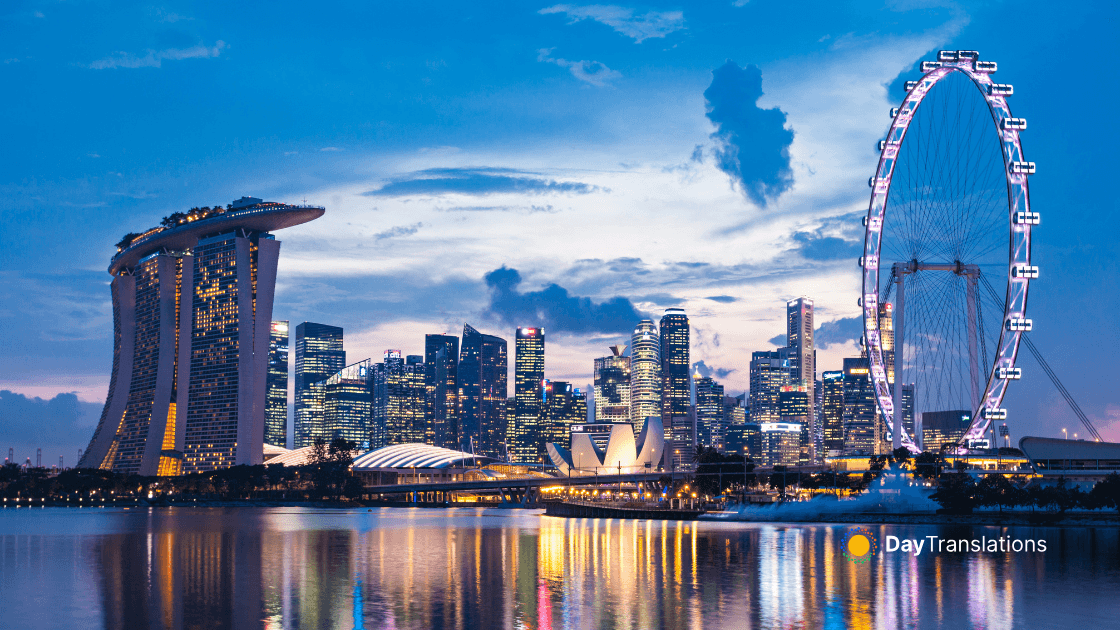
Singapore was under British rule and was established as a trading colony of the British in 1819. It joined the Malaysian Federation briefly in 1963 but became independent after two years. It is a very busy nation and has become a center of commerce due to its strategic location as a major international seaport. It is a country dotted with state-of-the art architecture, varied and numerous skyscrapers interspersed with verdant and lush parks and natural reserves, temples and museums. It is a beautiful island where people of different ethnicities and cultural backgrounds happily and peacefully co-exist.
:: Background of Singapore ::
According to history records the name Singapore was coined by Srivijayan Prince San Nila Utama, also called Sri Tri Buana, combining Malay and Sanskrit words Singha and Pura meaning Lion City. Allegedly the prince saw a tiger when he reached the island in the 13th century. Prince Parameswara of Palembang ruled the island in the 14th century and Singapore became a vital port. Singapore was however destroyed in 1613 by Portuguese invaders.
The British under Sir Thomas Stamford Raffles established Singapore as one of their trading colonies, as they expand their colonial rule and trade routes by 1819. He was determined for Britain to surpass Netherlands’ control of the region because the trade route between British India and China traverses the region. He was able to convince the Governor-General of India, Lord Hastings, who was also his superior at the British East India Company to release funds to finance an expedition to look for alternative base. He landed in Singapore on January 29, 1819 and the naturally deep harbor around the island convinced him that it will be suitable as a trading post. Singapore also had abundant supply of fresh water and available timber that can be used to repair their ships.
In this Country Profile
The island of Singapore at that time was marginally ruled by Tengku Rahman, the Sultan of Johor and controlled by the Dutch. There were in-fighting within the sultanate and were easily overcame by Temenggong Abdu’r Rahman, the head of the small settlement installed by the British, and the followers that were loyal to Tengku Hussein, the elder brother of Tengku Rahman. Tengku Hussein was successfully brought back to the country by Sir Thomas Stamford Raffles with the help of Temenggong. A treaty was formally signed between the British and Tengku Hussein on February 6, 1819 wherein Hussein was recognized by the British as the Sultan of Johor and Hussein granted them power to install a trading post in the country. Singapore according to Raffles should be a free port and that signaled the birth of modern-day Singapore.
Raffles left the management of Singapore under Major William Farquhar and he increased the settlement in the country, although Raffles later criticized Farquhar who had granted licenses for gambling and the selling of opium to generate revenue. Raffles established ethnic and functional subdivisions to organize Singapore and named it the Raffles Plan of Singapore. He also replaced Farquhar with John Crawfurd as the new governor. Crawfurd signed a treaty with the Sultan as well as Temenggong wherein almost the whole island came under British rule. The commercial importance of Singapore spread far and wide and soon there were many merchant groups who settled in the country, and by 1827 the Chinese became the largest ethnic group of settlers. They were followed by the Malays who were predominantly wage earners, craftsmen and fishermen. Soon after, in 1860, Indian traders, unskilled laborers and convicts began to populate the island of Singapore.
The government was ineffective and lawlessness prevailed. There was rampant prostitution, drug (opium) abuse and gambling and Chinese criminal (secret) societies began to form and eventually became very powerful, being able to attract membership by the thousands. The population during that time was close to 60,000 and there were only 12 police officers in Singapore. This earned Singapore a reputation that is was populated by the very dregs of society.
Singapore came under Japanese rule for three and a half years from February 15, 1942 and was given the name Syonan meaning the Light of the South. The British again ruled Singapore starting from September 1945 and started to rebuild post-war Singapore. However, the failure of the British to defend Singapore during the war instilled a desire for independence and Merdeka became their battlecry. On April 1, 1946 Singapore became a Crown Colony and conducted their own elections.
There was internal turmoil during 1955 to 1959 as several factions including leftist, waged war for power. The Merdeka Talks in 1956 led by David Marshall failed and he resigned, to be replaced by Lim Yew Hock, the new Chief Minister. Under the Internal Security Act he started a crackdown on the leftist and communist groups and sent pro-communist trade union leaders and members in prison. The British recognized his efforts and granted Singapore with a right to self-government in 1957. The State of Singapore was established in August 1958.
The new government was aggressive in its campaign for reform. The People’s Action Party had a brilliant leader in Lee Kuan Yew. Goh Keng Swee, the Finance Minister encourage local and foreign investments, giving tax incentives and providing a massive industrial estate in Jurong located in the western region of Singapore. The educational system was changed so that a skilled workforce can be trained and English was made the language of instruction. The new government also answered the need for low-cost housing and consolidated the labor unions into one umbrella organization. During this time, Prime Minister Lee and Finance Minister Goh thought that the future of Singapore lies with Malaysia and amid opposition the Federation of Malaysia, which include Malaya, Singapore, Sarawak and Sabah was established on July 9, 1963.
However, the relation was shaky and there was racial tension. Singapore had restricted trading with Malaysia, prompting Singapore to refuse full loan extensions to Sarawak and Sabah that were previously agreed on. The tension increased and Malaysia suspected Singapore of providing funding to the communists. There were heated exchanges of writings and speeches, and there was a call for Lee Kuan Yew to be arrested. Finally, Singapore separated from the Federation of Malaysia on August 9, 1965.
To prevent threats from other neighboring countries, Singapore sought international memberships and started diplomatic relations with other countries. It became a member of the United Nations on September 21, 1965 and joined the Commonwealth on October 1965. The country became co-founder of the Association of Southeast Asian Nation on August 8, 1967.
With the rapid modernization and reforms to address the economic and social problems that Singapore faced, it began to attract large foreign investments, including Esso and Shell. The British were still influential in the development of Singapore until 1968 when the British announced that they will withdraw their troops starting 1971. Singapore slowly established their own Singapore Armed Forces, one of the best-equipped in Asia, with the help of military advisers from Israel.
Goh Chok Tong became the second prime minister after Lee Kuan Yew in 1990. He was succeeded by Lee Hsien Loong in 2004. Lee Hsien Loong is the eldest son of Lee Kuan Yew and he is still the Prime Minister of Singapore.
:: Geography of Singapore ::
Singapore is mightily important as an international hub of commerce, much bigger than the country’s size. The land is generally undulating, with some low hills. What Singapore lacks in natural resources is overcompensated by its deep seaports, making it one of the busiest in the world.
Location
Singapore is a collection of 63 islets in Southeast Asia, and nestled between Indonesia and Malaysia. Southeastern Asia, islands between Malaysia and Indonesia. Geographically, Singapore’s coordinates are 1° 22’ north and 103° 48’ east. Its total land mass is 697 square kilometers, with a total land area of 687 square kilometers and 10 square kilometers covered by water. Collectively the islets that make up Singapore are 3.5 times the land area of Washington D.C.
Land Boundaries
Singapore is situated between the South China Sea and the Indian Ocean. Singapore does not have any land boundaries. It is separated from Indonesia by the Singapore Strait while it is separated from Malaysia by the Straits of Johor. It does have 193 kilometers of coastline, with a territorial maritime claim of 3 nautical miles with an exclusive fishing zone that is within and beyond its territorial water, gained from traditional practice and special treaties.
Climate
With its proximity to the equator, the climate is Singapore is equatorial, which is generally hot and humid for most of the year with no distinct seasonal variations. Humidity can reach a 75% mark with an average rainfall of 100 inches and an average temperature of 75° F. The month of May is milder compared to the month of June, which is generally the hottest month in Singapore. Thunderstorms are a regular occurrence in Singapore due to its closeness to the equator and because of the prevailing climate. June, July and August are considered the best months of the year, as the rainy season in Singapore occurs in the months of November to December.
Terrain
Singapore is generally a flat area with a central plateau. There are no natural lakes in the country but there are several catchment areas and nature preserves. The lowest point can be found in the Singapore Strait and its highest elevation, Bukit Timah, located near the center of the main island of Singapore rises to a height of 166 meters.
Natural Resources
Singapore is a city-state where land is at a premium so it is not rich in natural resources. Singapore though has deep water ports, making the country one of the busiest seaports in the world. Fish is abundant in its inland waters and around its territorial limits.
Land Use
Singapore is a small state where land is scarce. The main island is Singapore and the rest of the land area is composed of numerous islets. Only 1.47% of the land is arable and planted with permanent crops and the rest, or 97.06% is allocated for industries and infrastructures, residential areas and parks and numerous catchments.
Natural Hazards
Despite being surrounded by water, Singapore is a sheltered nation where no major natural disasters take place. Heavy rains, strong winds and flooding occur due to the monsoon seasons. Earthquakes can be felt in Singapore and tsunamis are possible.
Current Environmental Issues
Singapore is highly industrialized, as it belongs to the four Asian tigers or fast-emerging economies including Taiwan, Hong Kong and South Korea. As such, it is plagued by industrial pollution. It also has limited natural freshwater resources and has problems with waste disposal due to the lack of available land. The seasonal forest fires in Indonesia carry smoke and haze that can envelop parts of the country.
International Agreements
Singapore, like most developed and developing nations has entered into international environmental agreements affecting climate change-Kyoto protocol, desertification, climate change, law of the sea, endangered species, ozone layer protection, hazardous wastes, ship pollution and biodiversity. None of the selected agreements have been ratified although the country has signed them.
:: People of Singapore ::
According to the July estimates, Singapore is home to 4,740,737 people. The males outnumber the females slightly in the zero to fourteen age group, with 13.8% males, equivalent to 338,419 over 314,704 females. In the 15 to 64 age bracket, the females edges slightly over the males, with 1,874,985 females to 1,774, 444 males, representing 77% of the population. There are 242,084 females and 196,101 males in the 65 years and over age brackets, representing 9.2% of the population.
The median age in Singapore is 40.1 years, with the males averaging 39.6 years and females placed at 40.6 years. The population, according to 2011 estimates grows at the rate of 0.817% annually. This represents 8.5 births per 1,000 population. The total fertility rate in Singapore is quite low, estimated at 1.11 children born for every woman of child-bearing age. The death rate is Singapore according to July 2011 estimates is 4.95 for every 1,000 population. Net migration, according to July estimates is 4.63 migrants per 1,000 people.
Males marginally dominate females in the sex ratio. At birth there are 1.077 males born than females. In the under fifteen age bracket, there are 1.08 males over females. In the 15 to 64 age group, the ration is 0.95 males per female while in the 65 years and over bracket, there are 0.81 male for every female, making the total population average of 0.95 males for every female.
Infant Mortality Rate
Of the total population, the average infant mortality rate is placed at 2.32 deaths for every 1,000 live births. Males edge the females slightly, with 2.52 deaths for every 1,000 live births while there are only 2.11 deaths for every 1,000 live births for females.
Life Expectancy at Birth
Life expectancy at birth is Singapore is quite high, with the average placed at 82.14 years. Breakdown is 79.53 years for the male population and 84.96 for the females, according to the July 2011 estimates
HIV/AIDS
Adult prevalence of HIV/AIDS in Singapore is estimated in 2009 to be 0.1%, with 3,400 persons estimated to be living with HIV/AIDS. There are fewer than 100 deaths caused by HIV/AIDS, according to the estimates done in 2009.
Nationality
Singapore nationals are called Singaporeans. This is used as a noun. Singapore is used as the nationality adjective.
Ethnic Groups
Singapore is a very densely populated country with various ethnicities but the majority is composed of Chinese which represents 76.8% of the total population. Next to the Chinese are the Malays, comprising 13.9% while the Indian population represents 7.9%. Other smaller ethnic groups comprise 1.4% of the population according to the census done in 2000.
Religions
Due to the existence of various ethnic groups in Singapore there are also several religions being followed. The Buddhists comprise the majority of the population with 42.5%, followed by the Muslims at 14.09%. There is also 8.5% of the population following Taoism. Hinduism is followed by 4% of the population while Catholics are placed at 4.8%. Other Christian religions are followed by 9.8% of the population and about 14.8% did not indicate their religion when the 2000 census was conducted.
Languages
Several languages are officially spoken in Singapore, it being a culturally-mixed nation and a hub for commerce and industry. Mandarin is an official language that is spoken by 35% of the population. Other official languages are English with 23%, Malay with 14.1% speakers and Tamil with 3.2%. Several Chinese dialects are also spoken by the rest of the population, broken down into Hokkien with 11.4%, Cantonese with 5.7% and Teochew spoken by 4.9%, with some undefined Chinese dialects spoken by 1.8% of the population. Still other minor languages are spoken by 0.9% of the population according to the 2000 census.
Literacy
Literacy in Singapore is very high and those 15 years and over can read and write. The literacy rate of the whole nation is placed at 92.5%, with the males slightly ahead of the females, with 96.9% literary rate for males versus 88.6 for the females. The figures were based on the 2000 census.
Geography of Singapore: Important Geographical Information about Singapore
In this Country Profile
Singapore has an interesting shape. The main island is shaped like a diamond, nestled between Indonesia and Malaysia. Singapore is actually closer to Malaysia, with the country lying on the southern tip of the Malay Peninsula and is linked to Malaysia by a causeway and a bridge over the Strait of Johore. Singapore is only 137 kilometers north of the Equator, which greatly affects its weather conditions. Singapore comprises 63 islets with a total landmass of 646 square kilometers, with a main island where the capital, Singapore is located.
There are a few rounded hills located almost in the center of the main island. The highest hill is Bukit Timah which is 166 meters high. The lowest point in Singapore is the Strait of Singapore, which has the deepest waters and where the Port of Singapore is located. The island is generally flat and sandy along the east and the southeast while the west and southwest regions display low ridges. The northwest is made of sedimentary rocks. Most of Singapore is just about 15 meters above sea level. There are no significant lakes or rivers in Singapore but there are several water reservoirs and catchments that were constructed for fresh water storage. Numerous water systems flow into the sea via estuaries, swamps and mangroves.
Pulau Tekong is a military area but may soon be turned into a semi-residential area. Together with Sentosa and Pulau Ubin, these are the larger of the smaller islands of Singapore. Pedra Branca, located in the easternmost side of Singapore is its farthest island. The name Pedra Branca is Portuguese for white rock and was so named due to the white bird droppings on the island. In Malaysian, the name is Batuh Puteh.
Singapore continues to increase in size through land reclamation, from its hills, the sea beds around it and from countries that are its neighbors. It is projected that by 2033 Singapore will grow by another 100 square kilometers.
Climate
Singapore is just one degree north of the Equator and therefore has an equatorial climate or a tropical rainforest climate, which means there is no definite dry season as rain falls throughout the year. Singapore is typically wet and hot all months of the year, with great changes in temperature between day and night. All of Singapore has ample rainfall and experience high humidity, with an annual rainfall of about 92.1 inches. Average minimum temperature is around 73.4° F while the maximum hovers around 88° F. The month of May is slightly cooler than the hottest month, June when strong sunshine and light winds prevail.
There is also marked contrast in humidity. It can be as high as 90% in the morning and drop down to about 60% to 50% in the afternoon and evening. The western parts of Singapore receive more rainfall than the eastern parts, making this areas drier and hotter. Two monsoon seasons occur in Singapore. The northeast monsoon begins in December and lasts until the early part of March, with northeast winds blowing up to 20 kilometers per hour, and increasing in speed towards the start of the year. The southwest monsoon happens in the months of June up to September, bringing scattered late morning or early afternoon showers.
Singapore is protected by the Sumatra landmass so the island is safe from tsunamis. It is also far from geologic fault line and only suffers from slight tremors which are mostly felt by those living in high-rise building complexes.
Granite and gabbro are the igneous rocks found in Singapore particularly in the Bukit Timah, the Pulau Ubin and in Woodlands. Little Guilin also has gabbro. Sandstone and mudstones are the sedimentary rocks that can be found in the southwestern part of Singapore while metamorphic rocks, mostly made up of quartzite are on the northeastern side as well as on Pulau Tekong.
Urban Landscape
Singapore is heavily populated and highly urbanized. The whole island is almost covered by concrete and steel infrastructure. Due to the scarcity of land, urban planning to make effective use of whatever land is available in strictly practiced in Singapore. Housing estates were developed in areas that are less densely populated and less busy that the central business district. Light industries are located around the island and limited to tenant that produce less or no pollution. Heavy industries are distributed in the western side, on Jurong Island and in Jurong. Amid the tall skyscrapers, Singapore has created numerous nature parks and gardens all over the island.
Information about the Singaporean Flag: Colors and Meaning of the Flag of Singapore
In this Country Profile
:: Meaning of the Singapore Flag ::
The British Union Jack was the flag that originally flew over Singapore from 1819 up to 1959, a total of 140 years. The national flag of Singapore was formally adopted on December 3, 1959. There are two equal horizontal bands of color on the flag. The top stripe is red and the lower stripe is white. An upright waxing crescent moon in white is placed on the canton on the upper left. Five individual five-pointed stars, also in white are arranged in a circle and positioned near the curved side of the crescent moon. The flag’s ratio is 2:3.
Originally the Singapore flag design only has three stars but the leaders of the country vetoed the design because the country may be associated with the Malayan Communist Party, whose flag also has three stars. It was also designed to use a single color, red, which is a traditional color of the Chinese but again, it was not approved because red is also related to communism.
The design of the Singapore flag was attributed to the committee created by Deputy Prime Minister Toh who was directed by Prime Minister Lee Kuan Yew.
The red stripe in the flag of Singapore represents democracy, equality of man and worldwide brotherhood. White symbolizes virtuousness as well as purity. The waxing crescent moon stands for the rise of the young country towards development and the five stars are meant to signify equality, growth, peace, justice and democracy.
Extensive List of Languages of Singapore: Spoken Languages
In this Country Profile
:: List of Languages ::
Bengali
[ben] 600 in Singapore (1985). Ethnic population: 14,000 in Singapore (Johnstone and Mandryk 2001). Classification: Indo-European, Indo-Iranian, Indo-Aryan, Eastern zone, Bengali-Assamese
Chinese, Hakka
[hak] 69,000 in Singapore (1980). Ethnic population: 151,000 in Singapore (1993). Alternate names: Hokka, Ke, Kechia, Kehia, Kek, Khek. Classification: Sino-Tibetan, Chinese
Chinese, Mandarin
[cmn] 201,000 in Singapore (1985). Alternate names: Guoyu, Huayu. Classification: Sino-Tibetan, Chinese
Chinese, Min Bei
[mnp] 4,000 in Singapore (1985). Ethnic population: 11,000 in Singapore. Alternate names: Min Pei. Dialects: Hokchia (Hockchew). Classification: Sino-Tibetan, Chinese
Chinese, Min Dong
[cdo] 34,200 in Singapore (2000). Ethnic population: 31,391. Mainly in China. Dialects: Fuzhou (Fuchow, Foochow, Guxhou). Classification: Sino-Tibetan, Chinese
Chinese, Min Nan
[nan] 1,170,000 in Singapore (1985). 736,000 speakers of Hokkien, 28.8% of the population (1993), 360,000 of Teochew (1985), 14.2% of the population (1993); 74,000 of Hainanese (1985), 2.9% of the population (1993). Ethnic population: 1,482,000 (1993) including 884,000 Hokkien (1993), 452,000 Teochew (1985), 146,000 Hainanese (1993). Alternate names: Min Nam, Southern Min. Dialects: Hokkien (Fukienese, Fujian, Amoy, Xiamen), Teochew (Chaochow, Chaozhou, Taechew), Hainanese. Classification: Sino-Tibetan, Chinese
Chinese, Pu-Xian
[cpx] 14,100 in Singapore (2000). Dialects: Henghua (Hinghua, Xinghua). Classification: Sino-Tibetan, Chinese
Chinese, Yue
[yue] 314,000 in Singapore (1985). Ethnic population: 338,000 (1993). Alternate names: Cantonese, Guangfu, Yue, Yueh. Classification: Sino-Tibetan, Chinese
English
[eng] 665,000 in Singapore (2000 census). Classification: Indo-European, Germanic, West, English
Gujarati
[guj] 800 in Singapore (1985). Ethnic population: 1,619 (1985). Alternate names: Gujerathi, Gujerati. Classification: Indo-European, Indo-Iranian, Indo-Aryan, Central zone, Gujarati
Javanese
[jav] 800 in Singapore (1985). Ethnic population: 21,230. Alternate names: Djawa, Jawa. Classification: Austronesian, Malayo-Polynesian, Javanese
Madura
[mad] 900 in Singapore (1985). Ethnic population: 14,292 (1985). Alternate names: Madhura, Madurese. Dialects: Bawean (Boyanese). Classification: Austronesian, Malayo-Polynesian, Malayo-Sumbawan, Madurese
Malay
[zlm] 396,000 in Singapore (1985). Alternate names: Colloquial Malay, Local Malay, Malayu. Dialects: Jugra-Muar-Melaka-Johor. Classification: Austronesian, Malayo-Polynesian, Malayo-Sumbawan, North and East, Malayic, Malay
Malay, Baba
[mbf] 10,000 in Singapore (Pakir 1986). Ethnic population: 250,000 to 400,000 (1986). Mainly in the Katong District on the east coast and the surrounding districts of Geylang and Jao Chiat. Also in Malaysia (Peninsular). Alternate names: Baba, Chinese Malay, Straits Malay. Dialects: It developed since the 15th century from Low Malay with many Min Nan Chinese [nan] borrowings. Regional variants between Malacca and Singapore. Partially intelligible with Standard Malay [zsm]. It is generally believed that the Baba of Malaysia is more ‘refined’, and that of Singapore more ‘rough’. Most have learned Standard Malay and English in school. Lim (1981) and Holm (1989) treat it as a Malay-based Creole. It is different from Peranakan Indonesian [pea]. Classification: Creole, Malay based
Malay, Standard
[zsm] Few L1 speakers. L2 speakers include ethnic Malays and some others, particularly the older generation. Alternate names: Formal Malay, Malay, Malayu, Melayu, Melayu Baku. Classification: Austronesian, Malayo-Polynesian, Malayo-Sumbawan, North and East, Malayic, Malay
Malayalam
[mal] 10,000 in Singapore. Ethnic population: 14,000 (1993). Alternate names: Alealum, Malayal, Malayalani, Malean, Maliyad, Mallealle, Mopla. Classification: Dravidian, Southern, Tamil-Kannada, Tamil-Kodagu, Tamil-Malayalam, Malayalam
Orang Seletar
[ors] 880 in Singapore (2000). North coast of Singapore, and opposite coast of Malaysia. Classification: Austronesian, Malayo-Polynesian, Malayo-Sumbawan, North and East, Malayic, Malay
Panjabi, Eastern
[pan] 9,500 in Singapore (1987). Ethnic population: 14,000 (1993). Classification: Indo-European, Indo-Iranian, Indo-Aryan, Central zone,
Panjabi
Singapore Sign Language
[sls] 3,000 (2007 SIL). Very few monolinguals. Ethnic population: 4,000 (2007 SIL). Dialects: Natural Sign Language, Contact Signing (Signing Exact English, Pidgin Signed English). Classification: Deaf sign language
Sinhala
[sin] 850 in Singapore (1987). Ethnic population: 12,000 (1993). Alternate names: Chingalese, Singhalese, Sinhalese. Classification: Indo-European, Indo-Iranian, Indo-Aryan, Sinhalese-Maldivian
Tamil
[tam] 90,000 in Singapore (1985). Ethnic population: 111,000 (1993). Classification: Dravidian, Southern, Tamil-Kannada, Tamil-Kodagu, Tamil-Malayalam, Tamil
:: Reference ::
Gordon, Raymond G., Jr. (ed.), 2005. Ethnologue: Languages of the World, Fifteenth edition. Dallas, Tex.: SIL International. Online version: http://www.ethnologue.com/
Famous Singaporean People: Singaporean Artists, Scientists, Leaders, Musicians, Politicians and Athletes
In this Country Profile
The following people made their mark on both the local and international scenes. They are just some of many famous Singaporeans who have lifted Singapore’s name worldwide and made a difference in our world. Their purpose and stories inspired awe if not greatness.
:: List of Famous People from Singapore ::
Lee Kuan Yew
Lee Kuan Yew was born on September 16, 1923 and the eldest child of Chua Jim Neo and Lee Chin Koon. His ancestors were Chinese immigrants. He was given an English education and graduated with Double Starred First Class Honors in law from the Fitzwilliam College in Cambridge, England.
During the Japanese occupation of Singapore he sold tapioca-based glue with the brand name Stikfas in the black market. He also became a transcriber of Allied reports for the Japanese as he had lessons in Chinese and Japanese. Lee Kuan Yew also became the English language editor of the Japanese propaganda department, Hodobu in 1943 up to 1944.
Lee was the election agent of John Laycock in 1951, in whose legal office Lee worked for after his graduation. Laycock ran under the pro-British party banner. Soon Lee realized that Laycock will not win mass support since majority of the voters are of Chinese descent. He started his links to the working class Chinese-speaking population when he was named as a legal advisor to the students’ union as well as the trade union.
His political party, the People’s Action Party or PAP was started with some of his fellow English – educated buddies. They needed a pro-communist support group while the communists needed a party that is non-communist as a shield because the Malayan Communist Party was considered illegal. The final aim of both parties was to end the British rule. Lee became the secretary-general of PAP from 1954 to 1992. He won the Tanjong Pagar seat in 1955. His position was temporarily threatened by the pro-communists in 1957 but was reinstated when the Chief Minister Lim Yew Hock ordered the arrest and imprisonment of the communist leaders and supporters.
The People’s Action Party won 43 out of the total 51 seats in the national elections held on June 1, 1959 and Lee was named the Prime Minister succeeding Lim Yew Hock. Singapore became won autonomy from the British in all matters regarding the state except for foreign affairs and defense. At that time, unemployment, education and housing were major problems for Singapore. His leadership was not smooth-sailing and was threatened the whole time and was almost overthrown when the issue of merging with Malaysia came about in 1962. Lee actively campaigned for the merger and Singapore was made part of the Federation of Malaysia in 1963 but this did not last long as the merger did not favor Singapore. Accusations and distrust led to Singapore’s expulsion from the federation in 1965 and Singapore became independent from Malaysia on August 9, 1975.
To strengthen Singapore’s status as an independent nation, Lee sought recognition for the country and became a member of the United Nations. He also co-founded the Association of Southeast Asian Nations and went on diplomatic missions to establish better ties with its neighboring countries. Lee also started a move to create a unique identity for Singapore with great focus on multiculturalism, stressing the importance of racial harmony and religious tolerance.
Lee Kuan Yew followed the Switzerland model of non-alignment and neutrality but was worried about his country’s vulnerability as an independent nation. He instructed Goh Keng Swee to build a strong Singapore Armed Forces, which was fulfilled with the help of Israel.
There were many policies introduced by Lee Kuan Yew which paved the way for Singapore to be one of the most developed countries in Asia. He instituted measures to stem corruption by creating an anti-corruption bureau with powers to search, arrest investigate bank accounts and income tax returns of suspected individuals, including their families and supported the belief that government officials should be well paid so they will not be tempted to engage in corrupt practices. He also instituted the Stop At Two program where married couples were encouraged to only have two children to prevent over-population. The law was strict and those families with three and four children had lower priorities in education and government rebates. He also believed in caning as an efficient corporal punishment.
Lee stepped down in as prime minister in 1990 and was succeeded by Goh Chok Tong. He remained in office as a Senior Minister until 2004 and became Minister Mentor from 2004 until 2011. His son, Lee Hsien Loong is the current prime minister.
Stephanie Sun
Stephanie Sun is a multi-awarded singer-songwriter born on July 23, 1978. She also goes by the name Sun Yan Zi. She has a degree in marketing from the Nanyang Technological University. She was discovered by her music teacher who also owns the school when she attended his Lei Wei Song School of Music. She has recorded 10 albums and has sold 10 million copies in Asia alone. Although Stephanie is a Singaporean, she has made Taiwan her base where she has a large fan base. She usually goes around Hong Kong, Malaysia, Singapore and China for record and album promotions.
Zoe Tay
Zoe Tay is a multi-awarded Singaporean model and actress who was born on January 10, 1968. She is nicknamed Thousand-Faced Lady as well as the Queen of Caldecott Hill. Zoe was discovered in 1988 during a Star Search. As a winner she was awarded a contract with a local TV station, Singapore Broadcasting Station, now owned by MediaCorp. She soon became a household name, starring in numerous drama series and product commercials for television. Her name was entrenched in the minds of local viewers that she was voted The Top0 10 Most Popular Female Artists for ten consecutive years until 2003 and she holds the distinction of being the first actress to achieve it. She was elevated to the All Time Favorite Artist in the 2004 Star Awards. Zoe has also starred in a few movies and had published a coffee table book. She was the first Singaporean female artist to do so.
Fandi Ahmad
Fandi Ahmad was a former Singaporean soccer superstar and now a coach. He was born on May 29, 1962. He was a striker and a midfielder, and was the captain of the national soccer team of Singapore from 1993 to 1997. He also played for soccer teams in Europe and Asia. Fandi used to be the youngest player, at age 16 to play for the national team. He was a member of the team that won the Malaysia Cup in 1980, even scoring the winning goal in the final against Selangor with a score of 2-1. Fandi played for FC Groningen of Netherlands from 1983 to 1985. His impact with the FC Groningen fans earned him a place in their 1999 Hall of Fame as one of the best 25 players to play for the club. He returned to Asia and played for Kuala Lumpur from 1986 up to 1990, and was instrumental in their winning the Malaysia Cup three years in a row from 1987 to 1989. Fandi won the Golden Boot Award in 1988. He moved to Greece 1990 to join the club OFI Crete and stayed with the club for a few months before returning to Malaysia to join Pahang in 1991 and was again instrumental in winning the Malaysian Cup and the Malaysian League in 1992.
He returned to Singapore in 1993 but he was not able to help the team to secure a win. In 1996 the S. League was launched with Fandi as captain of the Geylang United, which was the eventual champion. He then moved to captain the Singapore Armed Forces Football Club, winning the S. League championships in 1997 and 1998 before he became their coach. His club also won the title in 2000. Overall Fandi had won more than 100 caps for Singapore and had scored 50 goals and had helped Singapore to win silver in 1983, 1985 and 1989 Southeast Asian Games.
Goh Chok Tong
Goh Chok Tong was Singapore’s prime minister when Lee Kuan Yew stepped down. He was a broad-minded prime minister who announced that his cabinet will employ qualified homosexuals to available positions in 2003, shocking the more conservative people of Singapore. He was born on May 20, 1941. He earned his First Class Honors in economics from the University of Singapore and his Master’s in development economics for Williams College in the US. He joined the party of Lee Kuan Yew in 1976 and was elected as the representative of the Marine Parade constituency in the parliament. In 1981 he was appointed as the Senior Minister of State for Finance before being promoted to Minister for Trade and Industry before being appointed as the Minister for Health as well as the Minister for Defense. By 1985 he was already the First Deputy Prime Minister and became the prime minister-in training, assuming more government responsibilities. From 1990 up to 2004, Goh served as the Prime Minister of Singapore. While he instituted several policies that helped Singapore economically, it was also during his time that Singapore faced several crises, including the 2003 SARS outbreak, the economic recession of 2001 to 2003, the 2001 embassy-bombing plots by the Jemaah Islamiyah, and the Asian financial crisis in 1997.
From 2004 to 2011 he served as Senior Minister in the cabinet of Prime Minister Lee Hsien Loong. He was able to strengthen Singapore’s business ties with the Middle East while he was the Monetary Authority of Singapore chairman. He signed a Double Taxation Avoidance Agreement with Israel on May 19, 2005 so that Singapore businessmen will avoid double taxation when conducting business with Israel and vice versa as well as the recognition of each country’s standard of certification so that imported and exported goods from the two countries can move faster.
He now holds the title of Emeritus Senior Minister and was appointed by Prime Minister Lee as the senior adviser to the Monetary Authority of Singapore on May 18, 2011.
Ng Teng Fong
Although he was born in Fujian, China in 1928 his family migrated to Singapore when he was six years old and he became a citizen of Singapore. His family is into real estate and owns the Sino Group and the Far East Organization, which has several malls and hotels in Hong Kong and Singapore. Despite his obvious wealth, it was said the Ng Teng Fong lived a very frugal life, living in the same house he had acquired 30 years ago although they own at least one-fourth of the housing market in Singapore. He was also known to bring his own lunch even when traveling by plane. Their Far East Organization owns The Fullerton Singapore hotel and other hotels and properties in Singapore, handled by his younger son, Philip Ng. His older son Robert Ng takes care of the Sino Group’s real estate development interests in Hong Kong. Ng Teng Fong died on January 23, 2010 due to cerebral hemorrhage. Their family’s net worth in 2009 was 5.5 billion US dollars, making him the richest Singaporean when he died.
Sim Wong Hoo
Sim Wong Hoo is Singapore’s youngest billionaire. He started a computer repair shop that he named Creative with a school friend after graduating from Ngee Ann Polytechnic. It was in his shop that he developed and eventually sold the Apple II add-on memory board. It was the start for Creative to begin creating customized personal computers that conformed to the Chinese language. Their device was able to produce melodies and speech through an enhanced audio capability, which led to the development and eventual success of a stand-alone sound card which was branded as Sound Blaster. Through his guidance, his company Creative became very successful in the audio processing card line and the Sound Blaster’s success is still unsurpassed. Sim Wong Hoo was the first person to receive the Businessman of the Year award twice. The first was in 1992 and he again received the award in 1997. The Singapore Computer Society bestowed the Person of the Year award to Sim Hong Woo in 2002. As the star entrepreneur of Singapore, he is the current chairperson of the Technopreneurship 21 Private Sector Committee of Singapore.