
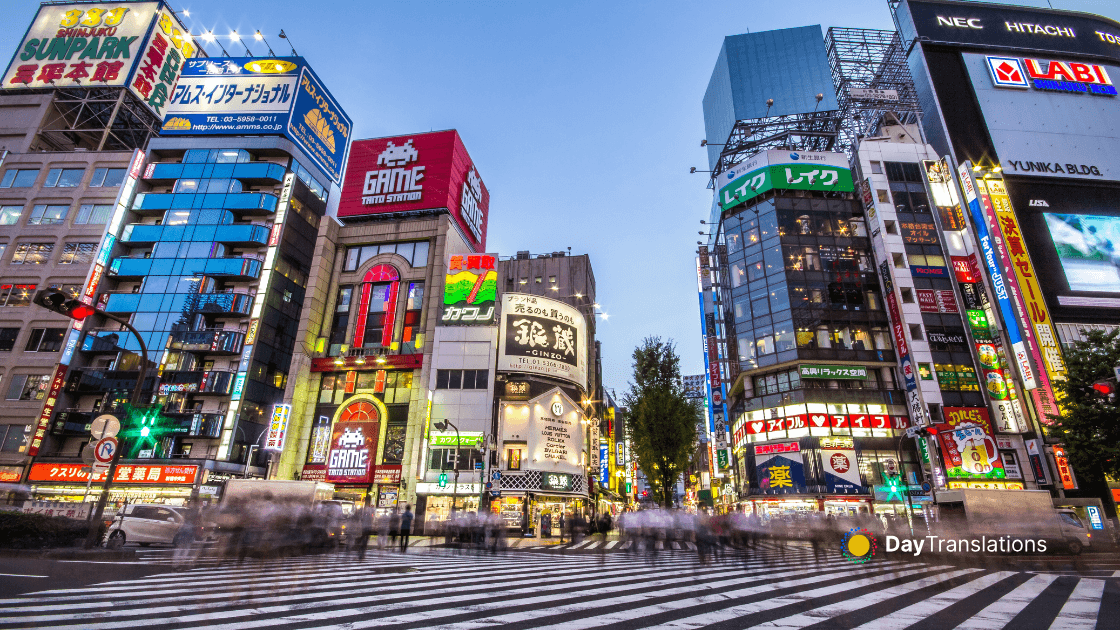
Japan is located east of China, on the eastern end of the Eurasian Continent between the Sea of Japan and the Pacific Ocean in the Northern Hemisphere. Japan comprises over 3,000 islands making it an archipelago. The major languages include: Japanese, Korean, and Okinawan. A few minor languages are: Kikai, Kunigami, Oki-No-Erabu, and Yonagami. Japanese is the sixth most spoken language in the world, with over 99% percent of the country’s population using it.
Japan is a global player in various fields that address global challenges, it has the world’s second largest economy by nominal GDP and the third largest in purchasing power parity. It is a member of the United Nations, G8, OECD and APEC, with the world’s fifth largest defense budget. It is also the world’s fourth largest exporter and sixth largest importer. Japan is a world leader in technology, machinery, and robotic.
In this Country Profile
:: Background of Japan ::
In 1603, a Tokugawa shogunate (military dictatorship) ushered in a long period of isolation from foreign influence in order to secure its power. For more than two centuries this policy enabled Japan to enjoy stability and a flowering of its indigenous culture. Following the Treaty of Kanagawa with the US in 1854, Japan opened its ports and began to intensively modernize and industrialize. During the late 19th and early 20th centuries, Japan became a regional power that was able to defeat the forces of both China and Russia. It occupied Korea, Formosa (Taiwan), and southern Sakhalin Island. In 1931-32 Japan occupied Manchuria, and in 1937 it launched a full-scale invasion of China. Japan attacked US forces in 1941 – triggering America’s entry into World War II – and soon occupied much of East and Southeast Asia. After its defeat in World War II, Japan recovered to become an economic power and a staunch ally of the US. While the emperor retains his throne as a symbol of national unity, elected politicians – with heavy input from bureaucrats and business executives – wield actual decisionmaking power. The economy experienced a major slowdown starting in the 1990s following three decades of unprecedented growth, but Japan still remains a major economic power, both in Asia and globally.
:: Geography of Japan ::
Location: Eastern Asia, island chain between the North Pacific Ocean and the Sea of Japan, east of the Korean Peninsula
Geographic coordinates: 36 00 N, 138 00 E
Area:
total: 377,835 sq km
land: 374,744 sq km
water: 3,091 sq km
note: includes Bonin Islands (Ogasawara-gunto), Daito-shoto, Minami-jima, Okino-tori-shima, Ryukyu Islands (Nansei-shoto), and Volcano Islands (Kazan-retto)
Area – comparative: slightly smaller than California
Land boundaries: 0 km
Coastline: 29,751 km
Maritime claims: territorial sea: 12 nm; between 3 nm and 12 nm in the international straits – La Perouse or Soya, Tsugaru, Osumi, and Eastern and Western Channels of the Korea or Tsushima Strait, contiguous zone: 24 nm, exclusive economic zone: 200 nm.
Climate: varies from tropical in south to cool temperate in north
Terrain: mostly rugged and mountainous
Elevation extremes: lowest point: Hachiro-gata -4 m, highest point: Mount Fuji 3,776 m
Natural resources: negligible mineral resources, fish. Note: with virtually no energy natural resources, Japan is the world’s largest importer of coal and liquefied natural gas as well as the second largest importer of oil
Land use:
arable land: 11.64%
permanent crops: 0.9%
other: 87.46% (2005)
Natural hazards: many dormant and some active volcanoes; about 1,500 seismic occurrences (mostly tremors) every year; tsunamis; typhoons.
Environment – current issues: air pollution from power plant emissions results in acid rain; acidification of lakes and reservoirs degrading water quality and threatening aquatic life; Japan is one of the largest consumers of fish and tropical timber, contributing to the depletion of these resources in Asia and elsewhere
Environment – international agreements: party to: Antarctic-Environmental Protocol, Antarctic-Marine Living Resources, Antarctic Seals, Antarctic Treaty, Biodiversity, Climate Change, Climate Change-Kyoto Protocol, Desertification, Endangered Species, Environmental Modification, Hazardous Wastes, Law of the Sea, Marine Dumping, Ozone Layer Protection, Ship Pollution, Tropical Timber 83, Tropical Timber 94, Wetlands, Whaling.
:: People of Japan ::
Population: 127,288,416 (July 2008 est
Age structure:
0-14 years: 13.7% (male 8,926,439/female 8,460,629)
15-64 years: 64.7% (male 41,513,061/female 40,894,057)
65 years and over: 21.6% (male 11,643,845/female 15,850,388) (2008 est.)
Median age:
total: 43.8 years
male: 42.1 years
female: 45.7 years (2008 est.)
Population growth rate: -0.139% (2008 est.)
Birth rate: 7.87 births/1,000 population (2008 est.)
Death rate: 9.26 deaths/1,000 population (2008 est.)
Net migration rate: NA (2008 est.)
Sex ratio:
at birth: 1.06 male(s)/female
under 15 years: 1.06 male(s)/female
15-64 years: 1.01 male(s)/female
65 years and over: 0.74 male(s)/female
total population: 0.95 male(s)/female (2008 est.)
Infant mortality rate:
total: 2.8 deaths/1,000 live births
male: 3 deaths/1,000 live births
female: 2.58 deaths/1,000 live births (2008 est.)
Life expectancy at birth:
total population: 82.07 years
male: 78.73 years
female: 85.59 years (2008 est.)
Total fertility rate: 1.22 children born/woman (2008 est.)
HIV/AIDS – adult prévalence rate: less than 0.1% (2003 est.)
HIV/AIDS – people living with HIV/AIDS: 12,000 (2003 est.)
HIV/AIDS – deaths: 500 (2003 est.)
Nationality: noun: Japanese (singular and plural) adjective: Japanese
Ethnic groups: Japanese 98.5%, Koreans 0.5%, Chinese 0.4%, other 0.6% Note: up to 230,000 Brazilians of Japanese origin migrated to Japan in the 1990s to work in industries; some have returned to Brazil (2004)
Religions: observe both Shinto and Buddhist 84%, other 16% (inc. Christian 0.7%)
Languages: Japanese
Literacy:
definition: age 15 and over can read and write
total population: 99%
male: 99%
female: 99% (2002)
Geography of Japan: Important Geographical Information about Japan
In this Country Profile
Japan is a spectacular country to visit, full of history and a cultural depth that is hard to find anywhere else. The Japanese scenery is as diverse as its history, culture and tradition. Japan’s natural landscape is filled with rocky terrain, mountains, lush forests, waterfalls and diverse plant life.
Japan is an island nation in East Asia comprising a large stratovolcanic archipelago extending along the Pacific coast of Asia. Japan’s closest neighbors are Korea, Russia and China. The Sea of Japan separates the Asian continent from the Japanese archipelago.
The main islands, sometimes called the “Home Islands”, running from north to south, are Hokkaido, Honshu (or the mainland), Shikoku, Kyushu, and Okinawa. There are also about 3,000 smaller islands, including Okinawa, and islets, some inhabited and others uninhabited.
Japan is a rugged land of high mountains and deep valleys, with many small plains. About four-fifths of Japan is mountainous (or hilly), with a mountain range running through each of the main islands. In central Honshu, especially in what are sometimes called the Japanese Alps, numerous peaks crest between 8,000 and 10,500 feet (2,400 and 3,200 m). The highest point in the Japanese Alps is Mount Kita at 3,193 meters. Many of these mountains contain dormant and active volcanos, including the famous Mount Fuji, which last erupted in 1707. Japan’s highest mountain is Mt. Fuji, with an elevation of 3,776 m (12,388 ft). Japan also lies on a major earthquake fault line. It lies in a volcanic, earthquake-prone belt called the Ring of Fire, which fringes most of the Pacific basin.
None of the populated plains or mountain basins are extensive in area. The largest, the Kanto Plain, where Tokyo is situated, covers only 13,000 square kilometers. Other important plains are the Nobi Plain surrounding Nagoya, the Kinki Plain in the Osaka-Kyoto area, the Sendai Plain around the city of Sendai in northeastern Honshu, and the Ishikari Plain on Hokkaido. Many of these plains are along the coast, and their areas have been increased by reclamation throughout recorded history.
The rivers of Japan are generally short and swift. The longest is the Shinano, some 230 miles (370 km) in length. Virtually all the lakes of Japan are small. The largest is Biwa Lake, covering some 265 square miles (686 km 2)on Honshu.
The great variety of natural environments in Japan support many kinds of animals. Some 140 species of mammals are known. About 450 species of birds are known on the islands. Water birds and songbirds each account for about a third of the species.
Professional Translation Organizations & Associations in Japan
In this Country Profile
Below is a list of the major translation organizations and associations of Japan.
:: List of Organizations ::
Daito Bunka University, Graduate School of Economics
Inter School
International Christian University
Japan Association of Translators
Japan Translation Federation Incorporated
Kyoto Tachibana Women’s University
Kyoto University
Medical Interpreters & Translators Association
Osaka University of Foreign Studies, English Department
Toyo Eiwa Women’s University
Information about the Japanese Flag: Colors and Meaning of the Flag of Japan
In this Country Profile
:: Meaning of the Japan Flag ::
The national flag of Japan has an overall white background with a large red circle in the center. Nisshoki (literally, Rising-Sun Flag) was adopted as Japan’s national flag in 1870. It also is called Hinomaru (literally, Disk of the Sun) and Nihon no Kokki (Flag of Japan). However, the flag was not adopted nationally until August 13, 1999. The shape and flag ratio of the Japanese flag is described as 2:3 ( length 1½ times the height ). The sun, a circle centered on the flag, has a diameter of 3/5 the width. (The sun actually is positioned 1/100th the length closer to the pole edge of the flag.)
According to the Britannica Encyclopedia, the sun goddess Amaterasu founded Japan in the 7th century BC and was an ancestor of the first of its emperors, Jimmu. Even today the emperor is known as the “Son of the Sun,” and a popular name for the country is “Land of the Rising Sun.” The characters which make up Japan’s name mean “sun-origin”, which is why Japan is sometimes identified as the “Land of the Rising Sun”.
The red circle represents the sun.
Extensive List of Languages of Japan: Spoken Languages
In this Country Profile
:: List of Languages ::
Ainu
[ain] 15 in Japan (1996 Alexander Vovin). Ethnic population: 15,000 in Japan. Kuril Islands (Tsishima), Hokkaido. Formerly also on south Sakhalin Island, Russia. Also spoken in Russia (Asia). Alternate names: Ainu Itak. Dialects: Sakhalin (Saghilin), Taraika, Hokkaido (Ezo, Yezo), Kuril (Shikotan, Tsishima). The last speaker of Sakhalin dialect died in 1994. There were at least 19 dialects. Classification: Language Isolate Nearly extinct.
Amami-Oshima, Northern
[ryn] 10,000 (2004). Northwestern Okinawa; northern Amami-oshima Island. Alternate names: Northern Amami-Osima, Oshima, Osima, Oosima. Dialects: Naze, Sani. Inherent intelligibility is generally impossible, or very difficult, with other Ryukyuan languages and Japanese. Classification: Japanese, Ryukyuan, Amami-Okinawan, Northern Amami-Okinawan.
Amami-Oshima, Southern
[ams] 1,800 (2004). Northern Okinawa; southern Amami-oshima, Kakeroma, Yoro, and Uke islands. Alternate names: Southern Amami-Osima. Dialects: Inherent intelligibility is low with other Ryukyuan languages and Japanese. Classification: Japanese, Ryukyuan, Amami-Okinawan, Northern Amami-Okinawan
Japanese
[jpn] 121,050,000 in Japan (1985). Population total all countries: 122,433,899. Throughout the country. Also spoken in American Samoa, Argentina, Australia, Belize, Brazil, Canada, Dominican Republic, Germany, Guam, Mexico, Micronesia, Mongolia, New Zealand, Northern Mariana Islands, Palau, Panama, Paraguay, Philippines, Singapore, Taiwan, Thailand, United Arab Emirates, United Kingdom, USA. Dialects: Western Japanese, Eastern Japanese. Possibly related to Korean. The Kagoshima dialect is 84% cognate with Tokyo dialect. Classification: Japanese
Japanese Sign Language
[jsl] 317,000 (1986 Gallaudet Univ.). Alternate names: Shuwa, Temane. Dialects: Related to Taiwanese and Korean sign languages. Classification: Deaf sign language
Kikai
[kzg] Ethnic population: 13,066 (2000 WCD). Northeastern Okinawa; Kikai Island. Dialects: Onotsu. Inherent intelligibility is generally impossible or very difficult of other Ryukyuan languages and Japanese. Classification: Japanese, Ryukyuan, Amami-Okinawan, Northern Amami-Okinawan
Korean
[kor] 670,000 in Japan (1988). Classification: Language Isolate
Kunigami
[xug] 5,000 (2004). Central Okinawa; central and northern Okinawa Island, Iheya, Izena, Ie-jima, Sesoko islands. Dialects: Nago. Inherent intelligibility is generally impossible, or very difficult, of other Ryukyuan languages and Japanese. Ryukyu languages are 62% to 70% cognate with Tokyo dialect of Japanese. Classification: Japanese, Ryukyuan, Amami-Okinawan, Southern Amami-Okinawan
Miyako
[mvi] Ethnic population: 67,653 (2000 WCD). Southern Okinawa; Miyako, Ogami, Ikema, Kurima, Irabu, Tarama, Minna islands. Dialects: Miyako-Jima (Hirara, Ogami), Irabu-Jima, Tarama-Minna. Not intelligible with other Ryukyuan languages and Japanese. The dialects listed have noticeable differences, but not impossible communication. Classification: Japanese, Ryukyuan, Sakishima
Okinawan, Central
[ryu] 984,285 (2000 WCD). Ethnic population: The total ethnic population of Okinawan is 120,000,000 (2000 Yukio Uemura). Central Okinawa; southern Okinawa Island, Kerama Islands, Kume-jima, Tonaki, Aguna islands, and islands east of Okinawa Island. Alternate names: Okinawan, Luchu. Dialects: Shuri, Naha, Torishima, Kudaka. Inherent intelligibility is generally impossible, or very difficult, with other Ryukyuan languages and Japanese. Ryukyu languages are 62% to 70% cognate with Tokyo dialect of Japanese. Classification: Japanese, Ryukyuan, Amami-Okinawan, Southern Amami-Okinawan.
Oki-No-Erabu
[okn] 3,200 (2004). North central Okinawa; Oki-no-erabu Island. Dialects: East Oki-No-Erabu, West Oki-No-Erabu. Inherent intelligibility is generally impossible, or very difficult, with other Ryukyuan languages and Japanese. Dialect differences are noticeable, but communication is not impossible. Ryukyu languages are 62% to 70% cognate with Tokyo dialect of Japanese. Classification: Japanese, Ryukyuan, Amami-Okinawan, Southern Amami-Okinawan
Toku-No-Shima
[tkn] 5,100 (2004). Northern Okinawa; Toku-no-shima Island. Dialects: Kametsu. Inherent intelligibility is generally impossible, or very difficult, of other Ryukyuan languages and Japanese. Classification: Japanese, Ryukyuan, Amami-Okinawan, Northern Amami-Okinawan
Yaeyama
[rys] Ethnic population: 47,636 (2000 WCD). Southern Okinawa; Ishigaki, Iriomote, Hatoma, Kohama, Taketomi, Kuroshima, Hateruma, Aregusuku islands. Alternate names: Yayeyama. Dialects: Ishigaki, Kabira, Shiraho, Taketomi, Kohama, Hatoma, Sonai, Kuroshima, Hateruma. Inherent intelligibility is generally impossible, or very difficult, with other Ryukyuan languages and Japanese. Classification: Japanese, Ryukyuan, Sakishima
Yonaguni
[yoi] 800 (2004). Southern Okinawa; Yonaguni Island. Dialects: Inherent intelligibility is generally impossible, or very difficult, with other Ryukyuan languages and Japanese. Classification: Japanese, Ryukyuan, Sakishima
Yoron
[yox] 950 (2004). North central Okinawa; Yoron Island. Dialects: Inherent intelligibility is generally impossible, or very difficult, with other Ryukyuan languages and Japanese. Ryukyu languages are 62% to 70% cognate with Tokyo dialect of Japanese. Classification: Japanese, Ryukyuan, Amami-Okinawan, Southern Amami-Okinawan
:: Reference ::
Gordon, Raymond G., Jr. (ed.), 2005. Ethnologue: Languages of the World, Fifteenth edition. Dallas, Tex.: SIL International. Online version: http://www.ethnologue.com/
Famous Japanese People: Japanese Artists, Scientists, Leaders, Musicians, Politicians and Athletes
In this Country Profile
Daring dreamers are great achievers! This category of Japanese daring dreamers changed the past, and shaped the modern world! No matter if we speak about scientists who changed the way people understood the universe, past and present dynamic leaders, famous writers or artists, they are simply remarkable individuals!
:: List of Famous People from Japan ::
Issey Miyake
Issey Miyake is considered to be the first Asian fashion designer to receive worldwide renown. Issey Miyake is known for his technology-driven clothing designs, exhibitions and fragrances and is considered one of the pioneering haute couturiers of today. Miyake won the Arts and Philosophy Kyoto Prize in 2006 and the Praemium Imperiale for Sculpture award in 2005. Issey Miyake is one of the three legendary Japanese designers (the others being Rei Kawakubo and Yohji Yamamoto) who changed fashion in the late 20th century.
Kyota Sugimoto
Sugimoto Kyota was a Japanese inventor who developed the first practical Japanese typewriter. He received the Blue Ribbon Award and the Small Asahi Ribbon. The Kanji style of Japanese writing was used in his typewriter. Out of the thousands of characters, Kyota used 2,400 of them. Until the popularization of word processor technology, the Japanese typewriter contributed greatly to increased efficiency of document preparation at Japanese companies and government Offices.
Yohji Yamamoto
Yoji Yamamoto is an internationally known Japanese fashion designer based in Tokyo and Paris. He is “one of the most important and influential fashion designers working today. Uniquely, Yamamoto’s clothing combines intellectual rigor with breathtaking romance; in his hands, stark and often extremely challenging modernity segues with references to Parisian haute couture”.
Yamamoto’s work has also become familiar to consumers through his collaborations with other fashion brands, including Adidas (Y-3), Hermès, Mikimoto and Mandarina Duck; and with artists of different genres, such as Sir Elton John, Placebo, Takeshi Kitano, Pina Bausch and Heiner Müller.
Hideki Matsui
Is a Japanese Major League Baseball left fielder who plays for the New York Yankees. Hideki Matsui is one of the most successful Japanese baseball players in Major League Baseball. He became a national hero in Japan with his down-to-earth approach playing for the Yomiuri Giants, before signing a three-year contract with the New York Yankees in 2003 — and then extending it another four years for $52 million in 2006.
Hideki Yukawa
Yukawa is a prominent Japanese physicist, who won the Nobel Prize for physics in 1949, is known for his theory of how the nuclear force holds the nucleus together. As a result of this theory, he predicted (1935) the existence of the meson, a subatomic particle, found in 1947 by Cecil Powell. Hideki Yukawa the first Japanese to win the Nobel prize.
Yoshiro Nakamatsu
Nakamatsu Yoshiro, a.k.a. Dr. NakaMats, is a notable Japanese inventor claiming to hold the world record for number of inventions with over 3,000 (according to the Guinness Book of World Records) including “PyonPyon” spring shoes and the basic technology for the floppy disk, the CD, the DVD, the digital watch, CinemaScope, armchair “Cerebrex”, sauce pump, and the taxicab meter. He is known as the “Edison of Japan.”
He is the only person who has licensed 16 patents to IBM, including the floppy disk. He created his first invention at the age of five. Moreover, he was awarded the 2005 the Nobel prize for Nutrition.
Hideyo Noguchi
Hideyo Noguchi (1876–1928) is one of the most famous doctors in Japanese medical history, noted bacteriologist, is credited with the discovery of the cause of yellow fever and is famed for his studies on viruses, snake poisons, and toxins.
Sakichi Toyoda
Toyoda Sakichi, (February 14, 1867 – October 30, 1930) was a Japanese inventor and industrialist. He was born in Kosai, Shizuoka. The son of a poor carpenter, Toyoda is referred to as the “King of Japanese Inventors”. He is often referred to as the father of the Japanese industrial revolution. He is also the founder of Toyota Industries Co., Ltd. After his death in 1930, Toyoda Industries Corporation put his son Kiichiro Toyoda in charge of a new auto-making division, now known as Toyota Motor Corporation.
Yoko Ono
Yoko Ono Lennon, born in Tokyo on February 18, 1933, is a Japanese artist and musician. She is known for her work as an avant-garde artist and musician, and her marriage and works with musician John Lennon. Yoko Ono is one of the pioneers of conceptual art and has an international exhibition career spanning nearly 50 years. She is unique in everything she does, weather it be performance art or music.
Yasunari Kawabata
Kawabata was a Japanese short story writer and novelist “whose spare, lyrical, subtly-shaded prose works won him the Nobel Prize for Literature in 1968, the first Japanese author to receive the award.” In 1968 Kawabata became the first Japanese to receive the Nobel Prize for Literature “for his narrative mastery, which with great sensibility expresses the essence of the Japanese mind.” In awarding the prize, the Nobel Committee cited three of his novels, Snow Country, Thousand Cranes, and The Old Capital.
Rinko Kikuchi
The first Japanese actress to secure an Oscar nomination in almost 50 years is Rinko Kikuchi. According to Oscar.com “she appeared in the critically-acclaimed Alejandro González Iñárritu-directed film Babel, where she played Chieko Wataya, a deaf-mute teenage girl, in a role for which she was critically acclaimed and nominated for numerous awards, including the Academy Award for Best Supporting Actress”
Leo Esaki
Born in Osaka, Japan, in 1925, Reona Esaki, known as Leo Esaki, is a Japanese physicist who’s famous for his discovery of the phenomenon of electron tunneling, for which he received the Nobel Prize in Physics in 1973 (along with Ivar Giaever and Brian David Josephson), and for his discovery of the Esaki Diode, which exploited the phenomenon of electron tunneling. While working at IBM in the United States, he also became a pioneer of the semiconductor superlattice (a periodic structure of layers of two or more materials). He’s been president of different Japanese universities such as the University of Tsukuba and the Shibaura Institute of Technology, and he is currently the President of the Yokohama College of Pharmacy. He has received many international honors and awards such as the following: the Stuart Ballantine Medal in 1961; the Institute of Electrical and Electronics Engineers (IEEE) Medal of Honor in 1991; the International Center in New York’s Award of Excellence; he became an IBM Fellow in 1967; and more.
Kenichi Fukui
“Japanese universities have a chair system that is a fixed hierarchy. This has its merits when trying to work as a laboratory on one theme. But if you want to do original work you must start young, and young people are limited by the chair system. Even if students cannot become assistant professors at an early age they should be encouraged to do original work.”
He was born in Nara, Japan, in 1918 and died in Kyoto, Japan, in 1998. He was a Japanese chemist and scholar who gained international recognition for his investigations on the mechanisms and the role of frontier orbitals in chemical reactions, for which he received the Nobel Prize in Chemistry in 1981, along with Roald Hoffman. He also made other important contributions to chemistry such as the statistical theory of gelation, organic synthesis by inorganic salts and polymerization kinetics. His contributions to science have also been acclaimed due to the fact that he developed them before chemists had access to large computers for modeling. During his career he was a professor of physical chemistry at the Kyoto University (1951 – 1982), the president of the Kyoto Institute of Technology (1982 – 1988), a member of the International Academy of Quantum Molecular Science and an honorary member of the International Academy of Science. The Nobel Foundation published an autobiographical profile of Kenichi Fukui. Some of his books are “Theory of orientation and stereoselection” (1975) and “Frontier orbitals and reaction paths: selected papers of Kenichi Fukui” (1997).
Kobo Abe
“When I look at small things, I think I shall go on living: drops of rain, leather gloves shrunk by being wet…When I look at something too big, I want to die: the Diet Building, or a map of the world…”
Kimifusa Abe was born in Kita, Tokyo, in 1924 and died in 1993. Best known by his pseudonym, Kobo Abe, he was a Japanese novelist, playwright, poet, inventor and photographer who was often compared to Kafka due to his surreal explorations of the individual in the contemporary society, and who gained international recognition with his successful novel “Woman in the dunes”, published in 1962, which was then adapted to the big screen with his collaboration as the screenwriter and the direction of Hiroshi Teshigahara. The movie of “Woman in the dunes” was very successful at the 11964 Cannes Film Festival. His first publication was “Poets of an unknown poet” in 1947 and his first novel was “The Road Sign at the End of the Street” in 1948. In 1973, he founded an acting studio in Tokyo, where he used to direct plays and train performers with his own methods. He received several awards and recognitions including the most prestigious literary award in Japan, the Akutagawa Prize, for his novel “The crime of S. Karuma” in 1951; the Yomiuri Prize for his novel “Woman in the dunes” in 1962; and the Tanizaki Prize for “Friends” in 1967. He was friends with the Japanese Nobel Prize winner Kenzaburo Oe who used to say Abe’s works were much better than his own and as great as those of Faulkner and Kafka, and also that he should have been awarded with the Nobel Prize in Literature.
Osamu Dazai
“I also have the impression that many women have been able, instinctively, to sniff out this loneliness of mine, which I confided to no one, and this in later years was to become one of the causes of my being taken advantage of.” Osamu Dazai in his novel No longer human.
He was born as Shuji Tsushima in the Aomori Prefecture, in Japan, in 1909 and died in Tokyo in 1948. Best known by his pen name, Osamu Dazai, he was an important Japanese novelist who is considered one of the greatest fiction writers of the 20th Century in Japan and who’s passed to history as one of the most acclaimed modern authors in the country. He was very affected by the suicide of his idol writer, Ryunosuke Akutagawa, in 1927, and that was when his life started to change. His life was full of controversy and addiction problems (drugs and alcohol) that led him to commit several attempts of suicide; his works have a significant autobiographical component and are characterized by their first person viewpoint, the obsession with suicide, a profound pessimism, the opposition to the prevailing social and literary trends, an ironic and gloomy wit, and a unique and brilliant fantasy. Dazai emerged as the literary voice of his time and became a celebrity after World War II, when he published the two works that are considered his masterpieces: “Shayo” (The setting sun) in 1947 and “Ningen Shikkaku” (No longer human) in 1948, the same year he died. Those two works have been considered to be closer to Dostoyevsky’s works than to those of other Japanese writers. He was candidate to the most prestigious fiction award in Japan, the Akutagawa Prize, in two occasions, 1935 and 1936. Some other of his works are: “Viyon no Tsuma” (Villon’s wife), published in 1947; “Doke no hana” (The flowers of buffoonery), published in 1935; “Gyakko” (Against the current), published in 1935; “Kyogen no kami” (The god of farce), published in 1936; among others. He, finally, succeeded to kill himself together with his lover when he was 39 years old and on the most important moment of his career. Every June 19th (his birthday), his tombs receives many visitants that arrive with different gifts like flowers, cigarettes, sake and cherries, which he used to like when he was alive. His works are still very popular and have great influence over people in Japan and other places of the world, especially over new generations.
Makoto Kobayashi
Born in Nagoya, Japan, in 1944, Makoto Kobayashi is a very important Japanese physicist who’s best known for his works on CP-violation and on the CKM Matrix (Cabibbo-Kobayashi-Maskawa Matrix), and for having received one quarter of the Nobel Prize in Physics (he shared half of the award with Toshihide Maskawa and the other half went to Yoichiro Nambu) in 2008 “for the discovery of the origin of the broken symmetry which predicts the existence of at least three families of quarks in nature”. In 1973, along with Toshihide Maskawa, Kobayashi published the article “CP-violation in the renormalizable theory of weak interaction”, which is one of the four most cited high energy physics papers of all times. His works led to the design of the Cabibbo-Kobayashi-Maskawa Matrix, which defines the mixing parameters between quarks. During his career he’s been research associate of the Kyoto University; assistant professor of the National Laboratory of High Energy Physics; professor of the Institute of Particle and Nuclear Science; director of the Institute of Particle and Nuclear Studies; and professor emeritus of KEK. Apart from the Nobel Prize in Physics, he’s received many other representative honors and awards such as the Sakurai Prize in 1985, the Japan Academy Prize in 1985, the Asahi Prize in 1995, the High Energy and Particle Physics Prize by the European Physical Society in 2007, and Japan’s Order of Culture in 2008.
Toshihide Maskawa
Born in Nagoya, Japan, in 1940, Toshihide Maskawa is a Japanese theoretical physicist best known for his works on CP-violation, which led to the design of the CKM Matrix (Cabibbo-Kobayashi-Maskawa Matrix), a model that defines the mixing parameters between quarks. In 2008, he received one quarter of the Nobel Prize in Physics (he shared half of the award with Makoto Kobayashi and the other half went to Yoichiro Nambu) “for the discovery of the origin of the broken symmetry which predicts the existence of at least three families of quarks in nature”. In 1973, the article “CP-violation in the renormalizable theory of weak interaction” was published by Maskawa, along with Makoto Kobayashi, and then became one of the four most cited high energy physics papers of all times. During his career he’s been the director of the Yukawa Institute for Theoretical Physics, professor emeritus of the Kyoto University (currently) and professor of the Kyoto Sangyo University (currently). Apart from the Nobel Prize in Physics, he’s received many other important honors and awards such as the Japan Academy Prize in 1985, the Sakurai Prize in 1985, the Asahi Prize in 1994 and Japan’s Order of Culture in 2008.
Yoichiro Nambu
Born in Tokyo, Japan, in 1920, Yoichiro Nambu is a very prestigious Japanese American theoretical physicist who’s gained international fame because of his proposal of the “color charge” of quantum chromodynamics and for being one of the founders of the string theory (he discovered that the dual resonance model could be explained as a quantum mechanical theory of strings). The Nambu-Goto action in string theory is named after Yoichiro Nambu and Tetsuo Goto. Also, Nambu’s known for his works on theoretical physics and for his discovery of the mechanism of spontaneous broken symmetry in subatomic physics, for which he was awarded half of the Nobel Prize in Physics in 2008 (Makoto Kobayashi and Toshihide Maskawa shared the other half). He’s has a long career as a scholar in different universities of the world like the University of Tokyo, the Osaka City University and the Institute for Advanced Study, and he’s currently Henry Pratt Judson Distinguished Professor Emeritus at the University of Chicago’s Department of Physics and Enrico Fermi Institute. Apart from the Nobel Prize in Physics, Nambu has received many national and international honors and awards such as the Dannie Heineman Prize in 1970; the J. Robert Oppenheimer Prize in 1977; Japan’s Order of Culture in 1978; the United States’ National Medal of Science in 1982; the Max Planck Medal in 1985; the Dirac Prize in 1986; the J.J. Sakurai Prize in 1994; the Wolf Prize in Physics 1994/1995; and the Franklin Institute’s Benjamin Franklin Medal in 2005.
Masatoshi Koshiba
Born in Toyohashi in the Aishi Prefecture, in Japan, in 1926, Masatoshi Koshiba is a famous Japanese physicist who’s best known for having received the Nobel Prize in Physics in 2002 (he won the prize together with Raymond Davis Jr. and Riccardo Giacconi) “for pioneering contributions to astrophysics, in particular for the detection of cosmic neutrinos”; his works led to the solution of the solar neutrino problem. During his career as a scholar he’s been research associate of the Department of Physics of the University of Chicago; associate professor of the Institute of Nuclear Study of the University of Tokyo; acting director of the Laboratory of High Energy Physics and Cosmic Radiation of the Department of Physics of the University of Chicago; emeritus professor at the University of Tokyo; and professor at the Tokai University. He’s currently a senior counselor at the International Center for Elementary Particle Physics (ICEPP), an emeritus professor of the University of Tokyo, a member of the Board of Sponsors of the Bulletin of the Atomic Scientists and a foreign fellow of the Bangladesh Academy of Sciences. He received the Benjamin Franklin Medal in Physics in 2003.
Ryunosuke Akutagawa
Ryunosuke Akutagawa was born in Tokyo, Japan, in 1892 and died in the same city in 1927. He was a very influential Japanese writer and short story teller who was part of the well-known “neo-realist” generation that emerged after World War I, and who’s considered and remembered as “the father of the Japanese short story”; he wrote over 150 short stories during his short life. He used two pseudonyms: “Chokodo Shujin” and “Gaki”. His works show his interest in like in feudal Japan. He was known for being an opponent of naturalism. He was very influenced by the Japanese writer Natsume Soseki, who became his mentor and helped him publish his first stories. The first short stories that he published were “Ronen” (Old Age) in 1914, “Rashomon” in 1914 and “Hana” (The nose) in 1916; then he started publishing more short stories such as “Gesaku zanmai” (A Life Devoted to Gesaku) published in 1917, “Kareno-sho” (Gleanings from a Withered Field) published in 1918, “Jigoku hen” (Hell Screen) published in 1918, “Hokyonin no shi” (The Death of a Christian) published in 1918, “Butokai” (The Ball) published in 1920, “Mikan” (Mandarin oranges) published in 1919 and “Aki” (Autumn) published in 1920. His most representative work is “Yabu no naka” (In a grove), published in 1922 after he returned from a four-month trip to China. He had many health and mental problems at the end of his life and that had a significant influence on some of his final works such as “Daidoji Shinsuke no hansei” (The early life of Daidoji Shinsuke), published in 1925; “Tenkibo” (Death register), published in 1926; “Aru aho no issho” (A fool’s life), published in 1927; and “Bungeiteki na, amari ni bungeiteki na” (Literary, much too literary), published in 1927. In 1950, the prestigious Japanese film director Akira Kurosawa directed the famous and classic movie “Rashomon”, which was based on two stories by Akutagawa: “Rashomon” (1915) and “In a grove” (1922). He committed suicide at the age of thirty five through an overdose of barbital, which had a great impact on other important young Japanese authors that admired him such as Osamu Dazai. The most prestigious Japanese fiction award, the Akutagawa Prize, was created in his honor by his closest friend, Kikuchi Kan, in 1935.
Fumiko Enchi
She was born as Fumi Ueda in Tokyo, Japan, in 1905 and died in the same city in 1986. Fumiko Enchi was her pen-name. She was a very famous Japanese writer and playwright, and one of the most prominent and prestigious women authors of the Showa period of Japan (the “period of enlightened peace”). As a child she had a very bad health so she studied at home, where she was introduced into the world of literature and started reading English, French, Chinese and Japanese representative writers at a very young age such as Edgar Allan Poe, Oscar Wilde, Nagai Kafu, Kyoka Izumi, Ryunosuke Akutagawa and Jun’ichiro Tanizaki. The first novel she managed to publish was “Himojii Tsukihi” (Days of hunger) in 1953. Then, she started publishing numerous short stories and novels such as “Onna zaka” (The waiting years); “Onna men” (Masks), published in 1958; “Nama miko monogatari” (A tale of false fortunes), published in 1965; and “Saimu” (Growing), published in 1976; among others. She was awarded numerous prizes and honors such as an award from the Society of Women Writers for her first novel (Days of hunger); the Noma Literary Prize for “The waiting years”; the Tanizaki Prize in 1969; and Japan’s Order of Culture in 1985.
Shusako Endo
“Over the years I have forged intimate familial ties with these characters, who are reflections of a portion of myself. Consequently, even a character who appeared only once in a short story waits now in the wings, concealed by the curtain, for his next appearance on-stage. Not one of them has ever broken free of his familial ties with me and disappeared for ever – at least, not within the confines of my heart.” Shusako Endo on “The final martyrs”.
He was born in Tokyo, Japan, in 1923 and died in 1996. He was an influential and famous Japanese writer of the renowned “Third Generation”, which is the third major group of authors that appeared after World War II and of which were part other renowned writers such as Junzo Shono, Ayako Sono, Junnosuke Yoshiyuki, Shotaro Yasuoka, Shumon Miura and Hiroyuki Agawa. His works are marked by one of his most particular characteristics: that one of being Japanese and Catholic, which is not that common given that only less than 1% of the Japanese population is Christian. His works were also marked by his childhood experiences. His works have been compared to the work of Graham Greene and Graham Greene himself expressed his admiration for the Japanese author, stating that he was one of the greatest writers of the 20th Century. The Shusako Endo Literary Museum in Sotome, Nagasaki, is dedicated to the life and works of this representative writer. His most famous work is the novel “Chinmoku” (Silence), published in 1966; it is considered his masterpiece. Some other works of Endo are “Obaka-san” (Wonderful fool), published in 1959; “Ren’ai to ha nani ka” “What is love?”, published in 1972; “Upon the dead sea”, published in 1973; “The samurai”, published in 1980; and “Scandal”, published in 1986; among others. His last novel, and also one of the most important ones of all his works, was “Fukai kawa” (Deep river), published in 1993; it was then adapted into a film of the same name by Japanese director Kei Kumai in 1995. He received the most prestigious Japanese literary award, the Akutagawa Prize, for his novel “Shiroi hito” (White Person) in 1955 and the Tanizaki Prize for his novel “Chinmoku” (Silence) in 1966.
Ryoji Noyori
With chemistry you can “produce high value from almost nothing”. Ryoji Noyori.
Born in Kobe, Japan, in 1938, Ryoji Noyori is a Japanese chemist who’s been known for encouraging scientists to be politically active and to express public opinions that lead government policies to build a sustainable society for the 21st Century. Also, he gained international fame after being awarded a quarter of the Nobel Prize in Chemistry in 2001 for the study of chirally catalyzed hydrogenations. He shared one half of the prize with William S. Knowles and the other half went to K. Barry Sharpless (Sharpless epoxidation). He’s known for his strong beliefs in the power of catalysis and of green chemistry. He created a method for isomerisation of allylic amines, which is currently used by Takasago International Co. to produce large quantities of menthol every year. He’s been professor at the Nagoya University and at the University of Rennes 1. He’s an honorary doctor at the University of Rennes 1, at the Technical University of Munich and at the RWTH Aachen University in Germany. He’s currently the president of RIKEN, a multi-site national research initiative with an annual budget of $800 million, and a chairman of the Education Rebuilding Council. He published “Organic synthesis in Japan: past, present, and future: in commemoration of the 50th anniversary of the Society of Synthetic Organic Chemistry, Japan” in 1992 and “Asymmetric catalysis in organic synthesis” in 1994. In 2002, the Society of Synthetic Organic Chemistry created the Ryoji Noyori Prize “to recognize and encourage outstanding contributions to research in asymmetric synthetic chemistry defined in its broadest sense”, as a commemoration of the 60th anniversary of the Society of Synthetic Organic Chemistry and of the Ryoji Noyori winning the 101st Nobel Prize in Chemistry.
Kenzaburo Oe
“However, please allow me to say that the fundamental style of my writing has been to start from my personal matters and then to link it up with society, the state and the world.”
Born in Uchiko in the Ehime Prefecture, on the Japanese island of Shikoku, in 1935, Kenzaburo Oe is a very famous Japanese essayist, novelist and short story teller who became the second Japanese writer to receive the Nobel Prize in Literature after Yasunari Kawabata (1968) and who’s considered one of the greatest representatives of contemporary Japanese literature. He received the Nobel Prize in Literature in 1994 for having created “an imagined world, where life and myth condense to form a disconcerting picture of the human predicament today”. He had a mentally disabled son, which became a recurrent subject in his works and his whole life. He was fascinated and very influenced by “The Adventures of Huckleberry Finn” and “The Wonderful Adventures of Nils”. Also, his works were very influenced by French and American literature, as well as by literary theory; some of his most subjects were social, political and philosophical issues such as social non-conformism, nuclear weapons and existentialism. The works of the Irish poet William Butler Yeats had a great influence on Oe’s life and writings. Some of his works are “Kojinteki na taiken” (A personal matter), published in 1964; “Man’en gannen no futtoboru” (The silent cry), published in 1967; “Warera no kyoki wo ikinobiru michi wo oshieyo” (Teach us to outgrow our madness), published in 1969; “Mizukara waga namida wo nuguitamau hi” (The day he himself shall wipe my tears away), published in 1972; “Atarashii hito yo mezame yo” (Rouse up O young men of the new age), published in 1983; “Shizuka na seikatsu” (A quiet life), published in 1990; and “Routashi Anaberu ri souke dachitu mimakaritu” (The beautiful Annabel Lee was chilled and killed); among others. Japanese film director Nagisa Oshima adapted Oe’s novel “The catch” into a film in 1961. Apart from the Nobel Prize in Literature he received other important awards such as the Akutagawa Prize (the most prestigious literary award in Japan) for his novel “Shiiku” (Prize stock) in 1958; the Shinchosha Literary Prize in 1964; the Jun’ichiro Tanizaki Prize in 1967; the Noma Prize in 1973; the Jiro Osaragi Prize in 1983; and Japan’s Order of Culture in 1994, which was refused by the author.
Masuji Ibuse
Masuji Ibuse was born in the village of Kamo (now part of Fukuyama, Hiroshima), Japan, in 1898 and died in 1993. He was a Japanese writer who became famous after World War II. Some of the most commonly employed subjects in his works were historical fiction, the country life and animal allegories. His most famous and acclaimed novel is “Kuroi ame” (Black rain), published in 1966, which refers to the bombing of Hiroshima. Some other works were “Sanshouo” (Salamander and other stories), published in 1929; “Aru Shojo No Senji Nikki” (A young girl’s wartime diary), published in 1943; “Honjitsu Kyushin” (No consultations today), published in 1952; and “Hanseiki” (The first half of my life), published in 1970; among others. Japanese film director Shohei Imamura adapted Ibuse’s most successful novel, “Kuroi ame”, into a film in 1989. He received very prestigious awards such as the Noma Prize and the Japanese Order of Cultural Merit for his novel “Kuroi ame” (Black rain).
Yukio Mishima
“What transforms this world is — knowledge. Do you see what I mean? Nothing else can change anything in this world. Knowledge alone is capable of transforming the world, while at the same time leaving it exactly as it is. When you look at the world with knowledge, you realize that things are unchangeable and at the same time are constantly being transformed.” Yukio Mishima in The temple of the golden pavilion.
He was born as Kimitake Hiraoka in Tokyo, Japan, in 1925 and died in the same city in 1970. Best known by his pen name, Yukio Mishima, he was a very famous Japanese writer, essayist, poet, short story teller, playwright and actor of the Second Generation of Postwar Writers who has been recognized as one of the greatest and most important postwar Japanese language stylists, and who wrote forty novels, eighteen plays, twenty books of short stories, at least twenty books of essays, one libretto (the text for an extended musical work) and one film. He used to read classical Japanese authors and works of writers like Oscar Wilde, Rainer Maria Rilke and Tachihara Michizo at a very young age. He admired and learned from the prestigious Japanese writer and Nobel Prize winner Yasunari Kawabata, who first introduced him to the literary circles of Tokyo in the 1940s. His first novel was “Tozoku” (Thieves), published in 1948. Thieves became a great success that made Mishima very famous at a very young age. Some other works of Mishima are “” (Confessions of a mask), published in 1948; “Shiosai” (Sound of the waves), published in 1954; “Kinkaku-ji” (The temple of the golden pavilion), published in 1956; “Utage no Ato” (After the banquet), published in 1960; and “Utage no Ato” (Beautiful star); among others. He also wrote several full length plays and acted in several movies. He was a candidate for the Nobel Prize in Literature in three occasions, but Yasunari Kawabata was given the award, so that made it less likely for it to be awarded to another Japanese writer in the near future. He’s remembered for his suicide by seppuku, which is a form of Japanese ritual suicide by disembowelment that was originally reserved for samurais as a way of dying with honor. Not long before dying, he finished writing the last book of his tetralogy “The sea of fertility”, which included “Haru no yuki” (Spring snow), published in 1968; “Honba” (Runaway horses), published in 1969; “Akatsuki no Tera” (The temple of dawn), published in 1970; and, the last one, “Tennin gosui” (The decay of the angel), published in 1970. He received numerous honors and awards such as the Shincho Prize from Shinchosha Publishing for his novel “The sound of the waves” in 1954; the Kishida Prize for Drama from Shinchosha Publishing in 1955; the Yomiuri Prizem from Yomiuri Newspaper Co. for best novel for his novel “The temple of the golden pavilion” in 1957; the Yomiuri Prize from Yomiuri Newspaper Co. for best drama for “Toka no kiku” in 1961. Numerous works have been written about Yukio Mishima’s life and works: “Mishima ou la vision du vide” (Mishima: A Vision of the Void), an essay by Marguerite Yourcenar; “Reflections on the death of Mishima”, a non-fiction book by Henry Miller, published in 1972; “Mishima: A biography”, written by the author’s translator, John Nathan, and published in 1974; “Yukio Mishima” by Peter Wolfe, published in 1989; “The life and death of Yukio Mishima” by Henry Scott Stokes, published in 1975; “Mishima: A life in four chapters”, a film directed by Paul Schrader in 1985; “Escape from the Wasteland: Romanticism and Realism in the Fiction of Mishima Yukio and Oe Kenzaburo” by Susan J. Napier, published in 1995; and many more.
Kenzo Takada:
Kenzo Takada was born in Himeji, Japan, in 1939. He’s a very popular Japanese fashion designer who’s best known for having founded Kenzo, the internationally famous brand of perfumes, skincare products and clothes, in Paris in 1970. He started gaining fame in 1970 with the opening of his first store “Jungle Jap”, the presentation of his first show at the Vivienne Gallery and the appearance of one of his models in the cover of ELLE magazine. The Kenzo Parfums brand has launched several fragrances, but FlowerbyKenzo, which was launched in 2000, is its most representative one. Kenzo retired in 1999 and is, since 2005, a decoration designer of his own brand, “Gokan Kobo” (Workshop of the five senses), which is a tableware, home objects and furniture brand. He received the Fashion Editor Club of Japan’s prize in 1972.
Mori Ogai:
He was originally born as Mori Rintaro in Tsuwano, in the Iwami Province of Japan (the current Shimane prefecture), in 1862 and died in 1922. Best known by his pen name, Mori Ogai, he was a famous Japanese military physician, translator, poet, literary critic and novelist who’s considered one of the most important authors of the Meiji period together with other relevant figures such as Natsume Soseki. He studied in Germany and learned from the Western literature, which allowed him to, later, as founder and editor of literary magazines, introduce Western aesthetic ideas and theories, as well as a modern literary critic into his country. He was a medical officer of the Imperial Japanese Army; he worked as a military physician in the First Sino-Japanese War (1894 – 1895), in the Russo-Japanese War (1904 – 1905) and throughout his whole literary career. He translated the works of classical German and European authors such as Goethe, Hans Christian Andersen, Ibsen, Schiller and Hauptmann. He published his own literary journal, “Shigarami Soshi”, between 1889 and 1894, and his own book of poetry, “Omokage”, in 1889. “Gan” (The wild geese), published between 1911 and 1913, is considered his most important work and was adapted to the big screen as “The mistress” by Shiro Toyoda in 1953. His birth house and another house in which he lived are preserved in Japan. As a very relevant figure of the Meiji Restoration, Mori Ogai plays an important role in the fantasy/historical fiction novel “Teito Monogatari” by Japanese author Hiroshi Aramata. Some other works of his are “Maihime” (The dancing girl), published in 1890; “Wita sekusuarisu” (Vita sexualis), published in 1909; and “Seinen” (Young men), published in 1910.
Eisaku Sato:
He was born in Tabuse, Japan, in 1901 and died in Tokyo, Japan, in 1975. He was a very important Japanese politician who was the longest continual serving prime minister in the history of Japan (he was the 61st Prime Minister of the country, elected in 1964; the 62nd Prime Minister of Japan, re-elected in 1967; and the 63rd Prime Minister of the country, re-elected in 1970) and who received the Nobel Peace Prize in 1974 (he shared it with Seán MacBride) for his contributions to the security of Japan and of the world through his ideas and projects against nuclear proliferation. Japan entered the Nuclear Non-Proliferation Treaty in 1971, during Sato’s term of office. During Sato’s government, in 1966, Japan participated in the creation of the Asian Development Bank and held a ministerial level conference on the Southeast Asian economic development that was the first international conference sponsored by Japan after the war. Before becoming the Japanese Prime Minister, Sato had already began his long political career, occupying several political positions such as a civil servant in the Ministry of Railways; Director of the Osaka Railways Bureau; Vice Minister for Transportation; member of the Liberal Party; Minister of Postal Services and Telecommunications; Chief Cabinet Secretary during the government of Shigeru Yoshida; Minister of Construction; Chairman of the Liberal Democratic Party; Minister of Finance; Minister of International Trade and Industry; and head of the Hokkaido Development Agency and of the Science and Technology Agency. He was also the state minister in charge of organizing the 1964 Summer Olympics in Tokyo. Sato is also known for having introduced the “Three non-nuclear principles” in 1967, which consisted of non-production, non-possession and non-introduction of nuclear weapons. In 1965, he became the first post-war prime minister to visit Okinawa and two years later, in 1967, he became the first Prime Minister of Japan to visit Singapore.
Osamu Shimomura:
Osamu Shimomura was born in Kyoto, Japan, in 1928. He’s an important Japanese organic chemist and marine biologist who received a third of the Nobel Prize in Chemistry in 2008 for his discovery and development of the green fluorescent protein (GFP) together with the American scientists Roger Y. Tsien of the University of California – San Diego and Martin Chalfie of Columbia University, who received each one a third of the prize as well. After having started the research that finally led him to his major discovery, Shimomura continued investigating at the Department of Biology of Princeton University where he culminated his research discovering the proteins aequorin and green fluorescent protein (GFP) in the small umbrella-shaped glowing jellyfish Aequorea victoria. He’s currently a Professor Emeritus at two scientific American institutions: the Marine Biological Laboratory (MBL) in Woods Hole, Massachusetts, and the Boston University Medical School. He’s received numerous national and international honors and awards such as the Pearse Prize in 2004; the Emile Chamot Award in 2005; the Asahi Prize in 2006; and the Japanese Order of Culture, the highest national honor of Japan, in 2008.
Hideki Shirakawa:
He was born in Tokyo, Japan, in 1936. He’s a very important Japanese chemist who was awarded a third of the Nobel Prize in Chemistry in the year 2000 for his revolutionary discovery of conductive polymers. He shared the prize with two American scientists who collaborated with him in the investigation: physics professor Alan J. Heeger and chemistry professor Alan G. MacDiarmid of the University of Pennsylvania. Shirakawa had developed polyacetylene and then, with the other two professors, they developed the electrical conductivity of polyacetylene. He was a professor and the Chief of Science and Engineering Department of Graduate School in the University of Tsukuba in Japan.
Kawasaki Shozo:
He was born in Kagoshima, Japan, in 1837 and died in 1912. He was a famous Japanese shipbuilder and industrialist who’s best known for having founded the internationally recognized Kawasaki Heavy Industries Ltd. back in 1878, the popular company that is mostly known because of its motorcycles and all-terrain vehicles, but also because of many other products such as ships, trains, small engines, personal water crafts, industrial plants, tractors, aerospace equipments and more. Kawasaki first founded the company as Kawasaki Tsukiji Shipyard in 1876 with the help and support of the Vice Minister of Finance of Japan, Matsukata Masayoshi. In 1896, the international corporation became Kawasaki Dockyard Co., Ltd. Kawasaki developed his idea of founding this business after having several sea-accidents in his life and inspired by the quality of Western ships. As the executive vice president of Japan Mail Steam-Powered Shipping Company, in 1894, Kawasaki succeeded in opening a sea route to the Ryukyu and transporting sugar to mainland Japan.
Hanae Mori:
Born in Japan in 1926, Hanae Mori is a very famous Japanese fashion designer who opened her fashion house in Japan in 1951 and who’s considered one of the most prominent and admired fashion designers in Japan, as well as the most honored female fashion designer in the country. She’s known for being one of the first women to have a career in Japan, which turned her into a very important and influential symbol of the liberation of women. She’s also very famous for having been the first Asian woman to be admitted as an official haute couture design house by the Féderation Francaise de la Couture in France, as well as for having been the first Japanese female fashion designer to present her collections on the runways of New York and Paris. By the 1990’s, her fashion house had become a very successful international business with a value of around five hundred million dollars. After opening her haute couture showroom in Paris, she became a member of La Chambre Syndicale de la Couture Parisienne. The butterfly is known to have been her signature design inspiration. Her fashion business has been divided into clothes and fragrances; Hanae Mori Parfums has produced very successful and internationally famous fragrances such as Hanae Mori Butterfly for women, Hanae Mori for men and Hanae Mori Magical Moon for women. She’s had very important clients such as Crown Princess Masako of Japan and Princess Grace of Monaco, and she’s also designed customs for numerous musicals, operas and ballets such as the Japanese production of “Evita”, “Elektra”, “Madame Butterfly” and “Cinderella”. Although she’s already retired from the runway, her fragrances are still sold around the world, she still has some boutiques in Tokyo and she continues to be an inspiration for different Japanese and Asian fashion designers such as Vera Wang, Catherina Walker, Vivienne Tam, Toshio Goma, Cho Cheng and Jotaro Saito. She has received very important honors such as the French Legion of Honor by French President Francois Mitterrand in 1989 and the Japanese Order of Culture by the Emperor of Japan in 1996. She’s published two books: “Hanae Mori 1960 – 1989” and “Fashion – A butterfly that flew across the border”.
Haruki Murakami:
“But who can say what’s best? That’s why you need to grab whatever chance you have of happiness where you find it, and not worry about other people too much. My experience tells me that we get no more than two or three such chances in a life time, and if we let them go, we regret it for the rest of our lives.”
Born in Kyoto, Japan, in 1949, Haruki Murakami is a famous Japanese translator and writer of fiction and non-fiction who’s written and published several best sellers and short story collections, and who’s considered a very representative figure in postmodern literature, as well as one of the most important Japanese artists since Akira Kurosawa. He’s been very influenced by the Western culture, especially by music and literature, which has differenced him from other Japanese writers. His works have been translated into more than forty languages. His first novel was “Hear the wind sing”, published in 1979. One of his most successful novels has been “Norwegian wood”, which was published in 1987 in two separate volumes. His passion for music has always influenced his works (he’s said that jazz music taught him everything he knows). He’s translated various important authors that have been an inspiration to him such as F. Scott Fitzgerald, John Irving, Ruman Capote, Raymond Carver, Chris Van Allsburg and Raymond Chandler. He’s been described by The Guardian as “one of the world’s greatest living novelists”. He’s criticized Israeli policies with statements and speeches such as the following: “Each of us possesses a tangible living soul. The system has no such thing. We must not allow the system to exploit us.” Some other works of Haruki Murakami are the novels “Pinball, 1973”, published in 1980; “Dance, dance, dance”, published in 1988; “1Q84”, published in 2009; short story collections like “The elephant vanishes” and “After the quake”; essays like “Underground” (1997 – 1998); and an autobiographical story called “What I talk about when I talk about running”, published in 2008. He’s received many international honors and awards such as the Franz Kafka Prize for his novel “Kafka on the shore” in 2006; an honorary doctorate from the University of Liège in 2007 and another one from the University of Princeton in 2008; the Jerusalem Prize in 2009; the Yomiuri Prize for his novel “The wind-up bird chronicle”; and the Kiriyama Prize for fiction for his collection of short stories “Blind willow, sleeping woman” in 2007, which was rejected by the author. Many of his novels and short stories such as “Hear the wind sing”, “The wind-up bird chronicle”, “Toni Takitani”, “All God’s children can dance” and others have been adapted into movies.
Ryu Murakami:
“… The type of loneliness where you need to keep struggling to accept a situation is fundamentally different than the sort you know you’ll get through if you just hang in there”. Ryu Murakami in “In the Miso Soup”.
Originally born as Ryunosuke Murakami in Sasebo, Nagasaki, Japan, in 1952, but best known as Ryu Murakami, he is a very prolific Japanese writer and film director who’s considered one of the most important modern Japanese authors to the point of being described as the “Maradona in Japanese literature”. He was very influenced by the hippie culture. He lived next to an American military base, which also taught him and influenced him a lot. His first novel was “Almost transparent blue”; it was very successful and was followed by other successful works such as “Blue” and “Coin locker babies”. He started winning prizes since his first publications and he’s received many of them such as the Newcomers Literature Prize for “Almost transparent blue” in 1976; the Akutagawa Prize for “Blue” in 1976; two times the Noma Liberal Arts New Member prize, one for “Coin locker babies” in 1980 and one for “Honto wo deyo”; the Hirabayashitai Children’s literary prize; the Yomiuri Literature Prize for “In the Miso Soup” in 1998; the Tanizaki Junichiro Prize for “Parasites” in 2000; the Mainichi Shuppon Culture Prize for “Honto wo deyo”; and more. One of his best known films is “Tokyo decadence” (1992). In 1999 he became the editor in chief of mail magazine JMM. His novel “Audition” was adapted into a film by Takashi Miike and “Coin locker babies” is currently also being adapted into a film by director Michele Civetta.
Koichi Tanaka:
Born in Toyama, Japan, in 1959, Koichi Tanaka is a famous Japanese chemist and scientist who’s best known for his development of the soft laser desorption (SLD) and for having received a quarter of the Nobel Prize in Chemistry together with John B. Fenn (they shared half of the prize) in 2002 “for their development of soft desorption ionisation methods for mass spectrometric analyses of biological macromolecules” (the other half of the prize was awarded to Kurt Wüthrich). He’s the only person without a post-bachelor’s degree to have won a Nobel Prize in a scientific field. Some people didn’t agree with him winning the Nobel Prize because they thought the discovery had been made using previous research by two German scientists, Franz Hillenkamp and Michael Karas, who weren’t given any part of the award. He’s currently the director of the Research Department of the Shimadzu Corporation in Tokyo, Japan.
Sin-Itiro Tomonaga:
Sin-Itiro Tomonaga (or Shin’ichiro Tomonaga) was born in Tokyo, Japan, in 1906 and died in the same city in 1979. He was a famous Japanese physicist who was awarded a third of the Nobel Prize in Physics in 1965 (he shared the prize with Richard Feynman and Julian Schwinger) for his works and developments of quantum electrodynamics, QED, and especially for his discovery of the renormalization method, which was also discovered by Julian Schwinger –independently but at the same time. He was a professor at the Tokyo University of Education and he also worked at the Institute for Advanced Study in Princeton Township. He was Alma Mater of the Kyoto Imperial University.
Natsume Soseki:
“You seem to be under the impression that there is a special breed of bad humans. There is no such thing as a stereotype bad man in this world. Under normal conditions, everybody is more or less good, or, at least, ordinary. But tempt them, and they may suddenly change. That is what is so frightening about men.” Natsume Soseki in Kokoro.
He was originally born as Natsume Kinnosuke in Tokyo, Japan, in 1867 and died in the same city in 1916. Best known by his literary pen name, Natsume Soseki, he was a very representative Japanese writer, poet and professor of British literature who is considered to have been the most important Japanese novelist of the Meiji Era (1868 – 1912) and whose portrait appeared on the front of the Japanese 1000 yen note from 1984 until 2004. He was a writer of the traditional Japanese haikus, of fairy tales and of Chinese poetry. His most representative works are “Wagahai wa neko de aru” (I am a cat), written between 1905 and 1906; “Botchan”, published in 1906; “Kokoro”, published in 1914; and “Light and darkness, a novel”, which was being written in 1916 but couldn’t be finished by the author. “I am a cat” was the work that first gained him fame and admiration. He taught literary theory and literary criticism as a professor of British Literature at the Tokyo Imperial University (now the University of Tokyo). At the beginning of his literary career, he collaborated with the respected literary magazine Hototogisu and, later, he collaborated with the second largest newspaper of Japan, Asahi Shimbun. His works were showed a pessimistic view of human nature and often talked about the relation between Japanese culture and Western culture. Important Japanese authors such as Ryunosuke Akutagawa and Kume Masao became admirers and followers of Soseki’s literary works and style. As one of Japan’s most important writers, Soseki is studied in all high schools in the country, especially one of his most representative works: “Kokoro”.
Yoji Matsuoka:
Born in Ichinomiya, Aichi, Japan, in 1961, Yoji Matsuoka is a famous Japanese film director who received the Japan Academy Prize for Best Director in 2007 for his film “Tokyo tawaa ~ okan to boku to, tokidoki, oton ~” (Tokyo Tower: Mom and me, and sometimes dad), which was adapted from the best-selling autobiography of Lili Franky. He started his career really successfully, winning different awards since he directed his first short films. Some of the recognitions he has received are an award at the Pia Film Festival for his independent short “Inaka no hosoku” in 1984 and a Hochi Film Award for best new director, among others. Complicated human relationships are a recurrent subject in his films.
Edogawa Rampo:
He was originally born as Hirai Taro in Nabari, Mie Prefecture, Japan, in 1894 and died in 1965. Best known by his literary pseudonym, Edogawa Rampo, he was an important Japanese critic, essayist, screenwriter and author of mystery novels who really admired Western mystery writers and who had a very relevant role in the development of Japanese mystery fiction. He created the Detective Author’s Club in 1947 and then, in 1963, its name was changed to the Japan Detective Writers Association of which he later became honorary president. He was very influenced by other mystery writers such as Sir Arthur Conan Doyle, Maurice Leblanc, Ruiko Kuroiwa and, especially, by Edgar Allan Poe, who inspired his pen name, which consists of a sort of Japanese pronunciation of the American writer’s name. Taro’s works are known by one of his most famous characters, a detective hero called Kogoro Akechi. His first publication was the mystery story “Ni-sen doka” (The two-sen copper coin), which appeared in 1923. He wrote many essays about the history of Japanese, American and European mystery fiction. He starred in the movie “The mystery of Rampo” in 1994. There are many films based on his stories. He created a literary award called the Edogawa Rampo Prize, which is given to the best Japanese mystery novel of the year and is the most important award of its type in Japan. Some of Rampo’s stories like “Case of the murder on D-Slope” and “The stalker in the attic” are now considered classics of early twentieth century Japanese popular literature.
Rei Kawakubo:
Born in Toyko, Japan, in 1942, she is a famous Japanese fashion designer who’s best known for being the founder of the company Comme des Garçons Co. Ltd., which started in Tokyo in 1973 dedicated exclusively to women’s fashion and then launched a men’s line in 1978. She opened her first boutique in Tokyo in 1975 and started presenting her fashion lines in Paris in 1980, opening her first boutique in the French capital in 1982. During the 1980s, Rei Kawabuko together with other two important Japanese designers, Issey Miyake and Yohiji Yamamoto, leaded an international fashion trend that challenged the glamorous western style and the established notion of beauty. She has inspired other designers such as the Austrian Helmut Lang and the Belgians Ann Demeulemeester and Martin Margiela. In the early nineties, she published her own bi-annual magazine, mainly of inspiring fotographs, which was called “Six”, standing for Sixth Sense. She was guest editor of the high art publication “Visionaire” in 1996. She’s a member of the Chambre Syndicale du Pret-a-Porter. She was a guest designer for a 2008 autumn collection of H&M.
Banana Yoshimoto:
“Love is the kind of thing that’s already happening by the time you notice it, that’s how it works, and no matter how old you get, that doesn’t change. Except that you can break it up into two entirely distinct types — love where there’s an end in sight and love where there isn’t.” Banana Yoshimoto in Goodbye Tsugumi.
Originally born as Mahoko Yoshimoto in Tokyo, Japan, in 1964, she’s best known by her pseudonym, Banana Yoshimoto, which is written in hiragana (a Japanese syllabary) and inspired by her passion for nature, especially for the banana flowers. She’s a famous Japanese contemporary novelist and essayist who’s sold over six million copies of her novels and essay collections around the world. She writes about, in her own words, “the exhaustion of young people in contemporary Japan” and “the way in which terrible experiences shape a person’s life”. Some critics have criticized her works by describing them as superficial, but she has a lot of fans that identify with her stories. She published her first novel, “Kitchen”, in 1988 with great success; there are two films that are based on her novel. She’s been influenced by the works of authors like Stephen King, Truman Capote and Isaac Bashevis Singer. She’s publicly expressed her desire of winning the Nobel Prize for Literature. Some other works of her are “Goodbye Tsugumi”, published in 1989; “Lizard”, published in 1993; and “Hard boiled & hard luck”, published in 1999; among others. She’s received several awards such as the Kaien Newcomer Writers Prize in 1987; the Umitsubame First Novel Prize; the Izumi Kyoka Literary Prize for “Kitchen” in 1988; the Best Newcomer Artists Recommended Prize by the Minister of Education in 1988; the Yamamoto Shugoro Literary Prize; the Murasaki-shikibu Prize for her first long novel, “Amrita”, in 1994; the Scanno Literary Prize in 1993; the Fendissime Literary Prize in 1996; and the Literary Prize Maschera d’ argento in 1999.
“I saw the sky and sea and sand and the flickering flames of the bonfire through my tears. All at once, it rushed into my head with tremendous speed, and made me feel dizzy. It was beautiful. Everything that happened was shockingly beautiful, enough to make you crazy.”
Nisio Isin:
Born in Japan in 1981, Nisio Isin (also written NisiOisiN to focus the attention on his pen name being a palindrome) is a very young Japanese novelist and manga writer who received the Mephisto Award when he was twenty years old for his novel “Kubikiri Saikuru” (Kubikiri cycle), which was published in 2002. He’s known for combining the style of mystery novels with that one of light novels. He currently works for some Kodansha (the largest Japanese publisher) literary magazines such as Faust and Pandora. Some of the manga series he’s written are “Hokago, Nanajikan-me”, “Uroboe Uroboros!” and “Medaka box”. Some of his novels like “Bakemonogatari” and “Katanagatari” have been adapted into anime. His novel “Death note another note: The Los Angeles BB murder cases” was released in English in 2008.