
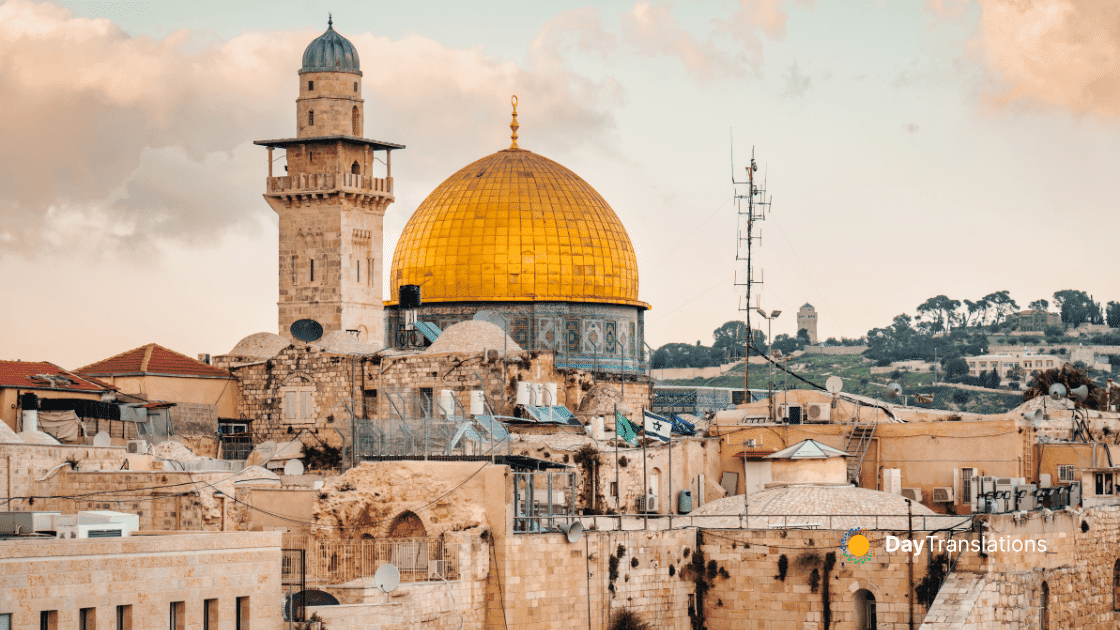
Israel is situated in southwestern Asia along the eastern end of the Mediterranean Sea and borders Lebanon in the north, Syria in the northeast, Jordan in the east, and Egypt on the southwest. Furthermore, the West Bank and Gaza Strip are also adjacent.
Israel is a global leader in high-tech and environmental solutions, exporting all kinds of water technologies to the world, as well as in in cutting-edge technology, in medical research and in the arts. Its population is a linguistically and culturally diverse.
:: Background of Israel ::
Following World War II, the British withdrew from their mandate of Palestine, and the UN partitioned the area into Arab and Jewish states, an arrangement rejected by the Arabs. Subsequently, the Israelis defeated the Arabs in a series of wars without ending the deep tensions between the two sides. The territories Israel occupied since the 1967 war are not included in the Israel country profile, unless otherwise noted. On 25 April 1982, Israel withdrew from the Sinai pursuant to the 1979 Israel-Egypt Peace Treaty.
In this Country Profile
In keeping with the framework established at the Madrid Conference in October 1991, bilateral negotiations were conducted between Israel and Palestinian representatives and Syria to achieve a permanent settlement. Israel and Palestinian officials signed on 13 September 1993 a Declaration of Principles (also known as the “Oslo Accords”) guiding an interim period of Palestinian self-rule. Outstanding territorial and other disputes with Jordan were resolved in the 26 October 1994 Israel-Jordan Treaty of Peace. In addition, on 25 May 2000, Israel withdrew unilaterally from southern Lebanon, which it had occupied since 1982. In April 2003, US President BUSH, working in conjunction with the EU, UN, and Russia – the “Quartet” – took the lead in laying out a roadmap to a final settlement of the conflict by 2005, based on reciprocal steps by the two parties leading to two states, Israel and a democratic Palestine. However, progress toward a permanent status agreement was undermined by Israeli-Palestinian violence between September 2003 and February 2005. An Israeli-Palestinian agreement reached at Sharm al-Sheikh in February 2005, along with an internally-brokered Palestinian ceasefire, significantly reduced the violence.
In the summer of 2005, Israel unilaterally disengaged from the Gaza Strip, evacuating settlers and its military while retaining control over most points of entry into the Gaza Strip. The election of HAMAS in January 2006 to head the Palestinian Legislative Council froze relations between Israel and the Palestinian Authority (PA). Ehud OLMERT became prime minister in March 2006; following an Israeli military operation in Gaza in June-July 2006 and a 34-day conflict with Hizballah in Lebanon in June-August 2006, he shelved plans to unilaterally evacuate from most of the West Bank. OLMERT in June 2007 resumed talks with the PA after HAMAS seized control of the Gaza Strip and PA President Mahmoud ABBAS formed a new government without HAMAS.
:: Geography of Israel ::
Location: Middle East, bordering the Mediterranean Sea, between Egypt and Lebanon.
Geographic coordinates: 31 30 N, 34 45 E
Area:
total: 20,770 sq km
land: 20,330 sq km
water: 440 sq km
Area – comparative: slightly smaller than New Jersey
Land boundaries: total: 1,017 km
border countries: Egypt 266 km, Gaza Strip 51 km, Jordan 238 km, Lebanon 79 km, Syria 76 km, West Bank 307 km
Maritime claims:
territorial sea: 12 nm
continental shelf: to depth of exploitation
Climate: temperate; hot and dry in southern and eastern desert areas
Terrain: Negev desert in the south; low coastal plain; central mountains; Jordam Rift Valley:
Elevation extremes:
lowest point: Dead Sea -408 m
highest point: Har Meron 1,208 m
Natural resources: timber, potash, copper ore, natural gas, phosphate rock, magnesium bromide, clays, sand.
Land use:
arable land: 15.45%
permanent crops: 3.88%
other: 80.67% (2005)
Natural hazards: sandstorms may occur during spring and summer; droughts; periodic earthquakes.
Environment – current issues: limited arable land and natural fresh water resources pose serious constraints; desertification; air pollution from industrial and vehicle emissions; groundwater pollution from industrial and domestic waste, chemical fertilizers, and pesticides.
Environment – international agreements: party to: Biodiversity, Climate Change, Climate Change-Kyoto Protocol, Desertification, Endangered Species, Hazardous Wastes, Ozone Layer Protection, Ship Pollution, Wetlands, Whaling. Signed, but not ratified: Marine Life Conservation.
:: People of Israel ::
Population: 7,112,359
note: includes about 187,000 Israeli settlers in the West Bank, about 20,000 in the Israeli-occupied Golan Heights, and fewer than 177,000 in East Jerusalem (July 2008 est.)
Age structure:
0-14 years: 28% (male 1,018,229/female 971,083)
15-64 years: 62.2% (male 2,242,928/female 2,183,688)
65 years and over: 9.8% (male 303,289/female 393,142) (2008 est.)
Median age:
total: 28.9 years
male: 28.2 years
female: 29.7 years (2008 est.)
Population growth rate: 1.713% (2008 est.)
Birth rate: 20.02 births/1,000 population (2008 est.)
Death rate: 5.41 deaths/1,000 population (2008 est.)
Net migration rate: 2.52 migrant(s)/1,000 population (2008 est.)
Sex ratio:
at birth: 1.05 male(s)/female
under 15 years: 1.05 male(s)/female
15-64 years: 1.03 male(s)/female
65 years and over: 0.77 male(s)/female
total population: 1 male(s)/female (2008 est.)
Infant mortality rate:
total: 4.28 deaths/1,000 live births
male: 4.43 deaths/1,000 live births
female: 4.12 deaths/1,000 live births (2008 est.)
Life expectancy at birth:
total population: 80.61 years
male: 78.54 years
female: 82.79 years (2008 est.)
Total fertility rate: 2.77 children born/woman (2008 est.)
HIV/AIDS – adult prévalence rate: 0.1% (2001 est.)
HIV/AIDS – people living with HIV/AIDS: 3,000 (1999 est.)
HIV/AIDS – deaths: 100 (2001 est
Nationality: noun: Israeli(s) adjective: Israeli
Ethnic groups: Jewish 76.4% (of which Israel-born 67.1%, Europe/America-born 22.6%, Africa-born 5.9%, Asia-born 4.2%), non-Jewish 23.6% (mostly Arab) (2004)
Religions: Jewish 76.4%, Muslim 16%, Arab Christians 1.7%, other Christian 0.4%, Druze 1.6%, unspecified 3.9% (2004)
Languages: Hebrew (official), Arabic used officially for Arab minority, English most commonly used foreign language
Literacy:
definition: age 15 and over can read and write
total population: 97.1%
male: 98.5%
female: 95.9% (2004 est.)
Geography of Israel: Important Geographical Information about Israel
In this Country Profile
Israel, with its spectrum of physical features, has a very diverse geography, with desert conditions in the south, and snow-capped mountains in the north. The south of the country is as already mentioned, dominated by the incredible arid region, the Negev desert which covers some 12,000 sq. km, at least 55% of the country’s land area. The north of the Negev contains the breathtaking Judean Desert, bordered by the Mountains of Judea to the west and by the Dead Sea to the East, which, at -408 meters is the lowest point on Earth. The highest point in Israel’s internationally recognized territory is the fascinating Mount Meron at 1,208 m. Israel may be divided into 4 physiographic regions:
Mediterranean Coastal Plain: the narrow coastal plain along Israel’s Mediterranean Sea stretches 187 km from the Lebanese border in the north to Gaza, interrupted only by Cape Carmel at Haifa Bay. The fertile and humid region is divided into a number of areas; the Plain of Zebulun (north of Haifa), Hof HaCarmel (from Haifa to Mount Carmel), the Sharon plain (from Mount Carmel to Tel Aviv), and the Plain of Judea (from Tel Aviv to Zikim).
The Central Hills: in the north of the Israeli Central Hills lie the mountains and hills of Upper Galilee and Lower Galilee. The highest point in Israel’s internationally recognized territory is in the Central Hills, the fascinating Mount Meron at 1,208 m. South of the Galilee, are the Samarian Hills with numerous small, fertile valleys rarely reaching the height of 800 meters. South of Jerusalem are the mainly barren Judean Hills, including Mount Hebron.
Jordan Rift Valley: East of the central highlands lies the Jordan Rift Valley, an elongated depression, which is a small part of the 6,500 kilometers long Syrian-East African Rift. In Israel the Rift Valley includes the Jordan River, Hula Valley, Lake Tiberias and the Dead Sea. The Jordan, Israel’s largest river (322 km).
Negev Desert: The Negev Desert, a region dominated by limestone and chalk, comprises 12,000 square kilometers, more than half of Israel’s total land area. Mark Twain described the Negev Desert in “The Innocents Abroad” as “a desolation that not even imagination can grace with the pomp of life and action”. Unique to the Negev region are the craterlike makhteshim cirques; Makhtesh Ramon, Makhtesh Gadol and Makhtesh Katan. The Negev is also sub-divided into five different ecological regions: northern, western and central Negev, the high plateau and the Arabah Valley.
Professional Translation Organizations & Associations in Israel
In this Country Profile
Below is a list of the major translation organizations and associations of Israel.
:: List of Organizations ::
Bar-Ilan University, Faculty of Humanities, Translation and Interpreting Studies
Israel Translators’ Association
Tel Aviv University, Department of Poetics and Comparative Literature, Faculty of the Humanities
Information about the Israeli Flag: Colors and Meaning of the Flag of Israel
In this Country Profile
:: Meaning of the Israel Flag ::
The flag of Israel consists of two blue stripes on a white background. On the white portion of the Israel flag there is the blue Star of David. The Star of David is composed of two crossing equal blue triangles. The flag of Israel was adopted on October 28, 1948. The shape and flag ratio of the Israeli flag is described as 8:11.
The blue hexagram (six-pointed linear star) known as the The Magen David (shield of David, Star of David, is a common symbol of the People of Israel. It became a Jewish symbol starting in late medieval Prague, and was adopted by the First Zionist Congress in 1897. The blue and white stripes represent purity, guided by the principles of the Torah.
Extensive List of Languages of Israel: Spoken and Extinct Languages
In this Country Profile
:: List of Living Languages ::
Adyghe
[ady] 3,000 in Israel (1987). Kafr Kama and Rehaniya, small border villages. Alternate names: West Circassian, Adygey. Classification: North Caucasian, West Caucasian, Circassian
Amharic
[amh] 40,000 in Israel (1994 H. Mutzafi). Classification: Afro-Asiatic, Semitic, South, Ethiopian, South, Transversal, Amharic-Argobba
Arabic, Judeo-Iraqi
[yhd] 100,000 in Israel (1994). Population total all countries: 100,100. Originally from Iraq. Also spoken in India, Iraq, United Kingdom. Alternate names: Iraqi Judeo-Arabic, Jewish Iraqi-Baghdadi Arabic, Arabi, Yahudic. Dialects: Not intelligible with Judeo-Tripolitanian Arabic, Judeo-Tunisian Arabic, or Judeo-Moroccan Arabic. Close to Baghdadi Arabic and North Mesopotamian Arabic. Classification: Afro-Asiatic, Semitic, Central, South, Arabic
Arabic, Judeo-Moroccan
[aju] 250,000 in Israel (1992 H. Mutzafi). Population total all countries: 258,925. Also spoken in Canada, France, Morocco. Dialects: Many dialects. Much intelligibility with Tunisian Judeo-Arabic, some with Judeo-Tripolitanian Arabic, but none with Judeo-Iraqi Arabic. May be inherently intelligible with Moroccan Arabic. Classification: Afro-Asiatic, Semitic, Central, South, Arabic
Arabic, Judeo-Tripolitanian
[yud] 30,000 in Israel (1994 H. Mutzafi). Population total all countries: 35,000. Originally from Tripolitania, Libya. None left in Libya. Also spoken in Italy. Alternate names: Tripolitanian Judeo-Arabic, Jewish Tripolitanian-Libyan Arabic, Tripolita’it, Yudi. Dialects: Not intelligible with Judeo-Iraqi Arabic. Medium intelligibility with Judeo-Tunisian Arabic and Judeo-Morocco Arabic. Classification: Afro-Asiatic, Semitic, Central, South, Arabic
Arabic, Judeo-Tunisian
[ajt] 45,000 in Israel (1995 H. Mutzafi). Population total all countries: 45,500. Also spoken in France, Italy, Spain, Tunisia, USA. Dialects: Medium intelligibility with Judeo-Moroccan Arabic and Judeo-Tripolitanian Arabic, but none with Judeo-Iraqi Arabic. A lexicon of 5,000 words in 1950 had 79% words of Arabic origin, 15% Romance loanwords, 4.4% Hebrew loanwords, 1.6% others (D. Cohen 1985:254). Classification: Afro-Asiatic, Semitic, Central, South, Arabic
Arabic, Judeo-Yemeni
[jye] 50,000 in Israel (1995 Y. Kara). Population total all countries: 51,000. Also spoken in Yemen. Alternate names: Judeo-Yemeni, Yemenite Judeo-Arabic. Dialects: San`a, `Aden, Be:da, Habban. Language varieties are all markedly different from their coterritorial Muslim ones. Classification: Afro-Asiatic, Semitic, Central, South, Arabic
Arabic, South Levantine Spoken
[ajp] 910,000 in Israel. Alternate names: Levantine, Palestanian-Jordanian Arabic. Dialects: Madani, Fellahi. Classification: Afro-Asiatic, Semitic, Central, South, Arabic
Arabic, Standard
[arb] Middle East, North Africa. Classification: Afro-Asiatic, Semitic, Central, South, Arabic
Armenian
[hye] 3,000 in Israel (1971 The Armenian Review). Jerusalem. Alternate names: Haieren, Somkhuri, Ermenice, Armjanski. Dialects: Western Armenian. Classification: Indo-European, Armenian
Barzani Jewish Neo-Aramaic
[bjf] 20 (2004 Mutzafi). In Israel since 1951. Alternate names: Lishan Didan, Lishan Dideni, Bijil Neo-Aramaic. Dialects: Barzan, Shahe, Bijil. Sandu is a Jewish Neo-Aramaic dialect closely related to Barzani, but evinces several isoglosses binding it with Lishana Deni. Classification: Afro-Asiatic, Semitic, Central, Aramaic, Eastern, Central, Northeastern Nearly extinct.
Bukharic
[bhh] 50,000 in Israel (1995 H. Mutzafi). Population total all countries: 110,000. Also spoken in USA, Uzbekistan. Alternate names: Bokharic, Bukharian, Bokharan, Bukharan, Judeo-Tajik. Dialects: Related to Tajiki Persian. May be easily intelligible with Tajiki or Farsi. Also close to Judeo-Persian. Classification: Indo-European, Indo-Iranian, Iranian, Western, Southwestern, Persian
Domari
[rmt] 2,000 in Israel (1997 Yaron Matras). Population includes Palestinian West Bank and Gaza. Mainly Jerusalem (Old City), Bir Zeit near Ramallah, and Gaza. Alternate names: Nawari, Dom, Near-Eastern Gypsy. Dialects: Nawari. Classification: Indo-European, Indo-Iranian, Indo-Aryan, Central zone, Dom
Dzhidi
[jpr] 60,000 in Israel (1995). Also spoken in Iran. Alternate names: Judeo-Persian. Dialects: Close to Bukharic, Western Farsi. Classification: Indo-European, Indo-Iranian, Iranian, Western, Southwestern, Persian
English
[eng] 100,000 in Israel (1993). Alternate names: Anglit. Classification: Indo-European, Germanic, West, English
Hebrew
[heb] 4,847,000 in Israel (1998). Population total all countries: 5,055,000. Also spoken in Australia, Canada, Germany, Palestinian West Bank and Gaza, Panama, United Kingdom, USA. Alternate names: Ivrit. Dialects: Standard Hebrew (General Israeli, Europeanized Hebrew), Oriental Hebrew (Arabized Hebrew, Yemenite Hebrew). Not a direct offspring from Biblical or other varieties of Ancient Hebrew, but an amalgamation of different Hebrew strata plus intrinsic evolution within the living speech. Classification: Afro-Asiatic, Semitic, Central, South, Canaanite
Hulaulá
[huy] 10,000 in Israel (1999 H. Mutzafi). Population total all countries: 10,300. Also spoken in Iran, USA. Alternate names: Judeo-Aramaic, Lishana Noshan, Lishana Axni, Jabali, Kurdit, Galiglu, ‘Aramit, Hula Hula. Dialects: Saqiz, Kerend, Sanandaj, Suleimaniya. Very different and not intelligible with the Christian Aramaic languages or Lishana Deni. 60% to 70% intelligibility of Lishanan and Lishanid Noshan. Classification: Afro-Asiatic, Semitic, Central, Aramaic, Eastern, Central, Northeastern
Hungarian
[hun] 70,000 in Israel (1998 H. Mutzafi). Classification: Uralic, Finno-Ugric, Ugric, Hungarian
Israeli Sign Language
[isr] 5,000 users including some hearing persons (1986 Gallaudet Univ.). Alternate names: ISL. Dialects: Not derived from and relatively little influence from other sign languages. No special signs have been introduced from outside by educators. Minor dialect variation. Classification: Deaf sign language
Judeo-Berber
[jbe] 2,000 (1992 Podolsky). Formerly High Atlas range, Tifnut, and other communities. Speakers went to Israel from 1950 to 1960. Classification: Afro-Asiatic, Berber, Northern, Atlas
Judeo-Georgian
[jge] 59,800 in Israel (2000 WCD). Population total all countries: 79,800. Some have gone elsewhere in the former USSR and to other countries. Also spoken in Georgia. Dialects: Oriental and Ashkenazic Jews in Georgia live separately. Judeo-Georgian speakers live separately from non-Jewish Georgian speakers. May not be a separate language from Georgian, but a dialect using various Hebrew loanwords. Classification: Kartvelian, Georgian
Judeo-Tat
[jdt] 70,000 in Israel (1998). Population total all countries: 101,000. Sderot, Haderah, and Or Akiva, Israel. None in Iran. They are emigrating from the Caucasus Mountains to Israel at the rate of 2,000 a year. Also spoken in Azerbaijan, Russia (Europe). Alternate names: Judeo-Tatic, Jewish Tat, Bik, Dzhuhuric, Juwri, Juhuri. Dialects: Derbend. Several dialects. Difficult intelligibility of Mussulman Tat. There may also be a Christian dialect. Classification: Indo-European, Indo-Iranian, Iranian, Western, Southwestern, Tat
Ladino
[lad] 100,000 in Israel (1985). Population total all countries: 110,000. Ethnic group members also in Salonica, Greece; Sofia, Bulgaria. Formerly also in Morocco. Also spoken in Greece, Puerto Rico, Turkey (Europe), USA. Alternate names: Judeo Spanish, Sefardi, Dzhudezmo, Judezmo, Spanyol, Haquetiya. Dialects: Judezmo (Judyo, Jidyo), Ladino, Haquetiya (Haketia, Haketiya, Hakitia). The Balkan dialect is more influenced by Turkish and Greek. The North African dialect is more influenced by Arabic and French. Classification: Indo-European, Italic, Romance, Italo-Western, Western, Gallo-Iberian, Ibero-Romance, West Iberian, Castilian
Lishán Didán
[trg] 4,228 in Israel (2001 WCD). Population total all countries: 4,378. Jerusalem and Tel-Aviv area mainly. Originally Iranian Azerbaijan and southeast Turkey. Also spoken in Azerbaijan, Georgia. Alternate names: Lishanán, Lishanid Nash Didán, Persian Azerbaijan Jewish Aramaic, Lakhlokhi, Galihalu. Dialects: Northern Cluster Lishán Didán, Southern Cluster Lishán Didán. 60% to 70% intelligibility of Hulaulá and Lishanid Noshan, but not of other Aramaic languages. Northern cluster subdialects are Urmi, Salmas, Anatolia; southern cluster dialects are Naghada, Ushno, Mahabad. The Urmi subdialect of Lishán Didán is different from the Urmi subdialect of Assyrian Neo-Aramaic. Classification: Afro-Asiatic, Semitic, Central, Aramaic, Eastern, Central, Northeastern
Lishana Deni
[lsd] 7,000 to 8,000 (1999 H. Mutzafi). Ethnic population: 9,061 (2000 WCD). Jerusalem and vicinity, including Maoz Tsiyon. Originally from northwest Iraqi Kurdistan. Alternate names: Judeo-Aramaic, Lishan Hudaye, Lishan Hozaye, Kurdit. Dialects: Zakho, Amadiya, Barashe, Shukho, Nerwa, Dohuk, Atrush, Bétanure. Resembles Chaldean Neo-Aramaic, but there are differences in morphology and other features. Inherent intelligibility is high between them. Low intelligibility of Ashirat dialects of Assyrian New-Aramaic; not intelligible with other Neo-Aramaic varieties. Classification: Afro-Asiatic, Semitic, Central, Aramaic, Eastern, Central, Northeastern
Lishanid Noshan
[aij] 2,000 to 2,500 (1994 H. Mutzafi). Originally eastern and southern Iraqi Kurdistan. Alternate names: Lishana Didán, Hulani, Kurdit, Galigalu, Jbeli, Hula’ula. Dialects: Arbel (Arbil), Dobe, Koy Sanjaq, Rwanduz, Rustaqa, Shaqlawa, Ranye, Qaladze. 60% to 70% inherent intelligibility of Lishanan and Hulaulá. Very different and not inherently intelligible with the Christian Aramaic languages and Lishana Deni. Western cluster subdialects are Arbil, Dobe. Eastern cluster subdialects are Southeastern varieties: Koy Sanjaq, Qaladze. Northeastern varieties: Rwanduz, Rustaqa. Classification: Afro-Asiatic, Semitic, Central, Aramaic, Eastern, Central, Northeastern
Polish
[pol] 100,000 in Israel (1992 H. Mutzafi). Alternate names: Polski. Classification: Indo-European, Slavic, West, Lechitic
Romanian
[ron] 250,000 in Israel (1993 Statistical Abstract of Israel). Classification: Indo-European, Italic, Romance, Eastern
Russian
[rus] 750,000 in Israel (1999 H. Mutzafi). Alternate names: Russit, Russki. Classification: Indo-European, Slavic, East
Tigrigna
[tir] 10,000 in Israel (1994 H. Mutzafi). Alternate names: Tigrinya. Classification: Afro-Asiatic, Semitic, South, Ethiopian, North
Yevanic
[yej] 35 in Israel. There were a few semispeakers left in 1987 and may be none now. Population total all countries: 50. There may be a handful of older adult speakers still in Turkey. Also spoken in USA. Alternate names: Judeo-Greek, Yevanitika. Classification: Indo-European, Greek, Attic Nearly extinct.
Yiddish Sign Language
[yds] Classification: Deaf sign language
Yiddish, Eastern
[ydd] 215,000 in Israel (1986). Population total all countries: 3,142,560. Southeastern dialect in Ukraine and Romania, Mideastern dialect in Poland and Hungary, Northeastern dialect in Lithuania and Belarus. Also spoken in Argentina, Australia, Belarus, Belgium, Canada, Costa Rica, Estonia, Hungary, Latvia, Lithuania, Moldova, Panama, Poland, Puerto Rico, Romania, Russia (Europe), South Africa, Ukraine, Uruguay, USA. Alternate names: Judeo-German, Yiddish. Dialects: Southeastern Yiddish, Mideastern Yiddish, Northeastern Yiddish. Has many loans from Hebrew and local languages where spoken. Eastern Yiddish originated east of the Oder River through Poland, extending into Belarus, Russia (to Smolensk), Lithuania, Latvia, Hungary, Rumania, Ukraine, and pre-state British-Mandate Palestine (Jerusalem and Safed). Western Yiddish originated in Germany, Holland, Switzerland, Alsace (France), Czechoslovakia, western Hungary, and is nearing extinction. It branched off medieval High German (mainly Rhenish dialects) and received Modern German influences during the 19th and early 20th centuries. Eastern and Western Yiddish have difficult inherent intelligibility because of differing histories and influences from other languages. There are some Western Yiddish speakers in Israel (M. Herzog 1977). Classification: Indo-European, Germanic, West, High German, Yiddish.
:: Extinct Languages ::
Hebrew, Ancient
[hbo] Extinct. Alternate names: Old Hebrew. Classification: Afro-Asiatic, Semitic, Central, South, Canaanite
:: Reference ::
Gordon, Raymond G., Jr. (ed.), 2005. Ethnologue: Languages of the World, Fifteenth edition. Dallas, Tex.: SIL International. Online version: http://www.ethnologue.com/
Famous Israeli People: Israeli Artists, Scientists, Leaders, Musicians, Politicians and Athletes
In this Country Profile
There is a category of people who changed not only Israel, but the entire world by their thoughts and deeds, and left an eternal trace in the centuries. They are simply remarkable individuals who have one thing in common: are not easy to stereotype. These people of purpose made a difference and inspired us to greatness.
:: List of Famous People from Israel ::
Jesus of Nazareth
“Ask and it will be given to you; seek and you will find; knock and the door will be opened to you.”
Jesus Christ was born in Bethlehem to Hebrew parents and grew up in Nazareth. He is regarded as one of the greatest spiritual leaders the world has ever known. Jesus is the central figure of Christianity, the founder of Christianity and is revered as the Son of God. Jesus was a Galilean Jew who was regarded as a teacher and healer. Furthermore, He is considered in history to be the most influential person in the world.
Natalie Portman
Natalie Portman is a very talented Israeli American actress. She is considered to be one of Hollywood’s most beautiful actresses. The role of Anne Frank in the Broadway production of The Diary of Anne Frank made her even more famous. Natalie was nominated for a Tony award for her performance. In 2005, she received a Golden Globe Award as Best Supporting Actress in the drama Closer. Often referred to as “the new
Audrey Hepburn,” Natalie surely has a bright film career ahead of her.
David Ben-Gurion
“In Israel, in order to be a realist you must believe in miracles”
David Ben-Gurion was the first Prime Minister of Israel, a remarkable statesmen, “a man with fierce ambition for leadership, extraordinary tactical-political skills and a sarcastic edge rather than a sense of humor”. Ben-Gurion’s passion for Zionism culminated in his instrumental role as architect of a new nation, the state of Israel. He is considered the “father” of modern Israel. Ben-Gurion was named also one of Time Magazine’s 100 Most Important People of the Century.
Shoshana Damari
The voice of a nation, Shoshana Damari, the diva of Israeli song, introduced pop music to Israel in 1948 and helped to create a unique sense of cultural identity for the newly formed state. She was gifted with an unusually powerful voice and presence. Damari is one of Israel’s best-loved singers. She was awarded the Israel Prize in 1988 or 1998 for her contributions to vocal music.
Yoram Gaon
Yehoram Gaon is an Israeli singer, gifted actor, TV and radio host, writer, poet and publicist, one of the major proponents of the Israeli culture and entertainment world. He has a long list of performances on stage and screen in both movies and on television. His most notable starring role was in the Israeli film Mivtza Yonatan (English: Operation Thunderbolt) (1977), where he played Yonatan Netanyahu. He has produced and directed plays and movies and written and edited books on Israeli culture and tradition.
Golda Meir
Golda Meir is one of the most influential women leaders of the 20th century, because she successfully navigated the tumultuous tide between conflict and peace. She was Israel’s first female prime minister during a key time in Israel’s history and the world’s third female prime minister. Meir was often described as the “Iron Lady” of Israeli politics, being associated with British prime minister, Margaret Thatcher. “Her complete involvement, tempered with love, fired by fierce devotion, caused the world to know that she was a true mover of mountains”.
Amichai Yehuda
If I forget thee, Jerusalem, Then let my right be forgotten. Let my right be forgotten, and my left remember. Let my left remember, and your right close And your mouth open near the gate. (from If I Forget Thee, Jerusalem’)
A. Yehuda was one of Israel’s foremost contemporary Hebrew poets, one of the first to write in colloquial Hebrew. Amichai’s first volume of poetry, “Achshav Uve-Yamim HaAharim” (“Now and in Other Days”) published 1955 aroused serious interest in readers. Much of Amichai’s fiction is autobiographical. Amichai has published eleven volumes of poetry in Hebrew. In addition to his numerous volumes of poetry, he has written short stories and novels. The work of the poet has been translated into thirty-seven languages. Amichai received the Israel Prize for Poetry and he became a foreign honorary member of the American Academy of Arts and Letters in 1986. “His contribution extends beyond his own literary achievements to an influence that helped create a modern Israeli poetry”.
Shari Arison
Shari Arison is a famous Israeli-American businesswoman and Israel’s wealthiest citizen. She is the owner of several businesses, the largest among them Bank Hapoalim. According to Forbes, she is the richest woman in the Middle East, and the only woman to be ranked in the region’s top 20 richest people in 2007.
Yael Arad
Yael Arad was the first Israeli to win an Olympic medal at the Olympic games in Barcelona in 1992. She had the opportunity to put Israel on the map of international athletic achievements. Yael Arad is widely recognized as one of the country’s most successful athletes of all time, and is credited with bringing the judo sport to the athletic mainstream. A two-time Olympian, Arad put judo on the map in Israel, making it a popular sport in the country
Alon Ben David:
He’s an Israeli print and television journalist who has covered Israeli military affairs for more than two decades and who’s considered an expert in numerous Middle East matters. He’s currently a senior defense correspondent for Channel 10 (Israel) and a Middle East correspondent for Jane’s Defence Weekly (JDW) and Aviation Week. He’s covered important events such as the first and the second Intifada; the first Lebanon War and Israel’s withdrawal from Lebanon in 200; the 9/11 attacks from New York (2001); and the second Lebanon War (2006).
Uri Geller:
Born in Tel Aviv, Israel, in 1946, he’s a very popular Israeli television personality, magician and paranormalist who’s gained international fame for “bending spoons with his mental powers” and for assuring that he’s a psychic who has paranormal abilities and psychic powers. Along with illusionist Chris Angel, he was a jury in the reality show “Phenomenon”, in which they looked for the most powerful mentalists of the moment. He has written more than fifteen books and writes articles for different news papers and for the Internet. Although being currently retired from public life, Geller still performs occasionally. Though he has many critics who assure that his so called powers are just easily replicated magic tricks, he’s been an entertainer for almost forty years.
Idan Raichel:
Born in Kfar Sava, Israel, in 1977, he’s a popular Israeli singer, songwriter and musician who’s gained most of his international fame with his “Idan Raichel Project” and with his fusion of jazz, ballads, electronic music and traditional Ethiopian and Sephardic music. Most of the lyrics of “The Idan Raichel Project” are in Hebrew and some of them are in Amharic, but, in 2006 was released an international version of the album with English translations. He started as a keyboardist and worked with other famous artists such as Ivri Lider. He’s sold more than three hundred copies of his albums.
Miri Ben Ari:
Born in Tel Aviv, Israel, in 1978, she’s a famous Israeli violinist who’s best known for playing her violin in rap music. She was first discovered by rapper and R&B singer Wyclef Jean, former member of The Fugees. She’s collaborated with famous artists like Kanye West, Brandy, Twista, John Legend, Jay-Z, Alicia Keys, Britney Spears, Maroon 5, Janet Jackson, Donna Summer, Don Omar, Aventura and others. She’s been part of several commercial and advertising campaigns of different companies such as Reebook, Pepsi and Coca-Cola. She was the voice of VH1 Save the Music. Some of her best known singles are “Overnight celebrity” (with Twista), “Jesus walks” and “The new workout plan” (with Kanye West). Her single “Symphony of brotherhood” (featuring Martin Luther King Jr.’s Dream speech) was the first instrumental single ever to hit on Billboard’s R&B/Hip Hop charts, MTV and VH1. She’s received several awards not only for her music, but also for her work in her non-profit organization “Gedenk” (Remember), which teaches and promotes awareness about the Holocaust among youth. Israeli President, Shimon Peres, presented her the first Israeli Martin Luther King Award.
Tamar Adar:
She was born in Tel Aviv, Israel, in 1939, and she died in 2008. She was an Israeli poet, writer, screenwriter and playwright best known for her children’s books and her screenplays for Israeli television series, among other works. She received several awards such as the Ze’ev Prize for Youth and Child Literature from the Ministry of Education of Israel.
David Grossman:
“The primary urge that motivates and engenders writing…is the writer’s desire to invent and tell a story, and to know himself. But the more I write, the more I feel the force of the other urge, which collaborates with and completes the first one: the desire to know the Other from within him. To feel what it means to be another person. To be able to touch, if only for a moment, the blaze that burns within another human being.”
Born in Jerusalem, Israel, in 1954, he’s a famous Israeli writer and essayist who’s considered the most important writer of the Israeli contemporary literature. He writes fiction, non-fiction, and youth and children’s literature. He has an innovative and complex language, and he’s been compared to writers of the level of Gabriel García Márquez and Günter Grass for his domain of the use of reality and fantasy. His works have been translated into 26 languages. Some of his books have been adapted to the screen. He’s known for being an activist and a pacifist who believes in other solutions for the Israeli-Palestinian conflict. He’s received several awards such as the Prime Minister’s Prize for Creative Work (1984), the Italian prize Premio Flaiano (2004), the Bialik Prize for literature (in 2004 along with Haya Shenhav and Ephraim Sidon), the Emet Prize (2007) and the Geschwister-Scholl-Preis (2008). Some of his novels are: “The smile of the lamb” (1983), “The book of intimate grammar” (1991) and “Someone to run with” (2000), among others. “The yellow wind” was an acclaimed but revolutionary nonfiction study about Palestinians in the Israeli-occupied West Bank and the Gaza Strip.
Meir Shalev:
Born in Nahalal, Israel, in 1948, he’s an Israeli writer, essayist, television and radio personality, author of fiction and nonfiction, and of literature for both children and adults. He’s the son of the Israeli poet Yitzchak Shalev. His first novel was “The blue mountain”, published in 1988. He’s a columnist in the Israeli press. He received Israel’s highest literary recognition, the Brenner Prize, for his novel “A pigeon and a boy”, published in 2006. He’s also received other awards such as the Juliet Club Prize, the Chiavari, the Entomological Prize and the WIZO Prize.
Yaky Yosha:
Born in Tel Aviv, Israel, in 1951, he’s a very famous, acclaimed and controversial Israeli film director, screenwriter, author and playwright whose works are considered among the best films of the Israeli cinema. He’s known for the realism in his movies, which has been very socially and politically controversial, especially in his country. His first feature film was “Shalom” (1972) and the second one was “Rocking horse” (1978), which was very important for the Israeli society and is considered one of the masterpieces of the Israeli film industry. He’s written one book called “Still walking”, which was published in 2008. He’s won several film awards such as the special jury prize and the best actor award in the Oxford Film Festival, both for his movie “Rocking horse”.
Haim Hazaz:
He was born in Kiev, Russian Empire (now Ukraine) in 1898 and died in Jerusalem, Israel, in 1973. He was an important Israeli novelist who lived in many European cities, started writing in Paris and spent the last four decades of his life writing and working in Jerusalem. He was named “Freeman of Jerusalem”. He received numerous national and international honors and awards; in 1953 he became the first winner of the Israeli Prize for Literature; he received the Bialik Prize for Literature in two occasions (in 1942, along with Shaul Tchernichovsky, and again in 1970); he received Honorary Doctorates from the Jewish Theological Seminary in New York, from Dropsie College in Philadelphia and from the Hebrew University in Jerusalem. He was an Honorary Member of the Hebrew Language Academy as well as the President of the Hebrew Writers Association. Some of his works have been translated into other languages. He’s buried in the Mount of Olives. Some of Hazaz’s works that have been translated into English are “The end of days” (1982), “The sermon” (1981) and “The gates of bronze” (1975).
Dorit Bar Or:
Born in 1975 in Israel, she’s an acclaimed Israeli film, television and theatre actress, as well as a fashion personality who’s been nominated for numerous awards. She’s acted in different television series of several Israeli cable networks such as Channel 10. In 2009, the Israeli magazine Pnai Plus named her No.1 Chic Dressed Person.
Raz Degan:
Born in Tel Aviv, Israel, in 1968, he’s a famous Israeli male actor (television, cinema and theatre) and model who’s worked with prestigious film directors such as Oliver Stone and who’s been part of the advertising campaigns and commercials of big brands such as Coca Cola, IBM, Levis, L’oreal, Polaroid, Cinzano, Jägermeister, among others. He debuted as an actor in 1994, in the film “Pret-a-porter” by Robert Altman.
Yvan Attal:
Born in Tel Aviv, Israel, in 1965, he’s an Israeli-born French actor and film director who’s appeared in several American films such as Sydney Pollack’s “The interpreter”, next to actors Nicole Kidman and Sean Penn; Steven Spielberg’s “Munich”; and “Rush Hour 3”. He debuted as an actor in 1989 in the movie “Un monde sans pitié” (Love without pity), for which he won a César Award for Most Promising Actor.
Uri Savir:
“I’m afraid we have not learned all the necessary lessons.”
Born in Jerusalem, Israel, in 1953, he’s an Israeli politician and diplomat who played an essential role in the negotiations and the signing of the Interim Agreement with Palestine in 1995. He was Israel’s Chief Negotiator with the Palestine Liberation Organization (PLO) in the Oslo Accords between 1993 and 1996, and became the first Israeli officer to secretly negotiate with a senior representative of the PLO. He was also the head of Israel’s delegation for the negotiations with Syria. He was Israel’s consul in New York from 1988 to 1992 and general manager of the Ministry of Foreign Affairs of Israel from 1993 to 1996. He was a member of the Knesset between 1999 and 2001. He’s been an associate of the current President of the State of Israel, Shimon Peres, since 1984; he currently heads the Shimon Peres Center for Peace in Tel Aviv and is the president of the Glocal Forum, an international relations nonprofit organization. He wrote the book “The Process: 1,100 Days that Changed the Middle East”, which was pubished in 1998.
Hillel Slovak:
He was born in Haifa, Israel, in 1963 and he died in 1988. He was a famous Israeli American composer, guitarist and musician who was one of the founders and members of the popular rock band Red Hot Chili Peppers. He recorded two albums with the band: “Freake styley” in 1985 and “The uplift mofo party plan” in 1987. He was very influenced by Jimi Hendrix. He had several nicknames such as “Slim Bob Billy”, “Slim” and “Huckleberry”. He was a drug addict and he died of a heroin overdose in Los Angeles when he was only 25 years old. The band couldn’t finish the album “Rockin Freakapotamus”, which was being recorded when Slovak died. In 1999, his brother James Slovak published a book about Hillel called “Behind the Sun: The Diary & Art of Hillel Slovak”, in which he included writings from Hillel’s photos, diaries and paintings. After Hillel’s death, the Red Hot Chili Peppers recorded two songs as a tribute to him: “Knock me down” and “My lovely man”.
Leah Goldberg:
“My homeland, a poor and fair land
The Queen has no home, the King has no crown
And there are seven days of spring-time a year
All the rest are rain and chill.”
She was born in Königsberg, Germany, in 1911 and died in Jerusalem, Israel, in 1970. She was a very important, influential and prolific Israeli writer, poet, playwright, translator, researcher and author whose works are considered classics of the Israeli and the Hebrew literature. She worked in different genres, including children’s literature, in which works like “Dira Lehaskir” (Apartment for rent) have become classics of the Israeli children’s literature. She spoke seven languages and she translated numerous works into Hebrew, especially Italian and Russian works. Her poems have been used in many songs by several singers such as Ajinoam Nini, Java Alberstein, Nurit Galron, Yossi Banai and others. She was awarded the Ruppin Prize in 1949 and the Israeli Prize for literature in 1970, which was presented to her mother.
Uri Orlev:
Born as Jerzy Henryk Orlowsky in Warsaw, Poland, in 1931, he’s a Polish born Jewish author, screenwriter and translator, a survivor of World War II, who writes fiction for children, youth and adults as well. He spent some years in the Warsaw Ghetto and in the Bergen-Belsen concentration camp. He has published over thirty books and his works have been translated into thirty eight languages. “The island on Bird Street”, published in 1981 and considered a semi-autobiographical book, is one of his most famous works and has been adapted as a film and as a play. He has received many national and international awards such as the Hans Christian Andersen Author Award (1996); the Yad Vashem Bruno Brandt Award (1997); the Ze`ev Prize for Lifetime Achievement (2002); the Andersen Award (2003); the Premio Cento (2003); the Best Audio Book for Youth (2006); and the Bialik Prize, together with Raquel Chalfi and Ruth Almog (2006).
These were the words of the jury when he won the Hans Christian Andersen Award in 1996:
“Uri Orlev’s experience as a Jewish boy in war-torn Poland is the background of this outstanding writer for children. Whether his stories are set in the Warsaw ghetto or his new country Israel, he never loses the perspective of the child he was. He writes at a high literary level, with integrity and humor, in a way which is never sentimental, exhibiting the skill to say much in few words. Uri Orlev shows how children can survive without bitterness in harsh and terrible times.”