
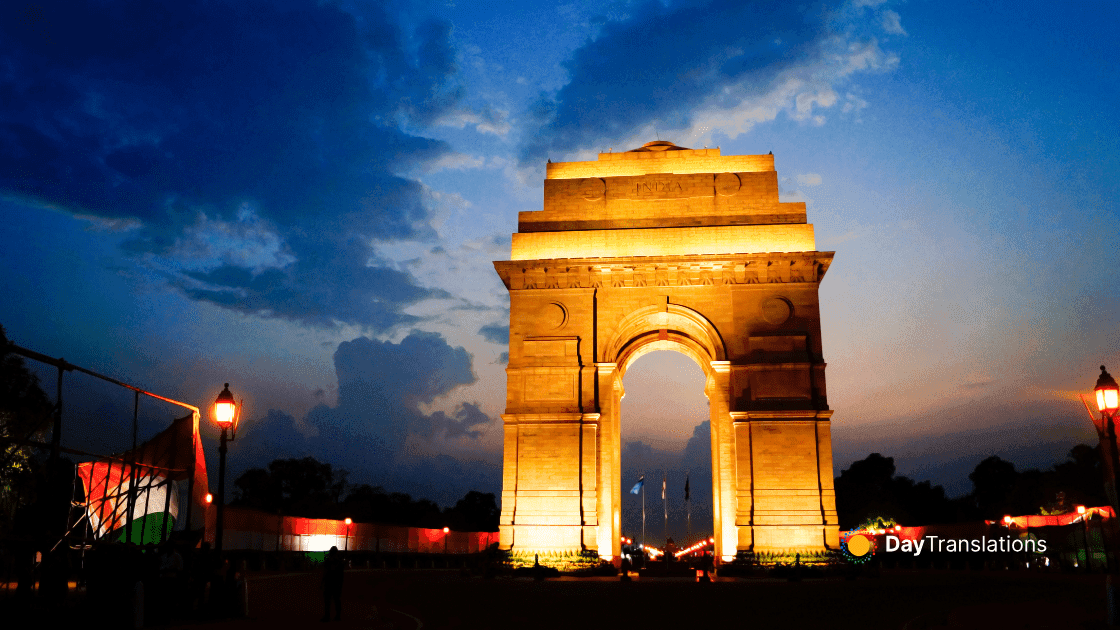
The Republic of India, commonly known as India, is located in South Asia. It is the seventh-largest country by geographical area, the second-most populous country with over 1.2 billion people, and the most populous democracy in the world. Mainland India is bounded by the Indian Ocean on the south, the Arabian Sea on the west, and the Bay of Bengal on the east; and it is bordered by Pakistan to the west; Bhutan, the People’s Republic of China and Nepal to the north; and Bangladesh and Burma to the east. In the Indian Ocean, mainland India and the Lakshadweep Islands are in the vicinity of Sri Lanka and the Maldives, while India’s Andaman and Nicobar Islands share maritime border with Thailand and the Indonesian island of Sumatra in the Andaman Sea. India has a coastline of 7,517 kilometers (4,700 mi).
Home to the ancient Indus Valley Civilization and a region of historic trade routes and vast empires, the Indian subcontinent was identified with its commercial and cultural wealth for much of its long history. Four of the world’s major religions – Hinduism, Buddhism, Jainismand Sikhism – originated here, while Zoroastrianism, Judaism, Christianity and Islam arrived in the first millennium CE and shaped the region’s diverse culture. Gradually annexed by the British East India Company from the early 18th century and colonized by the United Kingdom from the mid-19th century, India became an independent nation in 1947 after a struggle for independence which was marked by a non-violent resistance led by Mahatma Gandhi.
India is a federal constitutional republic with a parliamentary democracy consisting of 28 states and seven union territories. A pluralistic, multilingual and multiethnic society where more than 400 languages are spoken, India is also home to a diversity of wildlife in a variety of protected habitats. The Indian economy is the world’s eleventh largest economy by nominal GDP and the fourth largest by purchasing power parity. Since the introduction of market-based economic reforms in 1991, India has become one of the fastest growing major economies in the world. India is classified as a newly industrialized country and is one of the four BRIC nations. India is a regional power in South Asia.
In this Country Profile
:: Background of India ::
The Indus Valley civilization, one of the world’s oldest, flourished during the 3rd and 2nd millennia B.C. and extended into northwestern India. Aryan tribes from the northwest infiltrated onto the Indian subcontinent about 1500 B.C.; their merger with the earlier Dravidian inhabitants created the classical Indian culture. The Maurya Empire of the 4th and 3rd centuries B.C. – which reached its zenith under ASHOKA – united much of South Asia. The Golden Age ushered in by the Gupta dynasty (4th to 6th centuries A.D.) saw a flowering of Indian science, art, and culture. Islam spread across the subcontinent over a period of 700 years. In the 10th and 11th centuries, Turks and Afghans invaded India and established the Delhi Sultanate. In the early 16th century, the Emperor BABUR established the Mughal Dynasty which ruled India for more than three centuries. European explorers began establishing footholds in India during the 16th century. By the 19th century, Great Britain had become the dominant political power on the subcontinent. The British Indian Army played a vital role in both World Wars. Nonviolent resistance to British rule, led by Mohandas GANDHI and Jawaharlal NEHRU, eventually brought about independence in 1947. Communal violence led to the subcontinent’s bloody partition, which resulted in the creation of two separate states, India and Pakistan. The two countries have fought three wars since independence, the last of which in 1971 resulted in East Pakistan becoming the separate nation of Bangladesh. India’s nuclear weapons tests in 1998 caused Pakistan to conduct its own tests that same year. In November 2008, terrorists allegedly originating from Pakistan conducted a series of coordinated attacks in Mumbai, India’s financial capital. Despite pressing problems such as significant overpopulation, environmental degradation, extensive poverty, and widespread corruption, rapid economic development is fueling India’s rise on the world stage. In January 2011, India assumed a nonpermanent seat in the UN Security Council for the 2011-12 term.
:: Geography of India ::
Location: Southern Asia, bordering the Arabian Sea and the Bay of Bengal, between Burma and Pakistan Geographic coordinates: 20 00 N, 77 00 E
Area:
Total: 3,287,263 sq km
Land: 2,973,193 sq km
Water: 314,070 sq km
Area – comparative: slightly more than one-third the size of the US
Land boundaries: 14,103 km
Border Countries: Bangladesh 4,053 km, Bhutan 605 km, Burma 1,463 km, China 3,380 km, Nepal 1,690 km, Pakistan 2,912 km
Coastline: 7,000 km
Maritime claims:
territorial sea: 12 nm
contiguous zone: 24 nm
exclusive economic zone: 200 nm
continental shelf: 200 nm or to the edge of the continental margin
Climate: varies from tropical monsoon in south to temperate in north
Terrain: upland plain (Deccan Plateau) in south, flat to rolling plain along the Ganges, deserts in west, Himalayas in north
Elevation extremes:
lowest point: Indian Ocean 0 m
highest point: Kanchenjunga 8,598 m
Natural resources: coal (fourth-largest reserves in the world), iron ore, manganese, mica, bauxite, rare earth elements, titanium ore, chromite, natural gas, diamonds, petroleum, limestone, arable land
Land use:
Arable land: 48.83%
permanent crops: 2.8%
other: 48.37% (2005)
Irrigated land: 558,080 sq km (2003)
Total renewable water resources: 1.907.8 cu km (1999)
Freshwater withdrawal (domestic/industrial/agricultural):
total: 645.84 cu km/yr (8%/5%/86%)
per capita: 585 cu m/yr (2000)
Natural hazards: droughts; flash floods, as well as widespread and destructive flooding from monsoonal rains; severe thunderstorms; earthquakes; volcanism: Barren Island (elev. 354 m, 1,161 ft) in the Andaman Sea has been active in recent years
Environment – current issues: deforestation; soil erosion; overgrazing; desertification; air pollution from industrial effluents and vehicle emissions; water pollution from raw sewage and runoff of agricultural pesticides; tap water is not potable throughout the country; huge and growing population is overstraining natural resources
Environment – international agreements: party to: Antarctic-Environmental Protocol, Antarctic-Marine Living Resources, Antarctic Treaty, Biodiversity, Climate Change, Climate Change-Kyoto Protocol, Desertification, Endangered Species, Environmental Modification, Hazardous Wastes, Law of the Sea, Ozone Layer Protection, Ship Pollution, Tropical Timber 83, Tropical Timber 94, Wetlands, Whaling; signed, but not ratified: none of the selected agreements
Geography – note: dominates South Asian subcontinent; near important Indian Ocean trade routes; Kanchenjunga, third tallest mountain in the world, lies on the border with Nepal
:: People of India ::
Maritime claims:
Population: 1,173,108,018 (July 2010 est.)
Age structure:
0-14 years: 30.5% (male 187,197,389/female 165,285,592)
15-64 years: 64.3% (male 384,131,994/female 359,795,835)
65 years and over: 5.2% (male 28,816,115/female 31,670,841) (2010 est.)
Median age:
total: 25.9 years
male: 25.4 years
female: 26.6 years (2010 est.)
Population growth rate: 1.376% (2010 est.)
Birth rate: 21.34 births/1,000 population (2010 est.)
Death rate: 7.53 deaths/1,000 population (July 2010 est.)
Net migration rate: -0.05 migrant(s)/1,000 population (2010 est.)
Urbanization:
urban population: 30% of total population (2008)
rate of urbanization: 2.4% annual rate of change (2005-10 est.)
Sex ratio:
at birth: 1.12 male(s)/female
under 15 years: 1.13 male(s)/female
15-64 years: 1.07 male(s)/female
65 years and over: 0.91 male(s)/female
total population: 1.08 male(s)/female (2010 est.)
Infant mortality rate:
total: 49.13 deaths/1,000 live births
male: 47.7 deaths/1,000 live births
female: 50.73 deaths/1,000 live births (2010 est.)
Life expectancy at birth:
total population: 66.46 years
male: 65.46 years
female: 67.57 years (2010 est.)
Total fertility rate: 2.65 children born/woman (2010 est.)
HIV/AIDS – adult prevalence rate: 0.3% (2007 est.)
HIV/AIDS – people living with HIV/AIDS: 2.4 million (2007 est.)
HIV/AIDS – deaths: 310,000 (2007 est.)
Major infectious diseases:
degree of risk: high
food or waterborne diseases: bacterial diarrhea, hepatitis A and E, and typhoid fever vectorborne diseases: chikungunya, dengue fever, Japanese encephalitis, and malaria animal contact disease: rabies
water contact disease: leptospirosis note: highly pathogenic H5N1 avian influenza has been identified in this country; it poses a negligible risk with extremely rare cases possible among US citizens who have close contact with birds (2009)
Nationality: noun: Indian(s) adjective: Indian
Ethnic groups: Indo-Aryan 72%, Dravidian 25%, Mongoloid and other 3% (2000)
Religions: Hindu 80.5%, Muslim 13.4%, Christian 2.3%, Sikh 1.9%, other 1.8%, unspecified 0.1% (2001 census)
Languages: Hindi 41%, Bengali 8.1%, Telugu 7.2%, Marathi 7%, Tamil 5.9%, Urdu 5%, Gujarati 4.5%, Kannada 3.7%, Malayalam 3.2%, Oriya 3.2%, Punjabi 2.8%, Assamese 1.3%, Maithili 1.2%, other 5.9%
note: English enjoys the status of subsidiary official language but is the most important language for national, political, and commercial communication; Hindi is the most widely spoken language and primary tongue of 41% of the people; there are 14 other official languages: Bengali, Telugu, Marathi, Tamil, Urdu, Gujarati, Malayalam, Kannada, Oriya, Punjabi, Assamese, Kashmiri, Sindhi, and Sanskrit; Hindustani is a popular variant of Hindi/Urdu spoken widely throughout northern India but is not an official language (2001 census)
Literacy:
definition: age 15 and over can read and write
total population: 61%
male: 73.4%
female: 47.8% (2001 census)
School life expectancy (primary to tertiary education):
total: 10 years
male: 11 years
female: 10 years (2007)
Education expenditures: 3.2% of GDP (2007)
Geography of India: Important Geographical Information about India
In this Country Profile
The territory controlled by India, the major portion of the Indian subcontinent, lies between latitudes 6° and 36° N, and longitudes 68° and 98° E. The country sits atop the Indian tectonic plate, a minor plate within the Indo-Australian Plate.
India’s defining geological processes commenced seventy-five million years ago, when the Indian subcontinent, then part of the southern supercontinent Gondwana, began a northeastwards drift—lasting fifty million years—across the then unformed Indian Ocean. The subcontinent’s subsequent collision with the Eurasian Plate and subduction under it, gave rise to the Himalayas, the planet’s highest mountains, which now abut India in the north and the north-east. In the former seabed immediately south of the emerging Himalayas, plate movement created a vast trough, which, having gradually been filled with river-borne sediment, now forms the Indo-Gangetic Plain. To the west of this plain, and cut off from it by the Aravalli Range, lies the Thar Desert.
The original Indian plate now survives as peninsular India, the oldest and most geologically stable part of India, and extends as far north as the Satpura and Vindhya ranges in central India. These parallel ranges run from the Arabian Sea coast in Gujarat in the west to the coal-rich Chota Nagpur Plateau in Jharkhand in the east. To their south, the remaining peninsular landmass, the Deccan Plateau, is flanked on the left and right by the coastal ranges, Western Ghats and Eastern Ghats respectively; the plateau contains the oldest rock formations in India, some over one billion years old. Constituted in such fashion, India lies to the north of the equator between 6°44′ and 35°30′ north latitude and 68°7′ and 97°25′ east longitude.
India’s coast is 7,517 kilometers (4,700 mi) long; of this distance, 5,423 kilometers (3,400 mi) belong to peninsular India, and 2,094 kilometers (1,300 mi) to the Andaman, Nicobar, and Lakshadweep Islands. According to the Indian naval hydrographic charts, the mainland coast consists of the following: 43% sandy beaches, 11% rocky coast including cliffs, and 46% mudflats or marshy coast.
Major Himalayan-origin rivers that substantially flow through India include the Ganges (Ganga) and the Brahmaputra, both of which drain into the Bay of Bengal. Important tributaries of the Ganges include the Yamuna and the Kosi, whose extremely low gradient causes disastrous floods every year. Major peninsular rivers whose steeper gradients prevent their waters from flooding include the Godavari, the Mahanadi, the Kaveri, and the Krishna, which also drain into the Bay of Bengal; and the Narmada and the Tapti, which drain into the Arabian Sea. Among notable coastal features of India are the marshy Rann of Kutch in western India, and the alluvial Sundarbans delta, which India shares with Bangladesh. India has two archipelagos: the Lakshadweep, coral atolls off India’s south-western coast; and the Andaman and Nicobar Islands, a volcanic chain in the Andaman Sea.
Information about the India Flag: Colors and Meaning of the Flag of India
In this Country Profile
:: Meaning of the Flag of India ::
The National Flag of India is a horizontal rectangular tricolour of deep saffron, white and India green; with the Ashoka Chakra, a 24-spoke wheel, in blue at its centre. It was adopted in its present form during a meeting of the Constituent Assembly held on 22 July 1947, when it became the official flag of the Dominion of India. The flag was subsequently retained as that of the Republic of India. In India, the term “tricolour” almost always refers to the Indian national flag. The flag is based on the Swaraj flag, a flag of the Indian National Congress designed by Pingali Venkayya.
Saffron represents courage, sacrifice, and the spirit of renunciation; white signifies purity and truth; green stands for faith and fertility; the blue chakra symbolizes the wheel of life in movement and death in stagnation.
Extensive List of Languages of India: Spoken and Extinct Languages
In this Country Profile
:: List of Languages ::
Aariya [aay] Madhya Pradesh, Chhatarpur, Datia, Panna, Rewa, Satna, Shahdol, Sidhi, Tikamgarh districts. Classification: Unclassified
Adi [adi] 238,000 in India (2000 USCWM). 1,200 Palibo. Population total all countries: 241,190. Arunachal Pradesh, East, West, and Upper Siang districts, Upper Subansiri and Dibang Valley districts; Assam, north hills of Assam Valley, between Bhutan and the Buruli River. Also in Bhutan, China. Alternate names: Abhor, Abor, Boga’er Luoba, Lhoba, Luoba. Dialects: Ashing, Bokar (Boga’er Luoba), Bori, Gallong (Galong), Karko, Komkar, Milang, Minyong, Padam, Pailibo, Pangi, Pasi, Ramo, Shimong, Tangam. Sun (1993) lists Tani varieties as Apatani [apt], Milang, Damu, Mising [mrg], Bangni [dap], Tagin [dap], Sagli, south Aya, Leli, and perhaps the Padam, Bokar, Pailibo, Ramo, Bori, Minyong and Pasi dialects of Adi; Asing, Panggi, Simong, Karok, Hill, Miri [mrg], and some northern and western dialects of Nisi [dap]. Intelligible with Adi Galo [adl] but sociolinguistically distinct. A different language from Yidu Lhoba [clk]. Bokar, Milang, Pailibo, and Ramo are very divergent—possibly separate languages. Classification: Sino-Tibetan, Tibeto-Burman, North Assam, Tani
Adi, Galo [adl] 30,000 (2007 M. Post). A few older adult monolinguals. 74,600 (Joshua Project 07); 150,000–250,000 (Gode Doke 2006). Arunachal Pradesh, Assam, West Siang, East Siang, Dibang Valley (south), Lohit (east), Changlang (northeast), some in Upper Subansiri (west) districts. Alternate names: Adi, Adi-Gallong, Adi-Galo, Galo, Gallong, Galong. Dialects: Lare, Pugo, Karka, Ngongo. Reportedly intelligible with other Adi dialects but sociolinguistically distinct. Lare is the main dialect and is accepted by all the Galo. Classification: Sino-Tibetan, Tibeto-Burman, North Assam, Tani
Agariya [agi] 72,000 (2007). Madhya Pradesh, Mandla, Rewa districts, Maikal hills; Chhattisgarh, Bilaspur District; Uttar Pradesh, Agra, Mathura, Mirzapur districts. Alternate names: Agaria, Agharia, Agoria. Classification: Austro-Asiatic, Munda, North Munda, Kherwari
Ahirani [ahr] 779,000 (1997). Gujarat and Maharashtra states. In Maharashtra: Dhulia, Jalgaon, Nandurbar, Nasik, and Aurangabad districts. Alternate names: Ahiri. Dialects: Preliminary findings show Ahirani to be distinct from Khandesi [khn]. Classification: Indo-European, Indo-Iranian, Indo-Aryan, Central zone, Khandesi
Ahom [aho] Extinct. Assam. Alternate names: Tai Ahom. Classification: Tai-Kadai, Kam-Tai, Be-Tai, Tai-Sek, Tai, Southwestern, Northwest
Aimol [aim] 2,640 (2001 census). Manipur state, Chandel District, Unapal, Satu, Kumbirei, Chingunghut, Aimol Tampak, Khodamphai, Ngairong Aimol, Chandonpokpi, Soibong (Khudengthabi), Khomayai (Khunjai); Senapati District, Tuikhong; Churachandpur District, Luichungbum (Louchulbung); Bishnupur District, Kha-Aimol; Assam state. Dialects: Langrong. Langrong may be a separate language. Related to Chiru [cdf], Purum [pub]. Reportedly intelligible to Koireng [nkd]. Classification: Sino-Tibetan, Tibeto-Burman, Kuki-Chin-Naga, Kuki-Chin, Northern
Aiton [aio] 1,500 (Morey 2006). Assam, Jorhat, Karbi Anglong districts, Doboroni, Banlung, Ahomoni, Balipathar, Kaliyani, Chakihula, Tengani, Barhula villages. Alternate names: Aitonia. Dialects:Similar to Phake [phk]. Related to Shan [shn] of Myanmar. Classification: Tai-Kadai, Kam-Tai, Be-Tai, Tai-Sek, Tai, Southwestern, Northwest
Aka-Bea [abj] Extinct. Andaman Islands, South Andaman Island except northeast coast, and north and east interiors; Rutland Island except south coast; small islands southeast of Rutland; Labyrinth Islands. Alternate names: Aka-Beada, Bea, Beada, Biada, Bogijiab, Bojigniji, Bojigyab. Classification: Andamanese, Great Andamanese, Central
Aka-Bo [akm] Extinct. Andaman Islands, east central coast of North Andaman Island, North Reef Island.Alternate names: Ba, Bo. Classification: Andamanese, Great Andamanese, Northern
Aka-Cari [aci] Extinct. Andaman Islands, north coast of North Andaman Island, Landfall Island, other nearby small islands. Alternate names: Cari, Chariar. Classification: Andamanese, Great Andamanese, Northern
Aka-Jeru [akj] Extinct. Andaman Islands, interior and south North Andaman Island, Sound Island. Alternate names: Jeru, Yerawa. Classification: Andamanese, Great Andamanese, Northern
Aka-Kede [akx] Extinct. Andaman Islands, central and north central Middle Andaman Island. Alternate names: Kede. Classification: Andamanese, Great Andamanese, Central
Aka-Kol [aky] Extinct. Andaman Islands, southeast Middle Andaman Island. Alternate names: Kol. Classification: Andamanese, Great Andamanese, Central
Aka-Kora [ack] Extinct. Andaman Islands, northeast and north central coasts of North Andaman Island, Smith Island. Alternate names: Kora. Classification: Andamanese, Great Andamanese, Northern
Akar-Bale [acl] Extinct. Andaman Islands, Ritchie’s Archipelago, Havelock Island, Neill Island. Alternate names: Bale, Balwa. Classification: Andamanese, Great Andamanese, Central
Allar [all] 350 (Shashi 1994). Kerala, Malappuram District, Perinthalmanna tahsil, Manjeri tahsil, Mannarmala, Aminikadu, and Tazhecode; Palakkad District, Mannarkkad and Ottappalam tahsils.Alternate names: Aalan, Alan, Alanmar, Alar, Allan, Chatans. Dialects: Lexical similarity: 61% with Malayalam [mal], 59% with Tamil [tam]. Classification: Dravidian, Unclassified
Amri Karbi [ajz] 125,000 (2003). Assam, Kamrup District, south of Brahmaputra River in Chandubi, Loharghat, Rani block, Jalukbari, Pandu, Basbistha, Panikhaith, Jorabat, Sonapur, Khetri, Kahi Kusi; Meghalaya; Ri-Bhoi District, Nongpoh area, Barni Hat and Umling. Alternate names: Amri. Dialects: Lower Amri, Upper Amri. Reportedly unintelligible with Karbi [mjw]; intelligibility testing was inconclusive regarding whether Guriaghuli area dialect is well understood in Meghalaya. Lexical similarity: 57%–68% with Karbi; 70% to 86% between dialects. Classification: Sino-Tibetan, Tibeto-Burman, Mikir
Anal [anm] 13,900 in India (2001 census). Southeast Manipur, Chandel District, Chandel, Chakpikarong, Tengnoupal subdivisions, on banks of Chakpi River. Possibly in Bangladesh. Also in Myanmar. Alternate names: Namfau. Dialects: Laizo, Mulsom. Most similar to Lamgang [lmk] (Kuki Naga). Classification: Sino-Tibetan, Tibeto-Burman, Kuki-Chin-Naga, Kuki-Chin, Northern
Andaman Creole Hindi [hca] 20,500 (Singh 1994). Andaman and Nicobar Islands, Port Blair, 40 villages south of Port Blair. Alternate names: Andaman Hindi. Dialects: A creolization of Hindustani, Bengali [ben], Malayalam [mal]. Classification: Creole, Hindi based
Andh [anr] 100,000 (2007). Ethnic population: 420,000 (2007 Joshua Project). Maharashtra, Akola, Aurangabad, Buldana, Nanded, Parbhani, Yevatmal districts; Andhra Pradesh, Adilabad, Hyderabad; Madhya Pradesh. Alternate names: Andha, Andhi. Classification: Indo-European, Indo-Iranian, Indo-Aryan, Unclassified
Angika [anp] 725,000 in India (1997). Population total all countries: 740,900. Northern Bihar. Also in Nepal. Alternate names: Anga, Angikar, Chhika-Chhiki. Dialects: 79% inherent intelligibility with Brahmin Maithili. Lexical similarity: 81% (Brahmin) to 87% (non-Brahmin) with Darbhanga Maithili. Classification: Indo-European, Indo-Iranian, Indo-Aryan, Eastern zone, Bihari
Apatani [apt] 24,000 (2007). Ethnic population: 35,000. Arunachal Pradesh, Subansiri District, 7 villages in Ziro Valley: Hong, Hari, Billa, Dutta, Hija, Mudang-Tage, and Michi Bamin; Assam; Nagaland.Alternate names: Apa. Dialects: May be intelligible with Nisi [dap]. Classification: Sino-Tibetan, Tibeto-Burman, North Assam, Tani
A-Pucikwar [apq] 10 or less (Abbi 2006). 8–10 of total population of 53 individuals on Strait Island. Andaman Islands, Strait Island. Alternate names: Puchikwar, Pucikwar. Classification: Andamanese, Great Andamanese, Central Nearly extinct.
Aranadan [aaf] 200 (2001 census). Kerala, Kozhihkode District, Ernad taluk; Palakkad District, Malappuram District, Nilambur tahsil; Tamil Nadu, Karnataka. Alternate names: Aranatan, Eranadans. Dialects: Lexical similarity: 63%–69% with Malayalam [mal], 53%–55% with Tamil [tam]. Classification: Dravidian, Southern, Tamil-Kannada, Tamil-Kodagu, Tamil-Malayalam, Malayalam
.
Assamese [asm] 16,700,000 in India (2000). Population total all countries: 16,818,750. Assam; West Bengal; Meghalaya; Arunachal Pradesh. Also in Bangladesh, Bhutan, United States. Alternate names:Asambe, Asami, Asamiya. Dialects: Jharwa (Pidgin), Mayang, Standard Assamese, Western Assamese (Kamrupi). Classification: Indo-European, Indo-Iranian, Indo-Aryan, Eastern zone, Bengali-Assamese
Asuri [asr] 16,600 (2001). Jharkhand, southern Palamau, northern Ranchi, Gumla and Lohardaga districts of Chotanagpur Plateau; Chhattisgarh, Raigarh District, Jashpur area; Maharashtra; Orissa, Sambalpur District; West Bengal. Alternate names: Ashree, Assur, Asura, Maleta. Dialects: Brijia (Birjia, Koranti), Manjhi. Classification: Austro-Asiatic, Munda, North Munda, Kherwari, Mundari
.
A’tong [aot] 4,600 in India. Population total all countries: 10,000. Meghalaya state, Garo Hills; Assam, south Kamrup District. Also in Bangladesh. Dialects: Related to Koch [kdq], Rabha [rah]. Classification: Sino-Tibetan, Tibeto-Burman, Jingpho-Konyak-Bodo, Konyak-Bodo-Garo, Bodo-Garo, Koch
Awadhi [awa] 37,700,000 in India (2001 USCWM). Population total all countries: 38,261,000. Uttar Pradesh, Kheri, Sitapur, Lucknow, Unnao, Rae-Bareli, Bahraich, Bara-Banki, Pratapgarh, Sultanpur, Gonda, Faizabad, Allahabad districts; Bihar; Madhya Pradesh; Delhi. Also in Nepal.Alternate names: Abadi, Abohi, Ambodhi, Avadhi, Baiswari, Kojali, Kosali. Dialects: Gangapari, Mirzapuri, Pardesi, Uttari. Classification: Indo-European, Indo-Iranian, Indo-Aryan, East Central zone
Badaga [bfq] 245,000 (2001 census). Tamil Nadu, Madras-Nilgiri, Kunda hills. 200 villages. Alternate names: Badag, Badagu, Baduga, Badugu, Vadagu. Classification: Dravidian, Southern, Tamil-Kannada, Kannada
Bagheli [bfy] 7,760,000 in India (2004). Northeast Madhya Pradesh, Rewa, Satna, Sidhi, Shahdol, Umaria, Anuppur, Jabalpur, Mandla, Chhindwara, Dindori, Panna districts; Uttar Pradesh, Allahabad, Mirzapur, Banda, Hamirpur districts; Chhattisgarh, Bilaspur and Koriya districts. Also in Nepal. Alternate names: Bagelkhandi, Bhugelkhud, Gangai, Godwani Kawathi, Kenat, Kevat Boli, Kevati, Kewani, Kewat, Kewati, Kewot, Kumhari, Mandal, Mannadi, Riwai. Dialects: Ojhi (Ojaboli, Ojha, Ojhe, Oza, Ozha), Powari, Banapari, Gahore, Tirhari, Godwani (Mandlaha), Sonpari. Godwani (refers to Bagheli-speaking Gonds), Kumhari (refers to Bagheli-speaking Kumhar). Though geographic and caste variation is found in Bagheli, no dialect is prevalent. Rewa area variety is considered standard. Lexical similarity: 79%–99% between all Bagheli varieties; 72%–91% with Hindi. Classification: Indo-European, Indo-Iranian, Indo-Aryan, East Central zone
Bagri [bgq] 1,900,000 in India (2000). 25% monolingual. Population total all countries: 2,100,000. Punjab, Firozepur District; Rajasthan, Hanumangarh, Sriganganagar districts; Haryana, Sirsa, Fatehabad districts. Also in Pakistan. Alternate names: Bagari, Bagria, Bagris, Bahgri, Baorias. Dialects: Lexical similarity: 81%–95% between all varietes of Bagri, 58%–63% with Eastern Panjabi [pan], 56%–69% with Hindi, 56%–70% with Haryanvi [bgc], 51%–66% with Marwari [rwr], 58%–69% with Merwari [mtr], 69%–76% with Shekhawati [swv], 47%–63% with Godwari [gdx], 63%–65% with Dhundari [dhd], 60%–66% with Mewati [wtm], 74% with Jandavra [jnd]. Classification: Indo-European, Indo-Iranian, Indo-Aryan, Central zone, Rajasthani, Unclassified
Balochi, Eastern [bgp] 800 in India (2007). May be L2 speakers only. Ethnic population: 95,000. Uttar Pradesh; Gujarat. Alternate names: Balochi, Baloci, Baluci. Classification: Indo-European, Indo-Iranian, Iranian, Western, Northwestern, Balochi
Balti [bft] 38,800 in India (2001 census). Jammu and Kashmir. Alternate names: Baltistani, Bhoti of Baltistan, Sbalt. Classification: Sino-Tibetan, Tibeto-Burman, Himalayish, Tibeto-Kanauri, Tibetic, Tibetan, Western
Bareli, Palya [bpx] 10,000 (2000 NLCI). Madhya Pradesh, Barwani District: Rajpur, Barwani tahsils; Khargone District: Jhirniya tahsil; Maharashtra, Jalgaon District: Yawal, Raver tahsils; Dhule District: Shirpur tahsil. Alternate names: Pali, Palodi, Palya Bareli. Dialects: Dialect center is Madhya Pradesh, Barwani District, Choutharya village of Rajpur tahsil. Lexical similarity 62%–66% with Pauri Bareli [bfb], 67%–73% with Rathwi Bareli [bgd]. Classification: Indo-European, Indo-Iranian, Indo-Aryan, Central zone, Bhil
Bareli, Pauri [bfb] 175,000 (2000 NLCI). Maharashtra; Nandurbar District, Dhadgaon, Shahada, Taloda tahsils; Dhule District; Shirpur tahsil; Madhya Pradesh; Barwani District; Pansemal tahsil; Nivali and Pati blocks. Alternate names: Bareli, Barewali, Barli. Dialects: Pauri Bareli not intelligible with Rathwi Bareli [bgd] or Palya Bareli [bpx]. Dialect center in Maharashtra, Nandurbar District, Dhadgaon tahsil. Lexical similarity: 81%–88% among varieties of Pauri Bareli; 68%–79% with Rathwi Bareli; 62%–66% with Palya Bareli. Classification: Indo-European, Indo-Iranian, Indo-Aryan, Central zone, Bhil
Bareli, Rathwi [bgd] 63,700 (2000). Madhya Pradesh; Barwani District; Barwani, Sendhwa, Rajpur tahsils; Khargone District; Bhagawanpura, Jhirniya, Bhikangaon tahsils; Dewas District; Bagli tahsil; Khandwa District; Burhanpur tahsil; Dhar District; Dahi block; Rathia Bhilala in South Jhabua District; Maharashtra northern Dhule District; Shirpur tahsil; Jalgaon District; Chopda, Raver, Yawal tahsils. Alternate names: Barel, Pauri, Pawari, Pawri, Rathi, Rathia, Rathwi Pauri. Dialects:Pauri Bareli [bfb] and the Rathwi Pauri dialect not intelligible with Vasavi [vas] or Bhilori [noi]. Dialect center is Madhya Pradesh, Barwani District, Chiklia. Not intelligible with Palya Bareli [bpx] or Pauri Bareli. Understood by Rathia Bhilala of Nimad, Bhilala of Sondhwa block of Jhabua District and Bhils of south Dhar District. Lexical similarity: 81%–93% among Rathwi Bareli dialects; 67%–73% with Palya Bareli; 68%–79% with Pauri Bareli. Classification: Indo-European, Indo-Iranian, Indo-Aryan, Central zone, Bhil
Bateri [btv] 800 in India. 200 families. Jammu and Kashmir, near Srinagar. Classification: Indo-European, Indo-Iranian, Indo-Aryan, Northwestern zone, Dardic, Kohistani
Bauria [bge] 248,000 (1999). Punjab; Himachal Pradesh; Delhi; Haryana; Chandigarh; Rajasthan; Uttar Pradesh. Alternate names: Babri, Badak, Baori, Basria, Bawari, Bawaria, Bhoria, Vaghri. Classification: Indo-European, Indo-Iranian, Indo-Aryan, Central zone, Bhil
Bazigar [bfr] 58,200 (1981 census). Ethnic population: 800,000. Haryana; Chandigarh; Delhi; Gujarat; Himachal Pradesh; Punjab; Jammu and Kashmir; Madhya Pradesh; Karnataka. Dialects: Related to Tulu [tcy], Koraga [kfd]. Classification: Dravidian, Unclassified
Bellari [brw] 1,350 (1981 census). Karnataka; Kerala; Tamil Nadu. Dialects: Related to Tulu [tcy], Koraga [kfd]. Classification: Dravidian, Southern, Tulu
Bengali [ben] 70,600,000 in India (1997). West Bengal; Jharkhand, Dhanbad, Manbhum, Singhbhum, Santal Parganas; Bihar; Assam, Goalpara District; Meghalaya, Garo Hills; Mizoram; Nagaland.Alternate names: Bangala, Bangla, Bangla-Bhasa. Dialects: Barik, Bhatiari, Chirmar, Kachari-Bengali, Lohari-Malpaharia, Musselmani, Rajshahi, Samaria, Saraki, Siripuria (Kishanganjia). Classification: Indo-European, Indo-Iranian, Indo-Aryan, Eastern zone, Bengali-Assamese
Bhadrawahi [bhd] 53,000 (2002). Jammu; Kashmir, Doda District, Bhadarwah town and surrounding villages.Alternate names: Baderwali, Badrohi, Bahi, Bhadarwahi, Bhaderbhai Jamu, Bhaderwali Pahari, Bhadrava, Bhadri. Dialects: Bhalesi, Padari (Padar). Lexical similarity: 45% with Pangwali [pgg]. Classification: Indo-European, Indo-Iranian, Indo-Aryan, Northern zone, Western Pahari
Bhalay [bhx] 8,670 (1981 census). Maharashtra, Amravati District. Dialects: Lexical similarity 90% with Gowlan [goj]. Classification: Indo-European, Indo-Iranian, Indo-Aryan, Southern zone, Unclassified
Bharia [bha] 197,000 (1981 census). Madhya Pradesh, Chhatarpur, Chhindwara, Datia, Jabalpur, Mandla, Panna, Rewa, Sidhi, Tikamgarh districts; Chhattisgarh, Bilaspur, Durg, Surguja districts; Uttar Pradesh; West Bengal. Alternate names: Bhar, Bharat, Bhumia, Bhumiya, Paliha. Dialects:Reportedly also speak a variety of Hindi (Singh 1993). Classification: Dravidian, Unclassified
Bhatola [btl] 5,050 (2000). Madhya Pradesh. Classification: Unclassified
Bhatri [bgw] 600,000 (2002). Chhattisgarh, Bastar District, Jagdalpur tahsil; Maharashtra; Orissa, Koraput District, Kotpad tahsil. Alternate names: Basturia, Bhatra, Bhattra, Bhattri, Bhottada, Bhottara. Dialects: Dialects understand each other at 88% or more. Similar to Halbi [hlb]. Lexical similarity: 70%–90% between dialects, 58% with Adivasi Oriya [ort]. Classification: Indo-European, Indo-Iranian, Indo-Aryan, Eastern zone, Oriya
Bhattiyali [bht] 102,000 (1991 census). Himachal Pradesh, Chamba District, Bhattiyat tahsil, Sihunta Sub-tahsil. Alternate names: Bhateali, Bhatiali Pahari, Bhatiyali. Dialects: Lexical similarity: 61%–79% between Parya Bhilali [bhi] dialect and other Bhilali [bhb] varieties. Classification: Indo-European, Indo-Iranian, Indo-Aryan, Northern zone, Western Pahari
Bhilali [bhi] 1,150,000 (2000). 25,000 to 50,000 Parya Bhilali. Madhya Pradesh, Khargone (Segaon), Barwani (Rajpur), southern Jhabua and southern Dhar districts; Maharashtra, Dhule District; some in Gujarat; Karnataka; Rajasthan. Alternate names: Bhilala. Dialects: Parya Bhilali. Lexical similarity: 61%–79% between the Parya Bhilali dialect and other Bhilali [bhb] varieties. Classification: Indo-European, Indo-Iranian, Indo-Aryan, Central zone, Bhil
Bhili [bhb] 1,300,000 (1998). 1,000,000 Bhil plus 300,000 Patelia in Madhya Pradesh. 12,688 Kotvali (1994), 5,624,000 in languages in the Bhil family. Madhya Pradesh, Jhabua, Dhar, Ratlam, Indore, Khargone districts; Gujarat, Sabarkantha, Panchmahals, and Dahod districts. Alternate names: Bhagoria, Bhil, Bhilbari, Bhilboli, Bhilla, Bhilodi, Lengotia, Vil. Dialects: Ahiri, Anarya (Pahadi), Bhilodi, Bhim, Charani, Habura, Konkani, Kotali (Kotvali, Kotwalia), Magra Ki Boli, Nahari (Baglani), Naikdi, Panchali, Patelia, Ranawat, Rani Bhil, Siyalgir, Valvi. Bhili of Ratlam District in Madhya Pradesh is inherently intelligible with Wagdi [wbr] and a connecting link between Gujarati [guj] and Rajasthani (Marwari) [mve]. Classification: Indo-European, Indo-Iranian, Indo-Aryan, Central zone, Bhil
Bhojpuri [bho] 36,500,000 in India (2007). Population total all countries: 38,546,000. Uttar Pradesh, Gorakhpur, Basti, Deoria, Azamgarh, Ghazipur, Varanasi, Mirzapur, Ballia districts; Bihar, Champaran, Saran, Shahabad districts; Jharkhand, Palamau, Ranchi districts; Assam; Delhi; Madhya Pradesh; West Bengal. Also in Mauritius, Nepal. Alternate names: Bajpuri, Bhojapuri, Bhozpuri, Bihari, Deswali, Khotla, Piscimas. Dialects: Northern Standard Bhojpuri (Gorakhpuri, Sarawaria, Basti), Western Standard Bhojpuri (Purbi, Benarsi), Southern Standard Bhojpuri (Kharwari), Bhojpuri Tharu, Madhesi, Domra, Musahari. May be more than 1 language. Extent of dialect variation in India and Nepal not yet determined. The cover term ‘Bihari’ (alternate name for Bhojpuri )(Behari) is also used for Bhojpuri, Maithili [mai], and Magahi [mag]. Bhojpuri Tharu dialect is spoken by Tharu caste in Nepal. Distinct from Chitwan and other Tharu [awa]. Classification:Indo-European, Indo-Iranian, Indo-Aryan, Eastern zone, Bihari
Bhunjia [bhu] 6,790 (2000 USCWM). Madhya Pradesh, Hoshangabad District; Chhattisgarh, Raipur District; Orissa, Kalahandi, Koraput, Dhenkanal, Balasore (Baleshwar), Keonjhar Sambalpur districts, Sunabera Plateau area; Maharashtra. Alternate names: Bhumjiya, Bhunjiya, Bunjia. Dialects: A more divergent dialect of Halbi [hlb]. Classification: Indo-European, Indo-Iranian, Indo-Aryan, Eastern zone, Oriya
Biete [biu] 19,000 (1997). Mizoram northeast, Aizawl District, Darlawn, Ratu, New Vervek villages; Assam; Cachar Hills; Manipur; Meghalaya, Jaintia Hills District. Alternate names: Baite, Bete, Biate. Dialects: Similar to Hrangkhol [hra], and similar enough to Mizo [lus] and Hmar [hmr] that they can be read with intelligibility. Classification: Sino-Tibetan, Tibeto-Burman, Kuki-Chin-Naga, Kuki-Chin, Northern
Bijori [bix] 25,000 (1998). Jharkhand, Cowerdaga and Ranchi districts; West Bengal, Darjeeling and Jalpaiguri districts; Madhya Pradesh; Orissa. Alternate names: Binjhia, Birijia, Birjia, Brijia, Burja. Classification: Austro-Asiatic, Munda, North Munda, Kherwari
Bilaspuri [kfs] 295,000 (1991 census). Himachal Pradesh, Bilaspur District. Alternate names: Bilaspuri Pahari, Kahluri, Kehloori Pahari, Kehluri, Pacchmi. Dialects: 95% intelligibility with Mandeali [mjl], 94% with Kangri [xnr]. Lexical similarity: 90% with Kangri of Palampur, 86% with Mandeali, 84% with Chambeali [cdh]. Classification: Indo-European, Indo-Iranian, Indo-Aryan, Northern zone, Western Pahari
Birhor [biy] 10,000 (1998). Nomadic habits make assessment difficult. Some estimates as low as 1,000 (Parkin 1991). Jharkhand, southern Hazaribag, southern Palamau, Singhbhum, and Ranchi districts; Chhattisgarh, Raigarh District; Orissa, Sundargarh, Kalahandi, Keonjhar, Mayurbhanj, Sambalpur districts; West Bengal, Puruliya District; Maharashtra. Alternate names: Bihor, Birhar, Birhore, Birhul, Mankidi, Mankidia, Mankiria. Dialects: Lexical similarity: 55%–72% with Santhali [sat], Ho [hoc], Mundari [unr], Munda [unx]. Classification: Austro-Asiatic, Munda, North Munda, Kherwari, Mundari
Bishnupriya [bpy] 75,000 in India (1997). Population total all countries: 115,000. Assam, Cachar, Hailakandi, Karimganj districts; Tripura, North. Also in Bangladesh, Myanmar. Alternate names: Bishnupria Manipuri, Bishnupuriya, Bisna Puriya. Dialects: Madai Gang (Leimanai), Rajar Gang (Ningthaunai). Related to Bengali [ben], Assamese [asm]. Though once regarded as a Bengali-Meitei creole, it retains pre-Bengali features (Masica 1991). Intelligibility between the 2 caste dialects in Bangladesh sufficient to understand complex and abstract discourse. Lexical similarity: 81%–85% between dialects in Bangladesh, 41%–45% with Bengali. Classification: Indo-European, Indo-Iranian, Indo-Aryan, Eastern zone, Bengali-Assamese
Bodo [brx] 1,540,000 in India (2007). Population total all countries: 1,543,300. Assam, mainly in Darrang, Nagaon, Kamrup districts; also in Goalpara, Sibsagar, Lakhimpur districts; West Bengal, Darjeeling, Jalpaiguri, Cooch-Behar districts; Manipur, Chandel (Tengnoupal) District; Meghalaya, West Garo Hills District, 7 villages in the Tikrikilla block, East Khasi Hills District. Also in Nepal.Alternate names: Bara, Bodi, Boro, Boroni, Kachari, Mech, Meche, Mechi, Meci. Dialects: Chote, Mech. Related to Dimasa [dis], Tripuri [trp], Lalunga. West Bengal dialect reportedly different from Assam. Classification: Sino-Tibetan, Tibeto-Burman, Jingpho-Konyak-Bodo, Konyak-Bodo-Garo, Bodo-Garo, Bodo
Bodo Parja [bdv] 50,000 (2001). Orissa, Koraput District. Alternate names: Bodo Paraja, Harja, Jhaliya, Jharia, Jhodia Parja, Parajhi, Parja, Parjhi, Parji, Paroja, Poroja, Sodia Parja. Dialects: Phonology and grammar show Indo-European relationship, not related to Dravidian Duruwa Parji. 86%–96% intelligibility between Bodo and Jhodia caste varieties. Lexical similarity: 76%–86% between Bodo and Jhodia caste varieties, 70%–89% with Desia. Classification: Indo-European, Indo-Iranian, Indo-Aryan, Eastern zone, Oriya
Bondo [bfw] 9,000 (2002 SIL). Few Lower Bondo are monolingual. 5,565 Upper Bondo and 3,500 Lower Bondo. Orissa, Malkangiri District, Khoirput block, Bondo Hills. Alternate names: Bhonda Bhasha, Bonda, Bondo-Poraja, Nanqa Poroja, Poraja Katha, Remo, Remosum. Dialects: Upper Bondo, Lower Bondo. Bhuksa dialect sometimes mentioned as a dialect of Kanauji [bjj]. Lexical similarity: 70%–94% with other Bondo varieties, 45%–51% with Gutob Gadaba [gbj], 22% to 32% with Upper Gata’ [gaq] (Didayi). Classification: Austro-Asiatic, Munda, South Munda, Koraput Munda, Gutob-Remo-Geta’, Gutob-Remo
Braj Bhasha [bra] 44,000 (1997). Uttar Pradesh, Agra region; Rajasthan, Bharatpur, Sawai Madhopur districts; Haryana, Gurgaon District; Bihar; Madhya Pradesh; Delhi. Alternate names: Antarbedi, Antarvedi, Bijbhasha, Braj, Braj Bhakha, Bri, Brij Bhasha, Briju, Bruj. Dialects: Braj Bhasha, Antarbedi, Bhuksa, Sikarwari, Jadobafi, Dangi. Bhuksa is sometimes mentioned as a dialect of Kanauji [bjj]. Braj Bhasha is usually considered to be a dialect of Hindi, and was the predominant literary language before the switch to Hindi in the 19th century. Classification: Indo-European, Indo-Iranian, Indo-Aryan, Central zone, Western Hindi, Unclassified
Brokskat [bkk] 10,000 (Johnstone and Mandryk 2001). Jammu and Kashmir, along Indus River in Ladakh and Kargil districts, northern Kashmir, villages around Garkhon, including Darchiks, Chulichan, Gurgurdo, Batalik, Dah. Alternate names: Brokpa, Brokpa of Dah-Hanu, Dokskat, Kyango. Classification: Indo-European, Indo-Iranian, Indo-Aryan, Northwestern zone, Dardic, Shina
Bugun [bgg] 900 (2001). Arunachal Pradesh, West Kameng District, Singchung and Nafra circles, Wangho, Singchung, New Kaspi, Namphri, Mangopom, Diching, Sachita, Ramu, Situ, Lichini, Dikiang, and Bichom villages on the mountains on both sides of Rupa River, interspersed among the Aka. Alternate names: Kho, Khoa, Khowa. Dialects: Might be mutually intelligible with Sulung (Chowdhury 1996); Burling (2003) groups it with Sulung [suv] and Sherdukpen [sdp] and possibly also with Lish [lsh] and Sartang [onp]. Lexical similarity: low with all neighboring languages. Classification: Sino-Tibetan, Tibeto-Burman, North Assam, Tani
.
Buksa [tkb] 43,000 (1999). Uttarakhand, southwestern Nainital District, along a diagonal from Ramnagar to Keneshpur. 130 villages in Kichha and Kashipur tahsils, some in Bijnor and Garhwal districts.Dialects: 95% intelligibility with Rana Tharu [thr]. Lexical similarity: 58%–79% with western Tharu varieties, 58% with Chitwania Tharu [the], 83% with Hindi. Classification: Indo-European, Indo-Iranian, Indo-Aryan, Eastern zone, Unclassified
Bundeli [bns] 644,000 (1997). population estimates range as high as 20,000,000. Uttar Pradesh, Jalaun, Jhansi, Lalitpur, Hamirpur, Banda districts; Madhya Pradesh, Balaghat, Chhindwara, Hoshangabad, Sagar, Sehore, Panna, Satna, Chhatarpur, Tikamgarh, Shivpuri, Guna, Bhind, Morena, Gwalior, Narsinghpur, Seoni, Datia districts; Maharashtra, Bhandara, Nagpur districts; Rajasthan; Gujarat; Andhra Pradesh. Alternate names: Bondili, Bundelkhandi. Dialects: Standard Bundeli, Lodhanti (Rathora), Khatola, Banaphari, Kundri, Nibhatta, Tirhari, Bhadauri (Towargarhi), Gaoli, Kirari, Raghobansi, Nagpuri Hindi, Chhindwara Bundeli. Chhatapur dialect is widely understood. Other dialects listed by Grierson are Standard Braj of Mathura, Aligarh, western Agra; Standard Braj of Bulandshahr; Standard Braj of eastern Agra, southern Morena, southern Bharatpur; Braj merging into Kanauji in Etah, Mainpuri, Budaun, and Bareilly; Braj merging into the Bhadauri subdialect in northern Morena; Braj merging into Jaipuri (Rajasthani) in northern Bharatpur and Sawai Uradhopur; Bhuksa in southern Nainital. Lexical similarity: 65%–85% between Chhindwara [gno] and Standard Bundeli, 41% with Nagpuri Hindi. Classification: Indo-European, Indo-Iranian, Indo-Aryan, Central zone, Western Hindi, Bundeli
Byangsi [bee] 2,830 in India (2000). No monolinguals. Population total all countries: 4,560. Uttarakhand, Pithoragarh District, Darchula and Munsyari tahsils, Kuthi Yangti River valley in the Himalayas on Tibet and Nepal borders. Byangs Patti from Budi south to Kuti village in the north; includes Nabi, Gunji, Napalchyu, Rongkang, and Garbyang villages. Also in Nepal. Alternate names: Bhotia, Byangkho Lwo, Byangkhopa, Byanshi, Byansi, Jaba, Rang, Saukas, Shaukas. Dialects:Pangjungkho Boli, Yerjungkhu Boli, Kuti. Dialects of Byangs, Chaudangs and Darma valleys are unintelligible to each other (Sharma 1989, 1990). Those in Kuti (India) and Tinkar (Nepal) are closely related and quite different from those in other Byangsi villages. Tinkar variety differs from Byangsi, Chaudangsi [cdn], and Darmiya [drd] in forms of agreement affixes and basic vocabulary. (Sharma 2001). Classification: Sino-Tibetan, Tibeto-Burman, Himalayish, Tibeto-Kanauri, Western Himalayish, Almora
Chakma [ccp] 400,000 in India (2002). Other estimates less than 100,000 (2002). Mizoram, southwest along Karnafuli River; Tripura, North Tripura District, Kailashahar Subdivision, South Tripura District; Assam, Karbi, Anglong, North Cachar, Cachar districts; Arunachal Pradesh, Tirap District, Changlang District, Miao Subdivision; Lohit District, Chowkham Circle; West Bengal; Manipur.Alternate names: Chakama, Takam, Tsakma. Classification: Indo-European, Indo-Iranian, Indo-Aryan, Eastern zone, Bengali-Assamese
Chamari [cdg] 406,000 (2001 IMB). Madhya Pradesh; Uttar Pradesh, Lucknow; Maharashtra. Alternate names: Chamar, Chambhar Boli, Chambhari. Classification: Indo-European, Indo-Iranian, Indo-Aryan, Central zone, Western Hindi, Unclassified
Chambeali [cdh] 130,000 (1991 census). Himachal Pradesh, Chamba District, Chamba Tahsil; Jammu and Kashmir. Alternate names: Cameali, Chamaya, Chambiali, Chambiyali, Chamiyali Pahari, Chamya. Dialects: Bansbali, Bansyari, Gadi Chameali. 91% intelligibility with Mandeali [mjl], 87% with Kangri [xnr]. Lexical similarity: 90% with Palampuri Kangri, 86% with Bhattiyali [bht], 84% with Bilaspuri [kfs], 83% with Mandeali, 79% with Gaddi [gbk], 78% with Churahi [cdj]. Classification:Indo-European, Indo-Iranian, Indo-Aryan, Northern zone, Western Pahari
Changthang [cna] 10,100 (2000). Jammu and Kashmir, Tibet border area, Changthang region east and southeast of Leh. Alternate names: Byangskat, Byanskat, Changs-Skat, Changtang, Changtang Ladakhi, Rong, Rupshu, Stotpa, Upper Ladakhi. Dialects: 58%–85% intelligibility with Leh dialect of Ladakhi [lbj] with high standard deviation indicating some acquired intelligibility; 94%–95% intelligibility with Stod Bhoti [sbu] from Darcha village. Identify more with Leh Ladakhi culture than with Stod Bhoti despite lack of intelligibility. Related to Rangkas [rgk], Darmiya [drd], Byangsi [bee]. Classification: Sino-Tibetan, Tibeto-Burman, Himalayish, Tibeto-Kanauri, Tibetic, Tibetan, Western, Ladakhi
Chaudangsi [cdn] 1,830 in India (2000). No monolinguals. Population total all countries: 3,030. Uttaranchal, Pithoragarh District, Darchula and Munsyari tahsils, Chaudangs Patti, Kali River west bank facing the Nepal border along Mahakali Valley. Villages include Panggu, Rongto, Rimzhim, Waiku, Monggong, Chilla, Song, Sosa, Sirdang, Sirkha, Rung, Zipti, Gala, Tangkul, SyangKhola. Also in Nepal. Alternate names: Bangba Lo, Bangbani, Chanpa Lo, Chaudans Lo, Saukas, Shaukas, Tsaudangsi. Dialects: Related to Rangkas [rgk], Darmiya [drd], Byangsi [bee]. Classification:Sino-Tibetan, Tibeto-Burman, Himalayish, Tibeto-Kanauri, Western Himalayish, Almora
Chaura [crv] 2,020 (2000). Nicobar Islands, Chaura Island. Alternate names: Chowra, Tutet. Classification: Austro-Asiatic, Mon-Khmer, Nicobar, Chowra-Teressa
Chenchu [cde] 26,000 (2007). Andhra Pradesh, most in Kurnool District, Nallamalla Hills; Karnataka; Orissa.Alternate names: Chenchucoolam, Chenchwar, Chensulu, Chenswar, Choncharu. Classification:Dravidian, South-Central, Telugu
Chetti, Wayanad [ctt] 5,000 (2004). Kerala, Wayanad District, Chekadi, Appapara, Panavalli, Pulpalli, Thirunelli, Tholpetti and Kattikkulam villages; Tamil Nadu, Coimbatore, Nilgiri and Periyar districts, Karnataka, Bavali. Alternate names: Chetti, Chetty. Dialects: Lexical similarity: 62%–76% with Gowder, 65% with Jennu Kurumba [xuj], 52% with Kannada [kan]. Classification: Dravidian, Southern, Tamil-Kannada, Unclassified
Chhattisgarhi [hne] 17,500,000 (2002). 11,456,000 Chhattisgarhi (1997), 79,000 Laria (1997). Chhattisgarh; Bihar; Orissa; possibly in Maharashtra, Uttar Pradesh, and Tripura. Alternate names: Khaltahi, Laria. Dialects: Surgujia, Sadri Korwa, Baigani (Baiga, Bega, Bhumia, Gowro), Binjhwari, Kalanga, Bhulia, Chhattisgarhi Proper, Kavardi, Khairagarhi. Most closely related to Awadhi [awa] and Bagheli [bfy]. Surgujia dialect is spoken in Surguja and Raigarh districts of Chhattisgarh; Sadri Korwa spoken by Korwa people in Jashpur tahsil of Raigarh District; Baigani in Balaghat, Raipur, and Bilaspur districts of Chhattisgarh, and Sambalpur District of Orissa; Binjhwari in Raipur and Raigarh districts of Chhattisgarh; Kalanga [kck] and Bhulia dialect are spoken in Patna District of Bihar; Chhattisgarhi Proper in Raipur, Durg, Bilaspur, and other districts of Chhattisgarh. Classification: Indo-European, Indo-Iranian, Indo-Aryan, East Central zone
Chin, Bawm [bgr] 4,440 in India (2004). Population total all countries: 21,520. Mizoram, Chhimtuipui, Lunglei, and Aizawl districts; Tripura; Assam. Also in Bangladesh, Myanmar. Alternate names: Bawm, Bawn, Bawng, Bom. Dialects: Linguistically and ethnically a subgroup of the Laizou (Anal) [anm] (Matisoff et al. 1996:8). Classification: Sino-Tibetan, Tibeto-Burman, Kuki-Chin-Naga, Kuki-Chin, Central
Chin, Falam [cfm] 21,000 in India (2007). Assam, Karimganj District, south, a few villages in Cachar and North Hills districts; Tripura; Mizoram; West Bengal. Alternate names: Fallam, Halam Chin, Hallam, Tipura. Dialects: Chorei, Chari Chong, Halam, Kaipang, Kalai (Koloi), Mursum (Molsom), Rupini, Tapong. Classification: Sino-Tibetan, Tibeto-Burman, Kuki-Chin-Naga, Kuki-Chin, Northern
Chin, Haka [cnh] 30,000 in India (1997 IMA). Mizoram, Chhimtuipui District, 41 villages, and Aizawi District, Champhai Subdivision, southernmost tip; Assam; Meghalaya. Alternate names: Baungshe, “Haka” , Lai, Lai Hawlh, Lai Pawi. Dialects: Klangklang (Thlantlang), Zokhua, Shonshe. Classification: Sino-Tibetan, Tibeto-Burman, Kuki-Chin-Naga, Kuki-Chin, Central
Chin, Khumi [cnk] Assam. Alternate names: Kami, Khami, Khumi, Khuni, Khweymi, Kumi. Dialects: Khami, Khimi. Classification: Sino-Tibetan, Tibeto-Burman, Kuki-Chin-Naga, Kuki-Chin, Southern, Khumi
Chin, Mara [mrh] 22,000 in India (1997). Population total all countries: 42,000. Mizoram, Chhimtuipui District. 60 villages. Also in Myanmar. Alternate names: Lakher, Mara, Maram, Mira, Zao. Dialects:Tlongsai (Tlosai-Siaha), Hlawthai. Similar to Shendu [shl]. Reportedly affiliated with Lai (Haka Chin) [cnh]. Tlosai-Siaha dialect is the lingua franca of all Mara (Singh 1994, 1995). Classification:Sino-Tibetan, Tibeto-Burman, Kuki-Chin-Naga, Kuki-Chin, Southern
Chin, Matu [hlt] 20,000 in India (2000). Mizoram. Alternate names: Matupi, Nga La. Dialects: Haltu, Thui Phum. Classification: Sino-Tibetan, Tibeto-Burman, Kuki-Chin-Naga, Kuki-Chin, Southern
Chin, Paite [pck] 78,800 in India (2005). Population total all countries: 91,800. Assam; Manipur, Churachandpur District, Khuga Valley, Copur Bazar; Mizoram, Aizawl District, Champhai Subdivision, 20 villages; Tripura. Also in Myanmar. Alternate names: Haithe, Paite, Paithe, Parte, Zoukam. Dialects: Bukpi (Bukpui), Dapzal (Dapzar), Dim, Dimpi, Lamzang, Lousau, Saizang, Sihzang, Telzang (Teizang), Tuichiap. Related to Thado Chin [tcz], Tedim Chin [ctd], the Ralte dialect of Mizo [lus], Zou [zom]. Classification: Sino-Tibetan, Tibeto-Burman, Kuki-Chin-Naga, Kuki-Chin, Northern
Chin, Tedim [ctd] 155,000 in India (1990). Mizoram (north), Manipur (south). Alternate names: Tedim, Tiddim. Dialects: Sokte, Kamhau (Kamhow, Kamhao). Classification: Sino-Tibetan, Tibeto-Burman, Kuki-Chin-Naga, Kuki-Chin, Northern
Chin, Thado [tcz] 205,000 in India (2007). Population total all countries: 231,200. Manipur, Chandel, Churachandpur, Senapati, Tamenglong districts; Assam; Mizoram, northeast; Nagaland, Kohima District; Tripura. Also in Myanmar. Alternate names: Kuki, Kuki-Thado, Thaadou Kuki, Thado-Pao, Thado-Ubiphei, Thadou. Dialects: Changsen, Jangshen, Kaokeep, Khongzai, Kipgen, Langiung, Sairang, Thangngen, Hawkip, Shithlou, Singson (Shingsol). Related to Kamhau (dialect of Tedim Chin [ctd]), Ralte [ral], Paite Chin [pck], Zou [zom]. Classification: Sino-Tibetan, Tibeto-Burman, Kuki-Chin-Naga, Kuki-Chin, Northern
Chinali [cih] 750 (1996). Himachal Pradesh, Lahul Valley, Pattan Valley, Gushal village. Alternate names:Chana, Channali, Chinal, Dagi, Harijan, Shipi. Dialects: Closely related to Sanskrit [san]. Classification: Indo-European, Indo-Iranian, Indo-Aryan, Unclassified
Chiru [cdf] 7,000 (2000 A. Khorong). Manipur, Tamenglong District, Lamdangmei, Dolang villages; Senapati, Kangchup, Thangzing, Sadu, Bungte, Nungshai, Dolang Khunou, Uram villages; Churachandpur District, Charoi Khullen village; Thoubal District, Vaithou; Bishnupur District; Assam, Cachar District, 1 village near Jirbom; Nagaland. Scattered. Alternate names: Chhori. Dialects: Most similar to Chin Mizo [lus]. Classification: Sino-Tibetan, Tibeto-Burman, Kuki-Chin-Naga, Kuki-Chin, Northern
Chodri [cdi] 282,000 in Gujarat (2001 census). Gujarat, Surat, Broach and Dangs districts; some in Maharashtra, Karnataka, Rajasthan. Alternate names: Chaudhari, Chaudri, Chodhari, Choudhara, Choudhary, Chowdhary. Classification: Indo-European, Indo-Iranian, Indo-Aryan, Central zone, Bhil
Chug [cvg] 850 (2005). Arunachal Pradesh state, West Kameng District, Chug village. Alternate names:Chug Monpa, Chugpa, Monpa. Dialects: Most similar to Lish [lsh]. Classification: Sino-Tibetan, Tibeto-Burman, Himalayish, Unclassified
Churahi [cdj] 111,000 (1991 census). Himachal Pradesh, Chamba District, Chaurah and Saluni tahsils, Bhalai Sub-tahsil. Alternate names: Chaurahi, Churahi Pahari, Churai Pahari. Dialects: 90% intelligibility with Mandeali [mjl], 83% with Kangri, 85% with Chambeali [cdh]. Lexical similarity: 78% with Chambeali (most similar), 70% with Palampuri Kangri [xnr] and Bhattiyali [bht], 67%–69% with Gaddi [gbk], 65% with Mandeali and Bilaspuri [kfs], 64% with Pangi. Classification: Indo-European, Indo-Iranian, Indo-Aryan, Northern zone, Western Pahari
Darlong [dln] 6,000 (1998 T. Darlong). Tripura, North Tripura District, Kailashahar and Kamalpur subdivisions; Assam, Cachar District. Alternate names: Dalong. Classification: Sino-Tibetan, Tibeto-Burman, Kuki-Chin-Naga, Kuki-Chin, Central
Darmiya [drd] 1,750 (2006 Willis). Population total all countries: 2,950. Ethnic population: 4,000. Uttarakhand, Pithoragarh District, Darchula and Munsyari tahsils, Dhauli Valley, from Tawaghat near Dharchula south to Sipoo in the north along Dhauli River. Dar, Bongling, Selachal, Nanglin, Baling, Dugtu, Saung, Baun, Philam, Datu, Gwo, Marchha, Dhakar, Sobla, Sipoo villages. Also in Nepal. Alternate names: Darimiya, Darmani, Saukas, Shaukas. Dialects: Related to Rangkas [rgk], Chaudangsi [cdn], Byangsi [bee]. Classification: Sino-Tibetan, Tibeto-Burman, Himalayish, Tibeto-Kanauri, Western Himalayish, Almora
Deccan [dcc] 12,800,000 (2000). Central Maharashtra, Deccan Plateau; Karnataka, Belgaum, Bijapur districts; Madhya Pradesh, Raisen, Sehore districts; Gujarat. Alternate names: Desi, Dakini, Deccani. Dialects: Kalvadi (Dharwar), Bijapuri. Classification: Indo-European, Indo-Iranian, Indo-Aryan, Southern zone, Unclassified
Degaru [dgu] 10,100 (2000). Bihar; West Bengal. Alternate names: Desi, Dakini, Deccani. Classification:Indo-European, Indo-Iranian, Indo-Aryan, Eastern zone, Unclassified
Deori [der] 26,900 (2000). Ethnic population: 50,000. Assam, Lakhimpur, Demaji, Tinsukia, Jorhat districts. Alternate names: Chutiya, Dari, Deuri, Dewri, Drori. Dialects: May constitute its own subgroup under Bodo-Garo. Not similar to other languages. Dialect of Lakhimpur District is regarded as purest. Lexical similarity: 77%–93% among Deori varieties, 11%–16% with Bodo [brx]. Classification: Sino-Tibetan, Tibeto-Burman, Jingpho-Konyak-Bodo, Konyak-Bodo-Garo, Bodo-Garo, Bodo
Desiya [dso] 50,000 (2003). Orissa, Koraput District, Lamtaput block, Nowrangpur District. Alternate names: Deshia, Desia, Desiya Oriya, Koraput Oriya. Dialects: Intelligible with Adivasi Oriya [ort] but uses different scripts. Lexical similarity: 80%–85% with Adivasi Oriya dialects in Andhra Pradesh. Classification: Indo-European, Indo-Iranian, Indo-Aryan, Eastern zone, Oriya
Dhanki [dhn] 163,000 (2007). Secondary speakers. Gujarat, Dangs District; Maharashtra, Jalgaon District; Karnataka; Rajasthan. Alternate names: Dangi, Dangri, Dangs Bhil, Dhanka, Kakachhu-Ki Boli, Tadavi, Tadvi Bhil. Dialects: Similar to Khandesi [khn]. Classification: Indo-European, Indo-Iranian, Indo-Aryan, Central zone, Khandesi
Dhanwar [dha] 104,000 (1981 census). Ethnic population: 165,000 (2007). Chhattisgarh, Bilaspur, Raigarh, Surguja districts; Maharashtra, Akola, Amravati, Yavatmal, Nagpur, Wardha, Chandrapur, Buldana, Satara districts. Alternate names: Danuwar, Dhanvar. Dialects: Regarded as a ethnic subgroup and dialect of Marathi [mar]. Classification: Indo-European, Indo-Iranian, Indo-Aryan, East Central zone
Dhatki [mki] 16,400 in India (2000). Western Rajasthan. Alternate names: Thar. Classification: Indo-European, Indo-Iranian, Indo-Aryan, Central zone, Rajasthani, Marwari
Dhimal [dhi] 450 in India (2000 K. Cooper). West Bengal, Naxalbari, Chengadhari, Hatighisha, 16 villages. Dialects: Eastern Dhimal. Classification: Sino-Tibetan, Tibeto-Burman, Himalayish, Tibeto-Kanauri, Tibetic, Dhimal
Dhodia [dho] 152,000 (2007). Gujarat, Surat and Valsad districts, Daman and Diu, Dadra and Nagar Haveli; Madhya Pradesh; Maharashtra; Karnataka; Rajasthan. Alternate names: Dhobi, Dhore, Dhori, Dhowari, Doria. Classification: Indo-European, Indo-Iranian, Indo-Aryan, Central zone, Bhil
Dhundari [dhd] 9,000,000 (2002 L. Gusain). Rajasthan, Jaipur, Dausa, Tonk districts. Possibly in Bundi, Kota, Kishangarh, Ajmer, Jhalawar, northern Karauli, Sawai Madhopur districts. Alternate names:Dhundari-Marwari, Jaipuri. Dialects: 54% intelligibility with Marwari [rwr]; 86% with Shekhawati [swv]. Lexical similarity: 75%–89% between dialects; 62%–70% with Merwari [wry], 65%–81% with Shekhawati, 46%–66% with Godwari [gdx], 56% to 64% with Mewari [wry], 64%–73% with Harauti [hoj], 62%–67% with Mewati [wtm], 59% with Hindi. Classification: Indo-European, Indo-Iranian, Indo-Aryan, Central zone, Rajasthani, Marwari
Digaro-Mishmi [mhu] 8,620 (2001 census). Population total all countries: 9,470. Arunachal Pradesh, Lohit District, Hayuliang, Changlagam, Goiliang circles, Dibang Valley District; Assam. Also in China. Alternate names: Darang Deng, Digaro, Digaru, Mishmi, Taaon, Taraon, Taying. Dialects: May not be in the Tani group, but are related. Lexical similarity: 25% with Idu-Mishmi [clk], 10% with Miju-Mishmi [mxj]. Classification: Sino-Tibetan, Tibeto-Burman, North Assam, Tani
Dimasa [dis] 106,000 (1997). Assam, North Cachar District and Cachar Hills, Karbi Anglong, Nagaon districts; Nagaland, Haflong District; Meghalaya, Mizoram. Alternate names: Dimasa Kachari, Hills Kachar. Dialects: Dimasa, Hariamba. Related to Kachari [xac]. Classification: Sino-Tibetan, Tibeto-Burman, Jingpho-Konyak-Bodo, Konyak-Bodo-Garo, Bodo-Garo, Bodo
Dogri [dgo] 2,110,000 (1997). Jammu and Kashmir, Udhampur, Reasi, Kathua, Poonch districts.Alternate names: Dhogaryali, Dogari, Dogri Jammu, Dogri Pahari, Dogri-Kangri, Dongari, Hindi Dogri, Tokkaru. Dialects: Questionnaires reveal little or no difficulty with Dogri speakers understanding each other. Some reported difficulty understanding Kangri [xnr]. Department of Dogri at Jammu University has designated Samba as the standard dialect and published textbooks based on this variety. Lexical similarity: 78% between dialects; excluding the most divergent site, others are over 86% lexically similar. Classification: Indo-European, Indo-Iranian, Indo-Aryan, Northern zone, Western Pahari
Dogri [doi] A macrolanguage. Population total all countries: 3,805,000.
Domari [rmt] 202,000 in India (2000). Bihar, Saran and Champaran districts; Assam; West Bengal; Uttar Pradesh; Punjab; Madhya Pradesh; Jammu and Kashmir; Orissa. Alternate names: Dom, Domra Magu Hiya. Dialects: Domaki, Wogri-Boli. Classification: Indo-European, Indo-Iranian, Indo-Aryan, Central zone, Dom
Dubli [dub] 252,000 (2007). 791,000 (over half speak Gujarati [guj]). Gujarat, Surat, Valsad, Bharuch (Broach), Vadodara districts; Maharashtra, Thane District, Talasari and Dahanu areas; Dadra and Nagar Haveli; Daman and Diu; Karnataka: Rajasthan. Alternate names: Dubala, Dubla, Rathod, Talavia. Dialects: Dubli of Bharuch District is intelligible with Dungri dialect of Vasavi [vas]. Classification: Indo-European, Indo-Iranian, Indo-Aryan, Central zone, Bhil
Dungra Bhil [duh] 100,000 (2000). Gujarat, Vadodara District, Chotaudeyapur and Naswadi tahsils; Madhya Pradesh, Jhabua District, Alirajpur tahsil; Maharashtra, Dedgam tahsil; slopes of Vindhya Satpura mountains drained by Narmada River. 200 villages. Dialects: 84%–89% intelligibility with Bhilori [noi] of Maharashtra. Lexical similarity: 75%–85% between subgroups, 71%–87% with Bhilori and Noiri Bhili, below 53% with Garasia [gas]. Classification: Indo-European, Indo-Iranian, Indo-Aryan, Central zone, Bhil
Duruwa [pci] 80,000 (2002 IEM). Ethnic population: 100,000 (1986); 65% in Bastar, 35% in Koraput. Chhattisgarh, Bastar District, southeast Jagdalpur Tahsil; Orissa, Koraput District.Alternate names: Dhruva, Dhurwa, Durva, Paraja, Parajhi, Parjhi, Parji, Tagara, Thakara, Tugara. Dialects: Tiriya, Nethanar, Dharba, Kukanar. Nethanar dialect is central. Lexical similarity: 90%-96% between dialects, 70%-82% with Halbi [hlb]. Classification: Dravidian, Central, Parji-Gadaba
Dzongkha [dzo] 11,000 in India (2007). West Bengal, Kalimpong, Darjeeling, just inside the Indo-Bhutan border; Sikkim; Assam; Arunachal Pradesh; Nagaland; Manipur; Meghalaya. Alternate names:Drukpa, Lhoskad, Hloka. Classification: Sino-Tibetan, Tibeto-Burman, Himalayish, Tibeto-Kanauri, Tibetic, Tibetan, Southern
English [eng] 179,000 in India (2006). Classification: Indo-European, Germanic, West, English
Eravallan [era] 5,000 (2001). Ethnic population: 5,444 (2001 census). 3,890 in Kerala and 1,554 in Tamil Nadu. Kerala, Palakkad District, Chittoor taluk; Tamil Nadu, Coimbatore District. Alternate names:Ambuvilluvedar, Villu Vedan, Vilvedan. Dialects: Lexical similarity: 91% between Eravallan of Coimbatore and of Palakkad, 70%–74% with Tamil [tam], 59%–77% with Irula [iru], 77%–86% with Malasar [ymr]. Classification: Dravidian, Southern, Tamil-Kannada, Tamil-Kodagu, Tamil-Malayalam, Tamil
French [fra] 12,000 in India. Classification: Indo-European, Italic, Romance, Italo-Western, Western, Gallo-Iberian, Gallo-Romance, Gallo-Rhaetian, Oïl, French
Gadaba, Bodo [gbj] 8,000 (2000). Orissa, Koraput District, Lamtput, 40 villages; Malkangiri District, Khoirput block.Alternate names: Boi Gadaba, Gadba, Gadwa, Godwa, Gudwa, Gutob, Gutop. Dialects: Birong Raji, Kinda Raji, Lamtaput, Koraput. Dialects mutually intelligible. Speakers in Lamtaput block have 89%–94% intelligibility in Tikrapada and Audipoda villages. Intelligibility of the Hanumal village variety is less. Lexical similarity: 69%–89% among 7 varieties of Oriya [ori], 90% between listed dialects. Classification: Austro-Asiatic, Munda, South Munda, Koraput Munda, Gutob-Remo-Geta’, Gutob-Remo
Gadaba, Mudhili [gau] 8,000 (2000). Andhra Pradesh, Vizianagaram District, Salur and Pachipenta Mandals, Vishakhapatnam and Srikakulam districts. Alternate names: Gadaba, Gol Gadaba, Kondekar, Kondko. Dialects: 93%–98% intelligibility among dialects. Lexical similarity: 84%–94% between dialects, 42%–47% with Different from Dravidian Mudhili Gadaba [gau] and Pottangi Ollar Gadaba [gdb]. Classification: Dravidian, Central, Parji-Gadaba
Gadaba, Pottangi Ollar [gdb] 15,000 (2002). 4,000–7,000 in Pottangi block, Koraput District (1995). Orissa, Koraput District, Pottangi and Nandapur blocks. Alternate names: Ollar Gadaba, Ollari, Ollaro, Hallari, Allar, Hollar Gadbas, San Gadaba, Gadba, Sano. Dialects: Lexical similarity: 69%–80% with 1 variety; 42%–47% with 1 variety in Andhra Pradesh; 52%–62% with Mudhili Gadaba [gau] in Andhra Pradesh. Classification: Dravidian, Central, Parji-Gadaba
Gaddi [gbk] 110,000 (2007). Himachal Pradesh, Chamba District, Brahmaur Tahsil and Holi sub-tahsils; Uttar Pradesh; Jammu and Kashmir; Madhya Pradesh; Punjab; Delhi. Alternate names:Bharmauri Bhadi, Gaddyali, Gadi, Gadiali, Pahari Bharmauri, Panchi Brahmauri Rajput. Dialects:Bharmauri, Macleod Ganj. 93% intelligibility with Mandeali [mjl], 97% with Kangri [xnr], 83% with Chambeali [cdh]. Lexical similarity: 74%–80% with Palamuri Kangri [xnr], 79% with Chambeali, 67%–73% with Mandeali. Classification: Indo-European, Indo-Iranian, Indo-Aryan, Northern zone, Western Pahari
Gahri [bfu] 4,000 (1997). Himachal Pradesh, Gahr Valley along Bhaga River from confluence with the Chandra and upstream, Biling, Kardang, Kyelang, Guskyar, Yurnad, Gumrang, Barbog, Paspara, Pyukar, Styering villages. Alternate names: Boonan, Bunan, Erankad, Ghara, Keylong Boli, Lahuli of Bunan, Poonan, Punan. Dialects: Related to Tukpa [tpq], Kanashi [xns], Thebor [jna], Kanam [kcs], Sumcho [scu], Sungnam (Sungam) [ssk], Zangram [jna]. Lexical similarity: 39% with Sunam [ssk], 26%–39% with varieties of Chamba Lahuli (Pattani) [lae], 37% with Tinani [lbf], 26%–34% with varieties of Central Tibetan [bod], 34% with Jangshung [jna] and Shumcho [scu], 31% with Kinnaur Bhoti [nes], 30% with Chitkuli [cik] and Nesang (Tukpa) [tpq], 24% with Lhasa [bod], 23% with Kanauri [kfk]. Classification: Sino-Tibetan, Tibeto-Burman, Himalayish, Tibeto-Kanauri, Western Himalayish, Kanauri
Gamit [gbl] 400,000 (2000). Gujarat, Surat District; some in Bharuch, Dangs, and Valsad districts.Alternate names: Gamati, Gameti, Gamith, Gamta, Gamti, Gavit. Dialects: Similar to Mawchi [mke]. Classification: Indo-European, Indo-Iranian, Indo-Aryan, Central zone, Bhil
Gangte [gnb] 15,100 in India (2001 census). Manipur, south Churachandpur District, 37 villages; Meghalaya; Assam. Also in Myanmar. Alternate names: Gante. Dialects: Related to Thado Chin [tcz]. Differs little from Vaiphei, Paite [pck], or Zou [zom]. Classification: Sino-Tibetan, Tibeto-Burman, Kuki-Chin-Naga, Kuki-Chin, Northern
Garasia, Adiwasi [gas] 100,000 (1988 IEM). North Gujarat, Banaskantha District, Danta taluk; Sabarkantha District, Poshina taluk. Alternate names: Adiwasi Girasia, Adiwasi Gujarati, Girasia. Dialects: Understand Rajput Garasia [gra] well. Lexical similarity: 89%–96% between dialects, 75%–93% with dialects of Rajput Garasia; 79%–92% with dialects of Patelia [bhb]; 79%–93% with Wagdi [wbr]; 76%–87% with Marwari [rwr] dialects. Classification: Indo-European, Indo-Iranian, Indo-Aryan, Central zone, Bhil
Garasia, Rajput [gra] 100,000 (IEM 1999). Rajasthan, Sirchi, Pali, Udaipur districts; Gujarat, Banaskantha District.Alternate names: Dhungri Garasia, Dungari Garasia, Dungri Grasia, Girasia, Grasia, Rajput Garasia. Dialects: Rajput Garasia do not understand Adiwasi Garasia [gas] but intelligibility is high the other way. Lexical similarity: 94%–99% with Gujarati [guj] and Rajasthani [mve] dialects, 75%–93% with Adiwasi Garasia [gas] dialects; 76%–84% with Patelia [bhb] dialects; 79%–86% with Wagdi [wbr]; 67%–84% with Marwari [rwr] dialects. Classification: Indo-European, Indo-Iranian, Indo-Aryan, Central zone, Bhil
Garhwali [gbm] 2,920,000 (2000). Uttarakhand; Tehri Garhwal, Pauri Garhwal, Uttarkashi, Chamoli, Dehra Dun, Rudraprayag districts; Himachal Pradesh; Tehri and Uttarkash, Jaunpuri and Ravai.Alternate names: Gadhavali, Gadhawala, Gadwahi, Gashwali, Girwali, Godauli, Gorwali, Gurvali, Pahari Garhwali. Dialects: Srinagari, Tehri (Gangapariya), Badhani, Dessaulya, Lohbya, Majh-Kumaiya, Bhattiani, Nagpuriya, Rathi, Salani (Pauri), Ravai, Bangani, Parvati, Jaunpuri, Gangadi (Uttarkashi), Chandpuri. Kumaoni [kfy] is most similar language; Jaunsari [jns] is sometimes referred to as a dialect of Garhwali, but most say they cannot understand it. Parvati dialect also reportedly not intelligible; Srinagari is literary standard; Pauri generally regarded as the ‘sweetest’; Srinagari and Pauri are very similar. Lexical similarity: 53%–84% among dialects; 54–69% with Hindi, 55%–66% with Kumaoni. The divergent dialect varieties of Bangani, Parvati, and Ravai are no more similar to Western Pahari varieties than to Garhwali. Classification: Indo-European, Indo-Iranian, Indo-Aryan, Northern zone, Garhwali
Garo [grt] 780,000 in India (2007). Population total all countries: 900,000. Meghalaya, Garo Hills District; West Assam, Goalpara, Kamrup, Karbi Anglong districts; Nagaland, Kohima District; Tripura, South Tripura District, Udaipur Subdivision; North Tripura District, Kamalpur, Kailasahar subdivisions; West Tripura District, Sadar Subdivision; West Bengal, Jalpaiguri and Koch Bihar districts. Also in Bangladesh. Alternate names: Garrow, Mande, Mandi. Dialects: A’beng (A’bengya, Am’beng), A’chick (A’chik), Achik (A’we, Chisak, Dual, Matchi), Dacca, Ganching, Kamrup. Achik is the standardized dialect in India. A’beng dialect used in Bangladesh, but is not mutually intelligible. Most similar to Koch [kdq]. Classification: Sino-Tibetan, Tibeto-Burman, Jingpho-Konyak-Bodo, Konyak-Bodo-Garo, Bodo-Garo, Garo
Gata’ [gaq] 3,060 (1991 census). Ethnic population: 7,371 in Orissa. Orissa, Koraput, and Malkangiri districts, Kudumulgumma and Chitrakonda blocks, south of Bondo Hills; some in Khairput block. 47 villages; Andhra Pradesh, East Godavari District. Alternate names: Didayi, Didei, Dire, Gataq, Geta’, Getaq, Gta Asa, Gta’. Dialects: Plains Geta’, Hill Geta’. Ruhlen treats Plains Geta’ and Hill Geta’ as separate languages. Lexical similarity: 68%–93% among dialects, 27%–37% with Bondo varieties, 22%–28% with Gadaba Gutob [bfw] dialect. Classification: Austro-Asiatic, Munda, South Munda, Koraput Munda, Gutob-Remo-Geta’, Geta’
Godwari [gdx] 3,000,000 (2001 census). Rajasthan, Jhalor, Sirohi, Pali districts. Dialects: Balvi, Khuni, Madahaddi, Sirohi. 88%–92% intelligibility with Marwari [rwr]. Lexical similarity: 70% between dialects; 50%–72% with Marwari, 62%–75% with Merwari [wry], 45%–69% with Shekhawati [swv], 51%–73% with Mewari [wry], 46%–66% with Dhundari [dhd], 44%–67% with Harauti [hoj]. Classification: Indo-European, Indo-Iranian, Indo-Aryan, Central zone, Rajasthani, Marwari
.
Gondi [gon] A macrolanguage. Population total all countries: 2,054,000.
Gondi, Northern [gno] 1,950,000 (1997). 2,632,000 all Gondi. Madhya Pradesh, Betul, Chhindwara, Seoni, Mandla, Balaghat districts; Maharashtra state, Amravati, Wardha, Nagpur, Bhandara, Yavatmal districts. Alternate names: Gaudi, Ghond, Godi, Gondi, Gondiva, Gondu, Gondwadi, Goondile, Goudi, Goudwal. Dialects: Betul, Chhindwara, Mandla, Seoni, Amravati, Bhandara, Nagpur, Yavatmal. Inherent intelligibility between dialects 94%–97%. Speakers tested in other dialects understood Amravati 94%–97%; Betul 83%–96%, and Seoni 82%–97%. 58%–78% intelligibility of Southern Gondi [ggo]. Different from Muria [hlb], Maria [mrr] of Garhchiroli, Dandami Maria [daq], and Koya [kff]. Lexical similarity: 58%–90% among dialects. Classification: Dravidian, South-Central, Gondi-Kui, Gondi
Gondi, Southern [ggo] 100,000 (2004). Andhra Pradesh, Adilabad District; Maharashtra, south Yavatmal, south Chandrapur and southeast Garhchiroli districts; Chhattisgarh. Alternate names: Koi Gondi, Telugu Gondi. Dialects: Sironcha, Nirmal (Adilabad), Bhamragarh, Utnoor, Aheri, Rajura, Etapally Gondi. Sironcha dialect understood best by the others, with 90%–98% intelligibility. 49%–58% intelligibility of Northern Gondi [gno]. Lexical similarity: 64%–90% among dialects. Classification: Dravidian, South-Central, Gondi-Kui, Gondi
Gowlan [goj] 20,200 (2000). Maharashtra, Amravati District, and among Korku people. Madhya Pradesh, Hoshangabad District; some reported in north Karnata. Dialects: Dialects in Maharashtra and Karnataka reportedly different. May be more similar to Hindi (Central zone) than to Marathi [mar] (Southern zone). Classification: Indo-European, Indo-Iranian, Indo-Aryan, Southern zone, Unclassified
Gowli [gok] 35,000 (1997). Madhya Pradesh; Maharashtra, Amravati District. Alternate names: Nand. Dialects: Nand, Ranya, Lingaayat, Khamla. Nand subdialects have 93% or higher intelligibility with Khamla dialect. Dialect used in Madhya Pradesh appears more similar to Marathi [mar] (Southern zone) than to Hindi (Central zone). Lexical similarity: 84%–92% between the Ranya and Nand dialects. Classification: Indo-European, Indo-Iranian, Indo-Aryan, Central zone, Western Hindi, Unclassified
Groma [gro] 14,000 in India (2007). Sikkim, North District, Chumbi Valley. Alternate names: Tromowa. Dialects: Upper Groma, Lower Groma. Classification: Sino-Tibetan, Tibeto-Burman, Himalayish, Tibeto-Kanauri, Tibetic, Tibetan, Southern
Gujarati [guj] 45,500,000 in India (1997). Population total all countries: 46,493,990. Gujarat; Maharashtra; Rajasthan; Karnataka; Madhya Pradesh. Also in Bangladesh, Botswana, Canada, Fiji, Kenya, Malawi, Mauritius, Mozambique, Oman, Pakistan, Réunion, Singapore, South Africa, Tanzania, Uganda, United Kingdom, United States, Zambia, Zimbabwe. Alternate names: Gujerathi, Gujerati, Gujrathi. Dialects: Standard Gujarati (Saurashtra Standard, Nagari, Bombay Gujarati, Patnuli), Gamadia (Gramya, Surati, Anawla, Brathela, Eastern Broach Gujarati, Charotari, Patidari, Vadodari, Ahmedabad Gamadia, Patani), Parsi, Kathiyawadi (Jhalawadi, Sorathi, Holadi, Gohilwadi, Bhawnagari), Kharwa, Kakari, Tarimuki (Ghisadi). Some Pakistani dialects are more similar to standard Gujarati than others. Pakistani Gujarati is probably a subdialect of Patani [ptn] (Voegelin and Voegelin 1977). Memoni ethnic group in Karachi, Hyderabad, Sukkur, and other parts of Pakistan reportedly speak a variety more similar to Gujarati. In India reportedly speak a Kachchi [kfr] variety. Classification: Indo-European, Indo-Iranian, Indo-Aryan, Central zone, Gujarati
Gujari [gju] 690,000 in India (2000). Population total all countries: 992,000. Ethnic population: 1,600,000 (2002) in Uttar Pradesh, Haryana, Madhya Pradesh, Rajasthan, Maharashtra, Gujarat, Punjab, Delhi. Jammu, Line of Control border tahsils; Kashmir, Kukernag, Kangan, Tral, Doru, Pahalgam, Shopian, Kulgam, Handwara, Karnah, Kupwara, Uri tahsils; Himachal Pradesh; Uttarakhand. Also in Afghanistan, Pakistan. Alternate names: Gujuri, Gujer, Gujar, Gujjari, Gurjar, Gojri, Gogri, Kashmir Gujuri, Rajasthani Gujuri, Gojari, Hindki, Parimu. Dialects: Ajiri of Hazara. Poonchi [phr] may be understood by others and form the basis for a standard dialect. In Pakistan, Eastern Gujari appears more similar to Northern Hindko [hno] or Pahari-Potwari [phr]. Western Gujari appear to understand the Eastern dialect better than vice versa. Comparison with India varieties is needed. Lexical similarity: between Uttar Pradesh and Pakistan average 60%, with Poonchi 76%. Classification: Indo-European, Indo-Iranian, Indo-Aryan, Central zone, Rajasthani, Unclassified
Gurung, Western [gvr] 33,000 in India (2007). Ethnic population: 112,000 of which 77,000 speak Nepali. West Bengal, Darjeeling. Possibly in Myanmar. Alternate names: Gurung Kura. Classification: Sino-Tibetan, Tibeto-Burman, Himalayish, Tibeto-Kanauri, Tibetic, Tamangic
Hadothi [hoj] 4,730,000 (2001 census). Rajasthan, Kota, Jhalawar, Bundi, Baran districts; Madhya Pradesh, Gwalior District. Alternate names: Hadauti, Hadoti, Harauti, Piploda. Dialects: 45% intelligibility with standard Marwari [rwr], 57%–67% with Merwari [wry], 58%–66% with Shekhawati [swv], 44%–67% with Godwari [gdx], 61%–71% with Mewari [mtr], 64%–73% with Dhundari [dhd], 52%–70% with Mewati [wtm], 55%–62% with Bagri [bgq] 83%–99% between dialects including varieties of Mina [myi], 63%–77% with Hindi. Classification: Indo-European, Indo-Iranian, Indo-Aryan, Central zone, Rajasthani, Unclassified
Hajong [haj] 60,000 (Karotemprel 1998). Population total all countries: 68,000. Meghalaya, West Garo Hills District, western side, West and East Khasi Hills; Assam, Goalpara, Nagaon districts; Arunachal Pradesh; West Bengal. Also in Bangladesh. Alternate names: Haijong, Hazong. Dialects: Banai, Dalu. No prestige or standard dialect recognized. Bhunjia [bhu] and Kawari considered more divergent dialects. Reportedly a creole language. Grierson (1903–1928) called it a dialect of Marathi [mar] for convenience, but noted similarities to Bhatri [bgw], a dialect of Oriya [ori]. Halbi [hlb] intelligible only with difficulty. Intelligible with Hajong of Bangladesh. Lexical similarity: 82%–91% between Banai dialect of Koch [kdq] and mainstream Hajong varieties; 74%–77% between Dalu dialect and mainstream Hajong varieties; 79% between Banai dialect of Koch [kdq] and Dalu; 54%–64% with Assamese [asm]; 63%–67% with Bengali [ben]; 74%–85% with Hajong of Bangladesh. Classification: Indo-European, Indo-Iranian, Indo-Aryan, Eastern zone, Bengali-Assamese
Halbi [hlb] 500,000 (2000). Madhya Pradesh, Balaghat District; Chhattisgarh, plains in Bastar District; Maharashtra, Gondia District; Orissa, Koraput District; Andhra Pradesh. Alternate names: Bastari, Halabi, Halba, Halvas, Halvi, Mahari, Mehari. Dialects: Adkuri, Bastari, Bhunjia, Chandari, Gachikolo, Govari of Balaghat, Kawari, Kunbi, Mahari (Mahara, Mehari), Muri (Muria), Sundi. Bhunjia [bhu] and Kawari dialect considered more divergent dialects. Reportedly a creole language. Grierson (1903–1928) called it a dialect of Marathi [mar] for convenience, but noted similarities to Bhatri [bgw], a dialect of Oriya [ori]. Halbi [hlb] intelligible only with difficulty. Classification: Indo-European, Indo-Iranian, Indo-Aryan, Eastern zone, Bengali-Assamese
Haryanvi [bgc] 13,000,000 (1992 SIL). 107,000 Haryanvi proper (1997). Ethnic population: 16,000,000 (1992 SIL). Haryana; Rajasthan; Punjab; Karnataka; Delhi; Himachal Pradesh; Uttar Pradesh.Alternate names: Bangaru, Banger, Bangri, Bangru, Chamarwa, Desari, Hariani, Hariyani, Haryani, Jatu. Dialects: Bangaru Proper, Deswali, Khadar. Good intelligibility among dialects, but Haryanvi is not intelligible with Hindi. Most similar to Braj Bhasha [bra]. Lexical similarity: 92% among dialects. Classification: Indo-European, Indo-Iranian, Indo-Aryan, Central zone, Western Hindi, Unclassified
Hindi [hin] 180,000,000 in India (1991 UBS). Population total all countries: 181,676,620. Throughout north India: Delhi; Uttar Pradesh; Uttarakhand; Rajasthan; Punjab; Madhya Pradesh; northern Bihar; Himachal Pradesh. Also in Bangladesh, Belize, Bhutan, Botswana, Canada, Djibouti, Germany, Kenya, Nepal, New Zealand, Philippines, Singapore, South Africa, Uganda, United Arab Emirates, United Kingdom, United States, Yemen, Zambia. Alternate names: Khadi Boli, Khari Boli. Dialects: Formal vocabulary borrowed from Sanskrit, de-Persianized, de-Arabicized. Literary Hindi, or Hindi-Urdu, has 4 varieties: Hindi (High Hindi, Nagari Hindi, Literary Hindi, Standard Hindi); Urdu; Dakhini; Rekhta. “Hindustani”, though not listed separately in India, refers here to the unofficial lingua franca of northwest India. Has a lexical mixture in varying proportions of Hindi (vocabulary derived from Sanskrit) and Urdu (vocabulary derived from Persian or Arabic). Classification: Indo-European, Indo-Iranian, Indo-Aryan, Central zone, Western Hindi, Hindustani
Hinduri [hii] 29,700 (2001 census). Himachal Pradesh, Solan District, Ramshahr, Nalagarh and surrounding villages. Alternate names: Handuri. Dialects: Most similar to Bilaspuri [kfs]. Lexical similarity: 67% with Baghliani dialect of Mahasu Pahari [bfz] spoken in Arki; 60% with Lower Mahasui dialect of Pahari [bfz], and 56% with Upper Mahasui dialect of Pahari [bfz] and Sirmauri [srx]; 64% with Hindi. Classification: Indo-European, Indo-Iranian, Indo-Aryan, Northern zone, Western Pahari
Hmar [hmr] 50,000 (1997). Assam, North Cachar and Cachar districts; Manipur, south, Tipaimukh, Churachandpur, 35 villages; Mizoram, Aizawl, Cachar, North Cachar districts; Tripura. Alternate names: Hamar, Hmari, Mhar. Dialects: Similar to Zou [zom]. Classification: Sino-Tibetan, Tibeto-Burman, Kuki-Chin-Naga, Kuki-Chin, Central
Ho [hoc] 1,500,000 (2003). Jharkhand, Singhbhum District, Kolhan, Seraikella, Dhalbhum areas; Orissa, Mayurbhanj, and Koenjhar districts; West Bengal. Alternate names: Bihar Ho, Lanka Kol. Dialects: Lohara, Chaibasa-Thakurmunda. Most understand Chaibasa and Thakurmunda dialects well, 90%-92% comprehend narrative discourse. ‘Kherwari’ (Khanwar, Kharar, Kharoali, Kharwari) is group name for Ho, Mundari [unr], Munda [unx], and Santali [sat], closely related languages, and other smaller languages or dialects. Lexical similarity: 85% between most dialects, except for 3 on Ho area east and south edges. Classification: Austro-Asiatic, Munda, North Munda, Kherwari, Mundari
Holiya [hoy] 500 (2002). Madhya Pradesh, Seoni, Balaghat districts; Maharashtra; Karnataka. Alternate names: Gohllaru, Golari-Kannada, Holar, Holari, Hole, Holian, Holu. Classification: Dravidian, Southern, Tamil-Kannada, Kannada
Hrangkhol [hra] 18,700 in India (2000), decreasing. Assam; Tripura; a few in Manipur and Mizoram. Alternate names: Rangkhol. Dialects: Hadem. Classification: Sino-Tibetan, Tibeto-Burman, Kuki-Chin-Naga, Kuki-Chin, Northern
Hruso [hru] 4,000 (Breton 1997). Arunachal Pradesh, West Kameng District, Thrizino circle, Jamiri, Husigaon, Gohainthan, Buragaon, Karangonia, Raindogonia, Yayom, Gijiri, Dijungonia, Tulu, Polatari, Raghupam, Tania, Khuppi, Bhalukpong, Balipho, Palizi villages; East Kameng District, Seppa circle, Pisang village. Alternate names: Aka, Hrusso, Angka, Angkae, Tenae, Gusso. Dialects: Hruso, Levai (Bangru). No apparent wider affiliation within Tibeto-Burman. Varieties sometimes grouped under Tibeto-Burman as ‘Hruish’. Levai is similar to Miju-Mishmi [mxj] and may be a separate language. Lexical similarity: 9% between the speech of a group called Koro and the Hruso dialect [hru]. Both are highly dissimilar to neighboring languages. Classification:Sino-Tibetan, Tibeto-Burman, Unclassified
Idu-Mishmi [clk] 11,000 in India (2001 census). 20% are monolingual. Population total all countries: 11,080. Arunachal Pradesh, Dibang Valley District; Assam; West Bengal. Also in China. Alternate names: “Chulikata” , “Chulikotta” , Ida, Idu, Midhi, Midu, Sulikota, Yidu Luoba. Dialects: Most similar to Digaro-Mishmi [mhu]. Different from Adi [adi]. May be a dialect of Miri [mrg]. Lexical similarity: 7% with the Miju-Mishmi dialect of Miju-Mishmi [mxj], 25% with Digaro-Mishmi. Classification: Sino-Tibetan, Tibeto-Burman, North Assam, Tani
Indian Sign Language [ins] 2,680,000 in India. 2,680,000 in India (2003). Widespread. Also in Bangladesh, Pakistan.Alternate names: Indo-Pakistani Sign Language, Urban Indian Sign Language. Dialects:Calcutta Sign Language, Bangalore-Chennai-Hyderabad Sign Language, Mumbai-Delhi Sign Language. Over 75% of signs from all regions are related. Mumbai-Delhi dialect is most influential. Some influence from British Sign Language [bfi] in the fingerspelling system and a few other signs developed indigenously in India. Related to Nepalese Sign Language [nsp]. Classification: Deaf sign language
Indo-Portuguese [idb] 4,940 in India (Cardoso 2006). Relatively few monolingual speakers even in Korlai (Cardoso 2006). Population total all countries: 4,970. Daman and Diu; Maharashtra, Korlai near Bombay; Kerala, Cannanore, possibly in Cochin area. Also in Australia, Sri Lanka. Classification: Creole, Portuguese based
Irula [iru] 200,000 (2003). Tamil Nadu, Nilgiri, Coimbatore, Periyar districts; Karnataka; Kerala, Palakkad District, Attapady and Walayar panchayats; Andhra Pradesh. Alternate names: Erukala, Irava, Irulan, Irular, Irular Mozhi, Irulavan, Iruliga, Iruligar, Kad Chensu, Korava. Dialects: Mele Nadu Irula (Southern Irula), Northern Irula (Kasaba, Kasava, Kasuba), Vette Kada Irula (Irula Pallar), Irula Urali, Attapady Irula, Walayar Irula (Urali Irula). Dialects: Vette Kada had 73% intelligibility with Mele Nadu; Northern Irula had 83% intelligibility with Mele Nadu; not inherently intelligible with Tamil [tam] (Irula survey 93). Vette Kada had 94% intelligibility with Attapady; Walayar had 84% intelligibility with Attapady. (Palakkad survey 04). Lexical similarity: 78%–86% between Mele Nadu dialect varieties, 67%–70% with Northern Irula, 64%–66% with Vette Kada, 47%–50% with Tamil; Attapady has 73%–75% with Mele Nadu and 85%–89% with Vette Kada. Walayar has 74% to 79% with Attapady, 76% with Vette Kada, and 69% with Mele Nadu. Classification: Dravidian, Southern, Tamil-Kannada, Tamil-Kodagu, Tamil-Malayalam, Tamil
Jad [jda] 300 (Breton 1997). Uttarakhand, Uttarkashi District, Harsil Subdivision, Jadang and Nilang villages in the gorges of Jad Ganga. Alternate names: Bhotia, Dzad, Rongba. Dialects: Similar to Spiti Bhoti [spt]. Classification: Sino-Tibetan, Tibeto-Burman, Himalayish, Tibeto-Kanauri, Tibetic, Tibetan, Central
Jangshung [jna] 1,990 (1998). Himachal Pradesh, Kinnaur District, Morang Tahsil, Jangi, Lippa, Asrang villages. Alternate names: Central Kinnauri, Jangiam, Jangrami, Thebarskad, Thebor, Thebör Skadd, Zangram, Zhang-Zhung. Dialects: Most similar to Shumcho [scu], Sunam [ssk]. Lexical similarity: 70% with Shumcho, 65% with Sunam, 51% with Chitkuli Kinnauri [cik], 49% with Lower Kinnauri. Classification: Sino-Tibetan, Tibeto-Burman, Himalayish, Tibeto-Kanauri, Western Himalayish, Kanauri
Jarawa [anq] 250 (2006 A. Abbi). Andaman Islands, interior and south central Rutland Island, central interior and south interior South Andaman Island, Middle Andaman Island, west coast, 70 square km reserve. Dialects: Different from Önge [oon] and Sentinel [std]. Classification: Andamanese, South Andamanese
Jaunsari [jns] 100,000 (2001). Uttarakhand, Dehra Dun District, Kalsi tahsil, Tiuni tahsil, Chakrata tahsil, Jaunsar-Bawar Division. Alternate names: Jansauri, Jaunsauri, Pahari. Dialects: Jaunsari, Jaunsari-Bawari. 97% intelligibility between dialects. Perceived by some as a Garhwali [gbm] dialect; but speakers perceive Garhwali as distinct and report lack of intelligibility. Lexical similarity: 70%–77% between dialects, 63%–70% with Garhwali dialects, 64% with Kannada Kurumba [kfi], 66% with Hindi, 51% to 64% with Sirmauri [srx]. Classification: Indo-European, Indo-Iranian, Indo-Aryan, Northern zone, Western Pahari
Juang [jun] 50,000 (2000). Orissa, south Keonjhar, north Angul, east Dhenkanal districts. Alternate names: Juango, Patra-Saara, Patua, Puttooas. Dialects: Not closely related to other languages. Lexical similarity: 20%–22% with Kharia [khr]. Classification: Austro-Asiatic, Munda, South Munda, Kharia-Juang
Juray [juy] 801,000 (2000). Orissa. Dialects: Most similar to Sora [srb]. Classification: Austro-Asiatic, Munda, South Munda, Koraput Munda, Sora-Juray-Gorum, Sora-Juray
Kachari [xac] 59,000 (1997). Assam, North Cachar District, Cachar Hills; Nagaland, Kohima District, Dimapur, Dhansiri administrative circles, 16 villages. Alternate names: Cachari. Classification:Sino-Tibetan, Tibeto-Burman, Jingpho-Konyak-Bodo, Konyak-Bodo-Garo, Bodo-Garo, Bodo
Kachchi [kfr] 806,000 in India (1997). Population total all countries: 866,000. Gujarat, Rann of Kachchh Area; Andhra Pradesh; Madhya Pradesh; Uttar Pradesh; Assam; Kerala; Tamil Nadu; Maharashtra; Karnataka; Orissa. Also in Kenya, Malawi, Pakistan, Tanzania. Alternate names:Cuchi, Cutch, Kachchhi, Kachi, Katch, Katchi, Kautchy, Kutchchi, Kutchie. Dialects: Jadeji. Similar to Sindhi [snd]. Classification: Indo-European, Indo-Iranian, Indo-Aryan, Northwestern zone, Sindhi
Kadar [kej] 1,960 (2004), decreasing. Kerala, Thrissur District, Palakkad District, Chittoor Taluk; Tamil Nadu, Coimbatore District. Alternate names: Kada. Dialects: Phonology related to Tamil [tam] and vocabulary related to Malayalam [mal] (Menon 1996). Lexical similarity: 56%–62% with Tamil, 62%–65% with Malayalam, 67% with Mala Malasar [ima], 61%–63 % with Kanikkaran [kev]; 62% with Malamuthan. Classification: Dravidian, Southern, Tamil-Kannada, Tamil-Kodagu, Tamil-Malayalam, Malayalam
Kaikadi [kep] 23,000 (2007). Maharashtra, Jalgaon District; Karnataka. Alternate names: Kaikadia, Kaikai, Kokadi. Classification: Dravidian, Southern, Tamil-Kannada, Tamil-Kodagu, Tamil-Malayalam, Tamil
Kalanadi [wkl] 750 (2004). Kerala state, Wayanad District, southwest. Dialects: Lexical similarity: 75% with Malayalam [mal], 74% with Paniya [pcg], 72%–75% with Wayanad Kurichiya [kfh], 79%–83% with Mullu Kurumba [kpb], 88% with Pathiya [pty], 81% with Kunduvadi [wku]. Classification:Dravidian, Southern
Kamar [keq] 40,000 (2003). Madhya Pradesh, Rewa District; Chhattisgarh, Raipur District; Maharashtra.Classification: Dravidian, Unclassified
Kamta [rkt] 5,000,000 in India (2007). West Bengal, Jalpaiguri, Uttar Dinajpur, Koch Bihar, Darjeeling districts; Assam, Dhubri and Kokrajhar districts. Alternate names: Kamtapuri, Rajbangsi, Rajbansi, Rajbanshi, Rajbongshi, Goalparia, Koch Rajbanshi. Classification: Indo-European, Indo-Iranian, Indo-Aryan, Eastern zone, Bengali-Assamese
Kanashi [xns] 1,400 (Chauhan 2002). Himachal Pradesh, Kullu District, Kullu Tahsil, glen of Bios Valley, Malana (Malani) village area. Alternate names: Kanasi, Malani. Dialects: No intelligibility with any Tibeto-Burman languages of Lahul-Spiti and Kinnaur (Chauhan). Classification: Sino-Tibetan, Tibeto-Burman, Himalayish, Tibeto-Kanauri, Western Himalayish, Kanauri
Kanauji [bjj] 9,500,000 (2001 USCWM). Uttar Pradesh, Kanpur, Farrukhabad, Etawah, Hardoi, Shahjahanpur, Pilibhit, Mainpuri, Auraiya districts. Alternate names: Bhakha, Braj, Braj Kanauji, Kannauji, Dehati. Dialects: Kanauji Proper, Tirhari, Transitional Kanauji. Transitional Kanauji dialect is between Kanauji and Awadhi [awa]. Grierson (1903–1928) calls it a form of Braj Bhasha [bra]. The variety spoken in Kannauj and Farrukhabad is considered the pure form. Lexical similarity: 84%–97% between all varieties of Kanauji, 72%–76% with Bundeli [bns], 70%–78% with Braj Bhasha, 83%–94% with Hindi. Classification: Indo-European, Indo-Iranian, Indo-Aryan, Central zone, Western Hindi, Unclassified
Kangri [xnr] 1,700,000 (1996). Himachal Pradesh, Kangra, Hamirpur, Una districts. Alternate names:Kangra-Dogri, Pahari, Pahari Kangri. Dialects: Hamirpuri, Palampuri. Palampuri dialect has lexical similarity 90% with Bilaspuri [kfs] and Chambeali [cdh], 89% with Mandeali [mjl], 83% with Bhattiyali [bht], 80% with the MacLeod Ganj dialect of Gaddi [gbk]. Classification: Indo-European, Indo-Iranian, Indo-Aryan, Northern zone, Western Pahari
Kanikkaran [kev] 19,000 (2007). Kerala, Kozhikode, Ernakulam, Koliam, Trivandrum districts, Neyyattinkara and Nedumangadu taluks; Tamil Nadu, Kanniyakumari, Tirunelveli districts. Alternate names:Kanikkar, Kannikan, Kannikaran, Kannikharan, Malampashi. Dialects: Lexical similarity: 71%–80% between Kanikkaran varieties in Kerala, 67%–71% between Kanikkaran in Kerala and Tamil Nadu, 66%–75% with Malayalam [mal], 59%–65% with Tamil [tam]. Classification: Dravidian, Southern, Tamil-Kannada, Tamil-Kodagu, Tamil-Malayalam, Tamil
Kanjari [kft] 91,200 (1995). Uttar Pradesh, Aligarh, Farrukhabad, Etawah, Sitapur, Kheri districts; Rajasthan; Andhra Pradesh; Madhya Pradesh. Alternate names: Kagari, Kangar Bhat, Kangri, Kanjri. Dialects: Kuchbandhi. It may be in the Panjabi group. Classification: Indo-European, Indo-Iranian, Indo-Aryan, Unclassified
Kannada [kan] 35,300,000 in India (1997). Population total all countries: 35,327,600. Karnataka; Andhra Pradesh; Tamil Nadu; Maharashtra. Also in Canada, United States. Alternate names: Banglori, Canarese, Kanarese, Madrassi. Dialects: Bellary, Bijapur, Gulbarga, Kumta, Aine Kuruba, Jeinu Kuruba, Nanjangud. About 20 dialects; Badaga may be one. Classification: Dravidian, Southern, Tamil-Kannada, Kannada
Karbi [mjw] 492,000 (2007). Assam, Karbi Anglong District, Mikir and Rengma hills, Nagaon, Darrang, Marigaon, Sonitpur, Lakhimpur, North Cachar districts; Arunachal Pradesh, Papumpare District, Balijan circle; Meghalaya, Jaintia District; Nagaland, foothills around Dimapur. Alternate names:Arleng Alam, Karbi Karbak, Manchati, “Mikir” , “Mikiri” , Nihang, Puta. Dialects: Chingthang (Jynthong), Mirlong, Rong Kethang (Rengkhang, Rongkhang). Lexical similarity: 82%–96% between dialects. Classification: Sino-Tibetan, Tibeto-Burman, Mikir
Kashmiri [kas] 5,420,000 in India. Population total all countries: 5,640,940. Jammu and Kashmir; Punjab; Uttar Pradesh; Delhi; Kashmir Valley. Also in Pakistan, United Kingdom, United States. Alternate names: Cashmeeree, Cashmiri, Kacmiri, Kaschemiri, Keshur, Koshur. Dialects: Bakawali, Bunjwali, Standard Kashmiri, Kishtwari (Kashtawari, Kistwali, Kashtwari, Kathiawari), Miraski, Poguli, Rambani, Riasi, Shah-Mansuri, Siraji of Doda, Siraji-Kashmiri, Zayoli, Zirak-Boli. Transitional dialects to Panjabi [pan]. Kashtawari dialect is standard, other dialects are influenced by Dogri [dgo]. Classification: Indo-European, Indo-Iranian, Indo-Aryan, Northwestern zone, Dardic, Kashmiri
Katkari [kfu] 12,000 (2007). Ethnic population: 294,000 Kathodi. Maharashtra, Raigad and Thane districts, Sahayadri Range foothills; Rajasthan, northwest, Onga, Samicha Parebati, Mubusha, Jhadol police station areas; Gujarat, Surat, Bharuch, Sabarkantha, Dang districts; Dadra and Nagar Haveli, Amboli and Dapada Panchayat areas. Alternate names: Katakari, Katari, Kathodi, Katvadi. Dialects: Northern Katkari, Central Katkari, Southern Katkari. Referred to as a dialect of Marathi [mar]. 89%–96% intelligibility between dialects. Lexical similarity: 67%–75% with Marathi, 77%–90% among dialects. Classification: Indo-European, Indo-Iranian, Indo-Aryan, Southern zone, Konkani
Khaling [klr] Ethnic population: 294,000 Katkari [kfu], most speak Marathi [mar]. Darjeeling and Sikkim area, scattered. Alternate names: Khael Baat, Khael Bra, Khalinge Rai. Classification: Sino-Tibetan, Tibeto-Burman, Himalayish, Mahakiranti, Kiranti, Western
Khamba [kbg] 1,330 (1991). Arunachal Pradesh, West Siang District, Singa circle, Yang Sang Chu valley, Nyering, Nuykkang, Yortung, Mankota, Tashigong villages. Alternate names: Khamba Khaadi. Classification: Sino-Tibetan, Tibeto-Burman, Unclassified
Khamti [kht] 8,880 in India (2000). Assam, Lakimpur District, Barkhamti, Barigaon, Deotola, Tunijan, Sribhuyan, Barpathar, Tipling villages, Dibrugarh District; Arunachal Pradesh, Siang and Lohit districts, Chakham, Memong, Barpathar, Mime, Kheram, M. Pong, Man Khao villages within the Namsai Subdivision and Ningro, Nanam, Inten, Nathaw, Mamareng, Mahang villages in Lohit.Alternate names: Hkamti, Kham-Tai, Khampti, Khamti Shan, Khantis, Tai Kham Ti. Dialects:Assam Khamti, North Burma Khamti, Sinkaling Khamti. Classification: Tai-Kadai, Kam-Tai, Be-Tai, Tai-Sek, Tai, Southwestern, Northwest
Khamyang [ksu] 50 (2003 S. Morley). Ethnic population: Over 800. Assam, Tinsukia District, Pawaimukh village. Alternate names: Khamiyang, Khamjang, Shyam, Tai Khamyang. Dialects: Similar to Phake [phk] of Assam and Shan [shn] of Myanmar. Classification: Tai-Kadai, Kam-Tai, Be-Tai, Tai-Sek, Tai, Southwestern, Northwest Nearly extinct.
Khandesi [khn] 1,580,000 (1997). Maharashtra, Dhule District, Sakri tahsil, Nasik District, Satna tahsil, Nandurbar District, Nandurbar and Shahada tahsils; Gujarat. Alternate names: Khandeshi, Khandish, Dhed Gujari, Khandeshi Bhili, Maharashtra Bhil. Dialects: Dangri, Kunbi (Kunbau), Rangari, Khandesi, Kotali Bhil. All varieties of Khandesi tested at 90% or higher intelligibility with each other. A group of Kukna in Dhule District speak Khandesi. Classification: Indo-European, Indo-Iranian, Indo-Aryan, Central zone, Khandesi
Kharia [khr] 292,000 in India (1997). Population total all countries: 293,580. Primarily Jharkhand, Ranchi District, Simdega Subdivision, Thethaitangar Anchal and Kolebira Anchal in Khunti Subdivision; West Singhbhum, East Singhbhum; also Chhattisgarh, Raigarh, Jashpur, Durg, Bilaspur, Raipur districts; Orissa, Sundargarh, Sambalpur, Mayurbhanj districts; Assam; Tripura; West Bengal; Andaman and Nicobar Islands. Dhelki mainly in Jashpur, northwest Gangpur (Raigarh) and Sundargarh. Dudh to the east and south, in southern Ranchi, Gangpur (Raigarh) and western Sambalpur. Also in Nepal. Alternate names: Haria, Khadia, Khariya, Kharvi, Khatria, Kheria. Dialects: Dhelki Kharia, Dudh Kharia, Mirdha-Kharia. Classification: Austro-Asiatic, Munda, South Munda, Kharia-Juang
Kharia Thar [ksy] 25,000. Many have shifted to Bengali [ben] or Oriya [ori] as L1. Ethnic population: 25,500 (2007 survey). West Bengal, Purulia District, Bundwan, Manbazar, Purulia Muffasil, Puncha, Balrampur, Barabazar, Hura blocks, Bankura District, Raipur, Ranibandh, Indpur blocks, West Medinipur District, Binpur block; Jharkhand, East Singhbhum District, Potka, Dhalbhumgarh, Ghatsila, Musabani, Dumaria, Chakulia blocks; a few in West Singhbhum District. Dialects: A Western subdialect of Bengali [ben] (Grierson 1903–1928). Lexical similarity: 57%–90% among varieties of Kharia Thar; 53%–63% with Bengali, 51%–67% with Oriya [ori]; 57%–75% with Lodhi [lbm]. Classification: Indo-European, Indo-Iranian, Indo-Aryan, Eastern zone, Bengali-Assamese
Khasi [kha] 865,000 in India (1997). Meghalaya, East and West Khasi Hills, Jaintia Hills districts; Assam, Cachar, Nagaon, North Cachar Hills, Lakhimpur, Kamrup districts; Manipur; West Bengal; Tripura. Also in Bangladesh. Alternate names: Kahasi, Kassi, Khasa, Khashi, Khasiyas, Khuchia. Dialects: Bhoi-Khasi Khasi (Cherrapunji, Sohra), Khynrium, War. Bhoi Khasi in East Khasi Hills, Nongpoh block, and Nonglung in East Khasi Hills, Umksning block are very different from standard Khasi, with different word order. Many varieties have only partial mutual inherent intelligibility. War dialect is separate from War-Jaintia [aml]. Cherrapunji (Sohra) is the standard. Lexical similarity: 75% between War dialect and standard Khasi. Classification: Austro-Asiatic, Mon-Khmer, Northern Mon-Khmer, Khasian
Khirwar [kwx] 34,300. Madhya Pradesh, Bhind, Guna, Morena, Vidisha districts; Chhattisgarh, Surguja District. Alternate names: Kherwari, Khirwara. Classification: Dravidian, South-Central, Gondi-Kui, Gondi
Khowar [khw] 19,200 in India (2000). Classification: Indo-European, Indo-Iranian, Indo-Aryan, Northwestern zone, Dardic, Chitral
Kinnauri [kfk] 63,800 (2000). Himachal Pradesh, Kinnaur, Lahul-Spiti districts, Chauhra to Sangla and north along Satluj River to Morang, upper Ropa River Valley villages; Shimla and Rampur area; Uttar Pradesh; Punjab; Kashmir. Alternate names: Kanauri, Kanaury Anuskad, Kanawari, Kanawi, Kanoreunu Skad, Kanorin Skad, Kanorug Skadd, Kinnaura Yanuskad, Kinner, Kinori, Koonawure, Kunawari, Kunawur, Lower Kinnauri, Malhesti, Milchan, Milchanang, Milchang, Tibas Skad. Dialects: Dialect at Nichar has 79% inherent intelligibility of Sangla. Other varieties have functional intelligibility of each other. Related languages: Kanashi [xns], Chitkuli Kinnauri [cjk], Jangshung Tukpa [jna]. Lexical similarity: 76%–90% among varieties. Classification: Sino-Tibetan, Tibeto-Burman, Himalayish, Tibeto-Kanauri, Western Himalayish, Kanauri
Kinnauri, Bhoti [nes] 6,790 (2000 USCWM). Himachal Pradesh, Kinnaur District, Morang Tahsil, upper Kinnauri Sutlej River basin where it becomes Spiti River, Morang Tahsil, Nesang village, Puh Tahsil, Puh village. Possibly in Kuno, Charang villages. Alternate names: Bhotea of Upper Kinnauri, Bod-Skad, Bud-Kat, Myamkat, Myamskad, Nyamkat, Nyamskad, Puh, Sangyas, Sangs-Rgyas. Dialects: May be more than 1 language. Lexical similarity: 71% with Tukpa [tpq], 63% with Mane village, 59% with Darcha village, 54% with Tibetan [bod]. Classification: Sino-Tibetan, Tibeto-Burman, Himalayish, Tibeto-Kanauri, Western Himalayish, Kanauri
Kinnauri, Chitkuli [cik] 1,060 (1998). Himachal Pradesh, Kinnaur District, Nichar Subdivision, Sangla Valley, Baspa River area, Chitkul, Rakchham villages. Alternate names: Chitkhuli, Chitkuli, Kanauri, Kinnauri, Thebarskad, Tsíhuli, Tsitkhuli. Dialects: Lexical similarity: 46% with Kinnauri [kfk], 51% with Jangshung [jna], 43% with Shumcho [scu], 38% with Sunam [ssk]. Classification: Sino-Tibetan, Tibeto-Burman, Himalayish, Tibeto-Kanauri, Western Himalayish, Kanauri
Kinnauri, Harijan [kjo] 6,330 (1998). Himachal Pradesh, throughout Kinnaur District. Alternate names: Chamang Boli, Harijan Boli, Orasi, Ores, Boli, Sonar Boli. Classification: Indo-European, Indo-Iranian, Indo-Aryan, Northern zone, Western Pahari
Koch [kdq] 30,000 in India (2007), increasing. Hardly any monolinguals. Population total all countries: 36,000. Meghalaya, West Garo Hills District; Assam, Goalpara, Nagaon districts; Tripura; West Bengal; Bihar. Also in Bangladesh. Alternate names: Koc, Kocch, Koce, Kocha, Kochboli, Konch. Dialects: Harigaya, Margan (Dasgaya), Tintekiya, Wanang. Tintekiya in Meghalaya is intelligible with same dialect in Bangladesh; Tintekiya not intelligible with other Koch dialects; Koch-Rabha and Harigaya are mutually intelligible with Wanang; Dasgaya and Harigaya are mutually intelligible; except for Tintekiya, forming a dialect chain (Koch-Rabha-Wanang-Harigaya-Dasgaya). Lexical similarity: 90% between Tintekiya Koch of India and Bangladesh; Tintekiya has only 44%–55% similarity with other Koch dialects, 31%–39% all Koch dialects with Rongdani Rabha [rah], 13%–17% all Koch dialects with Garo [grt]. Some borrowing of lexical items from Assamese [asm]. Classification: Sino-Tibetan, Tibeto-Burman, Jingpho-Konyak-Bodo, Konyak-Bodo-Garo, Bodo-Garo, Koch
Koda [cdz] 300 (Parkin 1991). Ethnic population: 28,200 (1991 census). West Bengal, Burdwan, and Bankura. Alternate names: Kaora, Kora, Korali, Korati, Kore, Mudi, Mudikora. Classification:Austro-Asiatic, Munda, North Munda, Kherwari, Mundari
Kodaku [ksz] 15,700 (1991 census). Chhattisgarh, Surguja District; Jharkhand, Palamau, Garhwa districts; Uttar Pradesh, Sonbhadra District. Alternate names: Koraku, Korku. Dialects: A subgroup of Korwa [kfp] (Parkin 1991). Lexical similarity: 82%–96% between varieties, 50%–70% with Korwa. Classification: Austro-Asiatic, Munda, North Munda, Kherwari
Kodava [kfa] 241,000 (Rajyashree 2001). Ethnic population: 100,000 in Kodagu District plus 100,000 in other districts of Karnataka and major cities of India. Karnataka, Coorg (Kodagu) District, around Mercara, Malayalam border south. Alternate names: Coorge, Kadagi, Khurgi, Kodagu, Kotagu, Kurja, Kurug. Dialects: May be more than 1 language. 66% intelligibility of Malappuram [pcg]. Lexical similarity: 72% with Malappuram Paniya [pcg]. Classification: Dravidian, Southern, Tamil-Kannada, Tamil-Kodagu, Kodagu
Koireng [nkd] 3,000 (2002). 1,056 in Manipur (2001 census). Manipur, Senapati District, Saikul and Kangpokpi subdivisions, 5 villages; Bishnupur District, 3 villages south of Moirang; Chandel District, 2 villages near Palel; Nagaland. Alternate names: Koirng, Kolren, Koren, Kwoireng, Liangmai, Liangmei, Liyang, Liyangmai, Lyengmai, Quoireng. Dialects: Not intelligible with any related speech varieties (1991 P. Khasung). Lexical similarity: 62%–68% with Aimol [aim], 60%–66% with Purum [pub], 64% with Kharam Naga [kfw]. Classification: Sino-Tibetan, Tibeto-Burman, Kuki-Chin-Naga, Naga, Zeme
Kok Borok [trp] 691,000 in India (1997). Population total all countries: 696,000. Tripura; Assam. Also in Bangladesh. Alternate names: Kakbarak, Kokbarak, Tipura, Tripura, Tripuri, Usipi Mrung. Dialects: Jamatia, Noatia (Tipra), Debbarma. Debbarma is spoken by the royal family and is medium of communication with the other dialects; understood by all, but not vice versa. Classification: Sino-Tibetan, Tibeto-Burman, Jingpho-Konyak-Bodo, Konyak-Bodo-Garo, Bodo-Garo, Bodo
Kolami, Northwestern [kfb] 200,000 (2000 IICCC). All Kolami 115,000 (1997). Maharashtra, Yavatmal, Wardha, and Nanded districts; Andhra Pradesh; Madhya Pradesh. Alternate names: Kolam, Kolamboli, Kolamy, Kolmi, Kulme. Dialects: Madka-Kinwat, Pulgaon, Wani, Maregaon. Northwestern [kfb] and Southeastern Kolami [nit] not inherently intelligible. Neither is intelligible with Bodo Parja [bdv], Gadaba [gau], or Pottangi Ollar Gadaba [gdb]. Lexical similarity: 61%–68% with Southeastern Kolami [nit]. Classification: Dravidian, Central, Kolami-Naiki
Kolami, Southeastern [nit] 10,000 (1989 F. Blair). Andhra Pradesh, Adilabad District; Maharashtra, Chandrapur, Nanded districts. Dialects: Metla-Kinwat, Utnur, Asifabad, Naiki. Not intelligible with Northwestern Kolami [kfb]. Rao (1950) reports another dialect in Chinnoor and Sirpur Taluks of Adilabad District. The Naiki dialect is different from Naikri (Zvelebil 1970:13). Lexical similarity: 85%–88% between Naiki and other Southeastern Kolami dialects; 83% between the Metla-Kinwat and Utnur; 86% between Asifabad and Utnur; 60%–74% with Northwestern Kolami. Classification: Dravidian, Central, Kolami-Naiki
Koli, Kachi [gjk] 400,000 in India (1998). 100,000 Kachi Koli, 250,000 Rabari, 50,000 or more Vagri Meghwar, Katai Meghwar, and Zalavaria Koli. Gujarat, Rann of Kachchh District, centered around Bhuj. Alternate names: Bajania, Kachi, Kachi Gujarati, Katchi, Kohli, Kolhi, Koli, Kori, Kuchi, Kuchikoli, Vagari, Vagaria, Vaghri. Dialects: Kachi, Rabari (Rahabari), Kachi Bhil, Vagri (Kachi Meghwar), Katai Meghwar, Zalavaria Koli. Classification: Indo-European, Indo-Iranian, Indo-Aryan, Central zone, Gujarati
Koli, Wadiyara [kxp] 404,000 in India (2000). Population total all countries: 579,000. Gujarat, near Wadhyar town. Also in Pakistan. Alternate names: Wadaria, Wadhiara. Dialects: Tharadari Koli. Mewasi [kxp] and Wadiyara are almost the same linguistically and are converging as a caste. Dialects listed are distinct sociolinguistic endogamous ethnic groups. Lexical similarity: 78% with Kachi Koli [gjk]. Classification: Indo-European, Indo-Iranian, Indo-Aryan, Central zone, Gujarati
Kom [kmm] 15,500 (2001 census). East and central Manipur, Churachandandpur, Tamenglong, and Senapati districts, 22 villages. Alternate names: Kom Rem. Dialects: Kolhreng. Kolhreng may be a separate language. Classification: Sino-Tibetan, Tibeto-Burman, Kuki-Chin-Naga, Kuki-Chin, Northern
Konda-Dora [kfc] 20,000 (2007). Konda-Dora in Andhra Pradesh, Visianagaram, Srikakulam, East Godavari districts; Kubi in Orissa, Koraput District; Assam. Alternate names: Porja. Dialects: Konda-Dora (Konda), Kubi. Konda and Kubi dialects mutually inherently intelligible. Lexical similarity: 83% between Konda-Dora and Kubi dialect, 28%–36% with Telugu [tel]. Classification: Dravidian, South-Central, Gondi-Kui, Konda-Kui, Konda
Konkani [knn] 4,000,000 in India. Population total all countries: 4,004,490. North and central coastal strip of Maharashtra; Karnataka; Dadra and Nagar Haveli; Kerala. Also in Canada. Alternate names:Bankoti, Concorinum, Cugani, Central Konkan, North Konkan, Konkan Standard, Konkanese, Konkani Mangalorean, Kunabi. Dialects: Agari of Kolaba, Parabhi (Kayasthi, Damani), Koli, Kiristav, Dhanagari, Bhandari, Thakuri (Thakari, Thakri, Thakua, Thakura), Karhadi, Sangamesvari (Bakoti, Bankoti), Ghati (Maoli), Mahari (Dhed, Holia, Parvari), Chitapavani. Dialects closely related; Chitapavani recognized as Standard Konkani. Local fishermen use the Koli dialect (Hukkeri). Related to Katkari [kfu] (dialects: Kathodi, Katvadi), Varli [vav], Phudagi [phd], Samvedi [smv], Mangelas. Classification: Indo-European, Indo-Iranian, Indo-Aryan, Southern zone, Konkani
Konkani [kok] A macrolanguage. Population total all countries: 7,636,074.
Konkani, Goan [gom] 3,630,000 in India (2000). Population total all countries: 3,633,900. South coast strip of Maharashtra, Ratnagari District; Goa; Karnataka; Kerala. Also in Kenya, United Arab Emirates.Alternate names: Gomataki, Goan, Konanni, Southern Kanara. Dialects: Bardeskari (Gomantaki), Sarasvat Brahmin, Chitpavani (Konkanasths), Daldi (Nawaits), Kudali (Malvani), Mangalore Standard Konkani (Goan). Daldi and Chitapavani [knn] are intermediate varieties between Goan and Standard Konkani [knn]. Classification: Indo-European, Indo-Iranian, Indo-Aryan, Southern zone, Konkani
Koraga, Korra [kfd] 14,000 (1981 census). Karnataka, Dakshina Kannada, Udipi districts; Kerala, Kannur, and Kasargod districts; Tamil Nadu. Alternate names: Koragar, Koragara, Korangi, Korra. Dialects:Ande, Onti, Tappu. Related to Tulu [tcy], Bellari [brw]. Not intelligible with Mudu Koraga [vmd], Tulu [tcy], or Kannada [kan]. Structural differences in phonology with Mudu Koraga. According to Bhat (1968), there are 4 dialects: Onti (spoken in Udipi), Tappu (in Hebri), Mudu (in Coondapur), Ande (in Mangalore). Classification: Dravidian, Southern, Tulu, Koraga
Koraga, Mudu [vmd] Kerala. Alternate names: Muudu. Dialects: Distinct from Korra Koraga [kfd], Tulu [tcy], or Kannada [kan]. Structural differences in phonology with Korra Koraga. Classification: Dravidian, Southern, Tulu, Koraga
Korku [kfq] 478,000 (1997). South Madhya Pradesh, south Betul District, north and Betul City area, Hoshangabad District, East Nimar (Khandwa) District; north Maharashtra, Amravati, Buldana, Akola districts. Alternate names: Bondeya, Bopchi, Korki, Kuri, Kurku, Kurku-Ruma, Ramekhera. Dialects: Bouriya, Bondoy, Ruma, Mawasi (Muwasi, Muasi). Dialects in northern Maharashtra and south central Madhya Pradesh constitute one language; 82% to 97% intelligibility among them; Bouriya most widely understood. Lexical similarity: of dialects with Laki Bouriya is 76%–82%. Classification: Austro-Asiatic, Munda, North Munda, Korku
Korlai Creole Portuguese [vkp] 750 (1998 J. Clements). Maharashtra, Korlai, 200 kms. south of Mumbai, west coast.Alternate names: Creole Portuguese. Dialects: A blend of Portuguese and Marathi [mar]. Classification: Creole, Portuguese based
Korwa [kfp] 66,000 (1997). Few monolinguals. Jharkhand, Palamau, Garhwa and Gumla districts; Chhattisgarh, Jashpur, Surguja, Raigarh, Korba, Bilaspur districts; Orissa, Mayurbhanj and Sundargarh districts; Uttar Pradesh, Mirzapur District; West Bengal; Andhra Pradesh; Maharashtra. Alternate names: Ernga, Singli. Dialects: Majhi-Korwa. Lexical similarity: 71%–92% between dialects, 50%–70% with Kodaku [ksz], 26%–36% with local Sadri [sck] spoken by Dihari Korwa. Lexical similarity with Sadri (an Indo-Aryan language) shows noticeable influence of Sadri on Korwa. Classification: Austro-Asiatic, Munda, North Munda, Kherwari, Mundari
Kota [kfe] 900 (2007). Tamil Nadu, Sholur Kokkal, New Kotagiri, Kilkotagiri, Kollimalai, Kundah Kotagiri, Trichicady, and Gudalur settlements; a few in Ooty, Coonoor, Indunagar, Aravankavu, and Wellington; Chennai. Alternate names: Kother-Tamil, Kotta, Kowe-Adiwasi. Dialects: Ko Bashai. Reportedly intelligible with Toda [tcx] (Menon 1996). Lexical similarity: 35% with Badaga [bfq], 38% with Tamil [tam], 36% with Malayalam [mal], 24% with Toda. Classification: Dravidian, Southern, Tamil-Kannada, Tamil-Kodagu, Toda-Kota
Koya [kff] 300,000 (2003). Estimates up to 10,000,000 speakers. Andhra Pradesh, south of Godavari River, adjoining districts north of the river; Orissa, Koraput District, Malkangiri Subdivision; Chhattisgarh, Bastar District; Maharashtra. Alternate names: Kavor, Kaya, Koa, Koi, Koi Gondi, Koitar, Koyato, Koyi, Raj Koya. Dialects: Malakanagiri Koya, Podia Koya (Gotte Koya), Jaganathapuram Koya (Gommu Koya, Godavari Koya), Dorli (Chintoor Koya, Korla, Dora, Dor Koi, Dora Koi, Dorla Koitur, Dorla Koya). Linguistic center is Chintoor. Malkangiri and Podia are more divergent. Separate from North Gondi [gno] and South Gondi [ggo]. Classification:Dravidian, South-Central, Gondi-Kui, Konda-Kui, Manda-Kui, Kui-Kuvi
Kudiya [kfg] 2,800 (2007). Karnataka, Kodagu, Dakshina, Kannada districts; Kerala, Kannur, Kasargod districts; Tamil Nadu. Alternate names: Male Kudiya. Classification: Dravidian, Southern, Tulu
Kudmali [kyw] 37,000 (1997). Jharkhand, east side; West Bengal, west Purulia, Bankura Malda, Nadia, and Western Midnapur districts; Orissa, Keonjhar, Mayourbhanj, and Sundargargh districts; Assam, Darrang, Sonitpur, Golaghat, Jorhat districts. Alternate names: Bedia, Dharua, Khotta, Kurmali, Kurumali, Kurmali Thar. Dialects: Lexical similarity: 58%–89% between varieties, 61%–86% with Panchpargania [tdb], 58%–72% with Khortha, 51%–73% with Sadri [sck], 46% to 53% with Oriya [ori], 41%–55% with Bengali [ben], 44%–58% with Hindi. Classification: Indo-European, Indo-Iranian, Indo-Aryan, Eastern zone, Bihari
Kui [kxu] 765,000 (2007). Ethnic population: 410,000 ethnic Kui Khond who speak Kui plus additional ethnic groups. Orissa, Phulbani, Koraput, Ganjam districts; Ganjam, Udayagiri area; Andhra Pradesh; Madhya Pradesh; Tamil Nadu. Alternate names: Kanda, Kandh, Khond, Khondi, Khondo, Kodu, Kodulu, Kuinga, Kuy. Dialects: Khondi, Gumsai. Classification: Dravidian, South-Central, Gondi-Kui, Konda-Kui, Manda-Kui, Kui-Kuvi
Kukna [kex] 400,000 (2000 IICCC). Gujarat, Dangs, Valsad districts; Maharashtra, Dhule, Nasik, Thane districts; Dadra and Nagar Haveli; Karnataka, Dakshina Kannada (Kanara) District; Rajasthan.Alternate names: Kanara, Kanara Konkani, Kokna, Kokni. Dialects: Dhule District Kukna has 98%–100% intelligibility with Khandesi [khn]. Classification: Indo-European, Indo-Iranian, Indo-Aryan, Southern zone, Konkani
Kulung [kle] Sikkim; West Bengal, Jalpaiguri District; Uttarakhand, Dehradun; Assam. Alternate names:Kholung, Khulung, Khulunge Rai, Kulu Ring. Classification: Sino-Tibetan, Tibeto-Burman, Himalayish, Mahakiranti, Kiranti, Eastern
Kumaoni [kfy] 2,360,000 (1998). 20% monolingual. Scattered in Nepal border area. Uttarakhand, Almora, Nainital, Pithoragarh, Bageshwar, Champawat, Udhamsingh Nagar districts; Central Kumaoni in Almora and north Nainital; Northeastern Kumaoni in Pithoragarh; Southeastern Kumaoni in southeast Nainital; Western Kumaoni west of Almora and Nainital. Alternate names: Kamaoni, Kumauni, Kumau, Kumawani, Kumgoni, Kumman, Kunayaoni. Dialects: Central Kumaoni, Northeastern Kumaoni, Southeastern Kumaoni, Western Kumaoni. Dialects mutually functionally intelligible. Reportedly, eastern dialects are different. Names sometimes listed for dialects or subgroups are: Askoti, Bhabari of Rampur, Chaugarkhiya, Danpuriya, Gangola, Johari, Khasparjiya, Kumaiya Pachhai, Pashchimi, Phaldakotiya, Kumaoni, Rau-Chaubhaisi, Sirali, Soriyali. Most closely related to Garwhali [gbm] and Nepali [nep]. Classification: Indo-European, Indo-Iranian, Indo-Aryan, Northern zone, Central Pahari
Kumarbhag Paharia [kmj] 20,200 (2000). Jharkhand, central part of former Santhal Pargana District, Sundar Pahari block of Godda District, Pakaur District except block most south. Reported in West Bengal, Bankura, Barddhaman, Murshidabad districts; Orissa, Mayurbhanj. Alternate names: Kumar, Mad, Mal, Maler, Malti, Malto, Maltu, Paharia, Pahariya. Dialects: Low comprehension of Mal Paharia [mkb]. Related to Kurux [kru]. Lexical similarity: 80% with Mal Paharia. Classification: Dravidian, Northern
Kumbaran [wkb] 20,000 (2005 IJMF). Kerala state, Wayanad, Kozhikode, Malappuram districts; Palakkad, Trissur, Ernakkulam, Kannur; all states in peninsular India. Dialects: Reportedly cannot understand Telugu [tel] on Wayanad District radio. Lexical similarity: 48% with Telugu. Classification: Dravidian, Southern
Kunduvadi [wku] 1,000 (2004 SIL). Kerala state, Wayanad District, Puthadi, Purakkadi and Pulpalli villages; Kozhikode District, Vythiri Taluk, Cheeyambam, Irulambam, Manaluvayal, Pakkam, Porakady villages. Dialects: Like Malayalam [mal] but with peculiar intonation and dialect virtually unintelligible to others (Shashi 1994; Menon 1996). Lexical similarity: 65% with Malayalam, 61% with Aranadan [aaf], 83% with Pathiya [pty], 81% with Kalanadi [wkl]. Classification: Dravidian, Southern
Kupia [key] 6,600 (2007). Ethnic population: 79,000 Valmiki. Andhra Pradesh, Vishakhapatnam, East Godavari districts. Alternate names: Valmiki. Classification: Indo-European, Indo-Iranian, Indo-Aryan, Eastern zone, Oriya
Kurichiya [kfh] 29,400 (2004). Ethnic population: 32,746 (2001 census). Kerala, Wayanad District, Mananthavady, Vythiri tahsils; Kannur, Kozhikode districts. Alternate names: Kowohans, Kurichchan, Kurichchia, Kurichia, Kurichiyars, Kuruchans. Classification: Dravidian, Southern
Kurmukar [kfv] 3,000 in India (2000). Assam, Barpeta, Goalpara, Dhubri districts; Tripura, West Bengal, Bihar, a few in Madhya Pradesh. Also in Nepal. Alternate names: Karmakar, Kamar, Karmokar, Umar, Kumbhakar, Kumhar. Classification: Indo-European, Indo-Iranian, Indo-Aryan, Eastern zone, Bengali-Assamese
Kurumba, Alu [xua] 2,500 (1997). Tamil Nadu, east Nilgiri Hills. Alternate names: Alu Kurumba Nonstandard Kannada, Hal Kurumba, Pal Kurumba. Dialects: Lexical similarity: 80% between Alu Nonstandard Kannada and Pal. Classification: Dravidian, Southern, Tamil-Kannada, Tamil-Kodagu, Kodagu
Kurumba, Attapady [pkr] 1,370 (1991 census). Kerala state, Palakkad District, Attapady block. Alternate names:Kurumba, Pal Kurumba. Dialects: Separate from Alu Kurumba [xua], Kurumba Kannada [kfi]. Lexical similarity: 82% with Muduga [udg]; 61% to 70% with Irula [iru], 50% with Alu Kurumba, 52% with Kurumba Kannada, 55% with Malayalam [mal], 58% with Tamil [tam]. Classification:Dravidian, Southern
Kurumba, Betta [xub] 32,000 (2003), increasing. Tamil Nadu, Nilgiri District, Gudalur, Panthalur taluks; Karnataka, Kodagu District, Virarajendrapet, Somvarpet taluks; Mysore District, Heggadadevanakote, Piriyapatna taluks; Chamrajnagar District, Gundlupet taluk; Kerala, Wayanad District, S. Bathery, Mananthavady, Vythiri taluks. Alternate names: Kadu Kurumba, Urali Kurumba. Dialects: A nonstandard variety of Tamil [tam] or Kannada [kan]. May be same as Betta Kurumba dialect in Coorg District. Lexical similarity: 59%–77% among groups that are called ‘Betta Kurumba’. Classification: Dravidian, Southern, Tamil-Kannada, Tamil-Kodagu, Tamil-Malayalam, Tamil
Kurumba, Jennu [xuj] 35,000 (1997). North Nilgiri Hills, Tamil Nadu and Karnataka border, east of Kerala border, Karnataka, Mysore and Kodagu districts; Kerala, Wynad District. Alternate names: Jen Kurumba, Jennu Kurumba, Jennu Nudi, Kattu Nayaka, Naik Kurumba, Naikan, Nonstandard Kannada, Shola Nayakan, Ten Kurumba. Dialects: May or may not be the same as Jeinu Kuruba dialect of Kannada [kan]. Lexical similarity: 61%–83% among varieties called ‘Jennu Kurumba’, less than 60% with Betta Kurumba [xub] dialects. Classification: Dravidian, Southern, Tamil-Kannada, Tamil-Kodagu, Kodagu
Kurumba, Kannada [kfi] 180,000 (2000). Tamil Nadu, Teni District, Kambam Valley; Dindigul District, Sirumalai, Senkuruchi Hillocks, Palani; Coimbatore District, Pollachi, Western Fields, Western Gate Hills; Dharmapuri, Vellore, Chingalpattu, Salem districts; Karnataka; Andhra Pradesh. Alternate names:Canarese, Korambar, Kuramwari, Kuremban, Kuruba, Kuruban, Kurubar, Kuruman, Kurumans, Kurumar, Kurumba, Kurumban, Kurumbar, Kurumbas, Kurumvari, Kurubas Kuruma, Palu Kurumba, Southern Non-standard Kannada. Dialects: Coimbatore, Dharmapuri, Pudukottai. Classification: Dravidian, Southern, Tamil-Kannada, Tamil-Kodagu, Kodagu
Kurumba, Mullu [kpb] 26,000 (2004). 25,000 in Wayanad and 1,000 in Gudalur of Nilgiri. Kerala, east Wayanad District, Sulthan Bathery and Vythiri tahsils; Tamil Nadu, Nilgiri District, west Gudalur tahsil, Erumad and Cherangodu villages, 10 hamlets. Dialects: Lexical similarity: 89%–92% between Mullu Kurumba varieties in Tamil Nadu and Kerala, 73%–77% with Malayalam [mal], 56%–65% with Tamil [tam], 22%–36% with Kannada Kurumba [kfi], 29%–41% with other Kurumba languages. Classification: Dravidian, Southern, Tamil-Kannada, Tamil-Kodagu, Kodagu
Kurux [kru] 2,050,000 in India (1997). 1,834,000 Oraon, 219,000 Kisan. Population total all countries: 2,094,200. Chhattisgarh, Raigarh, Surguja districts; Jharkhand Ranchi District; West Bengal, Jalpaigiri District; Bihar; Orissa, Sundargarh, Jharsuguda districts; Assam; Tripura. Also in Bangladesh, Bhutan. Alternate names: Birhor, Kadukali, Kisan, Koda, Kola, Kora, Kuda, Kunha, Kunhar, Kunna, Kunrukh, Kunuk, Kurka, Kurukh, Morva, Oraon, Urang, Uraon. Dialects: Oraon, Kisan. Kisan and Oraon dialects have 73% intelligibility. Oraon becoming standard. Related to Kumarbhag Paharia [kmj]. Different from Nepali Kurux [kxl]. Classification: Dravidian, Northern
Kuvi [kxv] 350,000 (1995). Orissa, Koraput, Kalahandi, Ganjam, and Phulbani districts; Andhra Pradesh, Vishakhapatnam, Vizianagaram, Srikakulam districts. Alternate names: Jatapu, Khondh, Khondi, Kond, Kuvi Kond, Kuvinga, Kuwi. Dialects: Laxmipur, Rayagada, Dongria Khond. Classification: Dravidian, South-Central, Gondi-Kui, Konda-Kui, Manda-Kui, Kui-Kuvi
Ladakhi [lbj] 150,000 in India (2003). Population total all countries: 162,000. Jammu and Kashmir, Ladakh District. 250 villages and hamlets. Also in China. Alternate names: Ladak, Ladakh Skat, Ladaphi, Ladhakhi, Ladwags. Dialects: Leh (Central Ladakhi), Shamma (Sham, Shamskat, Lower Ladakhi), Nubra Ladakhi. Perhaps 30%–40% intelligibility with Tibetan [bod]. Leh comprehend Zangskari [zau] and Changthang [cna] 90%. Nubra and Sham do not have adequate intelligibility with Leh to use educational, literacy, or development materials. Changthang and Zanskar, while understanding Stod Bhoti [sbu] better than Leh dialect, identify more with Leh Ladakhi culture. 58% to 85% intelligibility of Leh by Changthang, 73% to 81% by Zanskar. Leh is in and around Leh; Shamma is west of Leh along the Indus Valley and south of Khaltse; Nubra is in Nubra Tahsil north of Leh. Lexical similarity: 71%–83% with Purik [prx], 53% to 60% with Tibetan, 84%–94% among 5 main dialects. Classification: Sino-Tibetan, Tibeto-Burman, Himalayish, Tibeto-Kanauri, Tibetic, Tibetan, Western, Ladakhi
Lambadi [lmn] 6,000,000 (2004). Ethnic population: Estimates range up to 40,000,000 for the total group. Andhra Pradesh; Madhya Pradesh; Himachal Pradesh; Gujarat; Tamil Nadu; Maharashtra; Karnataka; Orissa; West Bengal. Alternate names: Bangala, Banjara, Banjari, Banjori, Banjuri, Brinjari, Gohar-Herkeri, Goola, Gormati, Gurmarti, Kora, Labhani, Labhani Muka, Lamadi, Lamani, Lambani, Lambara, Lavani, Lemadi, Lumadale, Singali, Sugali, Sukali, Tanda, Vanjari, Wanji. Dialects: Maharashtra Lamani, Karnataka Lamani (Mysore Lamani), Andhra Pradesh Lamani (Telugu Lamani). Classification: Indo-European, Indo-Iranian, Indo-Aryan, Central zone, Rajasthani, Unclassified
Lamkang [lmk] 10,000 in India (1999 census). Southeast Manipur, Chandel District, 6 villages west of Chandel District east of Shuganu, 6 villages between Chalong and Mombi New, 18 villages between Palel, Chandel town, Palel and Sibong; Nagaland; Dimapur, Thamlakhuren. Also in Myanmar. Alternate names: “Hiroi-Lamgang” , “Lamgang” , Lamkaang, Lamkang Naga. Dialects:Most similar to Anal Naga. Classification: Sino-Tibetan, Tibeto-Burman, Kuki-Chin-Naga, Kuki-Chin, Northern
Lepcha [lep] 48,000 in India (2007). Population total all countries: 52,830. Sikkim, Dzongu District; West Bengal, Darjeeling District, Kalimpong. Also in Bhutan, Nepal. Alternate names: Lapche, Nünpa, Rong, Rongke, Rongpa. Dialects: Ilammu, Tamsangmu, Rengjongmu. Classification still uncertain; has been classified both in Himalayan and Naga groups. Classification: Sino-Tibetan, Tibeto-Burman, Himalayish, Tibeto-Kanauri, Lepcha
Lhomi [lhm] 1,320 (2000 USCWM). West Bengal, Darjeeling. Alternate names: Lhoket, Shing Saapa. Classification: Sino-Tibetan, Tibeto-Burman, Himalayish, Tibeto-Kanauri, Tibetic, Tibetan, Central
Limbu [lif] 24,000 in India (2007). Ethnic population: 143,792. Sikkim, West District; West Bengal, Darjeeling District; Assam. Alternate names: Limbo, Lumbu. Classification: Sino-Tibetan, Tibeto-Burman, Himalayish, Mahakiranti, Kiranti, Eastern
Lish [lsh] 2,340 (2005). Arunachal Pradesh state, West Kameng District, Lish, Lish Gompache, Lish Gompalok villages. Alternate names: Kishpignag, Lish Monpa, Lishpa, Monpa. Dialects: Most similar to Chug [cvg] but probably not adequately intelligible. Classification: Sino-Tibetan, Tibeto-Burman, Himalayish, Unclassified
Lisu [lis] 1,000 in India (Breton 1997). Arunachal Pradesh, Changlang District, Miao and Vijaynagar circles. Alternate names: Yawyin, Yobin. Classification: Sino-Tibetan, Tibeto-Burman, Lolo-Burmese, Loloish, Northern, Lisu
Lodhi [lbm] 25,000 (2007). Orissa, Mayurbhanj District, Morada and Suliapada in the Sadar Subdivision, Balasore District, Sora block; West Bengal, West Medinipur District, Binpur, Kharagpur-I blocks; Jharkhand, along West Bengal border. Alternate names: Lodha, Lodi, Lohi, Lozi. Dialects:Related to Sora [srb]. Lexical similarity: with Oriya [ori] 59%–67%, with Bangla (Bengali [ben]) 56%–72%, Santali [sat] 20%, Mundari [unr], Munda [unx] 10%; 66%–85% between varieties of Lodhi; 57% to 75% with Kharia Thar [ksy]. Classification: Indo-European, Indo-Iranian, Indo-Aryan, Eastern zone, Bengali-Assamese
Lohar, Gade [gda] 1,010 (2000). Rajasthan; Gujarat; Madhya Pradesh; Maharashtra; Uttar Pradesh; Delhi; Haryana; Punjab. Alternate names: Bagri Lohar, Belani, Bhubaliya Lohar, Chitodi Lohar, Chittoriya Lohar, Dhunkuria, Domba, Dombiali, Gadia Lohar, Gaduliya Lohar, Gara, Kanwar Khati, Lohari, Lohpitta, Panchal Lohar, Rajput Lohar. Dialects: No significant dialect differences. May be same as Loarki [lrk] in Pakistan. Classification: Indo-European, Indo-Iranian, Indo-Aryan, Central zone, Rajasthani, Unclassified
Lohar, Lahul [lhl] 750 (1996). Himachal Pradesh, Lahul Valley. Alternate names: Garas, Lohar. Dialects:Different from Gade Lohar [gda]. Classification: Indo-European, Indo-Iranian, Indo-Aryan, Unclassified
Lyngngam [lyg] 5,000 (Singh 94). Meghalaya state; Assam state, Kamrup District. Alternate names: Khasi, Lyngam, Lyngym. Dialects: Lexical similarity: 36% with standard Khasi. Classification: Austro-Asiatic, Mon-Khmer, Northern Mon-Khmer, Khasian
Magahi [mag] 13,000,000 (2002). Bihar, Gaya, Bhagalpur, eastern Patna districts; Jharkhand, northern Chotanagpur Division, Hazaribagh District; West Bengal, Maldah District. Alternate names: Bihari, Magadhi, Magaya, Maghai, Maghaya, Maghori, Magi, Magodhi, Megahi. Dialects: Southern Magahi, Northern Magahi, Central Magahi. Classification: Indo-European, Indo-Iranian, Indo-Aryan, Eastern zone, Bihari
Magar, Eastern [mgp] 71,700 in India (2006). Ethnic population: 278,247. Sikkim, South District, scattered in East District. Alternate names: Magari, Magarkura, Mangari, Manggar. Classification: Sino-Tibetan, Tibeto-Burman, Himalayish, Mahakiranti, Kham-Magar-Chepang-Sunwari, Magar
Mahali [mjx] 33,000 (2007), decreasing. Ethnic population: 278,000. Jharkhand, Chotanagpur region, Ranchi, Hazaribagh, Gumla, Santal Pargana, Lohardaga, West Singhbhum, East Singhbhum, Saraikela Kharsawan, Dhanbad districts; Orissa, Balasore, Mayurbhanj, Keonjhar districts; West Bengal, Jalpaiguri, West Medinipur districts; Assam, on tea estates. Alternate names: Mahili, Mahle, Mahli. Dialects: Possible dialect of Santali. Lexical similarity: 69%–87% between varieties of Mahali; 78%–93% with Santali; 53%–59% with Mundari [unr]. Classification: Austro-Asiatic, Munda, North Munda, Kherwari, Santali
Maithili [mai] 31,900,000 in India (2000). 40% monolingual. Population total all countries: 34,700,000. Bihar, Muzaffarpur on west, past Kosi east to west Purnia District, to Munger, Bhagalpur districts south, and Himalayan foothills north; Delhi, Calcutta, Mumbai. Many settled abroad. Cultural and linguistic centers are Madhubani and Darbhanga towns. Janakpur also important culturally and religiously. Also in Nepal. Alternate names: Apabhramsa, Bihari, Maitili, Maitli, Methli, Tirahutia, Tirhuti, Tirhutia. Dialects: Standard Maithili, Southern Standard Maithili, Eastern Maithili (Khotta, Kortha, Kortha Bihari), Western Maithili, Jolaha, Central Colloquial Maithili (Sotipura), Kisan, Dehati, Bajjika, Thetiya. Caste variation more than geographic variation in dialects. Functional intelligibility among all dialects, including those in Nepal. Most similar to Magahi [mag]. Lexical similarity: 91% between Brahmin and non-Brahmin dialects. Classification: Indo-European, Indo-Iranian, Indo-Aryan, Eastern zone, Bihari
Majhi [mjz] 20,400 in India (2000). Ethnic population: 121,000. Jharkhand, Gumla District; Sikkim, South District, Majhigaon near Jorethang; East District, Majhitar near Rangpo; West Bengal; Assam.Alternate names: Manjhi. Classification: Indo-European, Indo-Iranian, Indo-Aryan, Eastern zone, Bihari
Majhwar [mmj] 34,300 (1995). Ethnic population: 174,000. Chhattisgarh, Bilaspur District, Katghora tahsil, Raigarh and Surguja districts; Uttar Pradesh, Allahabad, Varanasi, Mirzapur districts; Sikkim.Alternate names: Majhvar, Manjhi, Manjhia. Dialects: Possibly a dialect of Asuri [asr]. Classification: Unclassified
Mal Paharia [mkb] 61,000 (1994). Possibly 40,000 in West Bengal. Ethnic population: 110,983 (2000). Jharkhand, south Santal Pargana District, Ramgarh Hills. Dumka District, Pakaur; south Godda, and Deoghar districts; some in Sahibganj District, Borio, Depart village. Reported in West Benga, Bankura, Barddhaman, and Murshidabad districts. Possibly in Bangladesh. Alternate names: Dehri, Mad, Mader, Mal, Mal Pahariya, Maler, Malpaharia, Malti, Malto, Maltu, Manlati, Mar, Marpaharia, Maw, Mawdo, Mawer, Mawer Nondi, Paharia, Parsi. Dialects: Not inherently intelligible with Kumarbhag Paharia [kmj], Sauria Paharia [mjt], Bengali [ben], or Hindi. Part of the Malto ethnic group. Speak a variety similar to Kharia Thar [ksy] of Manbhum (Jharkhand). Lexical similarity: 85% between dialects, but 59% with Mal Paharia Barmasiya and 55% with Khorta Babudoha. Classification: Indo-European, Indo-Iranian, Indo-Aryan, Eastern zone, Bengali-Assamese
Mala Malasar [ima] 1,000 (2004). Kerala, Palakkad District, Parambikulam wildlife sanctuary; Tamil Nadu, Coimbatore District, Annamalai hills. Alternate names: Maha Malasar, Malai Malasar, Malasir. Dialects: Lexical similarity: 68%–74% with the Malasar variety, 70% with Eravallan [era], 70% with Muduga [udg], 65% with Tamil [tam], 61% with Malayalam [mal], 67%–72% with the Attapady dialect of Irula [iru], 75% with the Walayar dialect of Irula. Classification: Dravidian, Southern, Unclassified
Malankuravan [mjo] 18,600 (2001 census). Tamil Nadu, Kanniyakumari District; Kerala, Trivandrum, Kollam, Kottayam districts, Chittar, Kattachira, Rajanpara in Ranni Range, Pathanamthitta Taluk, Nottakal in Pathanapuram Taluk, Pampa River banks, Neduvanged Taluk forest tracks. Alternate names:Mala Koravan, Malaikuravan, Malakkuravan, Male Kuravan. Dialects: Malayadiars. Classification: Dravidian, Unclassified
Malapandaram [mjp] 5,850 (2001 census). Kerala, Pathanamthitta, Kollam districts, some in Kottayam and Palakkad districts; Tamil Nadu, Villupuram, Coimbatore and Madurai districts. Alternate names:Hill Pantaram, Malapantaram, Malepantaram, Pandaram Basha. Dialects: Lexical similarity: 83%–94% between varieties in Kerala, 63%–68% with Malayalam [mal], 64%–68% with Tamil [tam]. Classification: Dravidian, Southern, Tamil-Kannada, Tamil-Kodagu, Tamil-Malayalam, Malayalam
Malaryan [mjq] Extinct. Kerala, Ernakulam, Idukki, Kottayam, and Trichur districts; Tamil Nadu. Alternate names: Arayans, Karingal, Malai Arayan, Malayarayan, Malayarayar, Male Arayans, Maley Arayan, Vazhiyammar. Classification: Dravidian, Southern, Tamil-Kannada, Tamil-Kodagu, Tamil-Malayalam, Malayalam
Malasar [ymr] 7,760 (2001 census). Tamil Nadu, Coimbatore District, Pollachi Taluk; Kerala, Palakkad District, Chittoor and Palakkad taluks. Alternate names: Malayar. Dialects: 68-74% with Tamil, 79-83% with Walayar Irula, 77-86% with Eravallan, 57-61% with Malayalam, 68-75% with Mala Malasar; (04 survey); 52-56% with Malayan, 77-82% between Malasar and Kollimalakkar, Kollimalakkar 80% with Malapulaya (06 survey). Classification: Dravidian, Southern, Unclassified
Malavedan [mjr] Total population unknown. 6,186 in Kerala, 6,411 in Tamil Nadu (2001 census). Kerala, Pathanamthitta, Idukki, Ernakulam, Kottayam, Kollam, Trivandrum districts; Tamil Nadu, Kanniyakumari, Madurai, Dindigul, Nilgiris, Salem, and Tirunelveli districts. Alternate names: Malai Vedan, Malavetan, Towetan, Vedans, Veda Bhasha, Vettava Bhasha. Dialects: Vetan, Vettuvan. Lexical similarity: 64%–68% with Malayalam [mal], 48%–52% with Tamil [tam]. Classification:Dravidian, Southern, Tamil-Kannada, Tamil-Kodagu, Tamil-Malayalam, Malayalam
Malayalam [mal] 35,400,000 in India (1997). Population total all countries: 35,893,990. Kerala, Laccadive Islands, neighboring states. Also in Bahrain, Canada, Fiji, Israel, Malaysia (Peninsular), Qatar, Singapore, United Arab Emirates, United Kingdom, United States. Alternate names: Alealum, Malayalani, Malayali, Malean, Maliyad, Mallealle, Mopla. Dialects: Malabar, Nagari-Malayalam, Malayalam, South Kerala, Central Kerala, North Kerala, Kayavar, Namboodiri, Moplah (Mapilla), Pulaya, Nasrani, Nayar, Kasargod. Caste and communal dialects: Namboodiri, Nayar, Moplah, Pulaya, Nasrani. Mapilla is among the most divergent dialects, differing considerably from literary Malayalam. Classification: Dravidian, Southern, Tamil-Kannada, Tamil-Kodagu, Tamil-Malayalam, Malayalam
Maldivian [div] 15,000 in India (2007). 10,000 in Minicoy and 5000 expatriates in Trivandrum. Laccadive Islands, Minicoy Island; Kerala, Trivandrum. Alternate names: Dhivehi, Dhivehi Bas, Divehi, Mahl, Malikh, Malki. Dialects: Maliku Bas (Minicoy Dialect). Classification: Indo-European, Indo-Iranian, Indo-Aryan, Sinhalese-Maldivian
Malvi [mup] 10,400,000 (2003). 20% monolingual. Madhya Pradesh, Ujjain, Indore, Rathlam, Mandsaur, Rajgarh, Dewas, Shajapur, Nimuch, Sehore, Dhar, Bhopal districts; Rajasthan, Jhalawar District. Sondwari dialect geographically isolated from the others. Alternate names:Malavi, Mallow, Malwada, Malwi, Ujjaini. Dialects: Ujjaini (Malvi Proper, Avanthika), Rajawadi, Umadwadi, Sondwari (Soudhwari, Sondhwadi). Considered the standard variety, Southeastern Rajasthani Nimadi [noe] is most similar language with 70% intelligibility. 88%–92% intelligibility of Ujjaini dialect by other dialects. Lexical similarity: 65%–89% among dialects. Classification: Indo-European, Indo-Iranian, Indo-Aryan, Central zone, Rajasthani, Unclassified
Manda [mha] 4,040 (2000). Orissa, Kalahandi District, Thuamul Rampur Subdivision. Classification:Dravidian, South-Central, Gondi-Kui, Konda-Kui, Manda-Kui, Manda-Pengo
Mandeali [mjl] 900,000 (1991 census). Himachal Pradesh, Mandi District. Alternate names: Himachali, Mandi, Mandiali, Pahari Mandiyali. Dialects: Preliminary survey suggests speakers have functional intelligibility of Kangri [xnr]. People in outheast Mandi District may have more difficulty understanding Kangri. Standard Mandeali is spoken throughout the broad valley running north and south from Jogindernagar to Sundarnagar. Mandeali Pahari is spoken north around Barot, east of Uhl River. Intelligible with difficulty to standard Mandeali. May be intermediate variety between Mandeali and Kullui [kfx]. Southeast District contains transition to Mahasui [bfz]. In the west, Sarkaghat is also a bit different from standard Mandeali, perhaps forming a transition towards Hamirpur [xnr] and Bilaspur [kfs]. Lexical similarity: 89% with Palampuri (dial. Kangri) [xnr], 83% with Chambeali [cdh]. Classification: Indo-European, Indo-Iranian, Indo-Aryan, Northern zone, Western Pahari
Manna-Dora [mju] Population unknown. Ethnic population: 30,000. Andhra Pradesh, East Godavari, Srikakulam, Vishakhapatnam, Vizianagaram districts; Tamil Nadu. Classification: Dravidian, South-Central, Telugu
Mannan [mjv] 7,850 (2001 census). Kerala, Idukki District, Udumpanchola, Devikulam, Pirmed tahsils; Tamil Nadu, Madurai District. Alternate names: Manne, Mannyod, Mannan Pasha. Dialects: Little variation between varieties with 92% intelligibility, 70% intelligibility with Malayalam [mal]. Lexical similarity: 86%–96% between varieties, 57%–61% with Tamil [tam], 56%–64% with Malayalam. Classification: Dravidian, Southern, Tamil-Kannada, Tamil-Kodagu, Tamil-Malayalam
Marathi [mar] 68,000,000 in India (1997). Population total all countries: 68,061,130. Maharashtra and adjacent states. Also in Canada, Israel, Mauritius, United States. Alternate names: Maharashtra, Maharathi, Malhatee, Marthi, Muruthu. Dialects: Cochin, Gawdi of Goa, Kasargod, Kosti, Kudali, Nagpuri Marati. 42 dialects. The dialect situation in the area is complex. Dialects bordering other major language areas share many features with those languages. Dialects or closely related languages: Konkani [knn], Goan Konkani [gom], Deccan [dcc], Varhadi-Nagpuri [vah], Gowlan [goj]. There is a dialect in Thanjavur District and elsewhere in Tamil Nadu influenced lexically by Tamil [tam] and Kannada [kan], with at least 100,000 speakers. Classification: Indo-European, Indo-Iranian, Indo-Aryan, Southern zone
Maria [mrr] 165,000 (2000). 141,200 Maria and 23,700 Hill Maria. Maharashtra, Garhchiroli (Chanda) District, Etapalli, Bhamragad, and Sironcha tahsils; Chhattisgarh, Bastar District, Narayanpur and Bijapur tahsils. In Narayanpur, an administrative block of 200 villages is known as ‘Abujhmar block’. Alternate names: Hill Maria, Madi, Madia, Madiya, Modh, Modi. Dialects: Abujmaria (Abujhmadia, Abujhmaria, Abujmariya, Abujmar Maria, Hill Maria), Adewada, Bhamani Maria (Bhamani), Etapally Maria. Etapally Maria dialect is apparently understood by all. A separate language from Muria, Dandami Maria [daq], Northern Gondi [gno], Southern Gondi [ggo], and Koya [kff]. 76%–77% intelligibility with other Gondi varieties. Muria Gondi is intelligible to Abujmaria around Narainpur area but not elsewhere. “Distinct from Maria dialect of Chanda District MH” (Natarajan). Intelligibility 90%–100% of Bhamragarh dialect by other Maria speakers. Maria is intelligible with the speech of the Gatte Maria, an ethnic group. Lexical similarity: 59%–80% among dialects (1991 survey), 65%–98% (1999 survey). Classification: Dravidian, South-Central, Gondi-Kui, Gondi
Maria, Dandami [daq] 200,000 (2000). Chhattisgarh, Bastar, Dantewara districts; Maharashtra, Garhichiroli District.Alternate names: Bastar Koya, Bison Horn Maria, Maria Gond, Madiya, Dhuru, Dandami Madiya. Dialects: Those in Geedam and Bailadila have 95%-98% mutual intelligibility, 81% of the Sukma variety, but 18%-21% of Maria [mrr], 18%-45% of Muria in Sukma understood the Geedam variety at 81% or lower; those in Bailadila understood Sukma at 92%. May be more than 1 language. A separate language from Northern Gondi [gno], Southern Gondi [ggo], Maria of Garhchiroli, and Koya [kff]. Classification: Dravidian, South-Central, Gondi-Kui, Gondi
Marma [rmz] 16,500 in India (2007). Mizoram; Tripura. Alternate names: “Mogh”. Classification: Sino-Tibetan, Tibeto-Burman, Lolo-Burmese, Burmish, Southern
Marwari [mwr] A macrolanguage. Population total all countries: 31,142,637.
Marwari [rwr] 5,600,000 in India (2007 SIL). Population total all countries: 5,622,600. Rajasthan, Jodhpur, Jaisalmer, Barmer, Bikaner, Churu, Pali, Jalore districts; Gujarat; Madhya Pradesh; Punjab; Delhi; Haryana; Uttar Pradesh; thoughout India. Also in Nepal, Pakistan. Alternate names: Marvari, Marwadi, Marvadi, Rajasthani. Dialects: Barmeri, Bikaneri, Jaisalmeri, Standard Marwari (Jodhpuri). The standard form of Marwari. May or may not be different from Marwari of Pakistan [mve]. 67% intelligibility by Shekhawati [swv], 61% by Godwari [gdx], 54% by Mewari [mtr], 54% by Dhundari [dhd], 45% by Harauti [hoj], 45% by Mewati [wtm]. 53% intelligibility of Shekawati by Marwari. Lexical similarity: 57%–69% between dialects; 49%–74% with Merwari [wry], 51%–68% with Shekhawati [swv], 50%–72% with Godwari [gdx], 56%–70% with Mewari [mtr], 53%–60% with Dhundari [dhd], 50%–60% with Harauti [hoj], 50%–61% with Mewati [wtm]; 80%–85% among some Gujarat and Rajasthan Marwari Bhil dialects; 75%–80% with Wagdi [wbr]; 75%–83% with the Patelia dialect of Bhili [bhb]; 67%–87% with Adiwasi Garasia [gas]; 67%–84% with Rajput Garasia [gra]. Classification: Indo-European, Indo-Iranian, Indo-Aryan, Central zone, Rajasthani, Marwari
Mawchi [mke] 80,000 (2007). Southwest Gujarat; Maharashtra, Dhule District. Alternate names: Mauchi, Mavchi, Mawachi, Mawchi Bhil, Mowchi. Dialects: Gamti, Mawchi, Padvi. Classification: Indo-European, Indo-Iranian, Indo-Aryan, Central zone, Bhil
Meitei [mni] 1,370,000 in India (2000). Population total all countries: 1,391,000. Manipur; Assam, Cachar, Karimganji; Nagaland; Tripura, West and North Tripura districts; Uttar Pradesh; West Bengal. Also in Bangladesh, Myanmar. Alternate names: Kathe, Kathi, Manipuri, Meiteilon, Meiteiron, Meithe, Meithei, Menipuri, Mitei, Mithe, Ponna. Dialects: Meitei, Loi (Chakpa), Pangal (Panal, Panan, Manipuri Muslim). Intelligibility of Meitei in Bangladesh is difficult. Those in Bangladesh may understand India Meitei better than vice versa possibly due to more language change in Bangladesh over the years. India Meitei is more standard. Intelligibility between dialects in Bangladesh definitely sufficient to understand complex and abstract discourse. Lexical similarity: 80%–86% between dialects in Bangladesh, 65%–70% between Bangladesh and India varieties. Classification: Sino-Tibetan, Tibeto-Burman, Meitei
Merwari [wry] 3,900,000 (2001 census). Rajasthan, Ajmer, Nagaur districts. Alternate names: Ajmeri. Dialects: 82%–97% intelligibility with Marwari. Lexical similarity: 60%–73% between varieties of Merwari in Ajmer and Nagaur districts; 49%–74% with Marwari [rwr], 58%–80% with Shekhawati [swv], 44%–70% with Godwari [gdx], 54% to 72% with Mewari [mtr], 62%–70% with Dhundari [dhd], 57%–67% with Harauti [hoj]. Classification: Indo-European, Indo-Iranian, Indo-Aryan, Central zone, Rajasthani, Marwari
Mewari [mtr] 2,000,000 (2003). Rajasthan, Udaipur, Bhilwara, Chittoaurgarh districts; Gujarat; Haryana; Delhi; Madhya Pradesh; Uttar Pradesh. Alternate names: Mewadi. Dialects: 54% intelligibility with Marwari [rwr]. Lexical similarity: 81%–97% between dialects, 73%–91% with Marwari, 75%–90% with Wagri-Dhevdi, 72%–89% with Malvi [mup], 54% to 72% with Merwari [wry], 57%–66% with Shekhawati [swv], 51%–73% with Godwari [gdx], 56%–64% with Dhundari [dhd], 69%–84% with Harauti [hoj]. Classification: Indo-European, Indo-Iranian, Indo-Aryan, Central zone, Rajasthani, Marwari
Mewati [wtm] 5,000,000 (2002 L. Gusain). 8% monolinguals. Rajasthan, Alwar, Bharatpur, Dholpur districts; Uttar Pradesh, Madhura District; Haryana, Gurgaon, Faridabad districts. Alternate names: Mewathi. Dialects: 45% intelligibility of Marwari [rwr]. Over 90% intelligibility with Alwar District dialect throughout Mewati area. Dialect in the Nuh area of Gurgaon is considered purest. Lexical similarity: 72%–77% with Hindi, 63% to 68% with Haryanvi [bgc], 57%–70% with Shekhawati [swv], 62%–67% with Dhundari [dhd], 52%–70% with Harauti [hoj], 68%–71% with Braj Bhasha [bra], 86%–99% between all varieties of Mewati. Classification: Indo-European, Indo-Iranian, Indo-Aryan, Central zone, Unclassified
Miji [sjl] 6,500 (2001). Arunachal Pradesh, West Kemang District, Nafra circle, Bichom and Pakesa River valley, 25 villages including Debbing, Dichik, Rurang, Nachinghom, Upper Dzang, Naku, Khellong, Dibrick, Nizong, Najang, Zangnaching, Chalang, Nafra, Lower Dzang; East Kameng District, Bameng and Lada Circles, Wakke, Nabolong, Kojo, Rojo, Sekong, Panker, Zarkam, Drackchi, Besai, Naschgzang, Sachung, Gerangzing, Kampaa, Salang, Pego, Dongko villages.Alternate names: Dammai, Dhammai, Namrei, Sajalong. Dialects: Generally considered in the Mirish subgroup. Lexical similarity: 54%–65% between varieties of West and East Kameng; 54%–83% between all varieties. Classification: Sino-Tibetan, Tibeto-Burman, Unclassified
Miju-Mishmi [mxj] 18,000. Population total all countries: 18,200. Arunachal Pradesh, Lohit District, 25 villages, high altitudes of east, upper Lohit and Dau valleys, area east of Haguliang, Billong, and Tilai valleys; Assam. Also in China. Alternate names: Eastern Mishmi, Geman Dend, Gaman Deng, Kaman, Mishmi, Miji, Miju. Dialects: Conflicting reports about Miju-Mishmi [kjo] similarity to Idu-Mishmi [clk] and Digaro-Mishmi [mhu]. Reportedly intelligible but recorded Lexical similarity: is too low for this to be possible. Ethnically related, but may not be linguistically similar. Related to Kachin, Chin and Lepcha [lep] languages (Chowdhury 1996). Some linguists believe the language to also be similar to Jingpho [kac]. Lexical similarity 7% with Idu-Mishmi, 10% with Digaro-Mishmi (IICCC). Classification: Sino-Tibetan, Tibeto-Burman, North Assam, Tani
Mina [myi] 3,800,000 (2003). Madhya Pradesh, Gwalior, Shivpuri, Guna, Rajgarh districts, Vidisha District, Sironj Subdivision; Rajasthan, Jaipur, Alwar, Bharatpur, Sawai Madhopur, Tonk, Bundi, Ajmer districts. Classification: Indo-European, Indo-Iranian, Indo-Aryan, Unclassified
Mirgan [zrg] 60,000 (1998 INDBT). Chhattisgarh, Bastar District; Orissa, Koraput, Nabarangapur districts.Alternate names: Mirgami, Mirkan, Panika, Panka. Dialects: Batasuna, Jagdal Pur, Kosagumuda, Kotpad, Nabarang Pur, Umerkote. Dialects have good intelligibility. Not functionally intelligible with Halbi [hlb]. Lexical similarity: 83%–95% among dialects. Classification: Indo-European, Indo-Iranian, Indo-Aryan, Eastern zone, Bengali-Assamese
Miri [mrg] 571,000 (2007). 10,050 Hill Miri. Assam, North Lakhimpur, Sonitput, Dhemaji, Dibrugarh, Sibsagar, Jorhat, Golaghat, Tinsukia districts; Arunachal Pradesh, Lower Subansiri District, Ziro Subdivision, a few villages near Pasighat, on both sides of Kamla River; Upper Subansiri District, Daporizo Subdivision. The Hill Miri are in Arunachal Pradesh, the Plain Miri are in Assam.Alternate names: Mishing, Mising, Takam. Dialects: Idu-Mishmi [clk] may be a dialect. Classification: Sino-Tibetan, Tibeto-Burman, North Assam, Tani
Mizo [lus] 529,000 in India (1997). Population total all countries: 541,750. Mizoram; Assam; Manipur, Churachandpur District; Nagaland; Tripura, Jampui Hill range. Also in Bangladesh, Myanmar.Alternate names: Duhlian Twang, Dulien, Hualngo, Lukhai, Lusago, Lusai, Lusei, Lushai, Lushei, Sailau, Whelngo. Dialects: Fannai, Mizo, Ngente, Tlau. Related to Hmar [hmr], Pangkhua [pkh], the Zahao dialect of Falam Chin [cfm]. Classification: Sino-Tibetan, Tibeto-Burman, Kuki-Chin-Naga, Kuki-Chin, Central
Monpa, Kalaktang [kkf] 8,000 (2005). Arunachal Pradesh state, West Kameng District, Kalaktang Administrative Center, Khalaktang, Balimu, and Tomko villages. Alternate names: Southern Monpa, Tsangla Monpa. Dialects: Most similar to Dirang dialect of Tshangla [tsj], average 55% intelligibility of Dirang. Classification: Sino-Tibetan, Tibeto-Burman, Himalayish, Tibeto-Kanauri, Tibetic, Unclassified
Monpa, Tawang [twm] 8,600 in India. Population total all countries: 9,900. Arunachal Pradesh state, Tawang District. Also in China. Alternate names: Brahmi, Cuona Menba, Dwags, Monkit, Northern Monpa, Takpa, Tawan Monba. Classification: Sino-Tibetan, Tibeto-Burman, Himalayish, Tibeto-Kanauri, Tibetic, Tibetan, Unclassified
Mru [mro] 1,230 in India (1981 census). Ethnic population: 2,100. West Bengal, Jalpaiguri, Nadia, and Hoogly districts. Alternate names: Mro, Mrung, Murung, Niopheng. Classification: Sino-Tibetan, Tibeto-Burman, Mru
Muduga [udg] 3,370 (1991 census). Kerala state, Palakkad District, Mannarkad Taluk, Attapady block, Chundakki, Thazhachundakki, Veeranuru, Karuvare, Ommale, Kallamale, Kottamale, Chitturu, Chandakulam, Koravanpady, Ummathupadiga, Molakambi, Thekkumpanna, Abbannuru, Kottiyuru, Pettikkallu, Kakkuppady, and Mukkali hamlets; Tamil Nadu state, Nilgiris, and Coimbatore. Alternate names: Mudugar. Dialects: Muduga influenced by Kannada [kan], Tamil [tam], Malayalam [mal], and Tulu [tcy], but not a dialect of any of them. Though it has similarities with Tamil in grammatical structure, it cannot be treated as a dialect of Tamil. It is distinct in the Dravidian family (Menon 1996:274 citing Rajendran). No dialects of Muduga determined on survey. Lexical similarity: 55%–57% with Malayalam, 59% with Muthuvan [muv], 60% with Tamil, 75% with the Attapady dialect of Irula [iru], 82%–83% with Attapady Kurumba [pkr]. Classification:Dravidian, Southern
Mugom [muk] 500 in India (2006). 100 families in India. Himachal Pradesh, Kullu, Manali; Kinnaur, Dharmshala, Ladakh. Classification: Sino-Tibetan, Tibeto-Burman, Himalayish, Tibeto-Kanauri, Tibetic, Tibetan, Central
Mukha-Dora [mmk] 29,700 (1991 census). Andhra Pradesh, Vishakhapatnam, Srikakulam, Vizianagaram districts. Alternate names: Conta-Reddi, Mukha Dhora, Nooka Dora, Nuka-Dora, Reddi, Reddi-Dora, Riddi. Classification: Dravidian, South-Central, Gondi-Kui, Konda-Kui, Konda
Munda [unx] 519,000 (1997 IMA). Orissa, Jharkhand; possibly Bihar and West Bengal. Alternate names:Heriki, Killi. Dialects: Most similar to Mundari [unr]. Classification: Austro-Asiatic, Munda, North Munda, Kherwari, Mundari
Mundari [unr] 1,550,000 in India (1997). 1,022,000 Mundari, 528,000 Bhumij. Population total all countries: 1,560,280. Jharkhand, south and west Ranchi District; Orissa; Madhya Pradesh; West Bengal; Himachal Pradesh; Assam; Tripura; Andaman and Nicobar Islands. Also in Bangladesh, Nepal.Alternate names: Mandari, Munari, Mondari, Horo, Colh. Dialects: Hasada’, Latar, Naguri, Kera’, Bhumij (Sadar Bhumij, Bhumij Munda, Bhumij Thar). Related to Ho [hoc] and Santali [sat]. 75% intelligibility of Ho. Lexical similarity: 70%–84% with the Bhumij dialect. Classification: Austro-Asiatic, Munda, North Munda, Kherwari, Mundari
Muria, Eastern [emu] 200,000 (2007). Chhattisgarh, Northeast Bastar District, Keshkal, Kondagaon tahsils; Orissa, Nabrangpur District, Raigarh tahsil. Dialects: Raigarh, Lanjoda. 95% intelligibility between dialects; 73%–83% with Western Muria [mut]; 19%–34% with Northern Gondi [gno]; 35% with Dandami Maria [daq]. Lexical similarity: 74%–77% with Western Muria, 65%–75% with Far Western Muria [fmu]. Classification: Dravidian, South-Central, Gondi-Kui, Gondi
Muria, Far Western [fmu] 400,000 (2007). Maharashtra, north Garhchiroli District, Kurkheda, Korchi, Dhanora, Armori tahsils, Gondia District, Jamdi tahsil; Chhattisgarh, Rajnandgaon District, Manpur and Mahola tahsils. Alternate names: Gondi, Koitor Boli, Koitori. Dialects: 79%–88% intelligibility with other Muria languages; 74% with Dandami Maria [daq], 0% to 34% with Northern Gondi [gno], 6%–50% with Southern Gondi [ggo], 2%–70% with Maria [mrr]. Lexical similarity: 72%–80% with Western Muria [mut]; 65%–75% with Eastern Muria [emu]. Classification: Dravidian, South-Central, Gondi-Kui, Gondi
Muria, Western [mut] 400,000 (2000). Chhattisgarh, north and west Bastar District. Alternate names: Jhoria, Mudia, Muria Gondi. Dialects: Sonapal, Banchapai, Dhanora. 80%–96% intelligibility among dialects, 69% to 73% with Eastern Muria [emu], 51%–78% with Far Western Muria [fmu]. Not inherently intelligible with Dandami Maria [daq], Northern Gondi [gno], Southern Gondi [ggo], or Maria [mrr]. Lexical similarity: 72%–80% with Far Western Muria; 74%–77% with Eastern Muria. Classification: Dravidian, South-Central, Gondi-Kui, Gondi
Muthuvan [muv] 16,800 (2006). Kerala, Idukki District, Devikulam tahsil, Devikulam and Adimali blocks; Kozhikode, Kannur, Ernakulam, Kottayam, and Thrissur districts; Tamil Nadu, Coimbatore District, Udumalpet and Valparai tahsils, Anaimalai Hills; Madurai District, Cardamom hills; Andhra Pradesh. Alternate names: Muduva, Mudavan, Muduvan, Muduvar, Mutuvar. Dialects: Western (Malayalam Muthuvan, Nattu Muthuvan), Eastern (Tamil Muthuvan, Pandi Muthuvan). 82%–87% between dialects, eastern dialect more intelligible to western than vice versa, 80% intelligibility with Malayalam [mal]. Lexical similarity: 77%–88% between dialects, 62%–67% with Tamil [tam], 58%–68% with Malayalam. Classification: Dravidian, Southern, Tamil-Kannada, Tamil-Kodagu, Tamil-Malayalam, Tamil
Na [nbt] 1,500. Arunachal Pradesh, Upper Subansiri District; Taksing circle, Gumsing, Taying, Esnaya, Lingbing, Tongla, Yeja, Reding, Redi, Dadu villages. Dialects: Affinity with Tagin dialect of Nisi [dap] (Singh 1994). Classification: Sino-Tibetan, Tibeto-Burman, North Assam, Tani
Naga Pidgin [nag] 30,000 (Holm 1989). Nagaland, Kohima District, Dimapur Subdivision; Arunachal Pradesh border area. Alternate names: Bodo, Kachari Bengali, Naga Creole Assamese, Naga-Assamese, Nagamese. Dialects: A variety farthest from Assamese [asm] is spoken by the Yimchenger Naga, and varieties most similar to Assamese by the Angami Naga, and around Dimapur and Kohima. Classification: Creole, Assamese based
Naga, Angami [njm] 125,000 (2001). West Nagaland, Kohima District; Manipur; Maharashtra. Alternate names:Angamis, Gnamei, Monr, Ngami, Tendydie, Tsanglo, Tsoghami, Tsugumi. Dialects: Dzuna, Kehena, Khonoma, Chakroma (Western Angami), Mima, Nali, Mozome, Tengima (Kohima). Tengima (Kohima) dialect is standard. Naga Chokri and Naga Khezha are eastern Angami groups with their own dialects. 2 southern varieties (Viswemal, Jakhama) are not intelligible with dialects listed. Classification: Sino-Tibetan, Tibeto-Burman, Kuki-Chin-Naga, Naga, Angami-Pochuri
Naga, Ao [njo] 232,000 (2001). Northeast Nagaland, central Mokokchung District; Assam. Alternate names:Ao, Aorr, Cholimi, Hatigoria, Nowgong, Paimi, Uri. Dialects: Mongsen Khari, Changki, Chongli (Chungli), Dordar (Yacham), Longla. Chongli and Mongsen border on mutual unintelligibility (Burling 3003). Classification: Sino-Tibetan, Tibeto-Burman, Kuki-Chin-Naga, Naga, Ao
Naga, Chang [nbc] 60,900 (2001). East central Nagaland, Tuensang District, 36 villages; Assam. Alternate names: Chang, Changyanguh, Machongrr, Mochumi, Mochungrr, Mojung. Dialects: Similar to Wancho Naga [nnp]. Tuensang village dialect is central and intelligible to all. Classification: Sino-Tibetan, Tibeto-Burman, Jingpho-Konyak-Bodo, Konyak-Bodo-Garo, Konyak
Naga, Chokri [nri] 24,000 (2001). Nagaland, Phek District; Cheswezumi is main village. Alternate names:Chakhesang, Chakrima Naga, Chakru, Chokri, Eastern Angami. Classification: Sino-Tibetan, Tibeto-Burman, Kuki-Chin-Naga, Naga, Angami-Pochuri
Naga, Chothe [nct] 3,600 (2001). Ethnic population: 3,600. Southeast Manipur, Chandel District, 15 villages; Nagaland, near Myanmar border. Alternate names: Chothe, Chowte, Chawte, Chote. Dialects:Most similar to Tarao Naga [tro]. Reported intelligibility with Aimol [aim]. Lexical similarity: less than 60% with any neighboring languages. Classification: Sino-Tibetan, Tibeto-Burman, Kuki-Chin-Naga, Kuki-Chin, Northern
Naga, Inpui [nkf] 10,000 (2000 Baptist Ass’n). Manipur, Senapati, Tamenglong, Imphal districts, 16 villages; Nagaland, Dimapur, New Zaluke, Mahei Namchi, Peren; Assam. Alternate names: Inpui, Kabui, Kabui Naga, Kapwi, Koboi, Kubai. Dialects: Considered by some the same language as Puimei Naga [npu]. Lexical similarity: 68% with Puimei Naga. Classification: Sino-Tibetan, Tibeto-Burman, Kuki-Chin-Naga, Naga, Zeme
Naga, Kharam [kfw] 1,400 (2000 SIL). Manipur, Senapati District, Phaijol, Laikot, Thuisenpai villages, Kharam Pallen village. Alternate names: Duisalongmei, Thinglong. Dialects: Lexical similarity: 71%–73% with Purum [pub], 58%–60% with Kom [kmm], 64% with Koireng [nkd]. Classification: Sino-Tibetan, Tibeto-Burman, Kuki-Chin-Naga, Kuki-Chin, Northern
Naga, Khezha [nkh] 23,000 (1997). East Nagaland, Kohima District, Khezhakhonoma, Phek District. Alternate names: Kezami, Khezha, Khezhama. Dialects: An east Angami group with its own language. Classification: Sino-Tibetan, Tibeto-Burman, Kuki-Chin-Naga, Naga, Angami-Pochuri
Naga, Khiamniungan [kix] 38,100 (2001 census). Nagaland, east central part of Tuensang District. Alternate names:Aoshedd, Khiamngan, Khiamniungan, Kalyokengnyu, Nokaw, Welam. Dialects: A divergent member of the Konyak subgroup. Classification: Sino-Tibetan, Tibeto-Burman, Jingpho-Konyak-Bodo, Konyak-Bodo-Garo, Konyak
Naga, Khoibu [nkb] 25,600 (2001). Ethnic population: 25,600. Manipur, southeast, Laiching; mountainous regions north border of Chandel District, Khoibu, Narum, Yangkhul, Saibol villages. Alternate names: Khoibu, Khoibu Maring, Khoibu Maring Naga. Classification: Sino-Tibetan, Tibeto-Burman, Kuki-Chin-Naga, Naga, Tangkhul
Naga, Konyak [nbe] 244,000 (2001). Assam, Sibsagar District, Nagagaon, Bortol villages near Simulguri Township; northeast Nagaland, Mon, Tuensang districts. Alternate names: Kanyak, Konyak. Dialects: Angphang, Hopao, Changnyu, Chen, Chingkao, Chinglang, Choha, Gelekidoria, Jakphang, Longching, Longkhai, Longmein, Longwa, Mon, Mulung, Ngangching, Sang, Shanlang, Shunyuo, Shengha, Sima, Sowa, Shamnyuyanga, Tableng (Mohung, Kongon, Angwangku, Wakching) Tabu, Tamkhungnyuo, Tang, Tobunyuo, Tolamleinyua, Totok. Tableng is standard dialect spoken in Wanching and Wakching. Similar to Phom Naga [nph]. Classification: Sino-Tibetan, Tibeto-Burman, Jingpho-Konyak-Bodo, Konyak-Bodo-Garo, Konyak
Naga, Liangmai [njn] 41,100 (2001 census). Nagaland, Kohima District, Jhaluke, Paren, Medzephima blocks.Alternate names: Kacha, Liangmai, Liangmei, Liyang, Lyangmay, Lyengmai. Classification: Sino-Tibetan, Tibeto-Burman, Kuki-Chin-Naga, Naga, Zeme
Naga, Lotha [njh] 148,000 (2001 census). Nagaland, west central, Wokha District. Alternate names: Chizima, Choimi, Hlota, Kyong, Lhota, Lotha, Lutha, Miklai, Tsindir, Tsontsii. Dialects: Live, Tsontsu, Ndreng, Kyong, Kyo, Kyon, Kyou. Classification: Sino-Tibetan, Tibeto-Burman, Kuki-Chin-Naga, Naga, Ao
Naga, Makuri [jmn] 4,000 (2007). Nagaland, Phek, Kiphire districts. Alternate names: Makury Naga, Shaera. Classification: Sino-Tibetan, Tibeto-Burman, Kuki-Chin-Naga, Naga, Unclassified
Naga, Mao [nbi] 81,000 (1997). Northwest Manipur, Senapati District; Nagaland. Alternate names: Mao, Spowama, Sopvoma, Maikel, Memi, Sopfomo, Emela, Imemai, Southern Angami. Dialects:Paomata. Related to Angami Naga [njm]. Paomata dialect and Poumei Naga [pmx] may be the same (Breton 1997). Classification: Sino-Tibetan, Tibeto-Burman, Kuki-Chin-Naga, Naga, Angami-Pochuri
Naga, Maram [nma] 25,000 (2000). Ethnic population: 25,000. North Manipur, Senapati District, 5 villages near Senapati, 26 villages near Maram; Imphal District; Assam. Alternate names: Maram. Dialects:Willong Circle, Maram Khullen Circle, T. Khullen, Ngatan. Classification: Sino-Tibetan, Tibeto-Burman, Kuki-Chin-Naga, Naga, Zeme
Naga, Maring [nng] 17,400 (2001 census). Manipur, southeast, Laiching; mountainous regions along Chandel District north border, Tengnoupal Subdivision. Alternate names: Maring. Classification: Sino-Tibetan, Tibeto-Burman, Kuki-Chin-Naga, Naga, Tangkhul
Naga, Monsang [nmh] 3,200 (2001). Ethnic population: 3,200. Manipur, Chandel District, Chandel Subdivision, Liwchangning, Heibunglok, Liwa Sarei, Japhou, Monsang Pantha villages; north Nagaland, near Myanmar border. Alternate names: Mawshang, Monshang, Moshang, Mushang. Dialects: Most similar to Moyon Naga [mno], Anal Naga [anm]. Classification: Sino-Tibetan, Tibeto-Burman, Kuki-Chin-Naga, Kuki-Chin, Northern
Naga, Moyon [nmo] 3,700 (2001). Ethnic population: 3,700. Nagaland, near Myanmar border; Manipur state, Chandel District, 14 villages including Moyon Khullen, Khongjom, Mitong, Komlathabi, Penaching, Heigru Tampak. Alternate names: Mayol, Mayon Naga, Moyon. Dialects: Related to Monsang Naga [nmh], Anal Naga [anm]. Classification: Sino-Tibetan, Tibeto-Burman, Kuki-Chin-Naga, Kuki-Chin, Northern
Naga, Mzieme [nme] 29,000 (1997). Southwest Nagaland, Kohima District, Paren area, northeast of Zeme.Alternate names: Mzieme, Northern Zeme. Dialects: Different from Zeme Naga [nzm]. Classification: Sino-Tibetan, Tibeto-Burman, Kuki-Chin-Naga, Naga, Zeme
Naga, Nocte [njb] 35,000 (2001). Southeast Arunachal Pradesh, Tirap District, Khonsa, Namsang, Laju circles; Changlang District; Assam, Lakhimpur District, Jaipur; North Nagaland, Mon District, Namsang.Alternate names: Borduria, Jaipuria, Mohongia, Namsangia, Nocte, Nokte, Paniduria. Dialects:Khapa, Laju, Ponthai (Lamlak). Similar to Tase Naga [nst]. Ponthai may be an ethnic group, not a dialect. 50% intelligible with Wancho Naga [nnp]. Classification: Sino-Tibetan, Tibeto-Burman, Jingpho-Konyak-Bodo, Konyak-Bodo-Garo, Konyak
Naga, Northern Rengma [nnl] 13,000 (1997). Ethnic population: 50,966. Nagaland; Kohima District, north Rengma. Kotsenyu is chief Ntenyi village. Alternate names: Northern Rengma, Ntenyi, Ntenyi Naga, Nthenyi. Classification: Sino-Tibetan, Tibeto-Burman, Kuki-Chin-Naga, Naga, Angami-Pochuri
Naga, Phom [nph] 115,000 (2001 census). Northeast Nagaland, Tuensang District, Longleng Subdivision, 36 villages. Alternate names: Phom, Phon, Tamlu Naga, Chingmengu, Tamlu, Assiringia. Dialects:Yongyasha. Similar to Konyak Naga [nbe]. Classification: Sino-Tibetan, Tibeto-Burman, Jingpho-Konyak-Bodo, Konyak-Bodo-Garo, Konyak
Naga, Pochuri [npo] 15,900 (2001 census). Southeast Nagaland. Phek District, Meluri Subdivision. 27 villages.Alternate names: Pochuri, Pochury, Meluri, Eastern Rengma. Classification: Sino-Tibetan, Tibeto-Burman, Kuki-Chin-Naga, Naga, Angami-Pochuri
Naga, Poumei [pmx] 51,000 (1997). Manipur. Alternate names: Paumei, Pomai, Pome, Poumei. Dialects: Similar to Mao Naga [nbi]. Not the same as Puimei Naga [npu] (Breton 1997:217). Paomata dialect of Mao Naga [mbi] and Poumei Naga may be the same (Breton 1997). Classification: Sino-Tibetan, Tibeto-Burman, Kuki-Chin-Naga, Naga, Angami-Pochuri
Naga, Puimei [npu] 3,000 (2001). Ethnic population: 3,000. Manipur; Assam. Alternate names: Puimei. Dialects:Different from Poumei Naga [pmx] (Breton 1997:217). Not functionally intelligible with any related language (Khasung). Lexical similarity: 68% with Inpui Naga [nkf]. Classification: Sino-Tibetan, Tibeto-Burman, Kuki-Chin-Naga, Naga, Unclassified
Naga, Purum [puz] 500 (2001 census). Manipur, Senapati District, Purumlikli, Purumkhulen, Purumkhunou, Waicheiphai, Moibunglikli villages; Chandel District, Lamlang Huipi, Chandanpokpi, Khongkhang Chothe, Loirang Talsi, Salemthar, Zat’lang, New Wangparan. Dialects: 95% intelligibility with Kharam Naga [kfw]. Lexical similarity: 60%–65% with Kom [kmm], 60%–66% with Koireng [nkd], 57%–60% with Aimol [aim], 71%–73% with Kharam Naga [kfw]. Classification: Sino-Tibetan, Tibeto-Burman, Kuki-Chin-Naga, Kuki-Chin, Northern
Naga, Rongmei [nbu] 59,000 (1997). Northwest Manipur; Nagaland; Assam, Cachar District. 35 villages. Alternate names: Kabui, Maruongmai, Nruanghmei, Rongmai, Rongmei. Dialects: Songbu. Classification:Sino-Tibetan, Tibeto-Burman, Kuki-Chin-Naga, Naga, Zeme
Naga, Sangtam [nsa] 83,700 (2001 census). Southeast Nagaland, Tuensang District, Kiphire Subdivision and Chare Circle. Alternate names: Isachanure, Lophomi, Sangtam. Dialects: Kizare, Pirr (Northern Sangtam), Phelongre, Thukumi (Central Sangtam), Photsimi, Purr (Southern Sangtam). Standard based on Tsadanger village dialect. Kizare north of Meluri, and not known how much it differs from other Sangtam. Classification: Sino-Tibetan, Tibeto-Burman, Kuki-Chin-Naga, Naga, Ao
Naga, Southern Rengma [nre] 21,000 (1997). West central Nagaland, Kohima District, Tseminyu Subdivision; Assam, Karbi-Anglong District, 15 villages; Manipur. Alternate names: Rengma, Rengma Naga, Mozhumi, Moiyui, Mon, Unza, Nzong, Nzonyu, Injang, Southern Rengma, Western Rengma. Dialects:Keteneneyu, Azonyu (Nzonyu, Southern Rengma). Tseminyu is main center for the principal dialect. Southern Rengma and Northern Rengma [nnl] are reportedly mutually inherently unintelligible. Classification: Sino-Tibetan, Tibeto-Burman, Kuki-Chin-Naga, Naga, Angami-Pochuri
Naga, Sumi [nsm] 242,000 (2001 census). Central and south Nagaland, Zunheboto, Kohima, Mokokchung, Tuensang districts; Assam, Tinsukia District, 7 villages. Dayang is near Dayang River. Alternate names: Sema, Simi, Sumi. Dialects: Dayang (Western Sumi), Lazemi, Zhimomi, Zumomi. Classification: Sino-Tibetan, Tibeto-Burman, Kuki-Chin-Naga, Naga, Angami-Pochuri
Naga, Tangkhul [nmf] 125,000 (2007). Manipur, Ukhrul District; Nagaland; Tripura. Alternate names: Champhung, Luhuppa, Luppa, Somra, Tagkhul, Tangkhul, Thangkhulm. Dialects: Ukhrul, Khunggoi, Khangoi, Kupome, Phadang. Ukhrul is principal dialect. Classification: Sino-Tibetan, Tibeto-Burman, Kuki-Chin-Naga, Naga, Tangkhul
Naga, Tarao [tro] 870 (2000). Manipur, Chandel District, 3 villages near Palel (Heikakpokpi, Leishokching, Khuringmul Laiminei village); Ukhrul District, Sinakeithei village. Alternate names: Tarao, Taraotrong, Tarau. Dialects: Most similar to Chothe Naga [nct], 70% intelligibility. Lexical similarity: less than 60% with any neighboring language; 43%–46% with Chothe Naga. Classification: Sino-Tibetan, Tibeto-Burman, Kuki-Chin-Naga, Kuki-Chin, Northern
Naga, Tase [nst] 45,000 in India (2001). Southeast Arunachal Pradesh, Changlang District, East Hills, Tirap River valley and Namchik area; Assam. Alternate names: Cham Chang, Rangpan, Tangsa, Tasey, Tangshang. Dialects: Have (Havoy), Higsho, Higtsii, Kimsing (Khemsing, Chamchang, Sanke, Shangge, Sechu, Shechu), Longphi (Longkhi), Lungchang, Lungri, Miti, Moklum, Mosang (Hewa), Mungray (Morang), Ngemu, Ponthai, Rongrang, Ronrang (Poerah), Sangche, Sangwal, Taipi, Tikhak, Tonglim (Tangrim), Yogli (Jugli), Yongkuk (Yukok). Classification: Sino-Tibetan, Tibeto-Burman, Jingpho-Konyak-Bodo, Konyak-Bodo-Garo, Konyak
Naga, Thangal [nki] 23,600 (2001). Ethnic population: 23,600. North Manipur, Senapati District, East and West Sadar Hills subdivisions, Mapao Thangal, Thangal Surung, Makeng Thangal, Tumnoupokpi, Yaikangpou, Tikhulen, Ningthoubam, Mayangkhang, and Gailongde. Most are east of Barak Valley. Alternate names: Khoirao, Khoirao Naga, Koirao, Kolya, Mayangkhang, Miyang-Khang, Ngari, Thangal, Thanggal, Tukaimi. Dialects: Similar to Maram Naga [nma]. Classification: Sino-Tibetan, Tibeto-Burman, Kuki-Chin-Naga, Naga, Zeme
Naga, Tutsa [tvt] 25,000 (2001). 50% monolingual. Arunachal Pradesh, south Changlang and east Tirap districts. Alternate names: Totcha, Tutsa. Dialects: Similar to Nocte [njb], Tase [nst] Naga. Classification: Sino-Tibetan, Tibeto-Burman, Jingpho-Konyak-Bodo, Konyak-Bodo-Garo, Konyak
Naga, Wancho [nnp] 48,000 (2007). Southeast Arunachal Pradesh, southwest Tirap District, 36 villages; Assam; Nagaland. Alternate names: Wancho, Banpara Naga, Joboka, Jokoba. Dialects: Changnoi, Bor Muthun (Bor Mutonia), Horu Muthun, Kulung Muthun (Mithan). Significant variation between spoken language in upper and lower regions. Similar to Chang Naga [nbc] and Konyak Naga [nbe]. Classification: Sino-Tibetan, Tibeto-Burman, Jingpho-Konyak-Bodo, Konyak-Bodo-Garo, Konyak
Naga, Yimchungru [yim] 96,400 (2001 census). North Nagaland, Tuensang District, between Namchik and Patkoi.Alternate names: Tozhuma, Yachumi, Yanchunger, Yimchunger, Yimchungre, Yimchungru. Dialects: Tikhir, Wai, Chirr, Minir, Pherrongre, Yimchungru. The last 3 dialects listed are in the south. Classification: Sino-Tibetan, Tibeto-Burman, Kuki-Chin-Naga, Naga, Ao
Naga, Zeme [nzm] 72,800 (2001). Assam, North Cachar District, large upper Barak Valley; Manipur, Tamenglong District; Nagaland, Kohima District, Jhaluke, Paren, Medzephima blocks. Alternate names: Arung, Empui, Jeme, Kacha, Kachcha, Kutcha, Mezama, Sangrima, Sengima, Zemi. Dialects: Paren, Njauna. Intelligible with Liangmei [njn]. Classification: Sino-Tibetan, Tibeto-Burman, Kuki-Chin-Naga, Naga, Zeme
Nagarchal [nbg] Madhya Pradesh, Balaghat, Chhindwara, Mandla, Seoni districts; Chhattisgarh, Durg District; Maharashtra, Bhandara District; Rajasthan. Alternate names: Nagar, Nagarchi. Classification: Dravidian, South-Central, Gondi-Kui, Gondi Nearly extinct.
Nahali [nlx] 15,000 (2003). Maharashtra, Nandurbar District, Dhadgaon tahsil, 12 villages near Toranmal, Jalgaon District; Chopda tahsil, north of Amalwadi. Alternate names: Kalto, Nahal, Nahale, Nahalia. Dialects: Lexical similarity: 58%–68% with Noiri varieties, 60%–61% with Dungra Bhil [duh], 69%–73% with Bareli Pauri [bfb]. Classification: Indo-European, Indo-Iranian, Indo-Aryan, Central zone, Bhil
Nahari [nhh] 20,400 (2000). Chhattisgarh, Raipur, Bilaspur districts; Orissa, Sambalpur District. Alternate names: Nahali. Dialects: A more divergent variety, related to Halbi [hlb]. Classification: Indo-European, Indo-Iranian, Indo-Aryan, Eastern zone, Bengali-Assamese
Nefamese [nef] Population unknown. May be replaced by Hindi. Arunachal Pradesh. Alternate names:Arunamese. Dialects: Most closely related to Adi Galo [adl]. Classification: Pidgin, Assamese based Nearly extinct.
Nepali [nep] 2,500,000 in India (2001). West Bengal, Darjeeling area; Sikkim; Assam; Arunachal Pradesh; Bihar; Haryana; Himachal Pradesh; Uttar Pradesh; Uttarakhand; Manipur; Mizoram; Nagaland; Meghalaya, Tripura. Alternate names: Eastern Pahari, Gorkhali, Gurkhali, Khaskura, Nepalese, Parbatiya. Dialects: Gorkhali, Palpa, Nepali. Classification: Indo-European, Indo-Iranian, Indo-Aryan, Northern zone, Eastern Pahari
Newar [new] 14,000 in India (2007). Ethnic population: 166,000. Sikkim; West Bengal; Some in Bettiah, Bihar; Andamans. Alternate names: “Newari”. Classification: Sino-Tibetan, Tibeto-Burman, Himalayish, Mahakiranti, Newari
Nicobarese, Car [caq] 37,000 (2005). North Nicobar Islands, Car Island. Alternate names: Car, Pu. Classification:Austro-Asiatic, Mon-Khmer, Nicobar, Car
Nicobarese, Central [ncb] 10,100 (2001 census). 800 Nancowry, 1,400 closely related dialects (Radhakrishnan 1981). 22,100 in all 6 Nicobarese languages (Wurm and Hattori 1981). Nicobar Islands, Katchal, Camorta, Nancowry, and Trinket islands. Alternate names: Nicobar. Dialects: Camorta (Kamorta), Katchal (Kachel, Tehnu), Nancowry (Nancoury), Trinkut (Trinkat). Related to Car, Chaura [crv], Shom Peng [sii], Southern Nicobarese [nik], Teressa [teg]. “Central Nicobar” once regarded as one language but no longer generally accepted. Dialects now regarded as mutually unintelligible with the exception of Trinket and Katchal. (Parkin 1991). Classification: Austro-Asiatic, Mon-Khmer, Nicobar, Nancowry
Nicobarese, Southern [nik] 57,500 (2001). 348 on Little Nicobar Island, 7,566 total on Great Nicobar, about 400 of these are Shompen. Nicobar Islands, Little Nicobar and outer Great Nicobar islands. Alternate names:Nicobara. Dialects: Condul (Kondul), Great Nicobar, Little Nicobar, Milo, Sambelong, Tafwap. Classification: Austro-Asiatic, Mon-Khmer, Nicobar, Great Nicobar
Nihali [nll] 2,000 (Parkin 1991). Ethnic population: 5,000 (1987). Maharashtra, Buldana District, Jamod Jalgaon tahsil. Alternate names: Nihal. Dialects: Lexical similarity: 25% between Nihal in Chikaldara taluk and Akola District and Korku [kfq] (Munda). Classification: Language isolate
Nimadi [noe] 1,430,000 (2000). Madhya Pradesh, Khandwa, Khargone, Barwani, and south Dhar districts; Uttar Pradesh; Maharashtra. Alternate names: Nemadi, Nimari, Nimiadi. Dialects:Bhuani. Dialects have 90%–100% mutual inherent intelligibility. Lexical similarity: 74%–94% among dialects, 64% to 75% with Malvi [mup], 62%–77% with Hindi, 56%–64% with Gujarati [guj], 49%–58% with Marathi [mar]. Classification: Indo-European, Indo-Iranian, Indo-Aryan, Central zone, Rajasthani, Unclassified
Nisi [dap] 261,000 (1997). 37,300 Tagin. Arunachal Pradesh, lower Subansiri and East Kameng districts; Assam, Darrang District. Alternate names: Bangni, “Dafla” , “Daphla” , Lel, Nishi, Nissi, Nyishi, Nyising. Dialects: Aka Lel, Bangni, Tagin, Nishang. Related to Apatani [apt], Adi [adi], Yano, possibly Lepcha [lep]. Tagin dialect may be a separate language. Apatani [apt] may be a dialect of Nisi. Classification: Sino-Tibetan, Tibeto-Burman, North Assam, Tani
Noiri [noi] 100,000 (2003). Maharashtra, Nandurbar District, Dhadgaon, Akkalkua, and Shahada tahsils; Dhule District, Shirpur Tahsil; Jalgaon District, Chopda Tahsil; Madhya Pradesh, Badwani District, Pansemal Tahsil. Dialects: Barutiya. Highly intelligible with Dungra Bhili [duh]. Barutiya people have high acquired intelligibility of Vasavi [vas] and Bareli Pauri [bfb]. Lexical similarity: 77%–87% with Dungra Bhili, 60%-71% with different Vasavi varieties, 58%–68% with Nahali [nlx] of Toranmal, 47%–54% with the Kotali dialect of Bhili [bhb]; the Barutiya dialect of Noiri, 64%–70% with Bareli Pauri. Noiri-Barutiya dialect/alternate name falls between Vasavi and Bareli Pauri on a dialect continuum. Classification: Indo-European, Indo-Iranian, Indo-Aryan, Central zone, Bhil
Oko-Juwoi [okj] Extinct. Andaman Islands, west central and southwest interior Middle Andaman Island.Alternate names: Junoi, Juwoi, Oku-Juwoi. Classification: Andamanese, Great Andamanese, Central
Öñge [oon] 94 (2006). Mainly monolingual. Ethnic population: 110 (1999 report). South Andaman Islands, Dugong Creek and South Bay islands. Alternate names: Ong. Dialects: Distinct from Sentinel [std]. Classification: Andamanese, South Andamanese
Oriya [ori] 31,700,000 in India (1997). Population total all countries: 31,732,500. Orissa; Jharkhand, Singhbhum, Ranchi districts; Chhattisgarh, Raigarh, Raipur, Bastar districts; West Bengal, Medinipur (Midnapore) District; Assam; Andhra Pradesh, Vishakhapatnam District. Also in Bangladesh. Alternate names: Odri, Odrum, Oliya, Orissa, Uriya, Utkali, Vadiya, Yudhia. Dialects:Mughalbandi (Oriya Proper, Standard Oriya), Southern Oriya, Northwestern Oriya, Western Oriya (Sambalpuri), North Balasore Oriya, Midnapore Oriya, Halbi. Some larger dialects have many subdialects. Sambalpuri around Sambalpur and Sundargh is highly similar to Standard Oriya. Classification: Indo-European, Indo-Iranian, Indo-Aryan, Eastern zone, Oriya
Oriya, Adivasi [ort] 150,000 in India (1998 U. Gustafsson). Population total all countries: 152,370. Andhra Pradesh, Vishakhapatnam District, Araku Valley. Also in United States. Alternate names: Adiwasi Oriya, Kotia Oriya, Kotiya, Tribal Oriya. Dialects: Lexical similarity: 38%–42% with Standard Oriya [ori], 80%–85% with Desiya [dso] in Orissa. Classification: Indo-European, Indo-Iranian, Indo-Aryan, Eastern zone, Oriya
Pahari, Kullu [kfx] 109,000 (1997). All Pahari 2,173,000 (1997). Himachal Pradesh, Kullu District, Banjar, Balichowk, Sainj tahsils. Alternate names: Kauli, Kullui, Kulu Boli, Kulu Pahari, Kului, Kulvi, Kulwali, Pahari, Pahari Kullu, Phari Kulu. Dialects: Inner Siragi (Inner Seraji, Siragi, Siraji, Saraji), Kullui, Outer Seraji. Inner Siragi is apparently different from the Siraji-Kashmiri dialect of Kashmiri [kas]. Lexical similarity: 85% or higher among dialects. Classification: Indo-European, Indo-Iranian, Indo-Aryan, Northern zone, Western Pahari
Pahari, Mahasu [bfz] 1,000,000 (2002). Himachal Pradesh, Shimla (Simla) and Solan districts. Alternate names:Mahasui. Dialects: Lower Mahasu Pahari (Kiunthali, Baghati, Baghliani), Upper Mahasu Pahari (Shimla Siraji, Sodochi, Rampuri, Rohruri). The Kiunthali variety appears to be understood by others, and their attitude toward it is favorable. The Rampuri variety is also called Kochi; the Rohruri variety is also called Soracholi. Intelligibility among dialects is above 85%. Lexical similarity: 74%–82% with upper dialects, 74%–95% with lower dialects. Classification: Indo-European, Indo-Iranian, Indo-Aryan, Northern zone, Western Pahari
Pali [pli] Extinct. Also in Myanmar. Classification: Indo-European, Indo-Iranian, Indo-Aryan, Unclassified
Paliyan [pcf] 9,520 (2001 census). Kerala, Idukki District, Pirmed tahsil, Kumily, Vandanmedu, Chakkupallam panchayats; Ernakulam, Kottayam districts; Tamil Nadu, Madurai, Ramanathapuram, Thanjavur, Pudukkottai, Tirunelveli, Coimbatore districts; Karnataka. Alternate names: Palaya, Palayan, Paliyar, Malai Paliyar, Palliyar, Poliyar, Palleyan, Palani, Makkal, Seramar, Tamil. Dialects: Mala Pulayan (Hill Pulaya, Karavazhi). Lexical similarity: 71%–75% with Tamil [tam], 62%–65% with Malayalam [mal], 79%–85% with Mala Pulayan [pcf]. Classification:Dravidian, Southern, Tamil-Kannada, Tamil-Kodagu, Tamil-Malayalam, Malayalam
Panchpargania [tdb] 274,000 (1997). Jharkhand, Ranchi, Singhbhum districts; West Bengal; Assam, tea gardens of upper Assam. Alternate names: Bedia, Chik Barik, Pan, Pan Sawasi, Tair, Tamara, Tamaria, Tanti, Temoral, Tumariya. Dialects: Related to Sadri [sck]. Possibly the same as Kudmali [kyw]. Sonahatu variety considered most pure. Lexical similarity: 77%–94% between dialects, 61%–86% with Kudmali, 68%–76% with Khortha, 61%–70% with Sadri, 48%–52% with Oriya [ori], 45%–58% with Bengali [ben], 50% to 60% with Hindi. Classification: Indo-European, Indo-Iranian, Indo-Aryan, Eastern zone, Bihari
Pangwali [pgg] 17,000 (1997). Himachal Pradesh, Chamba District, Pangi Tahsil, Lahul-Spiti District, Udaipur down the Chenab (Chandra-Bhaga) River to Chamba border at Purthi. Possibly from Tandi to Sach Pass. Alternate names: Pahari, Pangi, Pangwali Pahari. Dialects: 64% inherent intelligibility with Mandeali [mjl], 52% with Kangri [xnr], 44% with Chambeali [cdh], 50% with Bhadrawahi [bhd]; some dialect variation throughout the valley in Chamba District; Purthi reportedly most divergent. Lexical similarity: 55% with Hindi, 77% with Kullu Pahari [kfx]; 45% with Bhadrawahi. Classification: Indo-European, Indo-Iranian, Indo-Aryan, Northern zone, Western Pahari
Paniya [pcg] 94,000 (2003). 56,952 in Kerala, 6,393 in Tamil Nadu, 482 in Karnataka. Kerala, Wayanad, Kozhikode, Kannur, Malappuram districts; Tamil Nadu, west of Nilgiris Hills; Karnataka, Kodagu District. Alternate names: Nil, Pania, Paniyan, Panyah. Dialects: Intelligibility with Malappura Paniya by Kodava [kfa] is 66%. Dialects have 79%–88% lexical similarity with Malappura Paniya, Kodava has 71%. Lexical similarity: 79%–88% between dialects and Malappuram Paniya, 71% with Kodaku [ksz]. Classification: Dravidian, Southern, Tamil-Kannada, Tamil-Kodagu, Tamil-Malayalam, Malayalam
Panjabi, Eastern [pan] 27,100,000 in India. 26,975,000 Panjabi, 134,000 Bhatneri (1991). Population total all countries: 28,163,600. Punjab, Majhi in Gurdaspur and Amritsar districts, South Firozpur District, Bhatyiana; Rajasthan, north Ganganagar District, Bhatyiana; Haryana; Delhi; Jammu and Kashmir. Also in Bangladesh, Canada, Fiji, Kenya, Libya, Malaysia (Peninsular), Mauritius, Singapore, United Arab Emirates, United Kingdom, United States. Alternate names: Gurmukhi, Gurumukhi, Punjabi. Dialects: Panjabi Proper, Majhi, Doab, Bhatyiana (Bhatneri, Bhatti), Powadhi, Malwa, Bathi. Western Panjabi [pnb] is distinct from Eastern Panjabi, although there is a chain of dialects to Western Hindi (Urdu) [urd]. Bhatyiana dialect considered a mixture of Panjabi and Marwari [mve]. Classification: Indo-European, Indo-Iranian, Indo-Aryan, Central zone, Panjabi
Panjabi, Mirpur [pmu] 1,020,000 in India (2000). Population total all countries: 1,045,000. Kashmir, Mirpur area, near Pakistan border. Possibly in Pakistan. Also in United Kingdom. Alternate names: Mirpuri. Dialects: Distinct from Western Panjabi [pnb], though closely related. Classification: Indo-European, Indo-Iranian, Indo-Aryan, Northwestern zone, Lahnda
Panjabi, Western [pnb] 1,910,000 in India (2007). Population unknown. Jammu and Kashmir; Delhi; Haryana.Alternate names: Hindki, Lahanda, Lahnda, Lahndi, Western Punjabi. Classification: Indo-European, Indo-Iranian, Indo-Aryan, Northwestern zone, Lahnda
Pankhu [pkh] 230 in India (1971). Mizoram, Chhimtuipui, Lunglei districts. 12 villages. Alternate names:Paang, Pang, Pang Khua, Pangkhu, Pankho, Pankhua, Panko, Pankua. Classification: Sino-Tibetan, Tibeto-Burman, Kuki-Chin-Naga, Kuki-Chin, Central
Pao [ppa] 53,000 (2000). Madhya Pradesh, Satna, Chhatarpur, Datia, Panna, Rewa, Shahdol, Sidhi, Tikamgarh districts. Alternate names: Pabra. Dialects: May not be Tibeto-Burman. Classification:Sino-Tibetan, Tibeto-Burman, Unclassified
Pardhan [pch] 135,000 (2007). Ethnic population: 347,000. Madhya Pradesh, Seoni, Mandla, Chhindawara, Hoshangabad, Betul, Balaghat, Jabalpur districts; Chhattisgarh, Raipur, Bilaspur, Surguja districts; Maharashtra, Bhandara, Garhchiroli, Nagpur, Wardha, Yavatmal districts; Andhra Pradesh, Adilbad District. Alternate names: Pradhan, Pradhani. Classification: Dravidian, South-Central, Gondi-Kui, Gondi
Pardhi [pcl] 120,000 (2007). Maharashtra; Andhra Pradesh; Madhya Pradesh; Gujarat; widely scattered.Alternate names: Bahelia, Chita Pardhi, Lango Pardhi, Paidia, Paradi, Paria, Phans Pardhi, Takankar, Takia. Dialects: Neelishikari, Pittala Bhasha, Takari, Haran Shikari. Probably more than 1 language (Lango). Possibly a dialect of Bhili [bhb]. Classification: Indo-European, Indo-Iranian, Indo-Aryan, Central zone, Bhil
Parenga [pcj] 6,700 (2006). Ethnic population: 12,646 (2001 census). Orissa, Koraput District; Andhra Pradesh. Alternate names: Gorum, Gorum Sama, Pareng, Parenga Parja, Parengi, Parenji, Poroja. Classification: Austro-Asiatic, Munda, South Munda, Koraput Munda, Sora-Juray-Gorum, Gorum
Parsi [prp] 151,000 in India (2000). Population total all countries: 326,000. Gujarat; Maharashtra. Also in China, Pakistan, United Kingdom, United States. Alternate names: Parsee. Dialects: Parsi reportedly not inherently intelligible with Parsi-Dari [prd], from whom they separated 600 to 700 years ago. Other reports say they came to India 1300 years ago. Related to Zoroastrian Dari [gbz] in Iran. Classification: Indo-European, Indo-Iranian, Iranian, Western, Northwestern, Central Iran
Pathiya [pty] 1,000 (2004 SIL). Kerala state, Wayanad District, Mathamangalam, Thelampatta, Thekkumpatta, Cheramkolli, Kazhambu villages. Dialects: According to Menon (1996:313) and Shashi (1994 Vol.11) they speak Malayalam [mal] mixed with Kannada [kan] words. Lexical similarity: 88% with Kalanadi [wkl], 83% with Kunduvadi [wku], 72% with Malayalam, 79% with Paniya [pcg], 76%–80% with Mullu Kurumba [kpb], 70%–74% with Wayanad Kurichiya. Classification: Dravidian, Southern
Pattani [lae] 11,000 (1997). Ethnic population: 20,000. Himachal Pradesh, Lahul Valley, Pattan, Chamba-Lahul, and lower Mayar valleys. Some in Kullu, Manali cities. Alternate names: Chamba, Chamba Lahuli, Changsapa Boli, Lahuli, Manchad, Manchati, Patni, Swangla. Dialects: Chamba-Lahuli (Western Pattani), Eastern Pattani, Central Pattani. Dialects mutually intelligible. 3 caste dialects exist (Pandit-Rajput, Harijan and Lohar). The lower castes understand Pandit-Rajput, but not vice versa. Lexical similarity: 63%–55% between Western Pattani dialect and Tinani [lbf], 39%–26% with Bunan [bfu], 37% with Shumcho [scu], 35% with Jangshung [jna], 33% with Sunam [ssk], 31% with Chitkuli [cik] and Kinnauri [kfk], 25% with Puh and Kinnaur District varieties (Kinnaur Bhoti [nes]) of Tibetan, 22% with Nesang [tpq], 18% with Tibetan [bod], 14%–15% with the Spiti and Stod varieties of Tibetan. Average of 80% between dialects. Classification: Sino-Tibetan, Tibeto-Burman, Himalayish, Tibeto-Kanauri, Western Himalayish, Kanauri
Pengo [peg] 350,000 (2000). Orissa, Koraput District, Kashipur, Pappadahandi, Nowrangapur, Dasamantapur, and Nandapur tahsils; Kalahandi District. Alternate names: Pengu, Hengo. Dialects: Indi, Awe. Similar to Aiton [aio]. Similar to Shan [shn] of Myanmar. Classification:Dravidian, South-Central, Gondi-Kui, Konda-Kui, Manda-Kui, Manda-Pengo
Phake [phk] 5,000 (Diller 1990). Assam, Dibrugarh District, Bor-phake, Nam-phake, Tipam-phake, Man-long, Man-po-mung, Pha-neng, Ning-gam, Nong-lai, Mung-lang villages along Dihing River; Arunachal Pradesh. Alternate names: Faake, Phakey, Phakial. Dialects: Similar to Aiton [aio]. Similar to Shan [shn] of Myanmar. Classification: Tai-Kadai, Kam-Tai, Be-Tai, Tai-Sek, Tai, Southwestern, Northwest
Phudagi [phd] 1,010 (2000). Maharashtra, Thane District. Alternate names: Vadval. Dialects: A more divergent dialect of, or closely related language to, Konkani [knn]. Classification: Indo-European, Indo-Iranian, Indo-Aryan, Southern zone, Konkani
Pnar [pbv] 84,000 in India (1991). Population total all countries: 88,000. Meghalaya, Khasi and Jaintia Hills, north of War Jaintia; Mizoram, Aizawl District, north; Assam, North Cachar Hills, Jatinga, Borolokha, Dibruchera; Karbi Anglong District, Ulukunchi. Also in Bangladesh. Dialects: Jaintia (Synteng), Nongtung. Formerly considered a dialect of Khasi [khi]. Jaintia dialect has 12 spoken forms: Jowai, Shangpung, Batau, Raliang, Sutnga, Sumer, Nartiang, Barato, Rymbai, Lakadong, Mynso, Nongtalang. All are intelligible, except for Nongtalang, which is akin to Central Khmer [khm]. Jowai is standard spoken form. Lexical similarity: 68% with standard Khasi. Classification:Austro-Asiatic, Mon-Khmer, Northern Mon-Khmer, Khasian
Portuguese [por] 250,000 in India. Goa, Daman, Diu, Dadra, and Nagar Haveli. Classification: Indo-European, Italic, Romance, Italo-Western, Western, Gallo-Iberian, Ibero-Romance, West Iberian, Portuguese-Galician
Powari [pwr] 214,000 (1991 census). Ethnic population: 2,000,000 (1986 All India Powar council). Madhya Pradesh, Balaghat, Seoni, Chindwara, Betul districts; Maharashtra, Wardha, Bhandara, Gondia districts. Dialects: Bhoyar Powari (Bhoyari, Bhomiyari, Bhoyaroo, Bhuiyar, Bhuria, Bohoyeri), Vyneganga Powari, Govari of Seoni, Khalari, Koshti, Kumbhari, Lodhi, Marari. Reported intelligibility between Bhoyar and Vyneganga. Balaghat District dialect considered central among Bhoyar and Vyneganga varieties. Lexical similarity: 60%–87% among dialects; Koshti, Kumbhari, and Khalari subgroup at 80% to 83%; 49%–65% with Bagheli [bfy], 46% to 64% with Bundeli [bns]. Classification: Indo-European, Indo-Iranian, Indo-Aryan, Central zone
Purik [prx] 37,700 (2001 census). North Kashmir, Kargil District, mainly Suru Valley; Dras Valley, some in western Himalayas. Alternate names: Burig, Burigskat, Purig, Purigskad, Purik Bhotia, Purki. Dialects: Similar to Balti [bft]. Classification: Sino-Tibetan, Tibeto-Burman, Himalayish, Tibeto-Kanauri, Tibetic, Tibetan, Western
Rabha [rah] 50,000 (2000). Ethnic population: 374,152. West Assam, Darrang, Goalpara, Kamrup districts; Nagaland; West Bengal, Jalpaiguri, Alipurduar Subdivision, Koch Bihar District, Tafangunj Subdivision; Meghalaya, East, West Garo Hills districts. Alternate names: Rava. Dialects: Maitaria (Maituri, Maitoria), Rangdania (Rongdani). Rongdani is the standard dialect. Lexical similarity: 73% between Maituri and Rongdani. 31%–39% with Koch [kdq]. Classification:Sino-Tibetan, Tibeto-Burman, Jingpho-Konyak-Bodo, Konyak-Bodo-Garo, Bodo-Garo, Koch
Rajasthani [raj] A macrolanguage. Population total all countries: 19,972,883.
Ralte [ral] 900 in India (2007). Ethnic population: 34,000. Mizoram, mainly Aizawl District, scattered in Lunglei and Chhimtuipui districts; Manipur; Tripura, a few in Jampui Hills. Classification: Sino-Tibetan, Tibeto-Burman, Kuki-Chin-Naga, Kuki-Chin, Northern
Rangkas [rgk] No known speakers. Ethnic population: 1,014 in India, 1,421 all countries (2000). Uttarakhand, Pithoragarh District, Johar Valley, Darchula and Munsyari tahsils, facing Nepal border along Mahakali Valley. Alternate names: Canpa, Chyanam, Johari, Kyonam, Saukas, Saukiya Khun, Shaukas. Classification: Sino-Tibetan, Tibeto-Burman, Himalayish, Tibeto-Kanauri, Western Himalayish, Almora
Ranglong [rnl] 8,000 (BI 2003). Tripura, Joitang village; Assam, Mizoram. Alternate names: Ronglong. Classification: Sino-Tibetan, Tibeto-Burman, Kuki-Chin-Naga, Kuki-Chin, Northern
Rathawi [rtw] 451,000 (2006). Gujarat, Vadodara District, Chhota Udaipur, Kavant taluks, and Panchmahals District; Madhya Pradesh, Jhabua District, Alirajpur taluk. Alternate names: Kohelia, Bal-La, Rathwi. Dialects: 76% intelligibility with Bhilali [bhi]. There is a dialect continuum from Bhilali to Rathawa; extremes have limited mutual intelligibility. Lexical similarity: 83% with Bhilali [bhi]. Classification: Indo-European, Indo-Iranian, Indo-Aryan, Central zone, Bhil
Ravula [yea] 26,900 (2007). Karnataka, Coorg (Kodagu) District; Kerala, Wayanad District, Mananthavadi tahsil, Kannur District. Alternate names: Adiya, Adiyan, Iryavula, Panjiri Yerava, Yoruba, Yerava. Dialects: Adiya, Pani Yerava, Panjiri Yerava. 93%–94% dialect intelligibility between Yerava and Adiya dialects. Pani Yerava may be a dialect of Ravula or of Paniya [pcg]. Lexical similarity: 83%–98% among Yerava and Adiya varieties, 53%–61% with Standard Malayalam [mal], 35%–40% with Badaga [bfq], 32%–42% with colloquial Kannada [kan], 66%–74% Pani Yerava dialect with the Adiya and Yerava dialects. Classification: Dravidian, Southern, Tamil-Kannada, Tamil-Kodagu, Tamil-Malayalam, Malayalam
Rawang [raw] 60,500 in India (2000). Kunlang dialect is in Arunachal Pradesh, near the Myanmar and Tibet border. Alternate names: Ch’opa, Chiutse, Ganung-Rawang, Hkanung, Kiutze, Krangku, Numg, Nung Rawang, Taron. Dialects: Kunlang. Classification: Sino-Tibetan, Tibeto-Burman, Nungish
Rawat [jnl] 670 in India (1998). Uttarakhand, Pithoragarh District, north of Askot Maila. 9 villages.Alternate names: Ban Manus, Ban Rauts, Bhulla, Dzanggali, Jangali, Janggali, Jhangar, Raji, Raut. Classification: Sino-Tibetan, Tibeto-Burman, Himalayish, Tibeto-Kanauri, Western Himalayish, Janggali
Reli [rei] 19,000 (1997). Andhra Pradesh, near Adiwasi Oriya; Orissa, Koraput District. Alternate names: Relli. Dialects: Possibly a dialect of Oriya [ori]. Classification: Indo-European, Indo-Iranian, Indo-Aryan, Eastern zone, Oriya
Riang [ria] 5,400 in India (2007). Population total all countries: 5,900. Ethnic population: 144,000. North and central Tripura; Mizoram, Aizawl, Lunglei, Chhimtuipui districts, Karnafuli River bank area, 30 villages; Assam, Karimganj District. Also in Bangladesh. Alternate names: Kau Bru, Reang, Tipra. Dialects: Considered dialect of Kok Borok [trp] called ’Polong-O’ (Muanthanga). Classification:Sino-Tibetan, Tibeto-Burman, Jingpho-Konyak-Bodo, Konyak-Bodo-Garo, Bodo-Garo, Bodo
Rongpo [rnp] 7,500 (D. Bradley 2001). Uttarakhand, Chamoli District, Joshimath Tahsil, Niti valley, Niti, Gamshali, Bampa, Malari villages; Mana valley, Mana, Indradhara, Gajkoti, Pathiya-Dhantoli, Hanuman Chatti, Benakuli, Aut; Marchha dialect in Mana and Niti valleys, a few Tolchha in Niti valley. Alternate names: “Manchhi Bhassa” , “Marchha Pahari” , “Marchha” , Rang Po Bhasa, Rangkas, Rangpa, “Tolchha”. Dialects: “Marchha” , “Tolchha” . A Himalayan language distinct from Tibetan [bod]. Classification: Sino-Tibetan, Tibeto-Burman, Himalayish, Tibeto-Kanauri, Western Himalayish
Ruga [ruh] Meghalaya, near the Garo. Dialects: Most closely related to A’tong [aot], Koch [kdq], Rabha [rah]. Not inherently intelligible with Garo [grt]. Classification: Sino-Tibetan, Tibeto-Burman, Jingpho-Konyak-Bodo, Konyak-Bodo-Garo, Bodo-Garo, Koch Nearly extinct.
Sadri [sck] 1,970,000 (1997). 1,381,000 Sadani, 574,000 Nagpuria. Jharkhand, Ranchi, Palamau districts; West Bengal; Orissa; Assam; Madhya Pradesh; Andaman Islands; Nagaland. Alternate names: Chota Nagpuri, Dikku Kaji, Ganwari, Gauuari, Gawari, Goari, Jharkhandhi, Nagpuri, Nagpuria, Sadan, Sadana, Sadani, Sadari, Sadati, Sadhan, Sadhari, Sadna, Sadrik, Santri, Siddri, Sradri. Dialects: High mutual intelligibility among dialects. 77% of Sadri [sdr], Oraon of Bangladesh. Speakers name 3 registers of Sadri: Sadani (finer, respectful, formal), Common Sadri (Nagpuri), and Lower Sadri (rough). Lexical similarity: 77%–96% between dialects, 58%–71% with Hindi, 47%–54% with Oriya [ori], 45%–61% with Bengali [ben]. Classification: Indo-European, Indo-Iranian, Indo-Aryan, Eastern zone, Bihari
Sakachep [sch] 25,000 (2003). Assam, Karbi Anglong, N. Cachar Hills, Cachar Hills districts; Nagaland, Kohima District, Khelma village; Meghalaya, Jaintia Hills District, Saithsma, Rumphung, Mongor villages; Tripura; Mizoram; Manipur. Alternate names: Sankechep, Khelma. Dialects: Khelma, Thangkachep, Sakachep. Classification: Sino-Tibetan, Tibeto-Burman, Kuki-Chin-Naga, Kuki-Chin, Northern
Samvedi [smv] Maharashtra. Dialects: A divergent dialect of, or closely related language to Konkani [knn]. Shares many features with Gujarati [guj]. Classification: Indo-European, Indo-Iranian, Indo-Aryan, Southern zone, Konkani
Sansi [ssi] 60,000 in India (Gusain 2002). Population total all countries: 76,200. Rajasthan; Punjab; Haryana; Delhi; Himachal Pradesh; Jammu and Kashmir; Madhya Pradesh; Karnataka; Uttar Pradesh. Also in Pakistan. Alternate names: Bhilki, Sansiboli. Dialects: Intermediate between Eastern Panjabi [pan] and Hindustani. Sometimes identify themselves as Marwari [rwr]. Lexical similarity: 71% with Urdu [urd], 83% with the Sochi dialect of Sansi [ssi]. Numerous phonological and morphological borrowings from Eastern Panjabi, Hindi, and Gujarati [guj] (Gusain 2002). Classification: Indo-European, Indo-Iranian, Indo-Aryan, Central zone, Western Hindi, Hindustani, Sansi
Sanskrit [san] 2,950 (2001). Classification: Indo-European, Indo-Iranian, Indo-Aryan
Santali [sat] 5,960,000 in India (1997). Population total all countries: 6,170,900. Bihar, Bhagalpur, Munger districts; Jharkhand, Manbhum, Hazaribagh districts, Orissa, Balasore District; West Bengal, Birbhum, Bankura districts; Assam; Mizoram; Tripura. Also in Bangladesh, Bhutan, Nepal.Alternate names: Har, Hor, Samtali, Sandal, Sangtal, Santal, Santhali, Santhiali, Satar, Sentali, Sonthal. Dialects: Karmali (Khole), Kamari-Santali, Lohari-Santali, Manjhi, Paharia. Similar to Ho [hoc], Mundari [unr], Munda [unx]. Classification: Austro-Asiatic, Munda, North Munda, Kherwari, Santali
Sartang [onp] 1,000 (2005). Arunachal Pradesh, West Kameng District, Nafra and Dirang circles, Jerigaon, Sellary, Khoitam, Rahung, Darbu and Khoina villages. Alternate names: Bootpa, But Monpa, But Pa, Matchopa. Dialects: Most similar language: Sherdukpen [sdp]. Lexical similarity: 49%–60% with Sherdukpen. Classification: Sino-Tibetan, Tibeto-Burman
Saurashtra [saz] 310,000 (1997). Districts listed each have communities of at least 5,000. Tamil Nadu, Madurai, Thanjavur, Dindugul Quaid-E. Milleth, Ramanathapuram, Chengai-Annai, Salem, Tiruchchirappalli, Tirunelveli, North Arcot districts, Madras, Deccan, Madurai, Thanjavur, Salem cities; Karnataka; Andhra Pradesh. Alternate names: Patnuli, Saurashtri, Sourashtra, Sowrashtra. Dialects: Southern Saurashtra, Northern Saurashtra. Indo-Aryan elements reveal Gujarati [guj] relationship; some structure from Dravidian, lexicon from Telugu [tel] and Tamil [tam]. An Indo-European island surrounded by Dravidian languages. The 3 main populations in Salem, Thanjavur, and Madurai cities had between 67% and 97% inherent intelligibility among themselves. Lexical similarity: 77%–96% between all varieties. The 3 main populations: 84%–96%. Southern dialects have 83% or higher lexical similarity with Thanjavur variety. Classification:Indo-European, Indo-Iranian, Indo-Aryan, Central zone, Gujarati
Sauria Paharia [mjt] 110,000 in India (2000). Population total all countries: 117,000. Jharkhand, north part of former Santhal Pargana District, Rajmahal hills, Sahibganj and Godda districts, Pakaur District, Litipara block; West Bengal, Bankura, Barddhaman, and Murshidabad districts. Also in Bangladesh. Alternate names: Malatri, Maler, Malti, Malto, Maltu, Sawriya Malto. Dialects:Sahibganj, Godda, Hiranpur, Litipara (Chatgam). Some inherent intelligibility of Kumarbhag Paharis [kmj]. Related to Kurux [kru]. Lexical similarity: 80% with Kumarbhag Paharia. Classification: Dravidian, Northern
Savara [svr] 20,200 (2000). Andhra Pradesh; Orissa. Classification: Dravidian, South-Central, Telugu
Sentinel [std] 100 (2000). Southeast Andaman Islands, Sentinel Island. Alternate names: Sentinelese. Dialects: Similar to Önge [oon]. Classification: Andamanese, South Andamanese
Seraiki [skr] 20,000 in India (2000). Punjab; Rajasthan; Delhi; Gujarat; Maharashtra; Andhra Pradesh; Madhya Pradesh; Uttar Pradesh. Alternate names: Bahawalpuri, Multani, Mutani, Reasati, Riasati, Saraiki, Siraiki, Southern Panjabi. Dialects: Jafri, Siraiki Hindki, Thali, Jatki, Bahawalpuri (Bhawalpuri, Riasati, Reasati). Classification: Indo-European, Indo-Iranian, Indo-Aryan, Northwestern zone, Lahnda
Shekhawati [swv] 3,000,000 (L. Gusain 2002). Rajasthan, Sikar, Jhunjhunun, Churu districts. Alternate names: Shekhawati-Marwari. Dialects: Jhunjhunu-Churu, Sikar. 78% comprehension of Marwari [rwr], 72% intelligibility of Dhundari [dhd]. Lexical similarity: 74%–77% between dialects; 51%–68% with Marwari, 58%–80% with Merwari [wry], 45%–69% with Godwari [gdx], 57%–66% with Mewari [mtr], 66%–73% with Dhundari, 58%–66% with Harauti [hoj], 57% to 70% with Mewati [wtm], 69%–76% with Bagri [gda], 61%–73% with Haryanvi [bgc], 55% to 69% with Hindi. Classification: Indo-European, Indo-Iranian, Indo-Aryan, Central zone, Rajasthani, Marwari
Shendu [shl] Mizoram. Alternate names: Khieng, Khyen, Sandu, Shandu. Classification: Sino-Tibetan, Tibeto-Burman, Kuki-Chin-Naga, Kuki-Chin, Southern, Sho
Sherdukpen [sdp] 3,100 (2001). Arunachal Pradesh, West Kameng District, south of Bomdi La Range, Tengapani River valleys, Rupa (Kupa), Shargang (Shergaon), Jigang (Jigaon), Thungrao villages; Assam. Alternate names: Ngnok. Dialects: Most similar to Sartang [onp]. Lexical similarity: 49%-60% with Sartang. Burling (2003) groups it with Sulung [suv] and Bugun [bgg] and possibly also with Lish [lsh] and Sartang. Classification: Sino-Tibetan, Tibeto-Burman, Himalayish, Tibeto-Kanauri, Tibetic, Tibetan, Unclassified
Sherpa [xsr] 30,700 in India (2000). Ethnic population: 66,854. West Bengal, Darjeeling District; Sikkim; Arunachal Pradesh. Alternate names: Serwa, Sharpa, Sharpa Bhotia, Xiaerba. Classification:Sino-Tibetan, Tibeto-Burman, Himalayish, Tibeto-Kanauri, Tibetic, Tibetan, Southern
Shina [scl] 21,000 in India (2006). North Kashmir, Dras Valley, Kishenganga Valley, Gurais area.Alternate names: Shinaki, Sina. Dialects: Drasi, Gurezi. Classification: Indo-European, Indo-Iranian, Indo-Aryan, Northwestern zone, Dardic, Shina
Sholaga [sle] 24,000 (2006). Karnataka, Mysore District, Biligiri Rangana Hills; Tamil Nadu. Alternate names: Kadu Sholigar, Sholanayika, Sholiga, Sholigar, Solaga, Solanayakkans, Soliga, Soligar. Dialects: Lexical similarity: 65% with Kannada [kan]. Classification: Dravidian, Southern, Tamil-Kannada, Tamil-Kodagu, Tamil-Malayalam, Tamil
Shom Peng [sii] 400 (2004). Nicobar Islands, interior Great Nicobar Island. Alternate names: Shobang, Shom Pen, Shompen, Shompeng. Dialects: Distinct from other Nicobarese languages. Classification:Austro-Asiatic, Mon-Khmer, Nicobar, Shom Peng
Shumcho [scu] 2,170 (1998). Himachal Pradesh, Kinnaur District, Puh Tahsil, Kanam, Labrang, Spilo, Shyaso, Taling, Rushkaling villages. Alternate names: Central Kinnauri, Shumcu, Sumcho, Sumchu, Sumtsu, Thebarskad, Thebor, Thebör Skadd. Dialects: Lexical similarity: 70% with Jangshung [jna], 67% with Sunam [ssk], 45% with Lower Kinnauri [kjo], 43% with Chitkuli Kinnauri [cik]. Classification: Sino-Tibetan, Tibeto-Burman, Himalayish, Tibeto-Kanauri, Western Himalayish, Kanauri
Sikkimese [sip] 70,300 (2001). Sikkim, all districts; West Bengal, Darjeeling. Possibly in Tibet. Alternate names: Dandzongka, Danjongka, Danyouka, Denjong, Denjongkha, Denjongpa, Denjonka, Denjonke, Lachengpa, Lachungpa, Sikami, Sikkim Bhotia, Sikkim Bhutia. Dialects: Partially intelligible with Dzongkha [dzo] of Bhutan. Lexical similarity: 65% with Dzongkha of Bhutan, 42% with Tibetan [bod]. Classification: Sino-Tibetan, Tibeto-Burman, Himalayish, Tibeto-Kanauri, Tibetic, Tibetan, Southern
Simte [smt] 7,150 (2001 census). Southwest Manipur, Churachandpur District, Mingjang, Tubuong, Simveng, New Bazar, Thanlon, Leikangpai, Zouthang, Shumtuk, Monjon, Pamjal, Sasinoujang, Tallian, Dumsao, Khungung, Lungthul, Singhat, Moijin, Maokot, Suangdai, Suangpuhmun.Dialects: Related to Chin Thado [tcz] and Zou [zom]. An alternate name for Paite [pck] (Singh 1994). Classification: Sino-Tibetan, Tibeto-Burman, Kuki-Chin-Naga, Kuki-Chin, Northern
Sindhi [snd] 2,810,000 in India (1997). Gujarat; Rajasthan; Maharashtra; Andhra Pradesh; Bihar; Delhi; Madhya Pradesh; Orissa; Tamil Nadu; Uttar Pradesh. Dialects: Bhatia, Jadeji, Kayasthi, Lari, Lasi, Thareli, Thari, Viccholi, Visholi. Classification: Indo-European, Indo-Iranian, Indo-Aryan, Northwestern zone, Sindhi
Singpho [sgp] 2,500 (Morey 2006). Assam, Tinsukia District, Margherita Subdivision, Dibrugarh, Sibsagar districts; Arunachal Pradesh, Lohit, and Changlang districts. Alternate names: Jingphaw, Kachin, Sing-Fo. Dialects: Lexical similarity: 50% with Jingpho [kac] of Myanmar. Classification: Sino-Tibetan, Tibeto-Burman, Jingpho-Konyak-Bodo, Jingpho-Luish, Jingpho
Sirmauri [srx] 400,000 (2005 SIL). Himachal Pradesh, Sirmaur District, Shimla District, southeast section.Alternate names: Himachali, Pahari, Sirmouri, Sirmuri. Dialects: Dharthi (Giriwari), Giripari. Difficult intelligibility between Dharthi and Giripari; and between Upper Mahasui and Giripar. Dharthi dialect more influenced by Hindi. In south Shimla District, Kiunthali and Sirmauri are used interchangeably, but there is reportedly a different variety of Sirmauri in Sirmaur District. Lexical similarity: 56%–70% between Dharthi and Giripari, with considerable variation within each dialect; Giripari 67% with Lower Mahasui, 65% with Upper Mahasui, 61% with Jaunsari [jns]. Classification: Indo-European, Indo-Iranian, Indo-Aryan, Northern zone, Western Pahari
Sora [srb] 310,000 (Encyclopedia Britannica 2007). South Orissa, Ganjam, Koraput, Phulbani districts; Andhra Pradesh, Srikakulam District; Madhya Pradesh; Bihar; Tamil Nadu; West Bengal; Assam, Plains Division. Alternate names: Sabar, Sabara, Saonras, Saora, Saura, Savara, Sawaria, Shabari, Swara. Classification: Austro-Asiatic, Munda, South Munda, Koraput Munda, Sora-Juray-Gorum, Sora-Juray
Spiti Bhoti [spt] 10,000 (2000). Himachal Pradesh, Lahul-Spiti District, Spiti subdistrict. Alternate names: Piti Bhoti, Nyam. Dialects: Not intelligible with Ladakhi [lbj]; difficult intelligibility with Stod Bhoti [sbu]. All areas of Spiti understand each other. Lexical similarity: 41% with the Lhasa Tibetan dialect of Central Tibetan [bod], 57% with Ladakhi (Leh), 57% with Stod Bhoti from Darcha. Classification:Sino-Tibetan, Tibeto-Burman, Himalayish, Tibeto-Kanauri, Tibetic, Tibetan, Central
Stod Bhoti [sbu] 2,500 (1996). Himachal Pradesh, Lahul region, Stod, Khoksar, and upper Mayar valleys.Alternate names: Lahul Bhoti, Stod, Stod-Kad, Tod, Tod-Kad. Dialects: Stod (Kolong), Khoksar (Khoksar Bhoti), Mayar (Mayar Bhoti, Mayari). 85% intelligibility of Stod Bhoti by Khoksar, 75% by Mayar, 62% of Khoksar by Mayar, 95% of Khoksar by Stod Bhoti. Lexical similarity: 74% with Spiti Bhoti [spt]. Classification: Sino-Tibetan, Tibeto-Burman, Himalayish, Tibeto-Kanauri, Tibetic, Tibetan, Central
Sulung [suv] 5,000 (2007 SIL). Arunachal Pradesh, East Kameng, Papumpare, Kurung Kumey, Lower Subansiri districts, along Par River. 53 villages. Possibly also in China. Alternate names: Puroik. Dialects: A divergent language which may not be Sino-Tibetan but possibly Austro-Asiatic. Intelligible with Bugun [bgg] (Chowdhury 1996). Burling (2003) groups it with Sherdukpen [sdp] and Bugun and possibly also with Lish [lsh] and Sartang [onp]. Lexical similarity: 54%–67% between varieties; 57%–68% with Chug [cvg]; less than 15% with Bugun and Nisi. Classification:Sino-Tibetan, Tibeto-Burman, North Assam, Tani
Sunam [ssk] 560 (1998). Himachal Pradesh, Kinnaur District, Puh Tahsil, Sunam village. Alternate names: Sungam, Sungnam, Sunnam, Thebor, Thebör Skadd, Thebarshad, Central Kinnauri, Sangnaur. Dialects: Lexical similarity: 67% with Shumcho [scu], 65% with Jangshung [jna], 38% with Lower Kinnauri (Harijan) [kjo] and Chitkuli Kinnauri [cik]. Classification: Sino-Tibetan, Tibeto-Burman, Himalayish, Tibeto-Kanauri, Western Himalayish, Kanauri
Surjapuri [sjp] 273,000 (1997 IMA). Bihar, Purnia, Kishanganj, Katihar, Araria districts; West Bengal, Uttar Dinajpur District. Alternate names: Sura. Dialects: Preliminary survey results show sufficient intelligibility with Nepali Rajbanshi [rjs]. 70%–74% with Hindi, 67%–71% with the western variety of Kamta [rkt] spoken near Dinajpur, 77%–86% between varieties of Surjapuri [sjp]. Classification:Indo-European, Indo-Iranian, Indo-Aryan, Eastern zone, Bihari
Sylheti [syl] 3,000,000 in India (2003). South Assam: Barak Valley region; Karimganj, Cachar, Hailakandi districts; Nagaland, Calcutta. Alternate names: Bengali of Cachar, Sileti, Siloti, Srihattia, Sylheti Bangla, Sylheti Bengali, Sylhetti, Syloti, Syloty. Classification: Indo-European, Indo-Iranian, Indo-Aryan, Eastern zone, Bengali-Assamese
Tamang, Eastern [taj] 14,000 in India (1997). Ethnic population: 272,329. Sikkim, lower Teesta valley, Rangit valley; West Bengal, Darjeeling; Arunachal Pradesh. Classification: Sino-Tibetan, Tibeto-Burman, Himalayish, Tibeto-Kanauri, Tibetic, Tamangic
Tamil [tam] 61,500,000 in India (1997). Population total all countries: 65,675,200. Tamil Nadu and neighboring states. Also in Bahrain, Canada, Fiji, Germany, Malaysia (Peninsular), Mauritius, Netherlands, Qatar, Réunion, Singapore, South Africa, Sri Lanka, Thailand, United Arab Emirates, United Kingdom, United States. Alternate names: Damulian, Tamal, Tamalsan, Tambul, Tamili. Dialects: Adi Dravida, Aiyar, Aiyangar, Arava, Burgandi, Kongar, Madrasi, Madurai, Pattapu Bhasha, Tamil, Sri Lanka Tamil, Malaya Tamil, Burma Tamil, South Africa Tamil, Tigalu, Harijan, Sanketi, Hebbar, Mandyam Brahmin, Secunderabad Brahmin. Burgandi are nomadic. Aiyar and Aiyangar are Brahmin dialects. Southern dialect around Madurai is literary standard. Eastern dialect is colloquial standard (Zvelebil 1998). Sanketi dialect in Karnataka used by immigrants from Madurai and Shenkotta in Tamil Nadu. Their lexicon is greatly influenced by Kannada. Classification: Dravidian, Southern, Tamil-Kannada, Tamil-Kodagu, Tamil-Malayalam, Tamil
Telugu [tel] 69,600,000 in India (1997). Population total all countries: 69,758,890. Andhra Pradesh and neighboring states. Also in Bahrain, Canada, Fiji, Malaysia (Peninsular), Mauritius, Singapore, South Africa, United Arab Emirates, United States. Alternate names: Andhra, Gentoo, Tailangi, Telangire, Telegu, Telgi, Tengu, Terangi, Tolangan. Dialects: Berad, Dasari, Dommara, Golari, Kamathi, Komtao, Konda-Reddi, Salewari, Telangana, Telugu, Vadaga, Srikakula, Vishakhapatnam, East Godaveri, Rayalseema, Nellore, Guntur, Vadari, Yanadi (Yenadi). Classification: Dravidian, South-Central, Telugu
Teressa [tef] 2,080 (2001). Teressa, Bompoka, and Nicobar islands. Alternate names: Taih-Long. Dialects: Bompoka (Bompaka, Pauhut). Classification: Austro-Asiatic, Mon-Khmer, Nicobar, Chowra-Teressa
Thachanadan [thn] 3,000 (2004 SIL). Kerala, Wayanad District, Kalpetta, Meppadi, Muttil and Ambalavayal panchayats, Malappuram District, Nilambur area. Alternate names: Moopan, Thacchanadens, Thachanad Muppans. Dialects: 60-64% with Malayalam, 50-54% with Tamil, 66-72% with Mullu Kurumba. Classification: Dravidian, Southern, Unclassified
Thangmi [thf] 500 in India. Sikkim, East District, Aritar Sunua; West Bengal, Darjeeling. Alternate names:Thami. Classification: Sino-Tibetan, Tibeto-Burman, Himalayish, Tibeto-Kanauri, Western Himalayish, Eastern
Tharu, Chitwania [the] Classification: Indo-European, Indo-Iranian, Indo-Aryan, Eastern zone, Unclassified
Tharu, Dangaura [thl] 174,000 in India (2007). Uttar Pradesh, Kheri District, Nighasan tahsil border; Gonda District, Tulsipur tahsil; Bahraich District. Alternate names: Chaudary, Chaudhari, Chaudhuri, Dang, Dangali, Dangha, Dangora, Dangura. Classification: Indo-European, Indo-Iranian, Indo-Aryan, Central zone, Unclassified
Tharu, Kathoriya [tkt] Classification: Indo-European, Indo-Iranian, Indo-Aryan, Central zone, Unclassified
Tharu, Kochila [thq] Alternate names: Saptari. Dialects: Morangia. Classification: Indo-European, Indo-Iranian, Indo-Aryan, Eastern zone, Unclassified
Tharu, Rana [thr] 150,000 in India (2003). Nepal border, Uttar Pradesh, Kheri District, near Nighasan Tahsil, Pilibhit District; Uttarakhand, Nainital District, Khatima, Sitargani, Kiccha, and Haldwani tahsils.Alternate names: Rana Thakur. Classification: Indo-European, Indo-Iranian, Indo-Aryan, Eastern zone, Unclassified
Thulung [tdh] 3,310 in India (1961 census). Sikkim; West Bengal, Darjeeling District; Uttar Pradesh.Alternate names: Thulunge Rai. Classification: Sino-Tibetan, Tibeto-Burman, Himalayish, Mahakiranti, Kiranti, Western
Tibetan [bod] 189,000 in India (2007). Himachal Pradesh, Tibet border; Uttarakhand; Arunachal Pradesh; Assam; Delhi; Sikkim. Alternate names: Bhotia, Bod, Central Tibetan, Phoke, Pohbetian, Poke, Skad, Tebilian, Tibate. Dialects: Aba (Batang), Dartsemdo (Tatsienlu), Dru, Gtsang, Hanniu, Kongbo, Nganshuenkuan (Anshuenkuan Nyarong), Panakha-Panags, Paurong. Classification:Sino-Tibetan, Tibeto-Burman, Himalayish, Tibeto-Kanauri, Tibetic, Tibetan, Central
Tinani [lbf] 2,000 in India (1996). Population total all countries: 2,450. Himachal Pradesh, Lahul and Spiti Subdivision, lower Chandra, Tinan, Rangloi Valleys; Gondhla main village. Also in China.Alternate names: Gondhla, Gondla, Lahauli, Lahouli, Lahuli, Rangloi, Teenan, Tinan Lahuli. Dialects: Similar to Pattani [lae]. Lexical similarity: 63%–56% with Pattani [lae], 32%–37% with Bunan, 21% with the Spiti [spt] and Stod [sbu] varieties of central Tibetan [bod], 62% with Tandi village, 34% with Shumcho [scu], 32% with Jangshung [jna], 31% with Kanauri and Sunam [ssk], 13% with Tibetan [bod]. Classification: Sino-Tibetan, Tibeto-Burman, Himalayish, Tibeto-Kanauri, Western Himalayish, Kanauri
Tiwa [lax] 23,000 (1997). Ethnic population: 170,622. Assam, Nagaon, Karbi Anglong, Kamrup, Sibsagar, Lakhimpur districts; Meghalaya, Khasi Hills District. Alternate names: Dowyan, Lalung. Dialects: Hajowali, Datiyali. Classification: Sino-Tibetan, Tibeto-Burman, Jingpho-Konyak-Bodo, Konyak-Bodo-Garo, Bodo-Garo, Bodo
Toda [tcx] 1,100 (2007). Ethnic population: 1,560. Tamil Nadu, Nilgiri Hills, Kunda hills. Alternate names:Todi, Tuda. Dialects: Lexical similarity: 24% with Kota [kfe], the most similar language. Classification: Dravidian, Southern, Tamil-Kannada, Tamil-Kodagu, Toda-Kota
Toto [txo] 20,000 (King 1994). West Bengal, Jalpaiguri District, Subhapara, Dhunchipara, Panchayatpara hillocks on Indo-Bhutan border, Totopara village. Dialects: Not inherently intelligible with Dhimal [dhi] of Nepal. Low lexical similarity with Dhimal. Classification: Sino-Tibetan, Tibeto-Burman, Himalayish, Tibeto-Kanauri, Tibetic, Dhimal
Tshangla [tsj] 11,200 in India. 8,200 in Kameng District; 3,000 in West Siang. West Arunachal Pradesh, Kameng District, Dirang area, Namsu, Tempang, Sangti, Bishing villages; West Siang District, former Padma-bkod region, Tuting, Mechuka circles, Mechuka, Opu, Bona, Galling, Korfu, Dorgling Halung, Tuting villages. Alternate names: Tsangla, Sangla, Cangluo Menba, Memba, Menba, Monba, Monpa, Motuo, Central Monpa, Sharchopkha, Dirang. Classification: Sino-Tibetan, Tibeto-Burman, Himalayish, Tibeto-Kanauri, Tibetic, Bodish, Tshangla
Tukpa [tpq] 610 (2000). Himachal Pradesh, Kinnaur District, Nesang, Charang, and Kunnu villages.Alternate names: Nesang, Nyam-kat. Dialects: Related to Bhoti Kinnauri [nes], Chitkuli Kinnauri [cik], Kanashi [xns]. Classification: Sino-Tibetan, Tibeto-Burman, Himalayish, Tibeto-Kanauri, Western Himalayish, Kanauri
Tulu [tcy] 1,950,000 (1997). 636,123 monolinguals (1981). Karnataka, South Kanara (Dakshina Kannada) and Udipi districts; Kerala, Kasargod District; scattered in other states in India. Alternate names: Tal, Tallu, Thalu, Thulu, Tilu, Tullu, Tuluva Bhasa. Dialects: Northwest Tulu (Udipi, Mangalore), Northeast Tulu (Kerala, Belthangadi), Southwest Tulu (Manjeswara, Kasaragod), Southcentral Tulu (Bantwal, Puttur), Southeast (Sullia Subrahmanya), Brahmin Tulu, Common Tulu. Classification: Dravidian, Southern, Tulu
Turi [trd] 2,000 (2007). Ethnic population: 354,000. Jharkhand, Ranchi, Gumla, Lohardaga districts, Chotanagpur area; Chhattisgarh, Raigarh District; Orissa, Sambalpur and Sundargarh districts; West Bengal, Birbhum, Nadia, Murshidabad, Bankura districts. Classification: Austro-Asiatic, Munda, North Munda, Kherwari, Santali
Turung [try] Extinct. Assam, Golaghat District, Titabar; Karbi Anglong. Alternate names: Tai Turung, Tailung, Tairong. Classification: Tai-Kadai, Kam-Tai, Be-Tai, Tai-Sek, Tai, East Central, Northwest
Ullatan [ull] Ethnic population: 16,741 (2001 census). Kerala, Palakkad, Thrissur, Ernakulam, Kottayam, Idukki, Koliam, Pathanamthitta, Alleppey, Trivandrum districts. Alternate names: Katan, Kattalan, Kochuvelan, Ulladan. Classification: Dravidian, Southern, Unclassified Nearly extinct.
Urali [url] Kerala, Idukki District, Upputhara, Kanchiyar, Vannappuram, Velliyamattom, Ayyappankovil panchayats. Alternate names: Oorazhi, Uraly, Urli. Dialects: Shares features with Tamil [tam], Irula [iru], and Kannada [kan] (Lal 1991). Lexical similarity: 60%–71% with Malayalam [mal], 54%–58% with Tamil. Classification: Dravidian, Southern, Tamil-Kannada, Kannada Nearly extinct.
Urdu [urd] 48,100,000 in India (1997). Jammu, Kashmir and by Muslims in many parts of India; Dakhini around Hyderabad and in Maharashtra. Alternate names: Islami, Undri, Urudu. Dialects: Dakhini (Dakani, Dakkhini, Deccan, Desia, Mirgan), Pinjari, Rekhta (Rekhti). Classification: Indo-European, Indo-Iranian, Indo-Aryan, Central zone, Western Hindi, Hindustani
Vaagri Booli [vaa] 9,300 (2007). Ethnic population: 12,000. Tamil Nadu, Tiruvannamalai, Vellore, Cuddalore, Villupuram districts; Andhra Pradesh, Pondicherry, Karnataka, Maharashtra. Alternate names:Narakureavar, Narikkorava, Kuruvikkaran, Karikkorava, Hakkipikkaru, Haki Piki, Guvvalollu, Shikarijanam, Rattiyan, Marattiyan, Wogri Boli, Wagri Vel, Vagri. Dialects: Lexical similarity: 36% with Marathi [mar], 40% with Hindi [hnd]. Classification: Indo-European, Indo-Iranian, Indo-Aryan, Unclassified
Vaiphei [vap] 27,800 (2001 census). South Manipur, Churachandpur District, 30+ villages; Assam; Meghalaya; Tripura. Alternate names: Bhaipei, Vaipei, Veiphei. Classification: Sino-Tibetan, Tibeto-Burman, Kuki-Chin-Naga, Kuki-Chin, Northern
Varhadi-Nagpuri [vah] 6,970,000 (1995). Maharashtra, Amravati, Buldana, Akola districts; Madhya Pradesh, Chhindwara and Balaghat districts; Andhra Pradesh, Adilabad and Nizamabad districts. Alternate names: Berar Marathi, Berari, Dhanagari, Kumbhari, Madhya Pradesh Marathi. Dialects:Brahmani, Kunbi, Raipur, Jhadpi, Govari, Kosti (Rangari), Kunban (Kohli), Mahari (Dhedi). Regarded by some as a dialect of Marathi [mar]. More distinct varieties are Marheti, Natakani, Katiyai dialect of Malvi [mup]. Classification: Indo-European, Indo-Iranian, Indo-Aryan, Southern zone, Unclassified
Varli [vav] 600,000 (2003). Maharashtra, north Thane District, Dahanu, Talasari taluks, Nasik and Dhule districts; Gujarat, Valsad District, Dharampur taluk; Dadra and Nagar Haveli. Davari in far north Thane District and south Gujarat. Alternate names: Warli. Dialects: Davari, Western Nihiri, Eastern Nihiri. Some classify this as a dialect of Gujarati [guj] or Bhili [bhb]. Lexical similarity: 61%–93% among dialects, 60% with Marathi [mar], 65% with Kukna [kex]. Classification: Indo-European, Indo-Iranian, Indo-Aryan, Southern zone, Konkani
Vasavi [vas] 1,200,000 (2002). Maharashtra, Nandurbar District, Tapti River area; Gujarat, Surat, Bharuch districts, north of Tapti River in southern areas of Akkalkuwa and Akrani (Dhadgaon) tahsils, a narrow belt of land between Satpudas and Tapti banks; Satpudas; south of Tapti in central and north Nandurbar and Nawapur tahsils. Alternate names: Adiwasi Bhil, Dhogri Bhil, Keski Bhil, Bhilori, Padwi Bhilori, Ambodia Bhil, Vasava, Vasava Bhil, Vasave. Dialects: Dehvali (Kolche), Ambodi (Ambodia), Dogri (Dungri, Dhogri), Khatalia, Kot. Not intelligible with Pauri [bfb] or Bhili [bhb]. 77%–93% intelligibility between Dogri, Khatali, Dehwali, Dubli, and Kotni varieties. Vasavi Dungri 79% intelligible with Dungra Bhil. Classification: Indo-European, Indo-Iranian, Indo-Aryan, Central zone, Gujarati
Vishavan [vis] 150 (Shashi 1994). Kerala, Ernakulam, Kottayam, Thrissur districts, Parana and Perumuzhi on Idamala River, Idyara Range, Moovatupuzha Taluk; Chalakudi River near Ittyani. Alternate names: Malankudi, Malarkuti. Classification: Dravidian, Unclassified
Waddar [wbq] 1,930,000 (2003 IMA). Ethnic population: Population of India, Pakistan, Nepal, and Sri Lanka is 3.2 million (IMA 2003). Andhra Pradesh; Karnataka; Maharashtra, Jalgaon District.Alternate names: Od, Orh, Vadari, Vadda Beldar, Werders, Wodde. Classification: Dravidian, South-Central, Telugu
Wagdi [wbr] 1,710,000 (2000). Ethnic population: 3,000,000. Rajasthan, south Udaipur, Dungarpur, Banswara districts; Gujarat, Sabarkantha, Panchmahals; Andhra Pradesh, Hyderabad. Alternate names: Bhili, Bhilodi, Mina Bhil, Vagadi, Vagari, Vagdi, Vaged, Vageri, Vagi, Wagadi, Wagari, Waghari, Wagholi, Wagri. Dialects: Kherwara, Sagwara, Adivasi Wagdi, Rewadi. Dialect intelligibility above 95%. Intelligible with Adivasi Garasia [gas] of Bhiloda. Wagdi Banswara highly intelligible to Bhilodi of Gujarat. Wagdi highly intelligible to Patelia [bhb] of Gujarat. Lexical similarity: 84% with Patelia dialects; 75% to 80% with Marwari [rwr] dialects; 79%–93% with Adiwasi Garasia dialects; 79%–87% with Rajput Garasia dialects. Classification: Indo-European, Indo-Iranian, Indo-Aryan, Central zone, Bhil
War-Jaintia [aml] 12,000 in India (2000 SIL). Meghalaya, Khasi and Jaintia Hills area; Assam. Alternate names: Amwi, Khasi, War. Classification: Austro-Asiatic, Mon-Khmer, Northern Mon-Khmer, Khasian
Yakha [ybh] 810 in India (2000). West Bengal, Darjeeling District; Sikkim. Alternate names: Yakkha, Yakkhaba. Classification: Sino-Tibetan, Tibeto-Burman, Himalayish, Mahakiranti, Kiranti, Eastern
Yerukula [yeu] 300,000 (1997). Andhra Pradesh, Rayalseema, Telengana and Andhra regions; Tamil Nadu, Nilgiri, Coimbatore, Periyar, Salem, Chengai Anna; Karnataka; Kerala; Maharashtra.Alternate names: Erukala, Eruku Bhasha, Korava, Korchi, Kurru Bhasha, Kurutha, Yarukula, Yerkula, Yerukala, Yerukala-Korava, Yerukla, Yerukula-Bhasha. Dialects: Parikala, Sankara-Yerukala. Similar to Ravula [yea], Irula [iru]. Lexical similarity: among varieties ranges from 53% to 81%, with Irula from 33%–38%, with Ravula from 28%–45%, with Tamil [tam] from 27% to 45%. Classification: Dravidian, Southern, Tamil-Kannada, Tamil-Kodagu, Tamil-Malayalam, Tamil
Zakhring [zkr] 300 (2002). Arunachal Pradesh, Lohit District, Walong and Kibithoo, Lohit River area.Alternate names: Eastern Mishmi, Meyor, Zaiwa. Dialects: Similar to Tibetan [bod] (Singh), Miju-Mishmi [mxj]. Not related to Zaiwa [atb] in Yunnan. Classification: Sino-Tibetan, Tibeto-Burman, Unclassified
Zangskari [zau] 12,000 (2000). Jammu and Kashmir, Zaskar Mts.; southernmost end of Kargil District, between Himalayas and Indus River Valley, next to Leh-Ladakhi and Kargil-Purik areas. Alternate names: Zanskari, Zaskari. Dialects: 73%–81% intelligibility of Leh Ladakhi [lbj] with high standard deviation indicating some acquired intelligibility; 90% intelligibility of Stod Bhoti [sbu] of Darcha village. Classification: Sino-Tibetan, Tibeto-Burman, Himalayish, Tibeto-Kanauri, Tibetic, Tibetan, Western
Zou [zom] 20,600 in India (2001 census). Manipur, Chandel District, Singngat Subdivision, Sugnu area; Churachandpur District; Assam. Alternate names: Jou, Zo, Zoukamz. Classification: Sino-Tibetan, Tibeto-Burman, Kuki-Chin-Naga, Kuki-Chin, Northern
Zyphe [zyp] 3,000 in India (2000). Mizoram, Lakher District. Alternate names: Vawngtu, Zophei, Zoptei. Dialects: Lower Zyphe, Upper Zyphe. Classification: Sino-Tibetan, Tibeto-Burman, Kuki-Chin-Naga, Kuki-Chin, Central
:: Reference ::
Gordon, Raymond G., Jr. (ed.), 2005. Ethnologue: Languages of the World, Fifteenth edition. Dallas, Tex.: SIL International. Online version: http://www.ethnologue.com/
Famous Indian People: Indian Artists, Scientists, Leaders, Musicians, Politicians and Athletes
In this Country Profile
India is a melting pot of cultures, ethnicities and religions with outstanding individuals who made a difference with their remarkable achievements. The following people made their mark on both the local and international scenes. They are just some of many famous Indians who have lifted India’s name worldwide and made a difference in our world. Their purpose and stories inspired awe if not greatness.
:: List of Famous People from India ::
Mother Teresa of Calcutta, “Blessed Teresa of Calcutta:
“It is easy to love the people far away. It is not always easy to love those close to us. It is easier to give a cup of rice to relieve hunger than to relieve the loneliness and pain of someone unloved in our own home. Bring love into your home for this is where our love for each other must start.”
She was born as Agnes Gonxha Bojaxhiu in Üsküb, Ottoman Empire (today’s Skopje, Republic of Macedonia), in 1910 and died in Calcutta, India, in 1997. Beatified by Pope John Paul II and given the title of “Blessed Teresa of Calcutta” after her death, she was a very famous Albanian Catholic nun and missionary of Indian citizenship who was best known for her charity work and her humanitarian missions after having founded the Missionaries of Charity in Kolkata (Calcutta), India, in 1950, and who received the Nobel Peace Prize in 1979.
Mother Teresa is an international symbol of the defense of the poor and the helpless. The Missionaries of Charity became her way of helping the sick, the poor, the helpless, the homeless, the orphaned, the alcoholic and the dying in India and, then, in more than one hundred countries around the world. Her humanitarian work made her famous around the world and granted her many different honors and awards; apart from the Nobel Peace Prize, she was also honored with the Pope John XXIII Prize in 1971; the Nehru Prize for her promotion of international peace and understanding in 1972; the Balzan Prize in 1979; the Bharat Ratna in 1980, which is the highest civilian honor in India; and the Templeton and Magsaysay awards, among othres. The missions of the Missionaries of Charity have included hospices and homes for people with leprosy, HIV/AIDS, and tuberculosis; orphanages; soup kitchens; schools; and children’s and family counseling programs. She spent more than 45 years of her life –until her death- working in different missions to help the poor, the sick and the helpless. She is globally known for having sent many peace and love messages to humanity. She was a close friend of Diana, Princess of Wales. Her life has inspired several books, documentaries and movies such as the documentary film (1969) and book (1971) “Something beautiful for God” by Malcolm Muggeridge; the film “Mother Teresa: In the name of God’ poor”, directed by Kevin Connor, in 1997; and the Italian television miniseries “Madre Teresa” (2003), which, later, became an international television film called “Mother Teresa of Calcutta”
Mahatma Gandhi:
“I believe in the fundamental Truth of all the great religions of the world. I believe that they are all God given. I came to the conclusion long ago… that all religions were true and also that all had some error in them.”
He was born as Mohandas Karamchand Gandhi in Porbandar, Bombay Presidency, British India, in 1869 and died in New Delhi, Union of India, in 1948. Internationally known as Mahatma (which means “great soul”) Gandhi, he was a very famous Indian thinker, politician, writer, lawyer and spiritual leader who gained his international fame during the Indian independence movement, through his ideas and philosophies of total non-violence and of resistance to tyranny through mass civil disobedience. He had several ways of speaking to the world and to his society through social protests and methods of non-violent resistance like hunger strikes and other kinds of strikes; he spent different periods of his life in jail in South Africa and India as a result of his non-violent fight for India’s independence. His ideas and actions soon led him to be regarded as a national hero in India, where he was also known as Bapu, which, literally, means “father”. Leo Tolstoy, with whom he maintained correspondence until the famous Russian writer’s death, had a great influence on his ideas about non-violent resistance. Another thinker that had great influence on Gandhi’s ideas was the North American writer Henry David Thoreau. Gandhi became a very relevant figure of pacifist anarchism. He had a great moral influence on the conversations that led and prepared India for its independence. His principles were truth, non-violence, vegetarianism, Brahmacharya (spiritual and practical purity), simplicity, faith and Swaraj (self governance through individuals and community building). He was an example of what he preached; he had a very simple lifestyle: he was a vegetarian, lived in a self-sufficient residential community and wore traditional Indian clothes that he himself used to make. He was against killing animals to satisfy the human desires and his phrase about how a society treats its animals became world famous: “The greatness of a nation and its moral progress can be judged by the way its animals are treated”. He was killed by a radical Hindu called Nathuram Godse, who was apparently related to far right groups, in Birla Bhavan (Birla House) in 1948. He received many different honors and awards among which are the title of “Father of the Nation” in India and the commemoration of his birthday (October 2nd) as the Gandhi Jayanti, a holiday, in his country and the “International day of non-violence” in the rest of the world. He was nominated to the Nobel Peace Prize in five occasions between 1937 and 1948, but he never received the award. The International Gandhi Peace Prize, which was created in his honor and launched in 1995, is given by the government of India every year to persons or institutions that contribute to the political, social or economic transformation through non-violent and other methods that are influenced by Gandhi’s ideas and actions. Nelson Mandela is one of the persons that have won the International Gandhi Peace Prize.
Indira Gandhi:
“Even if I died in the service of the nation, I would be proud of it. Every drop of my blood… will contribute to the growth of this nation and to make it strong and dynamic.”
“My grandfather once told me that there are two kinds of people: those who work and those who take the credit. He told me to try to be in the first group; there was less competition there.”
She was born as Indira Priyadarshini Nehru in Allahabad, India, in 1917 and died in New Delhi, India, in 1984. Best known as Indira Gandhi (she took her last name from her husband Feroze Gandhi, who was not related to Mahatma Gandhi), she was a very famous and brilliant Indian politician and political thinker and strategist who became the first –and to the date the only- female Prime Minister of the Republic of India. She occupied the position of the head of her country for three consecutive terms (from 1966 to 1977) and then for a fourth term (from 1980 until her assassination in 1984); with a total of fifteen years as the Prime Minister of the Republic of India, Indira Gandhi still holds the record of the world’s all time longest serving female prime minister. She was the daughter of Jawaharlal Nehru, one of the most representative prime ministers in the history of the Republic of India. She is still regarded as one of the most powerful women in the history of the world. She led India to industrialization and she supported the independence of Eastern Pakistan, which is currently Bangladesh. Before becoming India’s Prime Minister, Indira Gandhi occupied several important government positions such as the Ministry of External Affairs and the Ministry of Finance. Indira Gandhi is remembered as one of the most representative members of the family that has governed the Republic of India throughout very long and important periods of its history and during most of the history of Independent India, the Nehru family. She’s also regarded as a symbol of feminism in India, since she became the country’s first female Prime Minister and a very influential leader in a mainly male dominated society. She was killed by two of her bodyguards in October, 1984. The Indira Gandhi International Airport of New Delhi is named in her honor.
Sonia Gandhi:
“The lifestyle of many of our colleagues has been very pompous. They conduct weddings and birthdays in such an ostentatious manner that it pains me a lot. It appears that they are making fun of our commitment to the poor.”
“The future of each of us is inter-connected and all of us should work together by following the path laid down by former leaders of the party for the development of the country and its brighter future.”
Originally born as Edvige Antonia Albina Maino in Lusiana, Italy, in 1946, Sonia Gandhi is a very important Italian Indian leader and politician, who is currently the President of the Indian National Congress Party, the Chairperson of the ruling United Progressive Alliance in the Lok Sabha and the leader of the Congress Parliamentary Party. She’s the widow of Rajiv Gandhi, Indira Gandhi’s son and former Prime Minister of the Republic of India. She lived in Italy but she met Rajiv Gandhi while studying in Cambridge, United Kingdom, fell in love with him and ended up marrying him and living in India, where her political future was waiting for her. She learned almost everything she knows about India and about politics from Indira Gandhi’s and Rajiv Gandhi’s work and ideas. Her foreign origins have been very controversial for such an important political figure in the second most populous country in the world, but she has managed to show the Indian society that she knows and loves the country, and that she is currently as Indian as any other citizen that has been born in India. She holds the record of having served as Congress President for 10 years consecutively. Forbes magazine named Sonia Gandhi the third most powerful woman in the world in the year 2004, and then, in 2007, the sixth most powerful woman on the planet. Also, in the years 2007 and 2008, she was listed among the 100 most influential people in the world by Time magazine.
Rajiv Gandhi:
“She was mother not only to me but to the whole nation. She served the Indian people to the last drop of her blood.” (Rajiv Gandhi speaking about his mother, Indira Gandhi)
“For some days, people thought that India was shaking. But there are always tremors when a great tree falls.”
He was originally born as Rajiv Ratna Gandhi in Bombay, Bombay Presidency, British India, in 1944 and died in Sriperumbudur, Tamil Nadu, India, in 1991. He was the son of Indira Gandhi and a very important Indian political leader and pilot who became the youngest Prime Minister of the Republic of India at the age of forty years. He governed the country from 1984, when his mother was murdered, until 1989, when he resigned after a general election defeat. He married Sonia Maino, an Italian woman he met in Cambridge who then, after his death, became the President of the Indian National Congress Party, continuing the political legacy of the Gandhi family until these days. Rajiv Gandhi worked as a pilot and didn’t like politics but was forced, after his mother’s assassination, to take charge of the country in order to not disappoint his family or disrespect his mother’s memory. Just before becoming India’s Prime Minister, he had been the Minister of External Affairs of the country. After becoming India’s Prime Minister, Rajiv Gandhi made some changes in the country’s government and politics: he improved the relations with the United States of America, modernized the telecommunications industry as well as the education system, expanded science and technology initiatives, and eliminated some regulations on the economic activity. The same as his mother’s, his life ended tragically with his assassination in 1991. He was posthumously awarded the Bharat Ratna, which is the highest national award of India.
Deepak Chopra:
“If you want to reach a state of bliss, then go beyond your ego and the internal dialogue. Make a decision to relinquish the need to control, the need to be approved, and the need to judge. Those are the three things the ego is doing all the time. It’s very important to be aware of them every time they come up.”
“The secret of attraction is to love yourself. Attractive people judge neither themselves nor others. They are open to gestures of love. They think about love, and express their love in every action. They know that love is not a mere sentiment, but the ultimate truth at the heart of the universe.”
Born in New Delhi, India, in 1946, Deepak Chopra is an internationally renowned Indian American prolific writer, public speaker and physician who has extensively written about spirituality, the healing power of the mind and Ayurveda. He is the founder and director of The Chopra Center for Well Being and of the Mind-Body Medical Institute in La Jolla, California, where he currently lives. This Hindu writer, who is a follower of Jiddu Krishnamurti, has been strongly influenced by the ideas of traditional Indian medical writings as well as by quantum physics. He has written more than 56 books that have been translated into more than 35 languages and, counting only the English versions, he has sold more than ten million copies of his books (he has sold more than twenty million copies of all versions of his books worldwide). He is a member of the American Medical Association (AMA), a fellow of the American College of Physicians and a member of the American Association of Clinical Endocrinologists. He was a close friend of Michael Jackson for more than twenty years and he publicly said Jackson’s death was an example of the co-dependent relationships between drug-pushing doctors and addicted celebrities. In 1994, Forbes magazine described him as “the latest in a line of gurus who have prospered by blending pop science, pop psychology, and pop Hinduism”. In 1999, Time Magazine chose him as one of the top hundred icons and heroes of the 20th Century and described him as “the poet prophet of alternative medicine”. Some of his most famous books are “The seven spiritual laws of success: a practical guide to the fulfillment of your dreams”, published in 1994; “Peace is the way”; and “The book of secrets: unlocking the hidden dimensions of your life”, among others. He also has music CDs, audio books and videos. He has received different honors and awards such as the International top five outstanding speakers award by Toastmasters in 1995; the Golden Gavel Award by Toastmasters in 1997; the Medal of the Presidency of the Italian Republic by the Pio Manzu International Scientific Committee; the Einstein Humanitarian Award by the Albert Einstein College of Medicine in collaboration with the American Journal of Psychotherapy in 2002; the Ellis Island Medal of Honor by the National Ethnic Coalition of Organizations in 2006; the Oceana Award in 2009; the Cinequest Life of a Maverick Award for his collaborations with filmmakers Shekhar Kapur and his son, Gotham Chopra, in 2010; the GOI Peace Award in 2010; and the Humanitarian Starlite Award “for his global force of human empowerment, wellbeing and for bringing light to the world” in 2010.
He became a Senior Scientist at the Gallup Organization in 2005.
Gautama Buddha:
“Do not believe in anything simply because you have heard it. Do not believe in anything simply because it is spoken and rumored by many. Do not believe in anything simply because it is found written in your religious books. Do not believe in anything merely on the authority of your teachers and elders. Do not believe in traditions because they have been handed down for many generations. But after observation and analysis, when you find that anything agrees with reason and is conducive to the good and benefit of one and all, then accept it and live up to it.”
Although the time of his birth and death are uncertain, according to some historians, Siddhartha Gautama lived between 563 BCE and 483 BCE (some others say his death might have occurred between 411 and 400 BCE), when the Vedic period was ending. Best known as Buddha, he was a spiritual leader and teacher from ancient India who founded one of the largest religions in the history of the world: the Buddhism. He is widely considered as one of the most important figures of human religious history together with Jesus Christ, Mahoma and others. He has been a sacred religious figure for two of the religions with the most followers in the world: Buddhism (he was the founder of the Buddhist Dharma and he is regarded as the first “enlightened one”) and Hinduism (he is considered the incarnation or the avatar of the god Vishnu). For Buddhists, Buddha means “the awaked one” or “the enlightened one”. Although he is the main figure of Buddhism, he is not an exclusive figure of this religious, but also of many others such as the Bahá’í faith, in which he is regarded as a prophet. According to the legend, Buddha was a wealthy prince that had access to the best education of the time, but then he started a journey in which he knew pain, illness and death; after living an ascetic life for a while, he learned that there were no good extremes and that balance was the ideal. Buddha himself made clear that he was not God and that only human beings could reach that state of illumination. During his life experience he comprehended the Four Noble Truths that are currently an important principle of Buddhism:
– The nature of suffering (or Dukkha)
– Suffering’s origin (or Dukkha Samudaya)
– Suffering’s cessation (or Dukkha Nirodha)
– The path (Dukkha Nirodha Gamini Patipada Magga) leading to the cessation of suffering
Jiddu Krishnamurti:
“Freedom and love go together. Love is not a reaction. If I love you because you love me, that is mere trade, a thing to be bought in the market; it is not love. To love is not to ask anything in return, not even to feel that you are giving something- and it is only such love that can know freedom.”
He was born in Madanapalle, Andhra Pradesh, India, in 1895 and died in Ojai, California, United States, in 1986. Jiddu Krishnamurti was a very famous Indian author, philosopher and public speaker on spiritual and philosophical matters. He traveled around the world giving lectures and teaching about the nature of human mind, the purpose of meditation, the psychological revolution, the human relations and how to implement positive changes in the global society. When he was very young he was discovered by some people who wanted him to become a spiritual leader, which he rejected to then start traveling as an individual speaker. Many of his speeches have been translated into many languages and published as books of philosophy. Some of his books are “The first and last freedom”, “The only revolution” and “Krishnamurti’s notebook”. He received the United Nations Peace Medal in 1984. There are several published biographies of Jiddu Krishnamurti such as “Krishnamurti: The years of awakening”, “The years of fulfillment”, “The open door” and “Krishnamurti and the Rajagopals”, by Mary Lutyens, who spent a lot of time with him during his life; and some others such as “Krishnamurti, a biography”, by Pupul Jayakar; and “Star in the east: Krishnamurti, the invention of a Messiah”, by Roland Vernon.
Tenzin Gyatso, 14th Dalai Lama:
“Afflictive emotions – our jealousy, anger, hatred, fear – can be put to an end. When you realize that these emotions are only temporary, that they always pass on like clouds in the sky, you also realize they can ultimately be abandoned.”
Jetsun Jamphel Ngawang Lobsang Yeshe Tenzin Gyatso was born in Taktser, Qinghai, Tibet, in 1935. His name is usually shortened as Tenzin Gyatso. He is the 14th Dalai Lama, a political ruler and spiritual leader of the people of Tibet, who is believed to be the reincarnation of his predecessors and who established the government of the Tibet in exile, in Dharamshala, Himachal Pradesh, India. He received the Nobel Peace Prize in 1989 for “the struggle of the liberation of Tibet and the efforts for a peaceful resolution instead of using violence” and, also, as a tribute to the memory of Mahatma Gandhi. He is the first Dalai Lama to travel to the west. He is a member of the Honor Committee of the International Coalition for the Decade for the promotion of a culture of peace and non-violence. In 2007, the Congress of the United States of America honored him with the Congressional Gold Medal, which was seen as an offense by the Chinese government. He has received many different honors and awards (more than one hundred) such as the Christmas Humphreys Award by the Buddhist Society of the United Kingdom in 2005 and the Honorary Citizenship given to him by the Governor General of Canada in 2006. There are also many films and documentaries that have been inspired on the 14th Dalai Lama’s life such as the documentary “Compassion in exile: The life of the 14th Dalai Lama” in 1993; “Kundun” directed by Martin Scorsese in 1997; “Seven years in Tibet” directed by Jean-Jacques Annaud in 1997; the documentary “What remains of us” in 2004; the documentary “10 questions for the Dalai Lama” in 2006; the documentary “Dalai Lama renaissance” narrated by Harrison Ford in 2008; and the documentary “The unwinking gaze: The inside story of the Dalai Lama’s struggle for Tibet” in 2008; among others. The 14th Dalai Lama already announced his semi retirement and these were his words when the press asked him about it: “I have grown old…. It is better if I retire completely and get out of the way of the Tibetan movement”.
Gopal Krishna Gokhale:
Gopal Krishna Gokhale was born in Maharastra, India, in 1866 and died in Bombay, India, in 1915. He was an important Indian political and social leader, a senior leader of the Indian National Congress and a founder of the Servants of India Society. He was one of the founders of the Indian Independence Movement against the British Empire in India; he worked for the independence as well as for a social reform, and he did it following two main principles, which were the avoidance of violence and the reforms within the existing government institutions. Founded by Shri R R Kale for the Servants of India Society, the Gokhale Institute of Politics and Economics (GIPE), commonly known as Gokhale Institute, is one of the oldest research and training institutes in Economics in India.
Jawaharlal Nehru:
“It is science alone that can solve the problems of hunger and poverty, of insanitation and illiteracy, of superstition and deadening of custom and tradition, of vast resources running to waste, or a rich country inhabited by starving poor… Who indeed could afford to ignore science today? At every turn we have to seek its aid… The future belongs to science and those who make friends with science.”
“I want nothing to do with any religion concerned with keeping the masses satisfied to live in hunger, filth, and ignorance. I want nothing to do with any order, religious or otherwise, which does not teach people that they are capable of becoming happier and more civilized on this earth, capable of becoming master of his fate and captain of his soul.”
Son of the Indian politician Motilal Nehru, Jawaharlal Nehru was born in Allahabad, United Provinces, British India, in 1889 and died in New Delhi, Delhi, India, in 1964. He was a very important Indian politician and statesman, the leader of the left wing of the Indian National Congress; one of the most important leaders of the Indian Independence Movement after Mahatma Gandhi and Netaji Subhas Chandra Bose; and the first Prime Minister of Independent India as well as the longest serving prime minister of the country to date (he was the head of the state until his death in 1964). He is also known as Pandit Nehru and, in India, as Panditji. Recognized as Gandhi’s political heir, Jawaharlal Nehru was Indira Gandhi’s father and the start of the Gandhi political dynasty, which has governed the Independent Republic of India for most of the time since his mandate until today. Apart from the relevant role he played in India’s independence and political future, Nehru was also one of the founders of the Non-aligned Movement and played an important role in the international politics and relations of the post war period. Nehru was determinant in the education development in his country; his education policies led to the creation of great education institutions such as the All India Institute of Medical Sciences, the Indian Institutes of Management and the Indian Institutes of Technology. He is frequently regarded and referred to as “the architect of modern India”.
Anthony de Mello:
“These things will destroy the human race: politics without principle, progress without compassion, wealth without work, learning without silence, religion without fearlessness and worship without awareness.”
“People mistakenly assume that their thinking is done by their head; it is actually done by the heart which first dictates the conclusion, then commands the head to provide the reasoning that will defend it.”
Anthony de Mello S.J. was born in Bombay, India, in 1931 and died in New York, United States of America, in 1987. He was a famous Indian Jesuit priest, spiritual guide, psychotherapist, public speaker and author who gained his fame around the world with his books and conferences about spirituality, in which he mixed the Jewish-Christian doctrine with Buddhism. Apart from his books, there are also audio CDs and films of his conferences and ideas. There are only a few of his conferences and talks that could be recorded such as “Awareness”, “A rediscovery of life” and “A way to God for today”. Thousands of people around the globe have read and listened to the words of Anthony de Mello, and many have said they changed their lives. He was sometimes criticized by the Catholic Church, including the Cardinal Joseph Ratzinger, who is now Pope Benedict XVI, because, as they said, his ideas had an important distance from the Catholic faith. Those critics have been attributed to the fact that Anthony de Mello was very influenced by the Thai Buddhist teacher Ajahn Chah, who is believed to have been his mentor. Some of the editions of his books include this phrase as a caution: ‘The books of Father Anthony de Mello were written in a multi-religious context to help the followers of other religions, agnostics and atheists in their spiritual search, and they were not intended by the author as manuals of instruction of the Catholic faithful in Christian doctrine or dogma”. Some of his books are “One minute of wisdom”, “The song of the bird”, “The way to love”, “Heart of the enlightened”, “Awareness: The perils and opportunities of reality” and “Wellsprings: A book of spiritual exercises”, among others.
Rudyard Kipling:
“Small miseries, like small debts, hit us in so many places, and meet us at so many turns and corners, that what they want in weight, they make up in number, and render it less hazardous to stand the fire of one cannon ball, than a volley composed of such a shower of bullets.”
Joseph Rudyard Kipling was born in Bombay, Bombay Presidency, British India, in 1865 and died in London, England, in 1936. He was a very important Indian British poet, novelist, short story teller and author who was one of the most popular writers of prose and verse in English in the late 19th and early 20th centuries, and who received the Nobel Prize in Literature in 1907, becoming the first British writer and the first English language author to win the prize. These were the words with which the prize was given to him: “In consideration of the power of observation, originality of imagination, virility of ideas and remarkable talent for narration which characterize the creations of this world-famous author.” He is also the youngest recipient of the Nobel Prize in Literature to date. Best known for his works of fiction, Rudyard Kipling’s children’s books are classics of children’s literature and he has been described as “an innovator in the art of the short story”. The British soldiers and the defense of the western imperialism were common subjects in his poems and stories. He was described as “a prophet of British imperialism” by a very young George Orwell. Another author that described him was the American-born Henry James, who said “Kipling strikes me personally as the most complete man of genius (as distinct from fine intelligence) that I have ever known”. He was offered several honors such as the national poetry prize “Poet Laureateship” in 1895, the Order of Merit and the title of “Sir” of the Order of the British Empire in three occasions, but he rejected them all. Some of his best known works are the short story “The man who would be king”, published in 1888; the short story collection “The jungle book”, published in 1894; the poem “If”, published in 1895; the poems “Gunga Din”, published in 1892; the poem “Mandalay”, published in 1890; the spy novel “Kim”, published in 1901; “The phantom Rickshaw and other eerie tales”; among others. Various novels of Rudyard Kipling have been adapted into films such as “Captains corageous” by Victor Fleming in 1037; “Gunga Din” in 1939; “Kim” by Victor Saville in 1950 and by John Davies in 1984; “The man who would be king” by John Huston in 1975; “The jungle book” several times like “Disney’s Rudyard Kipling’s The jungle book” by Stephen Sommers in 1994; and “My boy Jack” in 2006; among others. Critic Douglas Kerr described him with these words: “He is still an author who can inspire passionate disagreement and his place in literary and cultural history is far from settled. But as the age of the European empires recedes, he is recognized as an incomparable, if controversial, interpreter of how empire was experienced. That, and an increasing recognition of his extraordinary narrative gifts, makes him a force to be reckoned with.”
Ronald Ross:
“The belief is growing on me that the disease is communicated by the bite of the mosquito… She always injects a small quantity of fluid with her bite – what if the parasites get into the system in this manner.”
Sir Ronald Ross was born in Almora, India, in 1857 and died in London, England, in 1932. He was a very important Indian British physician, mathematician, naturalist, zoologist and entomologist who received the Nobel Prize in Physiology or Medicine for his great work on malaria, for having related this disease to mosquitoes, discovering that these animals transmitted malaria to other animals like birds and to humans. Apart from being famous as a physician and mathematician, Ross was also an acclaimed poet, playwright, painter and writer. He dedicated a great part of his career to the prevention of malaria in different African countries and around the world; one of his greatest contributions to this matter was the development of mathematical models for the study of this epidemiology. He received many different honors and awards such as his election as a Fellow of the Royal College of Surgeons in 1901; as a Fellow -and then, in 1911, Vice-President- of the Royal Society; as a Companion –and then, in 1911, Knight Commander- of the Most Honorable Order of Bath by King Edward VII; he received the James Tait Black Memorial Prize in 1923; among other titles and prizes. There are also several hospitals, roads and parts of universities named after Sir Ronald Ross.
Mata Amritanandamayi Devi, “Amma”:
“There is one Truth that shines through all of creation. Rivers and mountains, plants and animals, the sun, the moon and the stars, you and I—all are expressions of this one Reality.”
She was originally born as Sudhamani Idamannel in Parayakadadavu in the state of Kerala in India in 1953. Best known as “Amma”, “Ammachi” or “Mother”, she’s an Hindu spiritual leader and teacher who’s internationally recognized, respected and acclaimed for her great humanitarian activities and her huge charity work. Frequently referred to as “Mahatma” (great soul) and as “The Hugging Saint”, she’s regarded as a saint by her followers. She stopped going to school when she was very young to start taking care of her brothers and helping at home, and then continued her journey towards what has been described as the “universal motherhood”. The main objective of her charity work is the development of each individual in all his/her dimensions; she has helped with schools, hospitals, homes, medical camps, orphanages, pensions for poor women and higher education institutions, among other things. In India, she is admired and consulted by everyone from scientists and ministers to movie stars. Her great humanitarian works and her role as the “mother” of all those who need her have granted her many honors such as an invitation to the United Nation’s Millennium World Peace Summit in New York, United States of America, in the year 2000. She was chosen as one of the three representatives of Hinduism in the Parliament of the World’s Religions in Chicago in 1993; she’s been invited to give speeches in many different international events including some events and anniversaries of the United Nations; she received the Gandhi King Award for Non-Violence in 2002; she received an award in the Cinéma Vérité in Paris, France, in 2007; among other recognitions for her humanitarian work. Her house has been transformed into an Ashram and is home to a group of young disciples who started living according to the rules of Sannyasa, which are traditional rules of the lifestyle of monks in India. She’s the founder and chairperson of the Mata Amritanandamayi Math; the founder of Embracing World; the Chancellor of the Amrita Vishwa Vidyapeetham University; the founder of the Amrita Institute of Medical Sciences (AIMS Hospital); and a member of the International Advisory Committee of the Parliament of the World’s Religions. She’s also been part of several documentaries such as “River of love: A documentary drama on the life of Ammachi” in 1999; “Darshan: The embrace” directed by Jan Kounen in 2005; “In God’s name” directed by Jules Clément Naudet and Thomas Gédéon Naudet in 2007; and “Embracing Kenya” in 2009; among others. Swami Amritaswarupananda Puri, the Vice-Chairman of the Mata Amritanandamayi Math, described Amma’s labor in these words: “For Amma, removing the sorrows of others is as natural as drying the tears from her own eyes. The happiness of others, this is Amma’s happiness. The security of others, this is Amma’s security. The rest of others, this is Amma’s rest. This is Amma’s vision. And it is this vision that Amma’s life is dedicated to awakening in mankind.”
Har Gobind Khorana:
Born in Raipur, Punjab, British India (now Pakistan), in 1922, Har Gobind Khorana is an Indian American molecular biologist who received the Nobel Prize in Physiology or Medicine in 1968 for his work on the interpretation of the genetic code and its function in protein synthesis. He shared the prize with Robert W. Holley and Marshall Warren Nirenberg. He also received the National Medal of Science (United States) in 1966 and the Louisa Gross Horwitz Prize from the Columbia University in 1968. He’s an Alma Mater at the University of Liverpool and the University of the Punjab. He has worked at several important universities of the world such as the University of Wisconsin, the University of British Columbia, Cambridge University and the Swiss Federal Institute of Technology in Zurich. He currently works at MIT’s Faculty of Chemistry as the Alfred P. Sloan Professor of Biology and Chemistry, Emeritus.
Rabindranath Tagore:
“Let me not pray to be sheltered from dangers but to be fearless in facing them. Let me not beg for the stilling of my pain, but for the heart to conquer it. Let me not look for allies in life’s battlefield but to my own strength. Let me not cave in.”
“The religion of economics is where we should above all try to bring about this union of ours … If this field ceases to be one of warfare, if there we can prove, that not competition but cooperation is the real truth, then indeed we can reclaim from the hands of the Evil One an immense territory for the reign of peace and goodwill.”
Rabindranath Tagore was born in Kolkata (Calcutta), India, in 1861 and died in the same city in 1941. He was an Indian Bengali polymath: a poet, playwright, artist, musician, song writer, singer, essayist, short-story writer, novelist and philosopher of the Brahmo Samaj movement (then converted to Hinduism) who received the Nobel Prize in Literature in 1913, becoming the first Hindu and the first Asian to win the most important literature award in the world, and who’s regarded as the foremost Indian literary figure of all times. Also known as the “Guru of love”, Tagore’s works, such as “Ghare-Baire” (The home and the world), “Gitanjali” (Song offerings) and “Gora” (Fair-faced), were determinant for and revolutionized the Bengali music and literature in the late 19th and early 20th centuries. His works have been admired for their colloquialism, lyricism, contemplation and naturalism. He was a cultural reformer that modernized the Bengali art beyond the critics that all his works received. Two of his songs are currently the national anthems of Bangladesh, “Amar Shonar Bangla”, and India, “Jana Gana Pete Manana”; he’s the only writer who has written the national anthems of two countries. He’s a very important symbol of the Indian culture and one of the most important, popular and influential Indian international figures, together with Mahatma Gandhi. He was the one who named Gandhi “Mahatma” (great soul) because of the great admiration he felt for the famous Indian political leader. Apart from his fiction writings, he also wrote many non-fiction books that were compilations of his essays, lectures and travelogues such as “Europe Jatrir Patro” (Letters from Europe) and “Manusher Dhormo” (The religion of man).
Subrahmanyan Chandrasekhar:
“The black holes of nature are the most perfect macroscopic objects there are in the universe: the only elements in their construction are our concepts of space and time.”
Subrahmanyan Chandrasekhar was born in Lahore, Punjab, British India (now Pakistan), in 1910 and died in Chicago, Illinois, United States, in 1995. He was an Indian American physician, mathematician and astrophysicist who received the Nobel Prize in Physics together with William Alfred Fowler for their work in the theoretical structure and evolution of stars. He was the editor of the Astrophysical Journal from 1952 to 1971. He received many different honors and awards such as the Henry Norris Russell Lectureship of the American Astronomical Society in 1949; the Catherine Wolfe Gold Bruce Medal of the Astronomical Society of the Pacific in 1952; the Gold Medal of the Royal Astronomical Society in 1953; the Padma Vibhushan in 1968; the Henry Draper Medal of the United States National Academy of Sciences in 1971; the Copley Medal of the Royal Society in 1984; and the Gordon J. Laing Award in 1989. He was an honorary member of the International Academy of Science. Also, Chandrasekhar’s name has been used several times to honor him: the NASA named the third of its four Great Observatories after him (the “Chandra X-ray Observatory”) in 1999; the Chandrasekhar number, an important dimensionless number of magnetohydrodynamics, is named after him; and the asteroid 1958 Chandra is named after him. He was the nephew of Indian Nobel Prize winner Sir C. V. Raman. He worked in the University of Chicago until his death in 1995. These were the words with which R. J. Tayler described Chandrasekhar in the Biographical Memoirs of the Fellows of the Royal Society of London: “Chandrasekhar was a classical applied mathematician whose research was primarily applied in astronomy and whose like will probably never be seen again.” American astronomer Carl Sagan acclaims Chandrasekhar in his book “The demon-haunted world” with these words: “I discovered what true mathematical elegance is from Subrahmanyan Chandrasekhar”.
Sir Chandrasekhara Venkata Raman:
Sir Chandrasekhara Venkata Raman was born in Thiruvanaikoil, Tiruchirappalli, Madras Presidency, British India, in 1888 and died in Bangalore, Karnataka, India, in 1970. He was an Indian physicist who’s known for his important contributions to the quantum photo spin, the acousto-optic effect and the acoustics of Indian musical instruments, and also for having received the Nobel Prize in Physics for his work on the molecular scattering of light and for the discovery of the Raman Effect, which is named after him. He was the director of the Indian Institute of Science of Bangalore between 1933 and 1948, and then, a year later, he established the Raman Research Institute in Bangalore of which he was the director until his death, in 1970. He has received many different honors and awards such as his appointment as Honorary Secretary of the Indian Association for the Cultivation of Science (IACS) in 1919 and as a fellow of the Royal Society in 1924; in 1929, he was honored with the title of “Sir”; he was awarded the Franklin Medal in 1941; he received the most prestigious Indian award, the Bharat Ratna, in 1954; and the Lenin Peace Prize in 1957; among others. He was a member of many prestigious scientific societies and was honored with many honorary doctorates of some others. The discovery of the Raman Effect (1928) is commemorated with the National Science Day every 28 February. He has many publications among which are the “Molecular diffraction of light”, published in 1922; “The new physics: Talks on aspects of science”, published in 1951; “Lectures on physical optics”, published in 1959; and many more.
Sai Baba of Shirdi:
“Unless there is some relationship or connection, nobody goes anywhere. If any men or creatures come to you, do not discourteously drive them away, but receive them well and treat them with due respect. Shri Hari (God) will be certainly pleased if you give water to the thirsty, bread to the hungry, clothes to the naked and your verandah to strangers for sitting and resting. If anybody wants any money from you and you are not inclined to give, do not give, but do not bark at him like a dog.”
Sai Baba of Shirdi was born in Pathri, India, in the 1830’s and died in 1918. Also known as Shirdi Sai Baba, he was a world famous Indian yogi, guru and fakir that had many devotees and followers around the world and, specially, in India. There are some eyewitnesses and stories about miracles that he, supposedly, performed. He is regarded as a saint by many of his Hindu and Muslim devotees; he is also believed to be an incarnation of Shiva or Dattatreya by some of his Hindu followers; and, also, many of his devotees think he is a Sadguru (a true guru). His name is an Indian Persian combination that means “Saint” and “father, grandfather, old man, sir”, which is “holy father” or “saintly father”. He tried to reconcile Hinduism and Islam looking to find a communal harmony between these two important religions; for that purpose, he combined elements of both and taught about charity, forgiveness, helping others, inner peace, contentment, a moral code of love and devotion to God and guru. One of his best known epigrams about God is “Sabka Malik Ek” (One God governs all). He has inspired many films in India such as “Shirdi ke Sai Baba” in 1977, “Sri Shirdi Saibaba Mahathyam” in 1986, “Bhagavan shri Sai Baba” in 1989, “Sai Baba” in 1993, “Shirdi Sai Baba” in 2001, “Ishwarya Avatar Sai Baba” in 2005 and “Malik Ek” in 2008.
Amit Goswami:
“Consciousness is the ground of all being”.
“We have to introduce consciousness into science, but to do this consciousness must have some structure to manifest itself. That structure requires mind, vital energies, supra-mentality, soul in other words.”
Amit Goswami is a famous Indian theoretical nuclear physicist who’s recognized for being a pioneer of the new paradigm of science called science within consciousness. Since 1968, he’s a professor emeritus in the physics department of the University of Oregon, Eugene, Oregon, and a member of the University of Oregon Institute for Theoretical Physics. Also known for being a practitioner of spirituality and transformation, he calls himself a “quantum activist”. Goswami has been inspired by different topics such as immortality, reincarnation and death. His best known works are related to quantum cosmology, quantum measurement theory and applications of quantum mechanics to the mind-body problem. Some of his most famous works are the textbook “Quantum mechanics”; the two volume textbook for nonscientists “The physicist’s view of nature”; “The self-aware universe”; “The visionary window: A quantum physicist’s guide to enlightenment” with Deepak Chopra; “Physics of the soul: The quantum book of living, dying, reincarnation and immortality”; “Quantum creativity”; and “The quantum doctor: A physicist’s guide to health and healing”; among others. He’s been part of some feature films and documentaries that have increased his fame around the world such as the film “What the bleep do we know” in 2004; the documentary “Dalai Lama Renaissance”, narrated by Harrison Ford; and the documentary “The quantum activist” in 2009.
Venkatraman “Venki” Ramakrishnan:
Born in Chidambaram, Tamil Nadu, India, in 1952, Venkatraman “Venki” Ramakrishnan is an Indian American scientist and structural biologist who received the Nobel Prize in Chemistry in 2009 for his “studies of the structure and function of the ribosome”. He shared the prize with Thomas A. Steitz and Ada E. Yonath. He’s also known for his works on macromolecular crystallography and on histone and chromatine structure. He was a staff scientist at the Brookhave National Laboratory between 1983 and 1995 and then a professor of biochemistry at the University of Utah between 1995 and 1999. He currently works at the Medical Research Council Laboratory of Molecular Biology in Cambridge, England. He’s an Alma Mater at the Maharaja Sayajirao University of Baroda, the University of California in San Diego and the Ohio University. Apart from the Nobel Prize in Chemistry, he has also received other prestigious awards such as the Louis-Jeantet Prize for Medicine in 2007; the Heatley Medal of the British Biochemical Society in 2008; the Rolf-Sammet Professorship at the University of Frankfurt in 2009; and the Padma Vibhushan, which is India’s second highest civilian honor, in 2010. He’s a member of the United States National Academy of Sciences and of the European Molecular Biology Organization (EMBO), as well as a fellow of the Royal Society and of the Trinity College in Cambridge.
V.S. Naipaul:
“It was a good place for getting lost in, a city no one ever knew, a city explored from the neutral heart outward, until after many years, it defined itself into a jumble of clearings separated by stretches of the unknown, through which the narrowest”.
Born in Chaguanas, Trinidad, in 1932, Sir Vidiadhar Surajprasad Naipaul is a Trinidadian British novelist and essayist of Indian origin that’s regarded as one of the most important English writers of the second half of the 20th Century and that received the Nobel Prize in Literature in 2001 for “having united perceptive narrative and incorruptible scrutiny in works that compel us to see the presence of suppressed histories.” Best known as V. S. Naipul, he has been described as “a master of modern English prose” and, in 2008, he occupied the seventh place on the The Times’ list of “The 50 greatest British writers since 1945”. He’s an author of fiction and nonfiction; he’s written novels, travel stories, short novels and essays. His works have been classified as works of realism and post colonialism, and they often analyze the colonial world and talk about oblivion and cultural loss, and about alienation. Naipaul’s works are currently read in many educational institutions of the developing world. His first novel was “The mystic masseur”, published in 1957. When he received the Nobel Prize in Literature in 2001, the Committee of the Swedish Academy compared him with the novelist Joseph Conrad: “Naipaul is Conrad’s heir as the annalist of the destinies of empires in the moral sense: what they do to human beings. His authority as a narrator is grounded in the memory of what others have forgotten, the history of the vanquished”. Some of his most famous works are “The mimic men”, published in 1967; “A bend in the river”, published in 1979; “The enigma of arrival”, published in 1987; “The middle passage: Impressions of Five Societies – British, French and Dutch in the West Indies and South America”, published in 1962; “The lost of El Dorado”, published in 1969; “A house for Mr. Biswas”, published in 1961; and “In a free state”, published in 1971; among others. He has received many prestigious honors and awards such as the John Llewellyn Rhys Prize in 1958; the Somerset Maugham Award in 1969; the Hawthornden Prize in 1964; the W. H. Smith Literary Award in 1968; the Booker Prize in 1971; and the David Cohen Prize for a lifetime’s achievement in British literature in 1993. The Committee of the Swedish Academy described him with these words: “Naipaul is a modern philosophe carrying on the tradition that started originally with Lettres persanes and Candide. In a vigilant style, which has been deservedly admired, he transforms rage into precision and allows events to speak with their own inherent irony.” The first authorized biography of Naipaul, written by writer Patrick French, was released in 2008.
Amartya Sen:
“People’s identities as Indians, as Asians, or as members of the human race, seemed to give way – quite suddenly – to sectarian identification with Hindu, Muslim, or Sikh communities.”
Born in Santiniketan, West Bengal, India, in 1933, he’s an eminent Indian economists who’s best known for his important contributions to the human development theory and who received the Nobel Memorial Prize Economic Sciences in 1998 for his contributions to work on welfare economics, as well as the Bharat Ratna in 1999. Known as “the conscience and the Mother Teresa of economics” for his work on famine, welfare economics, human development theory, gender inequality, political liberalism and the underlying mechanisms of poverty, he’s been an exception among the economists of the 20th Century, since he has given a lot of importance to questions about human values and about own interest as an essential factor of human motivation. His books have been translated into more than thirty languages. His best known work is his essay “Poverty and famines: An essay on entitlements and deprivation”, published in 1981, in which he demonstrated that hunger is not a consequence of the lack of aliments, but a consequence of the inequality on the mechanisms of distribution of aliments. Apart from his works and research on the causes of famine, his works on the field of economic development have been very influential on the formulation of the United Nation’s Human Development Index (HDI). He has helped on the redirection of development plans and even politics of the United Nations. He’s the first Indian academic and the first Asian to head an Oxbridge college (he served as Master of the Trinity College of Cambridge between 1998 and 2004). He was included among Time Magazine’s list of the 100 most influential persons in the world in 2010. He has worked at very prestigious universities such as the University of Cambridge, the Massachusetts Institute of Technology, Harvard University, University of Oxford, London School of Economics, Cornell University, Stanford University, University of Calcutta and Delhi School of Economics. He is currently the Thomas W. Lamont University Professor and Professor of Economics and Philosophy at Harvard University. He’s a trustee of Economists for Peace and Security; a Fellow of Trinity College, Cambridge; and a Senior Fellow at the Harvard Society of Fellows. Sen has received over eighty honorary degrees from universities around the world as well as many honors and awards such as The Order of Companion of Honour, UK, in 2000; the Leontief Prize from the Global Development and Environment Institute in 2000; the Eisenhower Medal for Leadership and Service USA in 2000; the International Humanist Award from the International Humanist and Ethical Union in 2002; and the Lifetime Achievement Award from the Indian Chamber of Commerce in 2003; among others.
Akbar:
“The whole thing goes back to the presence of God. You need to be in a state of decorum. You must ask yourself: How would God like to see me?”
“Cultures are rubbing against each other more than ever before in history. We need to be sensitive to … respect, honor, dignity, and how they are viewed in different societies.”
Jalaluddin Muhammad Akbar was born in Umerkot, Sindh, in 1542 and died in Fatehpur Sikri, Agra, in 1605. Best known as Akbar the Great, he was the ruler of the Mughal Empire between 1556 and 1605, when the Mughal Empire covered most of northern and central India and was one of the most powerful empires of its age. The Third Mughal Emperor, Akbar, is regarded as the greatest of all Mughal Emperors. He is also known as Shahanshah Akbar-E-Azam and as Mahabali Shahanshah. His reign had a great influence on the art and the culture of his country. He founded a religious cult called the Din-i-Ilahi (Divine Faith), which gathered many teachings of all the major religions in the world, but the cult started losing strength after Akbar’s death, since it was built around Akbar’s figure alone. Although he was illiterate, he was very passionate about knowledge and used to invite people to from different religions to discuss and debate diverse subjects. Akbar commissioned a biographical book of his life to Abul Fazl, one of the Nine Jewels of his royal court, and the result was “The Akbarnama”, which literally means Book of Akbar, a book written in Persian that includes details and descriptions of the Third Emperor’s life. Akbar was of Timurid descent, the son of Humayun and the grandson of Babur, who founded the Mughal Dynasty in India; he was preceded by Humayun and succeeded by Jahangir.
Mumtaz Mahal:
Arjumand Banu Begum was born in Agra, India, in 1593 and died in Burhanpur in the Deccan (now in Madhya Pradesh), in 1631. She was a very famous Persian princess and Empress of India during the Mughal Dynasty, and was the one who inspired the construction of the world famous Taj Mahal in Agra, India. Best known by her nickname Mumtaz Mahal, which means “beloved ornament of the palace”, she married the Mughal Emperor Shah Jahan I (Prince Khurram) and became his favorite wife, giving birth to fourteen of his children. She died during labor of the fourteenth child and her husband’s pain was so deep, that he dedicated the rest of his life to the construction of her tomb, the Taj Mahal, which took more than twenty years and more than twenty thousand Indian and Persian workers to be built. Once the temple was finished, the body of Mumtaz Mahal was transferred to it and lies today next to her husband’s body. Muntaz Mahal was a Shi’a Muslim. She was the daughter of the Persian noble Abdul Hasan Asaf Khan. She was known for being a very kind Empress and for helping the widows, orphans and those who needed her help. This woman and the homage to her beauty and life inspired the story and the construction of one of the most –if not the most- famous monuments and symbols of love, which is also, currently, one of the most popular tourist destinations in India.
Aishwarya Rai:
Born as Aishwarya Rai Bachchan in Bangalore, Karnataka, India, in 1973, she is a very famous Indian model, actress and former Miss World (1994) who’s the queen of Indian cinema and who’s been described and is considered by many as the most beautiful woman in the universe. Her famous beauty has been the topic of several surveys such as one of Hello! Magazine in which her followers elected her as the most beautiful woman in the world, and television shows such as one edition of Oprah Winfrey’s “The Early Show”; one edition of “60 minutes” that was called “The most beautiful face of Hollywood”; one edition of “Late show with David Letterman” in which he described her as “the biggest movie star in the world”; Martha Stewart show; and Tyra Banks show. She was the first Indian to appear in those popular American television shows. In the year 2000, she was elected the most beautiful woman that had ever been elected in that beauty pageant. It is said that North American actress Julia Roberts called her “the most beautiful woman in the world” in the Cannes International Film Festival. Her native language is Tulu but she speaks several languages such as Hindi, English, Urdu, Marathi language, Tamil language and Kannada. She has acted in over forty movies, including international productions, in different languages such as Hindi, English, Bengali and Tamil. She is one of the leading contemporary actresses in the Hindi film industry. In 2003 she became the first Indian actress to be a jury member at the Cannes International Film Festival. She’s a practitioner of Hinduism and people who know her have described her as a woman of deep traditional values. She was elected by Time Magazine as one of the 100 most influential people of Asia in 2004. She occupied the ninth place on Harper & Queen’s list of 10 most beautiful women in the world in 2005. She’s received several awards such as the Filmfare Best Actress Award for her performance in the Bollywood movie “Hum Dil De Chuke Sanam” and the same award for her performance in the film “Devdas”, both directed by Sanjay Leela Bhansali. There’s a variety of tulip that was named “Aishwarya” in her honor.
A.R. Rahman:
“All my life I have had a choice of hate and love. I chose love and I am here.” A.R. Rahman on Love.
Born in Chennai, Tamil Nadu, India, in 1966, Allah Rakha Rahman is a very famous and influential Indian Tamil record producer, film composer, musician, instrumentalist, arranger and singer who’s worked in more than a hundred movies and sold more than 150 million records of his film scores and soundtracks worldwide –and more than 200 million cassettes-, becoming one of the world’s all time top selling recording artists, and who received two Academy Awards for his work in “Slumdog Millionaire” in 2009, one for Best Original Music Score and one for Best Original Song. He’s famous for having composed countless records for the Bollywood film industry. Described as the “Mozart of Madras” by Time Magazine and as “Isai puyal” (Music storm) by several Tamil commentators, A. R. Rahman has gained international fame with his beautiful and successful creations for Indian and international movies, especially, with the songs composed for the film “Roja” in 1992 and with those composed for the Academy Award winner “Slumdog millionaire” in 2008. His first album, “Roja”, which contained the songs he composed for the movie of the same name, which was directed by Mani Ratnam, was catalogued by Time Magazine as one of the top ten musical songs for movies of all times. He was one of the over seventy artists that sang on “We Are the World: 25 for Haiti”, a charity single in aid of the 2010 Haiti earthquake. He has received many honors and awards such as fourteen Filmfare Awards, four National Film awards, two Grammy Awards, a BAFTA award for Best Film Music and a Golden Globe award, among others. He received an honorary award from Stanford University for his contributions to global music in 2006. Time Magazine included him on its list of the 100 most influential people in the world in 2009. The music producer Ron Fair described Rahman as “one of the world’s great living composers in any medium”. Rahman is also involved in several charitable causes and supports charities as Save the children.
Sunil Mittal:
“Investors, including foreign investors, should like the fiscal deficit numbers and the growth projections.”
Born in Ludhiana, Punjab, India, in 1957, Sunil Barthi Mittal is an important Indian business magnate and philanthropist who received India’s third highest civilian honor, the Padma Bhushan, in 2007 and who is the founder, chairman and managing director of Bharti Enterprises, the company that runs the largest GSM based mobile phone service in India and one of the country’s leading business groups. He is an Alma mater at the Punjab University. His estimated net worth is 7.2 billion dollars as of 2010. He is opening a football academy in Haryana or Goa to help India send a team to the 2018 FIFA World Cup. Mittal is also the founder of the Barthi Foundation, the philanthropic arm of Barthi Enterprises, which creates and supports programs to help unprivileged children and young people; the Barthi Foundation has established over two hundred schools and libraries in India, and has provided numerous scholarships for college students. In 2009, Mittal was included –as the number sixteenth- in Barron’s list of the world’s top 25 philanthropists.
N. R. Narayana Murthy:
“If we have to make life better for these (rural) people and give them reasonable standards of living, disposable incomes, healthcare and nutrition and education, I personally believe we have to look at low-tech manufacturing to start with and then high-tech manufacturing in a big way just as China has done because most of these people are semi-literate or educated at a very basic level.”
He was born as Nagavara Ramarao Narayana Murthy in Mysore, Karnataka, India, in 1946. He’s an important Indian businessman and software engineer who founded Infosys Technologies, a huge consulting and Information Technology (IT) services company based in India, of which he was the CEO between 1981 and 2002. He is currently the non-executive chairman of the consulting and IT services company, and his estimated net worth is 1.6 billion dollars as of 2010. He has received different honors and awards such as the Padma Shri by the Government of India; the Padma Vibhushan by the Government of India; the Legion of Honor by the Government of France; the Indo French Forum Medal by the Indo French Forum; and the Order of the British Empire by the Government of the United Kingdom; among others. In 2003, Ernst & Young voted him the World Entrepreneur of the Year. In 2006, Time magazine voted him as one of the Asian heroes who have brought about revolutionary changes in Asia in the last sixty years. He has been included in numerous lists of the most important entrepreneurs and world business leaders by prestigious magazines, news papers and publications from around the world such as The Economist, the Financial Times and the Economic Times Corporate Dossier. He was elected as a foreign member of the American National Academy of Engineers (NAE) in 2010, which is considered the most important professional distinction for an engineer. He holds over 26 honorary doctorates from universities across the world. The book “A better India: A better world”, published in 2009, gathers the lectures that Murthy has delivered around the world. This is another of his famous quotes: “Performance leads to recognition. Recognition brings respect. Respect enhances power. Humility and grace in one’s moments of power enhances dignity of an organization.”
Ratan Tata:
“I am proud of my country. But we need to unite to make a unified India, free of communalism and casteism. We need to build India into a land of equal opportunity for all. We can be a truly great nation if we set our sights high and deliver to the people the fruits of continued growth, prosperity and equal opportunity.”
Born in Bombay, Bombay Presidency, British India, in 1937, Ratan Naval Tata is an important Indian businessman who’s best known for being the current chairman of Tata Sons and of India’s largest conglomerate, Tata Group, as well as chairman of other major Tata companies such as Tata Power, Tata Motors, Tata Steel, Tata Tea, Tata Consultancy Services, Tata Teleservices, Tata Chemicals and the Indian Hotel Companies. He is also famous for having received two of India’s highest civilian honors, the Padma Brushan (third highest), in 2000, when the country was celebrating fifty years of the “Republic Day of India”, and the Padma Vibhushan (second highest), in 2008. He invented the cheapest car in the world, the “Tata Nano”. Forbes Asia named him Businessman of the Year in 2005. He is a member of the international advisory board of very important business groups and companies such as JP Morgan Chase, the Mitsubishi Corporation, the Reserve Bank of India, the American International Group and Booz Allen Hamilton Inc. He is a member of the Prime Minister’s Council on Trade and Industry in India. He’s an Asia Pacific advisory committee member for the New York Stock Exchange. He is an Alma mater at Harvard University and Cornell University. He has famous quotes such as: “Question the unquestionable” and “A promise is a promise”.
Satyajit Rai:
“I had developed this habit of writing scenarios as a hobby. I would find out which stories had been sold to be made into films and I would write my own treatment and then compare it.”
Satyajit Rai was born in Calcutta, British India, in 1921, and died in the same city in 1992. He was a very famous Indian Bengali artist, film director, writer, editor, illustrator, graphic designer and film critic who is considered one of the greatest artists of the 20th Century and of the best auteurs of the 20th Century cinema. He’s well known because of his fine lyric style when directing films. He was a very prolific filmmaker who directed 37 movies during his career, including documentaries, feature films and shorts. French filmmaker Jean Renoir influenced him at the beginning of his career as a film director. “The Apu trilogy” (1955 – 1959), which consists of “Pather Panchali” (Song of the little road), “Aparajito” (The unvanquished) and “Apur Sansar” (The world of Apu), and which is based on two Bengali novels, is considered his masterpiece. His debut as a film director was with the first part of his trilogy, “Pather Panchali” (Song of the little road), in 1955, which was awarded eleven international prizes, including the Best Human Document at the Cannes International Film Festival in 1956. He received many important honors and awards including an Academy Honorary Award for Lifetime Achievement in 1992, shortly before dying; 32 Indian National Film Awards; the Dadasaheb Phalke Award in 1985; the Legion of Honor by the President of France in 1987; India’s highest civilian honor, the Bharat Ratna, shortly before his death; the Akira Kurosawa Award for Lifetime Achievement in Directing at the San Francisco International Film Festival, posthumously; the Golden Lion at the Venice Film Festival for “Apajarito” (The unvanquished) in 1956; the Silver Bear for Best Director at the Berlin Film Festival (he was one of only three film directors to win this award more than once and he still holds the record for the most number of nominations to the Golden Bear with seven nominations); among several different international awards. He was the creator of two popular characters in Bengali’s children literature: Feluda, a sleuth, and Professor Shonku, a scientist. He is the second film personality after Chaplin to have been awarded honorary doctorates by Oxford University. He has also been included in many lists of the greatest film directors of all times such as the lists of prestigious publications like Entertainment Weekly, Sight & Sound Critics, Total Film magazine and more.
Loveleen Tandan:
Born in Delhi, India, Loveleen Tandan is an Indian film director and casting director who gained international fame, mostly, after the huge success of the Indian film “Slumdog Millionaire” in 2008, which was directed by Danny Boyle and in which she was known as the “co-director: India”. Loveleen Tandan and Danny Boyle shared New York Film Critics Online Award (NYFCCO) for Best Director for their work in “Slumdog Millionaire”. The successful movie was very acclaimed internationally and received numerous awards such as eight Academy Awards (including Best Picture), seven BAFTA Awards, four Golden Globes, five Critics’ Choice Awards, among others. Tandan has also been the casting director of movies like “Tandoori love” in 2008; “Brick lane” in 2007, which was nominated for the BAFTA Award; “Migration” in 2007; “Vanity fair” in 2004; “Monsoon wedding” in 2001, which won the Golden Lion and was nominated to the Golden Globe; and casting consultant in “The namesake” in 2006, which was nominated for the Gotham Award and the Independent Spirit Award.
Shah Jahan:
Shahab-ud-din Muhammad Shah Jahan I was born in Lahore, India (now Pakistan), in 1592 and died in Agra, India, in 1666. Also known as Shahjahan The Magnificent, he was a very important Mughal Emperor, the fifth to occupy this position, who ruled the Mughal Empire in India between 1628 and 1658, and who is famous for having built many beautiful monuments, including the world famous Taj Mahal, which was built by the fifth Mughal Emperor as a symbol of love for his dead wife, Mumtaz Mahal. He had three wives but Mumtaz Mahal was his favorite one and the pain he felt when she died led him to the construction of the Taj Mahal, a temple that took more than twenty thousand Indian and Persian workers and more than twenty years to build. Both he and his wife are currently buried in the Taj Mahal. His name comes from Persian meaning “the king of the world”. He’s known for having been the favorite of his grandfather, the legendary Akbar the Great. His reign is remembered for having been very powerful and prosperous, and for having produced some of the most amazing architectural masterpieces of the world; the period of his reign was the golden age of Mughal architecture. He was preceded by Jehangir and succeeded by Aurangzeb.
Kishore Kumar:
He was born as Abhas Kumar Ganguly in Khandwa, Central Provinces and Berar, British India, in 1929 and died in Mumbai, Maharashtra, in 1987. He was an Indian actor, playback singer, composer, musician, director, producer, lyricist, scriptwriter and screenwriter who sang in many different Indian languages like Hindi, Bengali, Gujarati, Marathi, Kannada, Oriya, Malayalam and Bhojpuri. He worked with many major music directors. He was asked by Sanjay Gandhi to sing for a Congress rally in Mumbai during the Indian Emergency (1975 – 1977), but, since he refused to do it, the government put an unofficial ban on playing his music on all India’s radio and television. He produced and directed several movies such as “Badhti Ka Naam Daadhi” in 1978; “Door Wadiyon Mein Kahin” in 1980, in which he appeared the last time as an actor; and “Zindagi” in 1981. He received many different awards such as seven Bengali Film Journalists Awards, all for Best Male Playback Singer in several movies, and eight Filmfare Awards, among others.
:: List of Famous Indian Cricket Players ::
Mohammad Azharuddin
Mohammad Azharuddin, one of the best known players and captains the Indian Cricket team has ever had, was born and brought up in Hyderabad, the state capital of Andhra Pradesh. He studied in a Catholic convent school named All Saints High School, which has been the Alma Mater to some other prominent Indian Cricketers too, including Venkatapathy Raju and Noel David. Azharuddin has been most famous for his wonderful wrist flicks that transformed a Cricket match into a poetic creation with aesthetic nuances of a masterpiece. Eventually, Azharuddin showed the best of his batting capabilities against spin bowlers. His smooth and clean batting style was often compared with the same of David Gower, a batsman from England. On the 19th of February 2009, Azharuddin formally joined the Indian National Congress Party. He contested the General Elections 2009 from the Moradabad seat in Uttar Pradesh and is now a Member of Parliament.
Bhagwat Subramanya Chandrasekhar
Bhagwat Subramanya Chandrasekhar, also known as Chandra, has been one of the best Leg Spin specialists India has ever produced. He was one among the four India Leg Spinners who together formed the famous Indian Spin Quartet that ruled the world of Spin Bowling in the decades of 1960’s and 1970’s. The other 3 bowlers were E.A.S. Prasanna, Bishen Singh Bedi and Srinivasaraghavan Venkataraghavan. As a bowler, Chandrasekhar was famous for taking a very long run-up, and used to bowl at medium pace usually. During his career, he played 58 Test Matches and grabbed 242 wickets. He found the Batsman Ken Barrington from England to be the most difficult one to bowl to. Wisden awarded him with Cricketer of the Year award in the year 1972, and the Best Bowling Performance of the Century award in the year 2002, for his best performance against England at The Oval in the year 1971, where he took 6 wickets for 38 runs.
Bishan Singh Bedi
Bishan Singh Bedi has been a former member of the Indian Cricket team. Considered to be an orthodox Bowler with expertise in Slow Left Arm Bowling, Bedi has been one of the 4 members of the well known Indian Spin Quartet along with B.S. Chandrasekhar, E.A.S. Prasanna and Srinivasaraghavan Venkataraghavan. Bishan Singh Bedi played 67 Test Cricket matches in his career, in which he grabbed 266 wickets and gave 7637 runs in 118 innings, with a Bowling Average of 28.71 runs. As far as One Day International (ODI) Cricket is concerned, he played 10 matches and took 7 wickets at 340 runs with a Bowling Average of 48.57 runs. As a batsman, out of the 67 Test Cricket matches he scored 656 total runs with the highest being 50 not out, with a Batting Average of 8.98 runs. In the One Day International (ODI) Cricket matches, out of the 10 matches he played, he could just score a total of 31 runs with the highest score being 13 runs, with an average Batting Average of 6.30 runs.
Cottari Kanakaiya Nayudu
Cottari Kanakiya Nayudu, often known as C.K. Nayudu has to his credit the honor of being the first ever captain of the Indian Test Cricket team. He is also famous for being the fist Cricket player of India who was bestowed with the Padma Bhushan award. Nayudu is always remembered for leading the Indian Cricket team in its first Test Cricket match that was played against England at Lord’s in the year 1932. Initially this match had to be played under the captainship of the Maharaja of Patiala, but due to some health related problems he had to drop out of the match just 2 weeks before its commencement, and Nayudu was made the captain of the team. In this match, Nayudu got his hand injured while fielding in the first innings, still managed to make the highest score of 40 runs in the innings. Nayudu also played all the 26 First Class Cricket matches that were played in this tour, and scored 1,618 runs with a Batting Average of 40.45 runs. Overall, he scored 1,842 runs and grabbed 65 wickets during the whole tour.
Mahendra Singh Dhoni
Mahendra Singh Dhoni is one of the best known Indian Cricket players, who was made the Captain of the Indian Cricket team in the year 2007. One of the most flamboyant Indian Cricket stars ever, Dhoni is also fondly known as Mahi by the huge number of his fans particularly comprising of a big percentage of females. And not only his looks and style Dhoni equally proved to be a hard hitting batsman and one of the best Captains the Indian Cricket team has ever seen.
Sourav Chandidas Ganguly
Sourav Chandidas Ganguly, commonly known as Sourav Ganguly has been a member of the Indian Cricket team, and regarded to be one of the most successful Captains ever of the Indian Cricket team. As a matter of fact, the Indian Test Cricket team won 21 Test Cricket matches out of total 49 that were played under his Captainship, which is one of the best success rates any Captain of the Indian Test Cricket team has ever managed to accomplish. Not only this, Ganguly, fondly known as Dada by his fans and Maharaj by his teammates, has to his credit the feat of having nurtured a number of efficient players who played under his Captainship. These include Virender Sahwag, Harbhajan Singh and Yuvraj Singh among others.
Gundappa Rangnath Viswanath
Gundappa Rangnath Viswanath, fondly known as Vishy, has been one of the finest batsmen India has ever produced. He was famous for his beautiful style of playing which concentrated more upon timing and art rather than power. Square Cut was one of the Viswanath’s favorite shots that he executed against the fast bowlers a lot. In fact, Viswanath was known to be more of an artist than a run-making robot. Viswanath retired from Test Cricket in the year 1983, and continued to work as an ICC Match Refree during the years 1999-2004. He was also named the Chairman of the National Selection Committee and the Manager of the Indian Cricket team for some time. For his contribution to the Indian Cricket, the Board of Control for Cricket in India (BCCI) honoured Gundappa Viswanath with Col. C.K. Nayudu Lifetime Achievement Award in the year 2009.
Kapildev Ramlal Nikhanj
Kapil Dev Ramlal Nikhanj has been an Indian Cricket player, and is said to be one of the all time greatest all-rounders to have existed in the world of Cricket. Kapil also served the Indian Cricket team as its Captain, and is famous for being the only Captain of the Indian Cricket team that led it to win a World Cup Cricket Trophy in the year 1983. In his Test Cricket career, Kapil Dev played 131 Test matches in which he scored 5248 runs with a Batting Average of 31.05 runs. His highest score was 163 runs. As far as bowling is concerned, he took 434 wickets in the Test Cricket, and gave away 12867 runs with an average of 29.64 runs. Kapil played 225 ODI matches throughout his career, and scored 3783 runs with an average of 23.79 runs, his highest score being 175 not out. He took 252 wickets, and gave 6945 runs with an average of 27.45 runs in his ODI career. Kapil served as the Coach of the Indian Cricket team between October 1999 and August 2000, but resigned after match fixing allegations were imposed upon him. The Wisden magazine named him the Indian Cricketer of the Century in 2002, and has been conferred upon with Arjuna Award, Padma Shri and Padma Bhushan awards by the Government of India.
Anil Kumble
Anil Kumble has been an Indian Cricket player and Captain of the Indian Test Cricket team. A right handed batsman, Kumble specialized in Right Arm Leg Spin (Legbreak Googly) bowling. He has taken the third biggest number of wickets in the history of Test Cricket, having taken more than 300 wickets in Test matches. Throughout his Test Cricket career, Anil Kumble played 132 Test matches in which he managed to grab 619 wickets at the loss of 18355 runs, with an average of 29.65 runs. During his Test career he scored 2506 runs with an average of 17.77 runs. His highest score in Test Cricket was 110 not out. As far as One Day International (ODI) Cricket is concerned, Anil played 271 ODI matches throughout his career in which he took 337 wickets giving away 10412 runs with an average of 30.80 runs. He scored 938 runs with an average of 10.53 runs in the ODI matches he played, his highest score being 26. He was conferred with the Padma Shri award by the Government of India in the year 2005.
Nanik Amarnath Bharadwaj
Nanik Amarnath Bharadwaj, generally known as Lala Amarnath was a Test Cricket player of India. He was the first Indian Cricket player to score a Century in a Test match. In November 1947, he was made the Captain of the Indian Test Cricket team which visited Australia on a Test Series, hence, making him the first Captain of the Test Cricket team of Independent India. Throughout his Test Cricket career, Lala Amarnath played 24 Test matches and managed to score a total of 878 runs in them including 1 century and 4 half-centuries with a Batting Average of 24.38 runs and a highest score of 118 runs. In these 24 matches, he grabbed 45 wickets giving away 1481 runs, with a Bowling Average of 32.91 runs. He also played 186 First Class Cricket matches throughout his Cricket career in which he scored 10426 runs with a Batting Average of 41.37 runs, and a highest score of 262 runs. He took 463 wickets in the First Class Cricket matches and gave away 10644 runs, with a Bowling Average of 22.98 runs.
Vangipurappu Venkata Sai Laxman
Vangipurappu Vekata Sai Laxman, popularly known as V.V.S. (Very Very Special) Laxman by his fans, is an Indian Cricket player. Apart from the Indian Test and One Day International Cricket teams, he has represented Hyderabad and Lancashire teams and captained the Deccan Charges team in the IPL Twenty-20 tournament 2008.
Mansur Ali Khan Pataudi
Mansur Ali Khan Pataudi, fondly called Tiger has been an Indian Cricket player and the Captain of the Indian Cricket team. He has to his credit the honor of having been the 9th and last Nawab of Pataudi, a small Princely State which presently is a part of the Haryana state of India. n the year 1962, he was named the Captain of the Indian Cricket team. Mansur Ali Khan Pataudi, also known as Nawab Pataudi Jr., is considered to be one of the most successful Captains that the Indian Cricket team has ever got in its history. He led the Indian team in 40 Test matches, out of which 12 had been won by the team. Although the winning percentage was not very high, he is best known for instilling the winning confidence into the members of hitherto low-down Indian team, and boosting their morale that led them to further victories. Mansur is credited as the first Indian Cricket captain that got the team its much needed first Test victory at an overseas ground.
Irfan Khan Pathan
Irfan Pathan is an Indian Cricket player who has been playing for the team since the year 2003. Although primarily he is a Left-Arm Fast-Medium bowler, over the period of time Irfan has evolved himself as a bowling allrounder.
Pahlan Ratanji Umrigar
Pahlan Ratanji Umrigar, popularly known as Polly Umrigar was an Indian Cricket player who played First Class Cricket and Test Cricket. Primarily he was a middle-order batsman, although at times he also served the team as a medium pace and off spin bowler. Polly also led the Indian Cricket team between the year 1955 and 1958 in 8 Test matches, and at the time of his retirement had many national records to his credit. He was the first Indian player to score a double century in a Test match played against New Zealand.
Erapalli Anatharao Srinivas Prasanna Erapalli Anantharao Srinivas Prasanna, commonly known as E.Prasanna or simply Prasanna, has been an Indian Cricket player and a specialist of Off Spin Bowling. Prasanna was one of the 4 legendary Spin Bowlers constituting the famous Indian Spin Quartet, the other 3 being Srinivas Venkataraghavan, Bhagwat Chandrasekhar and Bishen Singh Bedi apart from him. He was one of the most difficult Off Spin bowlers to play even at good pitches, and was considered to be a Cricket player with the prowess of a Chess Grandmaster, owing to his mysteriously deceptive bowling.
Rahul Sharad Dravid
Rahul Sharad Dravid, generally known as Rahul Dravid is an Indian Cricket player and has been the Captain of the team for some time. Owing to his long and steady innings at the crease, Dravid is sometimes referred to as “The Wall” by Indian media and fans. Apart from Sunil Gavaskar and Sachin Tendulkar, Rahul Dravid is the only Indian batsman who has scored over 10,000 runs in Test Cricket, and the 6th batsman in the world to have scored 10,000 runs in One Day International (ODI) Cricket, although 2 other Indian batsmen, Sachin Tendulkar and Sourav Ganguly had achieved the feat before him. Dravid also has grabbed the biggest number of catches in the history of Test Cricket with a total of 182 catches, and has partnered in 72 centuries with 18 different batsmen which is in itself a world record.
Kumar Shri Ranjitsinghji
Kumar Shri Ranjitsinhji Vibhaji Jadeja, popularly known as K.S. Ranjitsinhji or Ranji, was an Indian Test Cricket player who represented the English Test Cricket team. Considered as one of the finest batsmen of all time, he managed to score big number of runs and also introduced some unique strokes into the game of Cricket. The most famous and important tournament of the Indian Domestic Cricket has been named upon him as Ranji Trophy. Maharaja Bhupinder Singh of Patiala initiated the tournament in the year 1935.
Sachin Ramesh Tendulkar
Sachin Ramesh Tendulkar, generally known as Sachin Tendulkar is an Indian Cricket player who is considered to be one of the all time greatest batsmen to have ever played the game of Cricket. The renowned Cricket magazine Wisden ranked Sachin Tendulkar the 2nd all time greatest Test Cricket batsman, only after Sir Donald Bradman at the 1st place in the year 2002. Also, the magazine ranked him the 2nd all time greatest ODI batsman after Viv Richards at the first spot.
Virender Sehwag
Virender Sehwag, fondly known as Viru, is an Indian Cricket player and considered to be one of the best batsmen India has got. He is a right handed batsman and a casual Off Spin bowler. Sehwag has a number of records to his credit, including the highest score by an Indian player in a Test match that he achieved in a match against South Africa played at Chennai on 26th of March 2008. He scored 319 runs off just 278 balls in the match, which was also the fastest Triple Century in Test Cricket. Sehwag is one of the three batsmen in the world who have scored 2 Triple Centuries in Test Cricket, and scored the fastest ODI century by an Indian Cricketer in March 2009 off just 60 balls in an ODI match against New Zealand on 11th of March 2009 at Hamilton.
Sunil Manohar Gavaskar
Sunil Manohar Gavaskar, popularly known as Sunil Gavaskar has been an Indian Cricket player and considered to be one of the all time best opening batsmen in the history of Test Cricket. Sunil is known for having set many batting records that lied unbroken for long years after some other batsman. He was the biggest Test scorer with the biggest number of centuries to his credit during his times. His record of scoring 34 Test centuries took 20 years to be broken when Sachin Tendulkar outclassed it in the year 2005. Gavaskar was especially quite good against the fast bowlers, and maintained a decent average of 65.45 runs against the super-fast West Indian bowlers. He also served as the Captain of the Indian Cricket team, although the team couldn’t fare much better under his leadership. In fact, during his Captaincy, the Indian Cricket team one played 31 Test matches without a single victory.
Dilip Balwant Vengsarkar
Dilip Balwant Vengsarkar, usually known as just Dilip Vengsarkar is a former Indian Cricket player and currently a Cricket Administrator. Fondly known as Colonel, Vengsarkar is known to be one of the best batsmen of his times.
Vijay Samuel Hazare
Vijay Samuel Hazare was an Indian Cricket player. Apart from being an efficient Right Handed Batsman and a Right Arm Medium Bowler, he also served the Indian Cricket team as its Captain during the year 1951-1953, and led the team into 14 matches during the period. He is well known for getting the Indian Cricket team its first victory in a Test match. The match was played against England at Madras on 6th of February 1952, and India won by an innings and 8 runs. Hazare scored 20 runs, and took 1 wicket giving away 15 runs in the match. This was Indian Cricket team’s 25th Test match, and almost 20 years after the team had been given the Test status. Hazare was primarily a batsman, and his batting performance suffered while he served the team as its Captain, although his batting record is still quite impressive.
Yuvraj Singh
Yuvraj Singh is an Indian Cricket player and has served the Indian One Day International (ODI) Cricket team as its Vice-Captain since the year 2007 to the year 2008. Yuvraj is famous for having hit 6 sixes in a over bowled by Stuart Broad during a Twenty-20 match against England in the 2007 World Twenty-20 Cricket tournament.