
The Dominican Republic was once ruled by Spain, including its neighbor, Haiti, which was once a French colony. The country being so diverse, with mountains, scenic landscape and a long coastline is a major tourist destination in the Caribbean. The Dominican Republic has free-trade zones that have become key revenue sources as well as top employers. Tobacco, sugar and coffee are some of the main export products of the country.
The country is generally composed of mixed races, mostly originating from Africa and Europe. The intermingling of culture is evidenced in art, literature and architecture. The colonial buildings that are found in the capital city of Santo Domingo attest to the great influence from the west. The country’s music is highly influenced by its African heritage. The influences of Europe and Africa gave way to a popular song and dance form, the merengue.
:: Background of Dominican Republic ::
Before Christopher Columbus set foot in the island he named Hispaniola, it was already inhabited by Amer-Indians believed to have come from Belize or the Yucatan and the descendants of the Arawakan Indians from Amazonia. The blend of these migrants created the Taíno Indians that Christopher Columbus met on the island. They were peaceful and generous with their hospitality and well organized, divided into political units. While Columbus gave the island the name Hispaniola, the Taínos call their island Bohio, Haiti or Quisqueya. They wore gold jewelry and ornaments made from gold found in the rivers of Hispaniola.
Columbus’ ship was destroyed in the reefs before he could return to Spain. The Taínos helped him salvage the valuables loaded on the ship and he created a small settlement and left 39 of his crew members on the island but pretty soon these Spaniards fought among themselves and offended the Indians by taking their wives and children and forced them to work as servants. A native chief, Caonabó led an attack on the Spanish settlement and killed all the Spaniards.
In this Country Profile
After years of resistance, another local chief Enriquillo and thousands of followers were able to escape toward the present border with Haiti and organized to raid Spanish plantations and fight with the Spanish patrol. They were successful after almost 15 years of fighting from 1519 to 1534 and the very first truce was reached between the natives and the Spaniards. The rebels were pardoned and they were provided with their own charter and their own town.
When the gold in the island was almost exhausted the Spanish looked for other countries to conquer and almost abandoned the island. The French were also making their own conquests in the Caribbean and were successful in colonizing neighboring Tortuga, inhabited by slaves, smugglers and pirates. Eventually in 1697 France was able to gain control of one third of the western portion of Hispaniola and named it Saint Domingue. France, using African slaves established a very rich colony in the part they ruled, the riches coming from sugar cane.
Slavery prevailed and disputes between the whites and the mulattos escalated, leading to slave revolts in the French colony in 1791 led by Toussaint L’ouverture, a French Black man. Spain had ceded the Spanish colony in the island to the French in 1795 so L’ouverture was able to claim and rule the whole of Hispaniola. L’ouverture and his successor Jean-Jacques Dessalines were able to establish order and renewed the economy but Napoleon Bonaparte was not amenable to having a Black man rule a French colony that was the richest at that time. He wanted slavery to be re-established but the expedition he sent was repelled by the Blacks and they declared their independence, which led to the establishment of the Republic of Haiti on the western side of Hispaniola although it was just one-third of the island. Although the eastern side was still under French rule, it was returned to Spain in 1809 and slavery returned. They raided Haiti, wanting to capture the Blacks. In retaliation and to remove the threat of slavery in Haiti, the president of Haiti, Jean-Pierre Boyer invaded and seized the eastern part of Hispaniola. They were successful in abolishing slavery and Santo Domingo became part of Haiti for 22 years.
The Spanish ruling class was resentful that they lost economic and political control during the occupation and they formed an underground resistance alliance called La Trinitaria, with Juan Pablo Duarte as head. The La Trinitaria is an organization composed three people per group and each group member had to recruit another three members, and so the resistance group grew. They led multiple attacked on the army of Haiti until they got victorious and declared their independence on February 27, 1844 and adopted the name Dominican Republic. Political opposition soon came and the La Trinitaria was removed from power after 6 months. For 70 years thereafter the Dominican Republic was constantly under civil uprisings. Different Spanish governors were appointed but they all were ineffective in bringing political and economic stability. They even invited the United States to take over the management of the colony. President Grant was supportive of the request but the US Congress vetoed the idea.
Amid the strife the economy in the southwest region transferred from ranching to the export of priced wood like oak, guayacán and mahogany. Tobacco to be used in the manufacture of the best cigars in the world as well as coffee became the major exports of the northern region.
A brutal dictator, General Ulysses Heureux came to rule the Dominican Republic in 1882. He was oppressive and violent and mismanaged the country. His corrupt regime came to a halt when he was assassinated in 1889. The succession of rulers proved chaotic for the country.
American entrepreneurs came and the sugar industry was revived. The Americans wanted to expand their influence in the country and used WWI to bring US Marines into the Dominican Republic. They occupied the country for eight years. They disarmed the population and disbanded the army and installed a puppet government headed by a US Marine commander. They removed import and customs barriers to enable them to bring American products into the country. The American succeeded in eliminating political violence and improved he educational system and the infrastructure, despite the losses incurred by local business due to the lifting of import duties.
The United States wanted to establish and train a local army. Rafael Leonidas Trujillo was the head of the Dominican Army at that time. Since the power was shifted from civilian to the military, he immediate came to power and used it for his personal advantage. There were embezzlement activities during Trujillo’s time, initially from military supply procurement. He used the army to enforce his dictatorship and for the repression, and elimination of opponents. He had a personal army and a network of spies. The US forces left the Dominican Republic in 1924 and by 1930 Trujillo had complete control of the country, treating it as a personal possession and even renamed Santo Domingo as Trujillo City. He was generous to his allies, including the United States. He continued to amass personal wealth buy confiscating control of local businesses. His greed led him to mess with the sugar industry, which was owned by the Americans. Trujillo became so arrogant and voiced his racist ideas. He disliked the black-skinned Haitians living in the border between Haiti and the Dominican Republic and subsequently ordered his army to annihilate them. According to records about 17,000 men, women and children were massacred under his order. For over 30 years Trujillo remained in power but had alienated even his most ardent followers. He was implicated in the aborted assassination attempt on Rómulo Bétancourt, the president of Venezuela. On May 30, 1961, his personal car was ambushed and Trujillo and his driver perished. Trujillo was the richest man in the world at the time of his death, with a personal wealth amounting to US$500 million, including ownership of major agricultural lands and several large local industries.
Vice-President Joaquin Balaguer became president after the assassination of Trujillo, succeeded by Juan Bosch of the Dominican Revolutionary Party one and a half years later. He favored a socialist program that made the US paranoid about the possible spread of Communism and a coup d’etat was mounted to remove his from power. The US Marines came back to manage the affairs of the Dominican Republic until Dr. Balaguer was reelected in what was termed a rigged election with some help from the US. The citizens were dissatisfied with his rule and elected Dr. Antonio Guzman of the Dominican Revolutionary Party in 1978. However, upon learning that his close family members were involved in embezzlement and corrupt activities, Guzman committed suicide. His successor was not good either. Dr. Salvador Jorge Blanco continued the tradition of rewarding family members, political supporters and close friends with juicy posts in government, so massive fund misappropriation and corruption continued. He was later found guilty of corruption and sentenced with 20 yeas imprisonment.
Dr. Joaquin Balaguer was again reelected as president in 1986, 1990 and 1994. During his years in office, Balaguer is almost as dictatorial as Trujillo. The international community condemned the exploitation of the sugar cane workers from Haiti. Pressure was mounted and the government of the Dominican Republic deported all the Haitian workers in 1991. Disillusioned citizens wanted a new president and Jose Francisco Peña Gomez of the Dominican Revolutionary Party was the likely choice. The 1994 election was alleged to be rigged. Due to pressure, Balaguer negotiated with Peña Gomez that he will only remain in office for 2 more years and will not seek reelection but in the 1996 elections Balaguer gave his support to Peña Gomez’ opponent, Dr. Leonel Fernández.
Leonel Fernández needed the support of his party members and they must win the majority of the seat in the National Assembly in 1998. Before the elections Peña Gomez succumbed to cancer. During the elections, majority of the seats were won by the party of Peña Gomez. Fernández was voted out of office in the 2000 elections to give way to Hipólito Mejía of the Dominican Revolutionary Party. There was economic success and growth in the Dominican Republic and manufacturing and tourism were able to sustain the economy of the country and remittances from expats came in.
The economic recession in 2003, the bankruptcy of the Banco Internacional and political scandal proved disastrous for the Dominican Republic and the economy plummeted. Desperate for government reforms and upliftment of the economy the people again voted for Dr. Leonel Fernández. Faced with heavy international debts, more taxes were levied, which affected the working class. With billions of dollars of debt to pay, the government of Dr. Leonel Fernández and the citizenry are still hopeful that they will regain economic and political stability.
:: Geography of Dominican Republic ::
The terrain of the Dominican Republic is very much the same as that of Haiti, with the mountain ranges and rivers, emanating and ending in either in the Dominican Republic or its neighbor.
Location
The Dominican Republic is situated in the Caribbean, occupying 2/3 of the island of Hispaniola. It is nestled between the North Atlantic Ocean and the Caribbean Sea. Its nearest neighbor is Haiti, which occupies 1/3 of the Hispaniola Island.
Geographic Coordinates
Geographic coordinates of the Dominican Republic is 19 ° 00’ North of the Equator and 70° 40’ West of Greenwich.
Area
The total landmass of the Dominican Republic is 48,670 square kilometers, where land measures 48,320 square kilometers while water comprises 350 square kilometers.
Comparative Area Size
The Dominican Republic is the next to Cuba in size, making it the second largest country in the Caribbean. Comparatively it is two times the size of New Hampshire or the combined size of Jamaica, Bahamas, Virgin Islands and Puerto Rico.
Land Boundaries
Most of the land juts out to the sea, and the only land boundary of the Dominican Republic is with Haiti on its eastern side, for a total of 360 kilometers.
Coastline
Since the country occupies more land area than Haiti, its coastline is much longer. It stretches for 1,288 km along the North Atlantic Ocean, the Mona Passage and the Caribbean Sea.
Maritime Claims
The Dominican Republic has a territorial sea claim of 6 nautical miles, with a contiguous zone of 24 nautical miles. Its exclusive economic zone extends for 200 nautical miles and a continental shelf of 200 nautical miles to the edge of its continental margin.
Climate
Lying on the hurricane belt, the Dominican Republics generally experiences tropical maritime climate, being almost surrounded by water. Temperature varies among the regions due to the presence of several mountains belonging to mountain ranges. Varied amounts of rainfall are also felt by the different regions, with some areas receiving higher rainfall than other regions while some are more arid most of the year.
Terrain
The terrain is quite rugged, with coastal plains, highlands and plateaus of varied elevation. Five mountains ranges traverse the country with peaks of different heights. The mountains are found all over the country interspersed with fertile valleys.
Elevation Extremes
Lake Enriquillo is the lowest point in the Dominican Republic. The largest saltwater lake in the Caribbean and also the lowest, Lake Enriquillo, measuring 265 square kilometers is 46 meters below sea level. In contrast, the highest peak in the country is Pico Duarte, located at the Central Range. It rises to a height of 3,175 meters. The mountain is named after one of the founding fathers of the Dominican Republic, Juan Pablo Duarte. His bronze bust is placed on a stone pedestal on the summit of the mountain, together with a cross and a flagpole flying the republic’s flag.
Natural Resources
The country has rich deposits of gold, nickel, silver and bauxite. The mineral deposits have attracted foreign investors to mine the minerals, contributing to the economy of the Dominican Republic. One of the world’s largest gold producers, Barrick has gold exploration near Santo Domingo. Nickel mining, which was stopped due to low demand, is expected to resume in March 2011.
Land Use
Total arable land, usually the fertile valleys that dot the landscape of the Dominican Republic is about 22.49%, and an additional 10.26% is planted with permanent crops. The rest of the land or about 67.25%, according to the 2005 estimates are allocated for other uses.
Natural Hazards
The Dominican Republic is prone to periodic droughts but cannot escape the occasional flooding brought about by the severe storms that pass the country, as it is located in the middle of the hurricane belt. The more severe storms occur around the start of June up to October.
Current Environmental Issues
The country is currently faces with water shortages due to the changing weather patterns. It is also facing deforestation while soil erosion is causing damage to its coral reefs.
International Environmental Agreements
The law of the sea had been signed but not yet ratified. The Dominican Republic also entered into various international environmental agreements including marine dumping, marine life conservation, hazardous wastes, endangered species, desertification, ozone layer protection, wetlands and ship pollution. It has also become a party to climate change-Kyoto protocol, biodiversity and climate change.
:: People of Dominican Republic ::
The population of the Dominican Republic is around 9,956,648 according to the July 2011 estimates, with a median age of 26.1 years, with the females slightly edging the males by a few months. Based on the estimates for 2011, the population growth is about 1.331%. The birth rate is about 19.67 births for every 1,000 inhabitants. The death rate is lower, pegged at 4.35 deaths for every 1,000 persons. Net migration in the Dominican Republic is almost non-existent. According to the estimates done in 2011, the net migration is -2.01 for every 1,000 people. The total fertility rate according to the 2011 estimates is 2.44 children born for every woman in the Dominican Republic.
Age Structure
In the age structure, the disparity between males and females across all age groups is almost even. In the zero to 14 years age group, which is 29.5% of the population, there are 1,493,251 males while there are 1,441,735 females. Sixty-four percent of the population is in the 15 to 64 age group, with 3,120,540 females and 3,251,419 males. The section of the population aged 65 years and over comprises 6.5%, broken down into 349,458 females and 300,245 males.
Sex Ratio
The sex ratio is almost 1:1, with the males edging the females very slightly across all age groups. At birth there are 1.04 males for every female. It is the same in the under 15 years and the 15 to 64 years age brackets. It goes lower in the 65 years and over age group, where there is 0.86 male for every female in the population of the Dominican Republic.
Infant Mortality Rate
The average infant mortality rate for the whole country is 22.22 deaths for every 1,000 live births. Between sexes, there are more male babies that die at birth, around 24.21 for every 1,000 live births than the females, which, according to 2011 estimates is about 20.14 deaths for every 1,000 live births.
Life Expectancy at Birth
The women outlive the men by a few years in the Dominican Republic. Life expectancy at birth, for the whole country averages 77.31 years. The female average life expectancy is 79.55 years, compared to only 75.16 years for the males.
HIV/AIDS
According to the 2009 estimates, adult prevalence of HIV/AIDS is about 0.9%. In that same estimate, there are 57,000 persons living with HIV/AIDS in the Dominican Republic and there have been 2,300 deaths directly related to HIV/AIDS.
Nationality
The adjective given to the citizens of the Dominican Republic is Dominican. The singular noun form in Dominican and the plural is Dominicans. Spanish is the official language spoken all over the country.
Ethnic Groups
Through the course of its history, there were several groups of people from different countries that have worked, migrated and settled in the Dominican Republic that the ethnic groups have been mixed through inter-marriages. Currently the mixed ethnic groups comprise about 73% of the population. The whites comprise 16% while the blacks are about 11%. About 95% of the population is Roman Catholic although 5% of the population follows other forms of religion.
Literacy
Education is highly valued in the country and people aged 15 and over can read and write. On the average a student stays in school for 12 years with the female staying two years longer than the males. Literacy for the whole population is placed at 87%, with 87.2% for the females and 86.8% for the males.
:: References ::
https://www.cia.gov/library/publications/the-world-factbook/geos/dr.html
http://en.wikipedia.org/wiki/Dominican_Republic
http://www.hispaniola.com/dominican_republic/info/history.php
http://articles.janes.com/articles/Janes-Sentinel-Security-Assessment-Central-America-And-The-Caribbean/Natural-resources-Dominican-Republic.html
Geography of Dominican Republic: Important Geographical Information about Dominican Republic
In this Country Profile
The Dominican Republic shares the Hispaniola Island with Haiti in the Caribbean. The border was first established in 1929 through the Frontier Treaty or the Tratado Fronterizo in Spanish. It was again reestablished by the 1936 Protocol of Revision of the Frontier Treaty of 1929. The Dominican Republic occupies two-thirds of the island. Its western side shares a border with Haiti for 360 kilometers. The rest of the island is surrounded by water. On the eastern side is a 130-meter wide channel, the Mona Passage that separates Dominican Republic from Puerto Rico. Its southern portion is bordered by the Caribbean Sea while the Atlantic Ocean borders the island on its northern portion. The Dominican Republic is the second largest country in the Caribbean, following Cuba, which is the largest. In total landmass, the Dominican Republic, with 48,670 square kilometers, is equivalent to the size of the combined area of New Hampshire and Vermont. Its coastline is 1,288 kilometers long.
Regions
The valleys and mountain ranges in the Dominican Republic divide the country into three natural regions, central, southwest and northern regions. The Atlantic coastal plains, the Cibao Valley, the Samaná Peninsula and the Cordillera Septentrional comprise the northern region. The region is a combination of coastal plains, mountains and lowland swamps. The Cibao Valley is the most fertile valley in the Dominican Republic and has been labeled as the food basket of the country, an area where everything is grown. Another fertile valley is the Vega Real, located at the eastern point of Cibao Valley.
The Central Range or the Cordillera Central dominates the central region of the Dominican Republic. The region contains the higher peaks in the country. Near the border with Haiti the range is already 200 meters high. Its highest peak is the Pico Duarte, which rises to a height of 3,175 meters. Other peaks in the central region include La Pelona with 3,094 meters, La Rucilla with a height of 3,049 meters and the Pico Yaque that is 2,760 meters high. The Cordillera Central extends through the Sierra de Yamasá up to the Cordillera Oriental or the eastern range where the Caribbean coastal plain is located. A unique feature of the Caribbean coastal plain is the series of limestone terraces. The terraces make a gradual rise from 100 to 200 meters.
The southwestern region is also a combination of lowlands and mountains although the peaks are lower, with most of them about 1,000 to 1,500 meters, with the highest rising to about 2,000 meters.
The cul-de-sac depression or the Hoya de Enriquillo is located in this region. It is a lowland area that extends from the southeastern part of Haiti down to the southwestern part of the Dominican Republic. Parts of the Hoya de Enriquillo are below sea level, including the lowest point in the Dominican Republic, Lake Enriquillo which is 46 meters below sea level. Lake Enriquillo is the largest saltwater lake in the Caribbean and the lowest point in any of the islands in the Caribbean.
Lake Enriquillo measures 265 square meters and it contains three islands, Isla Cabritos, Islita and Isla Barbarita. Isla Cabritos is the largest of the three islands and includes a national park inhabited by crocodiles and flamingos. Interestingly, the three islands are actually connected by sandbars, which can be seen when the water level in the saltwater lake drops.
Lake Enriquillo is situated in the rift valley that was formed by the Enriquillo-Plantain Garden Fault, which starts from Lake Enriquillo and runs across the southern part of the island of Hispaniola and through the Caribbean Sea toward Jamaica’s Plantain Garden River. This fault was responsible for the magnitude 7 earthquake that struck Haiti in 2010.
Rivers
The Dominican Republic has seven significant rivers, most of them originating from Cordillera Central, providing watershed and drainage basins. The Yaque del Norte is the most important and the longest river in the Dominican Republic, with a length of 296 kilometers. It rises from an area located near Pico Duarte and carries the excess water from the Cibao Valley to empty into the Atlantic Ocean. It has a watershed that covers 7,044 square kilometers. Other important rivers are the Yuna River, Yaque del Sur, Artibonite River, Ozama, Nizao, Mao and Camu. The largest lake (saltwater) is Lake Enriquillo. Other lakes Redonda, Limón, Rincón, a freshwater lake and Oviedo, with brackish water.
Climate
The Dominican Republic lies along the hurricane belt but is categorized to have a tropical climate. However, the temperature varies by day depending on the region due to the country’s terrain with its numerous mountains, steep valleys and coastal plains. The average temperature is about 77 °F, with about 64 °F in high altitudes and 82 °F in the lowlands. Extreme temperatures that can go as high as 104 °F can be experienced in the valleys while zero temperature can be felt in the highlands. Generally the coldest months are from January to February and the hottest month is August. Rainy season is also experienced differently in the Dominican Republic. The rainy season in the northern region starts from November and lasts until January while the rest of the country experience the rainy season from May to November, with the month of May usually experiencing the heaviest rainfall. The dry season for the rest of the country is from November up to April with March being the driest month. Some areas, like the Valle de Neiba receive only about 35 centimeters of rain annually due to the rain shadow given by the numerous mountain ranges while the region in the Cordillera Oriental can have 274 centimeters of rain.
Hurricanes, tropical storms, tropical depressions regularly occur in the Dominican Republic about once every two years, hitting the southern parts of the country. The cyclone season starts in June and lasts up to the end of November. It is possible for the cyclones to occur between May and December. Generally, the cyclones come in the months of September and October. August up to October is the season for hurricanes. Hurricane David, a category 5 hurricane the occurred in 1979 was the last hurricane that struck the Dominican Republic.
:: References ::
http://www.hispaniola.com/dominican_republic/info/nature_georaphy.php
http://www.thedominicanrepublic.net/geography_location.htm
http://www.mongabay.com/reference/country_studies/dominican-republic/GEOGRAPHY.html
http://en.wikipedia.org/wiki/Geography_of_the_Dominican_Republic
Information about the Dominican Flag: Colors and Meaning of the Flag of Dominican Republic
In this Country Profile
:: Meaning of the Dominican Republic Flag ::
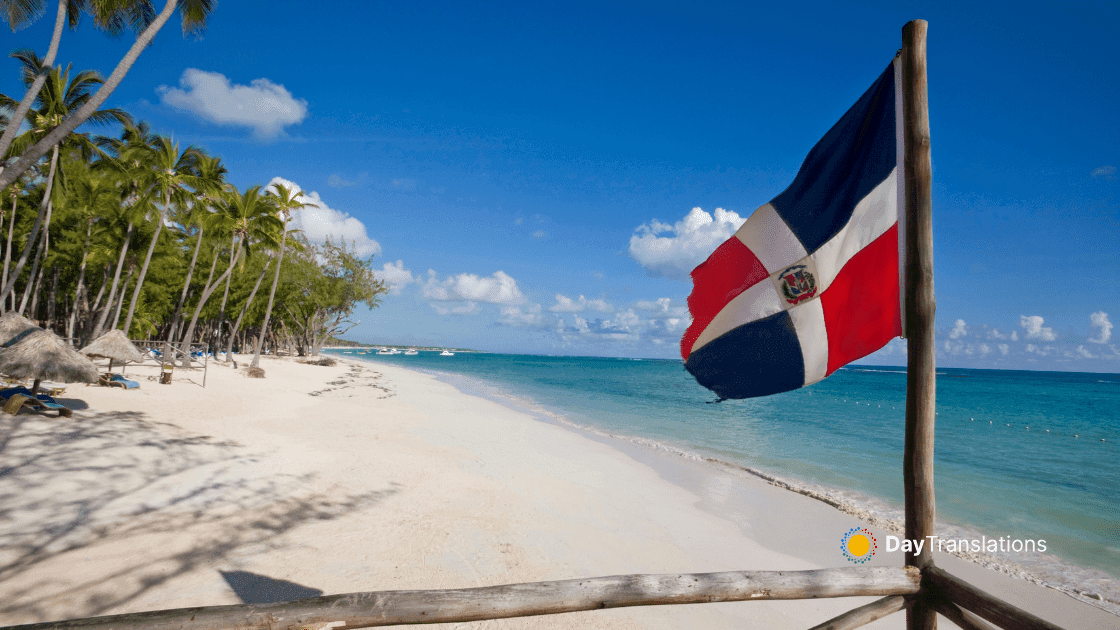
The Dominican Republic flag was adopted on November 6, 1844 after they gained their independence from Haiti, which ruled the Dominican Republic from 1820 to 1824. It has a large cross that is white in color, which divides the flag into four quarters. The top left and the lower right quarters are ultramarine blue while the top right and bottom left quarters are in vermilion red. The national coat of arms or the escudo was added to the flag according to the presidential decree issued in 1913. It is placed in the center of the white cross and has the same colors as the national flag. The coat of arms includes a golden cross above an open Bible with the words Y la verdad nos hara libre. The translation means, “And the truth shall set you free.” On each side of the Bible are two spears with flags and one empty spear. The escudo is flanked on the left with a laurel branch while the right side has an olive branch. A blue ribbon on top of the escudo is written with the words Dios, Patria, Libertad, the national motto which means God, fatherland and liberty. At the bottom of the escudo is a red ribbon. On it is the name of the country written in Spanish – República Dominicana.
The Dominican Republic is the only country in the world that includes a Bible in its national flag.
The Dominican flag has a white central cross that extends across the width and height of the flag. On the upper left near the hoisting side is an ultramarine blue rectangle. Below the left arm of the cross is a vermilion red rectangle. The order is reversed on the flying side. The red rectangle is on the upper right hand corner while the blue rectangle is on the lower left corner. According to some records the white central cross is a symbol the faith of the people of the country while the red and blue were taken from the flag of Haiti, which ruled the Dominican Republic from 1820 to 1844.
Nevertheless, the vermilion red symbolizes the blood that had been spilled by the countless heroes and liberators that fought for the country. The ultramarine blue is for the liberty and ideals of progress of the nation as well as a representation of God’s protection. The white cross represents the struggles of the citizens to live in a free country. It also symbolizes peace, unity and all the sacrifices the citizens of the country made to gain independence. The olive branch on the right side of the escudo represents liberty while the laurel branch on the left is a symbol of immortality.
The modern interpretation of the meaning of the flag is simpler. Red symbolizes fire and the blood shed by the freedom fighters to free their homeland. White is the symbol of dignity and the dedication to peace and the peaceful character of the people of the Dominican Republic while blue represents the sky.
If you go for the heraldic and ancient traditions of associating colors with symbolism, the white color means honesty and peace. Red stands for valor, strength, bravery and hardiness of the people while the blue is a representation of perseverance and justice, truth and loyalty as well as vigilance.
The dimension of the flag is 2:3.
:: References ::
http://www.hispaniola.com/dominican_republic/info/society_dominican_flag.php
http://www.flags-flags-flags.org.uk/dominican-republic-flag.htm
http://www.colonialzone-dr.com/flag-shield-national_symbols.html
Extensive List of Languages of Dominican Republic: Spoken and Extinct Languages
In this Country Profile
:: List of Languages ::
Dominican Sign Language
[doq] Dialects: Lexical similarity: 85%–90% with ASL [ase], and uses most of the features of ASL, such as absent referent and reduplication. Classification: Deaf sign language
English
[eng] 8,000 in Dominican Republic (Holm 1989). Samaná Peninsula, northeastern Dominican Republic. Dialects: Samaná English. Classification: Indo-European, Germanic, West, English
Haitian
[hat] 159,000 in Dominican Republic (1987). Alternate names: Creole, Haitian Creole. Classification: Creole, French based
Spanish
[spa] 6,890,000 in Dominican Republic (1995). Classification: Indo-European, Italic, Romance, Italo-Western, Western, Gallo-Iberian, Ibero-Romance, West Iberian, Castilian
:: Reference ::
Gordon, Raymond G., Jr. (ed.), 2005. Ethnologue: Languages of the World, Fifteenth edition. Dallas, Tex.: SIL International. Online version: http://www.ethnologue.com/
Famous Dominican People: Dominican Artists, Scientists, Leaders, Musicians, Politicians and Athletes
In this Country Profile
Despite many economic and political upheavals that occurred in the Dominican Republic, the country has its share of talents and personalities that made a name for themselves as well as put their country in the world stage. They made notable contributions in different fields. The beautiful ladies of the Dominican Republic have been international beauty pageants titlists and winners. Some have become popular as sport and fashion personalities, while others excelled in art, literature and other disciplines. The following people made their mark on both the local and international scenes. They are just some of many famous Dominicans who have lifted Dominican Republic’s name worldwide and made a difference in our world. Their purpose and stories inspired awe if not greatness.
:: List of Famous People from Dominican Republic ::
Oscar de la Renta
Oscar de la Renta was born in Santo Domingo on in 1932. He started art education at the National School of Art in the Dominican Republic when he was 18 years old and stayed for two years before moving to Spain to study at the Academia de San Fernando in Madrid. By that time his talent for fashion design was becoming more evident. Oscar was asked by the wife of the US Ambassador to Spain to design a dress for her daughter. The pictures taken of him fitting the dress on Miss Beatrice Lodge made it to the pages of LIFE magazine. That was the break that Oscar needed. He joined the house of Balenciaga then moved to join Antonio del Castillo in 1961. Afterwards he joined the house of Lanvin, Paris. After two years he again changed employment and designed for Elizabeth Arden. By 1965 he was with Jane Derby and stayed until she died in 1969. He was already getting famous and Oscar took over the business and name it the house of Oscar de la Renta.
Oscar married the senior editor of Vogue Magazine, Francoise de Langlade in 1967. They were married until her untimely passing 16 years later. Annette Reed is Oscar’s second wife whom he married in 1990. His son, Moises is also a fashion designer. Oscar expanded his interests and included men’s clothing, interior design, signature perfume label and furnishings. While managing and designing for his own fashion house, Oscar also designed from 1993 up to 2001 for the house of Balmain. Oscar has not forgotten his home country and has made significant contributions in the building of schools and daycare centers as well as other charitable activities to help the poor children in his country. He also makes several contributions to the design requirements of hotels and leisure complexes in the Dominican Republic’s tourist destinations.
Dr. Guillermo Linares
Guillermo Linares was born in Cabrera, Dominican Republic in 1951. He was one of nine children born into poor family. He migrated to the United States in 1966 and struggled to learn English while juggling jobs to finish his high school. He became a taxi driver to continue his college education. He became a US citizen when he was a sophomore in college. He earned his B.A. and M.S. degrees from the City College of New York. From Fordham University he finished a course in administration and supervision and taught at a school in Washington Heights and was elected to the school board in 1980.
He was elected to public office in 1991, the first Dominican to do so. He served the New York City Council from 1992 to 2001 and in 1999 became a chairperson of the President’s Advisory Commission on Educational Excellence for Hispanic Americans upon his appointed by President Bill Clinton. In 2004 he was appointed the Commissioner of Immigrant Affairs of New York City. He was elected as State Assemblyman for the 72nd district in 2010.
However his political career was tarnished. He founded a non-profit organization called the ACDP or the Community Association of Progressive Dominicans. His daughter Mayra was the chairperson of the organization. They were caught giving a paid job that does not require attendance to Miguel Castaños, a political friend of Linares. Through the ACDP he was able to acquire several residential buildings and promptly attempted to evict the tenants. In 2010 the buildings Linares and the ACDP owned has 316 violations. He even attempted to win a position in the New York City Council using petition signatures of a convicted felon in 2009. The Dominicans in New York declared Linares a persona non grata.
Fabio Fiallo
Fabio Fiallo was born on February 3, 1866 in Santo Domingo. He was the son of Ana Maria Cabral and General Juan Ramon Fiallo. He was a journalist as well as a teacher, working with the weekly magazine called El Hogar from 1894 to 1895. He wrote and directed The Freedom Flag, which became his basis for the article he wrote on the intervention of the United States in the Dominican Republic in 1916. His articles caused him to be imprisoned in the fortress in Ozama. Fiallo continued to write patriotic poetry that got published but eventually vanished. It was rumored that his body of work, enjoyed by his countrymen and the Spanish people outside of his country have been collected and archived by a historian named Emilio Rodriguez Demorizi. Fiallo had been a consul in Hamburg, New York and Havana, where he died in August 28, 1942. His remains were buried in Santiago de Cuba until 1977 before President Joaquin Balaguer had it transferred to the Dominican Republic to be buried in the in the national pantheon.
Virgilio Diaz Grullon
Virgilio was born in Santiago in 1924. After he graduated in 1946 he worked in public administration, international financial organizations and private banking. He was a prolific writer and had been a highly regarded one, thus he had been invited to be a judge in several literary contests in the Dominican Republic and outside his country. His work ranges from classic fairy tales, social criticism, psychological subject and narrative fiction in the urban and middle class settings. He won the National Short Story Award in 1958 for his volume of stories called Any Given Day. His novel entitled Oedipus was a finalist in the 1958 competition for Hispanic-American authors. The Institute of Hispanic Culture in Madrid sponsored the competition. For his work entitled The Carob Also Dream, he was awarded the Annual Novel Manuel de Jesus Galvan Prize in 1997. The novel was a strong criticism of the dictatorship of Trujillo and the ideological and armed struggle of the people. Grullon also received the National Prize of Literature in the Dominican Republic that same year.
A fellow writer, Juan Bosch described Grullon as a storyteller that was able to describe the psychological complexities of his characters with a few words, displaying a maturity in the treatment of gender that is beyond his years, after reading one of Grullon’s works entitled The Enemy. Although Grullon started writing at age 32, he had won several awards given by international literary award giving bodies from the 1950s up to late 1970s. Many of his works have been translated into Portuguese, English and French. Grullon died in Santo Domingo on July 18, 2001 at age 77.
Julia Alvarez
Julia Alvarez was born on March 27, 1950 in the city of New York. She was only 3 months old when her parents decided to return to Dominican Republic where she stayed for ten years. In 1960 her father was involved in an unsuccessful plot to overthrow Rafael Trujillo and they were forced to flee to the United States. Her ordeal during that time was chronicled in her 1991 novel entitled How the Garcia Girls Lost Their Accents. It was also chronicled in her poem entitled Exile. Julia Alvarez faced discrimination while in school and turned to writing for comfort, buoyed by the encouragement from her teachers. Her novel, In the Time of the Butterflies, written in 1994, recounts the story of the Mirabal sisters, Minerva, Patria and Maria Teresa who gallantly and valiantly fought during the fascist regime of Trujillo, who destroyed them out of vengeful spite. The three Mirabal sisters are considered national heroes in the Dominican Republic. Other internationally-acclaimed works of Julia Alvarez include Yo, which she wrote in 1997; poems like the Homecoming, written in 1984 and The Woman I Kept to Myself, which she wrote in 2004. She also published an autobiographical compilation, Something to Declare, which was written in 1988. Most of her works are influenced by her personal experiences on the issues of identity and assimilation, combined with personal and political undertones. Julia Alvarez is the current writer-in-residence at the Middlebury College located in the state of Vermont while continuing her successful writing career.
Junot Diaz
Junot Diaz hails from Santo Domingo, where he was born on December 31, 1968. He lived with his mother and grandparents while his father worked in the United States when he was a child. He migrated to the United States when he was six years old and lived with his father in Palin, New Jersey. He loved books at an early age and became a voracious reader. At the same time he got fascinated with apocalyptic and science-fiction films and books, particularly the works of John Christopher, one of the pseudonyms of British writer Christopher Simon Youd. He graduated with a BA in English at Rutgers College in 1992. He got involved in Demarest Hall, a live-in, creative-writing residence hall while in college where he met Nobel and Pulitzer Prize winner Toni Morrison and multi-awarded Sandra Cisneros, both of whom became Junot’s inspiration to be a writer himself. He took in several odd jobs to work his way through college.
He worked as an editorial assistant at the Rutgers University Press after graduation and earned his MFA from Cornell University in 1995. It was during this time that he wrote his first short stories. His short story collection entitled Drown, written in 1996 was a tale of a poor and fatherless young boy from the Dominican Republic and his struggles to survive in New Jersey. Another of his major works is a novel entitled The Brief Wondrous Life of Oscar Wao that he wrote in 2007. Junot received a Pulitzer Prize for Fiction award for this novel in 2008.
Junot Diaz currently is the fiction editor for the Boston Review and teaches creative writing at MIT.
Juan Pablo Duarte y Diez
Duarte was one of the founding fathers of the Dominican Republic, together with compatriots Matias Ramon Mella and Francisco del Rosario Sanchez. They engineered the Dominican Republic and its independence. He was a visionary who dreamt of a democratic government. He was the founding leader of La Trinitaria, a secret society. Duarte was born on January 26, 1813. His used his secret society La Trinitaria to spread his democratic ideals, gathering supporters using a concept of each member recruiting three other members. They staged theatrical events to spread their separatist ideals. They conceptualized the design of the flag for the Dominican Republic. Alas, his dissidence forced him into exile in Venezuela. The other members of the secret society continued his work. Although many lost their lives in the struggle for independence, they came out the winners and the Dominican Republic gained its independence from Haiti on February 27, 1844.
The tallest mountain in the Dominican Republic, the Pico Duarte is named in his honor. At the summit of the mountain sits an east-facing bronze likeness of Duarte, together with the national flag and a cross. In New York City he was honored with the Juan Pablo Duarte Square. Duarte died on July 15, 1876.
Mariasela Álvarez
Mariasela’s full name is Mariasela Margarita Álvarez Lebrón and she was born on January 31, 1960 in Santo Domingo. She was crowned Miss World in 1982, the first Dominican woman to ever win a beauty title in an international competition. She was still in college when she joined the pageant. After her reign as Miss World ended, she went back to the Universidad de Autonoma de Santo Domingo and finished her course in architecture. She designed one of the landmarks in Santo Domingo, the Crystal Tower (Torre Cristal). She was also a TV personality in the Dominican Republic, hosting a talk show in 1991 called Con Los Ojos Abiertos, which aired weekly. She formed Maralva S.A., her own TV production company and produced the award-winning Esta Noche Mariasela for eight years, starting in 1996. Although she had moved to Madrid where she lives with her hotelier husband Alberto del Pino, Mariasela still continues to produce Esta Noche Mariasela, which translates to Mariasela Tonight as well as Esta Tarde Mariasela or This Afternoon with Mariasela, which are both popular TV shows.
Amelia Vega Polanco
Born on November 7, 1984 in Santo Domingo, Amelia Vega is the first and only woman from the Dominican Republic to be crowned Miss Universe, the title she won in 2003. Her close family members are also highly regarded in their professions. Her father, Otto Vega is a general medicine practitioner in New York and Miami. Her mother, Patricia Polanco Alvarez graduated as a pilot and was also the representative of the Dominican Republic at the Miss World pageant in 1980. Grammy-awardee Juan Luis Guerra is Amelia’s uncle.
As Miss Universe she worked with the Global Health Council, God’s Love We Deliver, Cable Positive, Elizabeth Glaser Pediatric AIDS Foundation and amFAR to spread awareness, understanding and prevention of HIV/AIDS and help generate funds to support the organizations.
Amelia embarked on many activities after her stint with the Miss Universe organization. She did some magazine and commercial modeling. She became a reality show host. She launched her singing career and released a single on April 26, 2010, Pasa Un Segundito on iTunes and Smog in June 2010. Her first album, Agua Dulce will be released initially by iTunes on August 30, 2011. She is currently busy promoting her music. She also owns two Essence by Amelia Vega boutiques in Miami.
Milagros Quezada Borbón
She is more popularly known as Milly Quezada, the queen of merengue music and a winner of the Latin Grammy Awards for Dominican Merengue music. Milly was born on May 21, 1955 in Santo Domingo to a musical family. Her four brothers are all musicians and she spent her childhood singing with her brothers during family gatherings. Her interest in developing her singing talents was one of the reasons why her family migrated to the United States and settled in New York City. In school she developed an in-depth knowledge of the different Latin popular music styles and concentrated on her favorite genre, merengue. In the 1980s Milly was the lead singer for the Milly y los Vecinos and they released a total of 20 records that brought them international fame. She later embarked on a solo career and moved to Puerto Rico where she resides with her husband and children. She is still busy going on tours. She toured the Dominican Republic with Conjunto Quisqueya in May 2005. She collaborated with Dominican singers Anais and Sergio Vargas to record Reencuentro in 2007 and joined other legendary Dominican music artists on a national tour to celebrate merengue and bachata music traditions in 2009. The tour was made into a documentary entitled Sol Caribe by Felix Limardo, which featured an original once-in-a-lifetime collaboration of 12 Dominican music legends, La Puerta del Nuevo Mundo.
Osvaldo José Virgil
Osvaldo Virgil, popularly known as Ozzie was born on May 17, 1932 in Monte Cristi, Dominican Republic. He started his baseball career as a utility player from 1956 to 1969 and played for top baseball team in Major League baseball in the United States after serving the US Marines in 1951 and 1952. He was the first Dominican to play in the major leagues. He played for the New York Giants from 1956 to 1957. He then played for the Detroit Tigers in 1958 and then again from 1960 to 1961. Ozzie Virgil was the first player with colored skin to play for the Detroit Tigers. In 1961 he was with the Kansas City Athletics and then played for the Baltimore Orioles in 1962. By 1968 Ozzie was with the Pittsburgh Pirates. The following year, 1966 he played for the San Francisco Giants and then again in the 1969 season. Ozzie Virgil was a third baseman but had played all positions except being a pitcher. During his nine-year career in the major league, Virgil had a batting average of .231 and had hit fourteen home runs with 73 run batted in (RBI) in the 324 games that he had played. Virgil also played in the International League, playing for minor league Rochester Red Wings.
Virgil became a coach for the San Francisco Giants from 1969 to 1972 and then from 1974 to 1975 after his retirement from professional baseball. He also coached the Montreal Expos from 1976 up to 1981 and the San Diego Padres from 1982 to 1985. After that he coached the Seattle Mariners for two seasons from 1986 up to 1988. Ozzie Virgil served as the third-base coach on the staff of Dick Williams, a Baseball Hall of Fame manager from 1977 up to 1988. His son, Ozzie Virgil, Jr. is now making a name for himself, following his footsteps and playing in the major league.
Sammy Sosa
Popularly known as Sammy Sosa, his birth name is Samuel Peralta Sosa. He was born in Consuelo, in the province of San Pedro de Macorís in the Dominican Republic on November 12, 1968. He became famous for his feats in Major League Baseball. Sammy Sosa played for the Texas Rangers in 1989, his first club in the major league. He briefly played for the Chicago White Sox and in 1992 became a member of the Chicago Cubs. It was at this club where Sammy Sosa became on the best hitters in the league. He and Mark McGwire chased the home run record of Roger Maris in 1998, which began the road to national fame. Mark Maris’ record was 61 home runs. Sosa ended the 1998 season with 66 home runs, a club record, although he failed to surpass McGwire who had 70. Sammy Sosa went on the create records for his club and received numerous awards, including sharing Sports Illustrated magazine’s Sportsman of the Year award with Mark McGwire in 1988.
While there were reports that Sosa used anabolic steroid discovered during a drug test done in 2003, Sosa remained adamant that he did not use any performance-enhancing drug. He announced his retirement from Major League Baseball on June 3, 2009 and said that he will wait for his induction to the Baseball Hall of Fame.
Juan Luis Guerra
Singer, songwriter and producer Juan Luis Guerra, internationally acclaimed Latin artist for the Dominican Republic was born on June 7, 1957. He has won 15 Latin Grammy Awards, two Latin Billboard Awards and two Grammy Awards. His most recent recognition was in 2010, winning three Latin Grammy Awards for Best Tropical Song for Bachata en Fukuoka and Best Contemporary Tropical Album and Album of the Year for A Son de Guerra. His music style is a pop, combining bolero and merengue with Afro-pop-Latin fusion and other Latin beats. Juan Luis Guerra has sold more than 30 millions records so far.
Félix Sánchez
Currently residing in San Diego, Félix Sánchez, born on August 30, 1977 is a Dominican who was a star in track and field. During the 2004 Summer Olympics in Athens, Félix won the first ever Olympic gold medal for the Dominican Republic in the 400 meter hurdles. His parents are both Dominicans although Félix was born in the United States. Since 1999 he has been competing for the Dominican Republic. Félix has also won for his native country its first gold medal in the 2003 Pan American Games as well as managing to break the 400 meter hurdles record in the Pan American Games record.
Dania Ramirez
Dania Ramirez is a popular actress who hails from Santo Domingo. She was born on November 8, 1979 and since she was young she had dreamed of becoming a film star. She started her career as an advertising model when she was 15 years old and working for a convenience store in Los Angeles. She took acting lessons at the Actor’s Workshop in New York and graduated from Montclair State University where she excelled in volleyball. Dania appeared in several music videos done by popular music talents like Jay-Z, LL Cool J and Santana when she moved to Los Angeles to pursue her dream. She had some bit parts in several movies before being cast to play better roles. She portrayed Callisto in 2006 in the movie X-Men: The Last Stand. She was a lead actress in The 5th Commandment shown in 2008. She will be playing the part of a bicycle messenger in Premium Rush and the part of Trisha in American Reunion that will be shown in 2012.
Dania also played different characters in popular TV series. She was cast as Caridad in the final episodes of Buffy the Vampire Slayer. In the 6th season of The Sopranos, Dania played the part of Blanca Selgado. In the TV series Heroes, she was known as Maya. She was a guest star and portrayed the role of Alex in the seventh season of Entourage and was a celebrity guest judge in the reality show America’s Next Top Model.
Diana Reyna
Diana Reyna is a Dominican American born in 1974. Currently she serves as a Council Member for the 34th Council District in New York City. She holds the distinction of being the first Dominican woman to be elected in a New York public office, a position she has held since 2001.
Rafael Leónidas Trujillo Molina
Rafael Trujillo, born on October 24, 1891 became famous not for setting his country, the Dominican Republic, towards glory but for being a military dictator, who caused the death of many Dominicans and Haitians during his 30-year reign. Termed as the bloodiest, The Trujillo Era, led by Trujillo, a military strongman, who used his power to build a personal army to be at his beck and call, to prevent opposition and political opponents from gaining ground. He amassed a personal wealth during his reign of terror and corruption that amounted to several million dollars, making him wealthiest person in the Dominican Republic by the time he died. It was estimated that during his dictatorship more than 50,000 people were massacred.
Santiago Rodriguez
Equally notorious like Trujillo, Santiago Luis Polanco Rodriguez, born on June 16, 1961 made a name for himself in the United States by being the first to distribute crack cocaine in mass quantity. He was able to organize Jamaican, American and Dominican street drug dealers and eventually created a drug empire. His street name was Yayo. According to the US drug enforcement officials, Santiago Rodriquez was perhaps the richest drug kingpin from the Dominican Republic. He had since retired from his nefarious activities and had settled back in his home country.
:: References ::
http://www.visiting-the-dominican-republic.com/famous-people-from-the-dominican-republic.html
http://www.puntacana-travelguide.com/celebrities.html
http://www.intersites.co.uk/91710/