
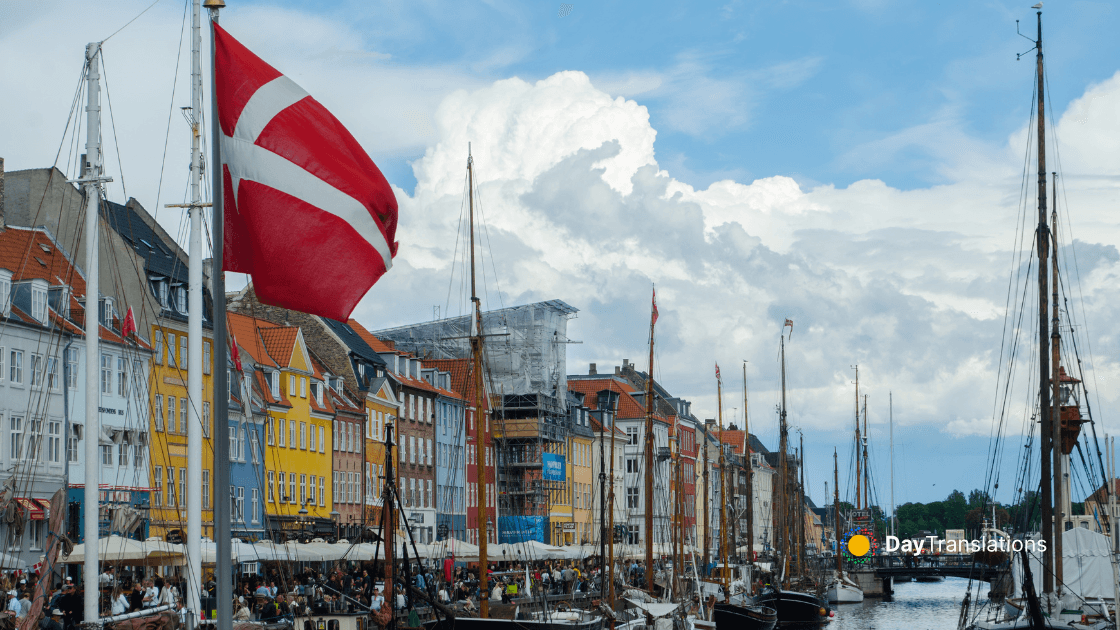
Denmark is a Scandinavian country in Northern Europe. The country of Denmark, together with Greenland and the Faroe Islands, comprises the Kingdom of Denmark. It is the southernmost of the Nordic countries, southwest of Sweden and south of Norway, and bordered to the south by Germany. Denmark borders both the Baltic and the North Sea. The country consists of a large peninsula, Jutland (Jylland) and many islands, most notably Zealand (Sjælland), Funen (Fyn), Vendsyssel-Thy (commonly considered a part of Jutland), Lolland, Falster and Bornholm, as well as hundreds of minor islands often referred to as the Danish Archipelago. Denmark has long controlled the approach to the Baltic Sea; before the digging of the Kiel Canal, water passage to the Baltic Sea was possible only through the three channels known as the “Danish straits”.
Denmark is a constitutional monarchy with a parliamentary system of government. Denmark has a state-level government and local governments in 98 municipalities. Denmark has been a member of the European Union since 1973, although it has not joined the Eurozone. Denmark is a founding member of NATO and the OECD. Denmark is also a member of the Organization for Security and Cooperation in Europe (OSCE).
Denmark, with a mixed market capitalist economy and a large welfare state, ranks as having the world’s highest level of income equality. Denmark has the best business climate in the world, according to the U.S. business magazine Forbes. From 2006 to 2008, surveys ranked Denmark as “the happiest place in the world”, based on standards of health, welfare and education. Gallup polls between 2005 and 2009 also ranked Denmark the happiest nation. The 2009 Global Peace Index survey ranks Denmark as the second most peaceful country in the world, after New Zealand. In 2009, Denmark was ranked as one of the least corrupt countries in the world according to the Corruption Perceptions Index, ranking second only to New Zealand. In 2010, Transparency International ranked it as the least corrupt country in the world, in a three-way tie with New Zealand and Singapore. Denmark remained consistent in the ‘Corruption Perceptions Index”, perceived as “very clean” country, second on the 2011 list and garnering the top 1 rank along with Finland in the 2012.
In this Country Profile
The national language, Danish, is closely related to Swedish and Norwegian, with which it shares strong cultural and historical ties. 80.9% of the inhabitants of Denmark are members of the Lutheran state church. As of 2010, 548,000 persons (9.9% of the Danish population) were either immigrants or descendants of recent immigrants. Most of these (54%) have their origins in Scandinavia or elsewhere in Europe, while the remainder originate mainly from Middle Eastern and African countries.
:: Background of Denmark ::
Once the seat of Viking raiders, and later a major north European power, Denmark has evolved into a modern, prosperous nation that is participating in the general political and economic integration of Europe. It joined NATO in 1949 and the EEC (now the EU) in 1973. However, the country has opted out of certain elements of the European Union’s Maastricht Treaty, including the European Economic and Monetary Union (EMU), European defense cooperation, and issues concerning certain justice and home affairs.
:: Geography of Denmark ::
Location: Northern Europe, bordering the Baltic Sea and the North Sea, on a peninsula north of Germany (Jutland); also includes two major islands (Sjaelland and Fyn)
Geographic coordinates: 56 00 N, 10 00 E
Area:
total: 43,094 sq km
land: 42,434 sq km
water: 660 sq km
note: includes the island of Bornholm in the Baltic Sea and the rest of metropolitan Denmark (the Jutland Peninsula, and the major islands of Sjaelland and Fyn), but excludes the Faroe Islands and Greenland
Area – comparative: slightly less than twice the size of Massachusetts
Land boundaries: 68 km
Border countries: Germany 68 km
Coastline: 7,314 km
Maritime claims:
territorial sea: 12 nm
contiguous zone: 24 nm
exclusive economic zone: 200 nm
continental shelf: 200 m depth or to the depth of exploitation
Climate: temperate; humid and overcast; mild, windy winters and cool summers
Terrain: low and flat to gently rolling plains
Elevation extremes:
lowest point: Lammefjord -7 m
highest point: Mollehoj/Ejer Bavnehoj 171 m
Natural resources: petroleum, natural gas, fish, salt, limestone, chalk, stone, gravel and sand
Land use:
arable land: 52.59%
permanent crops: 0.19%
other: 47.22% (2005)
Irrigated land: 4,490 sq km (2003)
Total renewable water resources: 6.1 cu km (2005)
Freshwater withdrawal (domestic/industrial/agricultural):
total: 0.67 cu km/yr (32%/26%/42%)
per capita: 123 cu m/yr (2003)
Natural hazards: flooding is a threat in some areas of the country (e.g., parts of Jutland, along the southern coast of the island of Lolland) that are protected from the sea by a system of dikes
Environment – current issues: air pollution, principally from vehicle and power plant emissions; nitrogen and phosphorus pollution of the North Sea; drinking and surface water becoming polluted from animal wastes and pesticides
Environment – international agreements: party to: Air Pollution, Air Pollution-Nitrogen Oxides, Air Pollution-Persistent Organic Pollutants, Air Pollution-Sulfur 85, Air Pollution-Sulfur 94, Air Pollution-Volatile Organic Compounds, Antarctic Treaty, Biodiversity, Climate Change, Climate Change-Kyoto Protocol, Desertification, Endangered Species, Environmental Modification, Hazardous Wastes, Law of the Sea, Marine Dumping, Marine Life Conservation, Ozone Layer Protection, Ship Pollution, Tropical Timber 83, Tropical Timber 94, Wetlands, Whaling; signed, but not ratified: none of the selected agreements
Geography – note: controls Danish Straits (Skagerrak and Kattegat) linking Baltic and North Seas; about one-quarter of the population lives in greater Copenhagen.
:: People of Denmark ::
Population: 5,529,888 (July 2011 est.)
Age structure:
0-14 years: 17.6% (male 500,265/female 474,829)
15-64 years: 65.3% (male 1,811,198/female 1,798,507)
65 years and over: 17.1% (male 417,957/female 527,132) (2011 est.)
Median age:
total: 40.9 years
male: 40 years
female: 41.8 years (2011 est.)
Population growth rate: 0.251% (2011 est.)
Birth rate: 10.29 births/1,000 population (2011 est.)
Death rate: 10.19 deaths/1,000 population (July 2011 est.)
Net migration rate: 2.41 migrant(s)/1,000 population (2011 est.)
Urbanization:
urban population: 87% of total population (2010)
rate of urbanization: 0.4% annual rate of change (2010-15 est.)
Sex ratio:
at birth: 1.055 male(s)/female
under 15 years: 1.05 male(s)/female
15-64 years: 1.01 male(s)/female
65 years and over: 0.78 male(s)/female
total population: 0.98 male(s)/female (2011 est.)
Infant mortality rate:
total: 4.24 deaths/1,000 live births
male: 4.3 deaths/1,000 live births
female: 4.18 deaths/1,000 live births (2011 est.)
Life expectancy at birth:
total population: 78.63 years
male: 76.25 years
female: 81.14 years (2011 est.)
Total fertility rate: 1.74 children born/woman (2011 est.)
HIV/AIDS – adult prevalence rate: 0.2% (2009 est.)
HIV/AIDS – people living with HIV/AIDS: 5,300 (2009 est.)
HIV/AIDS – deaths: fewer than 100 (2009 est.)
Nationality: noun: Dane(s) adjective: Danish
Ethnic groups: Scandinavian, Inuit, Faroese, German, Turkish, Iranian, Somali
Religions: Evangelical Lutheran 95%, other Christian (includes Protestant and Roman Catholic) 3%, Muslim 2%
Languages: Danish, Faroese, Greenlandic (an Inuit dialect), German (small minority)
note: English is the predominant second language
Literacy:
definition: age 15 and over can read and write
total population: 99%
male: 99%
female: 99% (2003 census)
School life expectancy (primary to tertiary education):
total: 17 years
male: 16 years
female: 18 years (2008)
Education expenditures: 7.9% of GDP (2006)
Geography of Denmark: Important Geographical Information about Denmark
In this Country Profile
Denmark shares a border of 68 kilometers with Germany to the south and is otherwise surrounded by 7,314 kilometers of coastline. It occupies 43,094 square kilometers. Since 2000 Denmark has been connected by the Øresund Bridge to southern Sweden.
Denmark’s northernmost point is Skagens point (the north beach of the Skaw) at 57° 45′ 7? northern latitude; the southernmost is Gedser point (the southern tip of Falster) at 54° 33′ 35? northern latitude; the westernmost point is Blåvandshuk at 8° 4′ 22? eastern longitude; and the easternmost point is Østerskær at 15° 11′ 55? eastern longitude. This is in the archipelago Ertholmene 18 kilometers northeast of Bornholm. The distance from east to west is 452 kilometers (281 mi), from north to south 368 kilometers (229 mi).
:: Denmark’s Geography and Regions ::
Denmark consists of the peninsula of Jutland (Jylland) and 443 named islands (1,419 islands above 100 m² in total). Of these, 72 are inhabited, with the largest being Zealand (Sjælland) and Funen (Fyn). The island of Bornholm is located east of the rest of the country, in the Baltic Sea. Many of the larger islands are connected by bridges; the Øresund Bridge connects Zealand with Sweden; the Great Belt Bridge connects Funen with Zealand; and the Little Belt Bridge connects Jutland with Funen. Ferries or small aircraft connect to the smaller islands. Main cities are the capital Copenhagen on Zealand; Århus, Aalborg and Esbjerg in Jutland; and Odense on Funen.
The country is flat with little elevation; having an average height above sea level of 31 metres (102 ft). The highest natural point is Møllehøj, at 170.86 metres (560.56 ft). Other hills in the same area southwest of Århus are Yding Skovhøj at 170.77 metres (560.27 ft) and Ejer Bavnehøj at 170.35 metres (558.89 ft). The area of inland water is: (eastern Denmark) 210 km2 (81 sq mi); (western D.) 490 km2 (189 sq mi).
Denmark’s coastline is, 7,314 km (4,545 mi). No location in Denmark is further from the coast than 52 km (32 mi). The size of the land area of Denmark cannot be stated exactly since the ocean constantly erodes and adds material to the coastline, and because of human land reclamation projects (to counter erosion). On the southwest coast of Jutland, the tide is between 1 and 2 m (3.28 and 6.56 ft), and the tideline moves outward and inward on a 10 km (6.2 mi) stretch.
Phytogeographically, Denmark (including Greenland and the Faroe Islands) belongs to the Boreal Kingdom and is shared between the Arctic, Atlantic European and Central European provinces of the Circumboreal Region. According to the World Wide Fund for Nature, the territory of Denmark can be subdivided into two ecoregions: the Atlantic mixed forests and Baltic mixed forests. The Faroe Islands are covered by the Faroe Islands boreal grasslands, while Greenland hosts the ecoregions of Kalaallit Nunaat high arctic tundra and Kalaallit Nunaat low arctic tundra.
The climate is in the temperate zone. The winters are not particularly cold, with mean temperatures in January and February of 0.0 °C, and the summers are cool, with a mean temperature in August of 15.7 °C. Denmark has an average of 121 days per year with precipitation, on average receiving a total of 712 mm per year; autumn is the wettest season and spring the driest.
Because of Denmark’s northern location, the length of the day with sunlight varies greatly. There are short days during the winter with sunrise coming around 9:00 am and sunset 4:30 pm, as well as long summer days with sunrise at 4:00 am and sunset at 10 pm. The shortest and longest days of the year have traditionally been celebrated. The celebration for the shortest day corresponds roughly with Christmas (Danish: jul), and modern celebrations concentrate on Christmas Eve, 24 December. The celebration for the longest day is Midsummer Day, which is known in Denmark as sankthansaften (St. John’s evening). Celebrations of Midsummer have taken place since pre-Christian times.
Professional Translation Organizations & Associations in Denmark
In this Country Profile
Below is a list of the major translation organizations and associations of Denmark.
:: List of Organizations ::
Association of Danish Authorized Translators ~ Translat?rforeningen
Danish State-Authorized Translators and Interpreters Association (DT)
Dansk Translatørforbund
Dansk Oversætter Forbund (DOF) Danish Translators Association
The Union of Communication and Language Professionals, Denmark
Information about the Danish Flag: Colors and Meaning of the Flag of Denmark
In this Country Profile
:: Meaning of the Denmark Flag ::
The national flag of Denmark is red with a white cross that extends to the edges of the flag; the vertical part of the cross is shifted to the hoist side; the banner is referred to as the Dannebrog (Danish flag) and is one of the oldest national flags in the world. The shifted design element was subsequently adopted by the other Nordic countries of Finland, Iceland, Norway, and Sweden.
Traditions as to the origin of the flag design vary, but the best known is a legend that the banner fell from the sky during an early-13th century battle; caught up by the Danish king before it ever touched the earth, this heavenly talisman inspired the royal army to victory; in actuality, the flag may derive from a crusade banner or ensign.
Extensive List of Languages of Denmark: Spoken Languages
In this Country Profile
:: List of Languages ::
Danish [dan] 5,450,000 in Denmark (2007). Population total all countries: 5,581,690. Also in Canada, Germany, Greenland, Norway, Sweden, United Arab Emirates, United States. Alternate names: Dansk, Rigsdansk. Classification: Indo-European, Germanic, North, East Scandinavian, Danish-Swedish, Danish-Riksmal, Danish
Danish Sign Language [dsl] 5,000 (2007). Dialects: Some signs are related to French Sign Language [fsl]. Intelligible with Swedish and Norwegian sign languages with only moderate difficulty. Not intelligible with Finnish Sign Language [fse]. Classification: Deaf sign language
Faroese [fao] 48,200 in Denmark (2007). Population total all countries: 48,260. Faroe Islands. Also in United States. Alternate names: Føroyskt. Dialects: Not inherently intelligible with Icelandic [isl]. Classification: Indo-European, Germanic, North, West Scandinavian
German, Standard [deu] 25,900 in Denmark (2007). North Slesvig (Sydjylland). Classification: Indo-European, Germanic, West, High German, German, Middle German, East Middle German
Jutish [jut] German-Danish border area, south Jutland. Also in Germany. Alternate names: Jutlandish, Jysk, Western Danish. Dialects: The westernmost and southernmost dialects differ so much from Standard Danish that many people from the Eastern Islands have great difficulty understanding it. From the viewpoint of inherent intelligibility, it could be considered a separate language (1996 N. Strade). Classification: Indo-European, Germanic, North, East Scandinavian, Danish-Swedish, Danish-Riksmal, Danish
Kalaallisut, Greenlandic [kal] 10,000 in Denmark (2002). Alternate names: Inuktitut, Greenlandic. Classification: Eskimo-Aleut, Eskimo, Inuit
Swedish [swe] Bornholm Island. Dialects: Scanian (Eastern Danish, Skane, Skånska, Southern Swedish). Classification: Indo-European, Germanic, North, East Scandinavian, Danish-Swedish, Swedish
Traveller Danish [rmd] Extinct. Alternate names: Rodi, Rotwelsch. Dialects: An independent language based on Danish [dan] with heavy lexical borrowing from Romani. Not inherently intelligible with Angloromani [rme]. It may be intelligible with Traveller Norwegian [rmg] and Traveller Swedish [rmu]. Classification: Mixed language, Danish-Romani
:: Reference ::
Gordon, Raymond G., Jr. (ed.), 2005. Ethnologue: Languages of the World, Fifteenth edition. Dallas, Tex.: SIL International. Online version: http://www.ethnologue.com/
Famous Danish People: Danish Artists, Scientists, Leaders, Musicians, Politicians and Athletes
In this Country Profile
Denmark is home to outstanding individuals who made a difference with their remarkable achievements. The following people made their mark on both the local and international scenes. They are just some of many famous Danes who have lifted Denmark’s name worldwide and made a difference in our world. Their purpose and stories inspired awe if not greatness.
:: List of Famous People from Denmark ::
Hans Christian Andersen
Hans Christian Andersen was a Danish author and poet noted for his children’s stories. These include “The Steadfast Tin Soldier”, “The Snow Queen”, “The Little Mermaid”, “Thumbelina”, “The Little Match Girl”, and “The Ugly Duckling”. During his lifetime he was acclaimed for having delighted children worldwide, and was feted by royalty. His poetry and stories have been translated into more than 150 languages. They have inspired motion pictures, plays, ballets, and animated films.
Søren Aabye Kierkegaard
Søren Kierkegaard was a philosopher, theologian and religious author interested in human psychology. He strongly criticized the philosophies of Georg Wilhelm Friedrich Hegel, Friedrich Wilhelm Joseph Schelling and Karl Wilhelm Friedrich Schlegel and the Christianity of the State Church versus the Free Church. Much of his philosophical work deals with the issues of how one lives as a “single individual”, giving priority to concrete human reality over abstract thinking, and highlighting the importance of personal choice and commitment.
Niels Bohr
was a Danish physicist who made fundamental contributions to understanding atomic structure and quantum mechanics, for which he received the Nobel Prize in Physics in 1922. Bohr mentored and collaborated with many of the top physicists of the century at his institute in Copenhagen. He was part of a team of physicists working on the Manhattan Project. Bohr married Margrethe Nørlund in 1912, and one of their sons, Aage Bohr, grew up to be an important physicist who in 1975 also received the Nobel prize. Bohr has been described as one of the most influential scientists of the 20th century.
Aage Bohr
Aage Bohr was a Danish nuclear physicistand Nobel laureate, and the son of the famous physicist and Nobel laureate Niels Bohr.
Karen Blixen
Karen Blixen was a Danish author also known by her pen name Isak Dinesen. She also wrote under the pen names Osceola and Pierre Andrézel. Blixen wrote works in both Danish and in English. Blixen is best known for Out of Africa, her account of living in Kenya, and one of her stories, Babette’s Feast, both of which have been adapted into highly acclaimed, Academy Award-winning motion pictures. Prior to the release of the first film, she was noted for her Seven Gothic Tales, for which she is also known in Denmark.
Viggo Mortensen
Viggo Mortensen is a Danish-American actor, poet, musician, photographer and painter. He is best known for his roles as Aragorn in Peter Jackson’s The Lord of the Rings film trilogy, Tom Stall in David Cronenberg’s A History of Violence, and his Academy Award-nominated role as Nikolai Luzhin in Cronenberg’s Eastern Promises. He also starred in the film adaptation of Cormac McCarthy’s novel The Road, as “The Man”.
Lars Von Trier
Lars Von Trier is a Danish film director and screenwriter. He is closely associated with the Dogme 95 collective, although his own films have taken a variety of different approaches. He is known for his female-centric parables and his exploration of controversial subject matter.
Famous Footballers: Famous Danish Football/Soccer Players.
In this Country Profile
The following Danish athletes dedicated themselves in promoting and inspiring people about football, one of the most well-loved sports in the world.
Michael Laudrup
Michael Laudrup is a retired Danish footballer, who currently manages La Liga side RCD Mallorca. His most prominent run of football came with Spanish club Barcelona, with whom he won four straight La Liga championships. He famously moved to arch rivals Real Madrid in 1994, with whom he won his fifth La Liga title in a row. He made his debut for the Denmark national football team on his 18th birthday in 1982, and scored 37 goals in a total of 104 appearances for his country. From November 1994, he captained Denmark for a total of 28 matches including the victorious 1995 Confederations Cup tournament. He retired as an active player in June 1998.
Brian Laudrup
Brian Laudrup is a Danish former football player who is a commentator for TV3+ and runs a youth coaching camp, widely regarded alongside his brother, Michael, as one of the greatest Danish football players in history.
Peter Schmeichel
Peter Schmeichel is a retired Danish professional footballer who played as a goalkeeper, and was voted the “World’s Best Goalkeeper” in 1992 and 1993. He is best remembered for his most successful years at English club Manchester United, whom he captained to the 1999 UEFA Champions League to complete The Treble, and for winning UEFA Euro 1992 with Denmark. The IFFHS ranked Schmeichel among the top ten keepers of the 20th century in 2000. In 2003, Schmeichel was inducted into the English Football Hall of Fame in recognition of his impact on the English game. In March 2004, he was named as one of the “125 greatest living footballers”, at the FIFA 100 celebrations. He is considered as one of the best goalkeepers in history. He holds the record for the greatest clean sheets-to-games ratio in the Premier League with 42% of the games he played in the league ending without his team conceding.