
The Republic of Chile is a country in South America occupying a long, narrow coastal strip between the Andes Mountains to the east and the Pacific Ocean to the west. It borders Peru to the north, Bolivia to the northeast, Argentina to the east, and the Drake Passage in the far south. Along with Ecuador, it is one of two countries in South America that do not border Brazil.
Prior to arrival of the Spanish in the 16th century, northern Chile was under Inca rule while the indigenous Mapuche inhabited central and southern Chile. Chile declared its independence from Spain on February 12, 1818. In the War of the Pacific (1879–83), Chile defeated Peru and Bolivia and won its current northern territory. It was not until the 1880s that the Mapuche were completely subjugated. Although relatively free of the coups and arbitrary governments that blighted South America, Chile endured the 17-year long military dictatorship (1973–1990) of Augusto Pinochet that left more than 3,000 people dead or missing.
Today, Chile is one of South America’s most stable and prosperous nations and a recognized middle power. It leads Latin American nations in human development, competitiveness, income per capita, globalization, economic freedom, and low perception of corruption. It also ranks high regionally in freedom of the press and democratic development. In May 2010 Chile became the first South American country to join the OECD. Chile is a founding member of both the United Nations and the Union of South American Nations.
In this Country Profile
:: Background of Chile ::
Prior to the coming of the Spanish in the 16th century, northern Chile was under Inca rule while the indigenous Mapuche inhabited central and southern Chile. Although Chile declared its independence in 1810, decisive victory over the Spanish was not achieved until 1818. In the War of the Pacific (1879-83), Chile defeated Peru and Bolivia and won its present northern regions. It was not until the 1880s that the Mapuche Indians were completely subjugated. After a series of elected governments, a three-year-old Marxist government of Salvador ALLENDE was overthrown in 1973 by a military coup led by Augusto PINOCHET, who ruled until a freely elected president was installed in 1990. Sound economic policies, maintained consistently since the 1980s, have contributed to steady growth, reduced poverty rates by over half, and have helped secure the country’s commitment to democratic and representative government. Chile has increasingly assumed regional and international leadership roles befitting its status as a stable, democratic nation.
:: Geography of Chile ::
Location: Southern South America, bordering the South Pacific Ocean, between Argentina and Peru
Geographic coordinates: 30 00 S, 71 00 W
Area:
total: 756,102 sq km
land: 743,812 sq km
water: 12,290 sq km
note: includes Easter Island (Isla de Pascua) and Isla Sala y Gómez
Area – comparative: slightly smaller than twice the size of Montana
Land boundaries: 6,339 km
Coastline: 6,435 km
Maritime claims:
territorial sea: 12 nm
contiguous zone: 24 nm
exclusive economic zone: 200 nm
continental shelf: 200/350 nm
Climate: temperate; desert in north; Mediterranean in central region; cool and damp in south
Terrain: low coastal mountains; fertile central valley; rugged Andes in east
Elevation extremes:
lowest point: Pacific Ocean 0 m
highest point: Nevado Ojos del Salado 6,880 m
Natural resources: copper, timber, iron ore, nitrates, precious metals, molybdenum, hydropower
Land use:
arable land: 2.62%
permanent crops: 0.43%
other: 96.95% (2005)
Irrigated land: 19,000 sq km (2003)
Total renewable water resources: 922 cu km (2000)
Freshwater withdrawal (domestic/industrial/agricultural):
total: 12.55 cu km/yr (11%/25%/64%)
per capita: 770 cu m/yr (2000)
Natural hazards: severe earthquakes; active volcanism; tsunamis
volcanism: Chile experiences significant volcanic activity due to the more than three-dozen active volcanoes situated within the Andes Mountains; Lascar (elev. 5,592 m, 18,346 ft), which last erupted in 2007, is the most active volcano in the northern Chilean Andes; Llaima (elev. 3,125 m, 10,253 ft) in central Chile, which last erupted in 2009, is another of the country’s most active; Chaiten’s 2008 eruption forced major evacuations; other notable historically active volcanoes include Cerro Hudson, Copahue, Guallatiri, Llullaillaco, Nevados de Chillan, San Pedro, and Villarrica
Environment – current issues: widespread deforestation and mining threaten natural resources; air pollution from industrial and vehicle emissions; water pollution from raw sewage
Environment – international agreements: party to: Antarctic-Environmental Protocol, Antarctic-Marine Living Resources, Antarctic Seals, Antarctic Treaty, Biodiversity, Climate Change, Climate Change-Kyoto Protocol, Desertification, Endangered Species, Environmental Modification, Hazardous Wastes, Law of the Sea, Marine Dumping, Ozone Layer Protection, Ship Pollution, Wetlands, Whaling; signed, but not ratified: none of the selected agreements
Geography – note: strategic location relative to sea lanes between Atlantic and Pacific Oceans (Strait of Magellan, Beagle Channel, Drake Passage); Atacama Desert is one of world’s driest regions
:: People of Chile ::
Population: 16,888,760 (July 2011 est.)
Age structure:
0-14 years: 22.3% (male 1,928,210/female 1,840,839)
15-64 years: 68.1% (male 5,751,091/female 5,744,014)
65 years and over: 9.6% (male 680,450/female 944,156) (2011 est.)
Median age:
total: 32.1 years
male: 31.1 years
female: 33.1 years (2011 est.)
Population growth rate: 0.836% (2011 est.)
Birth rate: 14.33 births/1,000 population (2011 est.)
Death rate: 5.97 deaths/1,000 population (July 2011 est.)
Net migration rate: 0 migrant(s)/1,000 population (2011 est.)
Urbanization:
urban population: 89% of total population (2010)
rate of urbanization: 1.1% annual rate of change (2010-15 est.)
Sex ratio:
at birth: 1.05 male(s)/female
under 15 years: 1.05 male(s)/female
15-64 years: 1 male(s)/female
65 years and over: 0.72 male(s)/female
total population: 0.98 male(s)/female (2011 est.)
Infant mortality rate:
total: 7.34 deaths/1,000 live births
male: 8.1 deaths/1,000 live births
female: 6.55 deaths/1,000 live births (2011 est.)
Life expectancy at birth:
total population: 77.7 years
male: 74.44 years
female: 81.13 years (2011 est.)
Total fertility rate: 1.88 children born/woman (2011 est.)
HIV/AIDS – adult prevalence rate: 0.4% (2009 est.)
HIV/AIDS – people living with HIV/AIDS: 40,000 (2009 est.)
HIV/AIDS – deaths: NA
Nationality: noun: Chilean(s) adjective: Chilean
Ethnic groups: white and white-Amerindian 95.4%, Mapuche 4%, other indigenous groups 0.6% (2002 census)
Religions: Roman Catholic 70%, Evangelical 15.1%, Jehovah’s Witness 1.1%, other Christian 1%, other 4.6%, none 8.3% (2002 census)
Languages: Spanish (official), Mapudungun, German, English
Literacy:
definition: age 15 and over can read and write
total population: 95.7%
male: 95.8%
female: 95.6% (2002 est.)
School life expectancy (primary to tertiary education):
total: 15 years
male: 15 years
female: 15 years (2008)
Education expenditures: 3.4% of GDP (2007)
Geography of Chile: Important Geographical Information about Chile
In this Country Profile
The geography of Chile is extremely diverse as the country extends from a latitude of 17° South to Cape Horn at 56° (if Chilean claims on Antarctica are included Chile would extend to the South Pole) and from the ocean on the west to Andes on the east.
Chile is situated in southern South America, bordering the South Pacific Ocean and a small part of the South Atlantic Ocean. Chile’s territorial shape is among the world’s most unusual. From north to south, Chile extends 4,270 km (2,653 mi), and yet it only averages 177 km (110 mi) east to west. On a map, it looks like a long ribbon reaching from the middle of South America’s west coast straight down to the southern tip of the continent, where it curves slightly eastward. Cape Horn, the southernmost point in the Americas, where the Pacific and Atlantic oceans turbulently meet, is Chilean territory. Chile’s northern neighbors are Peru and Bolivia, and its border with Argentina to the east, at 5,150 km (3,200 mi), is the world’s third longest.
The northern two-thirds of Chile lie on top of the telluric Nazca Plate, which, moving eastward about ten centimeters a year, is forcing its way under the continental plate of South America. This movement has resulted in the formation of the Peru-Chile Trench, which lies beyond a narrow band of coastal waters off the northern two-thirds of the country. The trench is about 150 km (93 mi) wide and averages about 5,000 m (16,404 ft) in depth. At its deepest point, just north of the port of Antofagasta, it plunges to 8,066 m (26,463 ft). Although the ocean’s surface obscures this fact, most of Chile lies at the edge of a profound precipice.
Much of Chile’s coastline is rugged, with surf that seems to explode against the rocks lying at the feet of high bluffs. This collision of land and sea gives way every so often to lovely beaches of various lengths, some of them encased by the bluffs. The Humboldt Current, which originates northwest of the Antarctic Peninsula (which juts into the Bellingshausen Sea) and runs the full length of the Chilean coast, makes the water frigid.
Chilean territory extends as far west as Polynesia. The best known of Chile’s Pacific Islands is Easter Island (Isla de Pascua, also known by its Polynesian name of Rapa Nui), with a population of 2,800 people. Located 3,600 km (2,237 mi) west of Chile’s mainland port of Caldera, just below the Tropic of Capricorn, Easter Island provides Chile a gateway to the Pacific. It is noted for its 867 monoliths (Moais), which are huge (up to twenty meters high) and mysterious, expressionless faces sculpted of volcanic stone. The Juan Fernández Islands, located 587 km (365 mi) west of Valparaíso, are the locale of a small fishing settlement. They are famous for their lobster and the fact that one of the islands, Robinson Crusoe Island, is where Alexander Selkirk, the inspiration for Daniel Defoe’s novel, was marooned for about four years.
Because Chile extends from a point about 625 km (388 mi) north of the Tropic of Capricorn to a point hardly more than 1,400 km (870 mi) north of the Antarctic Circle, within its territory can be found a broad selection of the Earth’s climates. For this reason, geographically it is possible to speak of several Chiles. The country usually is divided by geographers into five regions: the far north, the near north, central Chile, the south, and the far south. Each has its own characteristic vegetation, fauna, climate, and, despite the omnipresence of both the Andes and the Pacific, its own distinct topography.
The far north (Norte Grande), which extends from the Peruvian border to about 27° south latitude, is extremely arid. It contains the Atacama Desert, one of the driest areas in the world; in certain sections, this desert does not register any rainfall at all. Average monthly temperatures range at sea level between about 20.5 °C (68.9 °F) during the summer and about 14 °C (57.2 °F) during the winter. Most of the population lives in the coastal area, where the temperatures are more moderate and the humidity higher. Contrary to the image of monochrome barrenness that most people associate with deserts, the landscape is spectacular, with its crisscrossing hills and mountains of all shapes and sizes, each with a unique hue depending on its mineral composition, its distance from the observer, and the time of day.
The near north (Norte Chico) extends from the Copiapó River to about 32° south latitude, or just north of Santiago. It is a semiarid region whose central area receives an average of about 25 mm (0.98 in) of rain during each of the four winter months, with trace amounts the rest of the year. The near north is also subject to droughts. The temperatures are moderate, with an average of 18.5 °C (65.3 °F) during the summer and about 12 °C (53.6 °F) during the winter at sea level. The winter rains and the melting of the snow that accumulates on the Andes produce rivers whose flow varies with the seasons, but which carry water year round. Their deep transverse valleys provide broad areas for cattle raising and, most important, fruit growing, an activity that has developed greatly since the mid-1970s. Nearly all Chilean pisco is produced in the near north.
As in the far north, the coastal areas of the near north have a distinct microclimate. In those sections where the airborne moisture of the sea is trapped by high bluffs overlooking the ocean, temperate rain forests develop as the vegetation precipitates the vapor in the form of a misty rain. Because the river valleys provide breaks in the coastal elevations, maritime moisture can penetrate inland and further decrease the generally arid climate in those valleys. The higher elevations in the interior sections are covered with shrubs and cacti of various kinds.
Central Chile (Chile Central), home to a majority of the population, includes the three largest metropolitan areas—Santiago, Valparaíso, and Concepción. It extends from about 32° south latitude to about 37° south latitude. The climate is of the temperate Mediterranean type, with the amount of rainfall increasing considerably and progressively from north to south. In the Santiago area, the average monthly temperatures are about 19.5 °C (67.1 °F) in the summer months of January and February and 7.5 °C (45.5 °F) in the winter months of June and July; the average monthly precipitation is no more than a trace in January and February and 69.7 mm (3 in) in June and July. In Concepción, by contrast, the average monthly temperatures are somewhat lower in the summer at 17.6 °C (63.7 °F) but higher in the winter at 9.3 °C (48.7 °F), and the amount of rain is much greater: in the summer, Concepción receives an average of 0.8 inch (20 millimeters) of rain per month; in June and July, the city is pounded by an average of 10 inches (253 mm.) per month. The numerous rivers greatly increase their flow as a result of the winter rains and the spring melting of the Andean snows, and they contract considerably in the summer. The combination of abundant snow in the Andes and relatively moderate winter temperatures creates excellent conditions for Alpine skiing.
The southern portion of central Chile contains a mixture of some excellent agricultural lands, many of which were covered originally with old-growth forests. They were cleared for agriculture but were soon exhausted of their organic matter and left to erode. Large tracts of this worn-out land, many of them on hilly terrain, have been reforested for the lumber, especially for the cellulose and paper industries. New investments during the 1980s in these industries transformed the rural economy of the region. The pre-Andean highlands and some of the taller and more massive mountains in the coastal range (principally the Cordillera de Nahuelbuta) still contain large tracts of old-growth forests of remarkable beauty, some of which have been set aside as national parks. Between the coastal mountains and the ocean, many areas of central Chile contain stretches of land that are lower than the Central Valley and are generally quite flat. The longest beaches can be found in such sections.
The south is one of the rainiest areas in the world. One of the wettest spots in the region is Valdivia, with an annual rainfall of 2,535.4 mm (99.8 in). The summer months of January and February are the driest, with a monthly average precipitation of 67 mm (2.6 in). The winter months of June and July each produce on average a deluge of 410.6 mm (16.2 in). Temperatures in the area are moderate. In Valdivia, the two summer months average 16.7 °C (62.1 °F), whereas the winter months average 7.9 °C (46.2 °F).
The lakes in this region are remarkably beautiful. The snow-covered Andes form a constant backdrop to vistas of clear blue or even turquoise waters, as at Todos los Santos Lake. The rivers that descend from the Andes rush over volcanic rocks, forming numerous white-water sections and waterfalls. The vegetation, including many ferns in the shady areas, is a lush green. Some sections still consist of old-growth forests, and in all seasons, but especially in the spring and summer, there are plenty of wildflowers and flowering trees. The pastures in the northernmost section, around Osorno, are well suited for raising cattle; milk, cheese, and butter are important products of that area. All kinds of berries grow in the area, some of which are exported, and freshwater farming of various species of trout and salmon has developed, with cultivators taking advantage of the abundant supply of clear running water. The lumber industry is also important. A number of tourists, mainly Chileans and Argentines, visit the area during the summer.
Many of Chile’s distinctive animal species have been decimated as they have been pushed farther and farther into the remaining wilderness areas by human occupation of the land. This is the case with the huemul, a large deer, and the Chilean condor, the largest bird of its kind; both animals are on the national coat of arms. The remaining Chilean cougars, which are bigger than their California cousins, have been driven to isolated national parks in the south by farmers who continue to hunt them because they occasionally kill sheep and goats.
In the far south (Chile Austral), between 42° south latitude to Cape Horn, the Andes and the South Pacific meet. The continental coastline features numerous inlets and fjords, from which the mountains seem to rise straight up to great elevations. The rest of the land consists of literally thousands of islands forming numerous archipelagos interwoven with sometimes-narrow channels, which provide the main routes of navigation.
The far south contains large expanses of pastures that are often used for raising sheep, even though overgrazing is an issue in some areas. The area’s other main economic activity is oil and natural gas extraction from the areas around the Strait of Magellan. This strait is one of the world’s important sea-lanes because it unites the Atlantic and Pacific oceans through a channel that avoids the rough open waters off Cape Horn. The channel is perilous, however, and Chilean pilots guide all vessels through it.
Information about the Chilean Flag: Colors and Meaning of the Flag of Chile
In this Country Profile
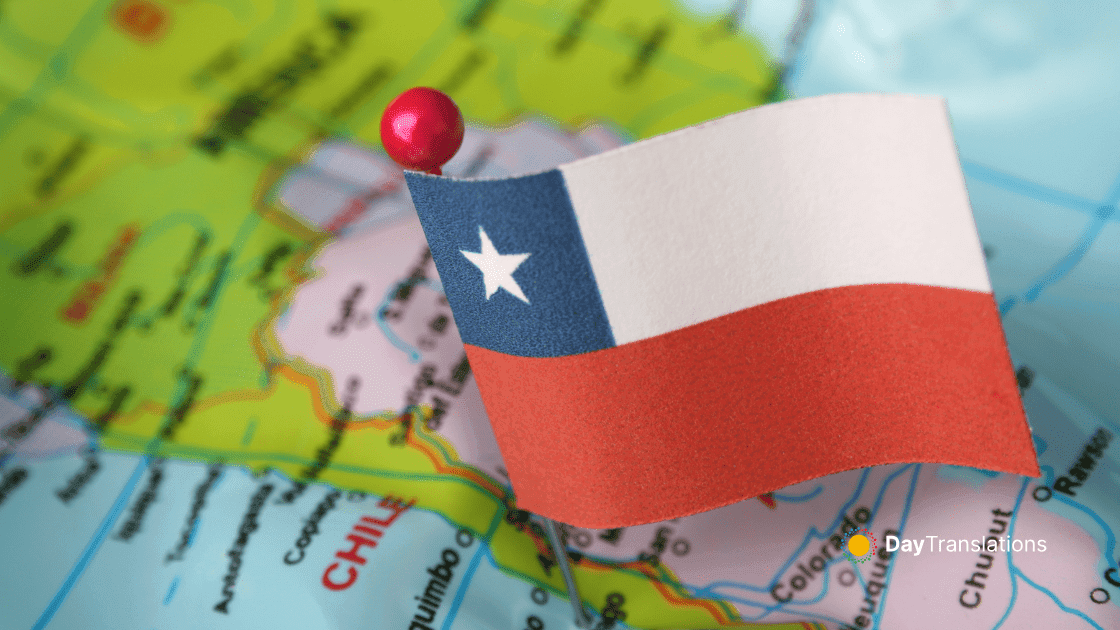
The national flag of Chile contains two equal horizontal bands of white (top) and red; a blue square the same height as the white band at the hoist-side end of the white band; the square bears a white five-pointed star in the center representing a guide to progress and honor.
Note: the design was influenced by the US flag.
Blue symbolizes the sky, white is for the snow-covered Andes, and red represents the blood spilled to achieve independence.
Extensive List of Languages of Chile: Spoken and Extinct Languages
In this Country Profile
Aymara, Central [ayr] 900 in Chile (Gundermann 1994). Ethnic population: 48,501 in Chile (2002). Mountains of extreme north, Tarapacá; Arica, Parinacota, Iquique. Classification: Aymaran
Chilean Sign Language [csg] Classification: Deaf sign language
Huilliche [huh] 2,000 (1982 SIL). South of Mapuche, Tenth region, Valdivia to Chiloé. Alternate names:Huiliche, Veliche. Dialects:
Tsesungún. Related to Mapudungun [arn], but barely intelligible with it. Classification: Araucanian
Kakauhua [kbf] Extinct. Alternate names: Cacahue, Kaukaue. Classification: Alacalufan
Kunza [kuz] No known speakers. A few were located in 1949 and since by anthropologists. Ethnic population: 2,000 (2000 W. Adelaar). Peine, Socaire (Salar de Atacama), and Caspana. Alternate names: Atacameño, Likanantaí, Lipe, Ulipe. Dialects: Greenberg places it in Macro-Chibchan. Classification: Unclassified
Mapudungun [arn] 200,000 in Chile (1982 SIL). Population total all countries: 300,039. Ethnic population: 604,349 (2002). Between Itata and Tolten rivers. Also in Argentina, United States. Alternate names: “Araucano” , Mapuche, Mapudungu. Dialects: Moluche (Ngoluche, Manzanero), Picunche, Pehuenche. Easy intelligibility among dialects. Pehuenche and Moluche are very similar. Classification: Araucanian
Qawasqar [alc] 12 (2006). 10 in Puerto Edin. Ethnic population: 2,622. West Patagonia, Channel region, Isle of Wellington off south Chilean coast, 49 degrees south. Center is Puerto Edin. Alternate names:Alacaluf, Alacalufe, Halakwulup, Kaweskar, Kawesqar. Dialects: Aksanás (Aksana). Classification: Alacalufan Nearly extinct.
Quechua, Chilean [cqu] 8,200 (2006). Northern second region. Dialects: May be intelligible with, or same as, South Bolivian Quechua [quh]. Classification: Quechuan, Quechua II, C
Rapa Nui [rap] 3,390 in Chile (2000). 2,200 on Easter Island; 200 to 300 on Chile mainland, Tahiti, and USA. Ethnic population: 3,500. Easter Island, 3,800 km from Chile, 4,000 km from Tahiti. Also in French Polynesia, United States. Alternate names: Easter Island, Pascuense, Rapanui. Dialects:Lexical similarity: 64% with Hawaiian [haw], Mangareva [mrv], Rarotongan [rar]; 63% with Marquesan [mrq]; 62% with Tahitian [tah], Tuamotuan. Classification: Austronesian, Malayo-Polynesian, Central-Eastern, Eastern Malayo-Polynesian, Oceanic, Central-Eastern Oceanic, Remote Oceanic, Central Pacific, East Fijian-Polynesian, Polynesian, Nuclear, East, Rapanui
Spanish [spa] 13,800,000 in Chile (1995). 25% Spanish, 66% mestizo. Alternate names: Castellano, Español. Classification: Indo-European, Italic, Romance, Italo-Western, Western, Gallo-Iberian, Ibero-Romance, West Iberian, Castilian
Yámana [yag] 1 (2003). Ethnic population: 100 (2000 W. Adelaar). Patagonia, Isla Navarino, Puerto Williams, Ukika hamlet. Alternate names: Tequenica, Yagán, Yaghan. Dialects: Most similar to Qawasqar [alc], and had some relationship to Siane [snp] (Tovar 1961). Earlier there were up to 5 dialects. Classification: Language isolate Nearly extinct.
:: Reference ::
Gordon, Raymond G., Jr. (ed.), 2005. Ethnologue: Languages of the World, Fifteenth edition. Dallas, Tex.: SIL International. Online version: http://www.ethnologue.com/
Famous Chilean People: Chilean Artists, Scientists, Leaders, Musicians, Politicians and Athletes
In this Country Profile
Chile is a melting pot of cultures and ethnicities with outstanding individuals who made a difference with their remarkable achievements. The following people made their mark on both the local and international scenes. They are just some of many famous Chileans who have lifted Chile’s name worldwide and made a difference in our world.
:: List of Famous People from Chile ::
Pablo Neruda
Pablo Neruda was the pen name and, later, legal name of the Chilean Communist poet and politician Neftalí Ricardo Reyes Basoalto. He chose his pen name after Czech poet Jan Neruda. Neruda wrote in a variety of styles such as erotically charged love poems as in his collection Twenty Poems of Love and a Song of Despair, surrealist poems, historical epics, and overtly political manifestos. In 1971 Neruda won the Nobel Prize for Literature. Colombian novelist Gabriel García Márquez once called him “the greatest poet of the 20th century in any language.” Neruda always wrote in green ink as it was the color of hope.
During his lifetime, Neruda occupied many diplomatic posts and served a stint as a senator for the Chilean Communist Party. Neruda was hospitalized with cancer at the time of the Chilean coup d’état led by Augusto Pinochet. Three days after being hospitalized, Neruda died of heart failure. Already a legend in life, Neruda’s death reverberated around the world. Pinochet had denied permission to transform Neruda’s funeral into a public event. However, thousands of grieving Chileans disobeyed the curfew and crowded the streets.
Gabriela Mistral
Gabriela Mistral was the pseudonym of Lucila de María del Perpetuo Socorro Godoy Alcayaga, a Chilean poet, educator, diplomat, and feminist who was the first Latin American to win the Nobel Prize in Literature, in 1945. Some central themes in her poems are nature, betrayal, love, a mother’s love, sorrow and recovery, travel, and Latin American identity as formed from a mixture of Native American and European influences. Gabriela Mistral was of Basque and Amerindian descent.
Salvador Allende
Salvador Allende was a Chilean physician and is generally considered the first democratically elected Marxist to become president of a country in the Americas. Allende’s involvement in Chilean political life spanned a period of nearly forty years. As a member of the Socialist Party, he was a senator,deputy and cabinet minister. In 1970, he won the presidency in a close three-way race.
He adopted the policy of nationalization of industries and collectivization. Amidst strikes by the far-right Patria y Libertad and CIA opposition under the Nixon administration, protests were held in Chile against Allende’s rule. The Supreme Court criticized Allende for subordination of the judicial system to serve his own political needs, whereas the Chamber of Deputies formally implored the military to intercede and restore rule of law on August 22, 1973. Less than a month later, on September 11, Allende was deposed by the military, thus ending the Popular Unity government. As the armed forces surrounded La Moneda Palace, Allende gave his last speech vowing not to resign, but he is believed to have committed suicide later in the day. Shortly following Allende’s ouster, General Augusto Pinochet refrained from returning authority to the civilian government, and Chile became a junta.
Augusto Pinochet
Augusto Pinochet was a Chilean army general and dictator who assumed power in a coup d’état on 11 September 1973. Among his titles, he was the Commander-in-Chief of the Chilean army from 1973 to 1998, President of the Government Junta of Chile from 1973 to 1974 and President of the Republic from 1974 until transferring power to a democratically elected president in 1990.
By early 1972, Pinochet was answering to General Chief of Staff of the Army. In August 1973, he was ascended to Commander-in-Chief of the Chilean Army by President Salvador Allende. On 11 September 1973, Pinochet led a coup d’état which overthrew Allende’s democratically elected socialist government. In December 1974, the military junta appointed Pinochet as President by a joint decree.
From the beginning, the government implemented harsh measures against its political opponents. The new government also implemented economic reforms, including the privatization of several state-controlled industries and the rollback of many state welfare institutions. These policies produced what has been referred to as the “miracle of Chile”, but the government policies dramatically increased economic inequality. Pinochet’s regime was given a legal framework through a highly controversial plebiscite in 1980, which approved a new Constitution drafted by a government-appointed commission. A plebiscite in 1988 (which saw 56% vote against continuing his presidency) led to democratic elections for the Presidency and Parliament.
After peacefully stepping down in 1990, Pinochet continued to serve as Commander-in-Chief of the Chilean Army until 10 March 1998, when he retired and became a senator-for-life in accordance with the 1980 Constitution. In 2004, Chilean Judge Juan Guzmán Tapia ruled that Pinochet was medically fit to stand trial and placed him under house arrest. By the time of his death on 10 December 2006, about 300 criminal charges were still pending against him in Chile for numerous human rights violations, tax evasion and embezzlement during his 17-year rule and afterwards. Pinochet was accused of having corruptly amassed a wealth of more than US$28 million.
Sebastián Piñera
Sebastián Piñera is the current President of Chile. He is a well-known economist, investor, businessperson, philanthropist, politician, former Senator, and leader of the presidential and parliamentary electoral coalition Coalition for Change. Piñera ranks among Chile’s richest persons.
Michelle Bachelet
Michelle Bachelet is a moderate socialist politician who became the first woman president in the country’s history. She won the 2006 presidential election in a runoff, beating center-right businessman and former senator Sebastián Piñera with 53.5% of the vote. She campaigned on a platform of continuing Chile’s free-market policies, while increasing social benefits to help reduce the gap between rich and poor.
Orlando Letelier
Marcos Orlando Letelier del Solar was a Chilean economist, political figure, and diplomat during the presidency of Socialist President Salvador Allende. As a refugee from the military dictatorship of General Augusto Pinochet, Letelier accepted several academic positions in Washington, D.C., where he was assassinated by Pinochet’s DINA agents in 1976.
Bernardo O’Higgins
Bernardo O’Higgins Riquelme was a Chilean independence leader who, together with José de San Martín, freed Chile from Spanish rule in the Chilean War of Independence. Although he was the second Supreme Director of Chile (1817–1823), he is considered one of Chile’s founding fathers, as he was the first holder of this title to head a fully independent Chilean state. O’Higgins was of Irish and Basque descent.
Lucho Gatica
Luis Enrique Gatica Silva, better known as Lucho Gatica, is a Chilean bolero singer. It is estimated that Gatica has released more than 90 recordings. He has toured a vast portion of the world, having made concerts in Europe, the Middle East and Asia. He is the father of the record producer Humberto Gatica.
José Miguel Insulza
José Miguel Insulza Salinas is a Chilean politician and statesman. Since May 26, 2005, he is the incumbent Secretary General of the Organization of American States. Insulza is nicknamed El Panzer, for his tank-like drive and reputation due to his ability to take political heat with little apparent damage.
Marcelo Ríos
Former Chilean tennis player Marcelo Ríos became the first Latin American player to reach the top position on the Association of Tennis Professionals (ATP) singles rankings in 1998. He held the World No. 1 ranking for six weeks.
Fernando González
Tennis player Fernando González is the only Chilean to win gold, silver and bronze medals at the summer Olympics.
Famous People from Chile: Famous Chilean Footballers Players/Soccer Players
In this Country Profile
The following Chilean athletes dedicated themselves in promoting and inspiring people about football, one of the most well-loved sports in the world.
Manuel Pellegrini
Manuel Pellegrini is a former Chilean footballer and manager. As a coach, he has managed teams mostly in Argentina – San Lorenzo, River Plate – and Spain – Villarreal, Real Madrid, Málaga. On 26 May 2010, Real Madrid’s directors announced that Pellegrini would be replaced by José Mourinho.
Marcelo Salas
Marcelo Salas was one of Chile’s most recognized football players. Nicknamed El Matador and El Fenómeno (The Phenomenon) when he started to play in Argentina, Salas had a deft touch with his left foot, which led to some spectacular goals.
Elías Figueroa
Three times elected as the Best Football Player of America, former football star Elías Figueroa is considered the best Chilean footballer of all time, as well as one of the greatest defenders ever to play the game.