
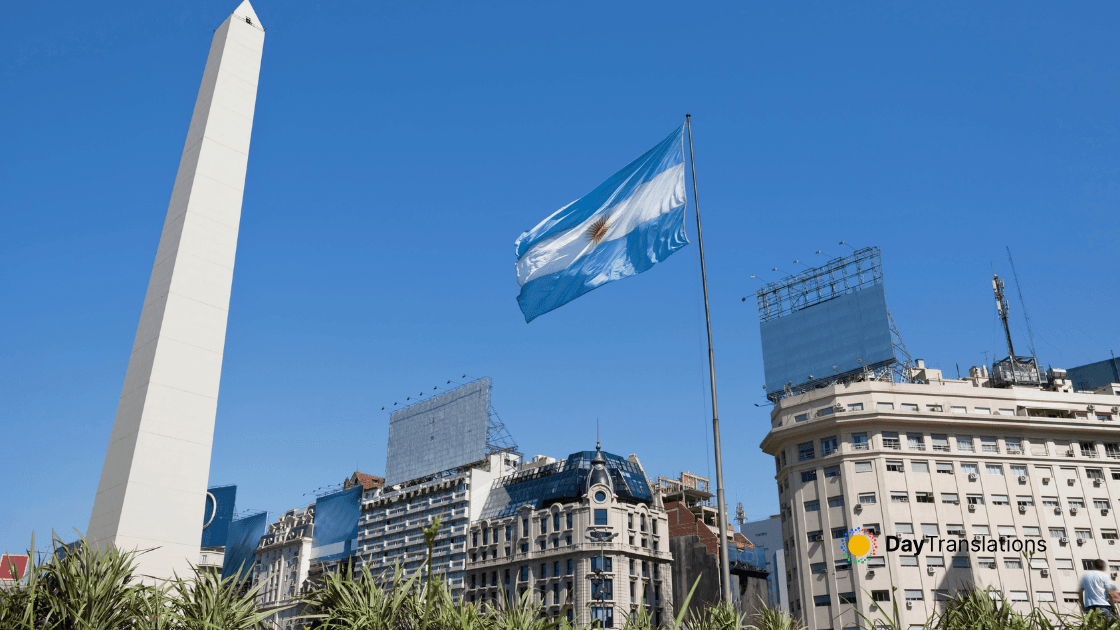
Argentina occupies most of the southern tail of the South American continent, bordering the South Atlantic Ocean, between Chile and Uruguay. Argentina is also bordered by Bolivia and Paraguay on the north, and by Brazil on the east. It is the second largest country in South America by land area, and eighth in the world.
Most of Argentina’s population is of European origin, usually being of Spanish, Italian, British, French, and German. Also, the high economic growth potential, investment incentives, competitive access to international markets, the development of infrastructure of Argentina convinced important investors to open a business in Argentina.
:: Background of Argentina ::
In 1816, the United Provinces of the Rio Plata declared their independence from Spain. After Bolivia, Paraguay, and Uruguay went their separate ways, the area that remained became Argentina. The country’s population and culture were heavily shaped by immigrants from throughout Europe, but most particularly Italy and Spain, which provided the largest percentage of newcomers from 1860 to 1930. Up until about the mid-20th century, much of Argentina’s history was dominated by periods of internal political conflict between Federalists and Unitarians and between civilian and military factions. After World War II, an era of Peronist authoritarian rule and interference in subsequent governments was followed by a military junta that took power in 1976. Democracy returned in 1983, and has persisted despite numerous challenges, the most formidable of which was a severe economic crisis in 2001-02 that led to violent public protests and the resignation of several interim presidents. The economy has recovered strongly since bottoming out in 2002.
In this Country Profile
:: Geography of Argentina ::
Location: Southern South America, bordering the South Atlantic Ocean, between Chile and Uruguay.
Geographic coordinates: 34 00 S, 64 00 W
Area:
total: 2,766,890 sq km
land: 2,736,690 sq km
water: 30,200 sq km
Area – comparative: slightly less than three-tenths the size of the US.
Land boundaries: total: 9,861 km.
Border countries: Bolivia 832 km, Brazil 1,261 km, Chile 5,308 km, Paraguay 1,880 km, Uruguay 580 km.
Maritime claims:
territorial sea: 12 nm
contiguous zone: 24 nm
exclusive economic zone: 200 nm
continental shelf: 200 nm or to the edge of the continental margin
Climate: mostly temperate; arid in southeast; subantarctic in southwest.
Terrain: rich plains of the Pampas in northern half, flat to rolling plateau of Patagonia in south, rugged Andes along western border.
Elevation extremes:
lowest point: Laguna del Carbon -105 m (located between Puerto San Julian and Comandante Luis Piedra Buena in the province of Santa Cruz) highest point: Cerro Aconcagua 6,960 m (located in the northwestern corner of the province of Mendoza)
Natural resources: fertile plains of the pampas, lead, zinc, tin, copper, iron ore, manganese, petroleum, uranium.
Land use:
arable land: 10.03%
permanent crops: 0.36%
other: 89.61% (2005)
Natural hazards: San Miguel de Tucuman and Mendoza areas in the Andes subject to earthquakes; pamperos are violent windstorms that can strike the pampas and northeast; heavy flooding.
Environment – current issues:environmental problems (urban and rural) typical of an industrializing economy such as deforestation, soil degradation, desertification, air pollution, and water pollution
note: Argentina is a world leader in setting voluntary greenhouse gas targets.
Environment – international agreements: party to: Antarctic-Environmental Protocol, Antarctic-Marine Living Resources, Antarctic Seals, Antarctic Treaty, Biodiversity, Climate Change, Climate Change-Kyoto Protocol, Desertification, Endangered Species, Environmental Modification, Hazardous Wastes, Law of the Sea, Marine Dumping, Ozone Layer Protection, Ship Pollution, Wetlands, Whaling. Signed, but not ratified: Marine Life Conservation.
:: People of Argentina ::
Population: 40.482 million (July 2008 est.)
Age structure:
0-14 years: 25.8% (male 5,341,642/female 5,095,325)
15-64 years: 63.5% (male 12,807,458/female 12,884,745)
65 years and over: 10.8% (male 1,784,652/female 2,568,176) (2008 est.)
Median age:
total: 29.7 years
male: 28.8 years
female: 30.8 years (2008 est.)
Population growth rate: 1.068% (2008 est.)
Birth rate: 18.11 births/1,000 population (2008 est.)
Death rate: 7.43 deaths/1,000 population (2008 est.)
Net migration rate: 0 migrant(s)/1,000 population (2008 est.)
Sex ratio:
at birth: 1.05 male(s)/female
under 15 years: 1.05 male(s)/female
15-64 years: 0.99 male(s)/female
65 years and over: 0.7 male(s)/female
total population: 0.97 male(s)/female (2008 est.)
Infant mortality rate:
total: 11.78 deaths/1,000 live births
male: 13.12 deaths/1,000 live births
female: 10.37 deaths/1,000 live births (2008 est.
Life expectancy at birth:
total population: 76.36 years
male: 73.11 years
female: 79.77 years (2008 est.)
Total fertility rate: 2.37 children born/woman (2008 est.)
HIV/AIDS – adult prévalence rate: 0.7% (2001 est.)
HIV/AIDS – people living with HIV/AIDS: 130,000 (2001 est.)
HIV/AIDS – deaths: 1,500 (2003 est.)
Nationality: noun: Argentine(s) adjective: Argentine.
Ethnic groups: white (mostly Spanish, Italian) 97%, mestizo (mixed white and Amerindian ancestry), Amerindian, or other non-white groups 3%.
Religions: nominally Roman Catholic 92% (less than 20% practicing), Protestant 2%, Jewish 2%, other 4%.
Languages: Spanish (official), Italian, English, German, French.
Literacy:
definition: age 15 and over can read and write
total population: 97.2%
male: 97.2%
female: 97.2% (2001 census)
Geography of Argentina: Important Geographical Information about Argentina
In this Country Profile
The vast Argentine territory encompasses a diverse assortment of natural environments, where ice fields contrast with arid zones; mountains with valleys or plateaus; fluvial streams and lakes with large oceans. Argentina may be divided into six geographical regions regarding climate and terrain.
Argentine Northwest: Jujuy, Salta, Tucumán, Catamarca, La Rioja
The provinces of the North-west region include Jujuy, Salta, Tucuman, Catamarca and La Rioja. The North-west is a mountainous region. The most striking feature of Argentina’s landscape is the imposing Andes mountain range which includes peaks of up to 7,000 m above sea level. The Puna is a high plateau which lies near the Chilean and Bolivian border.
Gran Chaco: Formosa, Chaco, Santiago del Estero CHODE
The fertile river valleys and subtropical lowlands of Argentina are found in the Gran Chaco. It is predominantly a level lowland of tropical scrub and savanna grassland lying between the Parana and Paraguay rivers and the Andes. Due to the challenging combination of physical conditions the Gran Chaco remains one of the least-inhabited parts of the country.
Mesopotamis: Misiones, Entre Ríos, Corrientes
Mesopotamia is a broad, flat plain and its characteristics are dominated by two rivers, the Paraná River and the Uruguay River. The area features plains, jungles, hills and swamps and it is extremely hot during the summer. Northern province of Misiones is densely forested. Here can be found also the majestic Iguazu Falls, of the one most popular tourist attractions in Argentina.
Cuyo: San Juan, Mendoza, San Luis
Located in Mendoza, at 6960 m, Argentina’s magnificent Cerro Aconcagua is among the world’s highest mountains and is the highest peak of the Western Hemisphere. Mendoza and San Juan are the country’s most important provinces for wine production.
The Pampas: Córdoba, Santa Fe, La Pampa, Buenos Aires
Fanning out from Buenos Aires is an area known as the Pampas, an immensely fertile central plain of grassy, treeless prairies, with soils among the richest in the world. The Pampas have the largest population.
Patagonia: Rio Negro, Neuquén, Chubut, Santa Cruz, Tierra del Fuego
To the east of the southern Andes is the broad Patagonian Steppe, a flatland with semi-desert plains dominated by short grasslands and low shrubs. The Land of Fire is an archipelago including the Isla Grande de Tierra del Fuego and the islands of the South Atlantic, like Malvinas and Georgias del Sur. The city of Ushuaia in Tierra del Fuego is the most southern city in the world.
Professional Translation Organizations & Associations in Argentina
In this Country Profile
Below is a list of the major translation organizations and associations of Argentina.
:: List of Organizations ::
Asociación Argentina de Traductores
Asociación de Intérpretes de Conferencias de la Argentina
Asociación Argentina de Traductores e Intérpretes
Asociación de Traductores e Intérpretes de la Provincia de Buenos Aires
Círculo de Traductores Públicos de la Plata
Círculo de Traductores Públicos de Zona Norte
Círculo de Traductores Públicos del Sur
Círculo de Traductores Públicos e Intérpretes de la Zona Oeste
Colegio de Traductores de la Pcia. de Santa Fe 2da. Circunscripción
Colegio de Traductores Públicos de la Ciudad de Buenos Aires
Colegio de Traductores Públicos de la Provincia de Córdoba
Instituto de Enseñanza Superior en Lenguas Vivas Juan Ramón Gonzalez
Universidad Argentina de la Empresa, Facultad de Ciencias Jurídicas y Sociales
Universidad Católica Argentina, Facultad de Filosofía y letras
Universidad de Morón,Informática, Cs. de la Comunicación y Téc. Especiales
Universidad del Aconcagua
Universidad del Salvador, Facultad de Filosofía, Historia y Letras
Universidad Nacional de Buenos Aires, Facultad de Derecho, Traductor Público
Universidad Nacional de Catamarca, Facultad de Humanidades
Universidad Nacional de Córdoba, Facultad de Lenguas
Universidad Nacional de La Plata, Facultad de Humanidades Y Ciencias de la Educación, Departamento de Lenguas Modernas
Universidad Nacional del Comahue, Escuela Superior de Idiomas
Universidad Nacional del Museo Social Argentino
Information about the Argentine Flag: Colors and Meaning of the Flag of Argentina
In this Country Profile
The Argentine flag consists of three equally proportional horizontal stripes – the top and bottom part are light blue in color, and the middle background is white where a golden sun. emblem popularly known as “Sun of May” is set.
:: Meaning of the Argentine Flag ::
The rationale behind the colors of the flag of Argentine varies. Historians deduced the colors have spiritual symbolism, attributed to the strong religious conviction of Manuel Belgrano, the creator of the national flag of Argentina. It is supposed to epitomize the color of the Virgin Mary – white and light blue dress.
Another popular belief is more wordly, where light blue is a representation of the sky and the emblem, of the sun. Although disputed, loyalty to the royal “House of Bourbon” is another interpretation.
Extensive List of Languages of Argentina: Spoken and Extinct Languages
In this Country Profile
:: List of Living Languages ::
Argentine Sign Language
[aed] Classification: Deaf sign language.
Aymara, Central
[ayr] Classification: Aymaran.
Chiripá
[nhd] Alternate names: Tsiripá, Txiripá, Nhandeva, Ñandeva, Apytare. Dialects: Apapocuva. Classification: Tupi, Tupi-Guarani, Subgroup.
Chorote, Iyojwa’ja
[crt] 800 (1982 Drayson). Northeast Salta Province. Alternate names: Choroti, Yofuaha, Eklenjuy. Dialects: A distinct language from Iyo’wujwa Chorote (Drayson). Classification: Mataco-Guaicuru, Mataco.
Chorote, Iyo’wujwa
[crq] 1,500 in Argentina. 50% monolinguals. Population total all countries: 2,008. In Argentina they are mixed with the Iyojwa’ja Chorote. No more than a couple of families in Bolivia. Also spoken in Bolivia, Paraguay. Alternate names: Choroti, Manjuy, Manjui. Classification: Mataco-Guaicuru, Mataco.
Guaraní, Mbyá
[gun] 3,000 in Argentina (2002 Dooley). Northeast Argentina. Alternate names: Mbua, Eastern Argentina Guaraní, Mbyá. Classification: Tupi, Tupi-Guarani, Subgroup I.
Guaraní, Western Argentine
[gui] 15,000 in Argentina. Jujuy, Salta. Alternate names: Eastern Bolivian Guaraní, “Chawuncu”, “Chiriguano”. Dialects: Chané, Izoceño (Izocenyo, Isocenio). Classification: Tupi, Tupi-Guarani, Subgroup I.
Kaiwá
[kgk] 512 in Argentina. Northeast Argentina. Alternate names: Caingua, Caiwá, Kayova. Classification: Tupi, Tupi-Guarani, Subgroup I.
Mapudungun
[arn] 100,000 in Argentina (2000). Provinces of Neuquen, Rio Negro, Chubut, Buenos Aires, La Pampa. Alternate names: Araucano, Maputongo, Mapuche, Mapudungu. Dialects: Pehuenche. Classification: Araucanian.
Mocoví
[moc] 4,525 (2000 WCD). South Chaco, northeast Santa Fe. Alternate names: Mocobí, Mbocobí. Classification: Mataco-Guaicuru, Guaicuruan.
Nivaclé
[cag] 200 in Argentina. Salta Province, northeast. Alternate names: Ashlushlay, “Chulupi”, “Churupi”, “Chulupie”, “Chulupe”. Dialects: Forest Nivaclé, River Nivaclé. Classification: Mataco-Guaicuru, Mataco.
Ona
[ona] 1 to 3 (1991 Adelaar). Patagonia, Tierra del Fuego. Also formerly in Chile. Alternate names: Aona, Selknam, Shelknam. Classification: Chon Nearly extinct.
Pilagá
[plg] 2,000 (1991 UBS). Along the valleys of the Bermejo and Pilcomayo rivers in central and western Formosa Province, also Chaco and Salta provinces. Alternate names: Pilaca. Dialects: Toba-Pilagá (Toba del Oeste, Sombrero Negro), Chaco Pilagá (Toba Sur). Intelligibility between the dialects needs investigation. Classification: Mataco-Guaicuru, Guaicuruan.
Puelche
[pue] 5 or 6. Pampas. Alternate names: Gennaken, Pampa, Northern Tehuelche. Classification: Language Isolate Nearly extinct.
Quechua, South Bolivian
[quh] 855,000 in Argentina. Population includes 200,000 temporary laborers, about 100,000 looking for work, 500,000 living in Buenos Aires (1971 F. Hicks). Possibly 70,000 in Salta Province. Buenos Aires, some working on docks. Some in Salta Province. Alternate names: Central Bolivian Quechua. Dialects: Northwest Jujuy (Colla). Classification: Quechuan, Quechua II, C.
Quichua, Santiago del Estero
[qus] 60,000 (2000 SIL). Ethnic population: 60,000. Santiago del Estero Province, north central Argentina, Departments of Figueroa, Moreno, Robles, Sarmiento, Brigadier J. F. Ibarra, San Martín, Silipica, Loreto, Atamisqui, Avellaneda, Salavina, Quebrachos, Mitre, Aguirre, some in southeast Salta Province, western Taboada Department along the Salado River, and Buenos Aires. Alternate names: Santiagueño Quichua. Dialects: Different from Bolivian (lexical similarity 81%) or other Quechua (P. Landerman SIL 1968). Classification: Quechuan, Quechua II, C.
Spanish
[spa] 33,000,000 in Argentina (1995). Classification: Indo-European, Italic, Romance, Italo-Western, Western, Gallo-Iberian, Ibero-Romance, West Iberian, Castilian.
Tapieté
[tpj] 100 in Argentina. Northeast, Tartagal, 1 village. Alternate names: Guarayo, Guasurangue, Tirumbae, Yanaigua, Ñanagua. Classification: Tupi, Tupi-Guarani, Guarani I.
Tehuelche
[teh] 4 (2000 W. Adelaar). Ethnic population: 200 (2000 W. Adelaar). Patagonia. Alternate names: Aoniken, Gunua-Kena, Gununa-Kena, Inaquen. Classification: Chon Nearly extinct.
Toba
[tob] 19,810 in Argentina (2000 WCD). Population total all countries: 20,656. Eastern Formosa Province and Chaco Province. Also spoken in Bolivia, Paraguay. Alternate names: Chaco Sur, Qom, Toba Qom, Toba Sur. Dialects: Southeast Toba, Northern Toba. Classification: Mataco-Guaicuru, Guaicuruan.
Vilela
[vil] 20 (1981 Buckwalter). Resistencia, east central Chaco Province near Paraguay border. Classification: Lule-Vilela Nearly extinct.
Welsh
[cym] 25,000 in Argentina (1998 A. Leaver). Patagonia, Chubut Territory. Dialects: Patagonian Welsh. Classification: Indo-European, Celtic, Insular, Brythonic.
Wichí Lhamtés Güisnay
[mzh] 15,000 (1999). Northern, Pilcomayo River area. Alternate names: “Mataco” Güisnay, Güisnay, “Mataco” Pilcomayo, “Mataco”. Classification: Mataco-Guaicuru, Mataco.
Wichí Lhamtés Nocten
[mtp] 100 in Argentina. Northern border down to Tartagal. Alternate names: “Mataco” Nocten, Nocten, Noctenes, Oktenai. Classification: Mataco-Guaicuru, Mataco.
Wichí Lhamtés Vejoz
[wlv] 25,000 in Argentina (1991 UBS). Northern area: Chaco, Formosa, Salta, Jujuy. Generally west of Toba, along upper Bermejo River Valley and Pilcomayo River. Also spoken in Bolivia. Alternate names: “Mataco” Vejoz, Vejos. Dialects: Bermejo Vejoz. Not intelligible with other Chaco languages. Classification: Mataco-Guaicuru, Mataco.
Extinct Languages
Abipon
[axb] Extinct. Classification: Mataco-Guaicuru, Guaicuruan.
Chané
[caj] Extinct. Salta Province. Dialects: Some have equated this name with ‘Guana’ (Kaskiha) of Paraguay of Mascoian affiliation, or Terena of Brazil of Arawakan affiliation, but they are distinct. Classification: Arawakan, Unclassified.
:: Reference ::
Gordon, Raymond G., Jr. (ed.), 2005. Ethnologue: Languages of the World, Fifteenth edition. Dallas, Tex.: SIL International. Online version: http://www.ethnologue.com/
Famous Argentine People: Argentine Artists, Scientists, Leaders, Musicians, Politicians and Athletes
In this Country Profile
Argentina has produced many talents who have made a difference to society. This list of famous Argentines includes scientists, politicians, art and entertainment figures, athletes, royalty and others. They are simply remarkable individuals and have one thing in common: are not easy to stereotype. These people of purpose shaped their careers brilliantly and made the world proud of them.
:: List of Famous People from Argentina ::
dolfo Bioy Casares
Adolfo Vicente Perfecto Bioy Casares was born in Buenos Aires in 1914 and died in the same city in 1999. He was a famous and influential Argentine writer of fantastic, police and science fiction literature who received the Miguel de Cervantes Prize and the Alfonso Reyes International Prize in 1990. He was a close friend of Jorge Luis Borges and collaborated with him in several occasions under several pen names of which the most famous was Honorio Bustos Domecq. Borges considered him one of the greatest Argentine writers. He became part of the French National Order of the Legion of Honour in 1981 and was declared an “Illustrious Citizen of the Autonomous City of Buenos Aires” in 1986. His most famous novel is “La invención de Morel” (The invention of Morel), published in 1940, and was described by Borges and Octavio Paz as “perfect”. He is considered an essential author in the comprehension of the Argentine literature of the 20th Century.
Astor Piazolla
Astor Pantaleón Piazolla was born in Mar del Plata, Argentina, in 1921 and died in Buenos Aires in 1992. He was a famous and controversial Argentine tango composer and bandoneón player, and is considered one of the most important tango musicians of the second half of the 20th Century. When some other tango musicians said that he was a “tango assassin” and that his music wasn’t tango, he replied describing his work as “contemporary music of Buenos Aires”. Later, his tango style, which incorporated elements from jazz and classical music, was called “nuevo tango”. He knew Carlos Gardel, helped him with the English language in Manhattan and acted with him on the film “El día que me quieras”, in which Galan starred. Some of his songs narrated poetry of Jorge Luis Borges. He composed melodies for over forty films. It is believed that Piazzolla wrote around 3,000 pieces and recorded around 500. “Balada para un loco” (Ballad for a madman) and “Adiós Nonino”, a dedication to his father, were two of his most famous and beautiful compositions.
Andrés Calamaro
Andrés Calamaro Masel was born in Buenos Aires in 1961; he’s a famous Argentine composer, musician, interpreter and producer who has composed some of the most important and influential songs of the “rock en español” (rock in Spanish) genre, becoming one of the icons or Argentine rock. He was part of a local band called The Morgan, which then became the famous band Soda Stereo, when Calamaro wasn’t a member anymore. He had another band called Los Rodríguez, which was very successful in Spain in the nineties. He was the producer or famous Argentine bands such as “Los fabulosos Cadillacs” and “Enanitos Verdes”. He has sold over 1.3 million copies.
Carlos Gardel
The Argentine Carlos Gardel embodies the soul of the tango. He is commonly referred to as “Carlitos”, “The King of Tango”, “El Mago” (The Magician). Gardel was the first great singer of tango and to this day remains an icon in Argentina. Together with lyricist, Gardel wrote several classic tangos, most notably: Mi Buenos Aires querido, Cuesta abajo, Amores de estudiante, Soledad, Volver, Por una cabeza and El día que me quieras. His figure epitomizes the very spirit of the Tango and dominated the Golden Age of the Tango. Carlos Gardel was one of the first true international superstars of the 20th century.
Cesar Pelli
The Argentine Cesar Pelli solidified throughout the years his position as one of the 20th century’s preeminent architects by designing some of the world’s tallest buildings and other major urban landmarks. His designs are known for their curved facades and metallic elements, appearance of his buildings, which were often surfaced in glass or a thin stone veneer.
Throughout his career Pelli. won more than 80 awards for design excellence, including the American Institute of Architects’ 1995 Gold Medal which recognizes a body of work of lasting influence on the theory and practice of architecture. His most famous work are the Petronas Twin Towers, which were for a time the world’s tallest buildings. He also designed the World Financial Center complex in downtown Manhattan, Expansion of Washington National Airport, Washington, D.C. and many others.
Cristina Fernández de Kirchner
Current President of Argentina, she was elected in 2007 and received the leadership of the country after her husband, Néstor Kirchner, ended his presidential period. She was the first woman to be elected for presidency in the history of Argentina, and the second to occupy position (In 1974, María Estela Martínez de Perón “Isabelita Perón” was elected vice president and then became the president after the death of Juan Domingo Perón). In 2008, she was elected by Forbes magazine as the thirteenth most powerful woman of the world in the publication’s top 100 powerful women list.
Diego Maradona
Diego Armando Maradona is considered by many to be the greatest footballer of all time. Maradona won a World Cup, league titles in Argentina and Italy, national Cups in Spain and Italy, and numerous individual honours including best player at the 1986 World Cup, FIFA Goal of the Century (a spectacular 60-metre weave through six England players) and FIFA Player of the Century (People’s Choice).
Diego Torres
Born in Buenos Aires in 1971 as Diego Antonio Caccia Torres, he’s an Argentine songwriter, pop singer and actor who’s been nominated for several Latin Grammy Awards. He’s the son of the Argentine singer Lolita Torres. His most famous and successful song is “Color esperanza”.
Domingo Liotta
Domingo Santo Liotta is a reputed pioneer of heart surgery, creator of multiple cardiac prostheses including the first total artificial heart used in a human being, both left ventricular assist systems, LVASs and total heart replacements. The historical operation, one of the greatest medical adventures of the 20th century, was performed for the first time in the afternoon of April 4 1969. His worthy contribution to human history has been remarkable.
Ernesto “Che” Guevara
At the risk of seeming ridiculous, let me say that the true revolutionary is guided by a great feeling of love. It is impossible to think of a genuine revolutionary lacking this quality.”
Che Guevara, El Che, or simply Che, was an Argentine Marxist revolutionary, outstanding leader of the Communist Revolution in Cuba, politician, author, physician, military theorist. He was the foremost figure in Latin America advocating revolution. After his death, his stylized image became a ubiquitous countercultural symbol worldwide. He is a symbol of rebellion and alluring zeal of revolution. He had published highly influential manuals Guerrilla Warfare (1961) and Guerrilla Warfare: A Method (1963). The philodopher Jean Pail Sartre called him „The perect man of his time.” Che Guevara had the same qualities of the most outstanding figure of history. He was called also „a red Robin Hood”, „Don Quixote of Communism”, “Marxist Saint Just”.
Ernesto Sábato
This physicist, essayist and writer was Born in the city of Rojas, in the province of Buenos Aires, in 1911. He was an active member of the communist party when he was young. He studied physics, but while he lived in Paris he joined a group of surrealists and his career started changing and turning into philosophy and literature. His novel “Sobre Héroes y Tumbas” (On Heroes and Tombs), published in 1961, consolidated him as one of the most important contemporary writers.
Fanny Mikey
This passionate actress and theater director and entrepreneur was born in the city of Buenos Aires, Argentina, in 1930 and spent her life between her native country and her second home, Colombia, as well as traveling around the world getting inspiration for her plays and showing her incredible work. She was the creator and director of the Bogota Iberoamerican Theater Festival, one of the biggest theater festivals in the world, and she was known as the “queen of theater” and the “queen of floorboards”. At her 78 years she still danced and performed in some of her plays. She died in the city of Cali, Colombia, in 2008 due to a kidney failure.
Fito Páez
His real name is Rodolfo Páez Ávalos and he was born in the city of Rosario, Argentina, in 1963. He’s a famous rock and roll musician, pianist, song writer and singer, as well as a film director and screenwriter. His work has been very successful in Argentina, the rest of Latin America, Spain and England. He was the first non-Cuban musician that performed in the Plaza de la Revolución, in La Habana, Cuba. He was also the first rock Latin musician that gave a concert in the Teatro Colón in the city of Buenos Aires, Argentina. His rock album “El amor después del amor” (Love after love) has the record of the best-selling Argentinean rock album with almost 750.000 copies to the date.
Gustavo Cerati
Gustavo Adrián Cerati Clark was born in Buenos Aires in 1959; he’s an Argentine musician, songwriter and artist who became famous for being a part of the band Soda Stereo, and who is currently one of the most important and influential figures of the Argentine and the Latin American rock. His first works were influenced by bands and singers like The Cure, Queen, The Police and David Bowie. He’s won several Latin Grammys and Latin MTV Video Music Awards, as well as other music awards.
Homero Manzi
His full name was Homero Nicoláz Manzione Prestera and he was born in Añatuya in 1907. He was a film director and song writer, author of several very famous tangos and milongas such as Malena, Barrio de tango, Romance de barrio, Sur and Milonga sentimental. He was politically active and strongly supported the politician and three times president of Argentina, Juan Domingo Perón. There’s a well known tango restaurant and bar in the city of Buenos Aires that is called “La esquina Homero Manzi” (Homero Manzi’s Corner) in his honor.
Isabel Perón
In 1974 Maria Estela Martinez de Peron, best known as “Isabel Peron”, became the first woman President in the modern history and the youngest Latin American head of state at 43 years. She is the widow of former President Juan Domingo Peron. She served during difficult, frequently bloody, political turmoil. She was the first non-royal female head of state. She was the most influence argentine political woman.
Jorge Luis Borges
Jorge Luis Borges is considered one of today’s best modern writers, is one of the great literary heroes of Argentina, the master of Spanish prose. Some of his influences are European culture, English literature, and writers like Alighieri, Miguel De Cervantes, G. K. Chesterton, Franz Kafka, Rudyard Kipling, Arthur Schopenhauer and H.G. Wells. Borges was an Argentine poet, essayist, critic, translator, and short-story writer, his texts serves as vehicles for complex philosophical themes. He was also a as specialist in the history, culture, and literature of Argentina and Uruguay.
Juan Domingo Perón
Politician, soldier and ex president of Argentina. He was the Argentinian president in three occasions; the first time he was elected and completed his period, then he was reelected and overthrown by a coup d’état after which he was sent into exile for 18 years, and the third time he couldn’t finish his presidency because he died in 1974 when he still had five years left.
Juan Gelman
This poet and journalist was born in the city of Buenos Aires in 1930. He was sent to exile for 12 years because of the political violence of his country and he currently lives in Mexico. He is considered one of the greatest contemporary poets. He received the National Poetry Award in 1997, as well as the Cervantes Award in 2007. The Ecuadorean writer, Jorge Enrique Adoum, has described him as “the greatest Spanish speaking poet alive”.
Juan Manuel Fangio
Many consider Juan Manuel Fangio to be the greatest racing driver in history. He was an Argentine race car driver who dominated the Grand Prix racing scene of the 1950s in a way nobody has done before.
He won five Formula One World Driver’s Championships in 1951, 1954, 1955, 1956, and 1957. Fangio won the world titles driving for Alfa Romeo, Mercedes-Benz, Ferrari, and Maserati. Many still consider him to be the greatest driver of all time and his winning score may never be topped.
Julio Cortázar
This famous intellectual, writer and translator was born in the Argentinian Embassy in the city of Brussels, in Belgium, in 1914. His full name was Jules Florencio Cortázar. He lived a good part of his life in Paris, France, where he died in 1984. He is considered one of the greatest, most innovative and original writers of his time. He was a master of short stories and prose poetry. He’s been compared to authors such as Edgar Allan Poe and Jorge Luis Borges, who was close to him and helped him with the publication of some of his first texts. One of his most acclaimed works was the novel “Rayuela” (Hopscotch).
Julio Bocca
Julio Mario González was born in Munro, Greater Buenos Aires, in 1967; he’s one of the most famous and important Argentine dancers of all times and one of the most important ballet dancers of the later part of the 20th Century. He won the gold medal on an International Ballet Competition in Moscow at the age of eighteen. He’s the founder and artistic director of the company “Ballet Argentino”, which was created in 1990 and presents different shows around the world, some of which have a combination of tango and ballet. He retired from dancing in 2007.
Mercedes Sosa
She was born in San Miguel de Tucumán, Argentina, in 1935 and died in Buenos Aires in 2009. Known as “La negra Sosa”, “La voz de América” (The voice of America) and the “voice of the voiceless ones”, she was a very influential Argentine folk music singer and songwriter, widely known in Latin America and Europe, and she’s considered the most important Argentine singer of all times. The lyrics of her songs had a strong social content. She was the founder of the cultural movement “Movimiento del nuevo cancionero” and of the Latin and Spanish music movement “La nueva canción latinoamericana”. She won several Grammy Awards and she received other numerous international honors and awards. She was an ambassador for UNICEF. Some of her most representative songs are “Gracias a la vida”, “Canción con todos”, “Alfonsina y el mar”, “Todo cambia”, and more.
Martín Caparrós
Born in Buenos Aires in 1957, he is an important Argentine journalist, writer and translator who was exiled for several years in Europe due to the dictatorship that governed Argentina between 1976 and 1983. He won the King of Spain International Prize for Journalism in 1992. One of his most famous novels is “A quien corresponda”, published in 2008.
Pampita (Carolina Ardohain)
Ana Carolina Ardohain Dos Santos, best known as Pampita, was born in La Pampa, Argentina, in 1978. She’s an Argentine top model and television personality that has been part of numerous commercials and magazines all over Latin America, as well as part of the Victoria’s Secret’s campaigns. She’s also been the cover of important magazines such as Elle, Maxim and Cosmopolitan.
Quino
Born as Joaquín Salvador Lavado in Guaymallén, Argentina, in 1932, Kino is a humorist and cartoonist, famous in Latin America and some places of Europe for his most successful comic strip, Mafalda, which was originally published between 1964 and 1973, translated into more than 30 languages, and was charged with cynical humor and with political messages that constituted critics to society. In 1976, UNICEF chose the character Mafalda to be a spokesperson for the Convention on the Rights of the Child. Cartoonists around the world chose Quino to be the “Cartoonist of the year” in 1982; that was just one of many recognitions and awards he has received.
René Favaloro
René Favaloro is a worldwide Argentine cardiac surgeon, a pioneer of coronary bypass surgery. In 1967, René Favaloro became the first surgeon to perform bypass surgery on a patient suffering from coronary artery disease. Dr Rene G. Favaloro (1923–2000) is considered one of the preeminent cardiovascular surgeons of the 20th century. He will be remembered as a great innovator and pioneer in the field of cardiothoracic surgery.
Roberto Giordano
This Argentine stylist and fashion entrepreneur is one of the most famous in Latin America who every year presents his fashion shows with important models from around the world. He discovered the Argentine top model Valeria Mazza when she was sixteen years old.
Tomás Eloy Martínez
He was born in Tucumán, Argentina, in 1934 and died in Buenos Aires in 2010. He was an Argentine journalist, essayist, writer and screenwriter, one of the most important and influential from Argentina. He was exiled in Caracas, Venezuela, for some years due to the dictatorship that governed Argentina during the late seventies and the early eighties. He received numerous international honors and prizes, among which are the Spain’s Alfaguara Novel Prize for his novel “El vuelo de la reina” (Flight of the queen), in 2002, and the Spain’s Ortega y Gasset Journalism Award for his whole career, in 2009. He was a close friend of the Colombian writer Gabriel García Márquez and was a professor at the “Fundación para un Nuevo Periodismo Iberoamericano”, which was created by García Márquez. One of his most representative works is “Santa Evita” (1995), which has been translated into more than thirty languages and published in fifty countries.
Valeria Mazza
Born in Rosario, Argentina, in 1972, Valeria Raquel Mazza is a famous Argentine top model (the most important from Argentina) and entrepreneur who was discovered by the Argentine stylist Roberto Giordano. She has been the cover and part of the pages of important magazines from around the world such as Elle, Vogue, Glamour and Sports Illustrated Swimsuit Issue, which has given her international fame. She’s currently the official advertising face of Guess. Her legs are considered a national symbol in Argentina.