

At Day Translations, we believe language does more than transmit information. It opens doors, creates understanding, and allows people from different backgrounds to share the same experience with confidence. In live settings especially, clear communication can shape how people learn, engage, and remember what they encounter. That is why interpretation is not simply a technical service. When done well, it becomes part of the event itself, helping every attendee feel included, informed, and genuinely connected to what is happening around them.
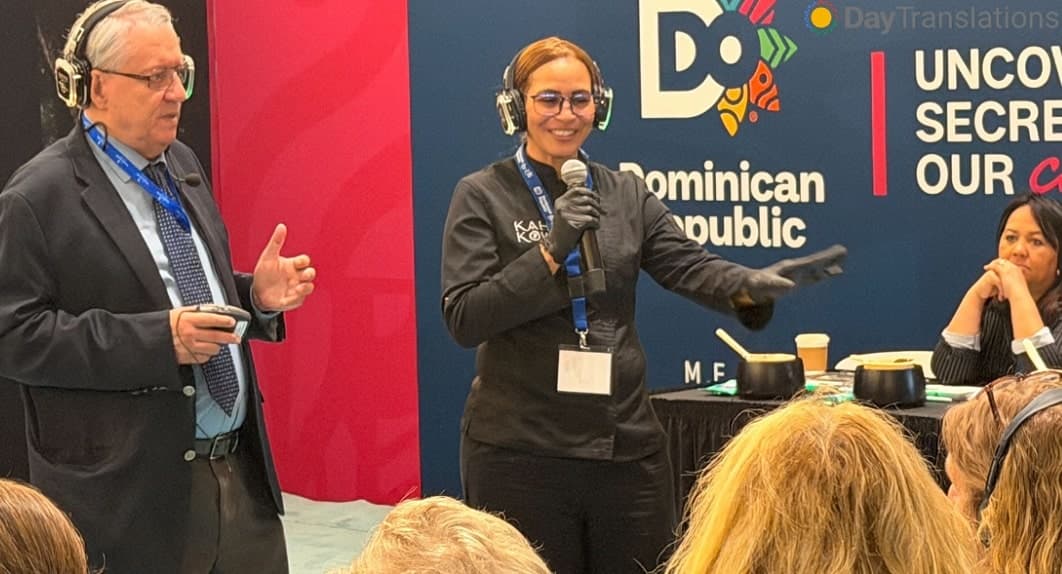
That belief was brought to life during a recent event dedicated to promoting the Dominican Republic through its tourism offerings, cultural traditions, and training sessions. Designed as an immersive experience rather than a conventional presentation, the event invited participants to move through a series of themed rooms, each one highlighting a different aspect of Dominican identity. From culinary traditions to dance and live cultural activations, the day was built around participation, movement, and discovery. Our role at Day Translations was to make sure that language never became a barrier to that experience.
For this project, our CEO, Mr. Hopwood, joined a team of 14 professional interpreters to provide in-person simultaneous interpretation support throughout the event. The setup involved seven rooms in total, with interpreters working in pairs to cover each space and maintain the accuracy, pace, and professionalism required in a live multilingual environment. Roughly 25 participants moved through each room in rotating groups, which meant the interpreting support had to remain consistent, flexible, and seamless from one session to the next.
An Event Built Around Experience
What made this event stand out was its format. Instead of asking guests to sit through a traditional sequence of speeches, the organizers created a dynamic environment where attendees could actively experience Dominican culture. Each room offered a different perspective, allowing participants to engage through taste, movement, conversation, and guided instruction. This kind of format creates a more memorable experience, but it also raises the communication stakes. When people are rotating quickly between activities, listening in real time, and responding on the spot, interpretation must be immediate, clear, and natural.
In one of the cultural rooms, guests took part in a cooking activation centered on casabe preparation, along with other dishes associated with Dominican culinary heritage. Food-based experiences are powerful because they create an immediate cultural connection. Attendees are not just hearing about a destination; they are learning through texture, aroma, preparation, and shared participation. In that setting, interpretation supports more than comprehension. It helps preserve the meaning behind ingredients, traditions, and instructions so that each guest can fully follow along and appreciate the story behind what they are making.

Other rooms focused on music, dance, and movement, giving guests an opportunity to experience the energy of the Dominican Republic through merengue and bachata. Cultural demonstrations like these are highly interactive and fast-paced. Attendees need to understand not only the spoken instructions, but also the context and spirit behind the activity. Our interpreters helped make those moments accessible in real time, allowing guests to participate more confidently and enjoy the experience without feeling excluded by language differences.

Why the Interpretation Setup Mattered
Because the activations were conducted in silent mode, the event required a solution that could support movement and interaction without interrupting the atmosphere. A traditional booth would not have suited the environment. Instead, mobile interpretation equipment with receivers allowed guests to move freely through the sessions while still hearing live interpretation clearly. The practical requirements were simple, with just a table and chair needed for the interpreter in each room, but the impact of the setup was significant.
This format made it possible for interpretation to remain almost invisible while still being essential. Guests could cook, observe, learn, ask questions, and move from one activity to another without feeling as though language support was slowing down the experience. That kind of fluidity is especially important in cultural and tourism events, where the goal is not only to communicate facts, but to sustain atmosphere, engagement, and emotional connection. In environments like these, the right interpreting format can make the difference between an event that feels fragmented and one that feels welcoming to everyone in the room.

Interpretation was also provided during the event’s training sessions, which required a different but equally important kind of precision. Training content demands clarity, consistency, and strong preparation, and our interpreters were present one hour before the scheduled start to ensure they were fully ready to support the program. That preparation matters. Successful live interpretation depends not only on linguistic skill, but also on readiness, coordination, and the ability to adapt to the rhythm of the event as it unfolds.
What This Event Reflects About Day Translations
For Day Translations, supporting this event was about more than delivering a service. It was an opportunity to contribute to an environment where culture could be shared openly and understood by everyone present. When language access is built into an event from the beginning, organizers can reach people more effectively, participants can engage more deeply, and the overall experience becomes more inclusive. That is true whether the setting is a tourism activation, a conference, a trade event, a training session, or a corporate program with an international audience.
This project also reflected the wider value that professional interpretation brings to business and institutional events. Multilingual support strengthens audience confidence, improves participation, and helps organizations communicate with clarity across diverse groups. For clients, that means greater reach and stronger outcomes. For attendees, it means they are able to focus on the substance of the event rather than the challenge of following along. That is where interpretation adds its greatest value: not only by converting language, but by creating access.
We were proud to support an event that celebrated the Dominican Republic in such a vivid and engaging way. The experience was a reminder that communication and culture are deeply connected. When language barriers are removed, people are better able to listen, learn, and connect with what is in front of them. They participate more freely. They remember more clearly. And they leave with a stronger sense of connection to the ideas, traditions, and people they encountered.

At Day Translations, this is the work we care deeply about. We help organizations create multilingual experiences that are professional, inclusive, and effective, whether the audience is moving through cultural activations, participating in training sessions, or attending a large-scale live event. We are grateful for the opportunity to have contributed to this initiative, and we look forward to continuing to support clients who want their events to be both globally accessible and genuinely memorable.
Closing
If your organization is planning a multilingual event and needs dependable interpretation support, Day Translations is ready to help create an experience that feels seamless for every audience. From cultural programs and tourism activations to business meetings and training sessions, our goal remains the same: to make communication clear, inclusive, and effective at every stage of the event.
