
One of the oldest democracies in the South American continent, Venezuela is blessed with several gifts from nature – beautiful rock formations carved naturally thousands of years ago, endemic wildlife, snow-capped Andes Mountains, long stretches of beaches with sugar-fine sand and vast petroleum and natural gas reserves. Venezuela was named after Venice when some 15th century European explorers arrived at this beautiful country and saw native houses on stilts called palafitos erected around Lake Maracaibo. Outside of the oil-producing countries in the Middle East, Venezuela is the fifth largest oil exporter in the world and still has vast resources of natural gas that remain untapped. Travel to this wonderful country and explore its natural beauty and its rich cultural history.
:: Background of Venezuela ::
The indigenous people of Venezuela, the Caribs, the Arawaks and some Chibchas lived a peaceful existence along the coast, on the wide plains and in the tropical forests of the country before the European explorers landed on its shores in the 16th century beginning with Christopher Columbus.
The arrival of the Spanish had almost decimated the number of indigenous people in Venezuela. Spain was quick to exploit the riches of the country and tried to subdue its people and gain their allegiance. Venezuela was once very rich in pearl oysters particularly in Margarita and in Cubagua. For a while the bountiful pearl oysters brought riches to Spain until it was almost exhausted, along with the number of indigenous people they used to gather the pearls. Another Spanish expedition led by Alonso de Ojeda landed at the Gulf of Venezuela and in seeing the houses on stilts lining the coast gave it the name Venezuela meaning Little Venice.
When gold was discovered, slavery became rampant and African slaves were also brought into the country to work in the mines. While it enriched Spain and opened Venezuela to international trade, the majority of the inhabitants were subjected to very strict laws. In the 18th century the people of Venezuela, after suffering too much oppression and discrimination were broken into factions. However, they were one in wanting to be independent from Spain. The first organized attempt at rebellion was instigated by José María España together with Manuel Gual. However it was quickly put down due to the mantuanos or the privileged people in the country who collaborated with the ruling Spanish families.
In this Country Profile
The rise of Napoleon and its wars with Spain gave the people of Venezuela inspiration. It also led Britain to become pro-independence. The War of Independence of Venezuela eventually started in 1811 and several commanders and leaders who rose in prominence, fought and with the leadership of Simon Bolivar started to liberate parts of Venezuela and annexed it to the Gran Colombia. In 1821, Gran Colombia gained independence from Spain. It was not one continuous battle with a series of victories. There were several wins and losses, retreats and advances as well as factional in-fighting. However, it the end, their dream of finally being freed of Spain’s dominance was achieved, even if Bolivar’s dream of uniting the nation was not achieved during his time. The ravages of war left Venezuela impoverished and its population down into almost a million. It was the discovery of oil in Lake Maracaibo while WWI was raging that helped Venezuela get back on its feet.
:: Geography of Venezuela ::
Venezuela is in an enviable position, being located on the major air and sea paths that link South and North America. Bounded by Guyana, Brazil and Colombia on the east, south and west respectively, its northern side has a coastline stretching about 2,800 kilometers along the coast of the Caribbean Sea and the North Atlantic Ocean. Venezuela has plenty of natural sites to offer travelers with Angel Falls, the highest in the world; the snow-capped Andes mountains, Pico Bolivar, its highest mountain, several unique tabletop plateaus and the Orinoco River, the second largest in South America next to the Amazon and ranks number age in terms of size among all the large rivers in the world.
The county also boasts of having the largest lake in South America, the petroleum-rich Lake Maracaibo. Venezuela has varied terrain due to the mountains, valleys, deep gorges and wide plains. Its topography contribute largely to the variety of climate patterns in Venezuela, which is classified as tropical although can range from hot and humid in some areas especially the interior and alpine cool nearer the mountains. There are areas that received huge amounts of rain whereas some there are areas that are shadowed by the mountains and are therefore dry and prone to droughts.
Location
Venezuela lies to the northern south of the continent of South and nestled between its closest neighbors, Guyana, Colombia and Brazil with its north side facing the North Atlantic Ocean and the Caribbean Sea. Venezuela’s geographic coordinates are 8° 0’ 00” north and 66° 0’ 00” west.
Area
Venezuela is a big landmass measuring 912,050 square kilometers. Its total land area is 882,050 square kilometers and while the area covered with water measures 30,000 square kilometers. The country is more than two times bigger than California, USA.
Land Boundaries
Located among other large South American nations, Venezuela has a long land border. Its longest border is shared with Brazil on its south side, stretching for about 2,200 kilometers. On the east, Venezuela shares a border with Guyana for 743 kilometers and along its western side, it is bordered by Colombia for about 2,050 kilometers.
Coastline
Venezuela also has quite a long coastline along its northern and southern parts. Its total coastline measures about 2,800 kilometers, facing the Caribbean Sea as well as the North Atlantic Ocean.
Maritime Claims
Its territorial sea claim covers 12 nautical miles with a contiguous zone of 15 nautical miles. Venezuela’s exclusive economic zone extends out for another 200 nautical miles and its continental shelf covers a depth of 200 meters or to the depth of allowed exploitation.
Climate
Venezuela’s climate is generally tropical but the temperature varies in the different regions of the country. Humidity is prevalent due to the bodies of water near and within the country although the presence of several peaks of the Andes Mountains, most of which are snow-capped, keep the temperature in the highlands from moderate to Alpine cold.
Terrain
The terrain of Venezuela is quite varied. There are lowlands, table-top plateaus and highlands. The central plains, called llanos are located in Orinoco while the lowlands are found in Maracaibo along the northwest section of Venezuela. The Guiana highlands on the southeast consist of various table-top plateaus, the highest of which contain the highest waterfall in the world, the Angel Falls. On the northeast are the Andes Mountains. It is also the location of the highest mountain in Venezuela, the Pico Bolivar.
Elevation Extremes
The Caribbean Sea at zero meters is the lowest point in Venezuela while its highest elevation is located at Pico Bolivar, officially measured to reach a height of 4,981 meters (previous measurement was 5,007 meters). Pico Bolivar, named after Simon Bolivar, is located in the Mérida.
Natural Resources
Aside from the beautiful beaches, mountain peaks, lakes, rivers and rock formations, Venezuela has bountiful natural resources that contribute greatly to the nation’s economy. It is second to the United States in vast reserves of natural gas, most of which remains untapped. It is also the fifth largest oil exporter in the world. Aside from these, Venezuela also have gold, iron ore, diamonds, bauxite and large hydropower potential because of several rivers in the country.
Land Use
Out of the total available land area, only 2.85% of it is arable with 0.8% planted with permanent crops. Much of the land or about 96.27% is allocated for other uses.
Natural Hazards
Venezuela is prone to rockslides due to the number of mountains and tabletop plateaus. It is also prone to floods and mud slides. Part of the country experience droughts periodically.
Current Environmental Issues
Venezuela is becoming highly industrialized and as such sewage pollution is becoming a problem particularly in Lago de Valencia. In Lago de Maracaibo, where oil exploration is ongoing, oil and urban pollution as a result of the increased number of residents are beginning to affect the area. Venezuela is also facing deforestation, urban and industrial pollution near the Caribbean coast and soil degradation, while irresponsible mining contributes greatly to the threats to its rainforest ecosystem.
International Environmental Agreements
Venezuela has signed all the international environmental agreements it has entered into but has not ratified any of it yet. It has signed agreements on ozone layer protection, tropical timber 83 and 95, wetlands, desertification, endangered species, biodiversity, Antarctic treaty, climate change, hazardous wastes, climate change-Kyoto protocol, marine life pollution and ship pollution.
:: People of Venezuela ::
Citizens of Venezuela are called Venezuelans (singular – Venezuelan). The word can be used as a noun as well as an adjective to describe a native from Venezuela.
Population
According to the 2011 CIA World Fact Book, the population of Venezuela is estimated to be around 27,635,743. Most of the population is concentrated in the urban areas in the northern coast of the country. The estimated population growth rate for 2011 is 1.493 percent. Total fertility rate for 2011 is about 2.42, translated into about 2 and a half children born to every female of child-bearing age in Venezuela. The country has zero net migration, according to the estimates done in the middle of 2011.
Age Structure
The highest age group in Venezuela belongs to the middle group, the 15 to 64 age bracket with 65.1%, broken into 9,130,561 females and 8,846,945 males. The next group belongs to the 0 to 14 age bracket where there are 4,149,781 males and 4,002,931 females collectively making 29.5% while those in the 65 years and over comprise 5.4% of the population, with females outnumbering the males, placed at 840,089 and 665,436 respectively.
Median Age
Of the total population, the median age in Venezuela is 26.1 years with the female median age at 26.8 years is slightly higher than the makes, measured at 25.4 years based on 2011 calculations.
Birth and Death Rates
Based on the July 2011 estimates, there are 20.1 births for every 1,000 inhabitants in Venezuela while the death rate is placed at 5.17 for every 1,000 inhabitants.
Sex Ratio
The disparity between the genders of Venezuelan inhabitants very slightly favors the males, but is it not by much. Among the total population it is estimated that there is 0.98 male for every female while at birth the ratio is 1.05 male for every female. It lowers slightly in the under-15 age group with 1.03 males for every female. The ratio between males and females goes lower as the age level increases, with only 0.97 males for every female and still lower at 0.79 males for every female in the 65 years and older age group.
Infant Mortality Rate
Infant mortality rate is quite high in Venezuela, with about 20.62 deaths for every 1,000 live births for the whole country. The rate is higher for the males with 24.12 deaths/1,000 live births. Significantly the rate is lower for females with only 16.95 deaths for every 1,000 live births, as stated in the 2011 estimates.
Life Expectancy at Birth
The figures for life expectancy at birth is quite good, with the average for the total population registering almost 74 years. The females outlive the men by a few years, estimated at 77.17 years while the average for the males is only 70.84 years.
HIV / AIDS
While data figures for HIV/AIDS in Venezuela varies, it is evident that the country is also struggling to overcome this dreaded disease. People living with HIV/AIDS in Venezuela jumped dramatically from about 62,000 in 2004 to over 110,000 in 2010. The prevalence of HIV/AIDS in adults 15 to 49 years of age was estimated at 0.7% in 2001. The death tally caused by the disease also increased, from 2,000 in 2001 to over 4,100 in 2003.
Ethnic Groups
About sixty-eight percent of Venezuelans are mestizos while 21% is composed of German, Italian Portuguese and Spanish. Blacks account for about 10% of the population while the native Amerindians (Caribs and Arawaks) make up 2% of the population. A handful of Arabs are also present in Venezuela.
Religions
The majority of the population of Venezuela are nominal Roman Catholics, representing 96%. The rest is equally divided into Protestants and other religions
Language
Spanish is the official language spoken by a huge majority of Venezuelan. Some other immigrant languages are spoken, including English while the older generation also speak some indigenous dialects.
Literacy
Literary in Venezuela is increasing from the rate jumping from 88% in 1991 to 93% based on the 2001 census. Inhabitants age 15 and over are able read and write, with the male literacy rate measured at 93.3% compared to the 92.7% for females.
:: References ::
https://www.cia.gov/library/publications/the-world-factbook/geos/ve.html
http://en.wikipedia.org/wiki/Venezuela
www.lonelyplanet.com/venezuela
Geography of Venezuela: Important Geographical Information about Venezuela
In this Country Profile
Topography
Traveling to South America gives a traveler a taste of several of nature’s scenic bounties. With snow-capped mountains and beaches with powder-fine sand, Venezuela has so much to offer. It has a total area of 912,050 square kilometers. It is situated in the northernmost part of South America. Venezuela’s land area covers 882,050 square kilometers, which is about two times the land size of California in the United States.
Venezuela is blessed with a long coastline, running for about 2,800 kilometers. On its northern side it is bounded by the Atlantic Ocean and the Caribbean Sea. Its eastern side shares a border with Guyana for about 740 kilometers. Colombia is Venezuela’s neighbor in the west and their shared border runs for 2,505 kilometers while its border with Brazil, which lies to its southern side, is about 2,200 kilometers long.
Venezuela is divided into four regions – central Venezuela as the Orinoco plains called llanos. In its southeast portion lie the Guiana highlands. To the northwest are the Maracaibo lowlands while the mountains are located on the northern part. Maracaibo is basically flat with some gentle slopes from the sections near the mountains. Parts of the northeastern most sections of the Andes Mountains are to the north of the country. This is where the highest peak in Venezuela, the Pico Bolivar, which rises to a height of 5,007 meters, is located. In the Guiana highlands, split into two by the Orinoco River, the largest in South America and the eighth largest in the world, is the location of the world’s highest waterfall, Salto Ángel in Spanish. In English the waterfall is popularly known as Angel Falls. In between the mountain peaks are fertile valleys where Caracas is one of the most important metropolitan centers. It is densely populated where the best transportation network in installed and where agriculture highly flourishes.
The plains of Orinoco spread from the Caribbean coast toward the border with Colombia, running through Rio Orinoco and the northern mountains. Nearer to the border in the Orinoco Delta are vast stretches of swampland. This section has higher elevation although never exceeding 200 meters. Another river, Rio Apure that originates from the northern mountains created shallow valleys that give the flat lands the appearance of gently rolling plains. The land south of the river Apure has lower elevation and flatter terrain. This part is called the Guiana highlands, one of the oldest landforms in South America where past soil erosions have cut unique formations, creating several tabletop plateaus etched by the swift currents of different tributaries of the larger rivers like the Orinoco. One of these majestic formations is the Gran Sabana or the Great Plain in Canaima, where travelers can find several bluffs or tepuis with flat tops of varying heights, some of which are cloud-covered. One of these tepuis (singular: tepuy), the Auyantepuy contains the Angel Falls, which is fifteen times higher than Niagara Falls.
Climate
While Venezuela is supposed to be a tropical country, due to its elevation and terrain, the direction and force of the wind, as well as the presence of the Andes mountain range, the country’s climate varies from alpine to humid. The rainy season is equivalent to winter, with rainfall coming from May until November. Summer months in Venezuela are from December to April. However, the prevailing temperature is variable as Venezuela has several temperature zones due to the different elevations. For the areas that are below 800 meters, the temperature can be hot, resembling that of a tropical country, averaging between 78 °F to about 82 °F. Most of the cities in Venezuela, including its capital, Caracas are in the second zone, with elevations between 800 meters and 2,000 meters and the temperature is cooler, averaging between 53 °F and 77 °F. As the elevation goes higher somewhere between 2,000 and 3,000 meters, the temperature moves to a more alpine one, with an average ranging from 48 °F to 51 °F. Venezuela also has a portion of the country that is above 3,000 meters high. These areas, called páramos are usually used as pastureland where the snow may be permanent. Here the temperature is usually in the 46°F range.
Rain is plentiful in Venezuela, averaging about 430 milliliters in the llanos and the lowlands while the areas near the Caribbean coast can receive about 1,000 milliliters that converts to about 61 cubic inches. The sheltered valleys between the plateaus receive less rain than the exposed slopes along the northeast. The capital city, Caracas receives about an average of 76 cubic inches of rainfall annually, with the months of June up to August receiving the most rains.
Rivers
Venezuela has more than 1,000 rivers across the land, although the Orinoco River is considered the most important. It is over 2,500 kilometers long, coming from the Guiana highlands all the way to the Atlantic Ocean. It is the second largest river in South America after the Amazon River and 8th largest in the world. Orinoco is not one straight river. It branches into tributaries. One branch goes to the Casiquiare Channel, locally known as Brazo Casiquiare, which in turn flows into a tributary to the Amazon River and the rest flows into the Orinoco Channel, providing shallow waterways.
One other very important river in Venezuela is Caroni. It originates from the Guiana highlands with a northern flow to feed the Orinoco. The waters of Caroni are fast flowing and provide hydropower significantly for the generation of electric power for industry in this part of Venezuela.
Rivers that originate from the northern mountains flow in a southeast direction to flow into the Apure River, an Orinoco River tributary. The Apure passes through the llanos in an easterly direction.
Venezuela also has the largest lake in Latin America called the Lago de Maracaibo, measuring around 13,500 square kilometers. This is a very important lake because its swampy shores and the land covered by its water is where some of the richest petroleum deposits in Venezuela are located. The deepest part of the lake is just about 10 meters deep. It is separated from the Caribbean with several sandbars and small islands. As a very important lake, a channel was cut through the sandbars in 1955 to facilitate the shipping activities between the Caribbean and the Lago de Maracaibo. However the channel brought in salt water that eventually mixed with the yellowish but fresh water of the lake, turning it murky and brackish and rendering the water unsuitable for either irrigation or drinking.
:: References ::
http://countrystudies.us/venezuela/8.htm
http://wikitravel.org/en/Venezuela
http://www.mapsofworld.com/venezuela/geography/
Professional Translation Organizations & Associations in Venezuela
In this Country Profile
Below is a list of the major translation organizations and associations of Venezuela.
:: List of Organizations ::
ESCUELA DE IDIOMAS MODERNOS, Facultad de Humanidades y Educacion, Universidad Central de Venezuela
Escuela de Idiomas Modernos, Universidad Metropolitana
Universidad Central de Venezuela
Information about the Venezuelan Flag: Colors and Meaning of the Flag of Venezuela
In this Country Profile
:: Meaning of the Venezuelan Flag ::
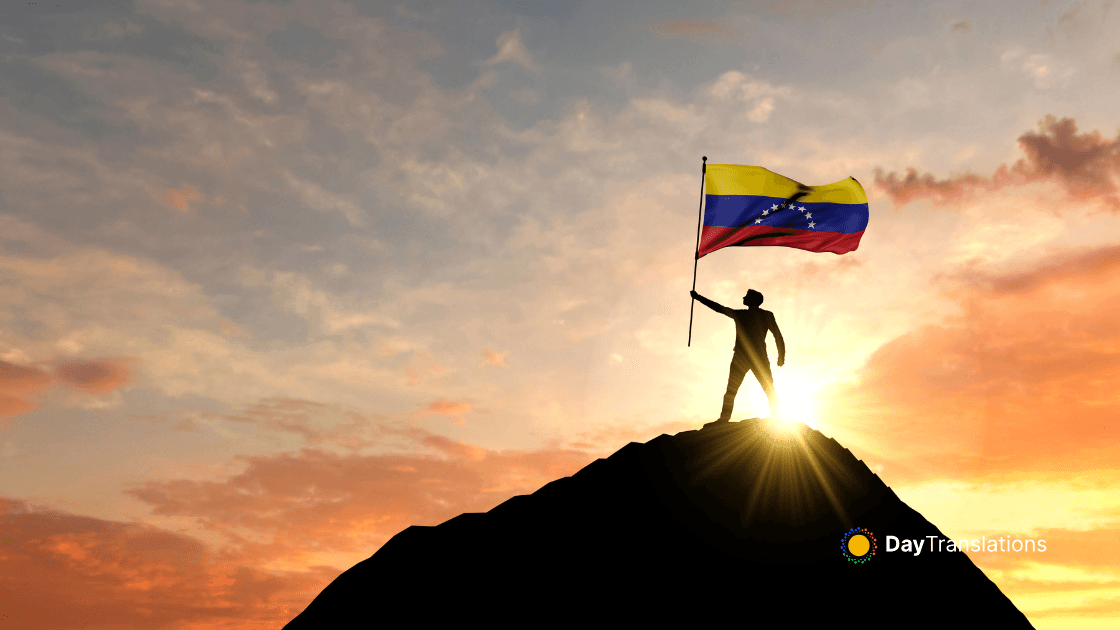
The national flag of the Bolivarian Republic of Venezuela is very bright and colorful. It consists of three horizontal stripes, consisting of a yellow top panel, blue middle panel and red bottom panel. In the center of the blue panel are eight white stars arranged in an arc pattern. On the top canton near the hoisting side is the coat of arms of Venezuela.
Venezuela’s national flag had undergone so many changes since 1811 when it was beginning to struggle for independence from Spain. It basically follows the design of Francisco de Miranda in 1806 and adopted by the national Congress in 1811. The original design of the flag was used and flown for the first time on March 12, 1806. It was raised in Jacmel, Haiti when Francisco Miranda was preparing for his travel to liberate Venezuela. The flag was raised in Venezuela’s La Vela de Coro on August 3, 1806. For a time March 12 was celebrated as Venezuela’s Flag Day but it was changed to August 3 from 2006 onwards.
According to historical records, Miranda learned the theory of primary colors, which he used on the design of the flag from Johann Wolfgang con Goethe whom Miranda met in his travels. It was said that Goethe, a celebrated German philosopher and writer explained that yellow is the warmest color, the most noble and the closest color to white light. Blue denotes serenity and excitement at the same time, which at a distance turns into a shadow while red enlivens blue and yellow – creating the meaning that the light vanishes into the shadows. Miranda also saw the same colors used on the flag of unfurled in a painting of Christopher Columbus and the standard used by the Burgers’ Guards.
Historically the colors used on the flag of Venezuela are meant to symbolize a golden America that is separated from the blood of Spain by the blue sea. Yellow was also said to depict the wealth of the land of Venezuela, with blue representing the courage of its people and red meant independence from Spain.
Originally there were seven stars in the flag representing the union of seven colonial provinces during the War of Independence against Spain. It was a union of Mérida, Trujillo, Margarita, Barcelona, Caracas, Cumaná and Barinas. When Simón Bolivar ended the Guayana campaign, he added another star to the flag to represent the freedom of Guayana through a decree written and signed by him in Angostura on November 20, 1817. But it did not happen as Bolivar decreed.
The coat of arms was added on February 19, 1954 when the flag was officially adopted and an 8th star added to the flag to fulfill Bolivar’s decree only in 2006 as announced by Venezuelan President Hugo Chávez and approved by the government amid some opposition due to the cost of the transition and changing all the documents and things bearing the image of the old flag. The decision to add another star prevailed, though. The flag of Venezuela has a proportional ratio of 2:3.
:: References ::
http://www.absoluteastronomy.com/topics/Flag_of_Venezuela
http://www.mapsofworld.com/flags/venezuela-flag.html
http://www.worldflags101.com/v/venezuela-flag.aspx
Extensive List of Languages of Venezuela: Spoken and Extinct Languages
In this Country Profile
:: List of Languages ::
Akawaio
[ake] 180 in Venezuela (2001 census). Ethnic population: 245. Bolivar State. Alternate names: Acewaio, Akawai, Acawayo, Acahuayo, Waicá, Waika. Classification: Carib, Northern, East-West Guiana, Macushi-Kapon, Kapon
Arawak
[arw] 100 in Venezuela (2002 SIL). Ethnic population: 428. Coastal area near Guyana, Delta Amacuro. Alternate names: Arowak, Lokono. Classification: Arawakan, Maipuran, Northern Maipuran, Caribbean
Arutani
[atx] 25 in Venezuela (2001 census). Ethnic population: 29 in Venezuela (2002 SIL). Below Karum River area, Bolivar state, headwaters of the Paraqua and Uraricáa rivers. Alternate names: Aoaqui, Auake, Auaqué, Awaké, Oewaku, Uruak, Urutani. Classification: Arutani-Sape Nearly extinct.
Baniva
[bvv] Extinct. Colombia border area. Alternate names: Abane, Avani, Ayane. Dialects: Baniva, Quirruba. Classification: Arawakan, Maipuran, Northern Maipuran, Inland
Baniwa
[bwi] 610 in Venezuela (2007 SIL), decreasing. Ethnic population: 2,408. Amazonas, between the Curipaco and the Guarequena, along the Colombia border. Alternate names: Baniba, Baniua do Içana, Baniva, Maniba. Classification: Arawakan, Maipuran, Northern Maipuran, Inland
Baré
[bae] No known speakers. Ethnic population: Perhaps 238 (1975 Gaceta Indigenista). Colombia border in extreme southwest, Amazonas, along the upper Rio Negro from Brazil-Venezuela border to Casiquiare Canal, Maroa. Alternate names: Arihini, Barauana, Barauna, Barawana, Cunipusana, Ihini, Maldavaca, Mitua, Yavita. Classification: Arawakan, Maipuran, Northern Maipuran, Inland
Barí
[mot] 1,770 in Venezuela (2001 census). Ethnic population: 2,200. Venezuela and Colombia border, Zulia state. Alternate names: Motilón, Motilone. Classification: Chibchan, Motilon
Carib
[car] 4,450 in Venezuela (2001 census). Population total all countries: 7,430. Ethnic population: 16,679. Monagas and Anzoategui states, northeast near Orinoco River mouth, a few communities in Bolivar state, just south of Orinoco. Also in Brazil, French Guiana, Guyana, Suriname. Alternate names: Caribe, Cariña, Galibi, Kalihna, Kalinya. Dialects: Tabajari. Classification: Carib, Northern, Galibi
Chaima
[ciy] East Venezuela coastal region. Alternate names: Chayma, Guaga-Tagare, Sayma, Warapiche. Classification: Carib, Northern, Coastal
Cuiba
[cui] 380 in Venezuela (2001 census). Nearly all monolingual. Ethnic population: 454. Apure Division. Alternate names: Cuiva. Dialects: Chiricoa, Amaruwa (Amorua), Masiguare, Siripu, Yarahuuraxi-Capanapara, Mella, Ptamo, Sicuane (Sicuari). Classification: Guahiban
Cumanagoto
[cuo] Extinct. East Venezuela coastal region. Classification: Carib, Northern, Coastal
Curripaco
[kpc] 3,460 in Venezuela (2001 census). Ethnic population: 4,925. Amazonas. Alternate names: Curipaco, Kuripako, Kurripako. Classification: Arawakan, Maipuran, Northern Maipuran, Inland
E’ñapa Woromaipu
[pbh] 3,540 (2001 census). 70%. Nearly all women monolingual; men bilingual in Spanish to varying degrees. Bolivar state, 150 mile perimeter south of Caicara de Orinoco, west of Cuchivero River. 2 groups: savana and highland. 20 or more settlements. Alternate names: Abira, Eñapa, Eñepa, Eye, Panare, Panari. Classification: Carib, Northern, Western Guiana
German, Colonia Tovar
[gct] Alternate names: Alemán Coloneiro. Dialects: Developed from Alemannisch [gsw] (Oberdeutsch) of 1843 under the influence of many other dialects of south Germany, Austria, and Switzerland. Not intelligible with Standard German. Classification: Indo-European, Germanic, West, High German, German, Upper German, Alemannic
Guahibo
[guh] 11,200 in Venezuela (2001 census). Ethnic population: 14,751. Amazonas, and Apure states, Orinoco River from Caicaro de Orinoco on the upper Orinoco. Alternate names: Guajibo, Wahibo. Classification: Guahiban
Guarequena
[gae] 160 in Venezuela (2001 census). Population total all countries: 500. Ethnic population: 513. Amazonas, San Miguel River, Guzmán Blanco village, half an hour below Maroa. Possibly in Colombia. Also in Brazil. Alternate names: Arequena, Guarekena, Uerequema, Urequema, Warekena. Classification: Arawakan, Maipuran, Northern Maipuran, Inland
Japreria
[jru] 95 (2002 SIL), decreasing. Ethnic population: 216. Zulia state, northern region of Sierra de Perija. Alternate names: Yapreria. Dialects: Not inherently intelligible with other Carib languages of the area (1973 M. Durbin). Lexical similarity: low with Yukpa [yup] (2005 L. Oquendo). Classification: Carib, Northern, Coastal
Maco
[wpc] 2,500 (2002 J. Miller). Tributaries of the Ventuari River, Wapuchi, Paru, Yureba, and Marueta rivers; Marueta, Wapuchi, Porvenir, Tavi-Tavi, Mariche, Morocoto villages. Alternate names: Itoto, Jojod, Mako, Wotuja. Classification: Salivan
Macushi
[mbc] 600 in Venezuela. East border area. Alternate names: Makushi, Makusi, Makuxi, Teweya. Classification: Carib, Northern, East-West Guiana, Macushi-Kapon, Macushi
Mandahuaca
[mht] 3,000 in Venezuela (1975 Gaceta Indigenista). Population total all countries: 3,003. Colombian border, extreme southwest, Amazonas, east of the Baré on Baria River and Casiquiare Canal. Also in Brazil. Alternate names: Arihini, Cunipusana, Ihini, Maldavaca, Mandauaca, Mandawaka, Mitua, Yavita. Dialects: Related to Yabarana [yar]. Classification: Arawakan, Maipuran, Northern Maipuran, Inland
Mapoyo
[mcg] 12 (2001 census), decreasing. Ethnic population: 365. Amazonas, Suapure River, 100 kilometers north of La Urbana. Alternate names: Mapayo, Mapoye, Mopoi, Nepoye, Wanai. Dialects: Similar to Yabarana [yar]. Classification: Carib, Northern, Western Guiana Nearly extinct.
Maquiritari
[mch] 5,520 in Venezuela (2001 census). Population total all countries: 5,950. Ethnic population: 6,523. Bolivar and Amazonas States, near the Brazilian border on the mid-Paragua, Caura, Erebato, upper Ventuari, upper Auaris, Matacuni, Cuntinano, Padamo, and Cunucunuma rivers. Also in Brazil. Alternate names: Cunuana, De’cuana, Maiongong, Maquiritai, Maquiritare, Pawana, Soto, Ye’cuana, Yekuana. Classification: Carib, Southern, Southern Guiana
Nhengatu
[yrl] 2,000 in Venezuela (Mosonyi 1987). Alternate names: Geral, Modern Tupi, Waengatu, Yeral. Classification: Tupi, Tupi-Guarani, Subgroup III
Ninam
[shb] 100 in Venezuela. Karun and Paragua rivers, Bolivar state. Alternate names: Xiriana, Yanam. Dialects: Northern Ninam, Southern Ninam. Classification: Yanomam
Paraujano
[pbg] No known speakers. Ethnic population: 4,306 (1975 Gaceta Indigenista). Zulia state, Lake Maracaibo, near Guajiro. Alternate names: Añú, Parahujano. Dialects: Alile, Toa. Classification: Arawakan, Maipuran, Northern Maipuran, Caribbean
Pemon
[aoc] 5,000 in Venezuela (2001 V. Becsky). Many monolinguals. Population total all countries: 6,160. Ethnic population: 22,270. Southeast Venezuela, Bolivar state, Gran Sabana and adjacent areas. Also in Brazil, Guyana. Alternate names: Pemong. Dialects: Camaracoto, Taurepan (Taulipang), Arecuna (Aricuna, Arekuna, Jaricuna, Pemon, Daigok, Potsawugok, Pishauco, Purucoto, Kamaragakok). Marginally intelligible with Akawaio [ake] and Patamona [pbc]. Camaracoto dialect may be a distinct language. Classification: Carib, Northern, East-West Guiana, Macushi-Kapon, Kapon
Pémono
[pev] 1 (2000 M. Muller). With the Yabarana [yar] in Upper Majagua village. Dialects: Similar to Mapoyo [mcg] and Yabarana [yar]. Classification: Carib, Northern, Western Guiana Nearly extinct.
Piapoco
[pio] 1,450 in Venezuela (2001 census). Area of San Fernando de Atapapo, Amazonas along the Orinoco. South of Vichada Department. Alternate names: Dzaze, Piapoko Dejá, Kuipaco, Wenéwika, Enegua, Yapoco, Amarizado. Classification: Arawakan, Maipuran, Northern Maipuran, Inland
Piaroa
[pid] 12,200 in Venezuela (2001 census). Population total all countries: 12,280. Ethnic population: 14,494. Amazonas, south bank of Orinoco River, inland from Paguasa River to Manipiari. Also in Colombia. Alternate names: Adole, Ature, Guagua, Kuakua, Quaqua. Classification: Salivan
Puinave
[pui] 880 in Venezuela (2001 census). Ethnic population: 1,307. Amazonas. Alternate names: Puinare, Wanse. Classification: Language isolate
Pumé
[yae] 5,840 (2001 census). Orinoco, Sinaruco, Meta, and Apure rivers, Amazonas and Apure states. Alternate names: Llaruro, Yaruro, Yaruru, Yuapín. Classification: Unclassified
Sáliba
[slc] 250 in Venezuela (1991 W. Adelaar). Cedoño Department. Alternate names: Sáliva. Classification: Salivan
Sanumá
[xsu] 4,610 in Venezuela (2000). 500 Yanoma in Venezuela. Population total all countries: 6,410. Caura and Ervato-Ventuari rivers. Also in Brazil. Alternate names: Chirichano, Guaika, Samatali, Samatari, Sanema, Sanima, Tsanuma, Xamatari. Dialects: Yanoma (Kohoroxitari), Cobari (Kobali, Cobariwa). Classification: Yanomam
Sapé
[spc] 5 (1977 E. Migliazza). Ethnic population: 25 or fewer (1977 E. Migliazza). 3 small settlements on Paragua and Karuna rivers. Alternate names: Caliana, Chirichano, Kaliána, Kariana. Dialects: Some lexical correspondences with Warao [wba] Greenberg classified it provisionally as Macro-Tucanoan. Classification: Arutani-Sape Nearly extinct.
Sikiana
[sik] Alternate names: Chikena, Chiquena, Chiquiana, Shikiana, Sikiána. Classification: Carib, Northern, East-West Guiana, Waiwai,Sikiana Nearly extinct.
Spanish
[spa] 21,500,000 in Venezuela (1995). Classification: Indo-European, Italic, Romance, Italo-Western, Western, Gallo-Iberian, Ibero-Romance, West Iberian, Castilian
Tamanaku
[tmz] Extinct. Near Mapoyo and Yawarana. Dialects: Similar to Eñepa [pbh]. Classification: Carib, Northern, Western Guiana
Tunebo, Central
[tuf] Apure state. Classification: Chibchan, Chibchan Proper, Tunebo
Venezuelan Sign Language
[vsl] Dialects: Sign language used in the classroom is different from the one used by adults outside. Classification: Deaf sign language
Warao
[wba] 28,100 in Venezuela (2007). Ethnic population: 36,129. Orinoco River Delta, Delta Amacuro, Sucre, Monagas. Also in Guyana, Suriname. Alternate names: Guarao, Guarauno, Warrau. Classification: Language isolate
Wayuu
[guc] 170,000 in Venezuela (1995 SIL). Ethnic population: 293,777. Zulia state, Guajira Peninsula. Alternate names: Goajiro, Guajira, Guajiro. Classification: Arawakan, Maipuran, Northern Maipuran, Caribbean
Yabarana
[yar] 35 (1977 E. Migliazza). Amazonas, Manapiare River basin, above San Juan de Manapiare. Alternate names: Yauarana, Yawarana. Dialects: Curasicana, Wokiare (Uaiquiare, Guayqueri). Similar to Mapoyo [mcg], Pémono [pev]. Classification: Carib, Northern, Western Guiana Nearly extinct.
Yanomamö
[guu] 15,700 in Venezuela (2000). Population total all countries: 17,640. Orinoco-Mavaca area. Eastern dialect in Parima Mountains, east of Batau River; Western dialect in Padamo River basin, Ocamo, Manaviche, and upper Orinoco rivers and south of Orinoco River up to headwaters of Marania and Cauaburi rivers, large villages in Siapa River area in the south. Also in Brazil. Alternate names: Cobari Kobali, Cobariwa, Guaharibo, Guaica, Guajaribo, Shamatari, Yanomame, Yanomami. Dialects: Eastern Yanomami (Parima), Western Yanomami (Padamo-Orinoco). Related to Yanomámi [wca] (Waiká) of Brazil. Cobari dialect is easily intelligible with the others. Classification: Yanomam
Yavitero
[yvt] Extinct. Alternate names: Paraene. Classification: Arawakan, Maipuran, Northern Maipuran, Inland
Yukpa
[yup] 6,130 in Venezuela (2007). Zulia state, Areas adjacent to Colombia border. Alternate names: Macoíta, Manso, Northern Motilón, Yucpa, Yuko, Yupa. Dialects: Yrapa, Río Negro. Classification: Carib, Northern, Coastal
Yuwana
[yau] 300 (1970 census). Ethnic population: 767. Central Venezuela. A northern group is in Bolivar Division on Kaima River, a tributary of Cuchivero River; an isolated southern group in Amazonas on the Iguana, a tributary of Asita River, and on the Parucito, a tributary of the Manapiare River. Alternate names: Chicano, Chikano, Hoti, Jodi, Joti, Waruwaru, Yoana, Yuana. Dialects: Linguistic similarities to Yanomamö [guu] and Piaroa [pid] (Salivan). Classification: Unclassified
:: Reference ::
Gordon, Raymond G., Jr. (ed.), 2005. Ethnologue: Languages of the World, Fifteenth edition. Dallas, Tex.: SIL International. Online version: http://www.ethnologue.com/
Famous Venezuelan People: Venezuelan Artists, Scientists, Leaders, Musicians, Politicians and Athletes
In this Country Profile
The northernmost country in the huge landmass of the continent of South America, Venezuela has been home to many famous people who have made their individual mark in society and throughout the world. Whether it is by their beauty, strong determination or their sheer talent, these famous people from Venezuela carved their own niche in history.
:: List of Famous People from Venezuela ::
Simon Bolivar
Born on July 24, 1783, Simon Bolivar embodied the title of El Libertador or The Liberator, being a military leader, a revolutionary and later a political leader who provided the leadership to be independent from Spain. He was able, amidst many hardships, lack of support and funds to liberate a large part of South America. He was orphaned at a young age and he used part of his inheritance to travel to other countries and was able to witness the coronation of Napoleon Bonaparte. That occasion gave him the inspiration to help liberate Venezuela. After victories and defeats Bolivar was able to successfully lead the liberation of Venezuela, Panama, Ecuador and Colombia and established Greater Colombia, comprised of these nations, with Bolivar as its first president in 1819. Two years after he subdued the Spanish army in Carabobo, Venezuela he liberated Educador, annexing the territories to Grand Colombia. The following year, 1822, Bolivar was the dictator of Peru. In 1824 he was able to liberate the whole of Peru and put at end to the Spanish rule in South America. Upper Peru was named a separate state and given the name Bolivia in his honor and he drew up its state constitution. Simon Bolivar became a force to be reckoned with as he dreamt of uniting all of the countries in South America. But his dream was not fully realized because some of the existence of separatists groups that brought political instability. A few months after his resignation as Greater Colombia’s president, Bolivar succumbed to tuberculosis in 1830.
Alejandro Chataing
Born on February 24, 1873 in Caracas, Venezuela, Alejandro Chataing was a very productive and eclectic architect that designed many of the buildings that gave a new look to Caracas. He joined efforts with his teacher to design the Arch of the Federation that was built in El Calvario. In 1904 he constructed the Villa Zoila, the presidential residence of Cipriano Castro, the 37th president and the first one from the Andes to rule Venezuela. The palace was located in El Paraiso. Chataing rebuilt the National Pantheon and modified the façade and structure of the Military School of La Planicie and followed the style of Antonio Guzman Blanco in the construction of the National Theater from 1904 to 1905, according to the wishes of Cipriano Castro. Many of his architectural works were done under the reign of President Cipriano Casto that he earned the moniker “Cipriano’s architect.” One of his last designs was for the Miramar Hotel located in Macuto. Chataing died on April 16, 1928.
Martin Tovar y Tovar
Born on February 10, 1827, Martin Tovar y Tovar was a very prominent painter In Venezuela during the 19th century. Most of his most famous works were depictions of battles in his native Venezuela, including the Battler of Junin, the Batlle of Ayacucho and the most famous one, the Battle of Carabobo. During his career Tovar y Tovar joined many expositions and exhibited his works in several art galleries and participated in the first ever art exposition in Venezuela, Exposición Anual de Bellas Artes. He became a favorite of Venezuelan president Antonio Guzmán Blanco as the painter of the portraits of prominent people of Venezuela. Tovar y Tovar died at the age of 75 on December 17, 1902.
Jesús Rafael Soto
Soto was born on June 5, 1923 in Ciudad Bolivar, Venezuela and started his art career as a cinema poster painter while still a young boy. He specialized in op and kinetic art as a sculptor and painter. His notable works were penetrable and interactive sculptures made of thin dangling tubes in which people viewing the piece are able to walk through. From 1947 up to 1950 he was the director of Escuela de Artes Plasticas located in Maracaibo. For twenty years, between 1970 until the 1990s Soto’s works have been on display in prominent art galleries in different countries, such as the Centre Georges Pompidou in Paris, the Guggenheim Museum in the city of New York as well as New York’s Museum of Modern Art.
Andrés de Jesús Maria y José Bello López
Andrés Bello, a poet, lawmaker, educator, philosopher and humanist, was born on November 29, 1781 in Caracas, Venezuela. He was one time a teacher of Simon Bolivar and accompanied Alexander von Humboldt, German explorer and naturalist on his expeditions in Latin America. Bello became the First Officer of the Foreign Secretariat of Venezuela and together with Simon Bolivar served in London as an attaché to Simon Bolivar’s mission to procure revolutionary funds on July 11, 1810. He studied the changes brought about the agricultural and industrial revolutions in England while earning a living teaching Spanish and tutoring the children of Lord Hamilton. He stayed in England for 19 years, developing friendships with Francisco de Miranda, a Venezuelan revolutionary, Vicente Rocafuerte from Ecuador, Bartólome José Gallardo (poet) and José María Blanco (writer). He handled the diplomatic affairs of Colombia and Chile while in England and continued his writing, publishing Biblioteca America in 1823 together with Juan Garcia del Rio. He wrote 2 epic poems, “Las Silvas Americanas” in 1826 and the more famous “Silva a la agricultura de la zona tórrida,” which described the tropical land of South America. Despite being a Venezuelan, Bello took on a post in the Ministry of Foreign Affairs of Chile in 1829 and later became a Santiago senator. He also published the first American-Spanish Grammar, Castilian Grammar Intended for the Use by Americans (Gramatica de la lengua castellana destinada al uso de los americanos) in 1847. Andres Bello died in Santiago, Chile at the age of 83 on October 15, 1865.
Maritza Sayalero
Maritza Sayalero was born in Caracas on February 16, 1961. She is the very first Miss Universe title winner from Venezuela. The Miss Universe 1979 pageant was held in Perth, Australia and Maritza won the competitions for swimsuit, interview and evening gown and the Miss Universe crown. As she was announced the winner and the proceedings for the live telecast ended, hordes of photographers and journalists went on stage, clamoring to get pictures that the stage collapsed. Maritza was able to save one contestant but there were several others who fell through the hole and were injured. Her win inspired others to do the same and the Miss Venezuela pageant became one of the most legendary and competitive beauty contests in the world. And several children and at least one ship were named after her. Maritza married Raul Ramirez, a tennis player from Mexico with whom she had three children. She runs her own fashion boutique where she sells her own designs. She and her husband live in Ensenada, Baja, California. After Maritza, five other beautiful ladies from Venezuela have become Miss Universe title winners – Irene Saez (1981), Barbara Palacios Teyde (1986) and Alicia Machado (1996). Recent winners are Dayana Mendoza (2008) and Stefania Fernandez (2009).
Gustavo Cisneros
Venezuelan media mogul Gustavo A. Cisnero Rendiles was born in 1945. His ancestors are from Cuba. Cisneros is included in the Forbes Magazine’s list of the world’s richest men, with an estimated worth of $4.2 billion as of 2010. His fortunes come from telecommunications, media and entertainment and consumer product company holdings. The Cisneros Group of Companies own Venevision International that produces and distributes Spanish-language telenovelas, which are popular worldwide. They also own a Venezuelan TV network, Venevisión, the Leoned del Caracas baseball team as well as the Miss Venezuela contest. His group of companies has overseas operations in Spain as well as in the US and China. Fundación Cisneros or the Cisneros Foundation has several cultural and educational programs to help improve Latin Americans, including programs for the development of visual arts education and the professional development of educators from Latin America.
Eugenio Mendoza
Eugenio Mendoza Goiticoa was born in Caracas on November 13, 1906. He was a business tycoon, a descendant of Simon Bolivar’s sister as Simon did not have any children. Mendoza’s family suffered financially due to the war for Venezuela’s independence and the succeeding civil wars in his country. Despite that they were able to get quality education although he was the only one who did not go to university. He went into business and became the largest cement supplier in Venezuela and later formed Protinal and went into the production of paints, pulp and paper and animal feed. His company grew and became El Grupo Mendoza, a large conglomerate with interests in construction, cement, heavy machinery, paint, manufacturing, paper mils, banking, insurance, animal feed. His company also owned General Motors in Venezuela. His foundation built Latin America’s largest children’s hospital. He also founded the privately-owned Universidad Metropolitana in 1970. It is the first educational institution in Venezuela to offer business management and finance courses. Up until now, Universidad Metropolitana is one of Venezuela’s most prestigious private universities. His children and grandchildren now run his businesses and foundation.
Carolina Herrera
Carolina Herrera was given the name Maria Carolina Josefina Pacanins y Niño when she was born on January 8, 1939 in Caracas, Venezuela. She is an entrepreneur and fashion designer and founded her own company, Carolina Herrera in 1980. Her father was an officer of the air force and later became the Governor of Caracas. Named as one of the world’s best dressed women, she also dressed several prominent celebrities, including Renee Zellweger and Jacqueline Kennedy Onassis. Her first marriage was to a Venezuelan land owner, Guillermo Behrens Tello. She had two daughters with him. They got divorced in 1964 and she later married Reinhaldo Herrera Guevarra in 1968, and they also had two daughters. Her husband used to be a morning news TV program in Venezuela and now works for Vanity Fair magazine as a special projects director.
Carolina Herrera has her own fashion and bridal collection as well as 10 fragrances. She is a multi-awarded fashion designer. Some of her awards include the Gold Medal from the Queen Sofia Spanish Institute (1997), Award for Excellence from The International Center in New York and the Gold Medal of Merit in the Fine Arts of Spain. Spain’s King Juan Carlos I presented the 2002 award to her. She has also received the 2004 Women’s Wear Designer of the Year and in 2008 received the Geoffrey Beene Lifetime Achievement Award. Carolina became a naturalized American citizen in 2009.
José Luis Rodríguez González
Better known by his nickname El Puma, José Luis Rodríguez González was born in Caracas on January 14, 1943. He is an actor and singer who have acted in several telenovelas in Puerto Rico and the Spanish version of Meet the Robinsons. He came from an impoverished family, with his father dying when he was only six. His mother raised him and his 11 sisters and brothers. His mother joined the revolution during the time of Marcos Perez Jimenez and they eventually had to live in exile in Ecuador. Being illiterate, he taught himself to read and focused on becoming a singer, with several hits, including “Dueño de nada”, “Agárrense de las manos” and “Pavo real.” He starred in a commercial for Wrigley’s Eclipse gum, with his El Puma persona and having the tagline of Free the puma within. The tagline translates to Spanish as Libera el Puma que hay en ti.
Maria Luisa Cáceres Diaz de Arismendi
One of the brave women from Venezuela during their fight for independence from Spain, Maria Luisa Cáceres Diaz was born on September 25, 1799. She was from a landed family and her father was a historian, intellectual and a Latin professor. She received her education from her father and showed a deep love for her country at an early age. While Venezuela declared itself independent from Spain on July 5, 1811, a massive earthquake caused havoc in Venezuela in 1812, leading to the toppling of the guerilla republic. Maria Luisa met her future husband, General Juan Bautista Arismendi on Christmas eve in 1813. Early the following year, while her father was visiting a friend in Ocumare, troops loyal to Francisco Rosete attacked the area and her father was killed and her brother who joined the revolutionary movement captured and killed. General Arismendi offered sanctuary to Maria Luisa and her family in Isla Margarita, although her four aunts died during the trip. Only Maria Luisa, her mother and her younger brother survived.
General Arismendi, then 39 years old married Maria Luisa who was only 15 in 1814. General Arismendi became the provisional governor of Margarita, making him a target for the loyalists to Spain. He eventually had to seek refuge in the mountains of Copey leaving pregnant Maria Luisa who was captured and incarcerated, tortured and abused by Spanish soldiers because of her refusal to reveal where her husband was hiding and because of her continued refusal to give her allegiance to Spain. While a friar tried to help, Maria Luisa suffered from malnutrition and torture and her daughter died soon after birth. She remained detained in the Santa Rosa fortress, then moved to Pampatar fortress to La Guaira and eventually sent to be exiled in Spain in 1816 where she was cared for by the Morón family. Throughout her ordeal she had no communication with any family member. While she suffered her husband and his fellow revolutionaries were making several successes. Lieutenant Francisco Carabaña and Mr. Tottem, an Englishman planned to help Maria Luisa escape and she was able to reach Philadelphia on May 3, 1818 and came under the care of General Lino Clemente, a patriotic general. Colonel Luis Rieux was sent to fetch her by her husband and she was able to go back to Margarita on July 26, 1818. The Council of the Indies had a resolution on September 19, 1819 whereby it granted Maria Luisa the total freedom to choose where she wanted to live. She decided to stay with her husband in Caracas, and had 11 children. She died in 1866.
Hugo Chavez
Hugo Rafael Chávez Frias was born in Sabaneta, Venezuela on the 28th of July 1954. He was one of the several military officers that held the top position in Venezuela’s political hierarchy. Hugo Chavez is the incumbent Venezuelan president and founder of the left-leaning Fifth Republic Movement. He was also a political leader of the United Socialist Party of Venezuela. He went to prison for two years due to his unsuccessful coup attempt in 1992 to remove Carlos Andres Perez, the president of Venezuela at that time. He was forgiven by Rafael Caldera, the president of his country in 1994. Chavez is a very good orator and was able to sway the voters and he was eventually elected as Venezuela’s president of Venezuela in 1998. He instituted many pro-poor reforms, which include a new Venezuelan constitution, nationalization of major industries in his country and democratic participation of his constituents – actions that were likened to that of Simon Bolivar and his social reforms was called the Bolivarian Revolution. He won the 2000 presidential race and was once again reelected for the third time in 2006. He is a very vocal critic of George W. Bush, former president of the United States and remains a steadfast supporter of Fidel Castro of Cuba.
Oscar D’León
Oscar Emilio León Somoza or Oscar D’León, popularly recognized by his monicker El Sonero del Mundo, is a very famous salsa singer from Venezuela. He was born in Caracas on the 11th of July 1943. He was an auto mechanic by day and also would play the bass guitar together with the local ensemble or conjuntos after work. D’León started the band “Los Psidodélicos” and the “La Golden Star” orchestra. He often performed on stage with a double bass while singing and dancing. He later formed “La Dimension Latina” with fellow musicians Cesar Monge, Jose Rodriguez and Jose Antonio Rojas. After leaving “La Dimension Latina” he organized “La Salsa Mayor” and produced numerous salsa music including “Deja Que Te Quiera”, “Préstame Tu Piel” and “Esperando Por Ella”. He also recorded “Juanita Morell”, which became a standard for merengue music. Oscar D’León holds the prestige of being the first Latin singer to be contracted by the British Broadcasting Corporation.
Luis Aparicio
Venezuela has produced 219 baseball players in different positions playing for different clubs playing in Major League Baseball in the United States from 1939 up to 2009. Out this number, Luis Aparicio’s name stands out as he is the first baseball player from South America to be inducted to baseball’s Hall of Fame in 1984.
Aparicio was born in Maracaibo on the 29th of April 1934 and made his professional debut as a shortstop on the 17th of April 1956 with the Chicago White Sox and went on to win The Sporting News Rookie of the Year as well as the Rookie of the Year in the same year. He also won the Gold Glove Award nine times and had been a 13-time All Star player. He was had stints with the Baltimore Orioles and Boston Red Sox where he ended his professional baseball career at the age of 39 in 1973. During his professional career he played a total of 2,599 games with 2,677 hits and a .262 batting average. Inside the U.S. Cellular Field, home ground of the Chicago White Sox stands a bronze statue of Luis Aparicio, an honor given to one of their most outstanding players. The statue was unveiled in 2006.
Humberto Fernández-Morán Villalobos
Humberto Fernández-Morán Villalobos, born in Maracaibo, Venezuela on February 18, 1924 was a research scientist. His most widely known inventions are the diamond knife / scalpel for ultrathin microtomy and the ultra microtome. He was also cited as a great contributor in the development of the electron microscope and was also the first person to explore the concept of cryo-ultramicrotomy for the three-dimensional study of unfixed cells and tissues. He had worked for the Apollo Project in NASA, founded the Institute of Neurological and Brain Studies in Venezuela and had taught at the University of Stockholm where his wife hailed from, the University of Chicago as well as MIT. Dr. Fernandez-Moran received the John Scott Award in 1967 for his diamond scalpel invention and the Order of the Polar Star, the fifth grade order of merit from Sweden. He died on March 17, 1999, was cremated and his ashes brought to Stockholm, Sweden.
:: References ::
http://www.nationsencyclopedia.com/Americas/Venezuela-FAMOUS-VENEZUELANS.html
http://en.wikipedia.org/
http://www.interholidays.co.uk/destinations/south-america/venezuela/general-info/famous-people.html