
Country Profile: Netherlands.
Interesting trivia: The Netherlands is also known as Holland.
The Kingdom of the Netherlands or simply Netherlands is a fascinating country to travel to. It is a land that is heavily associated with windmills. Once there were over 10,000 windmills in the Netherlands that were erected to keep the country dry. Nowadays there are about 1,150 complete and working windmills that can still be seen in the country. Netherlands is also a country were bicycle ownership is very high, with about 12 million bikes. The Dutch use it for transportation as well as for exercise. In fact it is typical to see bicycle riders in the streets of the Netherlands. Once a traditional footwear, the all-wood clogs or klompen are now basically tourist souvenirs but are still worn by people working in farms or when gardening.
Despite its relatively small size, the Netherlands is the most densely populated country in Europe and is the seat of international cooperation, with The Hague, its seat of government also being the location of the Supreme Court of the world. When planning to travel to Europe do not miss out on exploring a wonderful country with the most ingenious system of dikes and dams in the world and its vast number of historic sites and natural wonders. Or just simply lose yourself in the myriad of colorful tulips in bloom at the Keukenhof Park.
In this Country Profile
:: Background of Netherlands ::
During the medieval times, what is known as the Netherlands now had been under different rulers, including the Romans, Franks, Saxons, Frisians, the French and the Germans. It also came under the rule of the Vikings during the 9th to the 10th centuries. Under these different rules, the culture of the Netherlands began to take shape and the people began to learn about trading and a more organized lifestyle. The powerful Habsburg of Austria possessed Netherlands and the other Low Countries in Europe. And by 1555 Philip II of Spain was installed as the ruler of the Netherlands. Social, religious and political reforms were introduced most of which did not favor the citizenry. Protestants, particularly the followers of Calvinism were persecuted.
In 1572 Prince William of Orange or William the Silent led a group of pirates to revolt against the Spanish by capturing Dutch towns from the sea. The Spanish fought with resistance and the war raged for several years until the several provinces belonging to the Low Countries signed the Union of Utrecht in 1576. Four years after Netherlands declared their independence from Spain and formed a republic in 1588, after the last resistance of the Spanish was weakened and the Spanish Armada defeated when the English sent help. However, during the tumultuous times while they fought the Spanish, William of Orange was assassinated in 1584.
After their independence from Spain, the Dutch became able seafarers as well as a commercial power, gaining foothold in Africa and Asia, establishing the Dutch East India Company in 1601, the Dutch West India Company in 1621 and formed a colony in what is known as New York today, previously called New Amsterdam in 1625. They also formed a colony in Africa in 1652. Between these times, Dutch voyagers and explorers were able to discover new countries, including Australia in 1606 and Tasmania in 1642. Spain recognized Netherlands’ independence in 1648.
Trade rivalry with Britain resulted into three wars. Several wars with different countries exhausted the Dutch and the country went on a decline leaving the British and the French to exert commercial trade dominance. The country was neutral during the First World War but was not able to withhold Germany’s invasion during WWII.
From the devastation, the Depression and economic slump, the Netherlands was able to overcome all the trials and is now one of the ten leading exporting countries in the world. It ranks 16th among the world’s largest economies. It is one of the largest exporter of food products, supplying most of the needs of the world for tomatoes, chilies, apples, cucumbers and cut flowers.
:: Geography of Netherlands ::
Location
The Netherlands is situated in the estuaries of the Rhine and its distributaries, the Maas, also called Meuse and the Schelde. The country belongs to Western Europe and is between Germany and Belgium. Half of the Netherlands faces the North Sea. Geographic coordinates are 52° 30’ north and 5° 45’ east.
Area
Most of the land surface of the Netherlands proper is under water and what can be seen of the total land mass has a total of 41,543 square kilometers. Even then the total land surface is only 33,893 square kilometers while the surface covered with water is about 7,650 square kilometers. Compared to other states in the US, the Netherlands is slightly smaller if the size of New Jersey is twice combined
Land Boundaries
The land boundaries of the Netherlands are quite long. They stretch for a total of 1,027 kilometers, with the eastern part bounded by Germany a bit longer at 577 kilometers, and the rest or 450 kilometers is shared with Belgium on the south side.
Coastline
The northern and western sections of the Netherlands face the North Sea, giving the country a coastline that stretches for 451 kilometers.
Maritime Claims
While the Netherlands has a territorial sea claim of 12 nautical miles, its contiguous zone extends to 24 nautical miles, with an exclusive fishing zone covering an area of two hundred nautical miles.
Climate
Generally, the prevailing climate in the Netherlands is temperate, which means that the weather is variable but typically bring basically cool summers and with little snow falling, so the winters are mild.
Terrain
The Netherlands is a generally flat country and with most of the area below sea level will the higher regions are just about one meter above sea level. This geographical situation contributed to the name given to the country. A large portion of the land surface of the Netherlands is still under water, with ongoing reclamation that gives the nation quite a rugged appearance. These reclaimed parts are called polders, which are very rich soil that are suitable for agriculture. There are some hills located in the southeast, most of which are man-made so that parts of the land can remain dry. Rain falls almost daily and heavy storms cause flooding, hence the inhabitants created an ingenious way to keep their residences, families and livestock dry when flooding occurs.
Elevation Extremes
For a basically flat country, the Netherlands still has a spot that is considered as the highest point in continental Netherlands, the Vaalserberg, or Mount Vaals that is 322 meters high. There is another high point in the Netherlands, Mount Scenery located in Saba, a special municipality of the Netherlands and belong to the larger Kingdom of the Netherlands. The mountain rises to a height of 862 meters. Saba is an island in the Caribbean, which together with Bonaire and Sint Eustatius comprise Netherlands Antilles that was dissolved in May 17, 2010. The lowest part of the Netherlands is the Zuidplaspolder that is seven meters below sea level.
Natural Resources
Arable land is one of the natural resources of the Netherlands. Others include peat, salt, limestone, sand, gravel, petroleum and natural gas.
Land Use
Over twenty-two percent of the land in the Netherlands is arable and part of it or 0.77% is planted with permanent crops. The rest of the lands in allocated for other various uses.
Natural Hazards
Flooding is the main natural hazard that the country faces, being geographically low lying. However, the government of the Netherlands had already planned to prevent major flooding, like those that occurred in previous years, the last of which was the major flood that occurred in 1953 with the construction of the Delta Works.
Current Environmental Issues
The Netherlands is becoming increasingly industrial and as a result of that is now facing environmental problems related to industrialization such as the presence of heavy metals, organic compounds as well as phosphates and nitrates that pollute the water. Acid rain is also another environmental issue. Included in the current environmental problems is the rising air pollution issue brought about the number of refining companies and increasing ownership of vehicles
International Environmental Agreements
Like most nations around the world, the Netherlands also entered into several international environmental agreements. Even if the country has signed the selected agreements, it has yet to ratify any of these agreements. These selected agreements include Antarctic-environmental protocol, Antarctic Treaty, Antarctic-marine living resources, law of the sea, marine life conservation, marine dumping, ship pollution and whaling. Other agreements it has entered into are desertification, environmental modification, climate change-Kyoto protocol, climate change, biodiversity, Kyoto protocol, endangered species, ozone layer protection, hazardous wastes, wetlands, and tropical timber 83 and 94. As air pollution is a worldwide environmental issue, the Netherlands also signed agreements dealing with air pollution, air pollution-nitrogen oxides, air pollution-volatile organic compounds, air pollution-sulfur 85 and 94 as well as air pollution-persistent organic pollutants.
:: People of Netherlands ::
The people, language and culture of the inhabitants of the Netherlands are called Dutch. Some specifically call the males from the country as Dutchmen (singular: Dutchman) and the females as Dutchwomen (singular: Dutchwoman) but the generic Dutch to refer to both genders is acceptable.
Population
As of September 2011, the population of the Netherlands according to Statistics Netherlands is 16,709,440. Population growth is in the low percentage, estimated in 2011 to be at 0.371% with women’ fertility rate also in a low figure, placed only at 1.66 children born for every woman of child-bearing age in 2011. Net migration is also low, estimated at 2.33 migrants for every 1,000 inhabitants.
Age Structure
Citizens of the Netherlands are predominantly in the 15 to 64 age group, representing 67.4% of the population, broken down into 5,732,042 males and 5,624,408 females. Seventeen percent of the population on the other hand is still in the zero to fourteen age group, comprising 1,466,218 males against 1,398,463 females. According to the 2011 estimates, the males in the 65 years and over age group total 1,141,507 while the number of females is remarkably higher at 1,484,369. Collectively these data figures represent 15.6% of the total population of the Netherlands.
Median Age
While the median age for the entire population of the Netherlands is 41.1 years, the females slightly edge the males, with their median age placed at 41.9 years as against the males’ 40.3 years.
Birth and Death Rates
According to the demographic estimates done in 2011, the national birth rate in the Netherlands is about 10.23 births for every 1,000 citizens while the death rate is a bit lower at 8.85 deaths for every one thousand members of the population.
Infant Mortality Rate
The statistics for male infant mortality rate in the Netherlands is slightly higher than the female, with 5.08 deaths for every 1,000 live births as against only 4.07 deaths for female infants. For the whole country the average is 4.59 deaths for every 1,000 live births.
Life Expectancy at Birth
The females outlive the men in Netherlands, with their life expectancy estimated to be about 82.44 years, while the males only have a life expectancy of 77.06 years, giving a national average of 79.68 years.
Sex Ratio
It may be a fact that the women have a slight edge over the males in Netherlands in some aspects like life expectancy and infant mortality at birth but still the there is a slight variance in favor of the males when it come to sex ratio across different age brackets. At birth and under 15 years of age, the ratio is 1.052 males for every female. There is a tiniest increase in the 15 to 64 years age group, at 1.02 males for every female, then it goes lower to 0.76 male for every female in the 65 years and over age group. For the total population, the estimated average for 2011 is 0.98 male for each female.
HIV / AIDS
Just like in many countries, HIV/AIDS is a such a great problem. Luckily it is not that rampant in the Netherlands, with only about 0.2% incidence in adults, according to the estimates done in 2009. Also from that study, the number of people living with HIV/AIDS in the Netherlands based on reported cases is 22,000. The cases are very well managed, with less than 100 deaths related to the disease occurring in the country as of the 2009 estimates. This is because the Netherlands has instituted drug policies that help restrict the use of drugs and the spread of HIV/AIDS, providing care and treatment to patients. The country also provides clean environments for drug dependents where they can have access to healthcare and test if they are infected with HIV.
Ethnic Groups
Various ethnic groups comprise the population of the Netherlands, with the Dutch dominating at 80.7%. There are also several people from different EU countries that are now residents of the country and their number accounts for 5%. Indonesians are also present in the Netherlands, with about 2.4% of the population. The rest are other from other countries that have been under the Dutch, such as the Turkish with 2.2%; some 2 % each from Suriname and Morocco and 0.8% from the Caribbean. There are 4.8% belonging to some other ethnic groups.
Religions
The dominant religion in the Netherlands is Roman Catholic and about 30% of the population follows of this religion. The Dutch Reformist has about 11% following and the Calvinist has about 6%. Other forms of Protestant religions have 3% following while the Muslims are around 5.8%. The rest of the population professes not to follow any religion and they comprise about 42% while 2.2% follow other religions that they failed to identify during the census.
Language
While several dialects are spoken in different parts of the Netherlands, Dutch is one of the official languages of the country, spoken by almost 90% of the country’s population. Frisian, the other official language is spoken by 2.2% or about 350,000 people, mainly in Friesland. Less than 1% of the population also speaks Arabic and Turkish.
Literacy
Education in the Netherlands is compulsory from age 5 to until age 16. From age 16 they can go to school part time, although this is still compulsory. Literacy is high at 99% and higher education is heavily subsidized by the government. Both males and females spend a total of 17 years in school on the average.
:: References ::
https://www.cia.gov/library/publications/the-world-factbook/geos/nl.html
http://www.worldatlas.com/webimage/countrys/europe/nl2.htm
http://www.upiasia.com/Blogosphere/Sekina/20091215/the_netherlands_is_a_model_in_fighting_hivaids/
Geography of Netherlands: Important Geographical Information about Netherlands
In this Country Profile
Geographically, the Netherlands is a very low country, with half of it rising just about one meter above sea level. This very distinct characteristic is what gave the country its name. Twenty percent of the land mass is below sea level, including twenty-one percent of the areas where the nation’s population resides. Geologists have found out that most of the total land mass of the Netherlands is still under water. Frequent floods ages ago have created the rugged coastline and became irregular even more due to land reclamation, creating very fertile land called polders and the construction of many dikes to keep the entire country from flooding.
The Netherlands is basically a flat country and most of it is formed by the estuary of three rivers, the Rhine and its two distributaries, the Meuse and Waal. These rivers divide it into two major parts, and causing a linguistic barrier within the nation. As a country, the Netherlands is bounded in the east by Germany. Belgium shares borders with the Netherlands in the south while its northern and western parts face the North Sea. It is divided into 12 provinces, with major cities such as Rotterdam, which is the largest port in all of Europe; The Hague which the seat of the nation’s government and residence of the royal family as well as being the Supreme Court of the world and Amsterdam, the nation’s capital, all located in South Holland and North Holland, respectively.
While most of the country is flat, there are some low hills that can be found in the central region and the far southeast parts of Netherlands. It lowest point is the Zuidplaspolder, in the municipality of Zuidplas, located in South Holland. It is seven meters below sea level. Rising at 322, 7 meters above sea level is Vaalserberg or Mount Vaals, the highest point in the Netherlands, located in the Limburg province. If one is talking of the Kingdom of the Netherlands, which includes some Caribbean islands, then the highest point will be Mount Scenery, rising to a height of 877 meters in the island of Saba that is now a special municipality of Netherlands after the dissolution of Netherlands Antilles on the 10th of October 2010.
Netherlands has a total land size of 41, 848 square kilometers, and is home to 16,709,440 inhabitants, according to the Statistics Netherlands data as of September 2011. It is one of the most densely populated countries in Europe, particularly for those cities that are know tourist destinations. There are large farming areas and the picturesque landscape of old are being overcome by residential communities, causing the lowering of the number of real countryside and their iconic windmills, except for areas like Waterland and Zaan.
Climate
Netherlands enjoys a changeable maritime climate that brings negligible warmth during the summer months and cold winters in varying degrees. But it is good to note that the temperatures in the Netherlands do not reach extreme low and high levels. And snow does not fall too thickly. On the downside is the fact that rain falls regularly throughout the year. On the average, the temperature rises to about 66 °F around July while it can be about 36 °F in January. For the whole year the average temperature reaches 50 °F. Fog is a predominant part of the landscape during the winter season and clouds frequently appear daily. While the minimal sunshine that the country receives is not conducive for the growth of food crops, it is very ideal for raising livestock and for dairy farming.
Floods in the Netherlands
It is worth mentioning that the devastating floods that occurred in the Netherlands ages ago, including the one that happened in 1953 have spurred the Dutch to innovate and create what is considered to be the safest levee systems in the world. That is because the Dutch had to prevent their country from going under water due to its geographical anomaly.
The Dutch took too heart the lessons learned from the major floods that hit the country. In 1134, the now-you-see-now-you-don’t nature of Zeeland, that shows at low tide and disappears when the tide is high was greatly affected by the major storm. Eventually the inhabitants of the area created small hills so that some of the region can be habitable and remain dry when the tides are high. Soon the small hills became interconnected with a series of dikes. In 1827, December 14 to be exact, the storm that happened after the feast day of St. Lucia almost destroyed major parts of Germany and the Netherlands, although it did leave more than 50,000 people dead. Another flood that hit the country happened in 1421, called the St. Elizabeth flood. The last major calamity that occurred in the Netherlands was the flood in February 1953 where over 1,800 people drowned when several dikes collapsed. From then on the government embarked on a large-scale flood control system called the Delta Works. It was started in 1958 and was partially complete by 1997 and completed in 2002. Since most of the flooding occurs in Zeeland and South Holland, the project aimed to reduce the occurrence of major flooding in the area to once every 10,000 years. It involved the construction of higher outer sea dikes for a total length of 3,000 kilometers. The government also constructed 10,000 kilometer long river dikes and inner canals. They also closed the sea estuaries in Zeeland. The full Delta Works plan included the construction of sluices, dikes, levees, locks, storm surge barriers as well as dams. It was a marvel of construction, planning and engineering that the American Society of Civil Engineers called Delta Works as one of the Seven Wonders of the Modern World.
:: References ::
http://www.toursnetherlands.com/about-netherlands/geography/
http://www.cbs.nl/en-GB/menu/themas/bevolking/cijfers/extra/bevolkingsteller.htm
http://www.nationsencyclopedia.com/Europe/Netherlands-CLIMATE.html
Professional Translation Organizations & Associations in Netherlands
In this Country Profile
Below is a list of the major translation organizations and associations of Netherlands.
:: List of Organizations ::
Association of Translation Agencies
ATA, Association of Translation Agencies
Bureau for Sworn Interpreters and Translators
De Haagse Hogeschool Den Haag
Hogeschool Maastricht, Faculteit Tolk – Vertaler
Hogeschool West-Nederland voor Vertaler en Tolk
ITV Hogeschool voor Tolken en Vertalen
Katholieke Universiteit Nijmegen. Faculteit der Letteren
Maastricht School of Translation and Interpreting, Zuyd University
Nederlands Genootschap van Tolken en Vertalers (Netherlands Society of Interpreters and Translators) Radboud University Nijmegen
Rijksuniversiteit Groningen, Specialisatie vertalen
Stichting Instituut van Gerechtstolken en -vertalers
Stichting LOI Hogeschool
Stichting Nationale Examens Vertaler en Tolk
Universiteit Leiden
Universiteit van Utrecht, Faculteit der letteren, Specialisatie Vertalen
Vereniging Zelfstandige Vertalers
Information about the Dutch Flag: Colors and Meaning of the Flag of Netherlands
In this Country Profile
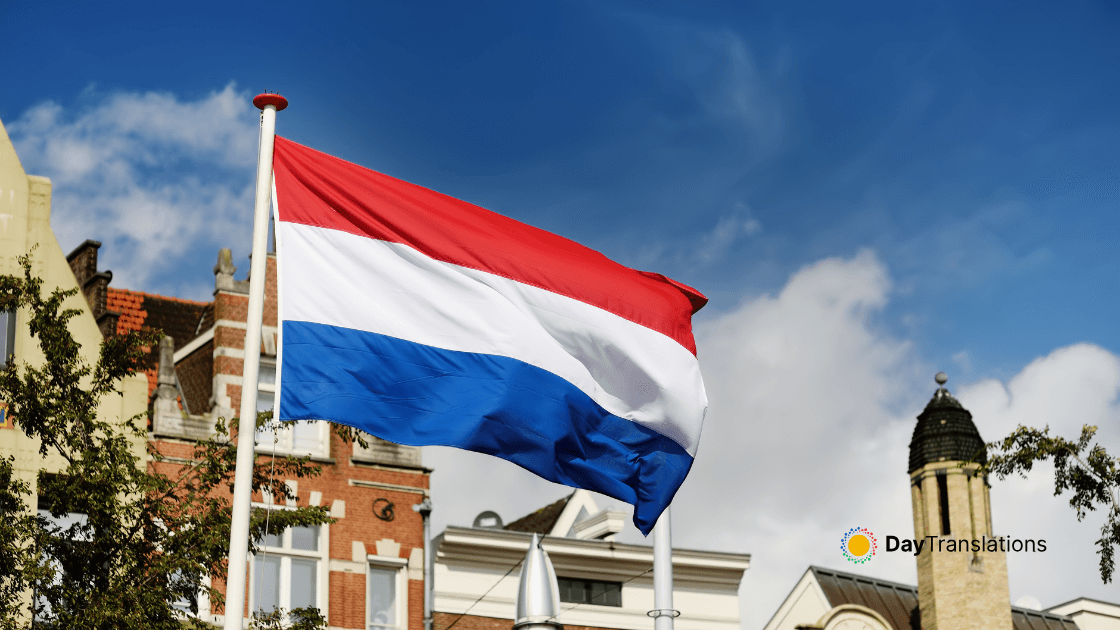
The Netherlands flag is tri-color, consisting of three horizontal bands of equal size. The red band is on top, with blue at the bottom and the white stripe in between the two. The country can erroneously be referred to as Holland, mainly because it rose to prominence as an economic and maritime power but in fact Holland is just a western region of the Netherlands. The country’s flag has a ratio 2:3, meaning its length is one and a half times longer than its width.
Although the national flag was officially adopted only on the 19th of February 1937 after a royal decree from Queen Wilhelmina, it had been used from the 1500s. However, at that time the red stripe was in fact orange in color, following the official colors of William of Orange who ruled the first republic after the Netherlands gained independence from Spain in 1568. Prince William of Orange was a leader in the nation’s campaign to be break free from Spanish colonization and the flag colors were taken from his coat of arms and the flag was appropriately called the Prinsvlag or the Prince’s flag. According to some theory, as the change of color was not verified, the dye used for orange faded in time and became red and became the official color ever since. The national flag was not used for a brief time when the French occupied the Netherlands in the 19th century until the country regained its independence by 1813.
The use of red, white and blue in the national flag of the Netherlands inspired the Tsar of Russia to adopt the colors for its flag. From then on the used of these three colors were predominant in the national flags of major countries in Europe and became the Pan-Slavic colors, just like there are Pan-African colors.
:: References ::
http://www.worldflags101.com/n/netherlands-flag.aspx
http://www.flags-flags-flags.org.uk/dutch-flag.htm
Extensive List of Languages of Netherlands: Spoken and Extinct Languages
In this Country Profile
:: List of Languages ::
Achterhoeks
[act] Northeast, Gelderland Province. Alternate names: Aachterhoeks, Achterhoek. Classification: Indo-European, Germanic, West, Low Saxon-Low Franconian, Low Saxon
Drents
[drt] Northeast, Drenthe Province, near Germany border. Alternate names: Drente. Dialects: North Drente (Noord-Drents), South Drente (Zuid-Drents). Classification: Indo-European, Germanic, West, Low Saxon-Low Franconian, Low Saxon
Dutch
[nld] 16,400,000 in Netherlands (2007 CBS). Population total all countries: 21,730,290. Also in Aruba, Belgium, Brazil, Canada, France, Germany, Indonesia (Java and Bali), Netherlands Antilles, South Africa, Suriname, United States. Alternate names: Hollands, Nederlands. Dialects: Northern North Hollandish (Westfries). The variety of Dutch (not Vlaams [vls]) spoken in Belgium is only slightly different from the variety spoken in the Netherlands. Classification: Indo-European, Germanic, West, Low Saxon-Low Franconian, Low Franconian
Dutch Sign Language
[dse] 20,000 (1986). 1,500,000 hearing impaired, 15,000 deaf. Alternate names: Sign Language of the Netherlands, SLN. Classification: Deaf sign language
Frisian, Western
[fry] 467,000 (2001 census). North, Friesland. Alternate names: Fries, Frysk. Dialects: Westerlauwers Fries, Súdhoeksk, Wâldfrysk, Klaaifrysk. Linguistically between Dutch [nld] and English. Lexical similarity: 71% with Standard German, 61% with English, 74% with Eastern Frisian [frs]. Classification: Indo-European, Germanic, West, Frisian
Gronings
[gos] 592,000 (2003). Groningen Province. Alternate names: Groningen, Grunnings. Dialects: West Groningen (West Gronings), Groningen-East Frisian (Gronings-Oostfries), Veenkoloniaals (Veen Colony), Westerwolds (Westerwold). Classification: Indo-European, Germanic, West, Low Saxon-Low Franconian, Low Saxon
Limburgish
[lim] 700,000 in Netherlands (2001). Population total all countries: 1,300,000. Limburg Province, Maastricht, Heerlen, Roermond, Venlo. Also in Belgium, Germany. Alternate names: Limburgan, Limburgian, Limburgic, Limberger, Limburgs Plat. Dialects: A Rhenisch-Mass group of dialects, often combined with Cleves dialects (Kleverländisch) as ‘Rheinmaasländisch’. Limburgish straddles the borderline between ‘Low Franconian’ and ‘Middle Franconian’ varieties. More-or-less mutually intelligible with Ripuarian dialects, but show fewer ‘High German shifts’ (R. Hahn 2001). Classification: Indo-European, Germanic, West, High German, German, Middle German, West Middle German, Rhenisch Franconian
Romani, Sinte
[rmo] 1,220 in Netherlands (2000). Dialects: Manouche. Classification: Indo-European, Indo-Iranian, Indo-Aryan, Central zone, Romani, Northern
Romani, Vlax
[rmy] 1,000 in Netherlands. 500 Kalderash, 500 Lovari. Dialects: Kalderash, Lovari. Classification: Indo-European, Indo-Iranian, Indo-Aryan, Central zone, Romani, Vlax
Sallands
[sdz] Northeast, Overijssels Province center, Sallands. Alternate names: Sallan, Salland. Classification: Indo-European, Germanic, West, Low Saxon-Low Franconian, Low Saxon
Stellingwerfs
[stl] Northeast, Stellingwerven region, Friesland Province. Centers are Oosterwolde and Wolvega. Alternate names: Stellingwarfs, Stellingwerf. Classification: Indo-European, Germanic, West, Low Saxon-Low Franconian, Low Saxon
Twents
[twd] Northeast, Overijssels Province; east. Alternate names: Twente. Classification: Indo-European, Germanic, West, Low Saxon-Low Franconian, Low Saxon
Veluws
[vel] Northeast, Gelderland Province. Alternate names: Veluwe. Dialects: East Veluws, North Veluws. Classification: Indo-European, Germanic, West, Low Saxon-Low Franconian, Low Saxon
Vlaams
[vls] 122,000 in Netherlands (1998 U. of Ghent). Province of Zeeland, southernmost island. Alternate names: Flamand, Flemish, Vlaemsch. Dialects: West Vlaams, Frans Vlaams (Vlaemsch). Classification: Indo-European, Germanic, West, Low Saxon-Low Franconian, Low Franconian
Zeeuws
[zea] 220,000. Zeeland Province, South Holland Province. Islands in Rhine-Scheldt Delta have their own dialects. Alternate names: Zeaws. Dialects: Goerees, Flakkees, Schouws, Duvelands, Fluplands, Bevelands, Walchers, Axels, Kezands. Classification: InIndo-European, Germanic, West, Low Saxon-Low Franconian, Low Franconian
:: Reference ::
Gordon, Raymond G., Jr. (ed.), 2005. Ethnologue: Languages of the World, Fifteenth edition. Dallas, Tex.: SIL International. Online version: http://www.ethnologue.com/
Famous Dutch People: Dutch Artists, Scientists, Leaders, Musicians, Politicians and Athletes
In this Country Profile
Netherlands has its share of famous people, world-renowned painters, artists and sculptors, architects, engineers, mathematicians, physicists, composers and explorers that have contributed to the country’s national identity, lifestyle and culture. These famous Dutch gives the reader a cross section of famous people from different fields, past and present.
:: List of Famous People from Netherlands ::
Jan de Bont
Jan de Bont was born in Eindhoven on October 22, 1943. He is one of the famous people involved in the movie industry that hails from the Netherlands. Jan de Bont is a producer, film director and cinematographer who worked mainly in Hollywood. He was born into a very large family, being one of 17 children. His initially worked as a cameraman and cinematographer for Adrian Ditvoorst, a Dutch avant garde director, one of which was entitled “I’ll be in Madras Somewhere Later” or “Ik Kom Wat Later Naar Madras” in Dutch. Jan de Bont got noticed for the movie “Turkish Delight” which was shot in 1973. In this film he worked as a cinematographer. The film director was Paul Verhoeven and the movie starred Dutch actors Monique van de Ven, whom he later married and Rutger Hauer. While most of his body of work was as a cinematographer, Jan de Bont also ventured into producing “Speed 2: Cruise Control” (also as director), “Equilibrium” and “Minority Report.” As a director, he helmed the films “Twister,” “Speed,” “Lara Croft Tomb Raider: The Cradle of Life,” and “The Haunting,”
Rutger Hauer
Dutch TV and film actor Rutger Oelsen Hauer was born to actor parents on January 23, 1944 in Breukelen, Netherlands. With his parents background he was exposed to acting quite early, and he was already acting on stage when he was five years old. He did not like the discipline that the school imposed on him and he ran away from home at age 15, hiding on a Dutch Navy freighter. This episode in his life taught him many things, exposing him to different peoples and cultures and he also discovered that he had a gift for languages and was able to master them quickly which became useful in his film career. He also had a passion for cars and motorcycles, which was significant since that allowed him to do daring stunts without a double, especially in the movie “The Hitcher.” Hauer is a dedicated environmentalist and had also established and AIDS awareness group called the Rutger Hauer Starfish Foundation, focused on helping pregnant women and children. Hauer is the father of movie actress Aysha Hauer and grandfather of fashion model Leandro Maeder.
Famke Janssen
Jean Grey/Phoenix and Xenia Onatopp are some of the famous characters that made Famke Beumer Janssen famous. She was born in Amstelveen, Netherlands on November 5, 1964. She first came to the United States to become a fashion model and was signed up by Elite Model Management and became one of the models for fashion brands Chanel, Victoria’s Secret as well as Yves Saint Laurent. After retiring from modeling she went back to school to study creative writing, literature and acting. She’s been in Star Trek, X-Men series, GoldenEye and several others and in the TV series Nip/Tuck. Janssen’s directorial debut, for which she also wrote the screenplay, is for the film “Bringing up Bobby”. She has been appointed in 2008 as the United Nations Goodwill Ambassador for Integrity.
Paul Verhoeven
Science-fiction fans the world over will recognize the American movies Robocop, Total Recall, Basic Instinct, Starship Troopers and Hollow Man. All of these thrilling films were directed by Paul Verhoeven, who hails from Amsterdam where he was born on July 18, 1938. Verhoeven made his mark and has been widely recognized for his films that explores social satire, violence and sex. He became widely known for these types of films that some films he did that were mellow in tone were not very well received. He was a good student, graduating with degrees in physics and mathematics and he also enjoyed watching American films together with his father, a school teacher. Perhaps his experience as an eye witness to what wars can do to a country and its people had a lasting impact on him and were expressed in the explosive films he made. He does not have a degree in biblical studies although he is a member of the Jesus Seminar. Verhoeven has also written a few books, including the 2007 Jesus of Nazareth, together with his biographer Rob Van Scheers. It was said that it was the completion of the research done for the movie, Jesus: The Man.
Vincent van Gogh
“Starry, starry night, paint your palette blue and grey,” goes the lyrics of the song Don McLean wrote and dedicated to Dutch post-Impressionist painter Vincent Willem van Gogh. Van Gogh was born on March 30, 1853 in Zundert. He loved art as a child although he also wanted to be a pastor. He worked for an art dealer and had the chance to travel to The Hague, Paris and London. While working as a missionary in a mining town in 1885 he painted his first painting The Potato Eaters. Its colors were quite somber, consisting of earth colors. His later paintings became increasingly brighter when he moved to France and became amazed by the amount of sunshine in the region. He made a total of 2, 000 works consisting of 900 painting plus various sketches and drawings. He lived poorly all his life, subsisting on allowances sent by his brother Theo. He had a liaison with a prostitute and an older woman that met opposition from his family. He had bouts of sexually transmitted disease and malnutrition, as well as mental illness and anxiety. He wanted recognition and hoped that painters Bock and Gauguin will help him. Feeling depressed on day, he cut off his left ear and gave it to a prostitute. Gauguin was able to bring him to the hospital. As Van Gogh’s mental health continued to decline he checked into the Saint-Rémy asylum in 1889, where he painted some of his popular works, including “The Starry Night.” He left the asylum in 1890 and moved to Auvers-sur-Oise to be near Theo and his physician. He suffered a severe setback from his illnesses thought and was increasing frustrated and in the end, at age 37 he shot himself on the chest. Vincent van Gogh ended his tragic on July 27, 1890 and the world later acknowledged his brilliance as an artist, a recognition he so desperately craved when he was still alive.
Piet Mondrian
Piet Mondrian was named Pieter Cornelis Mondriaan when he was born in Amersfoort on March 7, 1872. He evolved a painting style, which he called Neo-Plasticism, which is characterized by using a canvas painted in white where an irregular grid of black vertical and horizontal lines were added. In some of the boxes formed by the grid lines primary colors, red, yellow and blue were painted. Mondrian, who used his nickname “Piet” used to be a primary school teacher while practicing his painting. He started out as an impressionist painter, creating pastoral landscapes. He began to experiment with abstract painting around the early part of the 1900s and changed the spelling of his last name to “Mondrian” in 1911 when he moved to Paris. Most of Mondrian’s known and famous works are his abstracts, most of which are entitled Composition and followed either by a letter, number or the names of the colors used. His canvases were not flat, however, even if that is how they appear at first view. Upon closer inspection, the white background are done in small brushstrokes painted in one direction while the spaces filled with color were painted in different directions and different painting techniques to give the painting a sense of depth. Mondrian died of pneumonia on February 1, 1944 in New York.
Rembrandt van Rijn
One of the greatest painters from the Netherlands, Rembrandt Harmenszoon van Rijn was born in Leiden, formerly known as the Dutch Republic on the 15th of July in 1606. Rembrandt was also a very skilled etcher and printmaker. He belonged in the Dutch Golden Age when trade, military, art and science in the Netherlands were at their height and are known and revered all over the world. Most of his known works are self portraits, portraits of contemporaries and Biblical scenes. Although he became wealthy from his paintings, he encountered bankruptcy due to reckless spending. His personal life was not easy either, with only his son Titus surviving infancy. His oldest son and two daughters only lived for a few weeks or months. His painting of his wife lying on her death bed was considered to be the most moving of his works. He left behind over 300 paintings and about the same number of etchings as well as more than 2,000 drawings. Most of his great works can be seen in museums in the Netherlands, Paris, Berlin, Madrid, Russia, New York and Washington, D.C. One of his famous paintings, “The Storm on the Sea of Galilee, painted in 1633 remains missing since the time it was stolen in 1990 from the Isabella Stewart Gardner Museum in Boston.
Johannes Vermeer
Born on December 15, 1675, Jan Vermeer’s name when he was baptized in Delft was Joannis. It later evolved into Jan, Johannes and Johan. He was more known as Jan Vermeer, though. Although he enjoyed limited success when he was still alive he was also considered one of the greatest painters during the Dutch Golden Age. His paintings were mostly of interior domestic scenes that are exquisitely painted, with a great mastery of using light and exquisite use of bright colors, with a strong preference for yellow and cornflower blue and other expensive pigments. He used a style similar to pointillé to paint transparent colors, particularly for clothes, like his painting entitled “The Girl with the Wineglass.” He also applied colors in layers, making an object take on different reflected colors. Vermeer was a relative unknown outside of Delft, and most of his works were bought by a patron so his fame was limited. He also had eleven children which made things difficult for him financially and his financial worries were the reason why he died early. He also did not have art students so he was not recognized until after his death and his paintings were rediscovered. About 34 painting were attributed to Vermeer and the rest are still being disputed because he was one of the painters who is a favorite of forgers and because most of his works were undated and there is a lack of preparatory paintings or drawings that can be found.
Mata Hari
She was accused of being a woman spy for Germany and was executed by firing squad on the 15th of October in 1917 by French soldiers. She was christened as Margaretha Geertruida Zelle, born in Leeuwarden on August 7, 1876. Her father adored her and she led a luxurious life and attended exclusive schools until she was 13 years old. Her father’s business and investments collapsed and her parents divorced and her father remarried. At a very young age she had been the object of men’s fantasies and her headmaster took a liking to her while she was studying to be a school teacher. Being used to an expensive lifestyle, she answered an ad from a Dutch army man looking for a wife. They lived in luxury and moved to settle in Java where Zelle learned the Indonesian traditions that included dancing and she adopted a local name, Mata Hari meaning the “eye of the day.” Her marriage though was very explosive, with her husband openly keeping a concubine as well as a native wife. Their children died of complications from syphilis inherited from their father. When the couple finally separated, Zelle was destitute and left for Paris where she joined a circus as an exotic dancer and used Mata Hari as her stage name. Her sinuous body movements, her naturally flirtatious character and her promiscuity and her lust for money and the good life led to many liaisons. Although she was recruited by a German official to spy for Germany and even received money and H-21 as her identity number, she never thought of doing it. While she became the object of secret investigations, she was recruited by a French official to spy for France. Her skill in speaking several languages also caused her to become a suspected spy as well as her liaison with top military officials. She was accused of causing the death of more than 50,000 French soldiers and sentenced to die although it was later discovered that there was never enough evidence to support that claim.
Anton Philips
The Royal Philips Electronics N.V. is one of the most popular international corporations from the Netherlands and one of the world’s largest electronics companies. It was co-founded by Anton Frederik Philips who was born on March 14, 1874. He co-founded the company with his brother Gerard in 1912. The business started out as a family concern founded by their father Frederik in 1891, manufacturing carbon-filament lamps as well as other electro-technical items. Anton joined the business as a sales representative and his business acumen brought the company great success. They also took the boycott of products from Germany during World War I and their substitute products were in great demand. The business diversified into different global products carrying the Philips brand name. They are into lighting, personal electronics products, broadcast and recording devices, introducing to the world the first compact audio cassette tape, the portable cassette and radio recorder, the C-cassette, the first mass storage device for PCs, the first video cassette recorder. Philips will go on to introduce to the world so many inventions, such as the laser disc, the compact disc, DVD and Blu-ray disc.
Abel Tasman
Dutch merchant, explorer and seafarer Abel Janszoon Tasman was credited for being the first European explorer to reach Tasmania, formerly called Van Diemen’s Land and New Zealand. He was also able to see the islands of Fiji. Tasman was born in 1603. From his voyages during 1642 and 1642, his crew members were able to map large parts of New Zealand, some Pacific Islands and Australia. Their substantial contributions to the discovery of these islands merited having some places and things named in his honor, including the Tasman Sea, the Tasmanian tiger, the Tasmanian devil, the Abel Tasman National Park in New Zealand, the Tasman Bridge, the Tasman Peninsula and the Tasman highway in Australia.
Daniel Bernoulli
One of the most prominent mathematicians of the Netherlands during his time, Daniel Bernoulli was born in Groningen on February 8, 1700. His father Johann was one of the early mathematicians who studied and developed calculus. His uncle Jakob was credited for discovering the “theory of relativity”. One of his greatest works was in fluid mechanics. Daniel Bernoulli also studied the efficacy of vaccinations by analyzing mortality and smallpox morbidity data in 1766. He was also one of the first to write about the kinetic theory of gases in an attempt to explain Boyle’s law, one of the many gas laws and made a significant contribution in aerodynamics with his Bernoulli’s principle for fluid dynamics. Bernoulli’s body of work in mathematics, physics and statistics are still being studied in schools around the world.
Adriaen Block
Adriaen Block was born around 1567 and one of the many Dutch navigators and private traders that helped discover new worlds. He is credited for naming the Block Island of Rhode Island and maybe Rhode Island itself, from its early name, Roode Eylandt (rood means red in Dutch) due to the island’s red soil, and exploring the eastern and northeastern coast of the United States, particularly the areas that are now called Massachusetts and New Jersey. He was also one of the first to establish trade relations with American Indians. He and his crew were the first European to enter the Connecticut River, the Long Island Sound, as well as the first to determine that Long Island and Manhattan are indeed islands. Another of his major contributions in the discovery of new worlds was the map he made of his last voyage in 1614 that showed the new features of the mid-Atlantic region for the first time.
Herman Boerhaave
Herman Boerhaave was a physician, botanist and humanist who was born in Leiden on December 31, 1668. He was credited with demonstrating the relationship between symptoms and lesions as well as being the founder of modern teaching hospital and clinical teaching. First taking up philosophy in college, he wrote a dissertation where he aggressed the doctrines of Spinoza, Epicurus and Thomas Hobbes. He also took up medicine and became a lecturer and later a professor of botany and medicine at his alma mater, the University of Leiden. He made several additions and improvements to Leiden’s botanic garden and to botanic science in general. His reputation as an untiring, knowledgeable and caring teacher and guardian spread across Europe and even China. European princes sent their children to the University of Leiden to study under him. Boerhaave’s Syndrome named after him is a condition wherein the lining of the esophagus gets torn due to excessive regurgitation.
Cornelis Drebbel
The world’s first navigable submarine was invented by Dutch inventor Cornelis Jacobszoon Drebbel, born in Alkmaar around 1572. He was also instrumental in the development of optics, chemistry, control systems and measurement. He also learned and became a proficient engraver. Other works attributed to Drebbel were the 1619 design and creation of microscopes and telescopes when he moved to England. He was able to design and create a microscope with two convex lenses in 1621. He was involved in the invention of mercury fulminate, a primary explosive, a chicken incubator, mercury thermostat, air conditioning and working thermometer. By accident he was also able to discover a new brighter red dye, later named bow dye which brought big money to his two daughters and their husbands.
Eise Eisinga
Eise Jeltes Eisinga, born in Dronrijp on the 21st of February 1744 was an amateur astronomer. He built an orrery in his house to allay the fears of the people living in Friesland due to the prediction written by Reverend Eelco Alta that the earth will be burned by the sun when it is pushed out of orbit when the moon collides with the planets on May 8, 1774. An orrery is a mechanical device that shows the relative positions of the moons and planets in relation to the sun. The orrery that Eisinga built is still working and is the world’s oldest working planetarium although it does not have Uranus because it was just discovered during the time that the orrery was built. Eisinga thought he can build his planetarium within six months but it took a total of seven years before it was finished. King William I of the Netherlands bought the orrery for the Dutch state in 1818. It was donated to Franeker City in 1859.
Anton van Leeuwenhoek
The world’s first microbiologist and the Father of Microbiology is Dutch Antonie Philips van Leeuvenhoek. He was born on October 24, 1632 in Delft. He made great inroads in the improvement of the microscope due to his knowledge in glass making and became the first to observe as well as describe single-celled organisms called micro-organisms that he called animalcules during his time. Van Leeuwenhoek was also the first to record his observations of bacteria, blood flow in capillaries, spermatozoa and muscle fibers. He did not write any book on his findings although his association with the Royal Society of London where he shared his findings through correspondence got his observations published in the Society’s journal publication called Philosophical Transactions. Dr. Reinier de Graaf, also a Dutch was the one who introduced Van Leeuwenhoek to the Royal Society of London. His reputation as a keen microscopic observer was questioned when he sent his findings on single-celled organisms that were still unheard of at that time. He was later vindicated and the association was continued and he became a Fellow of the Society and his association with the Royal Society lasted for 50 years. His illness, which he described fully to the Royal Society, was later named Van Leeuwenhoek’s disease, an involuntary twitching of a group of muscles or myoclonus. It can be a symptom of a wide variety of diseases of the nervous system including multiple sclerosis, Parkinson’s disease and Alzheimer’s disease. Van Leeuwenhoek died at the age of 90 on the 26th of August in 1723.
Ruud van Nistelrooy
One of the most successful Dutch footballers is striker Rutgerus Johannes Martinus van Nistelrooy, better know Ruud van Nistelrooy. He was born on July 1, 1976. He currently plays for Spanish La Liga for the club Málaga CF. Van Nistelrooy has a current goal tally of 60, making him the second highest goal scorer in the history of Champions League and has won the top scorer award three times. He started his senior football career with Den Bosch, playing for the team for four seasons. He had a one-season stint with Heerenveen before he joined PSV Eindhoven for three seasons. Afterwards he was recruited by English club Manchester United and played for the club for five seasons. He made 150 appearances for ManU and kicked 95 goals. After his contract with ManU expired he was recruited by Real Madrid where he stayed for four seasons, kicking 46 goals in 68 games. After one season with Hamburger SV he started the 2011 season playing for Málaga. He also had been called up for the Dutch national football team since 1998 and has been capped 70 times and has amassed a total of 35 goals for the Netherlands.
Eduard Douwes Dekker
The pen name Multatuli, from the Latin word meaning “I have suffered much” belonged to Dutch writer Eduard Douwes Dekker who was born in Amsterdam on March 2, 1820. His father wanted him to be a trader like him but Dekker had other ideas and went to Java to work as a civil servant in the Dutch East Indies. His positions led to him knowing the all the Dutch abuses and he became very vocal about his indignation. He was threatened with dismissal and he had no recourse but return to the Netherlands. He started writing articles and submitting them to newspapers but his articles were overshadowed and no one took notice. Dekker published a book entitled “Max Havelaar” where he used the pseudonym Multatuli, a very thorough recollection of all the free labor abuses he had witnessed and learned while in Java. The book became a huge success all over Europe and it launched Dekker’s literary career. He continued to write satires and other publications and became a favorite author of Sigmund Freud.
Corrie ten Boom
Her full name was Cornelia ten Boom, a Dutch holocaust survivor who was born on April 15, 1892 in Amsterdam. She and her family helped many Jews during WWI. Corrie had been running a club for girls in 1940 when the Nazis banned her from doing so. Her family became involved with the Dutch underground movement in 1942 and they began to hide refugees, most of them Jews trying to escape the Nazi SS. It began when a well-dressed woman came to their doorstep and told them that she was looking for a place to hide since her husband was arrested and her son had gone into hiding. The ten Booms welcomed her. From then on Corrie and her sister started taking in refugees and helped the resistance movement. While there were plenty of extra rooms in their house food was scarce in those days. Through her charitable work especially with handicapped children she was in contact with a civil servant who issued food ration cards. Corrie went to visit him one night and instead of asking for 5 ration cards, she asked for one hundred. Fearing that they might be discovered, they decided to built a hiding place in the upper floor of their house where Corrie’s room was located, bringing in construction materials hidden in rolled up newspapers and briefcases. The room was accessible behind a false wall and can be entered by crawling on their hands and knees. It proved very useful during a raid and was able to hide 6 persons. Their family was arrested in February 1944. Her father died, while her other sister, a brother and nephew were released. Her sister Betsie and Corrie were sent to another prison where Betsie died. Corrie was released on New Year’s Eve of 1944. She was able to writer her book, The Hiding Place in 1971 where she described all their activities during WWI.
:: References ::
http://en.wikipedia.org/
http://www.rutgerhauer.org/biography/biography.php