
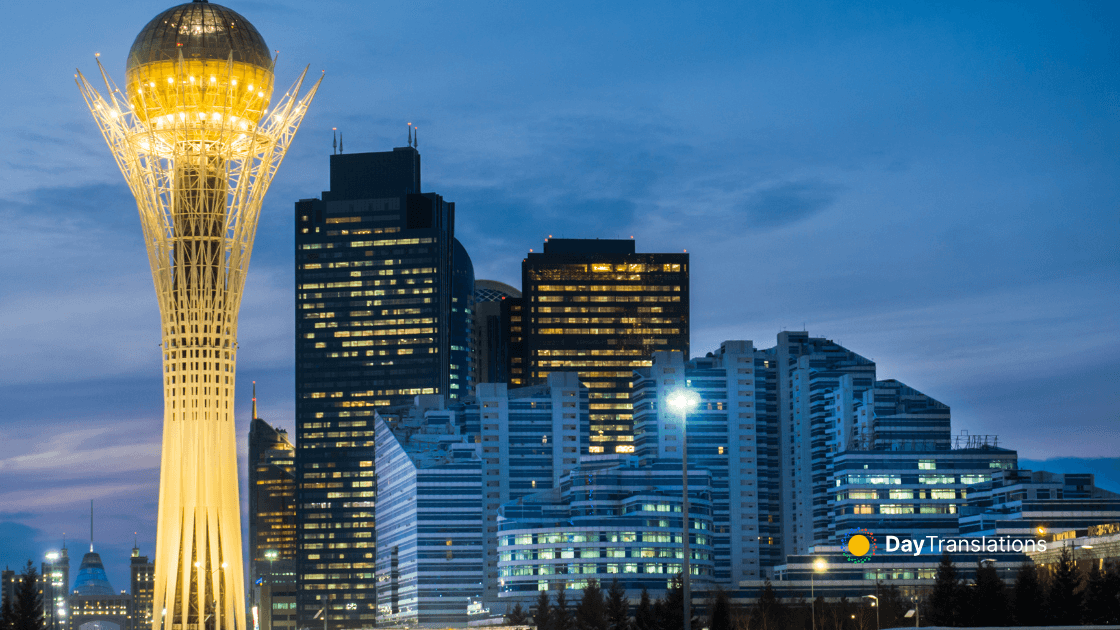
Kazakhstan is a country situated in between Central Asia and Eastern Europe. It is considered as the 9th largest country in the whole world in terms of land area. It is also said to be the one of the world’s largest landlocked countries. Kazakhstan is regarded as the only landlocked country in the whole world to be located in between two continents. Neighboring Kazakhstan are Russia, China, Kyrgyzstan, Uzbekistan, and Turkmenistan. It was part of the Great Silk Road during the 6th and 7th centuries AD.
This captivating and mysterious country is the largest of the states in Central Asia. It is extremely rich in mineral wealth and highly valuable in terms of natural resources. Out of the 110 elements in the periodic table of Mendeleev, 99 are found in the country, with 60 elements already being extracted. Kazakhstan is also one of the richest countries in the world when it comes to the production of gas, oil, tin, uranium, gold, magnesium and titanium. It is the world’s number one producer of tungsten; second in the production of phosphorus ores and chromium; fourth in molybdenum and lead and eighth in the production of iron ore. With its vast supply of raw resources, major industrial countries in the world, like the United States, Japan, China, Pakistan, Iran, Turkey, and Western Europe are highly interested in the country. According to experts, the deposits of oil and gas in Kazakhstan are comparable to those found in the Arab emirates, Saudi Arabia and Kuwait. Only areas near the western part of Kazakhstan near the Caspian Sea have been exploited, and it is projected that these are just fringe deposits, with the larger and more productive ones located near the northern section of the country along the Caspian Sea.
Aside from oil and gas, the country is also rich in gold deposits, estimated to be around 300 large deposits, of which only 173 have so far been investigated. It also produce fine-quality diamonds. So far only 1% of the estimated gold production of 100 tons per year is being mined. It would take huge investments for Kazakhstan to fully enjoy its highly valuable yield of minerals and other natural resources, including some of the rarest precious stones on earth.
Watersports, winter sports, trekking and hiking, biking and relaxing in spas are some of the activities that you could do in Kazakhstan. That is, after you have visited the country’s numerous archeological and ethnographic sites, and have spent several hours of being wowed by its beautiful and contrasting landscape, its numerous nature reserves and its rare flora and fauna.
In this Country Profile
:: History of Kazakhstan ::
Kazakhstan’s rich history goes back thousands of years ago. The country’s history is not yet fully discovered and as facts and evidences are unearthed, the fascinating origin of Kazakhstan is slowly coming to light. Some posit that the Amazons originated from the Asian country, descendants of the first steppe nomads that were ubiquitous residents of the area. Some historians believe that Genghis Khan was buried in this ancient country.
More than a million years ago, ancient men from the Lower Paleolithic age settled in the lands around Karatau where they found resources such as wild game and fruits fit for human consumption. At that time there were already evidences of settlements created by the people belonging from the Stone Age. By the Middle and Upper Paleolithic Ages passed, the people that settled in area have already mastered the conditions and environment in the region. They were known to be experts in horse breeding.
While life was generally harsh and unforgiving during those times, tribes from the Begazy-Dandybay and Andron culture survived. They were made of sterner stuff and were excellent warriors, but still displayed domestication as they engaged in activities such as cattle breeding and farming. Petroglyphs of them with horse drawn chariots engaged in battle, their gods represented by camels and bulls and sun-gods as well as their culture shown in their images and dances were carved out in several rocks. They already knew about metallurgy, evidenced by the axes, daggers and knives made of copper. They had local heroes and warriors of noble birth buried in large burial vaults and mounds. They started the development of copper as evidenced by the quarries that they have started. These tribes occupied their territories from the 17th century BC until the 9th to the 8th centuries AD. The nomadic tribes called Saks or Scythians, as the Greeks called them, ousted the original settlers in Karatau, but the tradition continued. They were excellent horsemen that could shoot arrows while riding at full speed. They established the first state in southeastern Kazakhstan. They had their own written language, mythology and a well-advanced animal-style form of art. Their skilled artisans were already creating bronze and gold masterpieces that even today would make excellent exhibition pieces in some of the world’s best museums. New evidence revealed that they spoke several languages in the prothoturkic family.
Several other tribes came and went in Kazakhstan throughout its history. Genghis Khan came in 1219, and from them on tribes of Mongol conquerors established their dynasty in Kazakhstan. By the 15th century they were divided into different khanates (political groups each headed by a khan). One of the most prominent was the Kazakh Khanate. While they were busy fending off the advances of would be conquerors, the territory was overtaken in the 17th century by the Cossacks that established their forts that eventually became cities in areas that are now known as Atyrau and Oral. The Russian colonization of Kazakhstan began in 1731 and lasted until 1917. The Russian settlers were quite lucky because the region was very fertile and mineral-rich. But their colonization wreaked havoc in the routine of the nomadic tribes that were previously free to come and go in Kazakhstan with their families and their livestock. The native inhabitants of Kazakhstan began to be greatly dispersed, leaving most of them starving and driven out of their land. Dissatisfaction with the colonizers escalated, leading to the Central Asian Revolt, also called the Basmachi Movement. It started in 1916 and lasted until 1934. The revolt became part of the First World War as well as the Russian Civil War. Although suppressed by the Tsar and the Russian armies, and getting embroiled in the ensuing wars, Kazakhstan finally declared its independence on December 16, 1991, which was finalized on Christmas Day, December 25 of the same year.
Throughout the years, Kazakhstan has evolved and developed into a rich and constantly improving country that is open and accessible for culture exchanges and tourism without having to give up their roots.
:: Geography of Kazakhstan ::
Kazakhstan is made up of steppes and mountains, with rich and fertile valleys among the mountains. Inland lakes and rivers drain to the Caspian Sea. Most of the waterways are filled by the run-offs from the mountains that are snow-capped throughout the year. The soil in Kazakhstan is very fertile and highly suitable for agriculture but its vast mineral resources make the country extremely rich. It exhibits distinct seasons while its flora and fauna and the location of its inhabitants depend on its topography and climatic zones.
Location
Kazakhstan is mostly located in Central Asia also known as the center of Eurasian landmass. Its geographic location is 48° 00’ north and 68° 00’ east. Kazakhstan’s present capital is Astana which is located 808 miles north of Almaty, its former capital, located almost at the country’s center.
Area
Kazakhstan occupies an area of 2,727,300 square kilometers or 1,053,000 square miles.
The country is divided into 14 provinces and two cities, Almaty and Astana. It has the largest dry steppe region in the world, which covers almost one-third of the nation. It is the largest landlocked country in the whole world, with only 1.7% of the area covered with water.
Comparative Area Size
The country is larger than Western Europe as a whole. Kazakhstan is slightly smaller than the size of the Texas in the US multiplied by four. The northern border with Russia that Kazakhstan shares is also the longest continuous bi-national border in the world at 6,846 kilometers.
Land Boundaries
Kazakhstan is a country that has several borders, that extend for 12,158 kilometers. It is bordered in the east by China for 1,533 kilometers. On the south side it is bordered for 1,224 kilometers by Kyrgyzstan and by Uzbekistan for 2,203 kilometers while 379 kilometers of border is shared with Turkmenistan. It shares borders on the north with Russia for 6,846 kilometers. , on the west by the Caspian Sea and on the north by Russia.
Coastline
Being landlocked, Kazakhstan does not have a coastline but part of the country borders the Aral Sea which is now divided into two bodies of water, for 1,070 kilometers and the Caspian Sea for a length of 1,894 kilometers.
Maritime Claims
Kazakhstan does not have any maritime claims because of its landlocked position between two regions, Central Asia and Eastern Europe.
Climate
Kazakhstan is one of the many countries in the world that experience extreme changes in weather characterized by abrupt highs and lows. The general climate is considered continental, characterized by arid and semi-arid climatic conditions with very hot summers and frosty winters. Kazakhstan has four distinct seasons: winter, spring, summer and autumn.
Terrain
Kazakhstan comprises the largest dry steppe in the world, together with some mountain ranges, deep canyons, valleys, gorges and deserts.
Elevation Extremes
Kazakhstan’s lowest point is the natural depression called Vpadina Kaundy, also called Sor Kaundy or Ozero Kaundy, which is located in Zhezqazghan region in Oblysy. It is minus 132 meters below sea level. On the other hand, the highest peak is the Khan Tangiri Shyngy, also known as Pik Khan-Tengri, which rises to a height of 6,995 meters.
National Resources
Kazakhstan is a country that is extremely rich in petroleum, coal, natural gas and other mineral resources like gold, iron ore, copper and zinc. It is also rich in manganese, nickel, cobalt, chrome ore, lead, bauxite, uranium and molybdenum. The country’s large oil deposits are found in western regions and in the Caspian coastal region.
Land Use
Over 8.2% of Kazakhstan’s land is used as arable land where crops like wheat, maize and rice are cultivated. Permanent crops like coffee, citrus, rubber, flowering shrubs, fruit trees, nut trees, vines, wood and timber use up about 0.05% of the land. The rest or 91.67% of land includes permanent meadows, forests, woodlands, roads and the like.
Natural Hazards
The southern parts of the country are prone to earthquakes. Areas around Almaty, the previous capital city of Kazakhstan are subjected to mudslides when heavy rains fall.
Current Environmental Issues
There are quite a number of environmental issues in Kazakhstan because of the country being a semi-arid steppe. In the past, the Soviet Union used Kazakhstan as its nuclear testing site. This has contributed as one of the leading causes of sickness in humans and animals in the rural areas of the country. Industrial pollution is getting severe. The Aral Sea is drying up because the its two tributaries have been diverted for irrigation, causing the shrinking of the Aral. At the same time the drying up of the Aral Sea leaves a layer of natural salt and harmful chemical pesticides, which contribute to noxious dust storms when picked up by strong winds. Salination from wasteful practices of irrigation, poor infrastructure and the overuse of chemicals used for agriculture contribute to soil pollution. Likewise, the Caspian Sea in increasingly getting polluted.
International Environmental Agreements
The country has signed but has yet to ratify the Climate Change-Kyoto Protocol. It has entered into agreements concerning biodiversity, climate change, air pollution, desertification, environmental modification and endangered species. It has also joined in the talks and agreements for ozone layer protection, hazardous wastes, wetlands and ship pollution.
:: People of Kazakhstan ::
People
Residents of Kazakhstans are called Khazakhtanis, a word that is used as a noun as well as an adjective to describe them.
Population
Based on the population estimate of 2011, Kazakhstan has a population of 16,600,000, a slight increase from the 2009 official census figure of 16.004,800. With the vastness of the country, the population density is very small, just 5.94 persons living in each square kilometer or about 15.39 for each square mile. The estimated population growth rate for 2012 is 1.235%. Despite this figures which seem small, Kazakhstan ranks 62nd in the world when it comes to population numbers. Historically populated by nomadic tribes, the Kazakhs became the most dominant of them. However, the population of the country is still divided into different ethnic groups, which, according to the 2009 census, are made up of 63.1% Kazakh, 23.7% Russian, 2.9% Uzbek and 2.1% Ukrainian. Lesser numbers make up the rest of the ethnic groups, with 1.4% Uyghur, 1.3% Tatar and 1.1% German, plus identified groups that make up the balance of 4.5%.
Nearly 60% of the population resides in urban areas. As of 2012, the estimated birth rate is 20.44 for every 1,000 residents while the death rate is estimated in 2012 to be 8.52 for every 1,000 persons. Maternal mortality is in placed at 51 for every 100,000 births in 2010.
Age Structure
The highest bulk of the population in Kazakhstan, according to the 2011 estimates, is at the employable and still productive years. Seventy-one percent of the population, broken down into 5,654,461 females and 5,373,755 males are within the 15 to 64 years age group. From zero to fourteen years, the ratio is 21.6%, with 1,709,929 males and 1,637,132 females. Seniors aged 65 years and over make up 7.4%, with 754,407 females and 392,689 males.
Median Age
Kazakhstan has quite a young population, with the estimated median age for males to be around 28.7 years, while it is 31.9 years for females. Overall, the average is about 30.2 years, based on 2011 estimates.
Net Migration Rate
Based on 2012 estimates, net migration in Kazakhstan has already gone higher, pegged at 0.43 for every 1,000 residents.
Sex Ratio
On average, sex ratio at birth is 0.94 male/female, 1.01 male/female for residents under 15 years of age. The ratio goes down, with 0.94 male/female for those in the 15-64 years age bracket and 0.52 male/female for people 65 years and over. For the total population, the ratio is 0.92 male/female based on 2011 estimates.
Infant Mortality Rate
Total infant mortality rate is at 23.06 deaths for every 1,000 live births. Among males, there are roughly 25.83 deaths for every 1,000 live births and for females, approximately 20.46 deaths for every 1,000 live births, based on estimates done in 2012.
Life Expectancy at Birth
Life expectancy at birth in Kazakhstan is at 69.63 years in total. Among males, the average is 64.34 years and 74.59 for females, as estimated in 2012.
HIV/AIDS
Kazakhstan is one of the countries with a relatively low rate for HIV/AIDS. In 1999, only 1,000 cases were registered in the country. Experts believe though that this rate has already increased tremendously as a result of poor facilities and medical equipment that could have helped HIV/AIDS prevention in the country. However, certain injectable and drugs are being used in Kazakhstan as a means of treatment for the said condition.
In 2009, it was estimated that adult prevalence of HIV /AIDS in Kazakhstan is at 0.1%, with about 13,000 living with the disease. The same estimate listed about 500 deaths due to the disease.
Ethnic Groups
According to the 2009 Census, Kazakhstan is divided into two major ethnic groups namely the Kazakhs at 63.1% and the Russians, which comprise 23.7%. Other ethnic groups include the Uzbek, which make up 2.8%, Ukrainian with 2.1% and Uighur with 1.4%. Tatars make up 1.3% while Germans are about 1.1%. Identified ethnic groups make up 4.5%. Figures are based on the 1999 census.
Religion
The Kazakhstanis follow several religions. Forty-seven percent of the population is of Muslim faith. Russian Orthodox comprises 44% while Protestants make up about 2%. The rest follow other religions that they failed to identify.
Kazakh (Qazaq) 63.1%, Russian 23.7%, Uzbek 2.8%, Ukrainian 2.1%, Uighur 1.4%, Tatar 1.3%, German 1.1%, other 4.5% (1999 census)
Language
The language that is primarily used in Kazakhstan belongs to the Turkish family of languages. They also share many different language roots from various European countries. Soon after the country declared its independence from the USSR it adopted the Kazakh language as its state language, spoken by over 40% of the population. The majority of the inhabitants of Kazakhstan still speak Russian, which is the official language for daily business transactions.
Literacy
The residents of Kazakhstan are highly literate. Across the country the literary average is 99.5%. This means residents that are 15 years of age and over are able to read and write. Students stay in school for an average of 15 years.
:: References ::
http://www.indexmundi.com/kazakhstan/elevation_extremes.html
http://en.wikipedia.org/wiki/Kazakhstan
http://www.kazakhstan.orexca.com/kazakhstan_history.shtml
http://en.wikipedia.org/wiki/Environmental_issues_in_Kazakhstan
http://www.nationsencyclopedia.com/economies/Asia-and-the-Pacific/Kazakhstan.html
http://www.kazakhstandiscovery.com/kazakhstan-climate.html
http://www.indexmundi.com/kazakhstan/land_use.html
http://www.indexmundi.com/kazakhstan/natural_hazards.html
http://www.indexmundi.com/kazakhstan/environment_international_agreements.html
http://www.indexmundi.com/kazakhstan/age_structure.html
http://www.un.org/womenwatch/daw/csw/hivaids/Zhusupov.html
http://en.wikipedia.org/wiki/Demographics_of_Kazakhstan
http://www.indexmundi.com/kazakhstan/literacy.html
http://www.indexmundi.com/kazakhstan/maritime_claims.html
https://www.cia.gov/library/publications/the-world-factbook/geos/kz.html
Geography of Kazakhstan: Important Geographical Information about Kazakhstan
In this Country Profile
Kazakhstan is conveniently located at the heart of Central Asia and Eastern Europe, lying on both sides of the Ural River. Its landlocked position makes the country lie within two continents, Europe and Asia. Its territory occupies an area of roughly 2,727,300 square kilometers or about 1,053,000 square miles. According to geographers, the size of Kazakhstan could be compared to the combined sizes of four Central Asian states of Kyrgyzstan, Turkmenistan, Tajikistan and Uzbekistan or roughly about the size of Alaska, times two.
Kazakhstan is the largest landlocked country in the world and at the same time the ninth largest in terms of land area in the world after Argentina, Australia, Brazil, Canada, China, the United States of America and Russia. The Xinjiang Uygur Autonomous Region of China borders its eastern part, while the Caspian Sea and parts of Russia border its western section. To its north lies Russia while the Central Asian states of Uzbekistan, Kyrgyzstan and Turkmenistan are its borders on its southern side.
Topography
Forty-four percent of Kazakhstan’s land area is covered by semi-desert while 26% is already desert land. Twenty-four percent is covered by steppe terrain while 6% is still covered with forest.
Kazakhstan is covered mainly by 26% desert, 44% semi-desert, 6% forest and 24% steppe terrain. The southern and eastern parts of Kazakhstan are still wild and have untouched mountain landscapes including the most striking ones such as Tien Shan and Altai. Kazakhstan’s highest peak is called Khan Tengri belonging to the Tien Shan mountain range located at the border of China, Kyrgyzstan and Kazakhstan, with a height of more than 7,010 meters or 22,999 feet.
The country’s central location in Europe and Central Asia gives it an equal distance from the Atlantic Ocean in the west and the Pacific Ocean in the east. More than 25% of its land is covered by gentle steppes, a section of land that spans from Central Europe all the way to Siberia. The beauty of Kazakhstan’s landscape is further enhanced by the various plants and wild life that are found in the high mountains in the south and the forest steppes in the north and complemented by its rivers, reservoirs and lakes. The run-off from the perpetually snowcapped mountains in the country fills up its waterways.
Kazakhstan’s lands consist of very rich soils. Majority of the country’s forest-steppe zone is covered with chernozem, rich dark-colored soil that is very fertile and produces high yield for agriculture. Interestingly, the chernozem in Kazakhstan has three colors – dark chestnut, light chestnut and brown as it goes farther south. However, on the semi-desert and desert areas, the soil is colored gray.
Climate
From north to south, Kazakhstan displays different climatic zones, with each area displaying its own set of plants and animals. The desert areas are very arid, receiving very little rainfall and experiencing high temperatures during the summer season that turns to intensely low temperatures in winter. Sand storms are churned by strong winds. In the summer, the air is very dry. Temperatures normally vary greatly within the whole day. Climate in Kazakhstan is generally affected by its size, its great distance from the major bodies of water like the oceans and it being right between two continents that are in different climatic zones, where the hot air from the south meets the cold air masses coming from the north. These climatic conditions and the country’s terrain also contribute greatly to the dispersion and distribution of the population away from the country’s center.
Extreme adventure sports are the things the lure visitors and travelers to Kazakhstan but the best time to visit the country, for all travelers is around late April towards the end of October. Winter in the country starts in the northern part of Kazakhstan by November, lasting until the month of March. Winter in Kazakhstan is harsh, with snow packing up to about a thickness of 30 centimeters. January is the coldest month, with temperatures in the northeastern section going down to -54 °C or -65.2 °F. The southern region exhibits a higher temperature during winter, and not likely to fall below -30 °C or -22 °F.
Things turn for the better when spring comes, usually around February in the southern section of the country before it reaches the northern part of Kazakhstan about one and a half months later. Nightly frosts would still be evident in larger parts of the country and blizzards might still occur at times. In the south the temperature would be higher, at about 16 °C to 18 °C or somewhere around 61 °F to 64 °F. Evening frost in the southern part of the country usually stops around April while it could go on until May in the northern part of Kazakhstan.
The month of May heralds the summer season in Kazakhstan and is a season to enjoy as it lasts for nearly five months. Temperature in the north rises to 38 °C or 100.4 °F while it would be about 46 °C or nearly 115 °F in the south. However, this is also the time when strong winds and thunderstorms occur early in the season. Extreme weather patterns characterize the weather conditions in the country and during summer, the eastern plains could be warm and rainy at the same time while the steppes in the west are suffering from hot and dry weather conditions. July is the warmest summer month with an average of over 28 °C or 82.4 °F to about 30 °C or 86 °F in the southern part while it could be about 19 °C and over or 66.2 up north.
The weather turns mellower when September approaches going full blown by October. Skies would be cloudy and wind and rains would be prevalent. The semi-desert areas would be the first to experience the freezing temperatures while the remnants of summer, characterized by dry and hot weather would still be lingering around October and November in the desert areas. Rain and mist would be appearing in the mountainous areas and snowfall would already be expected.
Rivers and Lakes
The sharply undulating landscape of Kazakhstan is characterized by its steppes and mountains. The mountain system in the country is a rich source of mineral springs. Kazakhstan has many rivers and reservoirs. The Caspian Sea has many tributaries over the country, covering a distance of more than 2,340 kilometers. In the east of the Caspian Sea lies another lake, the Aral Sea. There are about 7,000 natural lakes in the country, including Balkhash Lake, Zaisan Lake, Tengiz Lake and Alakol Lake. The country also boasts of large rivers such as Chu, Irtysh, Ishim, Lli, Nura, Syrdarya, Tobol, and Ural.
Mineral wealth
The country ranks sixth in the world when it comes to mineral wealth surplus. Despite its richness in various minerals, the country is unable to use its advantages effectively. The explored areas alone are estimated to roughly amount to 10 trillion U.S. dollars, which is just a fraction of the total value of its entire wealth in minerals.
The country also boasts of its huge contribution to the world’s supply of copper, molybdenum, nickel, polymetallic ores, tungsten, and other rare but very useful metals. The country also holds a top spot when it comes to deposits of chromite ore, iron ore and manganese. Kazakhstan also boasts of its rich gold and raw chemical material deposits.
:: References ::
http://en.wikipedia.org/wiki/Geography_of_Kazakhstan
http://www.kazakhstan.orexca.com/kazakhstan_geography.shtml
http://www.kazakhstandiscovery.com/kazakhstan-climate.html
Information about the Kazakhstani Flag: Colors and Meaning of the Flag of Kazakhstan
In this Country Profile
:: Meaning of the Kazakhstani Flag ::
Kazakhstan was once a republic of the USSR. It was the last Soviet republic to declare its independence on December 16, 1991. The landlocked country is situated between Europe and Central Asia. Throughout most of its history, nomadic tribes inhabited this region, which for the most part consists of vast dry steppes.
Officially, the country is called Qzaqstan Replicas or the Republic of Kazakhstan, with Akmola, now known as Astana as its capital.
:: History of the Kazakhstan Flag ::
It was in the 19th century that present day Kazakhstan came under the communist rule of the Russian Empire when it expanded its territories in Central Asia.
From 1937 until 1940, Kazakhstan, like the rest of the countries under communist rule waved a red flag with a hammer and sickle in gold in the upper part of its hoist side. Letterings, also in gold were under the communist emblem. From 1940 up to 1953, the flag was revised, moving the gold letterings to the top of the flag, to the side of the emblem, with the letters almost reaching the edge of the flying side of the flag.
In 1953, the gold letterings were removed from the flag. They were replaced by a strip of sky blue placed near the lower part of the flag while retaining the hammer and sickle in its original position. This version of the Kazakhstan flag was in use until 1991.
After it was granted independence on December 16, 1991, a new design, out of more than a hundred designs submitted was chosen. The winning designer was Shaken Niyazbekov. Numerous sources say that the new flag design was adopted on June 4, 1992 although there were sources that say that it was adopted a month later, on July 4, 1992.
:: Meaning of the Design and the Color of Kazakhstan Flag ::
The base color of the new republic’s flag was changed from red to sky blue. A golden sun, a golden gliding eagle and a traditional Kazakhstan emblem were the elements in the design of the new flag.
The national flag of Kazakhstan, with a size ratio of 1:2 has a sky blue field, almost duplicating the color of the vast and endless sky. It is a reflection of the Turkic religious beliefs, a color associated with the sky god, Tengri and a color that symbolizes the cultural and ethnic unity of the people of Kazakhstan. Present-day Kazakhstan has a population that is mainly composed of people of Turkic descent, including the Tatars, Mongols, Kazakhs, Uzbeks and Uyghurs. The blue color also represents water.
In the center of the blue field is a large golden orb that represents the sun. It is generally a representation of energy and as a source of life. In many cultures, the sun stands for abundance and wealth. The nomadic tribes of Kazakhstan use the sun’s movements to tell the time. Surrounding the golden sun are 32 small rays, which upon closer inspection resemble grains. For the Kazakhs these small rays or grains are the source of prosperity as well as sufficiency.
Underneath the golden sun is an image of a steppe eagle in flight, its wings wide open and surrounding the bottom half of the sun. The Kazakhs believe that the eagle symbolizes the power of their nation, their freedom and independence and their soaring flight into a better future.
Placed vertically on the hoist side of the flag is a golden traditional ornament, a symbol of the country’s traditions and culture. It is called the “horns of the ram,” which translates into Kazakh as koshkar-muiz.
:: References ::
http://en.wikipedia.org/wiki/Flag_of_Kazakhstan
http://www.mapsofworld.com/flags/kazakhstan-flag.html
http://www.kazakhstandiscovery.com/kazakhstan-flag.html#axzz28x7mFHpz
Extensive List of Languages of Kazakhstan: Spoken and Extinct Languages
In this Country Profile
Dungan
[dng] Dialects: Shaanxi. Classification: Sino-Tibetan, Chinese
German, Standard
[deu] 958,000 in Kazakhstan. Population excludes Plautdietsch [pdt]. Classification: Indo-European, Germanic, West, High German, German, Middle German, East Middle German
Ili Turki
[ili] Alternate names: T’urk, Tuerke. Classification: Altaic, Turkic, Eastern
Kazakh
[kaz] 5,290,000 in Kazakhstan (1979 census). Population total all countries: 8,331,950. Kazakhstan, northern Soviet Middle Asia into western Siberia. Also in Afghanistan, China, Germany, Iran, Kyrgyzstan, Mongolia, Russian Federation (Asia), Tajikistan, Turkey (Asia), Turkmenistan, Ukraine, United States, Uzbekistan. Alternate names: Kaisak, Kazak, Kosach, Qazaq. Dialects: Northeastern Kazakh, Southern Kazakh, Western Kazakh. Minor dialect differences. Classification: Altaic, Turkic, Western, Aralo-Caspian
Plautdietsch
[pdt] 50,000 in Kazakhstan (1986). Alma Ata near the China border, beyond Tashkent. Alternate names: Low German. Classification: Indo-European, Germanic, West, Low Saxon-Low Franconian, Low Saxon
Romani, Sinte
[rmo] Kazakhstan (formerly Volga area until 1941). Alternate names: Manouche, Manuche, Sinti, Tsigane. Classification: Indo-European, Indo-Iranian, Indo-Aryan, Central zone, Romani, Northern
Russian
[rus] 6,230,000 in Kazakhstan. Classification: Indo-European, Slavic, East
Uyghur
[uig] 300,000 in Kazakhstan (1993). Taranchi dialect in Kazakhstan; Kashgar-Yarkand in Uzbekistan. Alternate names: Novouygur, Uighur, Uiguir, Uygur. Dialects: Taranchi (Kulja), Kashgar-Yarkand. Classification: Altaic, Turkic, Eastern
:: Reference ::
Gordon, Raymond G., Jr. (ed.), 2005. Ethnologue: Languages of the World, Fifteenth edition. Dallas, Tex.: SIL International. Online version: http://www.ethnologue.com/
Famous Kazakhstani People: Kazakhstani Artists, Scientists, Leaders, Musicians, Politicians and Athletes
In this Country Profile
Kazakhstan, one of the countries in the world with the largest population, has produced several notable citizens that specialize in different fields. With their exemplary work, they have been recognized inside and outside of Kazakhstan. Some of them have migrated and opted to live in other countries but they are still closely related to the land of their birth.
:: List of Famous People from Kazakhstan ::
Byrganym Sariyevna Aitimova
Byrganym Sariyevna Aitimova, born on February 26, 1953, served as the ambassador of Kazakhstan to the United Nations from the time she was appointed in 2007. During the same year, she was also appointed as the Minister of Education and Science until she was replaced by her successor, Zhaseit Tuymenbayev on the 10th of January. Aitomova also served as an ambassador of Kazakhstan to Italy and is currently in the Solomon Islands serving as Kazakhstan’s ambassador.
Gulzhana Karagusova
Gulzhana Karagusova was a member of Kazakhstan’s Majilis of Parliament from the Nur Otan party. She once served as a Minister of Labor and Social Protection in the Government of Kazakhstan in 2001. She has also been one of the most respected speakers in various economic forums in her country. She is very active in seeking legislation and increasing the benefits of the workforce.
Karagusova was also the one responsible for pushing forth a mandate to raise the pension rates from 3,000 to 12,000 (in tenge, local currency) monthly. State employees also benefited from an increase in salary through her efforts. In 2004, Karagusova, together with Human Right’s Ombudsman Bolat Baikadamov signed an agreement to emphasize the protection of the rights of citizens in terms of the economy, thus conforming to international standards. In 2006, Karagusova was also the politician who was responsible for opening more opportunities for foreigners to work in the country with the issuance of more work permits. She’s a forward thinker and looking for reciprocal opportunities to make Kazakhstan a mover and shaker in world economics.
Zhumabay Shayakhmetov
Zhumabay Shayakhmetov was one of the most renowned political figures of the Kazakh Soviet Communist group. He served as the first ever Secretary of the Communist Party of the Kazakh SSR from 1946-1954, a solid eight years of dedicated service. Before he became a politician, Shayakhmetov once worked as a first-rate agent, in charge of solving different crimes in the district of Cherlaksky, Omsk Oblast. And from 1938 to 1946, he worked his way up the political ladder starting off as a Third Secretary then First Secretary of the Central Committee of the Communist Party of Kazakh’s SSR. Shayakhmetov was also the first ethnic Kazakh to hold such a high position in the office. Between the years 1950 to 1954, he worked as Chairman of the Soviet of Nationalities.
Olzhas Suleimenov
Olzhas Suleimenov was known for three things: his poetic abilities, his involvement in Kazakh’s politics, and as a Soviet anti-nuclear activist. As a poet, Suleimenov received a number of different awards for his works. “AZ-i-IA” was his most influential work. It was published in 1975. Elitist poets in Russia though, gave his work a lot of criticisms. Because of this, he was charged with national chauvinism as well as glorifying feudal nomadic culture. In order to free him of the said charges, Dinmuhammad Konayev, then Kazakhstan Communist Party First Secretary, explained the contents and true meaning of his work. From 1961 to 1969, Suleimenov continued to write and some of his published works include Argamaki, Zemleya Poklonis’ Cheloveku, God Obez’iany and several others. As a politician, he gained popularity once again when he lead an international environmental movement in 1989 to close the nuclear sites in Nevada and one in Semipalatinsk Province, within his native Kazakhstan. After being Kazakhstan’s ambassador to Rome, is in now assigned in Paris as his country’s ambassador to the UNESCO.
Imangali Tasmagambetov
Imangali Tasmagambetov is Astana, Kazakhstan’s current Mayor. From 2004 to 2008 he served as a Mayor of Almaty. In 2002 until 2003, before he became the mayor of Almaty, Tasmagambetov served as the Prime Minister of Kazakhstan. He resigned from the said post just after a year when he found out about the falsification of positive votes during his term. Upon his resignation, all the members of his cabinet were also dismissed.
Marat Tazhin
Marat Tazhin is one of Kazakhstan’s most famous politicians. From 2007 to 2009 he served as the country’s Foreign Minister. He also served as a Secretary of the National Security Committee (NSC) before he became a Foreign Minister. In 2009, he became an advisor to President Nursultan Nazarbayev and secretary of the country’s Security Council.
He was an alumnus of the Almaty National Economic Institute and pursued post-graduate studies at the Kazakh State University where he became a lecturer. He spent his internship in London and became a department head of the Al-Farabi University in Kazakhstan’s former capital of Almaty. His work in economics, culture, education, science and social issues was recognized with the awarding of the Order of Kurmet. He is closely identified with President Nazarbayev, to whom he has provided assistance in writing a number of books.
Kassym-Jomart Tokayev
Kassym-Jomart Tokayev served as the Chairman of the Senate of Kazakhstan and has been doing so since September of 2007 when senators voted for him unanimously. From 2003 to 2007, Tokayev served as the Foreign Minister. He also became the Deputy Prime Minister between the years 1994 to 1999. Tokayev was also influential in taking part at the Global Summit in 2005, confirming the role of the United Nations as vitally important on all international issues. Tokayev visited countries like the United States of America and Germany while he was Foreign Minister to communicate about cooperation between Kazakhstan and other countries and to reciprocally help each other for the good of the greater majority within a global setting. He is now the Director General of the United Nations Office in Geneva, a position he holds since 2011.
Aman Tuleev
Aman Tuleev is Kemerovo Oblast’s governor. He ran for office as President of Russia in 1991, 1996, and 2000. Tuleev was a prominent politician during the 90s. He took part in the Communist Party of Russian Federation and was actively involved in the said group. In 1991, he was known for giving his support to the coup attempt led by GKChP or the State Committee on the State of Emergency. In 1992, he protested against the policies of Yegor Gaidar and as result decided to resign from his position as Chairman of the Kemerovo Oblast Regional Council. In 1999, rumors had it that Tuleev received a Russian baptism but he denied such allegations.
Daniyal Akhmetov
Daniyal Akhmetov was once the Minister of Defense and General of Kazakhstan’s Army. He was appointed for this post on January 10, 2007 by former Prime Minister Karim Massinov. Akhmetov served as Prime Minster for four years, from 2003 to 2007. Throughout the many years he served in the country, people developed a name that he is associated with. “The Terminator” has become his pet name for suppressing supporters of Ghalynzhan Zhaqiyanov, a former Governor in the country. On his second to the last year in office, he was heavily criticized for his overspending and for his poor administrative judgments. In 2007, without any clear reason, Akhmetov resigned from office on January 8. After he resigned, he was appointed by President Nursultan Nazarbayev as Acting Prime Minister. Two days after his appointment, he resigned once again upon the entry of the new administration. Finally in 2009, he was dismissed from his political duties.
Timur Bekmambetov
Timur Bekmambetov is a famous Russian director whose works have inspired the lives of a lot of people. He is also known for producing several films and acts as screenwriter to some masterpieces as well. Other than films, Bekmambetov has also been influential in producing various types of commercials. One of the most famous films that Bekmambetov directed was Night Watch that was released in 2004 and its sequel entitled the Day Watch released two years after, in 2006. In 2008, he directed an American film entitled Wanted and in 2012 directed the movie Abraham Lincoln: Vampire Hunter, also an American film. Bekmambetov became very famous between the years 1992 to 1997 when he directed a series of World History commercials. In 1994, he became the brainchild behind the Bazelevs group, a film production and advertising company.
In 1994, Bekamambetov released his first feature film entitled Peshavar Waltz that gave life to the war between Russia and Afghanistan. Its English counterpart was entitled Escape from Afghanistan and was released in 2002. He also directed a number of television series and one of this most popular works included the 8-part miniseries for television called Our ‘90s.
In 2006, both Bekamambetov’s films Night Watch (2004) and Day Watch (2006) became so successful that Fox Searchlight Pictures decided to buy its exclusive rights for copy and distribution around the world excluding Russia.
In 2011, he produced the film entitled The Darkest Hour, a science fiction thriller that was released under New Regency. He was also responsible for producing some of the newer Tim Burton films.
Rashid Nugmanov
Rashid Nugmanov was one of the most influential people when it comes to Kazakhstan’s entertainment. He is a film director and a political activist. He founded the cinema movement called the Kazakh New Wave.
After college, Nugmanov enrolled at the prestigious Moscow State Film Institute where he honed his talent for directing and cinematograpy. In 1998, he released his first ever film entitled Igla (The Needle) as part of the Golden Duke festival in Odessa. The movie’s central theme was drug addiction, a taboo in Kazakhstan during that time and it was said that Nugmanov was the one responsible for putting an end to that mentality. In 1999, Igla was released and it became an instant success with approximately 30 million viewers. The film won First Prize at the Nuremberg Film Festival under Kazakh New Wave category.
Some of the films he directed and produced include a modern adaptation of the 90s film Igla called Igla Remix which was released in 2010, Dikiy Vostok released in 1993, Zgga released in 1977, The Snow Band released in 1971 and many other titles.
Gulshat Omarova
Gulshat Omarova is one of the most famous directors, actors, and screenwriters in Kazakhstan. In 2004, Omarova was given a much-deserved recognition called the Alice Award for being the Best Female Director for her film entitled Shiza. The prestigious award was given to her by the Copenhagen International Film Festival.
Omarova’s humble beginnings in the entertainment industry commenced when she worked as television assistant from 1986 to 1988. After graduating from the Academy of Arts in Almaty she moved to the Netherlands to further her career. In 2001, she was finally given her break with a notable role in the film Shiza for which she received a number of prestigious awards.
In 2007, Omarova served as a second unit director to the film Mongol aka The Rise to Power of Genghis Khan. The film was nominated for an Oscar Award for Best Foreign Film. In 2008 she directed and wrote the story for the film entitled Baksy aka Native Dancer.
Altynai Asylmuratova
Altynai Asylmuratova was a popular prima ballerina in Kazakhstan. She danced under the Kirov Ballet/Mariinsky Theatre. She has been invited as guest artist for a number of different shows around the globe. After graduating from the Vaganova Choreographic Institute in 1978, Asylmuratova joined the Kirov Ballet. In 1982, she was promoted to Principal Dancer after four years of being in the corps de ballet.
Asylmuratova gained more popularity in Western countries because of her frequent visits and performances there. Her most notable performances include Swan Lake, Giselle, The Sleeping Beauty, Don Quixote, Romeo and Juliet, The Fire Bird, and Les Sylphides, to name a few.
In 1982, Asylmuratova starred in a documentary film that featured her life as she busily prepares for a starring role in Swan Lake. In the year 2000, Aslymuratova was appointed as Vaganova Choreographic Institute’s Artistic Director.
Abylkhan Kasteev
Abylkhan Kasteev was one of the most famous painters in Kazakhstan. He received several awards for his masterpieces including a notable recognition for being called the National Artist of Kazakh SSR as well as The Laureate of the Chokan Valikhanov State Premium of the Kazakh SSR. He was also given two Orders of Labor red flags as well as the Order of October Revolution.
Kasteev was most famous for his ability to paint using oil and watercolors. He painted thousands of works that are presently displayed in various locations including the State Tretyakov Gallery in Kazakhstan, the State Museum of East Nations Art, the Central Museum of USSR Revolution in Moscow and at the State Museum of Fine Arts of Kazakhstan.
Marat Bisengaliev
Marat Bisengaliev is a famous violinist in Kazakhstan. He served as director of the West Kazakhstan Philharmonic Orchestra and the TuranAlem Kazakhstan Philharmonic Orchestra. At present, Bisengaliev also serves as the head of the Uralsk International Violin Competition and the current director of India’s Symphony Orchestra.
In 1988, Bisengaliev was awarded at the Leipzig International Bach Competition. In 1991 he bagged the first prize at the Nicanor Zabaleta Competition that was held in Spain. In the same competition he was awarded the special virtuoso prize for giving the most outstanding performance as well.
The year 2000 ushered even more awards for Bisengaliev. During that year he received the Independent Platinum Tarlan Award together with the Medal of Honor Award given by the government of Kazakhstan.
He was also influential in creating a symphony called Zere as a response to the comedy film entitled Borat.
Alan Buribaev
Alan Buribaev, born in 1979, is a famous musical conductor in Kazakhstan. He is the son of the equally famous cellist and conductor (father) and pianist (mother). He studied at the Kazakh State Conservatory and took up courses in violin and conducting. He also studied conducting at the Uros Lajovic in Vienna. In 2001, Buribaev received a prize in the Lovro von Matacic Conducting Competition that was held in Zagreb and won another prize at the Antonio Pedrotti Competition in the same year.
In 2003, Buribaev became the Principal Conductor of the Astana Symphony Orchestra, a post he held until 2007. Between the years 2004 to 2007 he also served as the General Musikdirektor of the Meiningen Theatre in Germany and became the Principal Conductor of the Norrköping Symphony Orchestra between 2007 and 2008. He went to the Netherlands between the years 2008 through 2009 where was appointed chief conductor of Het Barbants Orkest. Buribaev is set to conclude his chief conductorship of Het Barbants Orkets in 2012. From 2009 he was also serving as the principal conductor of the RTÉ National Symphony Orchestra of Ireland. He was supposed to hold the position for three years, but it was recently extended for another two years, a contract that would expire when the season ends in 2015.
Bukhar-zhirau Kalmakanov
Bukhar-zhirau Kalmakanov, born in 1693 was once a poet at the court of the Middle Horde, one of the main administrative divisions in traditional Kazakhstan. He was a court poet for 70 years. He was most famous for providing entertainment through poetry and singing to the court. He also acted as one of the reigning Khan’s advisors. Thus, his poetic works focused on topics like politics, foreign policies, and the Khan’s life.
Jambyl Jabayev
Jambyl Jabayev was a traditional Kazakhstan folksinger who was born in 1846. As a young boy, Jambyl, whose name was derived from Mt. Jambyl learned to play the dombura. At the age of 14 he fled home and started to become more involved in singing and making music. Jabayev also wrote some pro-revolution and pro-Stalin poetry and songs that were circulated in the Soviet Union. However, rumor has it that the work attributed to Jabayev was not really his work and were works of other Russian poets more popularly called translators.
Eight months before he turned 100, Jabayev succumbed to old age. He was buried in a garden that he had cultivated on his own. The Jambyl Province, where the city of Taraz is located was named after him.
Shamshi Kaldayakov
Born on August 15, 1937, Shamshi Kaldaykov was a famous compose in Kazakhstan. He was the composer behind the song entitled My Kazakhstan that was first released in 1956. In 2006 the said song was adopted as the national anthem of the country after the lyrics was modified upon the behest of President Nursultan Nazarbayev.
Erik Kurmangaliev
Kazakhstan actor, opera singer, and leading public figure in Russia’s music scene Erik Kurmangaliev was born on December 31, 1959. He was quite active in the perestroika, a movement calling for reform inside the Communist Party of the Soviet Union.
Kurmangaliev’s career started in 1980 at the Leningrad Philharmonia. He had performed several times in the Second Symphony of Alfred Shnitke and Dr. Faust throughout his career. In the 90s, his team up with the director Roman Viktyuk enabled his career to reach its peak. He performed in the Russian language version of M. Butterfly by David Hwang. He made his last appearance on the film entitled Vocal Parallels. In 2007, Kurmangaliev died of liver complications.
Gabit Musirepov
Gabit Musirepov was born in March 1902. He was a Soviet Kazakh playwright, writer and author. One of his most notable works was his first libretto, the Kyz-Zhibek which he wrote for the Kazakh opera. His literary career took off with his first story about the events that took place during the Russian Civil War from 1918 until 1920. It was titled To the Abyss.
Musirepov was the President of the Kazakhstan Union of Writers at different times from 1956 to 1966. He was the secretary of the Union of Soviet Writers in 1959 and was a member of the Kazakhstan Academy of Sciences. Some of his other famous works include short stories like Pair of Lakes and Urgent; novels such as The Awakening of the Region published in 1953 and playwrights such as Amangeldi, Kozbye-Korpesh and Bayan-Sulu and Poet’s Tragedy.
Makhambet Otemisuly
Born in 1804, Makhambet Otemisuly was a poet and political figure at the same time. He gained popularity for his rebellious leadership activities against Russian colonialism. Because of the problems that took place after his rebellion, he became a wanted man and had to flee his country.
Makhambet’s poetry was closely linked to the literary traditions and the Kazakh culture of his beloved nation. He wrote poetry centered on themes like politics, where he openly criticized the Russian government as well as the reigning Khan. He also wrote general poetry centered on life and human existence.
Roza Rymbayeva
Roza Rymbayeva was a Soviet and Kazakh singer and was also the National Artist of the Kazakh Soviet Socialist Republic in 1986. She also became one of USSR’s national artists. From 1976 to 1979, Rymbayeva was the soloist of the republic’s pop-youth band called Gulder, which translates to flowers in English. After her stint with the youth band Rymbayeva became a soloist for the Kazakhconcert, the country’s main Republican concert.
Rymbayeva’s repertoire includes not only Kazakh songs but also the works of modern foreign artists she had collaborated with. She’s on the 25th year of her career in the music industry and is organizing jubilee concerts to commemorate her anniversary.
Rymbayeva has received a number of awards including receiving the first prize in the republican contest of initiative in 1975; a 1976 Lenin Komsomol award and several Grand Prix awards in Song Contests as well as various other awards.
Nurbol Zhumaskaliyev
Nurbol Zhumaskaliyev, born on May 11, 1981 is a forward and an attacking midfielder currently playing for FC Tobol. He is the team’s captain and he has also scored seven goals in European competitions. He started his youth career at age 11 when he joined the Namys club of Almaty. His senior career began at FC Akzhayik in 1998 where he made 13 appearances. By the following season he had joined FC Zhetysu. He made 24 appearances for the club before he transferred to FC Tobol from 2000 to 2010, scoring 127 goals in 300 appearances. He had a brief stint with Astana’s Lokomotiv in 2011, contributing 10 goals to the team during his 31 appearances. He came back to FC Tobol at the start of the 2012 season. He had been selected to play in the national team in 2001. He has been capped 54 times, and has made six goals for the national team and has received international player recognition. He has been awarded the Best Player of the Year award in 2003, 2005 and 2010.
Darmen Sadvakasov
Darmen Sadvakasov is a well renowned Kazakhstani chess grandmaster. He was born on April 28, 1979. He received the International Master title in 1995 and received the Grandmaster title in 1998 after winning in the World Junior Championship. He won first place in 2004 at Copenhagen and in 2007 tied the first to eighth spot with Hikaru Nakamura and other chess masters in the Miami Open.
In 2003, he won several matches against Viktor Korchnoi, the oldest and still active chess grandmaster from Russia. Sadvakasov had also won games in 2004 against Anatoly Karpov, a Russian chess grandmaster and former Chess World Champion.
Arman Chilmanov
Arman Chilmanov is a Kazakhstani taekwondo athlete. He was the controversial athlete who stirred up the taekwondo competition during the Olympics in 2008. Chilmanov competed against Ángel Matos of Cuba at the +80-kilogram bronze medal match. He was actually behind Matos in the second round. It was inopportune that Matos suffered an injury to his toe and had to ask for an injury timeout. However, the injury timeout expired and since Matos was still unable to perform, Chilmanov was declared winner. The resulting fiasco due to the unsportsmanlike behavior of Matos caused him to be banned for life. Chilmanov said that he was happy with his win because it was already obvious that Matos would not be able to compete even after the injury timeout because his toe was already broken.
Shoukhrat Mitalipov
Although now a citizen of the United States, Shoukhrat Mitalipov was born in Almaty, Kazakhstan and is of Uighur ethnicity. Dr. Mitalipov is an associate scientist and researcher at the National Primate Research Center in Oregon, which is part of the Oregon Health and Science University. He made headlines in 2012 when it was announced that they were able to clone primates and he was the first scientist to achieve that feat. The U.S. Clinical Tests Commission gave him the license to conduct experiments using human embryos and eggs in 2010, which was a first in medical history. He is the co-author and the lead of the research for the mixed-embryo monkeys.
Evgeni Viktorovich Nabokov
Professional ice hockey goaltender Evgeni Nabokov was born in Ust-Kamenogorsk on July 25, 1975. He is a Kazakhstani Russian ice hockey player that is currently with the New York islanders in the NHL. His father was a very well-known goaltended in Kazakhstan and it was due to his father’s fame that the head coach of the San Jose Sharks scouted him without seeing him play. Before he joined his current team, Nabokov had stints with several hockey clubs in Kazakhstan and the United States, including Torpedo Ust-Kamenogorsk, HC Dynamo Moscow, Kentucky Thoroughblades, Cleveland Lumberjacks, San Jose Sharks, Metallurg Magnitogorsk and SKA St. Petersburg.
He is well known for his skill to challenge goal shooters and his excellent positioning abilities. To this date he remains the first goaltender in the history of the NHL to create a powerplay goal, meaning he was able to score a goal from a shot he himself made. That was way back in 2002. He reached a milestone in January 2012 by recording his 300th career win.
:: References ::
http://en.wikipedia.org/wiki/List_of_Kazakhs
http://en.tengrinews.kz/opinion/230/
http://en.wikipedia.org/wiki/Evgeni_Nabokov