
One of the oldest countries in Europe, the Republic of Hungary is nestled within the heart of Central Europe, landlocked by seven other countries, Austria, Croatia, Romania, Serbia, Slovakia, Slovenia and Ukraine. This small country of just over 93,000 square kilometers is home to over 20 million people, as of October 2011. It is a country divided into nineteen counties or “megyek,” 23 urban counties and one capital city or “favaros.” Its language, Hungarian is quite unique and its culture very distinct, spanning a development of almost 1,100 years. It is said the original settlers of Hungary are Magyars, who were also the ancestors of the Estonians and the Finns. They used to live in Asia, particularly in the area now occupied by Russia. Although part of its most recent past is very bloody, Hungary is now a peaceful nation, part of the Schengen area and noted for its hospitality. Hungary has hundreds of mineral springs that are sought after for their therapeutic benefits; where Lake Balaton, the largest freshwater lake in Central Europe is located and where you can find ancient Roman ruins standing side by side Turkish monuments. Hungary’s capital, Budapest, is considered as one of the most beautiful cities in the world and aptly called the Pearl of the Danube. A Christian nation, Hungary became a bulwark of the Turks, fell prey to the communist regime after the Second World War, endured a short-lived but very bloody civil uprising in 1956 that turned its history and now a member of the European Union.
In this Country Profile
:: Background of Hungary ::
Before the Magyars came to occupy the Carpathian Basin, there was already evidence of human settlement in the area some 350,000 years back. The Romans ruled vast regions in Europe since the first century BC and were there to wield their mighty power for over four centuries. A series of invasions by different tribes have either plundered or made contributions to the progress of the region that became the Hungary of today. Hungary even became the headquarters of Attila the Hun when he ruled over the Balkans, Gaul and Northern Italy until his death in 453.
Hungary came under the rule of different empires from mid-1200s up to the late 1800s. There were the Mongols, then the Turks and the Habsburgs. There were invasions, in-fighting and revolts during these periods in the history of Hungary, as well as divisions in the country. The autocratic rule exercised by these empires created unrest in the hearts of the Hungarians, including the revolt against the Habsburgs in 1848 to 1849, although they were defeated with the help of the Russian army. A compromise was reached with the Habsburgs in 1867, with the monarchy centered both in Vienna and in Pest-Buda, and an industrial revolution started to lift the economy of Hungary. By 1873 Obuda, Buda and Pest were united to form Budapest. It was also during this time that an underground railway in Hungary, the first in continental Europe, began operation.
Germany began to lose power by 1918 and from 1920 to 1940 began to return occupied territories back to Hungary but again occupied the country in 1944. The Russians liberated Hungary from the Nazis in 1945 but then took over the ruling of the country and Communism governed the nation from then until 1956. The citizens suffered different forms of abuse under the dictatorship of Josef Stalin.
What started as a mass student protest on October 23, 1956 became a full-fledged civil uprising against the government of Hungary and the policies imposed by the Soviets. Freedom fighters, members of the national army and ordinary citizens joined forces with the students. The revolution lasted for close to nine months but it became the turning point in Hungary’s history. It was doubly significant because the people toppled the 30-foot high bronze statue of Josef Stalin that was erected in an area where once stood a church. It was demolished just so the statue can be erected in its place. Only the boots of the statue remained, and became a constant reminder of what happened on that fateful day. There were thousands of casualties during the Hungarian Revolt but it created enough noise and international notice, even if the Hungarians were defeated initially and thousands fled the country.
The Communist Party gave up their rule voluntarily over Hungary in 1990 and a multi-party parliamentary democracy was put in place. The Soviet Army also left Hungary during this period and by 1999, Hungary was already a full member of NATO and the EU by 2004.
:: Geography of Hungary ::
Location
Hungary is located in Central Europe, right in the middle of the Carpathian Basin and landlocked by its border countries. It covers the main land routes between the Mediterranean Basin and Ukraine and the route between the Balkan Peninsula and Western Europe, making its position very strategic. Geographically, its coordinates are 47° 00’ north and 20° 00’ east.
Area
Hungary covers a total land mass of 93,028 square kilometers with about three percent or 3,420 square kilometers of water surface. Land comprises the rest of the area, for a total of 89,608 kilometers. The area Hungary occupies is only a bit smaller than the state of Indiana in the United States.
Land Boundaries
This landlocked country has a boundary that totals 2,185 kilometers shared with seven other European countries. Its longest border is shared with Slovakia, for 676 kilometers, followed by Romania, with 433 kilometers and with Austria for 366 kilometers. Hungary also shares border with Croatia for 329 kilometers and with Serbia for 166 kilometers. Its shorter borders are shared with Ukraine and Slovenia for 103 and 102 kilometers, respectively.
Climate
Hungary has a relatively even temperate climate characterized by winters that are cold, humid and cloudy. Summers in Hungary are normally tolerably warm.
Terrain
Being located in the depression called the Carpathian Basin or the Pannonian Basin, Hungary is relatively flat, with gently rolling plains for over half of its total land area. The northern portion of the country has hills and low mountains of volcanic origin that are very fertile and suitable for wine growing.
Elevation Extremes
While the lowest point, the Tisza River is still 78 meters above sea level, the Kékes, which is the highest point in the country rises to a height of about 1,015 meters. It is located in the northern region of Hungary and forms part of the Mátra mountain range. It got its name from its peculiar bluish tint, as “kék” in Hungarian means blue and “kékes” simply means bluish in the vernacular.
Natural Resources
Hungary is blessed with a large expanse of arable land with fertile soils for viticulture and other forms of agriculture. It also has deposits of natural gas, coal and bauxite.
Land Use
Nearly half of the land area in Hungary is arable and 2.06% of it is planted with permanent crops. The balance, including pastures and meadows is allocated for other uses, including organic farming.
Natural Hazards
There are no natural hazards that plague Hungary. The only one to look out for is the possible toxic contamination of some areas in Ajka as there was an aluminum waste spill in the area in October of 2010.
Current Environmental Issues
Hungary is bracing for some large expenses to meet the requirements imposed by the European Union to upgrade the country’s standards in air, soil and water pollution, as well as its energy efficiency and waste management systems.
International Environmental Agreements
Not one of the international environmental agreements that it had signed had been ratified by Hungary. It had entered agreements concerning air pollution and its derivatives – air pollution-nitrogen oxides, persistent organic pollutants, sulfur 85, sulfur 94, and volatile organic compounds. Hungary also signed agreements on biodiversity, climate change, including climate change-Kyoto protocol, Antarctic Treaty, hazardous wastes, law of the sea, ozone layer protection, wetlands, whaling, desertification, endangered species, marine dumping, ship pollution and environmental modification.
:: People of Hungary ::
Citizens of Hungary are called Hungarians, which can be used as a noun or as adjective. They are also called Magyars, from the Hungarian word “magyarok,” an ethnic group that is indigenous to Hungary. They have several sub-groups of ethnicity, distinguished by their cultural and linguistic characteristics. These include the Jassic, the Palóc, the Székely and the Csángó. The locals called themselves Magyars while foreigners call the people from Hungary by their nationality – Hungarians.
Population
According to population estimates done in July 2011, there are 9,976,062 inhabitants in Hungary. As of the latest count (October 2011), the population is a little over 10 million. Population growth is estimated at -0.17% for 2011, with the fertility rate recording 1.4 births for every woman. Net migration is estimated to be 1.39 for every one thousand residents.
Age Structure
The majority of the population of Hungary belongs to the 15 to 64 age group, slightly skewed to the female side of the population at 3,444,450. The males account for 3,361,538, representing 68.2%. In the 0 to 14 age category, the males slightly outnumber the females with 767,824 versus 721,242. This is equivalent to 14.9% of the total population. For the elderly belonging to the 65 years and over age bracket, the female once again outnumber the males, with a total of 1,058,582 as against only 622,426 males. The total makes up 16.9% of the total population for 2011.
Median Age
The median age for the whole of Hungary is 40.2 years, with the females averaging 42.8 years versus 38.1 years is the average for the males.
Birth and Death Rates
According to demographic estimates done in 2011, the birth rate per 1,000 members of the population is about 9.6 while the death rate is placed at 12.68 per one thousand residents.
Sex Ratio
For the total population is the sex ratio is slightly in favor of the males although it is not by much, at 0.91 male for every female. At birth and for those under 15 years of age, the ratio is 1.057 males and 1.06 males, respectively. The ratio becomes lower in the 15 to 64 years and for those 65 years and over, registering only 0.98 males and 0.57 males for each age group, respectively.
Mortality Rate
Despite being a developed country, there is still an average of 13 maternal deaths for every 100,000 live births in Hungary, according to available data from 2008. Infant mortality rate averages 5.31 for every 1,000 live births for the whole country. Breaking it down by gender, there are 5.57 male infant deaths for every 1,000 live births while the estimate is about 5.04 female infant deaths for every 1,000 live births.
Life Expectancy at Birth
Life expectancy in Hungary is high, with an average of 74.79 for the total population. By gender, the women outlive the men by at least seven years, averaging 78.76 years as against the males whose average is only 71.04 years.
HIV/AIDS
Adult prevalence of HIV/AIDS in Hungary is quite low a 0.1%, as of the 2009 estimates. There are about 3,000 people living with the disease in Hungary. From the same estimate, the number of deaths as a result of HIV/AIDS is less than 200.
Ethnic Groups
According to the census done in 2001, the percentage of Hungarians living in the country is equivalent to about 92.3%. There are also some Roma that comprise about 1.9%. About 5.8% of the population is of unknown ethnicities.
Religions
The Roman Catholics dominate at 51.9%. Other denominations include Calvinist at 15.9% while 3% are of the Lutheran faith. Greek Catholics make up 2.6% while other citizens follow other Christian religions, representing 1%. Others or about 11.1% did not specify if they are following any religion while 14.5% of the population maintains that they are not affiliated with any religion.
Language
The mother tongue for the majority of inhabitants is Hungarian, which comprises about 93.6% of the population while others or 6.4% speak other languages according to the 2001 census.
Literacy
Hungary’s citizens are highly literate, with almost the whole population or 99.4% of the inhabitants aged 15 and over can read and write. Students stay in school for at least 15 years.
:: References ::
https://www.cia.gov/library/publications/the-world-factbook/geos/hu.html
http://www.users.zetnet.co.uk/spalffy/h_hist_0.htm
http://hungary.com/about-hungary
Geography of Hungary: Important Geographical Information about Hungary
In this Country Profile
Landlocked by seven countries, Hungary is located in Central Europe and within the center of the Carpathian Basin. It is a vast depression created by the drying up of the Pannonian Sea during the Pliocene Epoch nearly 2.5 million years ago. Thus, the majority of the land in Hungary consists of low-lying plains, with some hills and mountain formations in the northeast. Hungary is wide in the east-west direction with 526 kilometers and narrower in the north-south direction that only measures about 268 kilometers. The total land area is roughly 93,028 square kilometers or about 35,918 square miles. Hungary is home to nearly 10 million people.
Topography
Two north-to-south flowing rivers, the Danube, which flows into Hungary for 417 kilometers and the 598-kilometer long Tisza River divide the country into three main divisions: the Northern Hills, the Great Alföld and the Transdanubia.
The Transdanubia is composed of nine counties and part of Pest country where Budapest, the nation’s capital is located. It is one of the larger administrative regions of Hungary and the location of Lake Balaton, the largest freshwater lake in Central Europe. The terrain consists of valleys, basins, gentle hills and low mountains as well as vast plains.
The Great Alföld or the Great Hungarian Plain is a vast flatland covering an area of 52,000 square kilometers or nearly 56% of the total land area of Hungary. This is characterized by rolling to flat plains. The river Tisza, the lowest point in Hungary is found here. Several Hungarian scientists, including Zoltán Bay, Frigyes Korányi, Gábor Kátai, János Kabay and János Irinyi were born in the Great Hungarian Plain. A number of medicinal baths are also found in the Great Alföld, such as the Szolnok, Szentes, Berekfürdö, Gyula, Cserkeszölö and Hajdúszoboszló.
The Northern Hills are located in the northeast section of the country and the location of the highest peak in Hungary, the Kékes Mountain that rises to a height of 1,014 meters and part of the Mátra mountain range. The region covers about 13,000 square kilometers. The region is very suitable for viticulture and also rich in brown coal, limestone, lignite and forestry products. In fact Hungary has 22 wine regions.
The Carpathian Basin, known as “Kárpat-medence” in Hungarian, is surrounded by mountain ranges, including the Alps, the Dinarides in Southern Europe, the Carpathian Mountains of Eastern and Central Europe and by the Balkan Mountains in Bulgaria and Serbia.
Climate
The Mediterranean, the Eastern European continental weather system and the Western European oceanic weather system greatly affect the climate and weather in Hungary, and for the most part give the country a temperate continental climate.
Hungary has four seasons, with January experiencing the coldest temperature while July and August are the hottest months. Temperature in Hungary fluctuates. Annually, the minimum can be around -10 °C, which is about 14 °F and the maximum can reach 38 °C or about 62.4 °F. The average annual temperature is a cool 12 °C (53.6 °F). Spring is ushered in by plenty of light showers in early April while the summer months are normally warm and dry. Fog, rain and cool temperatures are characteristics of autumn in Hungary, followed by a short winter, which can be moderately cold, with some sunshine but generally dry. In the city snowfall does not stay too long. Strong rains visit Hungary twice a year, with an average rainfall of 415 millimeters. Rains come during the early part of summer and again during autumn. For the most part, Hungary enjoys 2,015 days of sunshine.
:: References ::
http://www.budapest-hotel-guide.hu/en/hungary-information/geography-of-hungary.php
http://en.wikipedia.org/wiki/Geography_of_Hungary
Professional Translation Organizations & Associations in Hungary
In this Country Profile
Below is a list of the major translation organizations and associations of Hungary.
:: List of Organizations ::
Association of Hungarian Translation Companies
Budapest Business School
Budapest Chamber of Commerce and Industry
Budapest University of Technology and Economics, Centre of Modern Languages
Corvinus University of Budapest
Eötvös Loránd University, Faculty of Humanities, Interpreter and Translator Training Centre
Janus Pannonius University, Dept. of Slavic Studies
Kossuth Lajos University of Arts and Sciences, Language Centre
Szeged University
Université Technique de Budapest, Müegyetemi Távoktatási Központ
University of Western Hungary, Dept. of Applied Linguistics
Information about the Hungarian Flag: Colors and Meaning of the Flag of Hungary
In this Country Profile
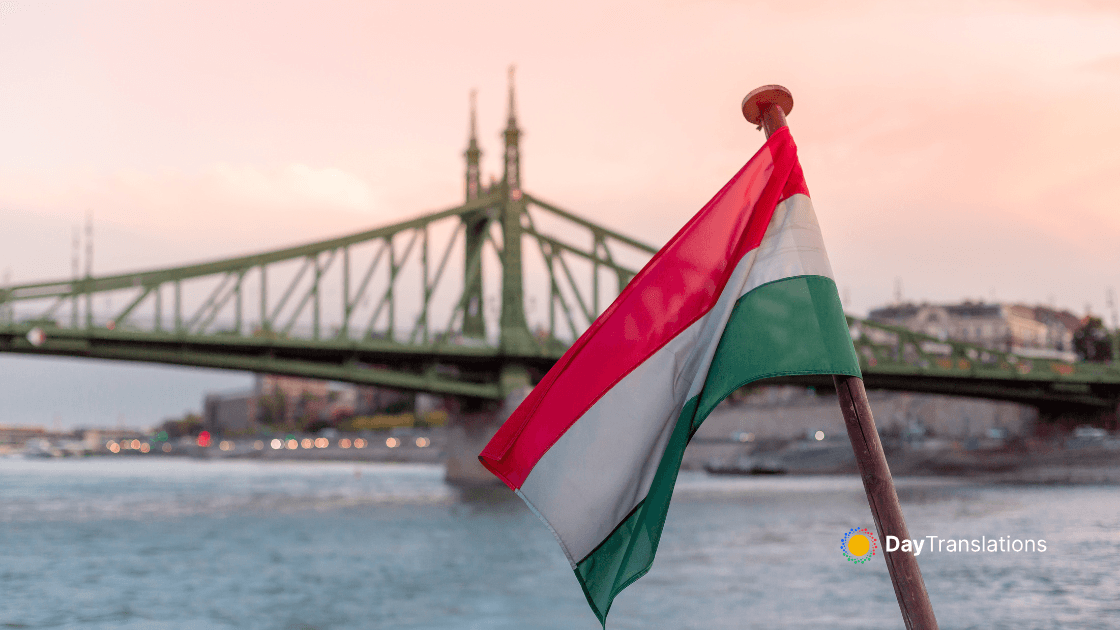
The flag of the Republic of Hungary has been in use since 1848, as a sign of the Hungarians’ unwavering desire to be a free country. The civil revolution of 1956 is the culmination of their quest for freedom, resulting in the official adoption of the current flag design on October 1, 1957. It is very basic in design, taking inspiration from the flag of France. It, too, is made up of three colors for its three equal-sized horizontal stripes, with red on top, white in the middle and green at the bottom.
The flag design may have been patterned after that of France’s but the colors of the Hungarian flag were taken from their coat of arms, and according to some reports, had been in use since the coronation of Mathias II in 1608.
Generally speaking, red means strength, while white is for faithfulness and green represents hope. In the case of the flag of Hungary, and for the same reason given by most countries that have had to endure endless wars and uprising, red symbolizes all the blood shed by the country’s freedom fighters, who unselfishly gave up their lives for the sake of freedom. The white middle field in the flag represents the purity and cleanliness of Hungary while the green stripe represents the color of the revolution in the mid-1900s. The usual dimensions for the flag of Hungary is a ratio of 2:3.
:: References ::
Extensive List of Languages of Hungary: Spoken and Extinct Languages
In this Country Profile
:: List of Languages ::
Armenian
[hye] 290 in Hungary (2001 census). Classification: Indo-European, Armenian
Croatian
[hrv] 14,300 in Hungary (2001 census). Ethnic population: 19,175. South border area. Dialects: Croatian, Serbian. Classification: Indo-European, Slavic, South, Western
German, Standard
[deu] 33,800 in Hungary (2001 census). Ethnic population: 88,416. Classification: Indo-European, Germanic, West, High German, German, Middle German, East Middle German
Hungarian
[hun] 9,550,000 in Hungary (2001 census). 60,000–70,000 in Romania and Moldova speak Csango. Population total all countries: 12,501,270. Also in Australia, Austria, Canada, Croatia, Czech Republic, Israel, Romania, Russian Federation (Europe), Serbia, Slovakia, Slovenia, Ukraine, United States. Alternate names: Magyar. Dialects: Alfold, Csango, West Danube, Danube-Tisza, King’s Pass Hungarian, Northeast Hungarian, Northwest Hungarian, Székely, West Hungarian. Most similar to the Uralic language Vogul (Mansi [mns]) in Siberia. Speakers of Standard Hungarian have difficulty understanding the Oberwart dialect spoken in Austria, and considerable difficulty understanding the Moldavian Csángó dialect spoken in Rumania. Classification: Uralic
Hungarian Sign Language
[hsh] 30,000 to 60,000 deaf. Widespread. Alternate names: Magyar Jelnyelv. Dialects: Budapest, Sopron, Debrecen, Szeged, Eger, Kaposvár, Vác. Related to Austrian Sign Language. Dialects have some different signs for lexical items, similar or same grammar. Classification: Deaf sign language
Romani, Balkan
[rmn] In Hungary, 150,000 Gypsies speak a variety of Romani as L1 (Réger 1995). Ethnic population: 190,000. Alternate names: Beás, Cigány, Roma. Classification: Indo-European, Indo-Iranian, Indo-Aryan, Central zone, Romani, Balkan
Romanian
[ron] 8,480 in Hungary (2001 census). Ethnic population: 9,162. East; Budapest. Alternate names: Daco-Romanian, Moldavian, Rumanian. Dialects: Boyash Romanian. Classification: Indo-European, Italic, Romance, Eastern
Slovak
[slk] 11,800 in Hungary (2001 census). Ethnic population: 26,631. Southeast and near Slovak-Hungary border. Classification: Indo-European, Slavic, West, Czech-Slovak
Slovene
[slv] 3,190 in Hungary (2001 census). Near Slovenia border. Alternate names: Slovenian. Dialects: Prekmurski. Classification: Indo-European, Slavic, South, Western
:: Reference ::
Gordon, Raymond G., Jr. (ed.), 2005. Ethnologue: Languages of the World, Fifteenth edition. Dallas, Tex.: SIL International. Online version: http://www.ethnologue.com/
Famous Hungarian People: Hungarian Artists, Scientists, Leaders, Musicians, Politicians and Athletes
In this Country Profile
Citizens of Hungary experienced a very long and tumultuous past, with their country coming into the hands of various rulers and getting exposed to different cultures. Despite the many upheavals in their country, Hungarians retained their ethnic culture and remained unique, slowly carving their own niche that made them stand out above the rest in different pursuits, whether it is creating a new form of self-defense to advancement in science and technology, creating games and writing instruments and giving the world timeless music, classic art masterpieces and world-class inventions. These famous people from Hungary worked tirelessly and meticulously to give the rest of the world a glimpse as to what Hungary and being Hungarian really means.
:: List of Famous People from Hungary ::
Franz Liszt
Composer, pianist, teacher and conductor Franz Liszt was born on the 22nd of October 1811. His father, who had German ancestry was a staunch Hungarian and would only speak the language in all his dealings. He too, was musically inclined and can play the piano, guitar, violin and cello and eventually taught his son to play the piano. Liszt’s first concert appearance was at age nine and he already showed so much promise that a number of sponsors were willing to support his musical education. He studied piano under Carl Czerny in Vienna and composition under Antonio Salieri. This jumpstarted his career in 1822 and he was able to meet noted composers such as Schubert and Beethoven. He traveled extensively and met more composers, artists and writers that shaped his career. He continued his performances, his compositions and transcriptions of the works of other composers. He eventually became a piano virtuoso and was considered to be the best during his time. The death of two of his children affected his health and caused him great sadness. After a lingering illness he finally succumbed to pneumonia on the 31st of July 1886 at the age of 74. Liszt’s most memorable piano work is called the Years of Pilgrimage or Années de pèlerinage.
Ernö Rubik
Born in Budapest on July 13, 1944, Ernö Rubik was an architect, inventor and an architecture professor who gave the world in 1974 the intriguing and sometimes frustrating mechanical puzzle, the Rubik’s Cube. His original invention was succeeded by, in chronological order, Rubik’s Magic, the master edition of Rubik’s Magic, Rubik Snake and finally, Rubik’s 360. Rubik’s mother was a poet and his father, also named Ernö was a flight engineer. The Rubik’s Cube was originally created when Ernö was trying to solve a structural problem on how to move parts independently without the whole system falling apart and as a tool to help his students in understanding 3D objects while he was teaching at the Academy of Applied Arts and Crafts. It was only when he tried to scramble and restore the cube that Ernö realized that he actually created a puzzle game. He applied for a Hungarian patent for it under the name Magic Cube.
János Irinyi
Although noted for his invention of the non-explosive and noiseless match, János Irinyi was a Hungarian chemist who did several researches on chemistry and wrote several papers on the actions and reactions of chemicals. Most of these papers paved the way for modern chemistry. He developed the idea of the noiseless match while attending the lecture and demonstration of his chemistry professor. His professor, Pál Meissner was demonstrating the capability of two chemicals, sulphur and lead-oxide to ignite by rubbing them together. However, the demonstration of his professor failed to produce the desired result. From that experiment, Irinyi substituted phosphor and eliminated potassium chlorate, the chemical that causes explosion. And the result was the precursor of the modern-day safety matches.
Kálman Kandó
His full name was Kálman Kandó de Egerfarmos et Sztregova and he was born on July 10, 1869. A mechanical engineer by profession, he worked first in France and gained exposure and experience in the design and development of the induction motor of Nikola Tesla. Kandó became known for the birth of the electric train when he was able to develop the “high-voltage three-phase alternating current motors” as well as generators for electric trains in 1894. He conducted his work and experimentation at the Ganz electric works factory in Budapest before he moved to Italy and worked on the Valtellina, which became the first electric locomotive in the world. For Hungary he developed a new system that did not rely on two overhead wires. He created the Kandó V40 that applied the theories of electrochemistry and electromechanics. Kandó died on January 13, 1931 but his legacy lives on.
László Bíró
László József Bíró hailed from Budapest where he was born on the 29th of September 1899. His claim to fame was the invention of the modern day ballpoint pen that has become one of the most popular writing instruments. Biró was a journalist and he was observant enough to notice that the printer’s ink used in printing newspapers was quick-drying and did not smudge. He tried to emulate that by using the same type of ink in fountain pens but the ink was too thick and viscous to flow smoothly from the pen’s tip. He was not deterred and worked with his chemist brother on creating a new type of ink. Biró on the other hand devised a new pen tip with a very small ball inside a socket that rotated freely while picking up ink inside the cartridge. As the ball rolled while writing on paper, ink was deposited. In 1938 they applied for a patent for their new writing instrument in Paris. To avoid prosecution from the Nazis who were then ruling over Hungary, the brothers fled to Argentina in 1943 and applied for another patent as well as started a pen factory to manufacture their ballpoint pens. The product became known as birome. The pen became an instant hit and was even used by the British Royal Air Force. The owner of Bic, Marcel Bich bought the patent from Biro in 1950. Biro is still a registered trademark.
Zoltán Lajos Bay
Zoltán Bay was born in Gyula on July 24, 1900. He was a trained physicist and engineer. He worked with Gyorgy Szigeti at the Tungsram Ltd. Research laboratory in 1923 where they made improvements on electric bulbs. The two worked together on fluorescent and metal-vapor lamps and were able to produce the precursors of the LED or light-emitting diodes and the tungsten lamps. Zoltán Bay also developed the electron multiplier, which he finished developing while teaching at the George Washington University in the United States in 1948. He also engineered the development of microwave technology.
Imre Lichtenfeld
Imre or Imi Lichtenfeld was born in Budapest on May 26, 1910. His father was a chief inspector of the Bratislava police force in Slovakia. His father, also a self-defense instructor owned a gym where Imi used to train as a wrestler and boxer. He was a member of the national wrestling team of Slovakia. Imi became exposed to violence as Jews became targets of anti-Semitic riots. While traveling to Israel for a wrestling competition, he was unable to compete due to a broken rib he sustained while training. His exposure to the violence in the streets gave him a deeper understanding of the difference between sport and street fighting. He combined the two elements, that of not getting hurt while training and new self defense techniques applicable to street fighting. He used a combination of natural reactions and movements for defense and strengthened it with the application of quick but decisive counterattack moves. This new style that Imi developed became known as Krav Maga that is being employed by the elite units of the Israeli army for their combat training.
Albert Fonó
Dr. Albert Fonó was a mechanical engineer who was born in Budapest on July 2, 1881. A 1903 graduate of József Technical University, he was one of the pioneers of ramjet (previously called an air-jet engine) and turbojet propulsion engines. He obtained the first patent for a ramjet engine in 1932. He conducted several researches and experimentations in the field of energetics and held many patents including one for an air compressor applicable to mining operations and a steam boiler. Fonó also had a solution for increasing the range of artillery projection which he submitted but was not accepted by the Austro-Hungarian Army. After the First World War, he got a patent for his ramjet engine, which he described as suitable for supersonic high-altitude aircraft.
In 1960 he was officially acknowledged as the inventor of the jet engine after the American Rocket Society reviewed his patents. Albert Fonó became a corresponding member of the International Academy of Astronautics in 1968.
Baron Lóránd Eötvös de Vásárosnamény
Minister of Education, professor and physicist Dr. Baron Loránd Eötvös was born in Buda on July 27, 1848. His father was a liberal politician, a writer and also a poet. Eötvös, who studied law before switching to physics, was educated in Königsberg and Heidelberg in Germany. After earning his doctorate degree he returned to Hungary to teach at a Budapest university. He first gained international recognition with his work on capillarity, which is the ability of liquid to flow against the pull of gravity such as in narrow spaces and in porous and non-porous materials. He also did extensive research and experiments related to gravitation and surface tension. A version of the torsion balance called the Eötvös pendulum, although not patented, was developed by Eötvös to measure the density of underlying rock layers. It was a very sensitive instrument that was able to measure the direction of the force of gravity, the extent of change of the gravitational force over a surface and was able to determine the distribution of the layers of the earth’s crust. An acceleration unit called eotvos, used in the centimeter-gram-second system of units (CGS) was named after him. His pendulum was instrumental in the discovery of some of the richest oilfields in the United States and was even used by Albert Einstein as a tool for his theory of relativity.
Béla Viktor János Bartók
Bela Bartok, born in Nagyszentmiklós on March 25, 1881 was considered as one of Hungary’s greatest composers. He was noted for his analytical study and collection Hungarian folk music, as well as folk music from different countries. His mother said that he showed his musical talents at a very early age and was able to play about 40 pieces on the piano by the time he was four years old. He was only seven when his father died and his mother took her family to live first in Ukraine and then in Slovakia. By age nine Bartok was already giving his first recital. His music became influenced by Richard Strauss, Claude Debussy and Johannes Brahms. Bartok married twice and his only opera, Bluebeard’s Castle was dedicated to his first wife, Márta Ziegler. After 15 years he divorced Marta and married piano student Ditta Pásztory. He composed his first ballet, The Wooden Prince between 1914 and 1916 and his other ballet, The Miraculous Mandarin years later. His views on the Nazis made him and his wife flee to the United States. There he continued to write and give performances but he was not recognized as a composer, although it was in the United States that he composed one of his greatest works, the Concerto for Orchestra. He died of complications caused by leukemia at the age of 64 on September 26, 1945. Initially interred in New York, his two sons, Bela III and Peter together with the Hungarian government requested the transfer of his remains to Budapest in the late 1980s. And on July 7, 1988 Bartok was given a state funeral in his native land.
Edward Teller
He was born on January 15, 1908 in Budapest, Hungary. A theoretical physicist, Edward Teller made several contributions to molecular, surface and nuclear physics as well as spectroscopy. Teller was part of the Manhattan Project, the research and development program that produced the first atomic bomb during the Second World War. Consequently, Teller became known as the originator of the hydrogen bomb. He was also part of the trio that discovered the BET equation, a theory that explains the physical adsorption of gas molecules on a solid surface to determine a specific area’s surface measurement. BET stands for the initials of the last names of its three discoverers, Stephen Brunauer, Paul Hugh Emmett and Edward Teller.
Teller was educated in Germany and published his first paper on Hydrogen Molecular Ion. In 1941 he was part of the Manhattan Project development team. It was a race to develop the first atomic bomb to beat the Germans. Teller calculated and assured the team that the destruction that would be created by the atomic bomb will be confined to a small area. He led the team at Los Alamos for the creation of the hydrogen bomb although the research and development subsequently slowed down after the bombing of Hiroshima and Nagasaki. He left Los Alamos in 1945 and taught at the University of Chicago but was recalled in 1949 to Los Alamos to continue the research on the H-bomb. Full development and testing of the hydrogen bomb was approved by President Harry S. Truman of the United States on January 31, 1950. From 1975 Teller was a senior research fellow at Stanford University’s Hoover Institute for the Study of War, Revolution and Peace. At the Lawrence Livermore National Laboratory he held the position of Director Emeritus. He died at the age of 95 in Stanford, California on September 9, 2003.
Eugene Fodor
At a very young age, travel guide writer Eugene Fodor was already moving about. He was born in Leva, Hungary on October 14, 1905. He grew up in Czechoslovakia and received his education in England. It was said that he found the travel guides published during his time very boring and so he decided to write his own. His first travel guide was entitled “On the Continent – The Entertaining Travel Annual,” which was published in 1936. He got married to a Czech national but became a US citizen and enlisted in the US Army during the Second World War. He served at the Office of Strategic Services that was stationed in Europe. By 1949 Fodor had already established his company, Fodor’s in Paris, France and published Fodor Modern Guides, initially from his office in Paris but later transferred it to Litchfield in Connecticut. His company had published more than 400 travel guides and 14 different travel series to suit every type of traveler. He was the only travel editor to be elected to the World Travel Congress Hall of Fame of the American Society of Travel Agents.
Harry Houdini
Erik Weisz was his true name. He was born in Budapest on March 24, 1874. At age four he and his family migrated to the United States. Rabbi Dr. Mayer Samuel Weiss, his father, became the first rabbi of the new congregation in Appleton, Wisconsin. He had six other siblings. His name was later changed to Ehrich Weiss and his friends called him Harry or Ehrie. The young Weiss began performing as a trapeze artist at age 9. He was good in track and swimming and was very aware of how to keep in shape. This proved handy when he became a magician and escape artist. He said he was inspired by French magician Jean Eugene Robert-Houdin, and borrowed that name to become Harry Houdini. He wowed audiences with his magic tricks and later with his elaborate productions of his “great escapes,” the first of which was his handcuffs act. It was an extraordinary feat that even left the members of Scotland Yard baffled. He later abandoned the act when imitators began to surface and moved on to more dangerous acts, and enjoined viewers to devise traps for him to escape from.
One of his famous acts was the “Chinese Water Torture Cell” where he was suspended upside down inside a locked water filled glass and metal cabinet where he had to escape after three minutes. While other magicians and escape artists kept mum on their trade secrets, Houdini often revealed how he did some of his escape acts. He said sometimes he hid lock picks, swallowed and regurgitate small keys or applied force and other methods to open locks. He also pioneered the Milk Can Escape and other daring escape routines.
After a performance in 1926 at the Princess Theater in Montreal, Canada, he was taking a breather and someone was sketching him. A McGill University student, J. Gordon Whitehead, came into the dressing room and asked Houdini if it was true that he can take blows to his stomach and Houdini replied in the affirmative. The student promptly delivered several strong punches onto Houdini’s stomach before he had time to tense his muscles to avoid serious injury. It turned out that Houdini was already suffering from acute appendicitis at that time but refused treatment. He was running a fever when he performed at Detroit, Michigan’s Garrick Theater on October 24, 1926 and was brought to Grace Hospital after his performance. Houdini died one week later due to peritonitis from a burst appendix. The doctors said that the appendix would have burst eventually but the blows he received on his stomach exacerbated the situation.
George Soros
Philanthropist, investor and business magnate George Soros was born in Budapest on August 12, 1930. His father, Tivadar Soros was a writer using Esperanto and he taught his son to speak Esperanto since childhood. Because they were Jews, they were doubly cautious of their religious roots especially during the time that the Nazis occupied Hungary. One of the ways he survived was to pose as a godson of a government employee from the Ministry of Agriculture who took a liking to him and gave him shelter. Soros was able to survive the Battle of Budapest. He migrated to England in 1947 and his education at the London School of Economics was financed by his uncle. He earned a degree in philosophy in 1952 and became a working student while continuing his studies and received financial aid from a charity through the help of a university tutor. His first real job was with Singer and Friedlander, a merchant bank in London. He moved to the United States in 1956 and became an arbitrage trader and analyst and developed his philosophy of reflexivity. However he soon realized that he cannot make money with his concept unless he actually made investments and went on to learn the inner machinations of investment deals. He learned the ropes while working for Arnold and S. Bleichroder, where he rose to become its vice-president from 1963 to 1973. He was able to persuade the company to open an offshore investment fund. He later went private to open his own investment company that evolved into the Quantum Fund based in Curacao. In 1969 he founded the Soros Fund Management, a private hedge fund management company and now one of the most profitable firms in the industry. George Soros is labeled as the man who broke the Bank of England because he made more than one billion US dollars in profit during the Black Wednesday UK currency crisis way back in 1992. Soros never forgot all the charity aid that he received when he was struggling to make ends meet and has given more that US$8 billion to different charitable institutions in different countries. He also made significant contributions during the transition of Hungary from communism to capitalism and pledged an endowment of 420 million euros to Budapest’s Central European University. According to Forbes.com, George Soros ranks 46th in the list of world billionaires and has a net worth of US$41.5 billion.
John von Neumann
Polymath, physicist and computing pioneer John von Neumann was born in Budapest on December 28, 1903. He was a genius and can already divide 8-digit numbers in his head by age six and learned calculus when he was eight. At 11 years of age he can memorize phone book entries. He enrolled at the University of Budapest in 1921 to study mathematics and at the same time enrolled at the University of Berlin to learn chemistry. He achieved this by not attending his mathematics lectures and still managed to earn high marks. He earned his doctorate in mathematics from the University of Budapest in 1926 as well as his diploma in chemical engineering from the Technische Hochschule in Germany. Von Neumann became a visiting lecturer at Princeton University in 1930 and a full time professor in 1931.
He was part of the team that developed the stored program computer and developed the binary code and the game theory. His involvement in the development of the nuclear power, weapons and artillery in the United States was enormous. He was a consultant in the Manhattan Project, a member of the Scientific Advisory Committee, Ballistic Research Laboratories, the Navy Bureau of Ordnance, Los Alamos Scientific Laboratory consultant, the Armed Forces Special Weapons Project, Air Force Strategic Missiles Evaluation Committee, chairman of the Atlas Scientific Advisory Committee and was a director of the Atomic Energy Commission. His most lasting legacy was his “Von Neumann machines,” the basic computer architecture that is still being used today in building super computers, mobile phones and everything that has to do with computing. He succumbed to pancreatic cancer on February 8, 1957.
Oszkár Asbóth
Aviation engineer Oszkár Asbóth was born in Pankota, now part of Romania on March 31, 1891. He studied under the tutelage of Tódor von Kármán, who developed supersonic flight. Together with his teacher, and fellow engineers Vilmos Zurovetz and István Petróczy, they designed the helicopter in 1917. After several experiments to perfect the design, he was able to develop the Asbóth-helicopter and the model AH-1 successfully passed its demonstration on September 9, 1928. The helicopter model was able to ascend from the ground and lift vertically to a great height at great speed and was able to perform stationary hovering, a first-time achievement for a helicopter. His propeller designs were also utilized in different types of airplanes that were used during the First World War.
Tivadar Puskás
Inventor Tivadar Puskás was born in Pest on September 17, 1844. He first studied law before taking up engineering services in college. He then worked for the Warnin Railway Construction Company in England before he went back home. For the World Exhibition in 1873 hosted by Vienna, he founded the Puskás Travel Agency, the first travel agency in Central Europe and the fourth oldest in the world. He was toying with the idea of a telegraph exchange during the time that the telephone was co-invented by Alexander Graham Bell. He was already in the United States then, living in Colorado as a gold miner.
He got in touch with Thomas Edison for his carbon microphone invention and started skewing his work towards the building of a telephone exchange. By 1877 Puskás and Edison had corroborated for the first telephone exchange and set up one in Paris by 1879. His brother on the other hand set up the first telephone exchange in Pest. His partnership with Edison was lasting and he became the inventor’s representative. He obtained the patent for Edison’s phonograph in London by 1877 and managed all the European affairs of Edison. By 1887, he was able to set up the first multiplex switchboard. Later he introduced the telephone news service in his home country. In a way it became the forerunner of the radio, announcing news and programs. In 1892 he registered the patent for a telephone newspaper service, Telefon Hirmondo and it officially started its service as a telephone newspaper on February 15 1893. A month and a day after this, Puskas died, leaving his affairs to his brother.
Tódor von Kármán
He was accorded the distinction of being called the father of supersonic flight for his aircraft inventions. Tódor von Kármán was born on May 11, 1881 in Budapest. He was an aerospace engineer as well as a physicist who mainly worked in the field of astronautics and aeronautics. He received his engineering degree from the Royal Joseph Technical University (Budapest University of Technology and Economics) and his doctorate degree in 1908 from the University of Göttingen in Germany.
He was the chief of research of the Austro-Hungarian army’s aviation corps during the First World War and was part of the team that developed the world’s first helicopter. He was one of the founders of Luftwaffe of Germany and an adviser to the Junkers airplane company after WWI.
Like many of the Jews he became unsettled by the developments in Europe and accepted the job offer to be the director of the California Institute of Technology and the Guggenheim Aeronautical Laboratory in 1930. He became one of the founders for space research of the Jet Propulsion Laboratory and made significant contributions to the development of the Atlas, Minuteman and Titan rockets and the B-36, B-47, B-52 aircrafts. He was also a scientific advisor to the community of scientists and engineers in the field of aerodynamics, space flights, aeronautics, airplane design and astronautics. Von Kármán was awarded the first National Medal of Science by President John F. Kennedy in 1962. The Von Kármán craters on Mars and the moon were named in his honor. He died on May 7, 1963. He was never married.
:: References ::
http://www.traveltohungary.com/english/articles/type.php?type=famous_people
http://en.wikipedia.org/wiki/List_of_Hungarians