
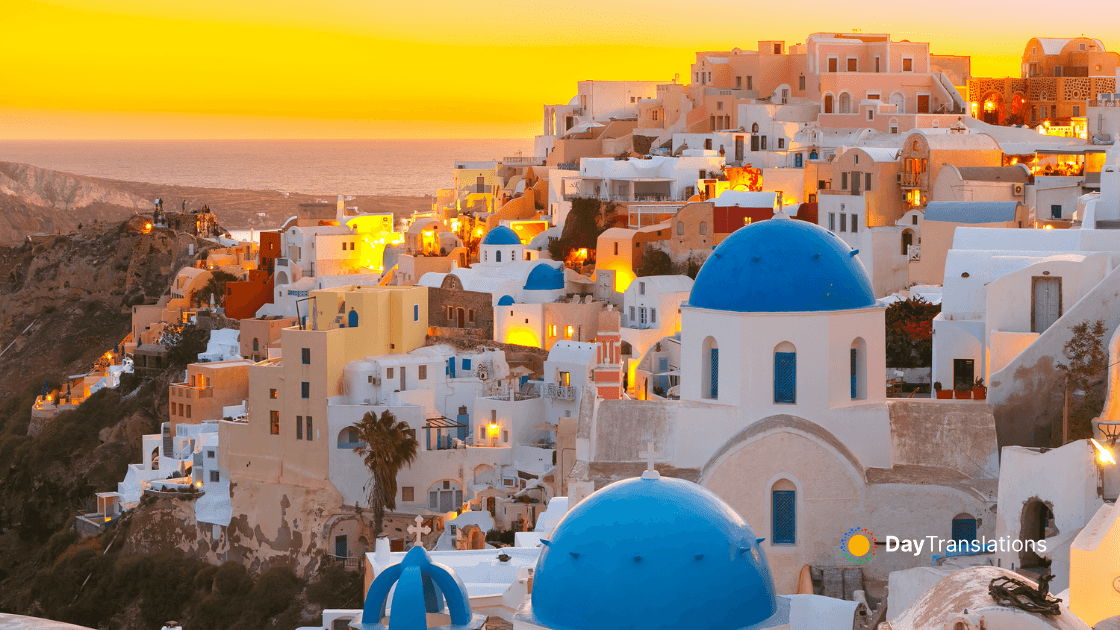
Greece or officially the Hellenic Republic is a country with a very colorful, classical and turbulent past. It is rich in cultural heritage, being one of the ancient civilizations that passed centuries of hardships and triumphs, of several achievements that shaped part of the new world and where great philosophers, the Olympic Games, architectural marvels and creative arts are still revered all over the world.
:: Background of Greece ::
Today’s Greece is very different from the ancient Greece. Greece today is vibrant, colorful, with more mobile phones that fixed lines, with cars zooming past on paved urban highways that were once, along time ago used to be dirt roads where animal-drawn carts and people used to travel. The rich history of Greece has to be known for one to really appreciate the inner beauty of a very mythical country.
Evidence clearly showed that humans were already living in Greece around 700,000 years ago during the Stone Age. This was proven by the discovery of a skull of a Neanderthal man on the Halkidiki peninsula in Macedonia in 1960.There were also tools and bone from the Paleolithic times, around 6500 B.C. unearthed in the Pindos Mountains. There were pots, vases and statuettes of the earth goddess, Mother Earth that was worshipped during the Neolithic age.
In this Country Profile
During the Bronze Age, the civilizations of the Cycladic, Minoan and Mycenaean begun when the processing of bronze was introduced by Indo-European migrants in ancient Greece. The Cycladic civilization from early 3000 B.C. to late 1100 B.C. brought about maritime trade links with neighboring countries because they were accomplished sailors. Their most impressive legacy was the statuettes carved from Parian marble of the Great Mother or earth goddess. They also made bronze and obsidian tools and weapon, gold jewelry as well as clay and stone pots, and vases that they sold to other countries.
The first advanced civilization in Europe, inspired by the Middle Eastern civilizations of Mesopotamia and Egypt was the Minoan civilization in Crete, which also existed during the Cycladic civilization, named after King Minos who was the mythical ruler of Crete during that period. This was the time when metalwork and pottery coming from Crete were the most beautiful and required great skill to produce. The civilization declined commercially and militarily due to the 1100 B.C. eruption of Thira, now called Santorini.
Though there was competition among the three civilizations, the Mycenean civilization in mainland Greece became more prominent when the Minoan civilization abruptly declined. While drawing inspiration from the Minoan civilization, the Mycenean society had a central ruler with independent city states. There existed Mycenae, Corinth, Tiryns and Pylos. Kings ruled and they lived in palaces erected on hilltops for easy defense against attacks.
The most impressive legacy the Mycenean civilization produced were the gold ornaments and jewelry, some of which are on display in the National Archeological Museum located in Athens. They also started an early form of Greek, called Linear B and worshipped a new set of gods that were the forerunner of the Greek deities. The Myceanean civilization was overrun by the Dorians in 12th century B.C.
The Dorians were ruthless and their 400 year-rule in Greece was part of the country’s dark age. However, they were also the ones that brought iron to Greece, introduced a new style of pottery with dramatic geometric designs and started the tradition of worshiping male gods, and adopted Apollo, Poseidon and Zeus from the Mycenean civilization, creating the way for the Greek pantheon.
After the Dorians settled down and had developed into land-holding aristocrats, autonomous regions were created, with an aristocratic rather than monarchic form of government. Most notable city-states were Athens, Argons, Sparta, Corinth, Elis and Thebes. The city-states contributed to the development of the Greek alphabet, the verses from Homer and the start of the Olympic Games, usually held in Delphi, which was a neutral meeting ground. This was the Middle Age of Greece.
The struggle between the rich and the poor already existed during that time. Solon, from Athens was appointed as arhon or chief magistrate around 594 B.C. His mandate was to defuse the rising tension between the rich and the poor. He cancelled all debts, freed those that were put in prison because of heavy debts and established four classes in their society based on their wealth. Only the first two classes were allowed to hold office but everyone were allowed to vote – reforms that were the precursor of democracy.
The Spartans were ruling Peloponnese differently. They were very strict and militarily-inclined. They made the original inhabitants of Laconia, the Helots as their slaves. They inspected every male child born and those that did not pass muster were left to die in the mountains and at age seven, young boys were taken from their families to start training as elite soldiers while the girls, although spared from training in the military were ordered to be fit and healthy to produce more sons. They were able to achieve stability in the areas they ruled and Sparta became a military power while Athens became powerful traders.
Emperor Darius of Persia was incensed by the support of Athens for the rebellion against Persians in Asia Minor that he vowed to destroy Athens. He died before he can fulfill his dream because his 25,000-strong army was defeated by a smaller army of 10,000 Athenians in what was known as the Battle of Marathon. His son Xerxes wanted to fulfill his father’s ambition and led a massive land and sea invasion in 480 B.C, with Delphi siding with the Persians. Sparta and Athens combined their army and navy forces to repel the attack with strategies provided by the tactician from Athens, Themistocles and King Leonidas of Sparta lead the army to guard the main passage into central Greece on Thermopylae (Lamia). They were outnumbered by the Persians but continued to hold on until a traitor showed the mountain passageway.
While the rest of the army was forced to retreat, King Leonidas and 300 of his elite troops fought to their death. When the Persians reached the inner city, Themistocles ordered an evacuation with the women and children sent to Samalis and the men joined the Athenian fleet. Persians burned Attica and Athens to the ground but their victory was not complete because the Greeks were able to trap the Persians ships. In the Battle of Plataea a year later, the Persian army was obliterated by the Greeks under the leadership of Spartan general Pausanias.
Peace reigned afterwards with the Spartans going back to Peloponnese and Athens founded the Delian League, which mandated that every state should have a navy no matter how small, to prevent further Persian attacks and liberate the other city-states still under Persian rule. The Delian League later became the Athenian empire, where each member state contributed ships annually. When Pericles was the leader of Athens in 461 B.C., the treasury was moved from Delos to the Acropolis. Sparing no expense he ordered the rebuilding of the Acropolis and linked Athens to the port of Piraeus. With fortification against future attacks, Athens began looking westward to expand which brought conflict against Sparta that was dominating the Peloponnesian League and eventually started the Peloponnesian Wars.
The first Peloponnesian war was between the Athens-backed Corcyra, now Corfu and Corinth, a wealthy state from which Sparta depended largely. Athens knew that Spartan army will be very strong so Athens blocked Peloponnese from the sea with its mighty navy. Both sides suffered badly and Pericles died in the plague, and a difficult truce was reached. The second Peloponnesian war broke in 413 B.C. when Sparta came to the aid of Syracuse. While the Spartans were able to destroy the Athenian fleet and army, Athens continued to fight for nine years until it was finally subdued by Sparta in 404 B.C. Sparta confiscated the Athenian navy, abolished the Delian League and removed the fortified walls between Piraeus and the city but spared Athens from destruction due to its role in saving Greece from the Persians.
Sparta began to rule Athens but its installation of oligarchs spurred widespread dissatisfaction. Getting more ambitious by wanting to reclaim the cities in Asia Minor from Persia, Athens sided with Persia and Thebes and brought the first defeat of Sparta. The strong rivalry between Thebes and Sparta waged on but Athens turned its back on Thebes and sided with Sparta. Although the battle in 362 B.C. was won by Thebes, its leader Epaminondas was killed and eventually led to the collapse of Theban strength and gave rise to the northern power in Macedon.
Macedon was regarded as a backwater place but it was slowly gaining strength and came to be a force to be reckoned with when King Philip II ascended to the throne in 359 B.C. Leading the Battle of Chaironeia in 338 B.C. they were able to defeat the armies of Athens and Thebes. The dream to conquer Persia was still there and that was the next target but a Macedonian noble assassinated King Philip and 336 B.C. and his son Alexander, who was 20 at that time, became the King. He became Alexander the Great, crushing rebellions against the Macedonian Empire by razing Thebes. He then led invasions into the Persian Empire, starting in 334 B.C. and by 333 B.C. was able to conquer Syria, Palestine and Egypt. He was made a pharaoh of Egypt and founded Alexandria. He and his army defeated Darius III, the King of Persia, continued east to conquer Uzbekistan, Balkh, a part of Afghanistan and the northern part of India.
Alexander the Great’s numerous battles took its toll on his army and he was forced to return to Mesopotamia in 324 B.C. and settled in Babylon where he died at the age of 33 from a sudden illness. As he was heirless, his army generals took advantage and each clamored to reign. The empire was divided into three and Ptolemy founded the Ptolemaic dynasty in Egypt where Cleopatra committed suicide in 30 BC; Antigonus ruled Asia Minor and Seleucus, founder of the Seleucid dynasty took over Persia and Syria. Macedonia lost the Greek city-states on the south and the Aetolian League in Delphi and the Achaean League from Peloponnese banded together, leaving Sparta and Athens independent.
While Alexander the Great was conquering the east, the Romans were expanding their holding in the west and started to conquer Greece, defeating Macedon in 168 B.C., the Achaean League in 146 B.C. and eventually Athens. Greece was under the Roman rule for the next 300 years, where peace reigned and the period called Pax Romana. Romans sent their children to schools in Athens to learn Greek art, literature and philosophy, which the Romans venerated long before they ruled Greece. They were also the first to call the Hellenes as Greeks.
While the Goths invaded Greece in AD 250, Christianity became the new religion in country due to the numerous visits of St. Paul where many were converted. Emperor Constantine I ruled in AD 324 and transferred the capital to Byzantium that was renamed Constantinople and now known as Istanbul. Rome was declining and Emperor Theodosius I made Christianity as the official religion in 394 AD. Several invasions by other Christians brought the demise of the Byzantine Empire. Some struck a deal with Venice and the Venetians became one of the most powerful and richest traders, having settled in Crete and controlled all the key ports.
The followers of Osman of the Turkish tribe Ottomans who ruled from 1289 to 1326 eliminated the Byzantine Empire and placed Greece, except the Ionian Islands under the Ottoman Empire. At its zenith under Sultan Suleyman the Magnificent, the empire was expanded through the Balkans, Hungary and almost conquered Vienna. Selim the Sot who succeeded Sultan Suleyman the Magnificent added Cyprus. Vienna continued to oppose the Turkish rule that subsequently weakened it. Catherine the Great, Empress of Russia tried to stir up rebellion in Peloponnese and Epiros but was crushed. She was eventually successful and removed the Turks by force from the coast of the Black Sea. Several towns were created and given Ancient Greek or Byzantine names and gave the Greeks financial incentives and free land to settle the region.
Notable was Odessa as this was where the first Greek Independence Party, the Filiki Eteria or the Friendly Party was born. It was founded in 1814 by Greek businessmen, namely Nikolaos Skoufas, Athanasios Tsakalof and Emmanuel Xanthos. This was the birth of the freedom fighters and was soon generously financed by the leaders in Odessa. Bishop Germanos of Patra hoisted the Greek flag at the monastery of Agia Lavra in Peloponnese which signaled the start of the War of Independence in 1821 and with the help of Russian troops, the Ottoman rule finally ceased with the Treaty of Adrianople in 1829.
The first president of the independent Greece was Ioannis Kapodistrias, a Corfiot who was the foreign minister of Tsar Alexander I of Russia. Nafplio, Peloponnese was the seat of the government. But the new president was too autocratic and the leaders of the War of Independence did not take this lightly and he was assassinated in 1831, four years after his election.
Britain, France and Russia decided that Greece should be a monarchy and chose a non-Greek, Prince Otto of Bavaria, who was only 17 at that time to be the head of Greece. Through the London Convention of 1832 the kingdom consisted of Peloponnese, the Cyclades, Sporades and Sterea Ellada. The seat of the government was transferred to Athens in 1834. King Otto was as autocratic as Kapodistrias and gave his cronies juicy government positions. The War of Independence leaders called for a constitution in 1834 and a parliamentary government with a senate and a lower house was put in place. Members of the War of Independence replaced the positions occupied by the cronies of Otto. Otto was deposed in 1862 and placed by Prince William of Denmark who later became King George I and ruled for 50 years. In 1864, Greece was under democratic rule. Amidst some pockets of uprising, King George I stabilized Greece.
The staging of the first Olympic Games in Athens in 1896 signaled the birth of the new Greece. There were still power struggle between neighboring countries in modern Greece, some of which were successfully prevented by the intervention of more powerful allied nations. The outbreak of the Balkan wars in 1912 and 1913 resulted in the Treaty of Bucharest and expanded the Greek territory to include the southern part of Macedonia, the Northeastern Aegean Islands, part of Epiros and part of Thrace. The treaty also recognized the union of Crete with Greece.
King Constantine, son of King George I who was assassinated by a lunatic in 1913 was married to the sister of a German emperor who demanded that Greece remained neutral during WWI. There was pressure from the allied forces of Britain, France and Russia, causing friction between the King and Prime Minister Vanizelos who favored the Allies. The king left Greece in 1917 and was replaced by his second-born son, Alexander.
Territorial disputes with Turkey continued and the Treaty of Lausanne in 1923 settled some of the issues over land holdings as well as paved the way for the exchange of population between the two nations with 400, 000 Turks leaving Greece and 1.5 million Greeks went back home, exchanging the affluent life they had in Asia Minor to a life of poverty, straining the Greek economy.
King Alexander died from a monkey bite in 1920 and his father Constantine was reinstated but abdicated once again when Smyrna fell. His first-born son George II became king but was no match for the might of the coup led by army officers. Stability was regained when Vanizelos returned to power but the Great Depression curtailed it. Vanizelos supported the anti-royal Liberal Party but the Popular Party, which was pro-monarchy, was stronger. King George II was restored to power by a rigged plebiscite and General Ioannis Metaxas, who was actually a dictator, became prime minister. He later created a Greek version of the Third Reich.
He denied Mussolini’s request to allow the Italians to pass through Greece during WWII and also denied the British request to land troops in Greece to prevent Hitler’s plan to invade the Soviet Union. Metaxas suddenly died in 1941. His replacement was Alexandros Koryzis, a timid person who agreed to the British request. The Allied forces from Greece, Britain, New Zealand and Australia were outnumbered and Greece fell into the hands of the Nazis. Koryzis committed suicide in 1941 when the Germans invaded Greece. Resistance movements continued until the Germans left the country in 1944.
Civil war ensued among the resistance movements until the British intervened once again and another rigged plebiscite reinstated King George II to the throne. The US became the minder of Greece by 1947 and the civil war turned into the beginning of the Cold War as communism was declared illegal and the Greek government introduced the Certificate of Political Reliability which was used by Greeks to find work and exercise their right to vote.
The left-wing Democratic Army of Greece or DSE continued to gain support, funded by Yugoslavia, Bulgaria and the Soviets via the Balkan states and were able to gain a huge chunk of the Greek mainland in 1947. They were not able to get the major towns, though. The continuous in-fighting killed more people than the casualties the country suffered during the three years of WWII and about 250,000 Greeks became homeless by 1949.This led to the mass exodus of Greeks, compelling them to seek a better life in the USA, in Australia and in Canada. Many headed to New York and Chicago in the US and to Melbourne in Australia.
After its tumultuous past, Greece is now a unitary parliamentary republic. President Karolos Papoulias is the current head of state and Giorgos Papandreou MP is the prime minister. Greece enjoys the privileges of the modern world, with a rising standard of living – cars, houses, modern infrastructures, telecommunication facilities, credit cards, tourism and commerce.
:: Geography of Greece ::
Location
Greece is considered as a southern European country, and is located in the southernmost section of the Balkan Peninsula. It is positioned in the eastern and northern hemispheres. Geographic coordinates are 39° 00’ North of the Equator and 22° 00’ East of the Equator.
Area
The total land area of Greece is 131. 957 square kilometers, divided into 130, 647 square kilometers of land and 1,310 square kilometers of water. Its total land area is comparatively smaller than the state of Alabama in the United States.
Land Boundaries
Greece is bordered for a total of 1,228 kilometers of several countries and seas. On the north it is bordered by Albania for 282 km, Bulgaria for 494 km and by The Former Yugoslav Republic of Macedonia for 246 kilometers. Its south and west parts are surrounded by the Mediterranean Sea; by the Libyan Sea to the south and the Ionian Sea to the west. The east is bordered by Turkey for 206 km and the Aegean Sea.
Coastline
The Greek Islands form a semi-circular shape so that many of the islands are facing the sea, making for quite a long coastline. The total coastline of Greece, is recorded at 13,676 kilometers, although some sources say that the Greek coastline is 15,147 kilometers long, and is one of the world’s longest coastlines.
Maritime Claims
Greece has a territorial sea claim of 12 nautical miles and a continental shelf of 200 meters deep or to the depth of exploitation. Greece has not claimed an exclusive economic and contiguous zone, although it is entitled to do so under the international law of the sea and the UNCLOS 1982.
Climate
Greece has a temperate climate but divided into two climatic regions. The central and eastern Peloponnese, the Cyclades, Dodecanese, Crete and the Attica Peninsula have dry and hot summers and mild winters that are typical of a Mediterranean climate. Northern Epiros and northern Macedonia experience a climate that prevails in the Balkans, characterized by extremely hot but humid summers and freezing winter months. Snow falls in the mountains but not the majority of the lowlands. Very strong northerly wind called the meltemi blows on the eastern coast of the Greek Mainland, including the Aegean Islands, Athens and the Cyclades in July all through August. The western parts of Peloponnese and Sterea Ellada as well as the southwestern Epiros and the Ionian Islands have the highest rainfall among all the Greek Islands. Crete has a longer summer while the Northeastern Aegean Islands, the Pelion Peninsula and the Halkidiki have a combination of Balkan and Mediterranean climate. Rain normally falls during the cooler months, from October to February, so the winters are cold and wet with periods of blue skies and sunshine.
Terrain
Greece is comprised of more than 1,400 islands. The terrain is mostly mountainous in the interior with several mountain ranges and coastal plains that extend to the sea as peninsulas and chains of smaller islands.
Elevation Extremes
The lowest point on all of Greece is the Mediterranean Sea at zero meters while the highest point is Mount Olympus, which is located in Thessaloniki, near the border between Thessaly and Macedonia. Mount Olympus has 52 peaks with the highest Mytikas having an elevation of 2,917 meters and considered as one of the highest peaks in Europe. Mount Olympus, according to Greek mythology is the residence of the twelve most important gods and goddesses, earning them the right to be called Olympians and where Zeus ruled.
Natural Resources
Greece has very few natural resources that can be considered economically valuable as only 23% of the land is arable and the mountains are mostly barren. Small quantities of black coal and low-quality lignite can be found. Under the Aegean Sea though are rich deposits of natural gas and petroleum. There is also significant amount of bauxite and iron, and smaller amounts of chromium, copper, nickel, magnesium and uranium, lead, marble, salt and zinc. Although almost surrounded by the sea, there are only a few species of fish that are abundant. The country also has cotton, grapes, pistachios, olives, sugar beets, wheat and tobacco.
Land Use
From the 2008 World Bank indicators statistical figures, the total arable land in Greece is only 19.8% with 8.8% of land area planted with permanent crops. Forest areas cover 29.6% and pastures and mixed farmland, forests and woodland shrubs, grassland, open spaces with little or no vegetation water bodies cover 41.8%.
Natural Hazards
Greece is almost surrounded by water on all sides and its terrain is mountainous and there are several active volcanoes in the island, formed by the sinking of the African lithosphere. As such, Greece is prone to severe earthquakes, droughts and wildfires. Historically there are seven volcanoes in Greece, formed in a semi-circular pattern and part of the Hellenic Arc. Santorini is deemed as the ‘decade volcano” which last erupted in 1950. While some of the volcanoes have remained quiet for several centuries, Methana and Nisyros in the Aegean are still classified as active volcanoes and have formed tourist attractions. Santorini and Milos are very famous. The Santorini caldera is the largest in the world and the Fyriplakes in Milos, Nisyros and Methana are also outstanding.
Environment Issues
Current environmental issues seriously affecting Greece are air pollution and water pollution.
Environment: International Agreements
Greece is party to: Air Pollution, Air Pollution-Nitrogen Oxides, Air Pollution-Sulfur 94, Antarctic-Environmental Protocol, Antarctic-Marine Living Resources, Antarctic Treaty, Biodiversity, Climate Change, Climate Change-Kyoto Protocol, Desertification, Endangered Species, Environmental Modification, Hazardous Wastes, Law of the Sea, Marine Dumping, Ozone Layer Protection, Ship Pollution, Tropical Timber 83, Tropical Timber 94 and Wetlands agreements.
Signed but not yet ratified are agreements on Air Pollution-Persistent Organic Pollutants and Air Pollution-Volatile Organic Compounds.
:: People of Greece ::
Population of Greece for 2011 is estimated to be 11.305,118. Annual population growth rate, according to 2011 estimate is 0.083%, with birth rate estimated to be 9.21 births/1,000 population and death rate, also according to 2011 estimate is put down at 10.7 deaths /1,000 population.
Age Structure
0 – 14 years 14.2% (male 787,143 / female 741,356)
15 – 64 years 66.2% (male 3,555,447 / female 3,567,383)
65 years and over 19.6% (male 923,177 / female 1,185,630) (2011 est.)
Median Age
Total 42.5 years
Male 41.4 years
Female 43.6 years (2011 est.)
Net Migration Rate
2011 estimate put migration rate at 2.32 migrants / 1,000 population. As of 2010 the urban population in Greece is 61% of the total population with an annual rate of change of 0.6%, according to 2010 to 2015 estimates.
Sex Ratio
Average sex ration at birth is 1.064 males per female born. Under 15 years of age the ratio is 1.06 male for every female. There are 0.78 male for every female age 65 years and over and for the total population, the sex ratio is 0.96 male for every female, based on 2011 estimate.
Infant Mortality Rate
Total infant mortality rate figures list 5 deaths for every 1,000 live births, with 5.49 deaths for males and 4.48 deaths for females, according to estimates for 2011.
Life Expectancy at Birth
The average life expectancy of the total population of Greece is 79.92 years. The females outlive the men, with the females averaging 82.65 years according to 2011 estimates, while the males only average 77.36 years. Also according to 2011 estimates, the total fertility rate figure shows that 1.38 children are born for every woman of child-bearing age in Greece.
HIV / AIDS
Like other countries, there are incidences of HIV / AIDS cases in Greece. Although the 2009 estimate places the prevalence of this dreaded disease at 0.1%, there are already 8,800 cases of people, adults and children age 15 and above who are already living with HIV / AIDS in Greece. Death due to HIV/ AIDS in Greece is less than 500.
Nationality
Greek (s) (noun); Greek (Adjective)
Ethnic Groups
Greeks dominate at 93%. Other groups, including foreign citizens constitute 7%, based on the 2001 census.
Special Note: Percents represent citizenship, since Greece does not collect data on ethnicity.
Religions
Ninety-eight percent of Greeks follow the Greek Orthodox religion with about 1.3% Muslims and 0.7% following other religions.
Languages
Majority of the people or 99% of the population in Greece speak the official Greek language while the other 1% speaks English and French.
Literacy
Of the total population, 96% are literate, with those aged 15 and above being able to read and write. Males or 97.8% of the population edge the women in literacy slightly. The 2oo1 census figure showed that literacy rate among Greek women is 94.2%. Greeks spend a total of 17 years for primary to tertiary education, with the males spending about an average of 16 years, while the women spend an average of 17 years, according to 2007 data.
:: References ::
https://www.cia.gov/library/publications/the-world-factbook/geos/gr.html
http://gogreece.about.com/cs/practicalinfo/a/fastfactsgreece.htm
http://www.lonelyplanet.com/greece
http://www.state.gov/r/pa/ei/bgn/3395.htm
http://www.greeklandscapes.com/travel/location.html
http://www.nationsencyclopedia.com/economies/Europe/Greece.html
http://en.wikipedia.org/wiki/Geography_of_Greece#Maritime_claims
http://alexandros.com/Greece/info.html
http://hivinsite.ucsf.edu/global?page=cr10-gr-00&post=19&cid=GR
Geography of Greece: Important Geographical Information about Greece
In this Country Profile
The Greek landscape is peppered with mountains and in fact, Greece is one of Europe’s most mountainous countries. The Pindus mountain range which divides the country in a northwest to southeast direction extends further across Peloponnesus and under the Aegean Sea to form many of the Aegean Islands as well as Crete. It joins the Taurus Mountains in southern Turkey. The central and western parts of Greece are characterized by several steep peaks, canyons and karst topography. The Vikos Gorges in the Pindus Mountains, on the southern slopes on Mount Tymfi is listed in the Guinness Book of World Records as the deepest gorge in the world. It is about 20 kilometers long, with a range of 450 meters to 1,600 meters in depth. Its width varies from 400 meters to only a few meters at its most narrow parts. Vikos Gorge is third deepest gorge after the Copper Canyon in Mexico and the Grand Canyon in the United States, with some parts plunging vertically to more than 1,100 meters deep. Thick forests cover some of the mountains. There are plains in Thrace, Thessaly and central Macedonia while lakes and wetlands can be found in Western Greece.
Greece lies on the southern tip of the Balkan peninsula and comprise smaller islands and peninsulas on the northeast part of the Mediterranean Sea. Only 170 of the more than 2,000 islands of Greece are inhabited.
There are nine different geographic regions in Greece. The difference lies in topography and regional tradition. Six regions are in the mainland comprising Thrace, Epirus and Macedonia in the north and the south by Central Greece, Peloponnesus and Thessaly. The island regions are in Crete, the Aegean Islands and the Ionian Islands. For administrative and electoral purposes, these regions are further subdivided into a total of 51 prefectures.
:: Greece’s Regions ::
Thrace
The Greek portion of Thrace is called the Western Thrace. Its eastern border with Turkey is the Evros River, while the Nestos River defines the western border between Thrace and Macedonia. There are no major rivers flowing through Thrace except for those in the borders. A huge portion of the northern part of Thrace is occupied by the southern tier of the Rhodopes Mountains with the Thracian Plain running along the shore of the Aegean Sea and the Maritsa Valley. Plateaus cut the plain into three parts and the part that is on the easternmost section is very suited for agriculture due to the abundant water supply from the Evros River and the fertile soil of the Maritsa Valley. The soil in Rodopi and Xanthi are favorable to tobacco farming. Lake Vistonis, a bay of the Aegean Sea located between Xanthi and Rodopi is a source of commercially important species of fish. The statue of the Winged Victory of Samothrace, a marble statue of the Greek goddess Nike which is on permanent display at the Louvre Museum in Paris was discovered in this region. This is also the only region where the Muslims were allowed to remain during the 1923 Treaty of Lausanne. The Muslim population is currently concentrated in Rodopi and Xanthi.
Macedonia
Greek Macedonia is to the west of Thrace and is the largest region of Greece with 13 prefectures and an autonomous area, the Monastic Republic of Mount Athos. The Greek Macedonia extends westward to the Albanian border from the Nestos River while the south is bordered by the Aegean coastline and the north is bordered by mountain ranges from the former Yugoslavia and Bulgaria. Macedonia has an agricultural center formed by the Plain of Drama in the far east and the valleys formed by the Vardar and Struma rivers. The second largest city and port in Greece, Thessaloniki is located between the mouth of the Vardar River and the Chalkidiki Peninsula. It is an important Greek port, second only to Piraeus in Athens.
Thessaloniki was the recipient of the epistles of Saint Paul and the Thessalonians form the two books of the New Testament. It is also the center of study of ancient architecture where Hellenistic and Byzantine church buildings can still be found.
Epirus
Epirus has been traditionally isolated since ancient times, being separated by the Pindus mountain range. There are no major river basins or valleys in Epirus and the steep ridges of the mountain range rendered the region only suitable for pasture. Grains are grown in the northern plains. Population is sparse and most of the inhabitants engage in animal husbandry. Corn is the chief crop in Epirus although oranges and olives are grown in the western lowlands. Tobacco is grown in the main city, Ioannina. The Egnatia highway now links Ioannina to Macedonia and the Aktio-Preveza Undersea Tunnel linking the southernmost of Epirus to western Greece reduced the region’s isolation. There are ferry services to Italy and the Ionian Islands. Two national airports provide airline services in Epirus, one in Ioannina and another one in Aetolia-Acarnania south of Preveza but the region does not have a railroad system.
Thessaly
Thessaly occupies the Pindus watershed on the east side. The region has several river valleys and river basins, formed by the southwest and northeast spurs of the Pindus mountain range including Mount Olympus while the easternmost end of the spur extends southward to the Aegean coast, ending at the Magnesia Peninsula that surrounds the Pagasetic Gulf. Thessaly has one major river, the Pineios. Thessaly is sometimes referred to as the breadbasket of Greece because of the fertile plains of Trikala and Larissa that benefit from the summer rains.
Central Greece
Central Greece is located south of Thessaly and Epirus and includes the island of Euboea. Central Greece is separated from the mainland by a narrow waterway at the city of Chalkis just north of Athens. It is the second largest island in Greece, formed by the extension of the Pindus spur. Fertile valleys in Euboea are planted with olives, grapes and different grains. The east coast that faces the Aegean Sea is rocky. Central Greece has two harbors, the Vorios Evvoikos and Petalion gulfs. Mount Parnassus, the mythical home of the Muses can be found in Central Greece’s southern shore. Two major rivers flow into Central Greece, the Kifisos that empties into the Vorios Evvoikos Gulf and the Acheloos River that empties into the Ionian Sea. These two rivers form a very fertile plain where grapes, olives and tobacco are grown.
Peloponnesus
Peloponnesus is another mountainous landmass in mainland Greece that is connected to Attica by an isthmus that is only about six kilometers wide at some parts. It is also cut by the Corinth Canal that was completed in 1893, allowing sea vessels to move between the Ionian and Aegean sea, passing the gulfs of Patras and Corinth, which shortened the voyage to Peloponnesus by 325 kilometers. Peloponnesus has fertile inland river valleys and mountain basins fed by springs, although the plains still require irrigation because the rivers dry up during the summer months. Sparta in located several kilometers inland near the Evrotas River, while Corinth, the origin of the word currant because Corinth was once a major exporter of the crop is currently just a small city that is relatively unimportant. The largest city and one of the two major ports is Patras located on the northeast. The southwest port is located in Kalamai.
Ionian Islands
The Ionian Islands comprise many uninhabited rocks, islets and the islands of Corfu, Leucas, Cephalonia and Zacynthus. Kefallinia or Cephalonia is the largest island, mountainous and rocky, where olives and currants are grown just like in its closest neighbor, Ithaca. Ithaca was where Odysseus, from the legend of Homer, returned after the Trojan War. Corfu or Kerkira lies off the coast of the Albanian side of Epirus and the Greek Epirus and is the northernmost of the four major islands. Its fertile lowland is planted with figs, olives, grapes and citrus fruits. Currants are the main crop of the very fertile Zakinthos (Zacynthus), the third largest island. Lefkada or Leucas is the smallest island with hilly inland terrain and with valleys and forests closer to the east coast. Leucas produces olive oil, red wine and currants as its main crops.
Aegean Islands
The islands are geological extension of the mountains from the Greek mainland that once formed a land bridge to Asia Minor. The Cyclades is a group of 24 islands clustered closer together southeast of Peloponnesus. Most of these are very rocky and dry and not suitable for agriculture, except Naxos and Syros where the provincial capital of Ermoupolis is located have adequate fertile land for vegetables and fruits. The island of Delos or Dilos is uninhabited although according to legend, this is the mythical birthplace of Apollo, attracting tourists and archeologists.
The Dodecanese Islands comprise 14 inhabited and 18 uninhabited islands. The largest of these islands are Rodos (Rhodes) and Kos. The inland valleys and coastal plains of Rodos are rich enough for grains and pasturage. The other islands have very poor drainage and have been deforested. Rhodes was once part of the ancient Minoan civilization and this is where a bronze statue of Helios, the sun god was erected at the harbor entrance to the city. Main produce of Rhodes are fruits, grains and wine. The island of Cos on the other hand has fertile lowland planted with tobacco, fruits, vegetables and olive trees.
North of the Dodecanese group are the islands of Samos, Ikaria and the island group of Fournoi. Samos is very fertile and its main crops are grapes and olives. The south and east parts of the island of Chios are fertile enough for grapes and other fruits. The well-irrigated foothills and lowlands of Lesbos, the third largest island produce olives while Lemnos is only suitable for goat and sheep rising while Ikaria and Fournoi have infertile lands.
Crete
Crete, technically part of the Aegean Islands is administered separately. It is the largest island in Greece and the fifth largest in the Mediterranean. It has many rugged mountains rising from the sea, forming a rocky coastline on the south while the mountain slopes on the north formed natural harbors and fertile plains. Rising from almost the center of Crete is Mount Ida, which is 1,456 meters high. The mountains break part of Crete into four segments, with the Mesara Plain as the major flatland, suitable for agriculture. Crete has one fresh-water lake and six rivers.
Crete once produced copper, lead, zinc and iron but now only yields limestone and gypsum. Twenty percent of the total land area of Crete is unproductive while 48% can only be used for grazing. Some parts are suitable for agriculture, yielding major crops such as citrus fruits, carob, almonds, grapes and olives. Crete’s capital is Heraklion which is an important port and tourist attraction. Other smaller cities include Chania, Agios Nikolaos, Lasithi and Rethymno.
:: References ::
http://en.wikipedia.org/wiki/Geography_of_Greece
http://en.wikipedia.org/wiki/Vikos_Gorge
http://wiki.phantis.com/index.php/Greece
Professional Translation Organizations & Associations in Greece
In this Country Profile
Below is a list of the major translation organizations and associations of Greece.
:: List of Organizations ::
Aristotle University of Thessaloniki
Centre for English Language and Training
Hellenic Association of Translation Companies
Hellenic Association of Translators – Interpreters in the Public Sector
Hellenic Society of Translators of Literature
Ionian University, Department of Foreign Languages, Translation & Interpreting
Metafrasi School of Translation Studies
National and Capodistrian University of Athens
Panhellenic Association of Professional Translators
Panhellenic Association of Translators
Information about the Greek Flag: Colors and Meaning of the Flag of Greece
In this Country Profile
:: Meaning of the Greece Flag ::
The flag of Greece has undergone several changes. Its pattern and colors have continued to evolve since the 1821, during the Revolution of the Hellenic Nation. The current flag is blue and white in color, with nine alternating blue and white horizontal stripes, starting and ending in blue.
There are many schools of thought on what the meaning of the stripes on the Greek flag represents. Some say that the stripes coincide with the nine syllables of Liberty or Death, which in Greek is Eleftheria i Thanatos, the five blue stripes for Eleftheria and the four white stripes for i Thanatos. This is the motto when the Greeks were fighting the Ottoman Empire in the 19th century. On the other hand some say that the 9 stripes represent the number of letters in Eleftheria, which means freedom.
It is said that the motto inspired the Greeks to finally fight 400 years of slavery and start what was called the Hellenic Revolution. And the stripes were chosen because they resemble the waves of the sea surrounding Greece and when flying, the alternate blue and white stripes look like the surface of the Aegean Pelagos (Aegean Sea) on a windy day.
There is a blue canton on the hoisting side of the Greek flag where the Hellenic Square Cross rests. This is a symbol of the respect and devotion for the Greek Orthodox Church. It also signifies the role that Christianity has in forming the modern Greek nation. It was the Church that helped the slaves to retain their Hellenic language, their ethnic identity, the Byzantine religion and the institution of the secret schools they called Crypha Scholia, that were operated all over Greece in secret to teach the Hellenic heritage passed down by their ancestors. And until today Christianity is still the major religion in Greece.
Different meanings are attached to the blue and white colors of the Greek flag. Some say that the blue looks like the Hellenic sea and the white represents the top of the restless waves. Some attach mythical meanings to the colors, saying that Aphrodite, the Goddess of love and beauty emerged from the waves of the Hellenic Sea. Some say that the blue represents the blue of the Greek sky and the white clouds, while others maintain that the blue and white are similar to the colors of the uniform or vrakes of the Greek sailors while the War of Independence was still waging.
:: Reference ::
http://alexandros.com/grflag.html
Extensive List of Languages of Greece: Spoken and Extinct Languages
In this Country Profile
:: List of Languages ::
Albanian, Arvanitika
[aat] 50,000. Ethnic population: 150,000. Attica (Attiki), Boeotia (Viotia), south Euboea (Evia), and Salamis island (Salamina); Thrace; Peloponiso Peninsula, Arkadia; Athens; northwest Peloponnese and other areas in the Peloponnese; Andros north. Mainly rural. 300 villages. Alternate names: Arberichte, Arvanitic, Arvanitika. Dialects: Thracean Arvanitika, Northwestern Arvanitika, South Central Arvanitika. Partially intelligible with Albanian Tosk [als]. Dialects perceived as mutually unintelligible. Classification: Indo-European, Albanian, Tosk
Albanian, Tosk
[als] 10,000 in Greece (2002 N. Nicholas). Epyrus region, village of Lehovo. Alternate names: Arvanitika, Camerija. Classification: Indo-European, Albanian, Tosk
Aromanian
[rup] 50,000 in Greece (Salminen 1993). Population total all countries: 123,300. Ethnic population: 700,000 in Greece (Association of French Aromanians). North, Northwest Salonika, Pindus Mountains, Trikala area. Also in Albania, Bosnia and Herzegovina, Bulgaria, Macedonia, Romania, Serbia. Alternate names: Armina, Arumanian, Macedo Romanian, Macedo-Rumanian, Vlach. Dialects: Structurally a distinct language from Mengleno Romanian [ruq] (F. Agard). It split from the other 3 Rumanian languages between 500 and 1000 A.D. Many dialects. Classification: Indo-European, Italic, Romance, Eastern
Bulgarian
[bul] 30,000 in Greece (1998 Greek Helsinki Monitor). Western Thrace, 3 departments, including Xanthi. Dialects: Pomak (Pomakci, Pomakika). Classification: Indo-European, Slavic, South, Eastern
Cappadocian Greek
[cpg] Extinct. Dialects: Sille, Western Cappadocian, Pharasa. Similar to Pontic [pnt]. Even more distinct from Standard Greek [ell] than Pontic [pnt]. Classification: Indo-European, Greek, Attic
Greek
[ell] 10,700,000 in Greece (2002 census). Population total all countries: 13,084,490. Widespread, especially in Greek Macedonia. Also in Albania, Armenia, Australia, Austria, Bahamas, Bulgaria, Canada, Congo, Cyprus, Czech Republic, Democratic Republic of the Congo, Djibouti, Egypt, France, Georgia, Germany, Hungary, Italy, Jordan, Kazakhstan, Libya, Macedonia, Malawi, Mozambique, Paraguay, Poland, Romania, Russian Federation (Europe), Sierra Leone, South Africa, Sweden, Tunisia, Turkey (Europe), Ukraine, United Arab Emirates, United Kingdom, United States. Alternate names: Ellinika, Graecae, Grec, Greco, Neo-Hellenic, Romaic. Dialects: Katharevousa, Dimotiki, Saracatsan. Katharevousa is an archaic literary dialect, Dimotiki is the spoken literary dialect and now the official dialect. The Saracatsan are nomadic shepherds of northern Greece. The Greek of Italy and that of Corsica are probably separate languages (1992 R. Zamponi). In Cyprus, the dialect is reportedly more similar to Classical Greek [grc] in some vocabulary and grammar than that spoken in Greece, and to have many Arabic and Turkish [tur] loanwords. Lexical similarity: 84%–93% with Greek in Cyprus. Classification: Indo-European, Greek, Attic
Greek Sign Language
[gss] 42,600 (VanCleve 1986). Classification: Deaf sign language
Greek, Ancient
[grc] Extinct. Dialects: Koine Greek, Classical Greek. Classification: Indo-European, Greek, Attic
Pontic
[pnt] 200,000 in Greece (Johnstone and Mandryk 2001). Population total all countries: 324,540. Throughout Macedonia, especially Salonica, a borough of Kalamaria. Also in Azerbaijan, Canada, Georgia, Kazakhstan, Russian Federation (Europe), Turkey (Europe), United States. Alternate names: Pontic Greek. Dialects: Standard Greek [ell] speakers cannot understand Pontic, and Pontic speakers reportedly do not understand or speak Standard Greek [ell]. Pontic clubs and centers exist in the Athens-Peiraeus suburbs. Classification: Indo-European, Greek, Attic
Romani, Balkan
[rmn] 40,000 in Greece (1996 B. Igla). 10,000 Arlija, 30,000 Greek Romani. Athens, Agia Varvara suburb, about 500 families. Dialects: Greek Romani, Arlija (Erli). Classification: Indo-European, Indo-Iranian, Indo-Aryan, Central zone, Romani, Balkan
Romani, Vlax
[rmy] 1,000 in Greece. Alternate names: Romanés, Tsingani. Dialects: Lovari. Classification: Indo-European, Indo-Iranian, Indo-Aryan, Central zone, Romani, Vlax
Romanian, Megleno
[ruq] 3,000 in Greece (2002 N. Nicholas). Population total all countries: 5,000. Kilkis Prefecture, Meglen region, north of Salonika. Also in Macedonia. Alternate names: Meglenite, Meglenitic. Dialects: Structurally a distinct language from Romanian [rom], Aromanian [rup], and Istro Romanian [ruo](F. Agard). Classification: Indo-European, Italic, Romance, Eastern
Romano-Greek
[rge] 30 (2000). Alternate names: Hellenoromani. Dialects: Structured on Greek [ell] with heavy Romani lexicon. Classification: Mixed language, Greek-Romani Nearly extinct.
Slavic
[mkd] 250,000 in Greece (2007 Boskov). Macedonia region, Florina, north Kastoria and Thessalonica prefectures. Alternate names: Macedonian, Macedonian Slavic. Classification: Indo-European, Slavic, South, Eastern
Tsakonian
[tsd] 1,200 (1981 J. Werner). 300 are shepherds. Kastanitsa, Sitena, Prastos, Leonidi, Pramatefti, Sapounakeika, Tyros, Melana towns, possibly Korakovunio; Peloponnesos east coast. Isolated in summer in east Peloponnesus in mountains west of Leonidi; in winter Leonidi town area. Alternate names: Tsakonia. Dialects: Northern Tsakonian (Kastanista-Sitena), Southern Tsakonian (Leonidio-Prastos), Propontis Tsakonian (Vatka-Havoutsi). Derived from the Doric dialect spoken in Lakonia by ancient Spartans. Northern and Southern are reportedly mutually intelligible, but Propontis was more distinct, and more similar to Standard Greek. Not inherently intelligible with modern Greek (Voegelin and Voegelin 1977). Lexical similarity: 70% or less with Standard Greek [ell]. Classification: Indo-European, Greek, Doric
Turkish
[tur] 128,000 in Greece (1976 WA). Thrace and Aegean regions. Alternate names: Osmanli. Classification: Altaic, Turkic, Southern, Turkish
:: Reference ::
Gordon, Raymond G., Jr. (ed.), 2005. Ethnologue: Languages of the World, Fifteenth edition. Dallas, Tex.: SIL International. Online version: http://www.ethnologue.com/
Famous Greek People: Greek Artists, Scientists, Leaders, Musicians, Politicians and Athletes
In this Country Profile
The following people made their mark on both the local and international scenes. They are just some of many famous Greeks who have lifted Greece’s name worldwide and made a difference in our world. Their purpose and stories inspired awe if not greatness.
:: List of Famous People from Greece ::
Thespis
Thespis is from ancient Greece, born in Icaria which is now known as Dionysos. According to Aristotle, he was the first one to appear as an actor on stage, playing a character instead of speaking as himself. Thespis was a singer of dithyrambs, songs based on mythology that have refrains sung by a chorus. Thespis introduced, according to records, a new style of performing different characters in a story by wearing different masks, paving the way for a new style of play called tragedy. Accordingly, Thespis, the first known actor in written plays, also paved the way for the invention of the theater and touring groups and is accorded the accolade for his contribution by referring to new world actors as thespians.
Criss Angel
He is famous for being an illusionist, hypnotist, stunt performer and an escapologist. He is also an actor, musician and songwriter. Popularly known as Criss Angel, his real name is Christopher Nicholas Sarantakos. Although born in New York, he is of Greek-American descent. His father was John Sarantakos and his mother’s name is Dimitra. He has two older brothers, Costa and JD and his father has a restaurant and doughnut shop in East Meadow, Long Island in New York. He became popular for his TV show, Criss Angel Mindfreak and his collaboration with world-renown Cirque du Soleil for a live illusion show at the Luxor Casino in Las Vegas, Nevada called Criss Angel Believe.
Hank Azaria
Henry Albert Azaria, shortened to Hank Azaria does film stage and TV shows. He is also a director and very good at comedy. He’s a very talented voice actor and is voicing several characters in the animated series The Simpsons. He was hilarious in the 1996 film The Birdcage with Robin Williams. Hank was born in Queens, New York but his parents are Sephardic Jewish who hailed from Thessaloni, Greece. His mother was a publicist for Columbia Pictures, assigned to promote films to the Latin American countries before she married Hank’s father, Albert who had many dress-manufacturing operations. Hank Azaria was once married to Helen Hunt.
George Chakiris
George Chakiris, born in Norwood, Ohio is the son of Greek immigrants, Steven Chakiris and Zoe Anastasiadou. He is a dancer, actor and singer and has appeared as a dancer or singer in Song of Love, Gentlemen Prefer Blondes, White Christmas, Flower Druim Song and Brigadoon. He won an Academy Award for Best Supporting Actor as Bernardo in the film version of West Side Story in 1961. George Chakiris has appeared in many films together with very well known stars during his time such as Charlston Hesston, Yvette Mimieux and Gene Kelly. During the 70s and 80s, Charikis has recurring roles in prime time TV and daytime soaps such as Wonder Woman, Murder She Wrote, Medical Center, Hawaii Five-O and Santa Barbara as well as in Superboy during its first and second season in late 1988 up to 1990. He was also a guest at the final episode of The Partridge Family as the old suitor of Shirley Partridge (Shirley Jones). George Chakiris was last seen in an episode of Last of the Summer Wine but has basically retired and turned his hobby of making sterling silver jewelry into a business.
Olympia Dukakis
Olympia Dukakis was born in Massachusetts in 1931. Her parents were Greek immigrants. Constantine S. Dukakis was from Anatolia and her mother Alexandra Christos was from Peloponnese. The former governor of Massachusetts, Michael Dukakis is Olympia’s cousin. Her brother’s name is Apollo.
She appeared in a host of movies, notable of which are Steel Magnolias, Joan of Arc, More Tales of the City, Moonstruck. Mr. Holland’s Opus and Search for Tomorrow. She had won an Academy Award, BAFTA and a Golden Globe Award Moonstruck and had received several Golden Globe and Emmy nominations.
Olympia Dukakis has three children with actor Louis Zorich whom she married in 1962.
Melina Kanakaredes
Her full name is Melina Eleni Kanakaredes Constantinides. She was born in Akron, Ohio to Constance Temo who was a candy company owner and Harry Kanakaredes, a Greek –American insurance salesman. Her maternal grandfather, Christ Temo established their chocolate store. Melina is fluent in Greek. She is best known for her portrayal of Detective Stella Bonasera in CSI: NY for 6 seasons and as Dr. Sydney Hansen for 5 seasons in the TV show Providence. Her first TV role was in the daytime drama Guiding where she had the role of Eleni Andros Spaulding Cooper for 4 years, receiving 2 Daytime Emmy Award nominations. She has recurring role in NYPD Blue as the reporter Benita Alden, Northern Exposure, Due South, The Practice and Oz. She is married to Peter Constantinides with whom she has 2 daughters.
Melina Mercouri
Melina Mercouri was born Maria Amalia Mercouris, in Athens in 1920. She was a Greek actress, singer and politician who became a member of the Hellenic Parliament in 1977 and the first female Minister of Culture of Greece. She was also credited to have conceived and proposed the program for the European Capital of Culture in 1983 that had been established by the EU in 1985. She debuted in the film Stella in 1955 and gained international success with her roles in Never on Sunday (1960), Phaedra (1962), Topkapi (1964) and the Promise at Dawn (1970). She has a Best Actress Award from the 1960 Cannes Film Festival. She also won three Golden Globe Awards, two BAFTA Awards and an Academy Awards nomination.
Melina Mercouri died of lung cancer in 1994.
Irene Papas
Irene Papas was discovered by Elia Kazan in Greece. She is a Greek actress, born in 1926 that had starred in over 70 films in her more than 50 years as an actress. Some of her most notable films include The Guns of Navarone, Zorba the Greek, Z, Electra, Antigone and The Trojan Woman as Helen. She portrayed Clytemnestra in the movie Iphigenia, Catherine of Aragon in Anne of the Thousand Days. She also starred in Mohammad, Messenger of God, Lion of the Desert and Captain Corelli’s Mandolin, her last film appearance.
Irene Papas is also an occasional singer and had collaborated with the Vangelis in 1978 for an album called Odes, an electronic rendition of 8 Greek folk songs. They again collaborated in 1986, producing an electronic rendition of 7 Byzantine liturgical hymns in an album entitled Rhapsodies.
Telly Savalas
He was born Aristotelis Savalas to Greek American parents Christina Kapsalis and Nick Savalas on January 21, 1922. His mother was an artist and his father was the owner of a Greek restaurant in New York. Telly was an actor and singer but he became popular as a TV personality when he starred in Kojak. Some of the films Telly Savalas did include Birdman of Alcatraz where he was nominated for a Best Supporting Actor Award at the Oscars, Young Savages, The Dirty Dozen, Battle of the Bulge, The Greatest Story Ever Told, Kelly’s Heroes, On Her Majesty’s Secret Service, Pretty Maids All in a Row, Escape from Athena and Inside Out. Telly shaved his head when he played Pontius Pilate in the movie The Greatest Story Ever Told and decided to remain bald all this life.
He worked as a lifeguard after his high school graduation but became unsuccessful in preventing a man from drowning on one occasion. The incident continued to haunt him for the rest of his life. He became interested in radio and television when he entered college, He joined the Army during WWII, worked as a host for the State Department’s Your Voice of America series and at ABC as an executive director ten senior director of the news special events.
Billy Zane
He was Caledon “Cal” Hockley in Titanic. He was also The Phantom. He was Mr. E in CQ and John Wheeler in Twin Peaks. He is William George “Billy” Zanetakos or Billy Zane – actor, director and producer. He is the son of Thalia and William George Zane, Sr., who were amateur actors, and founders a medical technician school. He has a sister, actress Lisa Zane.
Billy made several movies, including Back to the Future and Back to the Future II, Critters, Dead Calm and The Case of the Hillside Stranglers in 1980.
In 1990 he had his first starring role in Megaville then moved on to co-star in Memphis Belle, Tombstone and Sniper. He also starred in The Tales From The Crypt and had recurring roles in the hit TV series Twin Peaks. For his role in The Phantom, which was Billy’s favorite comic, Billy pumped iron because he wanted to correctly fill The Phantom’s spandex costume. Billy lent his voice to the John Rolfe character in Pocahontas 2 and Etrigan the Demon in one of the episodes of The New Batman Adventures and as Exhanort’s Heartless, Ansem in the video game Kingdom Hearts and Kingdom Hearts: Chain of Memories from Square Enix-Disney. He had a recurring role in Charmed.
Constantine Phaulkon
He was a Greek adventurer and merchant who was born in Kefalonia, one of the Ionian Islands and went to Siam (Thailand) in 1675 to work for the East India Company of England. He knew many languages and was fluent in English, French, Portuguese, Malay and learned Thai in just a few years. He later worked at the court of King Narai as a translator before becoming one of the King’s counselors.
Phaulkon converted to Catholicism in 1682 and married a Catholic woman named Maria Guyomar de Pinha of mixed Japanese-Portuguese-Bengali descent. They had an affluent life as Phaulkon became highly influential in the King’s court. He became instrumental in the establishment of cordial relations between France and Siam.
His closeness to the King fostered envy especially from King Narai’s foster brother, Phetracha. He thought the Phaulkon wanted to use Phra Pui, the designated heir as a puppet and become the ruler himself when King Narai became ill. Phetracha used this as an excuse to stage a coup (1688 Siamese Revolution) and executed the royal heir, Phaulkon and his followers without the King’s knowledge. The King was too weak to counter his foster brother and died soon after, and Phetracha installed himself as the next king.
Cynisca (Kyneska)
Cynisca, born circa 400 B.C. was a Greek Princess of Sparta. She was hailed as the first woman in history to triumph at the Olympic Games of ancient times. She was described as a tomboy and an expert equestrian. She also had great wealth being the daughter of the King of Sparta, Archidamus II. She was also the first woman to breed horses. Her achievements inspired other Greek women to participate and aim to win. Lacedaemonians, Euruleonis, Balistiche, Timareta, Theodota and Cassia also won in the chariot racing later but were not able to surpass or be at par with the achievements that Cynisca made. Cynisca became the symbolic figure, even today, on the rise of the social status of women. Ironically her name means female puppy in Greek.
Hydna of Scione
Hydna was an ancient Greek swimmer and diver. She was credited with the destruction of the Persian navy. According to records, Hydna and her father Scyllis of Scione volunteered to help during the battle with the Persians. Her father was an expert diver ad can dive into the deepest seas and had taught Hydna well. When the fleet of Xerxes were caught in a storm near Mount Helion on its way to Greece, father and daughter completed the destruction of the fleet by dragging away the boats’ anchors and swam 10 miles of choppy waters to cut the moorings of the boats that caused the boats to be tossed by the waves and crashed against each other.
Braith Anasta
Braith Anasta is a professional rugby league player who is currently the captain of the Sydney Roosters team in the National Rugby League competition in Australia. His parents are Greek-Australian and his full name is Braith Xianni Anastasakis. He used to play for the Bulldogs, had played for New South Wales and Australia in representative football and earned his first premiership ring in 2004 when he was still with the Bulldogs. Speculations are high that he will be switching codes at the end of the 2011 season because he will be off-contract with the Sydney Roosters and there are still no clubs interested in taking the 29-year old.
Marcos Baghdatis
He is a professional tennis player representing Cyprus. His mother was Lebanese and his father was a Greek Cypriot. He started playing tennis at the age five and also supports the Apollon Limassol football team of Cyprus. He received a scholarship from the Olympic Solidarity Youth Development Program and was able to train at the Mouratoglou Tennis Academy in Paris since he was 13 years old and learned the language in the process.
Highlights of his tennis career include being the runner-up in the 2006 Australian Open as well as reaching the semifinals of the Wimbledon Championships on the same year, giving him a career-high ranking of 8 in the ATP for August of that year. In that same year Baghdatis received an exemption from the mandatory 2-year military service. He was honored as the Cyprus Male Athlete of the Year in 2005.
Batista
American professional wrestler Batista was born David Michael Bautista, Jr. His father is a Filipino while his mother Donna Raye is Greek. His parents have long divorced. Batista admitted that he lived in poverty when he was younger but he was not ashamed of that fact. He said that at age 13 he was stealing automobiles; estranged from his parents at 17; worked as a bouncer for clubs and at one instance got arrested after a fight with patrons that left them badly injured. He was sentenced to one year of probation then worked as a lifeguard before he turned to bodybuilding, which he said saved his life.
While with the WWE he became the world champion 6 times; won the World Heavyweight Championships 4 times and made him the longest-reigning title holder in the history of WWE, and won the WWE Championships twice. He won the World Tag Team Championship twice with Rick Flair and once with John Cena as well as the WWE Tag Team Championship once with Rey Mysterio.
Giorgios Donis
Giorgios Donis holds the distinction of the being the first Greek to play in the English Premiership. He was born on October 29, 1969 in Frankfurt, Germany. Now retired, Giorgios started his football career with PAS Giannina before moving to Panthinaikos after a successful year. He helped his Greek club reach the semi-finals of the UEFA Champions League in 1996 before opting for a free transfer to the Blackburn Rovers club.
Famous Greeks from Mythology: List of Greek Gods, Goddesses, and Heroes
In this Country Profile
:: List of Greek Gods, Goddesses and Heroes ::
Aphrodite
Aphrodite is called Venus by the Romans. She is part of the 12 Olympians, gods and goddesses that presided over the lives of the ancient Greeks. Aphrodite is the goddess of love, procreation, pleasure and beauty. She was usually depicted accompanied by Eros or Love, a winged godling. She was also often depicted nude in sculpture and frescoes. Some of her attributes include an apple, a dove or a scallop shell as well as a mirror. She was believed to have come from sea foam. Other myths surrounding Aphrodite include having an affair with Ares, her love for the handsome and young Cypriot, Adonis and love for shepherd-prince Ankhises. She was also attributed to have been awarded golden apples by Paris for promising Helene in marriage, her support for Paris and Aeneas during the Trojan war, the winning of the race of Hippomenes for Atalanta, supposedly won with her help and her golden apples. She was said to have destroyed Hippolytos for scorning her worship, the persecution of Psykhe, the maiden who loved her son Eros and answering the prayers of King Pygmalion by bringing his statue of Galatea, the woman he loved to life.
Apollo
Apollo was said to be the Olympian god of oracles and prophecy, healing as well as plague and disease. He was also the god of song and poetry, archery and said to be the protector of the youth. He was often depicted with long hair and a wreath and laurel branch or a bow and quiver, with a raven or with a lyre. Apollo was a very handsome man that was shown as young and beardless. According to legend he was born in the island of Delos, and attributed for the slaying of the serpent Python that guarded the prophetic shrine of Delphi and the giant Tityos who tried to kidnap Apollo’s mother, Leto. It was also said that Apollo destroyed Niobides because his mother offended Leto. He won the music contest with the satyr Marsyas; served as a bondsman for Admetos, a mortal, struggled with Herakles for the tripod from Delphi and for sending the plague to the Greeks to help Paris slay Ahkilleus during the Trojan War. Apollo had many loves – Hyakinthos, killed by a discus throw and turned into a flower. He transformed the nymph Daphne into a laurel tree because she fled from him and also loved Koronis who was the lady love of Artemis and eventually killed by him for infidelity. It was also said that Apollo murdered Kyklopes who forged the lightning bolt that killed Asklepios.
Ares
Ares, Mars to the Romans, was the son of Zeus and Hera and he was the god of war in ancient Greece. His half-sister was Athena who was the goddess of Skill and Wisdom, as well as the goddess of war, although she used war for seeking justice. His mother Hera was said to be a very difficult character and he took after her, rendering him very unpopular and all cities in Greece declined to have him as their patron. He resided in Mount Olympus and sat on a throne decorated with human skin. Eris, the goddess of discord was his constant companion but he had an affair with Aphrodite and had a daughter, Armonia or Harmony who retained the traits of both her parents. Ares was said to have constant fights and conflicts with Athena and Artemis, the goddess of the Hunt. Ares was often depicted with his symbols, dogs and a spear.
Artemis
Artemis, called Diana by the Romans was the twin brother of Apollo, and the daughter of Zeus and Leto who was a mortal. She was considered the goddess of the Moon while her twin Apollo was the god of the Sun. She was born in Mount Cynthus in the island of Delos. She was older than Apollo. She told her father Zeus she wanted to remain an eternal virgin and became one of the three Virgin Goddesses. Artemis reigned over nature and all places that worshipped her gained fertile lands. She was the goddess of the Hunt, and used poisoned arrows during her hunts, a contradictory personality because she was a killer and protector of animals at the same time. She was usually accompanied by Oceanids and Nymphs during her hunting trips and normally depicted as wearing knee-length chiton and armed with bows and arrows. Her sacred symbol was her bow and the deer and the snake were her sacred animals.
Demeter
She was called Ceres by the Romans and she was the second daughter of Titans Cronus and Rhea. Her older sister was Hestia, the goddess of the hearth. Demeter was the goddess of harvest or agriculture. She was depicted as a mature woman with thick, golden hair, wearing a crown and holding a sheaf of wheat as well as a torch. According to legend Demeter also presided over the Mystery Cults whose members were promised a blessed life after death. It was believed that she brought great dearth on earth because Hades abducted her daughter Persephone. It was said that she was raped by Poseidon who was in the form of a horse and cursed Erysikhton with unquenchable hunger for cutting down a poplar that reached up to the sky in her holy grove.
Dionysus
He was a son of Zeus and Princess Semele, another mortal and was born in Thebes. He was said to be always lighthearted and ready to help those in need, which made him very popular with the other gods as well as mortals. There were yearly festivals in his honor but he did not live in Mount Olympus. He traveled the world accompanied by Satyrs and Maenads as he wanted to discover winemaking secrets. Dionysus was depicted as a very handsome young man with long hair reaching his shoulders, wore ivy on his head and held a light staff called a thyrsos wrapped with ivy leaves and a pine cone adorning its top. His sacred symbol was the panther and the Romans called him Bacchus.
Hades
Hades ruled the Underworld with Persephone. He was also the son of Cronus and Rhea and he is a brother of Demeter, which meant that his wife was his niece as Persephone was the daughter of Demeter. He was the god of the dead and stayed in the underworld where silence and darkness were ever present. He had a helper, Charos, the angel of the dead whose duty was to transfer the souls of the dead via a boat over the River Acheron. He was depicted in Greek mythology as a man with a beard, a gloomy face and dark long hair covering his brow. His helmet, which made him invisible, was the sacred symbol of Hades, who was called Pluto by the Romans.
Hephaestus
Hephaestus or Vulcan, according to the Romans was the god of metallurgy in Greek mythology. He was also a son of Zeus and Hera, like Ares and was married to Aphrodite who had an affair with Ares. According to the legend, Hephaestus was the only Greek god who was ugly and he was also lame. His physical disability was caused by his mother Hera who threw him from Mount Olympus to the sea due to his ugliness. Two Nereids, Eurynome and Thetis rescued and raised him inside a cave for nine years away from the sight of his mother. It was said that he had a workshop under the crater of Mount Aetna, a volcano in Italy, and worked with the Cyclopes to create strong thunderbolts for Zeus. Hephaestus was also credited for creating Pandora, the first woman of the ancient world. His sacred symbols were the hammer, the axe and the pincers.
Hera
Hera was the daughter of Titans Cronus and Rhea who were also the parents of Zeus. She was one of the three sisters of Zeus and later became one of his wives and bore him four children although it was said that Hephaestus was born without any intervention from Zeus. While she was the Olympian queen and the goddess of marriage and women, she had a tumultuous relationship with Zeus who gave her plenty of reason to be jealous and suspicious. According to the legend she used to stay in high places to keep an eye on Zeus and his dalliances, causing harm and havoc on the various mistresses because she cannot inflict harm on the invincible Zeus. Legend also mentioned that the creation of the Milky Way as attributed to Hera. According to the legend, Zeus brought his son Heracles whose mother was a mortal to suckle on Hera’s milk while she was sleeping. However she woke up and shove the baby away and the drops of milk that spurted from her became the stars in the Milky Way.
Hera or Juno was beautiful but not desirable as she was already mature, had pierced lobes and big eyes. According to the myth she loved to wear jewelry, used divine cosmetics on her body, had an ornate crown and wore clothes woven by Athena. She wore a belt to tighten her clothing and had golden sandals. Her sacred symbol was the symbol of fertility, the pomegranate and the peacock was her sacred animal.
Hermes
Hermes was considered the god of trade, eloquence and messenger of the gods who always brought luck with him. He was also called as Mercury. He was born in a cave in Mount Cyllene in Arcadia, now Peloponnesus, the son of Zeus and Maea, a mountain nymph, daughter of Atlas, a Titan. He was very popular with the other Greek gods and spirits. He wore wings on his sandals, so he was given the role of messenger and the conductor of souls. He was the only Olympian god who was allowed to visit heaven, earth and the underworld. He was also given human weaknesses like the other gods in Ancient Greece and Hermes cannot resist cheating and stealing since his infancy.
Hermes had a special relationship with his father who appreciated his wit. Hermes actually assisted Zeus in making decisions and also helped his father on his philandering. Hermes was always depicted wearing traveling clothes, with a petasus or flat hat and wings on his sandals. Sometimes he was shown with wings on his shoulders as well as his hat. He also had a winged staff wrapped with snakes so he can gain entry anywhere.
Hestia
According to the myth, Hestia was the goddess of the hearth, family and the home. She was the eldest daughter of Cronus and Rhea, a senior goddess among mortals and the first one to be swallowed by her father; however she was the last one to be regurgitated. She was also one of the three virgin goddesses, which included Hera and Athena. She was sought after by Apollo and Poseidon but she already gave her oath to Zeus to remain a virgin. Hestia never left Mount Olympus but was likewise revered by Olympian deities because she was kind, forgiving and very discrete. She personified the fire that burned in every hearth of all the homes and families poured wine in her honor and the fire in a hearth was only extinguished after a ritual.
Poseidon
Poseidon ruled the seas, the earthquakes and horses. He was the eldest brother of Zeus and the firstborn of Cronus and Rhea. The Romans gave him the name Neptune. According to the myth Poseidon had a bad temper, greedy and moody and never one to take insults kindly and always ready to exact revenge. Poseidon was responsible for natural and supernatural events associated with the sea. He had a very powerful trident that can cause earthquakes and bring floods, tempests and pulverize rocks, although he can also bring back peace. He had a palace in Mount Olympus and a bejeweled one under the sea where he preferred to stay with his wife Amphitrite.
Poseidon was a big, strong man and often depicted with flowing blue hair. His sacred symbol was the trident and the dolphin and the horse were his sacred animals. It was also said that Poseidon breathed life to the very first horse.
Zeus
Zeus or Jupiter was the ultimate ruler of the gods and mankind, according to the myth. He was the youngest son of Cronus and Rhea and had five older brothers and sisters who were all swallowed by their father. Zeus was able to escape and later exacted revenge on his father and freed his siblings and married his sister, Hera while conducting several liaisons with different women and fathered many children. He lived in his palace on the apex of Mount Olympus and sat on a golden throne. He was respected and revered by all the mortals and gods of Ancient Greece according to the myth and called the Lord of Justice for his fair treatments – punishing those who did wrong and kept the balance in everything in the world, giving blessings of fine weather when he was in a good mood while sending rain thunderbolts, wind and lightning when his mood turned sour. His only limit was that he was not able to intervene in the decisions made by the Fates. Zeus was jovial and enjoyed a good laugh but very unpredictable. He was depicted as a tall, strong person like his brother Poseidon and wore his hair long and curly. His sacred animal was the eagle and his sacred symbol was the thunderbolt, given by the Cyclopes that he freed.
Achilles
Achilles was a mighty Greek who fought in the Trojan War and the central figure in Homer’s Iliad. He was the son of the Nereid Thetis and the mortal Peleus. There were two legends connected to his boyhood. In one version, Thetis wanted her son to be immortal and anointed him with ambrosia and placed him over fire to burn away the mortal portions but was interrupted by Peleus. In another version, Thetis dipped her son in the River Styx and everywhere the water of the river touched was invulnerable. But as she held him by the heels, that part was not touched by the sacred water and so his heels were left unprotected. The prophesy said that the war with Troy will not be won without the help of Achilles and his mother disguised him as a young girl and sent him to the court of Lycomedes. When he grew up he was fascinated by the arms and armor and was eventually discovered by Odysseus and was brought along to fight the war. Achilles was invincible and in his many conquests he took a woman named Briseis as a war prize but was later taken by Agamemnon. Due to this Achilles refused to fight and allowed his friend Patroclus to wear his armor and fight in his stead. He was killed by Hector, a Trojan hero. Thetis obtained a new armor for him from Hephaestus and Achilles once again fought, and killed Hector, tied the body to his chariot and dragged it around Troy, refusing to give it the proper funeral rites. He finally relented when Hector’s father braved the Greek camp to plead for his son’s body. Paris, the son of Priam, aided by Apollo shot Achilles with an arrow to the heels, which led to Achilles’ death.
Heracles
He was the most famous of all the heroes in Greek mythology. He was legendary and many things were attributed to him and his strength. He was the last mortal son of Zeus. His mother was Alcmene, a granddaughter of Perseus the founder of Mycenae. His mortal father was Amphitryon, a grandson of Perseus. Hera was so jealous of Alcmene and because of a careless pledge done by Zeus Heracles was not able to rule Mycenae, which was ruled by his father’s cousin, Eurystheus.
According to the legend, Zeus brought Heracles to suckle Hera’s milk so he can have immortality. Even as a baby he already showed signs of strength and bravery. Hera placed two monstrous snakes where Heracles and his twin brother Iphicles slept. Heracles captured the snakes in his hands and suffocated them to death. He eventually grew to gigantic proportions, with more brawn than brains. He was asked to perform 12 tasks by Eurystheus, either to gain immortality so he has to submit to his uncle for 12 years or to inherit the kingdom of Mycenae.
Some of Heracles’ 12 labors were killing the lion of Nemea. He killed the nine-headed Hydra living in the swamps of Lerna. The Hydra sprung two new heads for each one that Heracles cut so with the help of his nephew Iolaus, he applied a branding technique, effectively cauterizing each head and also crushed a giant crab with his foot. He captured the doe of Cerynia that belonged to Artemis. The doe had long golden horns, one of which Heracles broke off during their struggle after cornering the doe after chasing it for one year.
Other tasks include the following:
• Capture of the gigantic Erymanthus boar alive
• Cleaning the stables of King Augeas by diverting the water of the Alpheios river to wash the manure. The king refused to pay him so Heracles vowed to exact revenge. On his second invasion he killed the King and created the Olympic Games to celebrate his victory.
• Eradication of the man-eating birds from Lake Stymphalus
• Capture of the Cretan bull. According to legend the bull was sent by Poseidon. Queen Pasiphae of Crete lusted after it and was able to copulate with it, giving birth to the Minotaur.
• Capture of the mares of Diomedes that fed on human flesh. His squire was eaten by the horses so Heracles fed Diomedes to them, thus putting a halt to their unnatural appetite.
• Quest for the belt of Hippolite, the Queen of the Amazons
• Stole the cattle herd from Geryon, a giant with three bodies and four wings, killing the cattle herder, the 2-headed guard dog and Geryon and brought the cattle to Peloponnese.
• Picking of golden apples of the 3 nymphs of Hesperides, goddesses of the evening and golden sunset. Heracles killed the hundred-headed serpent that guarded the tree.
• Capture of Cerberus a giant dog with 3 heads, a serpent’s tail, mane of snakes and claws of a lion. It guarded the gates of Hades to prevent the souls from leaving the underworld. He captured it with the help of Persephone.
Jason and the Argonauts
Jason was the mythical hero, who together with 50 men called the Argonauts went through many adventures to get the Golden Fleece from Asia Minor aboard his boat, Argus. Some of the Argonauts included Heracles, Nestor, Castor, Tiphus, Orpheus and Ancaeus. The Boreads Calais and Zethes and Polydeuces the Dioscuri were also among the crew. Jason was the son of King Aeson of Iolchos whose throne was seized by his other son, Pelias. It was predicted that a one-shoed man will exact revenge on Pelias. Jason was sent off to live with the centaur Cheiron on Mount Pelion and he only came back to Iolchos when he turned 20. He had lost one shoe along the way before he met Pelias. He promised to return the throne to Jason if he can bring the Golden Fleece to him. Jason gathered his crew and Athena helped build the Argus, adding a piece of holy oak from Zeus.
Jason and the Argonauts had many adventures on their voyage, impregnating all the women in Limnos who had killed all their cheating husbands. They killed the six-armed giants that tormented the people of Propontis. They unknowingly left Heracles in Chios who was cutting wood to replace his broken oar but had to look for his friend Hylas who was taken by a Nymph. Polydeuces killed King Amycos of Bebrycs who challenged them to a fistfight before he can let the strangers go. The winged Boreads chased off the Harpyes, the flying monsters tormenting the blind King Phineus of Bithynia. The King could see the future but revealed what he saw to his people and the gods punished him by taking away his sight. In gratitude the King told them how to pass the two slamming rocks called the Symphlegades, losing only the decoration at the stern of Argus.
They were also able to drive away the beautiful birds with arrows for feathers on the island of Aretias before they reached the kingdom of King Aeetes. Here they were asked to kill the two fire-breathing bronze bulls that guarded the Golden Fleece and the warriors that will grow from a dragon’s teeth they will sow. Medea the sorceress daughter of the king fell in love with Jason. She gave Jason a potion that doubled his strength during their fight with the bulls. He went back to Greece with Medea, and encountered many more adventures.
They killed the giant Thales of Crete then found out after his return that Aeson was forced to commit suicide by Pelias which led to Jason’s mother dying of a broken heart. Medea punished Pelias by putting a spell on his daughters and causing them to boil their father to make him young once again. After many trials resulting from his marriage to Medea, Jason died when a piece of wood from Argus fell on him while he was sleeping beside it.
Odysseus
Odysseus was the hero king of Itacha. Protected by Athena, the goddess of wisdom, Odysseus had the ability to find solutions to pressing problems. Although he loved Helen, he told all the suitors to respect Helen’s decision. He later married Helen’s cousin Penelope who bore his a son named Telemachus. It was preordained that Odysseus will not return for a long time if he is to join the Greek army in the Trojan War so he acted like crazy to avoid enlistment but was discovered by Palamedes. Later he got revenge by doing things to have Palamedes accused of treason and put to death.
Odysseus was the one who convinced 29 elite members of the Greek Army to hide in the Trojan Horse with him after stealing the horses of King Rhesus with Diomedes. The horse was the emblem of Troy. This ploy thought out by Odysseus caused them to end the decade-long conflict with Troy.
Pandora
She was the first woman formed out of clay. Prometheus was originally tasked to create man but he instead stole fire from the heaven which angered Zeus. Zeus then commanded his son Hephaestus and the other gods to create a beautiful and cunning woman and named her Pandora. She was delivered to the younger brother of Prometheus, Epimetheus as his bride. When she was received at his house, Pandora opened the storage jar or pithos given by Zeus as a wedding present. The jar contained evil spirits that plagued mankind from then on. Elpis or Hope was the only one which remained in the jar, to help mankind through their sufferings. Pandora had a daughter named Pyrrha or Fire. She was the first born mortal who started repopulating the earth with her husband Deukalion after the Great Deluge by casting stones over their shoulders. Females came from the stones cast by Pyrrha and males from those cast by Deukalion.
Perseus
Perseus was the legendary founder of Mycenae and the Perseid dynasty. He was known for defeating different monsters. Perseus was the son of Zeus and Danae, the only child of King Acrisius of Argos. In a prophecy, the king was told that he will be killed by the son of his daughter and fearing this placed Danae and Perseus into a wooden chest and threw them into the sea but they were rescued by Dictys a fisherman and brother of King Polydectes of Seriphos. Perseus was raised by the fisherman but the king has set his eyes on his mother. He protected his mother but the King found a way to get rid of him by demanding that he kill Medusa, who was punished by Athena because of the desecration Poseidon and Medusa made to her temple by changing her hair into snakes.
Athena helped Perseus to become victorious by instructing him to find the Hesperides who were keeping the weapons the can defeat Medusa. The Graeae were three older women who share one eye and they knew the location of the nymphs. Perseus snatched the eye until they told him where to find the Hesperides. They gave him a knapsack to hold the head of Medusa; Zeus gave him an adamantine sword and the helm of darkness of Hades that will make him invisible. Hermes lent him winged sandals and Athena gave him a highly-polished shield. He used the shield to see the reflection of the then sleeping Medusa and cut her head off easily. He wore the helm of darkness to escape the pursuing Gorgons.
Theseus
According to the legend, Theseus was the son of Aegus and Aethra while others believe that he was the son of Aethra and Poseidon or he was he son of both a mortal and a god, because Aethra slept with both men on the same night, giving Theseus the combined characteristics of a mortal and an immortal. While pregnant Aegus decided to return to Athens and buried his sword, shield and sandals under a very big rock, telling his wife that these will be the evidence for him to recognize his son someday. Theseus was able to move the rock and recover his father’s things. He had many victories along the way on his journey to Athens. He successfully passed the six entrances to the underworld and survived the attempts on his life by Medea, his stepmother. One of his greatest achievements was killing the Minotaur, the son of Pasiphae.
Bellerophon
Bellerophon was a demi-god, the son of Glaucus of Corinth, a mortal and a father who was a god, Poseidon. Bellerophon was sent in exile to the kingdom of King Iobates in Lycia for killing someone. He was supposed to meet his death there but the king thought it was better to send Bellerophon on impossible journeys including the task to kill the fire-breathing Chimera that was terrorizing the whole of the neighboring state of Caria. The Chimera was a hideous monster with the body of a goat, the head of a lion and a tail that ended with a serpent’s head. It was a sibling of Hydra and Cerberus.
Polyeidos, the seer from Lycia told Bellerophon that he will need Pegasus, the winged white horse who sprung from the neck of Medusa when her head was severed by Perseus, to kill the Chimera. He was also told to sleep in the temple of Athena. He dreamt that Athena gave him a golden bridle. Polyeidos also told him to drink from the Pirene well where he will be able to tame the Pegasus. Others believed that Athena gave Pegasus to him or that Poseidon helped his son in secret to tame the winged horse.
Riding Pegasus he made several attempts to attack the ferocious beast until he thought of attaching a block of lead on the tip of his spear and threw the lead down the throat of the Chimera. The metal melted and the Chimera choked allowing Bellerophon to kill it easily. With the help of his father Poseidon, Bellerophon finally married the daughter of King Iobates and gained half the kingdom. But Bellerophon thought that he deserved to belong among the gods on Mount Olympus and dared to fly there with Pegasus which angered Zeus. The mighty god of the gods sent a gad fly to bite the winged horse that caused it to get startled and dislodge Bellerophon. Athena saved him by allowing him to land softly on earth. According to the myth, Pegasus was able to fly to the top of Mount Olympus and Zeus used it to carry his thunderbolts.
:: References ::
http://www.theoi.com/greek-mythology/olympian-gods.html
http://www.greek-gods.info/greek-gods/ares/
http://en.wikipedia.org/wiki/