
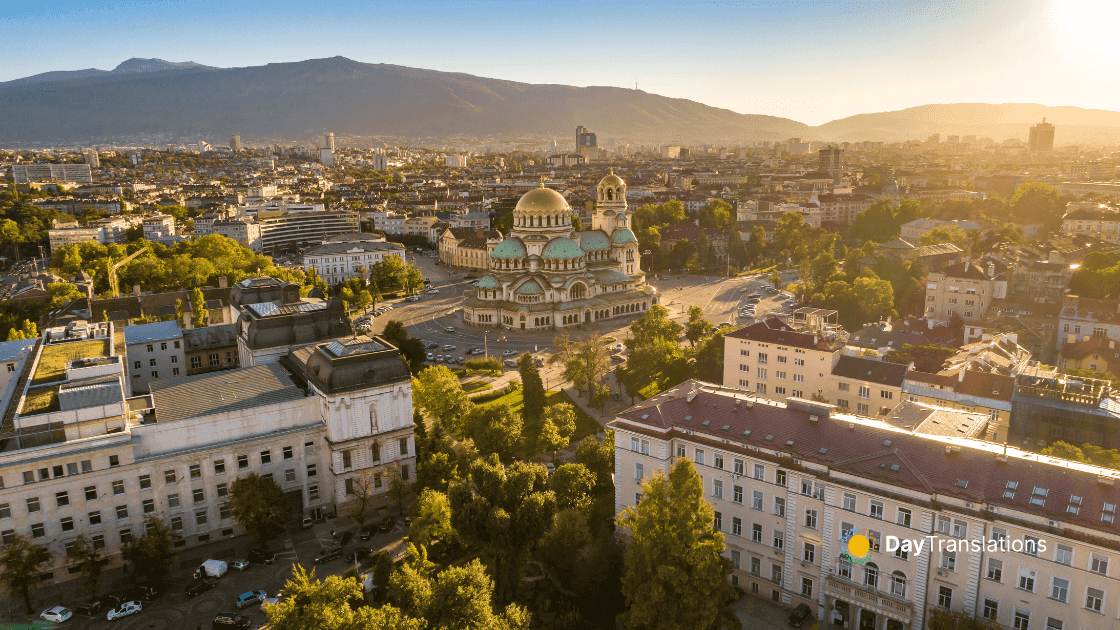
The Republic of Bulgaria is a country in Southeast Europe. Bulgaria borders five other countries: Romania to the north (mostly along the Danube), Serbia and the Republic of Macedonia to the west, and Greece and Turkey to the south. The Black Sea defines the extent of the country to the east.
With a territory of 110,994 square kilometers (42,855 sq mi), Bulgaria ranks as the 16th-largest country in Europe. Several mountainous areas define the landscape, most notably the Stara Planina (Balkan) and Rodopi mountain ranges, as well as the Rila range, which includes the highest peak in the Balkan region, Musala. In contrast, the Danubian plain in the north and the Upper Thracian Plain in the south represent Bulgaria’s lowest and most fertile regions. The 378-kilometer (235 mi) Black Sea coastline covers the entire eastern bound of the country. Bulgaria’s capital city and largest settlement is Sofia.
The emergence of a unified Bulgarian ethnicity and state dates back to the 7th century AD. All Bulgarian political entities that subsequently emerged preserved the traditions (in ethnic name, language and alphabet) of the First Bulgarian Empire (681–1018), which at times covered most of the Balkans and eventually became a cultural hub for the Slavs in the Middle Ages. With the decline of the Second Bulgarian Empire (1185–1396/1422), Bulgarian territories came under Ottoman rule for nearly five centuries. The Russo-Turkish War of 1877–1878 led to the establishment of a Third Bulgarian state as a principality in 1878, which gained its full sovereignty in 1908. In 1945, after World War II, it became after a questionable referendum a communist state and was a part of the Eastern Bloc until the political changes in Eastern Europe in 1989/1990, when the Communist Party allowed multi-party elections and Bulgaria undertook a transition to parliamentary democracy and free-market capitalism with mixed results.
Bulgaria functions as a parliamentary democracy within a unitary constitutional republic. A member of the European Union, NATO, the United Nations, the Council of Europe, the World Trade Organization and a founding state of the OSCE and the Black Sea Economic Cooperation Organization.
In this Country Profile
:: Background of Bulgaria ::
The Bulgars, a Central Asian Turkic tribe, merged with the local Slavic inhabitants in the late 7th century to form the first Bulgarian state. In succeeding centuries, Bulgaria struggled with the Byzantine Empire to assert its place in the Balkans, but by the end of the 14th century the country was overrun by the Ottoman Turks. Northern Bulgaria attained autonomy in 1878 and all of Bulgaria became independent from the Ottoman Empire in 1908. Having fought on the losing side in both World Wars, Bulgaria fell within the Soviet sphere of influence and became a People’s Republic in 1946. Communist domination ended in 1990, when Bulgaria held its first multiparty election since World War II and began the contentious process of moving toward political democracy and a market economy while combating inflation, unemployment, corruption, and crime. The country joined NATO in 2004 and the EU in 2007.
:: Geography of Bulgaria ::
Location: Southeastern Europe, bordering the Black Sea, between Romania and Turkey
Geographic coordinates: 43 00 N, 25 00 E
Area:
total: 110,879 sq km
land: 108,489 sq km
water: 2,390 sq km
Area – comparative: slightly larger than Tennessee
Land boundaries: 1,808 km
Border countries: Greece 494 km, Macedonia 148 km, Romania 608 km, Serbia 318 km, Turkey 240 km
Coastline: 354 km
Maritime claims:
territorial sea: 12 nm
contiguous zone: 24 nm
exclusive economic zone: 200 nm
Climate: temperate; cold, damp winters; hot, dry summers
Terrain: mostly mountains with lowlands in north and southeast
Elevation extremes:
lowest point: Black Sea 0 m
highest point: Musala 2,925 m
Natural resources: bauxite, copper, lead, zinc, coal, timber, arable land
Land use:
arable land: 29.94%
permanent crops: 1.9%
other: 68.16% (2005)
Irrigated land: 5,880 sq km (2003)
Total renewable water resources: 19.4 cu km (2005)
Freshwater withdrawal (domestic/industrial/agricultural):
total: 6.92 cu km/yr (3%/78%/19%)
per capita: 895 cu m/yr (2003)
Natural hazards: earthquakes; landslides
Environment – current issues: air pollution from industrial emissions; rivers polluted from raw sewage, heavy metals, detergents; deforestation; forest damage from air pollution and resulting acid rain; soil contamination from heavy metals from metallurgical plants and industrial wastes
Environment – international agreements: party to: Air Pollution, Air Pollution-Nitrogen Oxides, Air Pollution-Persistent Organic Pollutants, Air Pollution-Sulfur 85, Air Pollution-Sulfur 94, Air Pollution-Volatile Organic Compounds, Antarctic-Environmental Protocol, Antarctic-Marine Living Resources, Antarctic Treaty, Biodiversity, Climate Change, Climate Change-Kyoto Protocol, Desertification, Endangered Species, Environmental Modification, Hazardous Wastes, Law of the Sea, Marine Dumping, Ozone Layer Protection, Ship Pollution, Wetlands; signed, but not ratified: none of the selected agreements
Geography – note: strategic location near Turkish Straits; controls key land routes from Europe to Middle East and Asia
:: People of Bulgaria ::
Population: 7,093,635 (July 2011 est.)
Age structure:
0-14 years: 13.9% (male 506,403/female 480,935)
15-64 years: 67.9% (male 2,367,680/female 2,446,799)
65 years and over: 18.2% (male 522,343/female 769,475) (2011 est.)
Median age:
total: 41.9 years
male: 39.6 years
female: 44 years (2011 est.)
Population growth rate: -0.781% (2011 est.)
Birth rate: 9.32 births/1,000 population (2011 est.)
Death rate: 14.32 deaths/1,000 population (July 2011 est.)
Net migration rate: -2.82 migrant(s)/1,000 population (2011 est.)
Urbanization:
urban population: 71% of total population (2010)
rate of urbanization: -0.3% annual rate of change (2010-15 est.)
Sex ratio:
at birth: 1.06 male(s)/female
under 15 years: 1.05 male(s)/female
15-64 years: 0.97 male(s)/female
65 years and over: 0.68 male(s)/female
total population: 0.92 male(s)/female (2011 est.)
Infant mortality rate:
total: 16.68 deaths/1,000 live births
male: 19.93 deaths/1,000 live births
female: 13.25 deaths/1,000 live births (2011 est.)
Life expectancy at birth:
total population: 73.59 years
male: 69.99 years
female: 77.41 years (2011 est.)
Total fertility rate: 1.42 children born/woman (2011 est.)
HIV/AIDS – adult prevalence rate: 0.1% (2009 est.)
HIV/AIDS – people living with HIV/AIDS: 3,800 (2009 est.)
HIV/AIDS – deaths: fewer than 200 (2009 est.)
Nationality: noun: Bulgarian(s) adjective: Bulgarian
Ethnic groups: Bulgarian 83.9%, Turk 9.4%, Roma 4.7%, other 2% (including Macedonian, Armenian, Tatar, Circassian) (2001 census)
Religions: Bulgarian Orthodox 82.6%, Muslim 12.2%, other Christian 1.2%, other 4% (2001 census)
Languages: Bulgarian (official) 84.5%, Turkish 9.6%, Roma 4.1%, other and unspecified 1.8% (2001 census)
Literacy:
definition: age 15 and over can read and write
total population: 98.2%
male: 98.7%
female: 97.7% (2001 census)
School life expectancy (primary to tertiary education):
total: 14 years
male: 13 years
female: 14 years (2008)
Education expenditures: 4.1% of GDP (2007)
Geography of Bulgaria: Important Geographical Information about Bulgaria
In this Country Profile
Bulgaria is a country situated in south-eastern Europe, bordering Romania, Serbia, the Republic of Macedonia, Greece, Turkey and the Black Sea. Its northern border with Romania follows the Danube river until Silistra. The land area of Bulgaria is 110,550 square kilometers, slightly larger than that of Iceland or the U.S. state of Tennessee. The country is situated on the west coast of the Black Sea, with Romania to the north, Greece and Turkey to the south, and Serbia and Macedonia to the west. Considering its small size, Bulgaria has a great variety of topographical features. Even within small parts of the country, the land may be divided into plains, plateaus, hills, mountains, basins, gorges, and deep river valleys. The geographic center of Bulgaria is located in Uzana.
Bulgaria features notable diversity with the landscape ranging from the Alpine snow-capped peaks in Rila, Pirin and the Balkan Mountains to the mild and sunny Black Sea coast; from the typically continental Danubian Plain (ancient Moesia) in the north to the strong Mediterranean climatic influence in the valleys of Macedonia and in the lowlands in the southernmost parts of Thrace.
Bulgaria straddles the Illyrian and Euxinian provinces of the Circumboreal region within the Boreal kingdom. According to the WWF and to the European Environment Agency’s Digital Map of European Ecological Regions, the territory of Bulgaria subdivides into two main ecoregions: the Balkan mixed forests and Rhodope montane mixed forests. Small parts of four other ecoregions also occur on Bulgarian territory.
Although external historical events often changed Bulgaria’s national boundaries in its first century of existence, natural terrain features defined most boundaries after 1944, and no significant group of people suffered serious economic hardship because of border delineation. Postwar Bulgaria contained a large percentage of the ethnic Bulgarian people, although numerous migrations into and out of Bulgaria occurred at various times. None of the country’s borders was officially disputed in 1991, although nationalist Bulgarians continue to claim that Bulgaria’s share of Macedonia, which it shares with both Republic of Macedonia and Greece, is less than just because of the ethnic connection between Macedonians and Bulgarians.
Bulgaria has a total border of about 2,264 km. Rivers account for about 680 km and the Black Sea coast for 400 km; the southern and western borders are mainly defined by ridges in high terrain. The western and northern boundaries are shared with Serbia and Romania, respectively, and the Black Sea coastline constitutes the entire eastern border. The Romanian border follows the Danube for 464 km from the northwestern corner of the country to the city of Silistra and then cuts to the east-southeast for 136 km. The Danube, with steep bluffs on the Bulgarian side and a wide area of swamps and marshes on the Romanian side, is one of the most effective river boundaries in Europe. The line through Dobruja is arbitrary and was redrawn several times according to international treaties. In that process, most inhabitants with strong national preferences resettled in the country of their choice. Borders to the south are with Greece and Turkey, the border with Greece being 491 kilometers long, and the Turkish border having a length of 240 kilometers.
The relief of Bulgaria is varied. In the relatively small territory of the country there are extensive lowlands, plains, hills, low and high mountains, many valleys and deep gorges. The main characteristic of Bulgaria’s topography is alternating bands of high and low terrain that extend east to west across the country. From north to south, those bands (called geomorphological regions) are the Danubian Plain, Stara Planina, the Transitional region and the Rilo-Rhodope Massif. The easternmost sections near the Black Sea are hilly, but they gradually gain height to the west until the westernmost part of the country is entirely high ground.
More than two-thirds of the country is plains, plateaus, or hilly land at an altitude less than 600 m. Plains (below 200 m) make up 31 % of the land, plateaus and hills (200 to 600 m) 41 %, low mountains (600 to 1,000 m) 10 %, medium-sized mountains (1,000 to 1,500 m) 10 %, and high mountains (over 1,500 m) 3 %. The average altitude in Bulgaria is 470 m.
The contemporary relief of the country is a result of continuous geological evolution. Due to that evolution there are magmatic, sedimentary and metamorphic rocks of different origin, age and composition. Their formation began more than 500 million years ago during the Precambrian and continues till now. The Bulgarian lands were often submerged by ancient seas and lakes, some land layers rose others sank. Volcanic eruptions were common both on land and in the water basins.
The Danubian Plain extends from the western borders to the Black Sea. It encompasses the area between the Danube River, which forms most of the country’s northern border, and Stara Planina to the south. It covers the Moesian plate. As a result of the rock weathering processes the relief is uneven with flat rising grounds along the valleys and plateaus to the east. The plateau slopes gently from cliffs along the river, then it abuts into the low northern mountains of the Balkan range. The highest point is Tarnov Dyal (502 m) in the Shumen Plateau. The valleys of Vit and Yantra divide the Danubian plain into three parts – western, central and eastern. The altitude rises from west to east. To the north the plain has steep shores along the Danube or forms fertile alluvial plains (Vidinska, Chernopolska, Belenska, Pobrezhie, Aidemirska).
Hilly heights and plateaus are typical for the topography of plain. Most of the heights and all plateaus are situated into the eastern parts. There are 14 basalt mounds between Svishtov and the village of Dragomirovo.
The southern edge of the Danubian Plain blends into the foothills of Stara Planina, sometimes thought of as the Bulgarian part of the Carpathian Mountains. The Carpathians resemble a reversed S as they run eastward from the Czech Republic and Slovakia across the northern portion of Romania, swinging southward to the middle of Romania and then running westward, where they are known as the Transylvanian Alps. The mountains turn eastward again at the Iron Gate, a gorge of the Danube River at the Romanian-Serbian border. At that point, they become Stara Planina of Bulgaria.
Stara Planina originates at the Timok Valley in Serbia and run southward towards the Sofia Basin in west central Bulgaria. From there they run east to the Black Sea. The Balkans are about 600 km long and 30 to 50 km wide. They retain their height well into central Bulgaria, where Botev Peak, the highest point in the Balkan Mountains, rises to about 2,376 m. The range then continues at lower altitude to the cliffs of the Black Sea. Through most of Bulgaria, the Balkans form the watershed from which rivers drain north to the Danube River or south to the Aegean Sea. Some smaller rivers in the east drain directly to the Black Sea. The Sredna Gora is a narrow ridge about 160 km long and 1,600 m high, running east to west parallel to the Balkans. Nestled between both ranges is the Rose Valley, famous for rose oil used in perfume and liqueurs.
The southern slopes of the Balkan Mountains and the Sredna Gora give way to the Thracian Plain and the Sofia Basin. Roughly triangular in shape, the Thracian Plain originates at a point east of the mountains near Sofia and broadens eastward to the Black Sea. It includes the Maritsa valley and the lowlands that extend from the river to the Black Sea. Like the Danubian Plateau, much of the Thracian Plain is somewhat hilly and not a true plain. Most of its terrain is moderate enough to cultivate.
The largest basin in Bulgaria is the Sofia Basin. About 24 km wide and 96 km long, the basin contains the capital city and the area immediately surrounding it. The route through basins and valleys from Belgrade to Istanbul (formerly Constantinople) via Sofia has been historically important since Roman times, determining the strategic significance of the Balkan Peninsula. Bulgaria’s largest cities were founded on this route. Paradoxically, although the mountains made many Bulgarian villages and towns relatively inaccessible, Bulgaria has always been susceptible to invasion because no natural obstacle blocked the route through Sofia.
Relatively high mountains occupy the area between the Thracian Plain and Sofia Basin and the Greek border to the south. The western parts consist of three ranges: the Vitosha Mountain south of Sofia, the Rila Mountains further south, and the Pirin Mountains in the southwestern corner of the country. They are the most outstanding topographic feature of Bulgaria and of the entire Balkan Peninsula. The Rila range includes Mount Musala, whose 2,925-metre peak is the highest in any Balkan country. About a dozen other peaks in Rila are over 2,600 meters. The highest peaks are characterized by sparse bare rocks and remote lakes above the tree line. The lower peaks, however, are covered with alpine meadows that give the range an overall impression of green beauty. The Pirin range is characterized by rocky peaks and stony slopes. Its highest peak is Mount Vihren, at 2,915 meters the second-highest peak in Bulgaria. Further east are the extensive Rhodope Mountains.
A significant part of Bulgaria’s land is prone to earthquakes. Two especially sensitive areas are the borders of the North Bulgarian Swell (rounded elevation), the center of which is in the Gorna Oryahovitsa area in north-central Bulgaria, and the West Rhodopes Vault, a wide area extending through the Rila and northern Pirin regions to Plovdiv in south-central Bulgaria. Especially strong tremors also occur along diagonal lines running between Skopje in the Republic of Macedonia and Razgrad in northeast Bulgaria, and from Albania eastward across the southern third of Bulgaria through Plovdiv. Sixteen major earthquakes struck Bulgaria between 1900 and 1986, the last two in Strazhitsa on the Skopje-Razgrad fault line. Together the two quakes damaged over 16,000 buildings, half of them severely. One village was almost completely leveled, others badly damaged. Many inhabitants were still living in temporary housing four years later.
Information about the Bulgarian Flag: Colors and Meaning of the Flag of Bulgaria
In this Country Profile
The national flag of Bulgaria contains three equal horizontal bands of white (top), green, and red; the pan-Slavic white-blue-red colors were modified by substituting a green band (representing freedom) for the blue. The national emblem, formerly on the hoist side of the white stripe, has been removed.
Extensive List of Languages of Bulgaria: Spoken and Extinct Languages
In this Country Profile
Albanian, Gheg
[aln] 1,000 in Bulgaria (Newmark 1982). Classification: Indo-European, Albanian, Gheg
Aromanian
[rup] 10,600 in Bulgaria (2007). Associations in Peshtera, Velingrad, Dupnitsa, Rakitovo, and Blagoevgrad. Alternate names: Armina, Arumanian, Macedo, Macedo-Rumanian, Romanian. Classification: Indo-European, Italic, Romance, Eastern
Bulgarian
[bul] 7,990,000 in Bulgaria (1986). Population total all countries: 9,097,220. Also in Canada, Croatia, Czech Republic, Greece, Hungary, Israel, Libya, Moldova, Romania, Russian Federation (Europe), Serbia, Slovakia, Turkey (Europe), Ukraine, United States. Alternate names: Balgarski. Dialects: Palityan (Palitiani, Bogomil). Palityan dialect is functionally intelligible with Standard Bulgarian. The Pomak dialect spoken in Greece is similar to Serbian and Bulgarian; geographical dialect variation toward each. Classification: Indo-European, Slavic, South, Eastern
Bulgarian Sign Language
[bqn] Dialects: Different sign languages are used in the classroom and by adults outside. Classification: Deaf sign language
Crimean Tatar
[crh] 6,000 in Bulgaria (2006 A. Goriainov). Northeast. Alternate names: Crimean, Crimean Turkish. Dialects: Northern Crimean (Crimean Nogai, Steppe Crimean), Central Crimean, Southern Crimean. Classification: Altaic, Turkic, Southern
Gagauz
[gag] 12,000 in Bulgaria (1982). Varna coastal region. Alternate names: Gagauzi. Dialects: Bulgar Gagauz, Maritime Gagauz. Classification: Altaic, Turkic, Southern, Turkish
Macedonian
[mkd] 150,000 in Bulgaria. Pirin region, former Yugoslav Republic of Macedonia border. Classification: Indo-European, Slavic, South, Eastern
Romani, Balkan
[rmn] 371,000 in Bulgaria (2001 census). 100,000 Arlija, 20,000 Dzambazi, 10,000 Tinsmiths, 10,000 East Bulgarian. Sofia to the Black Sea (Central dialect). Tinsmiths dialect is in central and northwest Bulgaria; Arlija in Sofia region. Alternate names: Gypsy. Dialects: Arlija, Tinners Romani, Greek Romani, Dzambazi, East Bulgarian Romani, Paspatian, Ironworker Romani. Classification: Indo-European, Indo-Iranian, Indo-Aryan, Central zone, Romani, Balkan
Romani, Vlax
[rmy] 500 in Bulgaria. Classification: Indo-European, Indo-Iranian, Indo-Aryan, Central zone, Romani, Vlax
Russian Sign Language
[rsl] Classification: Deaf sign language
Turkish
[tur] 747,000 in Bulgaria (2001 census). South, Kurdzhali Province and neighboring areas, along the Danube; various regions east. Alternate names: Osmanli, Turki. Dialects: Danubian, Razgrad, Dinler, Macedonian Turkish. Classification: Altaic, Turkic, Southern, Turkish
:: Reference ::
Gordon, Raymond G., Jr. (ed.), 2005. Ethnologue: Languages of the World, Fifteenth edition. Dallas, Tex.: SIL International. Online version: http://www.ethnologue.com/
Famous Bulgarian People: Bulgarian Artists, Scientists, Leaders, Musicians, Politicians and Athletes
In this Country Profile
Bulgaria is home to outstanding individuals who made a difference with their remarkable achievements. The following people made their mark on both the local and international scenes. They are just some of many famous Bulgarians who have lifted Bulgaria’s name worldwide and made a difference in our world. Their purpose and stories inspired awe if not greatness.
:: List of Famous People from Bulgaria ::
Simeon II of Bulgaria
Simeon Borisov of Saxe-Coburg and Gotha is an important political and royal figure in Bulgaria. He was a minor during his reign as the Tsar of Bulgaria from 1943 to 1946, the monarchical authority being exercised over the kingdom on his behalf by the regents, Simeon’s uncle Prince Kiril of Bulgaria, General Nikola Mihov and the Prime Minister Bogdan Filov. In 1946 the monarchy was overthrown as a consequence of a greatly manipulated referendum won by the communist republicans. Simeon went into exile. Fifty-five years later, on 6 April 2001, Simeon resumed the role of leader of the nation upon taking office as Prime Minister of the Republic of Bulgaria from July 2001 until August 2005.
As of 2011, Simeon is one of the last living heads of state from the World War II-era, the only living person who has borne the Bulgarian title “Tsar”, and one of the few monarchs in history to have become the head of government through democratic elections.
Boris Christoff
Boris Christoff was a Bulgarian opera singer. He is considered to have been one of the greatest basses of the 20th century.
Vladimir Dimitrov
Vladimir Dimitrov was a Bulgarian painter, draughtsman and teacher. He is considered one of the most talented 20th century Bulgarian painters and probably the most remarkable stylist in Bulgarian painting in the post-Russo-Turkish War era. His portraits and compositions have expressive color, idealistic quality of the image and high symbolic strength.
Valya Balkanska
Valya Balkanska is a Bulgarian folk music singer from the Rhodope Mountains known locally for her wide repertoire of Balkan folksong, but in the West mainly for singing the song “Izlel e Delyu Haydutin”, part of the Voyager Golden Record selection of music included in the two Voyager spacecraft launched in 1977.
Raina Kabaivanska
Raina Kabaivanska is a Bulgarian opera singer, one of the leading lyrico-spinto sopranos of her generation, particularly associated with Verdi and Puccini, although she sang a wide range of roles. A versatile singer with a beautiful voice and fine musicianship, she is also a singing-actress of considerable ability.
Famous People from Bulgaria: Famous Bulgarian Footballers/Soccer Players
In this Country Profile
The following Bulgarian athletes dedicated themselves in promoting and inspiring people about football, one of the most well-loved sports in the world.
Hristo Stoitchkov
Hristo Stoitchkov was a member of the Bulgaria national team that finished fourth at the 1994 World Cup. He was honoured as European Footballer of the Year in 1994. He was named by Pelé as one of the125 Greatest Living Footballers at a FIFA Awards Ceremony in 2004.
Georgi Asparuhov
Georgi Asparuhov is considered to be among the top Bulgarian footballers of all time. Asparuhov died in a car crash in 1971 with his talented teammate, Nikola Kotkov. At his funeral, thousands of people went to Sofia to pay tribute and their respect to him and to bid him farewell. The present stadium of PFC Levski Sofia is called Georgi Asparuhov Stadium in honor of the famous striker.
Dimitar Berbatov
Dimitar Berbatov is a Bulgarian footballer who plays as a forward for Manchester United. Berbatov captained the Bulgarian national team from 2006 to 2010, and is its all-time leading goalscorer and has also won the Bulgarian Footballer of the Year a record seven times, surpassing the number of wins by Hristo Stoitchkov.
Hristo Bonev
Hristo Bonev is the second all-time leading scorer for the Bulgarian national team behind Dimitar Berbatov, who surpassed his record on November 18, 2009. Currently he manages PFC Lokomotiv Plovdiv in the Bulgarian A PFG.
Yordan Lechkov
Yordan Lechkov became the first Bulgarian to ever play in the German Bundesliga. At the 1994 World Cup in the United States, Lechkov was one of the “golden boys” of the Bulgarian team. He has also played for the French soccer team Olympique Marseille and Besiktas of Turkey.