
The Republic of Peru is a country in western South America. It is bordered on the north by Ecuador and Colombia, on the east by Brazil, on the southeast by Bolivia, on the south by Chile, and on the west by the Pacific Ocean.
The Spanish Empire conquered the region in the 16th century and established a Viceroyalty, which included most of its South American colonies. After achieving independence in 1821, Peru has undergone periods of political unrest and fiscal crisis as well as periods of stability and economic upswing.
Peru is a representative democratic republic divided into 25 regions. Its geography varies from the arid plains of the Pacific coast to the peaks of the Andes Mountains and the tropical forests of the Amazon Basin. It is a developing country with a high Human Development Index score and a poverty level around 36%. Its main economic activities include agriculture, fishing, mining, and manufacturing of products such as textiles.
The Peruvian population, estimated at 29.5 million, is multiethnic, including Amerindians, Europeans, Africans, and Asians. The main spoken language is Spanish, although a significant number of Peruvians speak Quechua or other native languages. This mixture of cultural traditions has resulted in a wide diversity of expressions in fields such as art, cuisine, literature, and music.
In this Country Profile
:: Background of Peru ::
Ancient Peru was the seat of several prominent Andean civilizations, most notably that of the Incas whose empire was captured by the Spanish conquistadors in 1533. Peruvian independence was declared in 1821, and remaining Spanish forces defeated in 1824. After a dozen years of military rule, Peru returned to democratic leadership in 1980, but experienced economic problems and the growth of a violent insurgency. President Alberto FUJIMORI’s election in 1990 ushered in a decade that saw a dramatic turnaround in the economy and significant progress in curtailing guerrilla activity. Nevertheless, the president’s increasing reliance on authoritarian measures and an economic slump in the late 1990s generated mounting dissatisfaction with his regime, which led to his ouster in 2000. A caretaker government oversaw new elections in the spring of 2001, which ushered in Alejandro TOLEDO Manrique as the new head of government – Peru’s first democratically elected president of Native American ethnicity. The presidential election of 2006 saw the return of Alan GARCIA Perez who, after a disappointing presidential term from 1985 to 1990, has overseen a robust macroeconomic performance.
:: Geography of Peru ::
Location: Western South America, bordering the South Pacific Ocean, between Chile and Ecuador
Geographic coordinates: 10 00 S, 76 00 W
Area:
total: 1,285,216 sq km
land: 1,279,996 sq km
water: 5,220 sq km
Area – comparative: slightly smaller than Alaska
Land boundaries: 7,461 km
Coastline: 2,414 km
Maritime claims:
territorial sea: 200 nm
continental shelf: 200 nm
Climate: varies from tropical in east to dry desert in west; temperate to frigid in Andes
Terrain: western coastal plain (costa), high and rugged Andes in center (sierra), eastern lowland jungle of Amazon Basin (selva)
Elevation extremes:
lowest point: Pacific Ocean 0 m
highest point: Nevado Huascaran 6,768 m
Natural resources: copper, silver, gold, petroleum, timber, fish, iron ore, coal, phosphate, potash, hydropower, natural gas
Land use:
arable land: 2.88%
permanent crops: 0.47%
other: 96.65% (2005)
Irrigated land: 12,000 sq km (2003)
Total renewable water resources: 1,913 cu km (2000)
Freshwater withdrawal (domestic/industrial/agricultural):
total: 20.13 cu km/yr (8%/10%/82%)
per capita: 720 cu m/yr (2000)
Natural hazards: earthquakes, tsunamis, flooding, landslides, mild volcanic activity
Volcanism: Peru experiences volcanic activity in the Andes Mountains; Ubinas (elev. 5,672 m, 18,609 ft), which last erupted in 2009, is the country’s most active volcano; other historically active volcanoes include El Misti, Huaynaputina, Sabancaya, and Yucamane
Environment – current issues: deforestation (some the result of illegal logging); overgrazing of the slopes of the costa and sierra leading to soil erosion; desertification; air pollution in Lima; pollution of rivers and coastal waters from municipal and mining wastes
Environment – international agreements: party to: Antarctic-Environmental Protocol, Antarctic-Marine Living Resources, Antarctic Treaty, Biodiversity, Climate Change, Climate Change-Kyoto Protocol, Desertification, Endangered Species, Hazardous Wastes, Marine Dumping, Ozone Layer Protection, Ship Pollution, Tropical Timber 83, Tropical Timber 94, Wetlands, Whaling; signed, but not ratified: none of the selected agreements
Geography – note: shares control of Lago Titicaca, world’s highest navigable lake, with Bolivia; a remote slope of Nevado Mismi, a 5,316 m peak, is the ultimate source of the Amazon River
:: People of Peru ::
Population: 29,907,003 (July 2010 est.)
Age structure:
0-14 years: 29.1% (male 4,370,923/female 4,216,364)
15-64 years: 65.2% (male 9,695,270/female 9,574,018)
65 years and over: 5.7% (male 796,631/female 893,757) (2010 est.)
Median age:
total: 26.4 years
male: 26.1 years
female: 26.7 years (2010 est.)
Population growth rate: 1.193% (2010 est.)
Birth rate: 19 births/1,000 population (2010 est.)
Death rate: 6.13 deaths/1,000 population (July 2010 est.)
Net migration rate: -0.93 migrant(s)/1,000 population (2010 est.)
Urbanization:
urban population: 71% of total population (2008)
rate of urbanization: 1.3% annual rate of change (2005-10 est.)
Sex ratio:
at birth: 1.046 male(s)/female
under 15 years: 1.04 male(s)/female
15-64 years: 1.01 male(s)/female
65 years and over: 0.89 male(s)/female
total population: 1.01 male(s)/female (2010 est.)
Infant mortality rate:
total: 27.74 deaths/1,000 live births
male: 30.15 deaths/1,000 live births
female: 25.21 deaths/1,000 live births (2010 est.)
Life expectancy at birth:
total population: 71.03 years
male: 69.14 years
female: 73 years (2010 est.)
Total fertility rate: 2.32 children born/woman (2010 est.)
HIV/AIDS – adult prevalence rate: 0.5% (2007 est.)
HIV/AIDS – people living with HIV/AIDS: 76,000 (2007 est.)
HIV/AIDS – deaths: 3,300 (2007 est.)
Nationality: noun: Peruvian(s) adjective: Peruvian
Ethnic groups: Amerindian 45%, mestizo (mixed Amerindian and white) 37%, white 15%, black, Japanese, Chinese, and other 3%
Religions: Roman Catholic 81.3%, Evangelical 12.5%, other 3.3%, unspecified or none 2.9% (2007 Census)
Languages: Spanish 84.1% (official), Quechua 13% (official), Aymara 1.7%, Ashaninka 0.3%, other native languages 0.7% (includes a large number of minor Amazonian languages), other 0.2% (2007 Census)
Literacy:
definition: age 15 and over can read and write
total population: 92.9%
male: 96.4%
female: 89.4% (2003 est.)
School life expectancy (primary to tertiary education):
total: 14 years
male: 13 years
female: 14 years (2007)
Education expenditures: 2.7% of GDP (2008)
Geography of Peru: Important Geographical Information about Peru
In this Country Profile
Peru covers 1,285,216 km2 (496,225 sq mi). It borders Ecuador and Colombia to the north, Brazil to the east, Bolivia to the southeast, Chile to the south, and the Pacific Ocean to the west. The Andes Mountains run parallel to the Pacific Ocean, dividing the country into three geographic regions. The costa (coast), to the west, is a narrow plain, largely arid except for valleys created by seasonal rivers. The sierra (highlands) is the region of the Andes; it includes the Altiplano plateau as well as the highest peak of the country, the 6,768 m (22,205 ft) Huascarán. The third region is the selva (jungle), a wide expanse of flat terrain covered by the Amazon rainforest that extends east. Almost 60% of the country’s area is located within this region.
Most Peruvian rivers originate in the peaks of the Andes and drain into one of three basins. Those that drain toward the Pacific Ocean are steep and short, flowing only intermittently. Tributaries of the Amazon River are longer, have a much larger flow, and are less steep once they exit the sierra. Rivers that drain into Lake Titicaca are generally short and have a large flow. Peru’s longest rivers are the Ucayali, the Marañón, the Putumayo, the Yavarí, the Huallaga, the Urubamba, the Mantaro, and the Amazon.
Peru, unlike other equatorial countries, does not have an exclusively tropical climate; the influence of the Andes and the Humboldt Current cause great climatic diversity within the country. The costa has moderate temperatures, low precipitations, and high humidity, except for its warmer, wetter northern reaches. In the sierra, rain is frequent during summer, and temperature and humidity diminish with altitude up to the frozen peaks of the Andes. The selva is characterized by heavy rainfall and high temperatures, except for its southernmost part, which has cold winters and seasonal rainfall. Because of its varied geography and climate, Peru has a high biodiversity with 21,462 species of plants and animals reported as of 2003; 5,855 of them endemic. The Peruvian government has established several protected areas for their preservation.
Information about the Peruvian Flag: Colors and Meaning of the Flag of Peru
In this Country Profile
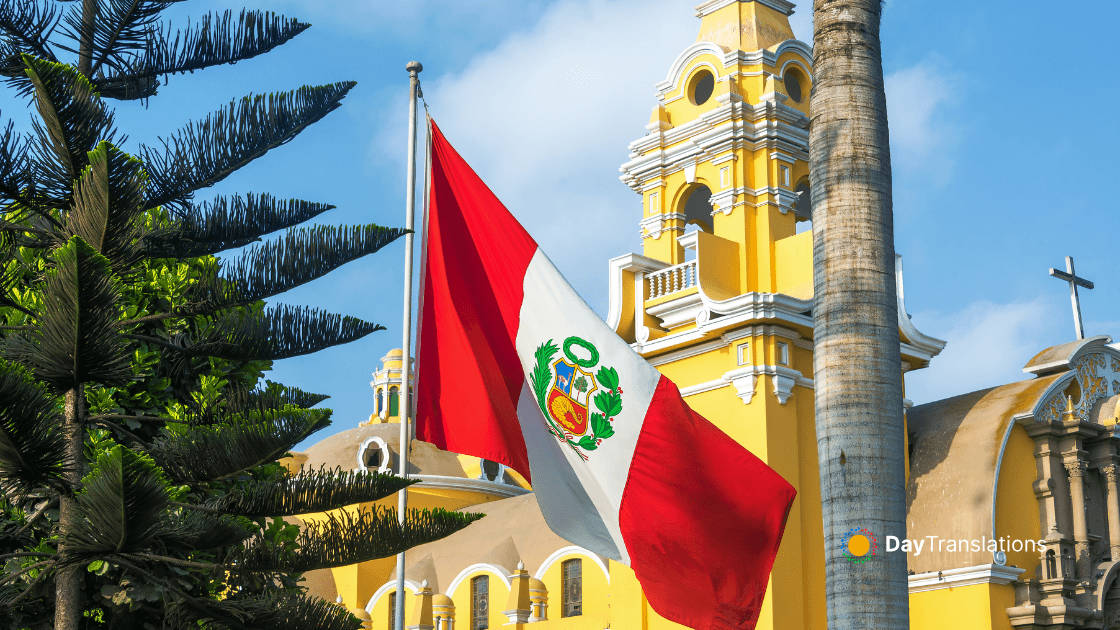
The national flag of Peru contains three equal, vertical bands of red (hoist side), white, and red with the coat of arms centered in the white band. The coat of arms features a shield bearing a vicuna (representing fauna), a cinchona tree (the source of quinine, signifying flora), and a yellow cornucopia spilling out coins (denoting mineral wealth).
The color red signifies the bloodshed while achieving Peruvian independence. Legend said about flamingos flying across a white clouded sky from which the inspiration for the colors came. The story goes that inspiration for the flag came when Jose San Martin landed in the southern coastal town of Paracas in 1820 to launch the invasion of Peru and he saw a flock of flamingos take flight. Others said that the white represents peace and the red is the blood from the fighters of their freedom.
Extensive List of Languages of Peru: Spoken and Extinct Languages
In this Country Profile
:: List of Languages ::
Abishira [ash] Extinct. Puerto Elvira on Lake Vacacocha on Napo River. Alternate names: Abigira, Abiquira, Agouisiri, Auishiri, Avirxiri, Ixignor, Tequraca, Vacacocha. Classification: Unclassified
Achuar-Shiwiar [acu] 3,000 in Peru. Population total all countries: 5,000. Morona, Macusari, Tigre, Huasaga, and Corrientes rivers. Also in Ecuador. Alternate names: Achual, Achuale, Achuar, Achuara, Jivaro, Maina. Dialects: Different from Shuar [jiv] (Jivaro) of Ecuador. Classification: Jivaroan
Aguano [aga] No known speakers. Ethnic population: 40 families in Santa Cruz de Huallaga. Lower Huallaga and upper Samiria rivers, right bank tributary of Marañon River. Alternate names:Aguanu, Awano, Santa Crucino, Uguano. Classification: Unclassified
Aguaruna [agr] 38,300 (2000), increasing. Almost no monolinguals. Western upper Marañon River area, Potro, Mayo, and Cahuapanas rivers. Alternate names: Aguajun, Ahuajun. Dialects: Similar to Huambisa [hub], Achuar-Shiwiar [acu]. Classification: Jivaroan
Ajyíninka Apurucayali [cpc] 4,000 (2000 SIL). Apurucayali tributary of Pachitea River. Alternate names: Ajyéninka, Apurucayali Campa, Ashaninca, Ashéninca Apurucayali, “Axininka Campa” , “Campa”. Dialects:Not intelligible with other varieties of Ashéninka. Classification: Arawakan, Maipuran, Southern Maipuran, Pre-Andine
Amahuaca [amc] 110 in Peru (2000 SIL), decreasing. 20 monolinguals. Population total all countries: 330. Ethnic population: 500 (300 in Peru and 200 in Brazil). Perhaps 50 in the border areas have not been contacted. Southeast Amazon Basin, scattered in Ucayali and Madre de Dios states on the following rivers: Sepahua, Curiuja, Curanja, Upper Ucayali, Inuya, Mapuya, Purus, Aguaytía, Yuruá, Las Piedras. Also in Brazil. Alternate names: Amaguaco, Amawaka, Ameuhaque, Ipitineri, Sayaco. Dialects: Most similar to
Kashinawa [cbs] and Shipibo-Conibo [shp]. Classification:Panoan, South-Central, Amahuaca
Amarakaeri [amr] 500 (1987 SIL). Madre de Dios and Colorado rivers. Alternate names: Amaracaire, Amarakaire, “Mashco”. Dialects: Kisambaeri. Harakmbet languages not Arawakan. Classification: Harakmbet
Andoa [anb] Extinct. Pastaza River. Alternate names: Gae, Gaye, Semigae, Shimigae. Dialects: Distinct from Záparo [zro] (Kayapwe) of Ecuador, which now has no remaining speakers. Classification:Zaparoan
Arabela [arl] 50 (2002 SIL). Ethnic population: 500 (2002 SIL). Arabela River, tributary of Napo. 2 villages.Alternate names: Chiripuno, Chiripunu. Classification: Zaparoan Nearly extinct.
Asháninka [cni] 26,100 (2000 SIL). Ethnic population: 25,000 to 30,000 (2000 SIL). Apurimac, Ene, Perene, Tambo rivers and tributaries. Alternate names: Asháninca, “Campa”. Dialects: Similar to Ashéninka varieties, Caquinte [cot] and Machiguenga [mcb]. Classification: Arawakan, Maipuran, Southern Maipuran, Pre-Andine
Ashéninka Pajonal [cjo] 12,000 (2002 SIL). Ethnic population: 12,000 (2002 SIL). Central Gran Pajonal area.Alternate names: Ashéninca, Atsiri, “Campa” , Pajonal. Classification: Arawakan, Maipuran, Southern Maipuran, Pre-Andine
Ashéninka Perené [prq] 5,500 (2001 SIL). Upper Perené River (tributary of Pachitea River). Alternate names:Ashéninca Perené, “Perené Campa”. Dialects: Somewhat intelligible with other Ashéninka varieties. Classification: Arawakan, Maipuran, Southern Maipuran, Pre-Andine
Ashéninka, Pichis [cpu] 12,000 (2001 SIL). Pichis and tributaries except Apurucayali. Alternate names: Pichis Ashéninca, “Pichis Campa”. Dialects: Somewhat intelligible with other Ashéninka varieties. Classification: Arawakan, Maipuran, Southern Maipuran, Pre-Andine
Ashéninka, South Ucayali [cpy] 13,000 (2002 SIL). Ethnic population: 14,000 (2002 SIL). Upper Ucayali River and tributaries (Southernmost part of Ucayali Department). Dialects: Most closely related to Pajonal Ashéninka [cjo]. Classification: Arawakan, Maipuran, Southern Maipuran, Pre-Andine
Ashéninka, Ucayali-Yurúa [cpb] 7,000 in Peru (2001 SIL). Population total all countries: 7,870. Ucayali River tributaries (Pachitea, Arruya, Shahuaya, Sheshea, Cohengua, Inuya), Yurúa River. Also in Brazil. Alternate names: Ucayali Ashéninca. Dialects: Somewhat intelligible with other Ashéninka varieties. Classification: Arawakan, Maipuran, Southern Maipuran, Pre-Andine
Aushiri [avs] Extinct. Napo River right bank tributaries, Escuelacocha. Alternate names: Auxira. Classification: Zaparoan
Aymara, Central [ayr] 442,000 in Peru (2000). Lake Titicaca area, Puno. Classification: Aymaran
Aymara, Southern [ayc] 219,000 (2006). From Lake Titicaca toward ocean. Dialects: Important verb forms and vocabulary differences
from Central Aymara [ayr]. Dialect intelligibility needs investigation in Tacna and Moquegua (Landerman 1984). Classification: Aymaran
Bora [boa] 2,330 in Peru (2000). Population total all countries: 3,390. Northeast Yaguasyacu, Putumayo, Ampiyacu River area. 5 villages. Also in Brazil, Colombia. Alternate names: Mirana. Dialects: Miraña. Distinct from Bora Muinane [bmr] but related. 94% intelligibility with Miraña dialect. Classification: Witotoan, Boran
Cahuarano [cah] 5 (1976 SIL). Nanay River. Classification: Zaparoan Nearly extinct.
Candoshi-Shapra [cbu] 3,000 (1981 SIL). Morona, Pastaza, Huitoyacu, Chapuli rivers. Alternate names: Candoshi, Candoxi, Kandoshi, Murato. Dialects: Chapara (Shapra), Kandoashi. May be distantly related to Arawakan; probably not Jivaroan. Classification: Language isolate
Capanahua [kaq] 390 (2000). No monolinguals. Ethnic population: 400 (2000 W. Adelaar). Tapiche-Buncuya rivers area. Alternate names: Kapanawa. Dialects: Pahenbaquebo. Most similar language is Shipibo [shp]. Lexical similarity: 50%–60% with Shipibo. Classification: Panoan, North-Central
Caquinte [cot] 300 (2000 SIL), increasing. Ethnic population: 300. Poyeni, Mayapo, and Picha rivers. Upper Poyeni River, which flows into Tambo Yori and Agueni rivers which become Mipaya River flowing into the Urubamba; a few on Sensa and Vitiricaya rivers, affluents of the Urubamba. Alternate names: “Cachomashiri” , Caquinte Campa, Poyenisati. Dialects: Most similar to Asháninka [cni]. Classification: Arawakan, Maipuran, Southern Maipuran, Pre-Andine
Cashibo-Cacataibo [cbr] 5,000 (1999). Some women over 50 monolingual. Aguaytía, San Alejandro, Súngaro rivers.Alternate names: Cachibo, Cacibo, Cahivo, Caxibo, Hagueti, Managua. Dialects: Cacataibo de Mariscal, Cacataibo de Sinchi Roca, Cashibo. Classification: Panoan, Western
Chamicuro [ccc] 2 (2000 W. Adelaar). Ethnic population: 10 to 20 (2000 W. Adelaar). Pampa Hermosa, Huallaga tributary. Alternate names: Chamicolo, Chamicura. Classification: Arawakan, Maipuran, Western Maipuran Nearly extinct.
Chayahuita [cbt] 11,400 (2000). Paranapura, Cahuapanas, Sillay, Shanusi rivers. Alternate names:Balsapuertino, Cahuapa, Chawi, Chayabita, Chayawita, Chayhuita, Paranapura, Shayabit, Tshaahui. Dialects: Chayahuita, Cahuapana. Not intelligible with Jebero [jeb]. Classification:Cahuapanan
Cholón [cht] Extinct. Huallaga River valley from Tingo María to Valle. Alternate names: Seeptsa, Tinganeses. Dialects: Ruhlen says it is Andean. Adelaar says it is in the Hibito-Cholon family. Classification: Hibito-Cholon
Cocama-Cocamilla [cod] 2,000 in Peru (2000 W. Adelaar). Few monolinguals. Population total all countries: 2,050. Ethnic population: 15,000 in Peru (2000 W. Adelaar). Northeast lower Ucayali, lower Marañon, and Huallaga rivers area. Also in Brazil, Colombia. Alternate names: Cocama, Huallaga, Kokama, Pampadeque, Pandequebo, Ucayali, Xibitaoan. Dialects: Cocamilla, Cocama. Most similar to Omagua [omg]. Classification: Tupi, Tupi-Guarani, Subgroup III
Culina [cul] 400 in Peru (2002 Boyer), increasing. Primarily monolingual. Ethnic population: 400. Southeast, near Brazilian border, upper Purus and Santa Rosa rivers. Alternate names:Kollina, Kulina, Kulino, Kulyna, Kurina, Madihá, Madija. Classification: Arauan
Ese Ejja [ese] 470 in Peru (2000). Ethnic population: 400 to 500 in Peru (2000 SIL). Tambopata and Heath rivers around Maldonado. Alternate names: “Chama” , Ese Eja, Ese Exa, Ese’ejja, Huarayo, Tambopata-Guarayo, Tiatinagua. Classification: Tacanan, Tiatinagua
Hibito [hib] Extinct. Bobonaje River, Jelache tributary, Huayabamba tributary entering Huallaga on west.Alternate names: Chibito, Ibito, Jibito, Xibita, Zibito. Classification: Hibito-Cholon
Huachipaeri [hug] 310 (2000). 12 Sapiteri, 10 Toyeri, 20 Arasairi, 50 Manuquiari, 36 to 50 Pukirieri (Puncuri). Upper Madre de Dios and Keros rivers. Alternate names: Huachipaire, “Mashco” , Wacipaire. Dialects: Huachipaire, Sapiteri, Toyeri (Toyoeri, Tuyuneri), Arasairi. Similar to Amarakaeri [amr]. Sapiteri integrating with the Amarakaeri. Toyeri is similar to Sapiteri. Some Kisambaeri (Amarakaeri dialect) have integrated with the Toyeri and others with the Sapiteri. Manuquiari may be a subgroup of Toyeri or Huachipaeri. Pukirieri may be a subgroup of Toyeri or Arasairi. Arasairi is distinct from Amarakaeri or Huachipaeri; similar to Sapiteri. Classification:Harakmbet
Huambisa [hub] 9,330 (2000). Morona and Santiago rivers. Alternate names: Huambiza, Wambisa. Dialects:Similar to Aguaruna [agr] and Achuar-Shiwiar [acu]. Classification: Jivaroan
Huitoto, Murui [huu] 1,000 in Peru (1995 SIL), decreasing. Very few monolinguals. Population total all countries: 7,800. Northeast Peru, southwest Colombia. Ampiyacu, Putumayo, and Napo rivers; north of Amazon River between Iquitos, Peru and Leticia, Colombia on the south, Caquetá River north. Also in Colombia. Alternate names: Bue, Witoto. Dialects: Mica. Classification: Witotoan, Witoto, Witoto Proper, Minica-Murui
Huitoto, Nüpode [hux] 100 (1991 SIL). Alternate names: Muinane Huitoto, Nipode Witoto. Classification: Witotoan, Witoto, Witoto Proper, Nipode
Iñapari [inp] 4 (1999 SIL). Piedras River, mouth of Sabaluyo, near Puerto Maldonado. Alternate names:Inamari. Classification: Arawakan, Maipuran, Southern Maipuran, Purus Nearly extinct.
Iquito [iqu] 35 (2002 SIL), decreasing. 1 monolingual. Ethnic population: 500. Loreto Province, Pintoyacu, Nanay, and Chambira rivers; San Antonia and Atalaya. Alternate names: Amacacore, Hamacore, Ikito, Iquita, Puca-Uma, Quiturran. Dialects: Pintuyacu. Similar to
Cahuarano [cah]. Classification: Zaparoan Nearly extinct.
Isconahua [isc] 82 (2000). Callaria River. Alternate names: Iscobaquebu. Dialects: Most closely related to Shipibo [shp]. Classification: Panoan, North-Central Nearly extinct.
Jaqaru [jqr] 740 (2000 W. Adelaar). 725 Jaqaru, 11 Kawki. Ethnic population: 2,000 (2000 W. Adelaar). Lima Department, Yauyos Province, Tupe (Jaqaru) and Cachuy villages (Cauqui).Alternate names: Aru, Haq’aru, Haqaru, Haqearu. Dialects: Cauqui (Kawki, Cachuy). Lexical similarity 73% with Aymara [ayr], 79% between Cauqui dialect and Aymara. Classification:Aymaran
Jebero [jeb] 2,500 (2006). Ethnic population: 2,000 to 3,000 (2000 W. Adelaar). Jebero District. Alternate names: Chebero, Xebero, Xihuila. Classification: Cahuapanan
Kashinawa [cbs] 1,600 in Peru (2003), increasing. Population total all countries: 2,000. Ethnic population: 5,000. Curanja and Purus rivers. Also in Brazil. Alternate names: Cashinahua, Caxinawa, Caxinawá, Kashinahua, Kaxinawá, Kaxynawa. Dialects: Possibly most similar to Sharanahua [mcd]. Classification: Panoan, Southeastern
Machiguenga [mcb] 10,100 (2000). Urubamba, Camisea, Picha, Manu, Timpia, Tigompinia, Kompiroshiato, and Mishagua rivers. Alternate names: Mañaries, Matsiganga, Matsigenka. Dialects: Most similar to Nomatsiguenga [not]. There are minor dialects. Classification: Arawakan, Maipuran, Southern Maipuran, Pre-Andine
Mashco Piro [cuj] 60 (1976 SIL). Completely monolingual. Manu Park, Madre de Dios Deparment. Cujar, Purus, Tahuamanu, Mishagua, and Piedras rivers. Alternate names: Cujareno, Cujareño, “Mashco”. Dialects: About 60% inherent intelligibility with Yine [pib]. Classification: Arawakan, Maipuran, Southern Maipuran, Purus
Matsés [mcf] 1,400 in Peru (2006 SIL). Population total all countries: 2,200. Yaquerana. Also in Brazil.Alternate names: Magirona, Majuruna, Maxirona, Maxuruna, Mayiruna, Mayoruna, Mayuzuna. Dialects: Different from Mayo or Maya and Marúbo [mzr] of Brazil. Classification: Panoan, Northern
Muniche [myr] 3 (1988 SIL). Paranapura River, Muniches town. Alternate names: Munichi, Munichino, Otanabe, Otanave. Classification: Language isolate Nearly extinct.
Nanti [cox] 480 (2002 Michael). Headwaters of Camisea and Timpia rivers. Alternate names:”Cogapacori” , “Kogapakori”. Dialects: Most closely related to Machiguenga [mcb], but have remained separate. Classification: Arawakan, Maipuran, Southern Maipuran, Pre-Andine
Nomatsiguenga [not] 6,500 (2003 SIL). 5,500 to 6,000 monolinguals. Junín Department, between rivers Ene and Perene, Anapati River system in the foothills. Alternate names: “Nomatsiguenga Campa”. Dialects: Most similar to Machiguenga [mcb]. Classification: Arawakan, Maipuran, Southern Maipuran, Pre-Andine
Ocaina [oca] 54 in Peru (2000). Population total all countries: 66. Ethnic population: 150 in Peru (2000 W. Adelaar). Northeast Peru, Yaguasyacu, Ampuyacu, and Putumayo rivers. Also in Colombia.Alternate names: Okaina. Dialects: Dukaiya, Ibo’tsa. Classification: Witotoan, Witoto, Ocaina
Omagua [omg] 10 to 100 in Peru (1976 SIL). Ethnic population: 627 (1976). Omaguas near Iquitos. Also in Brazil. Alternate names: Agua, Anapia, Ariana, Cambeba, Cambeeba, Cambela, Campeba, Canga-Peba, Compeva, Kambeba, Macanipa, Omagua-Yete, Pariana, Umaua, Yhuata. Dialects: Most similar to Cocama-Cocamilla [cod]. Classification: Tupi, Tupi-Guarani, Subgroup III Nearly extinct.
Omurano [omu] Extinct. Alternate names: Humurana, Mayna, Numurana, Roamaina, Umurano. Classification: Zaparoan
Orejón [ore] 190 (1976 SIL). Ethnic population: 405. Yanayacu, Sucusari, Algodon, and Putumayo rivers.Alternate names: Coto, Koto, Mai Ja, Orechon, Oregon, Payagua, Tutapi. Dialects: Nebaji. Classification: Tucanoan, Western Tucanoan, Southern
Panobo [pno] Extinct. Ucayali River mixed with the Shetebo. Alternate names: Huariapano, Manoa, Pana, Pano, Pelado, Wariapano. Classification: Panoan, Unclassified
Peruvian Sign Language [prl] Classification: Deaf sign language
Pisabo [pig] 600 (2006). Matses territory, between Tapíche and Blanco rivers. Alternate names: Pisagua, Pisahua. Classification: Panoan, Northern
Quechua [que] A macrolanguage. Population total all countries: 10,098,161.
Quechua, Ambo-Pasco [qva] 90,000 (1998 SIL), decreasing. 20% monolinguals. Ethnic population: 90,000. Huánuco Department, Ambo Province, Huacar, San Francisco de Mosca, and San Rafael districts. Pasco Department, Pasco Province, Chaupimarca, Huachón, Huariaca, Ninacaca, Pallanchacra, San Francisco de Asís de Yarusyacán, Simón Bolívar, Ticlacayán, Tinyahuarca, Vicco, and Yanacancha districts. Alternate names: San Rafael-Huariaca Quechua. Classification:Quechuan, Quechua I
Quechua, Arequipa-La Unión [qxu] 18,600 (2000). 10,000 monolinguals. Ethnic population: 32,000. Arequipa Department, La Unión Province, Cotahuasi District; Apurímac Department, Antabamba Province. Alternate names: Arequipa Quechua, Cotahuasi Quechua. Dialects: Cotahuasi, Northern Arequipa, Highland Arequipa, Antabamba (Apurímac). More similar linguistically to Cusco than to Ayacucho. Very similar to Eastern Apurímac [qve]. Classification: Quechuan, Quechua II, C
Quechua, Ayacucho [quy] 900,000 (2000 SIL), decreasing. 300,000 monolinguals. Southwest Ayacucho region and Lima. Alternate names: Chanka. Dialects: Andahuaylas, Huancavelica. Lexical similarity 96% with Surcubamba, Puquio, and Cusco [quz]. Classification: Quechuan, Quechua II, C
Quechua, Cajamarca [qvc] 30,000 (2000 D. Coombs). Cajamarca, Chetilla, and Los Baños districts. Western dialect in Chetilla District; Eastern dialect in Porcón and areas around Cajamarca valley. Dialects: Western Cajamarca, Eastern Cajamarca. Relatively minor dialect differences. Lexical similarity: 94% with Lambayeque [quf] (most similar), 92% with Pacaraos [qvp]. Classification: Quechuan, Quechua II, A
Quechua, Cajatambo North Lima [qvl] 7,000 (2000 SIL), decreasing. 2,800 monolinguals. Northeast Lima Department: Copa, Cajatambo, Huancapón, northern Manas districts; northeast Gogor and southeast Ancash departments: Pacllón, La Primavera, Mangas (south of Llamac River and east of Pativilca River) districts. Dialects: 74% intelligibility of Huamalíes Quechua [qvh]. Classification: Quechuan, Quechua I
Quechua, Chachapoyas [quk] 7,000 (2003 SIL). 100 to 300 monolinguals (2003). Ethnic population: 7,000. Amazonas Department, Chachapoyas and Luya provinces. Alternate names: Amazonas. Dialects: Lamud (West Chachapoyas), Grenada-Mendoza (East Chachapoyas), La Jalca (South Chachapoyas), Llakwash Chachapoyas. Most similar to San Martín Quechua [qvs]. Classification: Quechuan, Quechua II, B
Quechua, Chaupihuaranga [qur] 20,500 (1972 census), decreasing. 8,200 monolinguals. West Pasco Department; Yanahuanca, Villcabamba, Tapoc, Chacayan, Paucar, San Pedro de Pillao, Goyllarisquizqa, Chinche districts; sparsely populated high country, more densely populated valleys. Alternate names: Daniel Carrion, Yanahuanca Pasco Quechua. Dialects: Many related Quechua dialects intersect here: Junín [qvn], Ambo-Pasco [qva], Santa Ana de Tusi [qxt], Cajatambo [qvl], Huamalies-Dos de Mayo Huanuco [qvh]. Further intelligibility studies may be needed. Classification: Quechuan, Quechua I
Quechua, Chincha [qxc] 6,000 (2000 SIL). Northeast Chincha Province, Ica; northwest Castrovirreyna Province, Huancavelica; southeast Yauyos Province, Lima. Classification: Quechuan, Quechua II, A
Quechua, Chiquián Ancash [qxa] 10,000 (2000 SIL), decreasing. 4,000 monolinguals. Southeast Ancash Department, Bolognesi Province, Chiquián District, western Bolognesi west of Pativilca River and north of Llamac River, and east Ocros, Corpanqui Valley border. Western Ocros may be included, but the dialect is somewhat different. Dialects: Possibly intelligible with Cajatambo Quechua [qvl]. Some contact with Cajatambo and very little with Huamalíes [qvh]. 73% intelligibility with Huamalíes. Classification: Quechuan, Quechua I
Quechua, Classical [qwc] Extinct. Central Peru. Classification: Quechuan, Quechua II, C
Quechua, Corongo Ancash [qwa] 4,000 (2000 SIL), decreasing. 1,700 monolinguals (2000 SIL). North Ancash Department, Corongo Province, Aco, Corongo, Cusca, La Pampa, and Yanac districts. Most in Aco and Cusca. Dialects: Most closely related to Huaylas [qwh] and Sihuas [qws] Quechua. Some contact with Sihuas, Northern Conchucos [qxn], and Huaylas by road. Classification: Quechuan, Quechua I
Quechua, Cusco [quz] 1,500,000 (1989 UBS). 300,000 to 500,000 monolinguals. Total Quechua in Peru 3,500,000 to 4,400,000 including Quechua I 750,000, Quechua II 2,675,000 (2000 Adelaar). Ethnic population: 1,500,000. Departments of Cusco, half of Puno, and northeast Arequipa. Alternate names: Cuzco, Cuzco Quechua, Qheswa, Quechua Cusco, Quechua de Cusco-Collao, Quechua Qosqo-Qollaw, Runasimi Qusqu Qullaw. Dialects: Caylloma Quechua, Eastern Apurímac Quechua, Puno Quechua. Some dialect differences, but not as distinct as elsewhere. Substantial phonological and morphological differences with Ayacucho Quechua. Classification:Quechuan, Quechua II, C
Quechua, Eastern Apurímac [qve] 200,000 (2002 SIL). 80,000 monolinguals (30% in towns, 60%–70% in remote areas, especially at high altitudes). Ethnic population: 200,000. Apurímac Department: Abancay, Grau, Cotabambas, Antabamba Ayamaraes, and Andahuaylas provinces; Arequipa Department: La Unión Province. Alternate names: Apurímac Quechua, Quechua del Este de Apurímac. Dialects:Abancay, Antabamba, Cotabambas. Arequipa-La Unión Quechua [qxu] very similar to the Antabamba dialect. Classification: Quechuan, Quechua II, C
Quechua, Huallaga Huánuco [qub] 40,000 (1993 SIL). 66% monolingual. Northeast Huánuco Department, Huánuco City.Classification: Quechuan, Quechua I
Quechua, Huamalíes-Dos de Mayo Huánuco [qvh] 72,400 (2000). 20,000 to 30,000 monolinguals. Ethnic population: 80,000 to 110,000. Northwest Huánuco Department. Dialects: Monzón, Huamalíes, Northern Dos de Mayo. Lexical similarity: 96% with Margos-Yarowilca-Lauricocha Quechua [qvm]. Classification:Quechuan, Quechua I
Quechua, Huaylas Ancash [qwh] 336,000 (2000). Less than 20,000 monolinguals. Ethnic population: 300,000. Central Ancash Department, Huaraz, Carhuaz, Caraz provinces; Callejón de Huaylas. Alternate names:Huaraz Quechua. Dialects: Huaraz, Yungay, Huailas (Huaylas). Parker says not intelligible with Cusco [quz], Ayacucho [quy], Huaylla Wanca Quechua [qvw], Cajamarca [qvc], Chachapoyas Quechua [quk], or San Martín Quechua [qvs]. Classification: Quechuan, Quechua I
Quechua, Huaylla Wanca [qvw] 250,000 (2002 SIL). South Junín Department, Huancayo and Concepción provinces.Alternate names: Huanca Huaylla Quechua, Southern Huancayo Quechua. Dialects: Waycha (Huaycha, Central Huancayo), East Waylla, West Waylla. Classification: Quechuan, Quechua I
Quechua, Jauja Wanca [qxw] 23,000 (1962 census). Ethnic population: 77,727 (2000 WCD). Central Junín Department, Jauja Province. Alternate names: Huanca Jauja Quechua, Shausha Wanka Quechua. Dialects:Considerable phonological differences with North Junín [qvn]. Classification: Quechuan, Quechua I
Quechua, Lambayeque [quf] 20,000 (1998 SIL). Lambayeque region; Inkawasi, Kañaris, and Miracosta districts, and Penachí and Santa Lucía communities; adjacent areas of other departments (Cajamarca, Piura).Alternate names: Ferreñafe. Dialects: Incahuasi, Cañaris. Lexical similarity: 94% with Cajamarca Quechua [qvc]. Classification: Quechuan, Quechua II, A
Quechua, Margos-Yarowilca-Lauricocha [qvm] 83,400 (1993 census). 14,000 monolinguals. Ethnic population: 114,000 (1993 census). Southwest and south central Huánuco Department, Obas, Aparicio Pomares, Cahuac, Chavinillo, Chacabamba, Jacas Chico, Rondos, San Francisco de Asis, Jivia, Baños, Queropalca, Jesús, San Miguel de Cauri, Yarumayo, Margos, and San Pedro de Chaulán districts. Dialects: Literature can be adapted from Huamalíes-Dos de Mayo [qvh]. Lexical similarity 90% with Panao [qxh], 85% with Corongo Ancash [qwa], Sihuas [qws], Monzón Ancash, North Junín [qvn], Ulcumayo Quechua. Classification: Quechuan, Quechua I
Quechua, Napo Lowland [qvo] 8,000 in Peru. Population total all countries: 14,000. Napo River region; communities on the Putumayo; Madre de Dios. Also in Colombia, Ecuador. Alternate names: Kicho, Lowland Napo Quichua, Napo, Napo Kichua, Napo Lowland Quichua, Quijo, Quixo, Runa Shimi, Santa Rosa Quechua, Santarrosino, Yumbo. Classification: Quechuan, Quechua II, B
Quechua, North Junín [qvn] 60,000 (1998). 7,000 monolinguals (1972 census). North Junín Department, Junín, Carhuamayo, Ondores, San Pedro de Cajas districts, southeast of Pasco. Alternate names: Junín Quechua, Tarma-Junín Quechua. Dialects: 2 dialects in Tarma Province which differ from the town of Junín. Lexical similarity 97% with Cajatambo [qvl], 96% with Arequipa-La Unión Quechua [qxu]. Classification: Quechuan, Quechua I
Quechua, Northern Conchucos Ancash [qxn] 250,000 (2002 SIL). 65,000 monolinguals (1994 census). East Ancash Department, Pomabamba to San Luis, and Huacrachuco in northwest Huánuco Department; possibly north Marañon area. Alternate names: Conchucos Quechua, Northern Conchucos Quechua. Dialects:Related to Southern Conchucos [qxo], Huamalíes [qvh], Sihuas [qws]. Classification: Quechuan, Quechua I
Quechua, Pacaraos [qvp] 250 (1984 W. Adelaar). Ethnic population: 900. East central Lima Department, Pacaraos village. Dialects: Divergent lexically, morphologically, and phonologically from other Quechua. By its archaic features it occupies an important position relative to the reconstruction of Proto-Quechua. Lexical similarity 94% with Huarí, Cajatambo [qvl], North Junín [qvn], and Carás Quechua. Classification: Quechuan, Quechua II, A
Quechua, Panao Huánuco [qxh] 50,000 (2002 SIL). 10,000 monolinguals. East central Huánuco Department. Alternate names: Pachitea Quechua. Dialects: Lexical similarity 98% with Arequipa-La Unión [qxu], 96% with Cajatambo Quechua [qvl]. Classification: Quechuan, Quechua I
Quechua, Puno [qxp] 500,000. 100,000 monolinguals (2002). Puno Department, northeast Arequipa Department, Moquegua Department highland area. Alternate names: Quechua Collao, Quechua Qollaw. Dialects: North Bolivian Quechua, Cailloma Quechua. Mutually intelligible with Cusco Quechua [quz] and North Bolivian Quechua [qul]: possibly sufficient to understand complex and abstract discourse. Classification: Quechuan, Quechua II, C
Quechua, San Martín [qvs] 15,000 (2000 SIL), decreasing. 2,000 monolinguals. Ethnic population: 43,982 (2000 WCD). Loreto Department, San Martín region, Sisa, Lamas, and other districts, and along Ucayali River. Lamas town is cultural center. Alternate names: Lama, Lamano, Lamista, Lamisto, Motilón, Ucayali. Dialects: Several minor dialects. Classification: Quechuan, Quechua II, B
Quechua, Santa Ana de Tusi Pasco [qxt] 10,000 (1993 SIL). Pasco Department, southeast Daniel Carrión Province. Dialects:Probably dialect of Chaupihuaranga Quechua [qur]. Classification: Quechuan, Quechua I
Quechua, Sihuas Ancash [qws] 6,500 (2002 SIL), decreasing. 3,000 monolinguals. Ancash Department, Sihuas Province, districts west of Sihuas River and north of Rupac River: southern Quiches, Alfonso Ugarte, Huayllabamba, Sihuas, and western Ragash. Dialects: Most closely related to Northern Conchucos [qxn] and Corongo Quechua [qwa]. Initial intelligibility testing shows intelligibility with Corongo Quechua [qwa] on the high end of marginal. Intelligibility with Northern Conchucos [qxn] appears lower. Classification: Quechuan, Quechua I
Quechua, Southern Conchucos Ancash [qxo] 250,000 (1994 census), increasing. 80,000 monolinguals. East Ancash Department, Chavín to San Luis to Llamellín; northwest Huánuco Department: Huacaybamba, Huacrachuco, San Buenaventura, and Pinra districts, much of southern Marañon Province. Alternate names:Conchucos Quechua, Southern Conchucos Quechua. Dialects: Related to Northern Conchucos [qxn], Huamalíes [qvh], Huaylas [qwh]. Classification: Quechuan, Quechua I
Quechua, Southern Pastaza [qup] 1,550 (2000). 20% monolinguals. North jungle, Anatico Lake, Pastaza and Huasaga rivers, along Ñucuray River and Manchari. Alternate names: Inga. Classification: Quechuan, Quechua II, B
Quechua, Yauyos [qux] 6,500 (2003 SIL). Lima Department, Yauyos Province; Ica Department, Chincha Province, north section; Huancavelica Department, Castrovirreyna Province, northeast corner. Dialects:San Pedro de Huacarpana, Apurí, Madean-Viñac (Madeán), Azángaro-Huangáscar-Chocos (Huangáscar), Cacra-Hongos, Tana-Lincha (Lincha), Tomás-Alis (Alis), Huancaya-Vitis, Laraos. Not a single language, but a cover term for a highly differentiated linguistic area with many one-village varieties. Classification: Quechuan, Quechua II, A
Quichua, Northern Pastaza [qvz] 2,000 in Peru. Alamos, Tigre River. Alternate names: Alama, Bobonaza, Tigre Quechua. Classification: Quechuan, Quechua II, B
Remo [rem] Extinct. Between Tapiche and Calleria rivers. If they exist, they are in Brazil at Moa River headwaters; but there is no evidence of their existence in Brazil. Alternate names: Rheno. Classification: Panoan, North-Central
Resígaro [rgr] 14 (1976 SIL). Northeast Peru, Loreto Department, Bora and Ocaina villages. Alternate names: Resígero. Classification: Arawakan, Maipuran, Northern Maipuran, Inland Nearly extinct.
Secoya [sey] 140 in Peru. North Peru, Boca de Angusilla and Santa Marta, a small River off Napo River near Ecuador border. Alternate names: Angotero, Encabellao. Dialects: Angotero, Piojé. Classification: Tucanoan, Western Tucanoan, Northern, Siona-Secoya
Sensi [sni] Extinct. Right bank of Ucayali River. Alternate names: Mananahua, Senti, Tenti. Classification: Panoan, North-Central
Sharanahua [mcd] 450 in Peru (2000 SIL). 70% monolinguals. 200 to 300 Mastanahua. Population total all countries: 453. Upper Purus River area. Also in Brazil. Dialects: Marinahua (Marinawa), Chandinahua, Mastanahua. Similar to Yaminahua [yaa] Chitonahua dialect, Yora [mts]. Classification: Panoan, South-Central, Yaminahua-Sharanahua
Shipibo-Conibo [shp] 26,000 (2003 SIL). Northeast middle Ucayali River area, Painaco, Requena, Sur Bolognesi, Pisqui (on the other side of Contamana). Dialects: Shipibo (Alto Ucayali), Conibo (Coniba), Pisquibo, Shetebo (Setebo, Setibo, Xitibo, Manoita), Shipibo del Madre de Dios. Classification:Panoan, North-Central
Spanish [spa] 20,000,000 in Peru (1995). Alternate names: Castellano, Español. Classification: Indo-European, Italic, Romance, Italo-Western, Western, Gallo-Iberian, Ibero-Romance, West Iberian, Castilian
Spanish, Loreto-Ucayali [spq] 2,800 (2006). Loreto and Ucayali river areas. Alternate names: Jungle Spanish. Dialects:Other speakers have limited comprehension of colloquial standard Spanish. Classification: Indo-European, Italic, Romance, Italo-Western, Western, Gallo-Iberian, Ibero-Romance, West Iberian, Castilian
Taushiro [trr] 1 (2002 SIL). Ethnic population: 20. Off Tigre River, Aucayacu River, Ahuaruna River tributary.Alternate names: Pinche, Pinchi. Dialects: Possibly Zaparoan. Ruhlen says it is related to Candoshi-Shapra [cbu]. Classification: Language isolate Nearly extinct.
Ticuna [tca] 8,000 in Peru (2000 SIL). Northeast Amazon River region, from Chimbote in Peru to San Antonio do Iça in Brazil. Alternate names: Tikuna, Tukuna. Classification: Language isolate
Urarina [ura] 3,000 (2002 SIL). Loreto Department: Urarinas District, Pucayacu, Chambira, and Urituyacu rivers. Alternate names: Itucali, Shimacu, Simacu. Dialects: Several dialects with minor differences. Ruhlen and others classify it as Andean. Classification: Language isolate
Yagua [yad] 5,690 in Peru (2000). 2,000 monolinguals. Ethnic population: 6,000. Northeast Amazon River region, Loreto, from Iquitos to Brazil border. Also in Colombia. Alternate names: Llagua, Nijyamïï Nikyejaada, Yahua, Yava, Yegua. Dialects: 2 dialects. Classification: Peba-Yaguan
Yameo [yme] Extinct. Marañon and Amazon rivers from the mouth of the Tigre to the Nanay River.Classification: Peba-Yaguan
Yaminahua [yaa] 750 in Peru (2003 SIL). 400 Yaminahua (1998 SIL), 200 Mastanahua (1981 SIL), 150 Chitonahua. Population total all countries: 1,390. Yuruá, Mapuya, and Mishagua. Also in Bolivia, Brazil. Alternate names: Jaminawá, Yamanawa, Yaminawa, Yuminahua. Dialects: Yaminahua, Chitonahua (Morunahua, Moronahua, Foredafa, Horudahua, Horunahua). Most similar to Sharanahua [mcd]. Classification: Panoan, South-Central, Yaminahua-Sharanahua
Yanesha’ [ame] 9,830 (2000). Ethnic population: 10,000 (2000 W. Adelaar). Central and east Pasco region; Junín, western jungle, headwaters of Pachitea and Perene rivers. Alternate names: Amage, Amagues, Amaje, Amajo, Amoishe, Amueixa, Amuese, Amuesha, Amuetamo, Lorenzo, Omage. Classification: Arawakan, Maipuran, Western Maipuran
Yine [pib] 4,000 (2000 SIL), increasing. Ethnic population: 4,000 to 5,000. Ucayali and Cusco departments, east central Urubamba River area; Ucayali and Loreto departments, along Ucayali River (Conatmana and Pucallpa); Department of Madre de Dios, Madre de Dios River. Alternate names: Chontaquiro, Contaquiro, Pira, “Piro” , Pirro, Simiranch, “Simirinche”. Dialects: Machinere [mpd] in Brazil is different enough to need separate literature. Classification: Arawakan, Maipuran, Southern Maipuran, Purus
Yora [mts] 380 (1998 SIL). Manu Park, Panagua River; Mishagua River. May be some in Brazil.Alternate names: Manu Park Panoan, Nahua, Parquenahua, Yoranahua, Yura. Dialects: Similar to Yaminahua [yaa], Sharanahua [mcd]. Classification: Panoan, South-Central, Yora
:: Reference ::
Gordon, Raymond G., Jr. (ed.), 2005. Ethnologue: Languages of the World, Fifteenth edition. Dallas, Tex.: SIL International. Online version: http://www.ethnologue.com/
Famous Peruvian People: Peruvian Artists, Scientists, Leaders, Musicians, Politicians and Athletes
In this Country Profile
Peru is a melting pot of cultures and ethnicities with outstanding individuals who made a difference with their remarkable achievements.
:: List of Famous People from Peru ::
Mario Vargas Llosa
Mario Vargas Llosa is a Peruvian-Spanish writer, politician, journalist, essayist, and Nobel Prize laureate Vargas Llosa is one of Latin America’s most significant novelists and essayists, and one of the leading authors of his generation. Some critics consider him to have had a larger international impact and worldwide audience than any other writer of the Latin American Boom. He was awarded the 2010 Nobel Prize in Literature “for his cartography of structures of power and his trenchant images of the individual’s resistance, revolt, and defeat”.
Vargas Llosa rose to fame in the 1960s with novels such as The Time of the Hero (La ciudad y los perros, literally The City and the Dogs, 1963/1966), The Green House (La casa verde, 1965/1968), and the monumental Conversation in the Cathedral (Coversación en la catedral, 1969/1975). He writes prolifically across an array of literary genres, including literary criticism and journalism. His novels include comedies, murder mysteries, historical novels, and political thrillers. Several, such as Captain Pantoja and the Special Service(1973/1978) and Aunt Julia and the Scriptwriter (1977/1982), have been adapted as feature films.
Like many Latin American authors, Vargas Llosa has been politically active throughout his career; over the course of his life, he has gradually moved from the political left towards the right. While he initially supported the Cuban revolutionary government of Fidel Castro, Vargas Llosa later became disenchanted. He ran for the Peruvian presidency in 1990 with the center-right Frente Democrático (FREDEMO) coalition, advocating neoliberal reforms. He has subsequently supported moderate conservative candidates.
Javier Pérez de Cuéllar
Javier Pérez de Cuéllar y de la Guerra is a Peruvian diplomat who served as the fifth Secretary-General of the United Nations from January 1, 1982 to December 31, 1991. In 1995, he ran unsuccessfully against Alberto Fujimori for President of Peru. He was President of the Council of Ministers, as well as Minister of Foreign Affairs from November 2000 until July 2001, during the turbulent period following Fujimori’s resignation over corruption charges. In September 2004, he stepped down from his position as Peru’s Ambassador to France, where he formerly resided. With the death of Kurt Waldheim in June 2007, he became the oldest former Secretary General of the United Nations.
Alberto Fujimori
Alberto Fujimori served as President of Peru from 28 July 1990 to 17 November 2000. A controversial figure, Fujimori has been credited with uprooting terrorism in Peru and restoring its macroeconomic stability, though his methods have drawn charges of authoritarianism and human rights violations. Even amidst his 2008 prosecution for “crimes against humanity” relating to his presidency, two-thirds of Peruvians polled voiced approval for his leadership in that period. A Peruvian of Japanese descent, Fujimori fled to Japan in 2000 amidst a corruption scandal, where he attempted to resign his presidency. His resignation was rejected by the Congress of the Republic, which preferred to remove him from office by the process of impeachment. Wanted in Peru on charges of corruption and human rights abuses, Fujimori maintained a self-imposed exile until his arrest during a visit to Chile in November 2005. He was finally extradited to face criminal charges in Peru in September 2007.
César Vallejo
César Abraham Vallejo Mendoza was a Peruvian poet. Although he published only three books of poetry during his lifetime, he is considered one of the great poetic innovators of the 20th century in any language. Thomas Merton called him “the greatest universal poet since Dante”. Always a step ahead of the literary currents, each of his books was distinct from the others and, in its own sense, revolutionary. Clayton Eshleman and José Rubia Barcia’s translation of The Complete Posthumous Poetry of César Vallejo won the National Book Award for translation in 1979. The late British poet, critic and biographer Martin Seymour-Smith, a leading authority on world literature, called Vallejo “…the greatest twentieth-century poet in any language.”
Alfredo Bryce Echenique
Alfredo Bryce Echenique is a Peruvian writer born in Lima. His first novel, Un mundo para Julius, published in 1970, became a big success and counts today as one of the classics of Latin American literature. The novel, which has since been translated into ten languages, tells the story of a young boy who grows up as the youngest of four children of a rich, Peruvian upper class family. Although Julius actually belongs to the ruling classes he feels a stronger bond with the servants which surround him and this brings him into conflict with his family. With biting irony the author exposes, through the eyes of a child, the great social differences in Peruvian society. Un mundo para Julius marked the start of an extremely productive literary career, in which he has until today written nearly twenty novels and story volumes.
Sofía Mulánovich
Sofía Mulánovich Aljovín is a Peruvian surfer. She is the first Peruvian surfer ever to win an Association of Surfing Professionals World Championship Tour event, and the first South American ever to win the World Title. In 2004, Sofía Mulánovich won three out of the six World Championship Tour events and finished the season as World Champion.
Gian Marco Zignago
Gian Marco Javier Zignago Alcóver is a singer-songwriter. He has won the Grammy Latino 2005 for the best ‘álbum Cantautor’ (Singer-Songwriter Album) and was named UNICEF Goodwill Ambassador in Peru. His mother is the well-known Peruvian actress and singer Regina Alcóver Ureta, and his father was the late Peruvian composer and singer Javier Zignago, known in the musical world as “Joe Danova”.
Famous People from Peru: Famous Peruvian Footballers/Soccer Players
In this Country Profile
The following Peruvian athletes dedicated themselves in promoting and inspiring people about football, one of the most well-loved sports in the world.
Claudio Pizarro
Claudio Miguel Pizarro Bosio is a Peruvian football forward. Pizarro plays for Werder Bremen of the German Bundesliga. He also plays for the Peru national team, for which he has 56 caps. On 23 October 2010, Claudio Pizarro surpassed the 133 goals record previously reached by Giovane Elber, making him the top foreign scorer in German football history, when he scored with his team, Werder Bremen against Borussia Mönchengladbach.
Nolberto Solano
Nolberto Albino Solano Todco, commonly known as “Nobby” or “Ñol”, is a Peruvian football player, who currently plays for Championship side Hull City. He has spent much of his career in the English Premier League. He is a popular figure in his native Peru, where he is seen as one of the most famous Peruvians, appearing on a postage stamp, telephone cards and having his wedding televised live. His talents in football range from accurate crosses to accomplished dead-ball skills and he has traditionally played either on the right wing or as a right back during his career. He is the first choice player to take corner and direct free kicks. Solano is the first Peruvian to play in the Premier League and the FA Cup Final. He is also an accomplished trumpet player and has set up his own Salsa band, The Geordie Latinos. He has described himself as an “adopted Geordie.”
Jefferson Farfán
Jefferson Agustín Farfán Guadalupe, also known as “La Foquita”, is a Peruvian football player, playing for Schalke 04 in the German Bundesliga. Farfán is currently an important player for the Peru national team. Since making his debut for the side in February 2003, he has already gained more than 30 caps. He has also contributed vital goals for PSV both domestically as well as in the UEFA Champions League which saw PSV enjoying a fine run to the semi-finals in the 2004-05 season. Jefferson Farfán ended the South American 2006 World Cup qualifiers as the second top scorer, with seven goals.
Hugo “Cholo” Sotil
Hugo Alejandro Sotil Yerén is a Peruvian former professional football player.
Nicknamed El Cholo, he played as a striker or midfielder. Together with Teofilo Cubillas and Héctor Chumpitaz, he was one of Peru’s most recognized football players of the 1970s. He also was a popular player in Peru, and a biopic on his life was released in that decade. Sotil was part of the Peruvian squad that won the Copa América 1975. He also played for Peru at the 1970 and 1978 FIFA World Cups. Sotil won the 1973-74 La Liga title with FC Barcelona, with Johan Cruyff as a teammate.